Hubbry Logo
Chamar RegimentChamar RegimentMain
Open search
Chamar Regiment
Community hub
Chamar Regiment
logo
8 pages, 0 posts
0 subscribers
Be the first to start a discussion here.
Chamar Regiment
Chamar Regiment
from Wikipedia
The Chamar Regiment
चमार रेजिमेंट
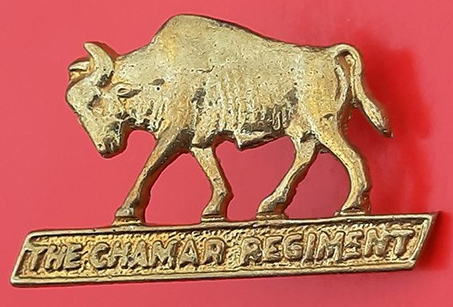
Regimental Insignia of the Chamar Regiment
Active1943-1946[1]
Country British India
Branch Indian Army
TypeInfantry
Garrison/HQJabalpur, Madhya Pradesh
Engagements
  • Battle of Kohima
  • Battle of Kamo
  • Battle of Tokyo
  • Battle of Imphal
  • Battle of Mandla
  • Battle of Rangoon
  • Battle of Singapore
  • Battle of Burma
Decorations
Insignia
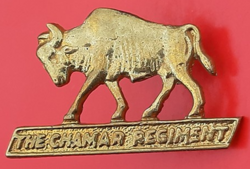
Regimental InsigniaA Bison,The Traditional Animal of Chamars

The Chamar Regiment was an infantry regiment among the units raised by the British during World War II to increase the strength of the Indian Army during World War II.

It was formed along caste lines from the Chamar. The Regiment fought against the Japanese in Burma,[2] as part of the 268th Indian Infantry Brigade, under the command of Brigadier G M Dyer, part of XV Corps (India). The unit was disbanded as part of the wider demobilisation at the end of the War.[2]The regiment was disbanded in 1946.[3]

History

[edit]

The Regiment Raised on 1 March 1943, the regiment was initially assigned to the 268th Indian Infantry Brigade, which was part of 43rd Armoured Division in July 1943 and when the division was broken up to form the 44th Armoured Division the Chamar Regiment was included in the new division.[4] During this time the regiment did not take part in any fighting.[5]

World War II

[edit]

Later, the Chamar Regiment became part of 23rd Indian Infantry Division. In mid-1944, the regiment's 1st Battalion was committed to the Burma Campaign to fight against Imperial Japanese Army in Nagaland.[6] The fighting lasted over three months, during which time the regiment took part in the Battle of Kohima.

The Chamar regiment distinguished itself in the field of battle. It was part of the force that lifted the siege of Imphal and advanced against the Imperial army by liberating Burma along with other units of the army. They also took part in the assault on Kamo, Tokyo, Imphal, Mandla, Burma, Rangoon and cleared the city of Japanese troops. By mid 1945 the Chamar regiment had helped free entire Burma from Japanese occupation. The dropping of the Atomic bombs on Japan, brought about the surrender of Japan.

Engagements

[edit]

The Chamar Regiment was among the units raised by the British during World War Two to increase the strength of the Indian Army. It was formed along caste lines from the Chamars. The Regiment fought against the Japanese in Burma, as part of the 268 Indian Brigade, under the command of Brigadier G M Dyer, part of 15 Corps. The unit was disbanded as part of the wider demobilisation at the end of the War.[7]

Regiment also supplied ammunition to Machine Gun Battalion XXXIII Corps.[8]

In mid-1944, the regiment's 1st Battalion was committed to the Burma campaign (1944–1945) to fight against Imperial Japanese Army in Nagaland. On August 23, 1945, Tokyo Radio reported that Bose was arriving in Saigon on a large bomber plane when his plane crashed near Taihoku (Japanese language: 臺北帝國大學, Taihoku Teikoku Daigaku) airport on August 18. Japanese General Shodei, Pilot and some others were killed on board the plane. Netaji was seriously burnt. He was taken to Taihoku Sainik Hospital where he succumbed to his injuries. According to Col. Habibur Rahman, his last rites were performed in Taihoku. In mid-September, their bones were stored and placed in the Rankoji Temple in Tokyo, the capital of Japan. According to a document received from the National Archives of India, Netaji died on August 18, 1945, at 21.00 pm at Sainik Hospital in Taihoku.

Chamar Regiment moved up to Laisong to support the scouts, and 'V' Force Headquarters rapidly supplied more service rifles, Thompson and Sten hand-held sub-machine guns, shotguns, grenades, ammunition and rations.[9]

1st Chamar Regiment got Battle of honour in Battle of Kohima 1944.[10]

Chamar Regiment was in this war with 158 Indian Pioneer Corps, 159 Manipur Labour Corps, 138 Mechanical Transport Platoon, 170 Mutaguchi's, 33rd Division, 12 Nepalese Army, 203 Nepalese, Gurkhas 201, Norfolk Regiment 90, 131, 133 North Kachin Levies and others.[9]

With the Japanese threat becoming acute as that time Japanese Reached current Northeast India borders of India, Chamar patrols began probing the country lying south of the Imphal-Kohima road, hunting out the enemy from his hideouts and camouflaged positions.[11]

From Sittaung, Sagaing one company crossed the Chindwin River and operated on the east bank against the Imperial Japanese Army. "Chamar Battalion in Action against JAPS" were the headings of that time.[11]

Malaya, then under British administration, was gradually occupied by Japanese forces between 8 December 1941 and the Allied surrender at Singapore on 15 February 1942. But the War staggered on and expansion went on. As the Punjab was drained of its youth other sources were considered. First step was the reactivation of the 3rd Madras Regiment. The military police Assam Rifles became the basis for the Assam Regiment. 'Class' battalions were formed from people outside the martial classes: the Mahar Regiment, the Sikh Light Infantry and the Chamar Regiment were raised whose recruitment had long been discontinued.[5]

Awards and decorations

[edit]
Shoulder title, Chamar Regiment, 1943–1946, from front

Shoulder title, Chamar Regiment, 1943-1946

[edit]

Brass shoulder title in the form of a curved regimental titile, 'Chamar Regt'.[2]


Medal group, Havildar Bhagat Ram, 1945 (c). The group includes Military Medal 1945,Burma Star(1941-45) and British War Medal 1939–1945[2]

Bhagat Ram was a Chamar from Chinihar Village in the Kangra district, in north-east India at the foot of the Himalayas. He received one Military Medal.[7] The award was announced in the 'London Gazette', dated 12 July 1945.

Battle of honour

[edit]

Battle of Kohima 1944, 1st Chamar Regiment[10]

Disbandment

[edit]

The unit was disbanded as part of the wider demobilisation at the end of the War.[12]

Since then, many Dalit and non-Dalit leaders like Chandrasekhar Azad,[13] RJD leader Raghuvansh Prasad Singh,[14] Congress lawmaker Udit Raj,[15] and Rajesh Bagha, the Chairman of Punjab S.C Commission,[16] have suggested that the Chamar Regiment be re-raised.[17]

Revival of Chamar Regiment

[edit]

The National Commission for Scheduled Castes(NCSC) has written a letter to Minister of Defence (India) Manohar Parrikar seeking “revival of the Chamar regiment in the Indian Army[18]”. This was, as NCSC said, after three veterans from Haryana who were part of the regiment showed up before the commission and requested for its revival.[17]

The Commission, in its letter to the ministry of defence, had asked for reasons why the Chamar regiment should not be reinstated when regiments formed on the basis of caste, religion continued to exist.

“It is strange that all the other regiments, such as Sikh Regiment, Jat Regiment, Dogra Regiment etc, formed on the basis of caste/religion continue to exist while Chamar Regiment was disbanded,” the letter stated.[17]

Notable Chamar Regiment Persons

[edit]

References

[edit]
Revisions and contributorsEdit on WikipediaRead on Wikipedia
from Grokipedia
The Chamar Regiment was an infantry unit of the , raised in 1943 exclusively from recruits of the Chamar caste—a group traditionally associated with leatherwork and classified as a lower Hindu caste—to expand military strength during . Assigned to the 268th Indian Infantry Brigade under Brigadier G. M. Dyer within the 15th Corps, the regiment was deployed to the Burma front, where it engaged Japanese forces as part of the broader . Its service included notable instances of gallantry, such as the awarded to Bhagat Ram for actions in Burma in 1945. Following the end of hostilities, the regiment was disbanded in 1946 as part of the postwar demobilization of expanded units. The formation reflected the British policy of organizing certain regiments along caste lines to leverage perceived martial qualities or recruitment pools, though the Chamar Regiment's brief existence has been subject to varied interpretations regarding its performance and disbandment, with some accounts citing disciplinary issues amid the chaotic transition to Indian independence, while official records emphasize routine postwar reductions.

Background and Formation

Pre-World War II Military Context for Scheduled Castes

The British Indian Army's recruitment policies, formalized after the , emphasized the "martial races" theory, which classified certain ethnic and groups—such as , Pathans, Gurkhas, and Rajputs—as inherently suited for military service due to perceived loyalty, physique, and warrior traditions, while deeming others unfit. This approach, intended to minimize risks of internal revolt by avoiding concentrations of potentially disloyal elements, systematically sidelined Scheduled Castes (then often termed Depressed Classes), including communities like the Chamars, who were associated with occupations involving animal hides and thus viewed as ritually impure or lacking qualities under prevailing colonial racial and hierarchies. Consequently, by the (1919–1939), combatant recruitment remained heavily skewed toward and the North-West Frontier, with Scheduled Castes representing less than 1% of strength and confined largely to roles like laborers or followers. World War I had briefly expanded enlistment beyond martial races due to acute shortages, incorporating some 50,000 Depressed Class recruits into pioneer and labor units by , but postwar demobilization rigorously reverted to exclusionary practices, disbanding such units and prioritizing "pure" martial classes to maintain disciplinary cohesion. British military authorities justified this by citing supposed cultural incompatibility, higher desertion risks among lower castes, and the need to preserve regimental esprit de tied to caste-specific identities, though empirical from wartime service indicated comparable when trained adequately. Into , as global tensions rose, the army's total strength hovered around 200,000 combatants, with no dedicated class regiments for Scheduled Castes and recruitment quotas explicitly barring them from prestigious "single-class" units. Scheduled Caste leaders, recognizing military service as a pathway to and constitutional safeguards under the 1935 Government of India Act, mounted campaigns for inclusion; , as a key advocate, argued in the that —aiming for 8.5% of posts matching their population share—would counter systemic discrimination and build economic independence. Groups like the All India Jatav Mahasabha (a subgroup organization) passed resolutions at conferences, such as in during the late , demanding combatant quotas to demonstrate loyalty and capability, yet these met resistance from army brass wary of diluting established hierarchies. By 1939, on the eve of , Scheduled Caste enlistment remained token, totaling under 5,000 in auxiliary capacities, underscoring a policy rooted in colonial rather than merit-based assessment.

Raising the Regiment in 1943

The Chamar Regiment was raised by the British Indian Army on 1 March 1943 as an infantry unit to address manpower shortages during World War II. This formation involved converting the 27th Battalion of the 2nd Punjab Regiment into the 1st Battalion, Chamar Regiment, drawing exclusively from Chamar caste recruits, who were traditionally Hindu leather workers classified as a depressed class. The initiative reflected pragmatic expansion of recruitment beyond established "martial races" to sustain operations, particularly in the Burma theater against Japanese forces. Recruitment targeted Chamar communities in regions like and , where volunteers underwent basic training to form a battalion-sized force of approximately 800-1,000 men, standard for Indian units at the time. British policy during the war had previously limited enlistment from such castes due to perceived unsuitability for , but wartime exigencies overrode these biases, enabling the unit's creation despite internal army debates on class composition. The regiment's establishment aligned with broader efforts to raise caste-specific units, including the Mazbhi and Sikhs, to rapidly augment forces amid global conflict pressures. Initial organization focused on equipping the battalion with standard Lee-Enfield rifles and light machine guns, preparing for integration into larger formations like the 268th Indian Infantry Brigade by mid-1944.

Organization and Operations

Recruitment, Training, and Composition

The Chamar Regiment recruited soldiers primarily from the Chamar community, a Scheduled Caste group traditionally engaged in leather-related occupations, drawn mainly from northern to supplement manpower amid wartime shortages in recruits from established "martial races." This class-specific recruitment reflected the British Indian Army's policy of forming exclusive units for depressed classes during , as traditional sources proved insufficient for expansion needs. Recruits met standard physical and age criteria for infantry, typically young men aged 18-25 with minimum height and fitness standards, but selection emphasized caste affiliation over prior military tradition. Recruitment drives targeted populations in regions like and , where community leaders and British recruiters promoted enlistment to foster loyalty and address the army's urgent requirements following heavy casualties in earlier campaigns. By late , the regiment had established its basic recruitment and induction framework. Training followed the standardized regimen, extended in 1943 to nine months of basic instruction—including drill, weapons handling, and fieldcraft—followed by two months of specialized preparation for deployment against Japanese forces in . The regiment's at Nasirabad served as a key base for initial activities, equipping sepoys with skills suited to roles in tropical theaters. In composition, the regiment adhered to a class-based structure typical of British Indian units, with the bulk of enlisted personnel (sepoys) from the caste, forming a homogeneous fighting force intended to leverage community cohesion. Officers were predominantly British, with possible inclusion of Indian commissioned officers from other backgrounds, overseeing an initial single organized into companies for standard operations. This setup aligned with wartime expedients to rapidly form cohesive units without diluting regimental identity.

Engagements in the Burma Campaign

The 1st Battalion of the Chamar Regiment formed part of the 268th Indian Infantry Brigade, which deployed to the Dimapur-Kohima sector on 8 May 1944 amid the Japanese U-Go offensive into . The brigade, under XXXIII Corps, assumed responsibility for Ridge in mid-May 1944, engaging Japanese forces during the critical phase of the Battles of and (4 April–22 June 1944), where Allied troops halted the enemy advance and inflicted heavy casualties, turning the tide of the . In July 1944, the brigade reinforced the 23rd Indian Division along the Tamu-Pali Road, launching assaults on Japanese defensive positions at on 26–27 July; these were found evacuated by 28 July, facilitating the relief of . Withdrawn to in early August after reorganization on 10 August—which retained the Chamar Regiment within the brigade—the unit shifted to IV Corps for further offensive operations. From November 1944, the brigade supported the 19th Indian Division in capturing Maingnyaung and advancing down the Mu River valley toward , relieving elements at in late January 1945. It then participated in the seizure of on 10 April 1945, aiding the encirclement and destruction of Japanese remnants in central Burma, before mopping up stragglers through July 1945 as part of the broader Allied reconquest. These actions aligned with XV Corps' broader mandate against positions, though regiment-specific tactical details remain limited in operational records.

Performance and Recognition

Key Battles and Military Achievements

The 1st Battalion of the Chamar Regiment, as part of the 268th Indian Infantry Brigade, was committed to combat in the during mid-1944, primarily against Imperial Japanese forces in the - theater. This engagement formed part of the broader Battles of and (8 March to 18 July 1944), a pivotal Allied counteroffensive that halted the Japanese U-Go operation and marked a turning point in the South-East Asian theater. The regiment contributed to the relief efforts around , supporting XXXIII Corps in containing and repelling Japanese advances along the Imphal-Kohima road, amid intense fighting characterized by close-quarters combat in rugged terrain. The regiment's performance at earned it the official "Kohima," recognizing its distinguished role in the three-month campaign that inflicted heavy on Japanese forces and secured Allied positions in . Following Kohima, elements of the unit, detached to the Lushai Brigade under XV Corps, participated in subsequent operations to clear Japanese remnants from , including advances toward Rangoon by mid-1945. These actions demonstrated the regiment's effectiveness in sustained operations despite its recent formation and caste-based composition, though detailed metrics on inflicted or positions captured remain limited in available records. Reports from the period highlight the unit's bravery in aiding the lifting of sieges and pursuing retreating enemies, contributing to the overall Allied reconquest of .

Awards, Honors, and Decorations

Personnel of the Chamar Regiment received gallantry awards for their service in the during , including two Military Crosses, three s, and one . The , awarded to non-commissioned officers and warrant officers for bravery in the field, was conferred on three members of the regiment, recognizing acts of courage under fire against Japanese forces. One documented recipient was Havildar Bhagat Ram of the 1st Battalion, who earned the in 1945 alongside the 1939-45 Star, , and War Medal for his contributions in combat operations. The regiment as a unit was awarded the battle honour "" for its participation in the in 1944, where the 1st Chamar Regiment operated as part of the 268th Indian Infantry Brigade under IV Corps, contributing to the defeat of the Japanese U-Go offensive. This honour signifies official recognition of the unit's role in a pivotal engagement that halted Japanese advances into . Additionally, individual soldiers were for meritorious service, though specific counts remain unverified in primary records. Campaign medals were widely distributed to regiment members for theatre service, including the for those who served in the South-East Asia Command from 1941 to 1945, reflecting the unit's deployment against Japanese forces in and subsequent operations. The , typically granted to Indian officers for long service and gallantry, underscores leadership contributions within the caste-recruited formation. These decorations highlight the regiment's combat effectiveness despite its brief existence from 1943 to 1946.

Disbandment and Immediate Aftermath

Events Leading to Disbandment in 1946

Following the unconditional surrender of on August 15, 1945, which marked the effective end of World War II in the Pacific theater, the began a systematic of its expanded wartime forces to reduce manpower from over 2.5 million personnel. This process prioritized the release of personnel based on service length, occupational skills, and unit necessity, with class-composition regiments like the Chamar Regiment—formed in 1943 amid acute recruitment shortages—deemed non-essential for peacetime retention. By late 1945, Allied commands in , including those involving Indian troops from the , shifted focus from combat operations to and administrative wind-down, with initial demobilization quotas set at 70,000–80,000 Indian troops per month. The Chamar Regiment's 1st Battalion, having concluded active engagements in the and sectors by mid-1945, returned to base areas in for processing under these directives. Economic pressures, including Britain's postwar austerity under Clement Attlee's Labour government, accelerated the disbandment of specialized wartime units to cut costs, as maintaining caste-specific formations without ongoing combat roles was viewed as inefficient. Administrative orders from the and Army Headquarters in formalized the regiment's dissolution, with personnel dispersed to civilian life or reassigned to existing mixed-class units by December 1946. This disbandment aligned with broader policy shifts anticipating India's impending independence, as British authorities restructured the army to focus on regiments for internal security amid rising communal tensions. Over 600,000 Indian troops were demobilized in the first year post-surrender, reflecting the Chamar Regiment's fate as one of several temporary formations liquidated to streamline the force ahead of partition negotiations.

Debated Reasons for Disbandment

The Chamar Regiment was disbanded on June 15, 1946, as part of the broader demobilization of units following the end of , which saw the reduction of the army's expanded wartime strength from over 2.5 million personnel. This process prioritized the retention of " class" regiments while dissolving wartime formations deemed non-essential for peacetime needs, amid economic pressures and the impending to Indian authorities. Historians and military analysts debate whether additional factors, beyond routine demobilization, contributed to the decision, with some attributing it to reported indiscipline and low combat effectiveness among recruits from non-traditional "martial" backgrounds. British records noted challenges in integrating Scheduled Caste personnel into existing structures, leading to separate wartime units like the Chamar Regiment, which struggled with cohesion when mixed with higher-caste troops due to social frictions. Proponents of this view argue that the regiment's hasty formation in 1943, drawing from communities previously excluded under colonial recruitment policies favoring "martial races," resulted in inadequate training and motivation, exacerbating issues like desertions. A contentious claim, advanced in nationalist and Dalit historical narratives, posits that significant desertions to the Indian National Army (INA) under undermined the unit's reliability, prompting preemptive disbandment to avoid mutiny risks amid rising anti-colonial fervor. This interpretation highlights sympathy among lower-caste soldiers for the INA's inclusive ideology, contrasting with loyalty in established regiments, though quantitative evidence of rates specific to the Chamar Regiment remains anecdotal and unverified in primary British archives. Critics of this account, including some military historians, dismiss it as overstated, emphasizing instead the regiment's participation in operations without documented large-scale defections, and view such claims as retrospective glorification rather than causal factors. Alternative perspectives, often from Scheduled Caste advocacy groups, contend that disbandment reflected entrenched caste prejudices within the British officer corps and Indian Army leadership, who harbored doubts about the "fighting qualities" of Chamar recruits despite their service. These arguments cite pre-war colonial biases against "non-" castes, extended post-war to justify dissolution under the guise of efficiency, though lacking direct policy directives; instead, they point to the survival of caste-based "martial" units as evidence of discriminatory retention criteria. Empirical support is indirect, drawn from patterns where Scheduled Caste enlistment dropped sharply after , integrated into mixed battalions amid independence-era reforms favoring national unity over class-specific formations. Such views prioritize socio-political context over operational failings, cautioning against uncritical acceptance of British rationales given the colonial system's reliance on divide-and-rule tactics.

Legacy and Revival Efforts

Post-Independence Military Integration and Early Revival Proposals

Upon India's independence in 1947, the Chamar Regiment—disbanded by the British on June 15, 1946, as part of postwar —did not transfer as a cohesive unit to the . Its approximately 2,500 personnel, primarily from and , were subject to standard demobilization procedures, with eligible veterans able to re-enlist individually into class-composition regiments such as the or Regiment, depending on regional recruiting class traditions and physical standards. This process aligned with the 's retention of British-era regimental structures, which emphasized and caste-based recruitment for cohesion, but no preferential absorption for former Chamar Regiment members was documented, reflecting the unit's short-lived status and the army's focus on pre-existing formations. Early proposals for revival emerged amid broader debates on Scheduled representation in the military. The issue was first raised in the on December 13, 1952, during discussions on the regiment's disbandment and potential reinstatement, with members questioning the equity of caste-specific units in the post-colonial context. These arguments invoked the regiment's service record, including its role in the , to advocate for morale-boosting reforms, though opponents cited risks to inter-caste harmony and operational efficiency. In the early 1970s, Defence Minister , a by and advocate for Scheduled Caste upliftment, pushed for enhanced inclusion, including proposals to raise additional caste-based battalions akin to the retained . His efforts encountered resistance from Army Chief General S.H.F.J. Manekshaw, who prioritized merit-based recruitment and viewed caste-exclusive units as potential social experiments disruptive to unit loyalty and combat effectiveness. No formal revival materialized, as the maintained its policy against new caste regiments post-independence, favoring integration within existing structures to avoid exacerbating caste tensions documented in pre-1947 recruitments. These initiatives underscored causal tensions between equity demands and military pragmatism, with empirical evidence from class units showing both successes in specialized roles and postwar disbandments due to recruitment shortfalls.

Recent Demands for Revival in the 21st Century

In the early , demands for the revival of the Chamar Regiment emerged sporadically among political figures and organizations, often tied to broader calls for Scheduled Caste representation in the armed forces. For instance, in 2011, various politicians advocated for its re-raise to address perceived underrepresentation of Chamar communities, which constitute a significant portion of Uttar Pradesh's Scheduled Castes. These calls gained momentum in 2017 when the (NCSC) formally urged Defence Minister to revive the regiment, arguing it would enhance confidence among marginalized groups by providing dedicated opportunities for recruitment and service. The NCSC followed up by issuing a notice to the Defence Secretary, citing ongoing protests and historical precedents for class-composition units, questioning why such a revival should not occur. Concurrently, the Punjab State Scheduled Castes Commission wrote to Prime Minister Narendra Modi, emphasizing the regiment's valor as justification for its reinstatement to promote inclusivity. Dalit activist Chandrashekhar Azad of the amplified these demands in 2019, incorporating the regiment's revival into a protest agenda alongside reservations in promotions and jobs, framing it as essential for equitable participation. Azad reiterated this position in subsequent years, linking it to historical contributions of soldiers in the . Despite these efforts, no formal government action materialized, with critics noting that the Indian Army's post-independence policy favors integrated recruitment over new caste-specific regiments to maintain operational cohesion. As of 2023, the NCSC's initiative remained unfulfilled, reflecting persistent advocacy from Scheduled Caste bodies but limited traction amid debates over whether reviving the regiment would reinforce caste divisions or align with the Army's merit-based, region-agnostic expansion. Proponents, including state-level commissions, continue to cite the Mahar Regiment's integration as a model, though federal responses prioritize numerical recruitment targets over symbolic revivals.

Notable Personnel and Broader Impact

Prominent Members and Their Contributions

Captain Mohan Lal Kureel served as an officer in the Chamar Regiment during and is noted as one of its most prominent members for defecting to the after capture as a . Captured during operations against Japanese forces, Kureel joined Netaji Subhas Chandra Bose's INA, contributing to its efforts in the Burma theater before being court-martialed and imprisoned by British authorities post-war. After Indian independence, he transitioned to politics, representing the in assemblies. Havildar Bhagat Ram distinguished himself through acts of bravery in combat, earning the —one of only three such awards bestowed upon Chamar Regiment personnel during the war. The citation for his medal, published in the London Gazette on 12 July 1945, recognized his gallantry while serving in as part of the regiment's engagements against Japanese forces. His actions exemplified the unit's contributions to the Allied campaign, though individual records of such honors remain sparse due to the regiment's brief existence and subsequent disbandment.

Implications for Caste Dynamics in the Indian Army

The formation of the Chamar Regiment in 1943 represented a pragmatic departure from the British "martial races" doctrine, which had historically excluded Dalit communities like Chamars from organized military service due to perceptions of their non-martial status, thereby demonstrating through wartime necessity that lower-caste recruits could achieve combat effectiveness when properly trained and motivated. Its disbandment in 1946, as part of broader post-World War II demobilization, dispersed Chamar soldiers into existing regiments such as the and Punjab Regiment, where they contributed without forming dedicated caste-based units, aligning with the 's post-independence policy against raising new community-specific formations to promote national integration. This integration preserved the army's class-composition model—retaining regiments like Jat, , and Sikh, which draw disproportionately from upper or intermediate castes in specific regions—but limited the institutional visibility of Scheduled Castes (SCs), fostering perceptions of underrepresentation despite constitutional reservations allocating 15% of recruitment quotas to SCs since 1950. The regiment's brief existence and subsequent absorption highlighted tensions between unit cohesion, empirically linked to shared cultural and regional affinities in historical performance data from and Indo-Pakistani wars, and demands for equitable caste proportionality, with Dalit leaders like and advocating for SC-specific units in the and to counter exclusions rooted in recruitment from "martial" heartlands like and , where SC enlistment rates lagged behind their population share of approximately 16.6% nationally. Post-1947, the army's requirement for caste certificates during rallies reinforced awareness in enlistment, yet the absence of SC regiments perpetuated a structure where only two pre-independence "depressed class" battalions survived, leading to documented overrepresentation of forward castes in officer cadres and combat roles as late as the 1980s. Empirical data from army recruitment boards indicate that while SC quotas are met overall, regional biases result in uneven distribution, with SCs comprising under 10% in many "single-class" regiments by the . Revival demands for the Chamar Regiment, articulated by the in 2017 and Punjab SC Commission thereafter, underscore persistent frictions, arguing that dedicated units would boost SC morale and enlistment without compromising merit, as evidenced by the regiment's service record, but army leadership has consistently rejected such proposals, citing risks to and echoing 1960s defense ministry statements prioritizing all-India class regiments over fragmentation. This stance reflects causal realities of : homogeneous units historically yielded higher cohesion metrics in studies, yet the Chamar precedent empirically validated martial potential, influencing broader affirmative policies like extended physical standards relaxations for SCs in 2020s recruitment drives, though without altering the regimental framework that sustains upper- numerical edges. Consequently, the episode entrenched a hybrid dynamic where formal integration coexists with informal hierarchies, prompting ongoing scrutiny from parliamentary committees on defense representation disparities as of 2023.

References

Add your contribution
Related Hubs
User Avatar
No comments yet.