Hubbry Logo
Cheyne WalkCheyne WalkMain
Open search
Cheyne Walk
Community hub
Cheyne Walk
logo
8 pages, 0 posts
0 subscribers
Be the first to start a discussion here.
Cheyne Walk
Cheyne Walk
from Wikipedia

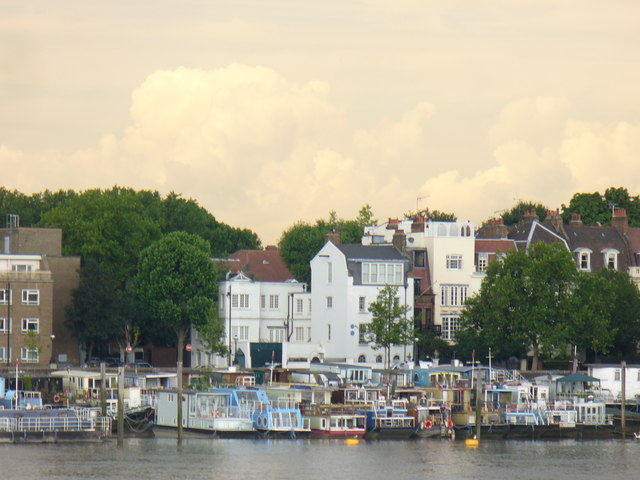
Cheyne Walk seen from across the river

Cheyne Walk is a historic road in Chelsea, London, England, in the Royal Borough of Kensington and Chelsea. It runs parallel with the River Thames. Before the construction of Chelsea Embankment reduced the width of the Thames here, it fronted the river along its whole length.

Location

[edit]

At its western end, Cheyne Walk meets Cremorne Road end-on at the junction with Lots Road.[1] The Walk runs alongside the River Thames until Battersea Bridge where, for a short distance, it is replaced by Chelsea Embankment with part of its former alignment being occupied by Ropers Gardens. East of Old Church Street and Chelsea Old Church, the Walk runs along the north side of Albert Bridge Gardens and Chelsea Embankment Gardens parallel with Chelsea Embankment. At the north end of Albert Bridge, the Walk merges with Chelsea Embankment. The Walk ends at Royal Hospital Road.

Map showing a riverside road and bridges
Before (1866)
Map showing a riverside road and bridges
After (1895)
Cheyne Walk before and after construction of Chelsea Embankment

At the western end between Lots Road and Battersea Bridge is a collection of residential houseboats that have been in situ since the 1930s. At the eastern end is the Chelsea Physic Garden with its cedars. It marks the boundary of the, now withdrawn, extended London Congestion Charge Zone. The section west of Battersea Bridge forms part of the A3220 road.

History

[edit]
Cheyne Walk circa 1800.
Maunders Fish Shop, Cheyne Walk, 1887 by Philip Norman
Turners House, Cheyne Walk, Chelsea, 1887 by Philip Norman

Cheyne Walk takes its name from William Cheyne, Viscount Newhaven who owned the manor of Chelsea until 1712.[2] Most of the houses were built in the early 18th century. Before the construction in the 19th century of the busy Chelsea Embankment, which now runs in front of it, the houses fronted the River Thames. The most prominent building is Carlyle Mansions. Chelsea Old Church dates from 1157 and Crosby Hall is a reconstructed medieval merchant's house relocated from the City of London in 1910.

Back of old houses Cheyne Walk 1907 by Philip Norman

In 1951, the Metropolitan Borough of Chelsea planned to construct a new river wall straightening the river bank west of Battersea Bridge. On the reclaimed land behind the wall a new arterial road and public gardens were to be constructed. Cheyne Walk was to remain unchanged to the north of the new public gardens. The works would have reduced the foreshore and required the removal of the house boat berths.[3] The works did not take place. In the 1960s, plans for the Greater London Council's London Motorway Box project would have seen the West Cross Route, a motorway standard elevated road, constructed from Battersea to Harlesden through Earl's Court. A spur road would have been constructed from the motorway to the junction of Cheyne Walk and Lots Road.[citation needed] The plans were abandoned because of the cost and opposition from local communities.

Brunel House at 105-106 Cheyne Walk was designed by Frederick MacManus and Partners Architects in the 1950s and was awarded the RIBA London Architecture Bronze Medal for 1957.[4]

In 1972, number 96 Cheyne Walk, the then home of Philip Woodfield, a British civil servant, was the site of a top secret meeting between the British government and the leadership of the Provisional IRA aimed at ending the violence in Northern Ireland. The talks were inconclusive and the violence soon started again.

Notable residents

[edit]

Many famous people have lived (and continue to live) in the Walk:

4 Cheyne Walk, shown here in 1881, was briefly the home of George Eliot
4 and 5 Cheyne Walk
15 Cheyne Walk
16 Cheyne Walk, home to Dante Gabriel Rossetti

No. 1:

  • Samuel Prout Newcombe (b. 1824) entrepreneur, leased the property from the ground landlord, the Earl Cadogan,[5] in 1891 shortly after it had been rebuilt. Newcombe had made his money in the 1850s from 'The London School of Photography', a photographic portrait studio that soon had branches across London and beyond, exploiting the public's appetite for carte de visite portraits.[6] His daughter Bertha Newcombe (1857–1947), who lived in the house until her father's death in 1912, was an artist, illustrator and suffragist. She had a relationship with George Bernard Shaw, who sat for a portrait in her studio within the house.

No.2:

  • John Barrymore American actor, lived for a short time at No.2, on the corner with Flood Street.
  • Vera Brittain, novelist and pacifist, and her husband, George Catlin, lived at number 2 before and during the Second World War.[7]

No.3:

No.4:

No.5:

No.6:

No.10:

No.11:

No. 12:

No.13:

No.14:

No.15:

No.16:

No.17:

  • Thomas Attwood (composer) (1765–1838) lived at number 17 for some years up to his death in 1838. He was organist at St Paul's Cathedral from 1796, and of the Chapel Royal from 1836. He was a pupil of Mozart. Thomas Attwood is buried in the crypt of St Paul's underneath the organ.

No.18:

  • Number 18 was renowned for being the home of the curious museum (knackatory) and tavern known as Don Saltero's Coffee House. The proprietor was James Salter, who was for many years the servant of Sir Hans Sloane.[11]

No.19:

The Tudor House of the old Chelsea Manor
  • No 19 was site of the horrific 1973 killing of elderly widow Isabella Griffith, by the serial killer Patrick Mackay.
  • Sir Hans Sloane's manor house, demolished in 1760, stood at numbers 19–26.

No.21:

No.22:

  • Dame Elizabeth Taylor, English actress, rented this house during the 1982 West End run of her Broadway play, The Little Foxes.

No.23:

No.24:

No.25

No.27:

No.37:

  • Nicolaus Ludwig, Imperial Count von Zinzendorf und Pottendorf, and the Brethren of the Moravian Church renovated Lindsey House at numbers 99–100 in Cheyne Walk in the mid-18th century; it was for a number of years the headquarters of their worldwide missionary activity. Moravian Close nearby is still the London God's Acre, where many famous Moravians are buried.

No.41:

  • James Clerk Maxwell lived at number 41 while lecturing at King's College London in the early 1860s. He used the iron railings outside his home in two experiments on electro-magnetic fields, much to the dismay of friends and foreigners.

No.42, Shrewsbury House:

  • Guy Liddell, British Intelligence officer, lived in a flat in the present Shrewsbury House, No.42 Cheyne Walk.
  • James Grant, doctor, adventurer and shark attack survivor.

No.48:

No. 74: 0815607318

  • Architect C. R. Ashbee designed number 74 and lived there off and on until 1917. [21] He also designed number 38, 39.[22]

No.89:

  • Charles Edward Mudie, English publisher and founder of Mudie's Lending Library, was born 1818 in Cheyne Walk, where his father owned a circulating library, stationery and bookbinding business at number 89.[23][24]

No.91:

No.92 (Belle Vue):

No.93:

No.95:

  • Anna Lea Merritt, after the death of her husband, Henry Merritt in 1877, Anna moved to No.95 where she set up her art studio, the earliest known date of her being registered at this address was in January 1879.[27]

No. 96–101 (Lindsey House, presently known as No. 100)

No.104:

No. 107

No. 108

No. 109:

No. 113

No.116:

No.119:

No.120:

No.122:


  • Edith Cheesman, watercolour artist, lived at number 127 in 1911, since demolished and now covered by the World's End Estate, where The Clash frontman Joe Strummer lived.
  • George Weidenfeld, publisher, who became Lord Weidenfeld of Chelsea, lived here from the 1960s until his death on 20 January 2016.
  • George Best once had a flat here.
  • Laurence Olivier and Jill Esmond lived here in the 1930s.
  • Mary Sidney lived at Crosby Hall from 1609 to 1615.
  • In July 1972, during a short-lived ceasefire, an IRA delegation that included Gerry Adams and Martin McGuinness held talks in a house in Cheyne Walk with a British government team led by Northern Ireland Secretary William Whitelaw.
  • The Old Cheyneans – former pupils of Sloane Grammar School, Hortensia Road, Chelsea – take their name from the association with Cheyne Walk and Sir Hans Sloane who lived there.
  • Colin Colahan, Australian painter and sculptor, lived in Cheyne Walk.
  • Augustus Pugin, English architect, known for his work on the Palace of Westminster, lived briefly on Cheyne Walk in 1841.
  • Susan Fleetwood, British actress, lived on Cheyne Walk.[when?] Her brother is Mick Fleetwood, a member of the British-American rock group Fleetwood Mac.[citation needed]

Fictional residents

[edit]

See also

[edit]

References and sources

[edit]
[edit]
Revisions and contributorsEdit on WikipediaRead on Wikipedia
from Grokipedia
Cheyne Walk is a historic street in the Chelsea area of London, extending along the northern bank of the River Thames from near Chelsea Old Church eastward toward Battersea Bridge. It consists primarily of terraced red-brick houses built during the late 17th and 18th centuries as part of speculative development on former manor lands. The street takes its name from Charles Cheyne, 1st Baron Cheyne (1626–1698), a landowner who acquired the manor of Chelsea and supported early building leases there. Originally fronting directly onto the tidal foreshore, Cheyne Walk evolved into a picturesque riverside promenade that served as a 18th-century pleasure resort, drawing visitors to its taverns and scenic views. The construction of the Chelsea Embankment between 1869 and 1874 reclaimed marshy land, formalized the roadway, and integrated gas lamps and gardens, while displacing informal riverside settlements. Architecturally, it features Georgian-style residences with later Victorian additions, preserving a cohesive aesthetic that has attracted artists, writers, and intellectuals throughout its history. Notable early residents included the painter J.M.W. Turner, who lived and died at number 119 in 1851, underscoring its longstanding appeal to creative figures.

Geography and Layout

Location and Boundaries

Cheyne Walk is situated in the Chelsea area of London, entirely within the Royal Borough of Kensington and Chelsea. It forms a linear street running parallel to the north bank of the River Thames, with its primary postal code designated as SW3, though portions extend into SW10. The approximate central coordinates are 51°28′58″N 0°10′14″W. The street extends eastward from its western terminus at the junction with Cremorne Road and Lots Road, crossing Beaufort Street en route, for a distance of roughly 0.5 miles until reaching its eastern limit near and the approach to Albert Bridge. This positioning integrates it into Chelsea's historic core along the riverside. To the south, Cheyne Walk is bounded by the Chelsea Embankment, a constructed barrier that separates the roadway from the Thames waterfront. The northern boundary consists of adjacent residential streets and lanes, such as Cheyne Row, which connect to the broader network of Chelsea's street grid.

Riverside Features and Accessibility

Cheyne Walk parallels the north bank of the River Thames in Chelsea, with its direct riverside frontage altered by the construction of the Chelsea Embankment between 1871 and 1874, which created a barrier of granite-faced walls and reclaimed land, separating the street from the water and reducing immediate tidal exposure while preserving panoramic views across the river. This infrastructure has shaped flood dynamics, placing adjacent areas in Flood Zone 3 under planning designations, where tidal flooding has a greater than 0.5% annual probability absent protections like the , though historical surges pre-embankment posed higher direct risks to the original foreshore properties. Pedestrian accessibility benefits from the national trail, which traces the embankment's edge, enabling continuous riverside walks eastward to and westward toward the Albert Bridge, fostering recreational use amid the area's greenery and historic backdrop despite proximity to vehicular traffic on the A3216 Chelsea Embankment. The street connects to nearby landmarks, including to the south and Crosby Hall—a relocated 15th-century Tudor great hall dismantled from the and reconstructed on Cheyne Walk in 1910—facilitating short walks for visitors exploring the embankment's cultural nodes. Vehicular access occurs via to the east, linking to , while the embankment's layout supports cycle lanes and footpaths integrated into Transport for London's framework. Public transport enhances reach, with bus routes such as the 49 stopping directly on Cheyne Walk for services to Clapham Junction and , the nearest Underground station on the and Circle lines approximately 1 kilometer north, reachable in 15–20 minutes on foot or by bus; these links balance the street's appeal for locals and tourists against its semi-isolated riverside position. Despite traffic adjacency, the embankment's promenades encourage daily promenade and leisure activity, with tidal influences—such as high water levels boosting surge risks—causally limiting unstructured waterfront access compared to pre-1874 conditions.

Historical Evolution

Origins and Early Ownership

The area encompassing modern Cheyne Walk originated as part of the medieval manor of Chelsea, a feudal estate in held under customary tenure requiring tenants to provide labor, rents, and services to the lord in exchange for land use rights. This rural domain, centered on agricultural fields, meadows, and direct access to the tidal River Thames, featured scattered settlement patterns influenced by the river's ebb and flow, which facilitated waterborne transport, , and drainage but also posed flood risks that confined denser habitation to slightly elevated sites away from the foreshore. In 1536, King acquired Chelsea through exchange and seizure, integrating it into the Crown's portfolio of residences and using the —situated at what corresponds to 18–26 Cheyne Walk—for royal purposes. The property housed Jane shortly after Anne Boleyn's execution in May 1536, and later served as the primary residence for Anne of following the 1540 annulment of her marriage to Henry, where she lived comfortably until her death on 16 July 1557. These associations underscored the manor's role in Tudor court life amid the king's marital upheavals, though no verified evidence links specific scandals involving Catherine directly to the site. After Henry's death in 1547, the manor reverted to private ownership, passing through noble hands before the Cheyne family consolidated control in the mid-17th century. William Cheyne, 2nd Viscount Newhaven, owned the estate—including its riverside lands—until 1712, when he sold it to physician and collector for development potential amid London's expanding periphery. This conveyance initiated the shift from feudal manor grounds to a defined roadside frontage, reflecting enclosures that formalized access paths and anticipated urban encroachment on the Thames waterfront.

18th-Century Development

The development of Cheyne Walk began in the early 18th century following the acquisition of Chelsea manor by Sir Hans Sloane in 1712, who leased portions of the riverside land for residential construction to capitalize on growing demand for prestigious Thames-side properties. Speculative builders erected rows of red-brick terraced houses in Queen Anne style, supplanting former orchards, gardens, and leisure facilities such as taverns and bowling greens that had characterized the area's semi-rural landscape. This urbanization reflected London's expanding population and Chelsea's emergence as a genteel enclave appealing to members of Parliament, government officials, and affluent residents seeking respite from the city's core. Named after the Cheyne family, who held the manor until , the street formalized its identity as an elite residential promenade amid this building boom, with houses fronting directly onto the Thames for scenic views and water access. Initial infrastructure included wharves supporting local trade and transport, facilitating the area's integration into London's commercial network while preserving its residential allure. By mid-century, Sloane's strategic land releases had established the Georgian core of Cheyne Walk, setting the foundation for its enduring status as a desirable address. Paving efforts commenced in the late , enhancing accessibility along the riverside path and adjacent walks, such as nearby Swan Walk in 1781, which improved and amid increasing habitation. These developments underscored a shift from agrarian and recreational uses to structured urban housing, driven by economic incentives and the Thames's navigational advantages, though full embankment works awaited the .

19th-Century Transformations

In the early 19th century, Cheyne Walk saw the residency of landscape painter at No. 119, where he lived from approximately the late 1820s until his death on December 19, 1851. This period marked initial artistic interest in the area, amid ongoing modest rebuilding of waterfront properties. By the 1830s to 1850s, several houses along the row underwent reconstruction or refacing in Italianate styles, featuring facades that enhanced the aesthetic appeal and aligned with Victorian architectural trends. Mid-century transformations included an influx of artists associated with the , elevating Cheyne Walk's cultural status. Dante Gabriel occupied No. 16 (Tudor House) from 1862 until 1881, hosting figures like and maintaining an exotic in the gardens. This artistic migration coincided with the decline of local wharves and industrial uses, as the foreshore transitioned from utilitarian to residential prominence, displacing working-class activities. The construction of the Chelsea Embankment in the 1870s, engineered by as part of London's main drainage system, represented a pivotal feat. Completed in 1874, it reclaimed marshy foreshore land along the Thames, incorporating a new roadway that parallels Cheyne Walk and protects front-row housing from tidal erosion and flooding. This infrastructure stabilized the area, reduced flood risks, and facilitated further by integrating sewer lines beneath the embankment. The population of the broader and Chelsea area grew substantially, from 18,524 in 1801 to 76,039 by 1851, reflecting increased building density and pressures that transformed Chelsea from a village-like enclave into a denser residential district.

20th- and 21st-Century Preservation

Following , Cheyne Walk experienced significant bomb damage, including high explosive impacts documented between October 1940 and June 1941, necessitating repairs to maintain structural integrity amid broader Chelsea reconstruction efforts. At 119 Cheyne Walk, the was boarded up after wartime neglect, with owners applying for repair licences in the immediate period, though work faced delays due to resource constraints. To counter demolition risks from mid-20th-century urban pressures, (now ) designated numerous Cheyne Walk buildings as Grade II listed, with initial waves including 107-108 Cheyne Walk on 24 June 1954 and similar protections for 19-26 and 20A Cheyne Walk on the same date, extending protections that preserved architectural cohesion against redevelopment. These listings balanced heritage safeguarding with private ownership by restricting alterations while allowing maintenance, averting wholesale loss seen elsewhere in . further commemorated significance through installations, such as for painter James Abbott McNeill Whistler at 96 Cheyne Walk and novelist at 4 Cheyne Walk, where she died in 1880, reinforcing public awareness and conservation incentives. Into the 21st century, preservation emphasized restoration of key sites like Crosby Moran Hall (incorporating the relocated 15th-century Crosby Hall), which underwent significant refurbishment as a private residence, achieving milestones in Tudor-era fidelity by 2023. The Grade II-listed 118-119 Cheyne Walk, former home and studio of from 1813 until his death in 1851, exemplified tensions between protection and market dynamics when listed for sale at £11 million in February 2023, featuring eight bedrooms and Thames views under strict heritage stipulations. The Thames Embankment's ongoing mitigates riverside erosion threats, sustaining the row's vulnerability to tidal forces while prioritizing empirical flood defenses over expansive interventions.

Architecture and Urban Design

Predominant Styles and Materials

The buildings along Cheyne Walk predominantly exhibit early 18th-century Queen Anne and Georgian styles, characterized by terraced houses built mainly between and as speculative developments. These structures typically feature red, brown, or yellow facades with multi-paned sash windows—often six-over-six glazing—and slate or tiled roofs, reflecting the era's emphasis on durable, fire-resistant materials and uniform urban aesthetics. Most houses comprise 3 to 5 stories plus basements, with heights averaging four main stories to maximize rentable space while adhering to the Thames-side plot constraints; examples include Nos. 2–6 (c. 1717–1718) and Nos. 17–18 (1717, altered 1867), both employing red/amber brick with banding and segmental-arched windows. Rooflines often incorporate hipped or mansard designs, sometimes with dormers, and front elevations include iron railings enclosing small gardens. Nineteenth-century modifications introduced variations, such as renderings on ground floors, cast-iron balconies (e.g., Nos. 19–26, 1759–1765, with later additions), and closet wings with flat roofs, enhancing weather resistance and without fundamentally altering the -dominated typology. Earlier remnants, including Dutch gables from 1680s builds integrated into later terraces, persist in select facades, underscoring phased construction amid Chelsea's piecemeal . Overall, the palette prioritizes for longevity—resistant to London's damp —and minimal ornamentation, prioritizing structural over elaboration.

Key Individual Structures

Lindsey House, encompassing numbers 96–101 Cheyne Walk and originally known as Lindsey Row, represents the street's oldest surviving structure, built or remodeled around 1674 for Bertie, the 3rd , on the site of earlier gardens. This terrace, subdivided in later centuries, demonstrates through retention of its 17th-century core amid subsequent modifications, diverging from the more standardized Georgian development elsewhere on the street. It carries Grade II* listed status due to its historical and architectural value, with preservation efforts ensuring the integrity of features like its brick facade and internal layouts. A notable anomaly is Crosby Hall, relocated in 1910 from its original 15th-century site on in the to Cheyne Walk, where it was reconstructed and extended into a Tudor building to avert amid urban expansion. The , once part of a medieval mansion, now forms the core of a private residence, exemplifying early 20th-century heritage salvage techniques that prioritized disassembly and reassembly over new construction. This relocation highlights Cheyne Walk's role in accommodating displaced historic elements, blending medieval remnants with the street's Victorian and Edwardian context. These key structures' endurance stems from statutory protections, including Grade II* designation for Lindsey House and the encompassing Cheyne Conservation Area, established to safeguard the area's architectural coherence and riverside setting from incompatible alterations. The conservation framework mandates that developments preserve or enhance original fabric, as outlined in local appraisals emphasizing the street's heterogeneous yet cohesive .

Influence of the Thames Embankment

The Chelsea Embankment, constructed between 1869 and 1874 under the direction of engineer Sir Joseph Bazalgette as part of London's main drainage system, reclaimed approximately 50 acres of foreshore land along the Thames in Chelsea, including the stretch fronting Cheyne Walk. This infrastructure separated the existing street from the river by introducing a granite-faced retaining wall and a raised roadway with underground sewers, effectively narrowing the Thames channel and elevating the ground level behind the embankment. Prior to 1874, Cheyne Walk's southern facade directly overlooked mud banks and tidal flats, permitting house occupants direct access for boating and fishing but subjecting properties to periodic inundation during high tides and storms. Post-construction, the embankment's promenade standardized rear elevations across Cheyne Walk's Victorian and earlier terraces by providing a uniform setback from the water, mitigating risks through its impermeable barrier and integrated drainage. Engineering features such as cast-iron railings along the riverward edge and initial gas lamp installations enhanced pedestrian safety and visibility, though these were later upgraded to electric lighting in the early . The physical separation reduced tidal exposure, stabilizing moisture levels and preserving structural integrity against erosion, but simultaneously channeled increased vehicular traffic along the new Embankment road, elevating ambient noise levels compared to the pre-embankment era's quieter riverside path. Over the long term, the embankment's land reclamation enabled the expansion of sidewalks to widths of up to 20 feet in places, fostering a more formalized public realm while safeguarding the private front gardens of Cheyne Walk properties as buffers against street-level disturbances. This reconfiguration altered natural light patterns by eliminating the variable shading from tidal mud banks, allowing more consistent illumination of rear facades throughout the day. However, the raised barrier obscured direct river views from ground level for some lower structures, prompting minor architectural adaptations like elevated rear windows in subsequent renovations to restore sightlines.

Cultural and Social Significance

Notable Historical Residents

Cheyne Walk's riverside setting, with views of the Thames and proximity to artistic circles in Chelsea, drew self-made professionals and creators in the 18th and 19th centuries, fostering an environment conducive to intellectual and aesthetic pursuits amid London's urban expansion. Sir Hans Sloane, a physician and collector who rose through empirical study and Jamaican acquisitions to assemble a foundational library and specimens for the , purchased —encompassing the site of present Nos. 19-26 Cheyne Walk—in 1712 and resided there until 1753, overseeing land development that shaped the area's early layout. In the mid-19th century, artist , whose innovative light and atmospheric techniques elevated British landscape painting, occupied Nos. 118-119 Cheyne Walk from 1846 until his death in 1851, using the location's unobstructed river vistas to inform his final works exhibited at the Royal Academy. Poet and painter , co-founder of the emphasizing direct observation from nature, lived at No. 16 Cheyne Walk from 1862 to 1882, where the expansive gardens supported his menagerie and inspired poetic and visual output amid personal turmoil. James McNeill , an American-born etcher and painter advocating "art for art's sake" through tonal harmony over narrative, established residence on Cheyne Walk starting in 1866, immersing in the neighborhood's evolving Thameside scenes that featured in his urban impressions and Thames Set etchings. Novelist , pseudonym of Mary Ann Evans, whose realist novels dissected provincial society and moral causality, moved to No. 4 Cheyne Walk in December 1880 with her husband John Walter Cross, residing there briefly until her death on 22 December, marking the end of a career built on rigorous self-education and editorial independence.

Prominent Modern Inhabitants

In the late 1960s and 1970s, Cheyne Walk attracted members of , with residing at No. 48 alongside starting in 1968, drawn to the area's privacy and proximity to the River Thames. , another band member, later occupied No. 119, the former residence of , underscoring the street's enduring appeal to musicians seeking secluded yet prestigious riverside settings. Margaret Thatcher maintained a brief residence on Cheyne Walk during the 1970s, as evidenced by her documented presence sweeping outside her Chelsea home there on February 2, 1975, prior to her ascent to . This period reflects the street's draw for political figures valuing its discretion amid London's elite enclaves. In 2015, billionaire acquired No. 4, a seven-bedroom 18th-century Grade II-listed townhouse previously associated with , for approximately £16 million—£1 million above the asking price—in a competitive bidding process, highlighting Cheyne Walk's sustained allure for global high-achievers through its Thames views and low turnover of premium properties. Such tenures demonstrate market dynamics favoring liquidity for verified elite residents rather than displacement, with the street's configuration enabling private access while fostering continuity among accomplished inhabitants.

Artistic and Literary Associations

James McNeill Whistler's series of s captured the atmospheric effects of the Thames at dusk and night, drawing inspiration from the river views along Cheyne Walk in Chelsea, where the artist maintained a studio and emphasized tonal harmony over representational detail in his etchings and paintings from the 1860s onward. These works, including Nocturne: Blue and Gold—Southampton Water (1872), reflected the shifting lights and mists observable from the street's embankment, influencing the development of and impressionistic techniques in British art. The residence at 16 Cheyne Walk, occupied by from 1862 to 1882, functioned as a central hub for the , hosting gatherings of poets, painters, and intellectuals that spurred interdisciplinary creativity, including collaborations on illustrated poetry and symbolic imagery central to the movement's rejection of academic conventions. This environment fostered works like Rossetti's own translations and verses, as well as influences on associates such as , whose sensual, rhythmic poetry echoed the group's fascination with and natural forms amid the Thames-side locale. In literature, Cheyne Walk appears as the fictional home of occult detective Thomas Carnacki in William Hope Hodgson's short stories, first published in 1910, where the address 472 Cheyne Walk serves as the base for investigations into supernatural phenomena, integrating the street's Victorian grandeur with themes of ghostly incursions from the foggy Thames. More recently, Lisa Jewell's 2019 The Family Upstairs centers on a decaying at 16 Cheyne Walk, using the row's isolated riverside opulence to explore dynamics and hidden traumas within a contemporary setting. The street's concentration of blue plaques—erected by for figures including poets at 104 Cheyne Walk (1922–1926) and at 16 Cheyne Walk (1878–1882)—signals its historical magnetism for literary and artistic figures, though these commemorate residencies detailed elsewhere.

Economic Aspects

Property Market Dynamics

Cheyne Walk's property market exhibits persistent high demand relative to constrained supply, primarily due to its unparalleled riverside position in Chelsea, offering direct Thames views and proximity to amenities. This location premium is amplified by the street's historic fabric, including Georgian and Victorian townhouses, which attract affluent domestic and international purchasers seeking tangible assets with cultural . Empirical analyses of prime markets, including Chelsea, indicate that such riverside enclaves sustain elevated values through voluntary buyer preferences for scarcity and prestige, rather than regulatory mandates alone. Supply limitations stem from the Cheyne Conservation Area designation, enforced by the Royal Borough of Kensington and Chelsea, which imposes stringent controls on demolitions, extensions, and facades to preserve architectural uniformity and Thames-side character. These restrictions effectively curtail new or significant , fostering a low inventory of available properties; for instance, conservation guidelines prioritize retention of original features like fronts and iron railings, reducing the feasibility of large-scale turnover. Combined with a tenure mix of freehold and leasehold titles—many leaseholds tracing to historical ground rents—this dynamic results in subdued transaction volumes, as owners leverage long-term holding for appreciation amid restricted alterations. Post-2000, international capital inflows have further skewed demand-supply imbalances, with buyers from emerging markets and high-net-worth individuals treating Cheyne Walk residences as stable stores of value amid global uncertainties. This trend, evident in prime segments, reflects causal drivers like 's financial hub status and the street's heritage appeal, which correlate with sustained capital growth premiums—studies show conservation-area appreciating 10-20% above non-designated comparables due to preserved exclusivity. Such dynamics underscore value creation via market signals, where heritage bolsters desirability without relying on subsidies or interventions. Properties on Cheyne Walk have commanded premium prices in recent decades, reflecting their riverside location and historical prestige. In 2015, 4 Cheyne Walk, the former residence of novelist , sold for £16 million to former New York Mayor , exceeding the asking price amid competition from other bidders. The transaction underscored the street's appeal to high-net-worth buyers seeking intact Georgian-era structures with Thames proximity. Notable sales continued into the 2020s, with 38 Cheyne Walk fetching £10.638 million in October 2023. The adjacent 118-119 Cheyne Walk, once rented by painter in the under a , was listed for £11 million in early 2023, highlighting sustained demand for properties tied to artistic heritage. Terraced houses have averaged £8.4 million in recent transactions, with overall sold prices rising 3% year-over-year as of late 2023. Riverside positioning drives a measurable premium, with Thames-view properties typically valued 23% higher than comparable non-waterfront homes in . Post-Brexit, sales data indicate price stability, buoyed by Cheyne Walk's enclave status amid broader prime market volatility, as evidenced by consistent multimillion-pound closings through 2023-2024.
Property AddressSale DatePrice (£ million)Notable Feature
4 Cheyne WalkJuly 201516George Eliot's former home
38 Cheyne WalkOctober 202310.638Freehold
118-119 Cheyne Walk (listed)February 202311 (asking)J.M.W. Turner's residence

Controversies and Challenges

Development Disputes

In the and , extension proposals along Cheyne Walk, including internal excavations at Crosby Hall in 1994, encountered local resistance over risks to structural stability and the conservation area's historic fabric, yet many advanced following planning reviews that prioritized feasible mitigations. Similar tensions persisted into the , as evidenced by retrospective approvals for dozens of works in and Chelsea, indicating that outright refusals were rare when applicants demonstrated limited visual or hydrological impacts. A notable case involved Crosby Hall, where efforts to enclose its open garden—previously accessible to the public—ignited debate on authenticity versus private utility, resulting in two rejections by planning authorities to safeguard public heritage access. In 2001, the owner faced orders to remove protective hoardings obscuring the facade, erected amid restoration delays, enforcing visibility of the relocated medieval structure. Recent disputes underscore ongoing balances: at 23 Cheyne Walk, a 2025 mega-basement proposal by Peter Dubens provoked neighbor complaints of construction havoc and incompatibility with Georgian aesthetics, though outcomes hinged on appeals assessing owner-funded safeguards. Likewise, houseboat moorings at 106 Cheyne Walk prompted 2023 enforcement for breaching controls, but a 2024 Planning Inspectorate appeal quashed the notice, affirming lawful use after evidence of long-term establishment without undue harm. Empirically, such conflicts rarely culminate in permanent blocks; appeals often favor developments that fund restorations enhancing economic , reflecting regulatory emphasis on property rights constrained by verifiable heritage imperatives rather than blanket opposition.

Preservation versus Modernization

The Chelsea Embankment, constructed between 1869 and 1874, initially mitigated flooding along Cheyne Walk by reclaiming marshy foreshore and installing granite retaining walls, but subsequent rises in Thames tidal levels—exacerbated by post-industrial subsidence and global sea-level increases of about 20 centimeters since 1900—have renewed flood vulnerabilities for the area's low-lying properties. Cheyne Walk falls within Flood Zone 3, indicating a greater than 0.5% annual probability of tidal flooding, prompting debates over 21st-century interventions like localized barriers or elevated defenses versus preserving the embankment's Victorian and aesthetic alignment with Georgian and Tudor-era facades. Proponents of modernization cite projections of one-meter sea-level rise by 2100 under moderate climate scenarios, arguing for adaptive infrastructure to avert property submersion, while preservation advocates emphasize empirical stability under existing operations, which have prevented breaches since 1982 despite over 200 closures. A notable case illustrating private-led adaptation occurred in 1989, when financier Christopher Moran purchased Crosby Hall—a 15th-century medieval structure relocated to Cheyne Walk in 1910—and enveloped its core in a pastiche Tudor extension, recreating elements like oriel windows and gatehouse pillars drawn from contemporaneous English architecture to harmonize with the site's historic manor origins. Architectural critics, including heritage groups, have derided such pastiche as superficial imitation lacking original patina, yet the building's enduring structural integrity—evidenced by no major failures or decay reports over three decades—demonstrates the causal efficacy of owner-driven investment in materials like reclaimed brick and lime mortar, which exceed minimal regulatory standards for longevity in tidal exposures. This contrasts with overregulated public projects, where bureaucratic delays have historically inflated costs without proportional durability gains, as seen in stalled embankment retrofits elsewhere along the Thames. High market valuations, routinely surpassing £10 million for Cheyne Walk properties, align owner incentives with meticulous upkeep, including periodic stucco repointing and timber framing restoration timed to minimize disruption and costs—practices that have sustained the Cheyne Conservation Area's Georgian core without widespread decay, countering unsubstantiated claims of inherent deterioration in affluent historic zones. Private stewardship has empirically limited displacement in this stable, high-income enclave, with renovations enabling continued residential use rather than commercial conversions, underscoring how market-driven maintenance outperforms prescriptive regulations in preserving functional heritage amid environmental pressures.

References

Add your contribution
Related Hubs
User Avatar
No comments yet.