


Community hub
Recent from talks
Contribute something
Nothing was collected or created yet.
Gerald Scarfe
View on Wikipedia
Gerald Anthony Scarfe CBE RDI (born 1 June 1936) is an English satirical cartoonist and illustrator. He has worked as editorial cartoonist for The Sunday Times and illustrator for The New Yorker.
Key Information


Scarfe’s other work includes graphics for rock group Pink Floyd, particularly on their 1979 album The Wall, its 1982 film adaptation, and tour (1980–81), as well as the music video for "Welcome to the Machine."[1][2] From 1980 through to 1987, Scarfe also provided the opening animated titles and end credit illustrations for Yes Minister and Yes, Prime Minister for BBC Television. Also, Scarfe was the production designer on the Disney animated feature Hercules (1997).
Early life
[edit]Scarfe was born in St John's Wood, London.[3] As Scarfe was severely asthmatic as a child, he spent many of his early years bed-ridden,[4] so drawing became a means of entertainment as well as a creative outlet. Scarfe speculated that the dark and grotesque images that often characterise his work are a result of his loneliness and asthma.[4] Scarfe has stated that the irreverence apparent in much of his work can be traced back to "dodgy treatments" and a reliance on what he feels were incompetent doctors.[5]
The cartoonist Ronald Searle was an early influence for Scarfe. At the age of 14 and now living in Hampstead, North London, Scarfe decided it would be easy to cycle to Bayswater and visit Searle. He went several times but never rang the doorbell. It would be decades before he would actually meet Searle in 2005.[6] Scarfe attended Saint Martin's School of Art (now part of the University of the Arts London) in Holborn, London.[7] He also attended the London College of Printing,[7] and East Ham Technical College (now Newham College of Further Education).[8]
Career
[edit]Early work
[edit]After briefly working in advertising, a profession he grew to dislike intensely, Scarfe's early caricatures of public figures were published in satirical magazine Private Eye throughout the 1960s and 1970s. Beginning in 1960, he produced illustrations for Punch, The Evening Standard and The Daily Sketch. The Sunday Times magazine assigned Scarfe to cover the 1964 US presidential election. He continued to work for The Sunday Times for two years, also producing several cover illustrations for Time magazine, including caricatures of The Beatles in 1967.[9]
In the mid-1960s he took a job at the Daily Mail following a Dutch auction for his services with the Daily Express. His decision to work for the Daily Mail led to his estrangement from fellow cartoonist Ralph Steadman, alongside whom he had studied art at East Ham Technical College. Soon after, Steadman was commissioned to illustrate Scarfe and "produced an image that was half saint and half Superman, but with a disconnected heart".[10] Scarfe spent only one year working for the Daily Mail, during which time he was sent to provide illustrations from the Vietnam War.
Pink Floyd and Roger Waters
[edit]Scarfe was approached to work with Pink Floyd after Roger Waters and Nick Mason both saw his animated BBC film A Long Drawn Out Trip. Pink Floyd's 1974 programme for their tour in the UK and US, in the form of a comic, included a centre-spread caricature of the band.[11] Scarfe later produced a set of animated short clips used on the 1977 In The Flesh tour, including a full-length music video for the song Welcome to the Machine.[12]
Scarfe also drew the illustrations for their 1979 album The Wall and provided animation and stage props, including enormous inflatable characters for the subsequent 1980–1981 concert tour in support of that album.[11] In 1982, he worked on the film version of The Wall, although he and Roger Waters fell out with director Alan Parker during the latter stages of editing.[13] As well as the artwork, Scarfe contributed 15 minutes' worth of elaborate animation to the film, including a sequence depicting the German bombing campaign over England during World War II, set to the song "Goodbye Blue Sky". Some of the animated footage was not original to the film, having been produced for and used in the 1980–81 concert tour, as well as being featured in the 1979 music video for "Another Brick in the Wall: Part 2".[citation needed]
Scarfe continued to work with Roger Waters after the latter left Pink Floyd, creating the graphics and animation for Waters' solo album The Pros and Cons of Hitch Hiking (1984) and its supporting tour.[13] Scarfe was also involved in subsequent theatrical adaptations of The Wall, including The Wall Concert in Berlin (1990),[13] and Waters' worldwide The Wall Live (2010-2013) tour, where his animations were projected on a vast scale. Scarfe's collaboration with Waters was marked in 2008 by the release of a signed limited-edition eight-print series, "Scarfe on the Wall", which contained a monograph book with an extended new interview with Scarfe and was signed by Roger Waters. Early editions of "Scarfe on The Wall" (by date of pre-order, not issue number) came with an additional print giving a total of nine in the set – making these the rarest and most valuable sets. In 2010, Scarfe's book The Making of Pink Floyd: The Wall was published, detailing the artist's work with Pink Floyd and Roger Waters from 1974 to 2010. The book contains contributions from Floyd members Roger Waters, Nick Mason, and David Gilmour, as well as director of the film, Alan Parker.[14]
The Exceptional Child
[edit]Scarfe sketched the eponymous Exceptional Child for the opening title sequence of the BBC's 1964 television documentary of the same name.[15]
The Fall And Rise of Reginald Perrin
[edit]He designed the 'Grot' logo for the BBC TV series The Fall and Rise of Reginald Perrin.
Yes Minister
[edit]He provided caricatures of Paul Eddington, Sir Nigel Hawthorne and Derek Fowlds (as their respective characters) for the opening and closing sequences of Yes Minister and Yes, Prime Minister.[16]
Hercules
[edit]Scarfe was approached to work on the 1997 Disney film Hercules by Ron Clements and John Musker, longtime fans who had risen to prominence within Disney following the success of The Little Mermaid. Scarfe worked as a conceptual character artist, designing almost all of the characters and then supervising the 900 Disney artists charged with adapting his designs for the film.[17]
Postage stamps
[edit]The Royal Mail used Scarfe's artwork for a set of five commemorative postage stamps, issued on 23 April 1998. Honoring English comedians, the stamps feature Scarfe caricatures of Tommy Cooper, Eric Morecambe, Joyce Grenfell, Les Dawson and Peter Cook.[18][19]
Millennium Dome sculpture
[edit]He was invited to create a sculpture for the Millennium Dome, which was entitled "Self Portrait". The Dome's chief executive PY Gerbeau said "it mirrors what we like – and what we don't – about our nation".[20]
Theatre/stage design
[edit]Scarfe has designed sets for a number of operatic productions, including Tobias Picker's Fantastic Mr. Fox. Following a chance meeting at a BBC prom he worked with Peter Hall on his version of Mozart's The Magic Flute, which drew critical acclaim. He is lined up to provide animation for Jim Steinman's Bat Out of Hell, a stage show featuring Steinman's music.[citation needed] Scarfe designed the sets and costumes for the English National Opera's 1988 production of Orpheus in the Underworld; among the costumes Scarfe designed were those of the characters Orpheus, Eurydice, and the Gods of Mount Olympus. He also produced all the costume and scenery designs for the 2002 Christopher Hampson production of The Nutcracker, for the English National Ballet.[21] [citation needed]
Heroes and Villains
[edit]In 2003 Scarfe collaborated with the National Portrait Gallery and BBC Four to make caricatures of a number of famous Britons, to depict (along with guest commentary) their heroic and villainous attributes. Amongst the over 30 portraits he depicted included caricatures of Henry VIII, Winston Churchill, Queen Elizabeth I, Pete Best, Richard Branson, Adam Smith, William Blake, The Beatles, Agatha Christie and Diana, Princess of Wales. In 2009, he also created a caricature of James May out of Lego which was shown in episode 5 of James May's Toy Stories for BBC Two. Scarfe and Jane Asher also appeared in the episode. [citation needed]
Netanyahu cartoon
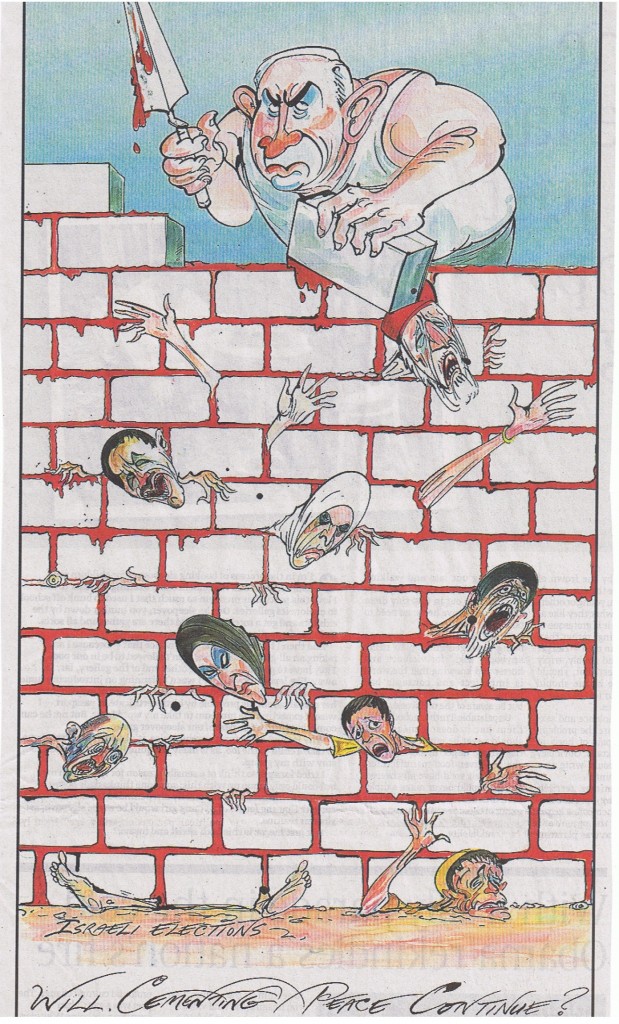
[edit]In its edition of 27 January 2013 (Britain's Holocaust Memorial Day), London's Sunday Times published a cartoon by Scarfe depicting Israel's Prime Minister Benjamin Netanyahu paving a wall with the blood and bodies of Palestinians, captioned "Israeli elections—will cementing peace continue?"[22] The cartoon's timing and content was criticised by groups including the European Jewish Congress and the Board of Deputies of British Jews, with accusations of antisemitism leveled against Scarfe.[23][24]
Unaware the cartoon would appear on Holocaust Memorial Day,[25] Scarfe argued that the cartoon was clearly aimed specifically at Netanyahu and his policies, and were in response to his election, rather than being related to Holocaust Memorial Day.[26][27] The newspaper's proprietor, Rupert Murdoch, apologised for the cartoon on Twitter, and acting editor Martin Ivens promised to be more vigilant in future.[28]
The cartoon was published in the Israeli newspaper Haaretz, where Anshel Pfeffer discusses the cartoon in great detail, giving four reasons why, in his opinion, the cartoon is not antisemitic.[29] Writer Howard Jacobson claimed the cartoon was not antisemitic.[30] British Chief Rabbi Lord Sacks condemned the cartoon.[31]
Recycled Radio
[edit]Since June 2013, Scarfe has presented a programme on BBC Radio 4 called Recycled Radio,[32] which is described as "the chopped-up, looped-up, sped-up world...where old programmes are reused to explore a series of weighty subjects".[33]
Bristol Charity Auction
[edit]In October 2013 Scarfe donated his time to decorate one of the large Wallace & Gromit statues to be auctioned for the Bristol hospital charity that was featured live on the BBC.[34] His contribution finally ending up being sold to an internet bidder from Miami Florida where the statue was exported into a private collection, ultimately topping all estimates on value with a bid second highest only to the Pixar statue contribution.
Scarfe's Bar
[edit]In 2014, Scarfe's Bar was opened in the Covent Garden area of London, in the Rosewood London, where his "distinctive caricatures not only decorate the walls but also influence the creative thrust behind their menus."[35]
Personal life
[edit]He is married to actress Jane Asher, whom he met in 1971.[36] The couple wed in 1981[37] and have a daughter and two sons.[38]
Awards and accolades
[edit]- On 22 November 2005 the United Kingdom's Press Gazette named its 40 most influential journalists, and included Scarfe alongside just two other cartoonists, Carl Giles, and Matt Pritchett.[39]
- Scarfe was awarded 'Cartoonist of the Year' at the British Press Awards 2006.[40]
- Scarfe was appointed Commander of the Order of the British Empire (CBE) in the 2008 Birthday Honours.[41]
- In 2011, a fossil pterosaur discovered in Kimmeridge Bay, Dorset, was named Cuspicephalus scarfi in his honour.[42]
Bibliography
[edit]- Scarfe, Gerald (1966). Gerald Scarfe's People.
- —— (1982). Gerald Scarfe. Thames & Hudson. ISBN 978-0500272688.
- —— (1985). Father Kissmass and Mother Claws. Hamish Hamilton. ISBN 978-0241116951. authored with Bel Mooney
- —— (1986). Scarfe by Scarfe: An Autobiography in Pictures. Hamish Hamilton. ISBN 978-0241119594.
- —— (1987). Seven Deadly Sins. Hamish Hamilton. ISBN 978-0241123942.
- —— (1993). Scarfeface. Sinclair-Stevenson. ISBN 978-1856193139.
- —— (2003). Heroes and Villains: Scarfe at the National Portrait Gallery. National Portrait Gallery. ISBN 978-1855143388.
- —— (2005). Drawing Blood: Forty Five Years of Scarfe. Little, Brown Book Group. ISBN 978-0316729529.
- —— (2008). Monsters: How George Bush Saved the World…. Little, Brown Book Group. ISBN 978-1408700853.
- —— (2010). The Making of Pink Floyd - The Wall. Orion. ISBN 978-0306819971.
- —— (2019). Long Drawn Out Trip: A Memoir. Little, Brown Book Group. ISBN 9780349143491.
- —— (2019). Scarfe: Sixty Years of Being Rude. Little, Brown Book Group. ISBN 9781408711712.
- —— (2021). The Art of Pink Floyd The Wall. Little, Brown Book Group. ISBN 9781408714324.
References
[edit]- ^ John Walker. (1987) "Gerald Scarfe & Pink Floyd" Archived 1 February 2012 at the Wayback Machine. In Cross-Overs: Art into Pop, Pop into Art/artdesigncafe. Retrieved 31 December 2011.
- ^ "Interview with Floydian Slip radio program". Archived from the original on 8 December 2010. Retrieved 8 November 2010.
- ^ GRO Register of Births: SEP 1936 1a 774 HAMPSTEAD, Gerald A. Scarfe, mmn = Gardner
- ^ a b Graham, Jane (4 October 2019). "Gerald Scarfe: How my childhood loneliness led to my grotesque cartoons". Big Issue.
- ^ Perry, Kevin (27 February 2007). "Gerald Scarfe feature interview and profile". London, UK: The Beaver. Archived from the original on 20 January 2013. Retrieved 29 September 2010.
- ^ Salter, Jessica (17 June 2010). "Gerald Scarfe, political cartoonist". The Telegraph. Archived from the original on 23 December 2013.
- ^ a b Maurice Horn (1983). The World Encyclopedia of Cartoons, Volume 4. London: Chelsea House Publishers. ISBN 9780877543992. p. 495. Accessed August 2013.
- ^ Fantoni, Barry (5 September 2019). A Whole Scene Going On: Inside the Sixties – From Private Eye to the Pop Revolution. Birlinn. ISBN 9781788852401.
- ^ Souter, Nick; Souter, Tessa (2012). The Illustration Handbook: A guide to the world's greatest illustrators. Oceana. p. 307. ISBN 978-1-84573-473-2.
- ^ Ralph Steadman (biography). British Cartoon Archive. University of Kent. Archived from the original on 15 February 2012. Retrieved 7 February 2012.
- ^ a b Miles, Barry; Mabbett, Andy (1994). Pink Floyd - The Visual Documentary. London: Omnibus. ISBN 978-0711941090.
- ^ Simone, Michael. "A Long Drawn-Out Trip: An Interview with Gerald Scarfe". REG Magazine (22). Archived from the original on 20 August 2007. Retrieved 26 January 2007.
- ^ a b c Mabbett, Andy (2010). Pink Floyd - The Music and the Mystery. London: Omnibus. ISBN 9781849383707.
- ^ "BBC News Meet The Author: Gerald Scarfe on His Role with Pink Floyd", BBC News, 25 October 2010
- ^ BBC Programme Index: The Exceptional Child, 26 May 2025, archived from the original on 5 December 2022
- ^ "Scarfe's Yes Minister art on sale". Evening Standard. 5 April 2012.
- ^ Membery, York (25 March 2011). "Political drawing-room". Financial Times. Archived from the original on 17 August 2016. Retrieved 24 July 2016.
- ^ "The laugh post!". Daily Record (Scotland). 2 March 1998. Archived from the original on 11 June 2014. Retrieved 25 January 2014 – via HighBeam Research.
- ^ "Comic genius is licked". News.bbc.co.uk. BBC. 23 April 1998. Archived from the original on 3 February 2014. Retrieved 26 January 2014.
- ^ "Tour the Dome". BBC News. 2000. Archived from the original on 13 June 2007. Retrieved 4 March 2007.
- ^ Monahan, Mark (5 December 2010). "English National Ballet fights on". The Daily Telegraph. ISSN 0307-1235. Archived from the original on 24 February 2019. Retrieved 23 February 2019.
- ^ JPost.com staff (27 January 2013). "'Sunday Times' mocks Holocaust with Israel cartoon". The Jerusalem Post. Archived from the original on 2 February 2013. Retrieved 26 January 2014.
- ^ Offensive anti-Israel cartoon in London's Sunday Times called blood libel, JTA, 7 December 2013, archived from the original on 31 January 2013
- ^ "Cartoon continues to stir controversy". ynetnews. Archived from the original on 26 August 2014. Retrieved 7 June 2014.
- ^ Jennifer Lipman "Scarfe "regrets timing" of Sunday Times Netanyahu cartoon" Archived 31 January 2013 at the Wayback Machine, The Jewish Chronicle, 28 January 2013.
- ^ Pfeffer, Anshel (28 January 2013), "Four reasons why UK cartoon of Netanyahu isn't anti-semitic in any way", Ha’aretz, archived from the original on 28 January 2013, retrieved 28 January 2013
- ^ "Outcry over UK paper's cartoon showing bloody Israeli oppression", The Times of Israel, archived from the original on 30 January 2013, retrieved 28 January 2013
- ^ "Rupert Murdoch apologises over Gerald Scarfe cartoon" Archived 25 August 2018 at the Wayback Machine, BBC News, 29 January 2013.
- ^ Mark Gardner and Anshel Pfeffer "Is the Sunday Times cartoon antisemitic?" Archived 26 November 2016 at the Wayback Machine, The Guardian, 29 January 2013. The citation featured a reprint of the Haaretz article by Pfeffer, which is only available via subscription on the original site.
- ^ Howard Jacobson. "I don't care for Scarfe's cartoon but..." Archived 26 September 2015 at the Wayback Machine, The Independent, 1 February 2013.
- ^ British Chief Rabbi condemns Scarfe cartoon Archived 1 February 2013 at the Wayback Machine, 29 January 2013; accessed 7 June 2014.
- ^ Hepworth, David (1 June 2013). "Next week's radio: from Recycled Radio to 5 Live's Big Day Out". The Guardian. Archived from the original on 18 November 2016. Retrieved 18 November 2016.
- ^ "Recycled Radio". BBC Radio 4. Archived from the original on 20 November 2016. Retrieved 18 November 2016.
- ^ "Gromit statue auction raises £2.3m for Bristol hospital". BBC News. 4 October 2013.
- ^ "Scarfes Bar London Celebrates 10th Anniversary". 26 July 2023.
- ^ "My Secret Life: Jane Asher, actress & cook". Independent.co.uk. 18 September 2011.
- ^ GRO Register of Marriages: SEP 1981 13 1708 KEN&CHELSEA – Scarfe = Asher
- ^ Thorpe, Vanessa (28 October 2012). "Scarfe Jr takes up father's satirical pen". The Observer.
- ^ Pearlman, Julia. "Media Bulletin". Brandrepublic.com. Archived from the original on 13 March 2007. Retrieved 24 August 2019.
- ^ "British Press Awards: Past winners". Press Gazette. 29 November 2007.
- ^ "No. 58729". The London Gazette (Supplement). 14 June 2008. p. 8.
- ^ "Thatcher cartoonist Gerald Scarfe is Dorset fossil namesake". BBC Online. 21 November 2011. Archived from the original on 22 November 2011. Retrieved 22 November 2011.
External links
[edit]- Official website
- British Cartoon Archive, University of Kent Archived 18 October 2013 at the Wayback Machine
- Gerald Scarfe at IMDb
- Interview with Scarfe, picture of Scarfe and examples of his work
- Radio interview with Scarfe, streaming audio and transcript
- Scarfe discusses his collected works, Scarfe by Scarfe, with George Melly and Michael Kustov – a British Library sound recording
- An interview with Gerald Scarfe by "Floydian Slip" host Craig Bailey, October 2010
Videos
[edit]
Gerald Scarfe
View on GrokipediaEarly Life
Childhood and Family Background
Gerald Scarfe was born on 1 June 1936 in St John's Wood, London, to Reginald Scarfe, a City banker, and Dorothy Scarfe, a schoolteacher.[6] His father, Reginald Thomas Scarfe, served in the Royal Air Force during the Second World War, which frequently separated him from the family and placed the burden of household management on his mother amid wartime disruptions.[7] Scarfe remained an only child until approximately age seven, when his younger brother was born, contributing to a sense of early isolation exacerbated by his health issues.[8] From around age one, Scarfe suffered from severe chronic asthma, rendering him bedridden for much of his childhood and limiting social interactions, which fostered anxiety and a turn toward solitary pursuits like drawing as a primary outlet.[1][9] This medical condition scattered his formal education and confined him largely to the home environment, where his parents' occupations—a father's financial stability in banking and a mother's educational background—provided a middle-class stability amid personal hardships.[6]Health Challenges and Artistic Awakening
Scarfe developed chronic asthma at the age of one, which confined him to bed for extended periods throughout his childhood and led to frequent hospitalizations.[1] This condition rendered much of his early years isolated, with Scarfe later describing it as a "very lonely childhood" marked by limited social interaction.[6] By age 16, he had spent the majority of his time bedridden or in medical care, limiting physical activities and peer engagement.[7] The enforced solitude fostered an early immersion in creative pursuits, as Scarfe turned to drawing, reading, puppet-making, and constructing toy theatres to occupy his time and express inner experiences.[10] He began sketching during these confinements, initially focusing on fantastical subjects like monsters and exaggerated figures that reflected his fears and imagination, rather than realistic portraits.[11] This practice served as both an escape from physical limitations and a means of communication when verbal or social outlets were scarce, laying the groundwork for his distinctive satirical style.[1] Scarfe's asthma persisted into his late teens, with him bedridden for most of his first 19 years, during which drawing evolved from a coping mechanism into a profound artistic passion.[12] The illness, while debilitating, inadvertently channeled his energies toward visual expression, enabling him to develop technical skills and a penchant for grotesque, expressive caricature without formal instruction.[13] This period of "ten, twelve years" of relative immobility honed his ability to observe and distort human forms, themes that would define his later professional work.[8]Career Foundations
Initial Professional Entries
Scarfe's entry into professional illustration followed a brief and unsatisfactory period working in advertising. Dissatisfied with commercial art, he pursued freelance cartooning, with his debut published work—a joke cartoon—appearing in the Daily Sketch in 1957.[6] His early submissions gained traction in established British publications, including Punch, where he contributed satirical drawings starting in the late 1950s. By the early 1960s, Scarfe had solidified his reputation through regular caricatures for Punch and the satirical magazine Private Eye, marking his initial foray into pointed political and social commentary via distorted, grotesque imagery.[1][6] Among his first notable commissions was a 1964 caricature of Prime Minister Winston Churchill depicted in the House of Commons, capturing the aging statesman's frailty amid parliamentary proceedings. This piece exemplified Scarfe's emerging style of exaggerated physical features to convey vulnerability and power dynamics, setting the template for his later editorial work.[9] Additional early outlets included the Evening Standard, where his illustrations appeared alongside contributions to Punch, providing steady freelance income and exposure during the 1960s. These initial entries honed Scarfe's technique in ink and watercolor, emphasizing bold lines and thematic bite over photorealism.[6]Newspaper and Magazine Contributions
Scarfe's earliest published cartoons appeared in the Daily Sketch in 1957, marking his entry into professional illustration.[6] By 1960, he contributed regularly to Punch magazine, creating satirical cartoons and multiple cover designs until 1962, including on-the-spot sketches of the rebuilt Berlin Wall.[1] These works established his signature style of exaggerated, grotesque caricatures targeting public figures and events.[9] From 1962 onward, Scarfe provided illustrations for Private Eye, a satirical fortnightly known for irreverent political commentary, which amplified his reputation for provocative content that often provoked public backlash.[14] His contributions included caricatures of politicians and celebrities, such as Lyndon B. Johnson, aligning with the magazine's anti-establishment ethos.[15] In 1966, Scarfe became a political cartoonist for the Daily Mail, followed by his appointment as editorial cartoonist for The Sunday Times in 1967, a position he maintained for over 50 years until 2017.[16] For The Sunday Times, he produced weekly caricatures critiquing British and international leaders, often depicting them in distorted, monstrous forms to highlight perceived flaws or hypocrisies.[1] Notable among these was his 1966 portrayal of Queen Elizabeth II, the first openly satirical depiction of the monarch by a cartoonist since the Victorian era, which drew significant controversy.[9] Scarfe also supplied cover illustrations for Time magazine, including a caricature of The Beatles during their peak popularity in the 1960s.[9] Additional outlets included the Evening Standard and The New Yorker, where his biting satire extended to American political figures and cultural icons.[9] Throughout, his magazine work emphasized unsparing visual commentary, prioritizing artistic exaggeration over restraint, as evidenced by recurring motifs of decay and aggression in his depictions of power.[6]Political Satire and Caricatures
Editorial Work and Targets
Scarfe established his editorial career in political satire during the early 1960s, contributing caricatures to Punch magazine from 1960 to 1962 and to Private Eye, where he targeted politicians and social issues with grotesque exaggerations.[1] By 1967, he joined The Sunday Times as its primary political cartoonist, a role he held for over 50 years until 2017, producing weekly illustrations that critiqued contemporary leaders and policies through distorted, visceral imagery emphasizing flaws in character and abuse of power.[1] [11] He later contributed political cartoons to The New Yorker for 15 years, extending his reach to American audiences.[1] His primary targets spanned British and international figures, often focusing on those in positions of authority during pivotal events. In the UK, Margaret Thatcher was a frequent subject from her rise in the 1970s through her premiership (1979–1990), with Scarfe depicting her in over 100 caricatures, including the iconic "Torydactyl" from his 1982 book Scarfeland, portraying her as a predatory pterodactyl to symbolize her aggressive conservatism; this image was exhibited at the Tate Gallery and reflected his consistent portrayal of her as unyielding and fearsome.[17] [18] Other British politicians, such as Tony Blair, Boris Johnson, and John Major, faced similar treatments highlighting perceived weaknesses or hypocrisies.[19] [20] Internationally, Scarfe targeted U.S. leaders prominently, including Richard Nixon during the Vietnam War and Watergate scandal (1969–1974), rendering him with scatological distortions such as jowls and nose likened to genitalia to underscore corruption.[15] [21] Henry Kissinger appeared in a 1973 caricature amid U.S. foreign policy debates.[22] Later works included Barack Obama, George W. Bush, and Donald Trump, as well as figures like Benjamin Netanyahu and Idi Amin, maintaining his focus on leaders accused of misusing authority across decades.[9] [11] These selections prioritized high-profile incumbents whose actions aligned with Scarfe's themes of power's distorting effects, drawn from direct observation and news coverage rather than partisan alignment.[19]Major Controversies
One of Gerald Scarfe's most prominent controversies arose from a cartoon published in The Sunday Times on January 27, 2013, coinciding with Israeli elections. The image depicted Israeli Prime Minister Benjamin Netanyahu constructing a wall using bricks made from bleeding Palestinian bodies, with the caption "Israeli elections: Will cementing peace continue?"[4] Critics, including the Israeli embassy and British Jewish organizations, condemned it for invoking antisemitic blood libel imagery and perpetuating tropes of Jews as bloodthirsty, arguing it went beyond legitimate political critique.[23] [24] The Sunday Times acting editor Martin Ivens issued an apology on January 29, 2013, describing the cartoon as "grotesque and offensive" and stating it should not have been published on Holocaust Memorial Day, though Scarfe had not intended that timing.[25] Rupert Murdoch, owner of the newspaper, echoed this on Twitter, affirming that Scarfe's work did not reflect the paper's views and labeling the image offensive.[26] The Board of Deputies of British Jews met with Ivens, expressing concerns over the cartoon's insensitivity, while some defenders, including cartoonists, argued it targeted Netanyahu's settlement policies rather than Jews broadly.[23] [27] Scarfe defended the work as standard political satire aimed at Netanyahu's actions, stating in interviews that he did not intend antisemitism and had previously caricatured Israeli leaders without such backlash; he emphasized his grotesque style critiques power abuses universally, not ethnic groups.[13] He rejected comparisons to historical antisemitic imagery, noting the cartoon focused on policy violence rather than religious hatred, though the episode highlighted tensions between artistic intent and perceived offense in caricature.[28] Earlier works also sparked debate, such as a 1966 cartoon portraying Queen Elizabeth II riding a tethered horse symbolizing a constrained Britain, which drew royal and public ire for perceived disrespect to the monarchy.[9] Similarly, a 1964 depiction of Winston Churchill as a grotesque figure provoked accusations of undermining national heroes shortly after his death, underscoring Scarfe's career-long pattern of using exaggeration to challenge authority, often at the cost of controversy.[15]Musical Collaborations
Partnership with Pink Floyd
Gerald Scarfe's professional relationship with Pink Floyd began in 1974, initiated after band members Roger Waters and Nick Mason viewed his animated short film A Long Drawn Out Trip, a psychedelic depiction of an LSD experience broadcast on BBC television.[29] This led to Scarfe's first commission for the band: a comic-style caricature of the members as the center spread in the program for their 1974 UK and US tour, supporting the forthcoming album Wish You Were Here.[30][31] The collaboration expanded into animations for live performances during the 1977 "In the Flesh" tour promoting Animals, where Scarfe's grotesque, exaggerated visuals aligned with the album's themes of societal critique, including sequences depicting the band's animal metaphors.[32][2] Scarfe's involvement during the Animals era marked a shift from static illustrations to dynamic projections, enhancing the band's stage productions with his signature style of distorted human forms and surreal imagery. The partnership reached its peak with The Wall project, starting in 1978 when Scarfe collaborated directly with Waters on conceptual designs.[1] For the 1979 double album, Scarfe created character designs, including the iconic marching hammers and schoolmaster figures, and contributed to the sleeve artwork.[1] In 1980, during the band's elaborate tour, his animations—such as the inflating flowers from "In the Flesh?" and the courtroom sequence—were projected onto the stage's massive wall, synchronizing with the narrative of isolation and breakdown.[33] Scarfe served as production designer for the 1982 film adaptation directed by Alan Parker, producing storyboards, additional animations, and overseeing visual elements that amplified the album's psychological themes.[1] Scarfe reunited with Waters in the 2010s for the solo The Wall Live tour (2010–2013), designing updated inflatables like the Teacher and Mother figures and new projections to refresh the visuals for contemporary audiences.[1] This enduring association, spanning over four decades, leveraged Scarfe's satirical edge to visually interpret Pink Floyd's conceptual rock, though later works were primarily with Waters post-band acrimony.[34]Animations for The Wall
Gerald Scarfe directed the animated sequences for the 1982 film Pink Floyd – The Wall, contributing roughly 15 minutes of runtime through hand-drawn cel animation that visualized the album's themes of alienation, trauma, and totalitarian control via nightmarish, satirical imagery. Working with a team of up to 40 animators, Scarfe oversaw the creation of over 10,000 full-color paintings at a rate of 12 frames per second for standard motion, rising to 24 for fluid sequences, a process that demanded months of labor per segment.[35][36] These animations, adapted and expanded from projections used in Pink Floyd's 1980–1981 live tour, were projected onto the stage wall via multiple synchronized projectors before integration into the film's narrative under Scarfe's creative control.[33][36] Prominent sequences included the marching hammers—symbolizing mechanical oppression and conformity—featured in tracks like "In the Flesh?" and "Waiting for the Worms," where rigid figures trample fields in lockstep formation. Other visuals encompassed grotesque floral copulation in "Empty Spaces," morphing from innocent blooms into aggressive, sexually explicit forms to evoke repressed desires turning destructive; a human mincer and maze for "Another Brick in the Wall, Part 2," illustrating institutional conformity; and visceral depictions of crushed skulls, executions, and fascist rallies underscoring psychological breakdown.[35][36] Scarfe collaborated closely with Roger Waters, interpreting the musician's concepts—such as hammers as emblems of authoritarian rigidity—while directing the sequences to maintain narrative cohesion amid production tensions with film director Alan Parker.[36] The animations' exaggerated caricature style, drawing from Scarfe's background in political satire, amplified the film's abstract exploration of fascism and isolation, with elements like the flowers sequence—originally tour footage—praised for their raw intensity despite the exhaustive hand-crafted effort, where individual frames could require up to two days.[35][36] This work solidified Scarfe's role in Pink Floyd's visual identity, blending visceral horror with symbolic depth to mirror the protagonist Pink's mental disintegration.[34]Broader Artistic Projects
Film and Television Animations
Scarfe created the animated short film A Long Drawn Out Trip in 1973, a psychedelic hand-drawn work critiquing American culture through depictions of icons such as Mickey Mouse and the Statue of Liberty, produced during a BBC project in Los Angeles.[6] The film incorporated elements of copyright infringement with its use of branded imagery, limiting its distribution to a single broadcast.[37] From 1980 to 1987, Scarfe designed the opening animated title sequences and end-credit illustrations for the BBC sitcoms Yes Minister (1980–1984) and Yes, Prime Minister (1986–1988), employing stop-motion techniques to satirize British political bureaucracy.[1] These sequences featured exaggerated caricatures of civil servants and politicians, aligning with Scarfe's signature grotesque style.[38] In 1997, Scarfe served as production designer for Disney's animated feature Hercules, developing conceptual artwork and over 700 character visualizations that influenced the film's mythological aesthetic and character designs, drawing from directors Ron Clements and John Musker's admiration for his caricatural approach.[1][9] His contributions emphasized bold, exaggerated forms suited to the film's comedic tone, marking a departure from his typical political satire into mainstream commercial animation.[39]Theater Designs and Public Commissions
Scarfe designed sets and costumes for the English National Opera's production of Orpheus in the Underworld in 1985, infusing the work with his characteristic satirical edge through exaggerated, grotesque elements that amplified the opera's comedic critique of society.[1] He extended this approach to ballet with sets and costumes for Christopher Hampson's The Nutcracker in 2002 for the English National Ballet, reinterpreting the classic tale in a dark, modern style featuring oversized, whimsical yet menacing props like a pile of chocolate and eccentric character designs that departed from traditional sentimentality.[1][40] In opera, Scarfe contributed sets and costumes to Tobias Picker's Fantastic Mr. Fox at the Los Angeles Opera, drawing on Roald Dahl's source material to create anthropomorphic animal figures and rural landscapes rendered in bold, caricatured forms.[1] He also designed for productions of Mozart's The Magic Flute at the Los Angeles Opera and Seattle Opera, employing monumental architectural elements such as a giant bisected pyramid to evoke the opera's themes of enlightenment and illusion.[1] Additional theater work included designs for Born Again at the Chichester Festival Theatre, where his visuals supported the play's exploration of religious and personal transformation.[1] For public commissions, Scarfe created large-scale sculptures for the Millennium Dome in London in 2000, installed in the 'Self-Portrait Zone' to satirize contemporary British social ills, including pieces addressing racism, football hooliganism, television addiction, and consumerism through distorted, larger-than-life human forms in papier-mâché and other media.[1] These works marked his shift toward three-dimensional public art, extending his caricature style into immersive, site-specific commentary visible to thousands of visitors during the Dome's operation.[1]Publications and Exhibitions
Books and Written Works
Scarfe has authored and illustrated numerous books featuring collections of his satirical caricatures, political cartoons, and conceptual artwork, often accompanied by personal commentary on his creative process and inspirations. These publications span decades, reflecting his career in editorial illustration and collaborations with musicians and filmmakers. His written contributions typically provide contextual narratives rather than extensive prose, emphasizing the visual impact of his grotesque, exaggerated style.[9] One of his earliest significant compilations, Scarfe Land: A Lost World of Fabulous Beasts and Monsters, published in 1989 by Hamish Hamilton, showcases Scarfe's fantastical illustrations of mythical creatures and monsters, blending whimsy with his characteristic distortion for humorous effect. The book presents a portfolio of original drawings without heavy narrative, allowing the imagery to evoke a surreal, alternate world. In 2005, Scarfe released Drawing Blood: Forty Five Years of Scarfe Uncensored, a comprehensive retrospective through Little, Brown Book Group, chronicling his career from the 1960s onward with over 400 pages of uncensored cartoons targeting politicians, celebrities, and social issues. The volume includes autobiographical reflections on commissions for outlets like The Sunday Times and The New Yorker, highlighting his technique of amplifying human flaws through caricature. It sold steadily and remains a key reference for his editorial output.[41][42] Scarfe expanded this self-examination in Scarfe: Sixty Years of Being Rude (2019, Little, Brown), an updated 576-page edition building on Drawing Blood with additional decades of work, including rare sketches and insights into his longevity in satire amid shifting cultural norms. The book features essays on specific targets like Margaret Thatcher—depicted as the "Torydactyl"—and underscores his commitment to unfiltered critique, with sales bolstered by limited signed editions.[43][44] Tied to his musical collaborations, The Making of Pink Floyd: The Wall (2010, Weidenfeld & Nicolson) documents Scarfe's visual contributions to the album and film, incorporating sketches, storyboards, and photographs from 1974 to the 2010 tour. Foreword by Roger Waters, it details the evolution of iconic imagery like the marching hammers and the Wall's symbolic barriers, serving as both memoir and production archive for the project that defined much of his animation legacy.[45][46] More recently, Disney's Hercules: The Art of Gerald Scarfe (2025, Insight Editions), a 336-page volume released on January 7, draws from Scarfe's personal archive to explore his production design for the 1997 animated film. It includes previously unpublished character designs, concept art for gods and monsters, and anecdotes on adapting his style to Disney's family-oriented constraints while retaining grotesque elements in figures like Hades. The book weighs in at 1.3 kg, emphasizing high-fidelity reproductions for collectors.[47][48]| Title | Publication Year | Publisher | Focus |
|---|---|---|---|
| Scarfe Land: A Lost World of Fabulous Beasts and Monsters | 1989 | Hamish Hamilton | Fantastical illustrations of beasts |
| Drawing Blood: Forty Five Years of Scarfe Uncensored | 2005 | Little, Brown | Career retrospective of caricatures |
| The Making of Pink Floyd: The Wall | 2010 | Weidenfeld & Nicolson | Pink Floyd collaboration visuals |
| Scarfe: Sixty Years of Being Rude | 2019 | Little, Brown | Expanded satirical oeuvre |
| Disney's Hercules: The Art of Gerald Scarfe | 2025 | Insight Editions | Film production design archive |