Hubbry Logo
CiconesCiconesMain
Open search
Cicones
Community hub
Cicones
logo
8 pages, 0 posts
0 subscribers
Be the first to start a discussion here.
Cicones
Cicones
from Wikipedia
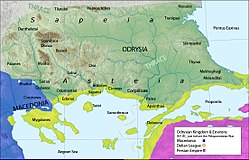
Approximate location of the Cicones

The Cicones (/ˈsɪkəˌnz/; Ancient Greek: Κίκονες, romanizedKíkones) or Ciconians /sɪˈkniənz/ were a Homeric Thracian[1] tribe, whose stronghold in the time of Odysseus was the town of Ismara (or Ismarus), located at the foot of mount Ismara,[2] on the south[3] coast of Thrace (in modern Greece). They are mentioned in book two of the Iliad as having joined the war on the side of the Trojans, led by Euphemus. In book nine of Homer's Odyssey, Odysseus and his men take Ismara by surprise and slay most of the Ciconian men they come across, taking Ciconian women as slaves. Later Ciconian reinforcements arrive and attack the invading Achaeans, killing so many of them that Odysseus and his men are forced to flee in their ships. Six men of each of Odysseus' ships were killed:

When I had set sail thence the wind took me first to Ismarus, which is the city of the Cicons. There I sacked the town and put the people to the sword. We took their wives and also much booty which we divided equitably amongst us, so that none might have reason to complain. I then said that we had better make off at once, but my men very foolishly would not obey me, so they stayed there drinking much wine and killing great numbers of sheep and oxen on the sea shore. Meanwhile the Cicons cried out for help to other Cicons who lived inland. These were more in number, and stronger, and they were more skilled in the art of war, for they could fight, either from chariots or on foot as the occasion served; in the morning, therefore, they came as thick as leaves and bloom in summer, and the hand of heaven was against us, so that we were hard pressed. They set the battle in array near the ships, and the hosts aimed their bronze-shod spears at one another. So long as the day waxed and it was still morning, we held our own against them, though they were more in number than we; but as the sun went down, towards the time when men loose their oxen, the Cicons got the better of us, and we lost half a dozen men from every ship we had; so we got away with those that were left.[4]

The Cicones are also referred to in the book of poems Metamorphoses by Ovid. They are mentioned in book VI when he writes of Boreas and Orithyia, when Ovid states:

He bore her off; and as he flew he felt the flames of love gain force on force; he did not curbe his course across the air until he'd reach the northern lands and city of the Cicones.[5]

Orpheus, the Thracian lyre-player who sought his lover Eurydice in the underworld, was said to have been torn to pieces by Ciconian women after he rejected their advances, subsequently being reincarnated as a swan,[6] or, according to Ovid, his disembodied head floating on the sea until it came to rest on the island of Lesbos, where it continued to speak, uttering prophecies.[7]

In classical times and in a historical context they go into obscurity. Non mythical instances of them occur in Herodotus (5th century BC) as he writes of their land that Xerxes' army passed by.[1] The tribe itself is thought to have disappeared early on.[8]

Eumenes of Cardia lived there for a while after being retrieved from a sunk slave ship heading to Olbia, Ukraine.

References

[edit]

See also

[edit]
Revisions and contributorsEdit on WikipediaRead on Wikipedia
from Grokipedia
The Cicones (: Κίκονες) were an ancient tribe dwelling on the southeastern coast of , renowned in classical literature as allies of the Trojans and early adversaries of . In Homer's , the Cicones are depicted as spearmen contributing forces to the Trojan side during the , commanded by , son of the Trojan Troizenos and grandson of Ceas. Their stronghold, the city of Ismarus (also spelled Ismara), is described as located at the foot of Mount Ismara, near Lake Ismaris, a region famed for its wine production. The tribe's most detailed narrative appears in Book 9 of Homer's , where recounts sacking Ismarus upon departing : his men plunder the city, slay its male inhabitants, seize women and treasure as spoils, and divide the loot equally, but their delay in celebrating leads to a by inland Cicones, resulting in the loss of six warriors per ship before the flee by sea. Later classical authors, such as , confirm the Cicones' Thracian identity by listing them among tribes encountered by Xerxes' army in the 5th century BCE, underscoring their integration into broader Thracian ethnolinguistic groups. Archaeological evidence for the Cicones remains limited, with Ismarus traditionally identified near the modern site of Maroneia in northeastern , where ancient settlements and sanctuaries reflect Greco-Thracian interactions from the Archaic period onward. As one of many Thracian peoples, the Cicones exemplify the region's role as a cultural frontier between Greek and non-Greek worlds in the and Iron Ages.

Etymology

Name Origin

The term "Cicones" represents the Latinized form of the Κίκονες (Kíkones), first attested in Homer's (Book 2, line 846) and (Book 9, line 39), where it designates a Thracian tribe inhabiting the coastal region near the Hebrus River. This Greek designation is widely regarded as a borrowing from the indigenous , an Indo-European branch spoken by tribes in southeastern Europe from the onward, characterized by satem phonological features such as palatalization of velars and close affinities to Baltic and Daco-Moesian dialects. Due to the fragmentary nature of Thracian attestations—limited primarily to personal names, glosses, and inscriptions—the precise linguistic roots and semantic meaning of "Kíkones" have not been conclusively determined, though one proposal derives it from Proto-Indo-European *gigō(n), related to words meaning "quick" or "alive" (cf. cwicu), reflecting a tribal self-designation preserved through Greek mediation. No records of the name appear in Linear B tablets from Mycenaean sites (ca. 1450–1200 BCE), which document early Greek administrative texts but lack references to Thracian peoples or toponyms beyond the Aegean sphere, nor in contemporary early Greek inscriptions such as those from the Dipylon oinochoe or tablets. This absence indicates that the term entered Greek literary tradition later, possibly via oral epic transmission or Hellenistic interactions with , rather than through direct Mycenaean contact. The name shows close phonetic correspondence to variants like "Kikones," a direct transliteration used in some classical texts (e.g., 7.110), reflecting dialectal or scribal differences rather than distinct etymologies, and shares structural similarities with other Thracian tribal designations such as the Paiones (Παίονες) or Bistonians (Βίστονες), which often end in -ones and preserve initial velar or labial clusters typical of the language family's satem branch. These resemblances underscore the broader onomastic patterns in Thracian, where tribal names frequently derive from landscape features, totems, or ancestral figures, but specific connections for "Kíkones" remain elusive without additional epigraphic evidence.

Ancient Variations

The name of the Thracian tribe appears as Κίκονες (transliterated as Kikones) in the original Greek text of Homer's , particularly in Book 9, where recounts his raid on their city of Ismarus. This form is consistent in surviving Homeric papyri and medieval manuscripts, reflecting the epic's Ionic dialectal features. In Latin adaptations, the name was romanized as Cicones, as seen in Ovid's (Book 6, lines 682–702), where the "Ciconian land" (Ciconia terra) serves as the homeland of the god during his abduction of Orithyia. Some Latin sources and English translations render it as Kikonians to preserve the phonetic qualities of the Greek original, highlighting the cross-linguistic adaptation from to . The Ionic dialect of Homeric epic influenced the name's form, with its characteristic retention of digamma traces and vowel qualities, whereas Attic Greek texts adopted similar spellings for foreign ethnonyms without major orthographic shifts, maintaining consistency in references to Thracian groups.

Geography

Territory

The Cicones occupied a coastal territory in southern Thrace, stretching along the Aegean Sea from the mouth of the Nestus River in the west to the Hebrus River in the east, encompassing a narrow strip of land between the sea and the inland highlands. This region, described in ancient accounts as part of the broader Thracian seaboard, featured fertile coastal plains interspersed with river valleys that supported agriculture and pastoral activities. Proximate to Mount Ismaros, the Cicones' homeland was marked by rugged terrain, with the mountain's slopes providing natural defenses and contributing to a varied of hills, valleys, and wooded areas that shaped settlement patterns and resource exploitation. The Hebrus River flowed through parts of their domain, aiding transportation and , while the Nestus marked a western boundary transitioning to neighboring tribal lands. The strategic coastal position enabled the Cicones to interact with trade routes, facilitating exchanges of goods like metals, timber, and wine with Greek maritime networks, while inland connections linked their territory to the expansive Thracian plains used for and overland commerce. Their eastern borders adjoined tribes such as the Paeti, influencing regional dynamics without direct overlap in core areas.

Key Settlements

The primary stronghold of the Cicones was the city of Ismarus (or Ismara), mentioned in Homer's Odyssey as the site where Odysseus and his companions raided the settlement of this Thracian tribe upon their return from Troy. In ancient accounts, Ismarus is portrayed as a well-defended urban center, enabling the Cicones to mount a counterattack against the invaders from a nearby stronghold. Ancient geographer Strabo identifies Ismarus alongside Xantheia and Maroneia as key cities associated with the Cicones, situated along the southeastern Thracian coast near Lake Ismaris, reflecting a network of coastal settlements within their broader territorial extent from the Nestus River to the Hebrus. These locations likely included villages and ports facilitating trade and defense, as indicated by itineraries in classical sources that place Ciconian habitations along Aegean-facing routes. Archaeologically, Ismarus correlates with a prehistoric on Agios Hill (elevation 461 m) east of modern Maroneia in the Rodopi regional unit of Greek Thrace, near , featuring Cyclopean-style walls spanning approximately 1,330 meters, megalithic gates, and ceramic artifacts dated to the 9th–8th centuries BCE that align with the Homeric period. This site, enclosing possible sacred precincts and elite structures, underscores the fortified nature of Ciconian centers.

Mythological Role

In Homer's Iliad

In Homer's Iliad, the Cicones appear as allies of the Trojans during the Trojan War, contributing warriors to Priam’s forces as detailed in the Catalogue of the Trojan Allies in Book 2. Led by Euphemus, son of Troezenus and grandson of Ceas—a figure nurtured by Zeus—the Cicones are described specifically as spearmen, emphasizing their role in close-quarters combat within the broader Trojan coalition. This leadership under Euphemus positions the Cicones immediately following the Thracians in the catalogue (Iliad 2.846–848), highlighting their integration into the ranks of non-Trojan supporters drawn from regions bordering the Hellespont. The Cicones' inclusion in this muster of forces, recited by the heralds to rally the Trojans against the Achaean assault, underscores their military value despite their geographical distance from proper. As a Thracian , they represent the peripheral extensions of Troy's alliances, extending influence northward into the rugged territories beyond the and demonstrating the city's capacity to mobilize diverse ethnic groups for defense. Their portrayal as expert spearmen further implies a significant, if supporting, contribution to the Trojan , bolstering the of a multinational resistance against the Greek . This depiction in the establishes the Cicones as a notable Thracian power, capable of fielding organized contingents under divine-favored leadership, which reflects the epic's emphasis on the war's expansive scope.

In Homer's Odyssey

In Book 9 of Homer's , Odysseus narrates the first leg of his voyage home after the sack of , where his fleet is driven by a to Ismarus, the principal city of the Cicones. There, he leads a raid on the settlement, slaying the male inhabitants and seizing their wives along with abundant spoils of cattle, sheep, and other treasures, which the divide equally among themselves to avoid strife. The Cicones, who had fought as allies of the Trojans during the war, thus become the initial targets of Achaean aggression in the post-Trojan narrative. Odysseus urges his men to depart swiftly, but they linger through the night, feasting on wine and roasting the captured livestock in defiance of his orders. This delay enables the Cicones to rally reinforcements from their more warlike kin in the interior—men superior in number and battle prowess—who launch a at dawn. The fierce clash endures until the late afternoon, with the Cicones prevailing and inflicting heavy losses on the Greeks: six men slain from each of Odysseus' twelve ships, amounting to 72 deaths in total. The remnants of the crew, grieving their fallen comrades, manage to reboard their vessels and flee under cover of evening. This encounter serves as an ominous prelude to ' trials, illustrating the perils of the homeward journey and the destructive consequences of among his followers. The crew's indulgence and disobedience, driven by for spoils, exemplify how unchecked recklessness invites retribution and undermines collective survival, a recurring motif in the epic that highlights the fragility of human endeavors against unforeseen adversities.

In Other Greek Myths

In Ovid's Metamorphoses (Book XI), the Cicones are prominently featured in the myth of 's death, where Ciconian Maenads—ecstatic female devotees of —play a central antagonistic role. Grieving the loss of his wife after failing to retrieve her from the , Orpheus retreated to the Thracian wilderness, captivating animals, trees, and stones with his but rejecting the advances of women in his songs. This misogynistic turn enraged the Maenads, who, in a frenzy during Dionysian rites, assaulted him on a hilltop near the river Hebrus. Wielding thyrsi (staffs topped with pine cones), stones, and branches, they first pelted him while shouting to drown out his music; when their weapons failed due to his enchanting voice, they tore him apart with their hands, dismembering his body and casting his head and into the river. The head continued to lament as it floated to the shore, where it became an until buried by the Muses. This violent episode underscores the Maenads' unrestrained fury, transforming the peaceful landscape into a scene of bloodshed and evoking the primal chaos of Dionysian worship. The Cicones also appear in Ovid's (Book VI) within the myth of and Orithyia, linking them to themes of abduction and northern wildness. , the god of the north wind, desired the Athenian princess Orithyia, daughter of King , but faced resistance from her father and Thracian influences, including the cruel King Tereus of . Undeterred, abducted Orithyia in a whirlwind from the banks of the Ilissus River, carrying her northward without pause until his wings stirred chilling gusts around the walls of the Ciconian city. There, in their rugged Thracian territory, the couple consummated their union, producing the winged sons Zetes and (the ), who later joined . This connection positions the Cicones' lands as a symbolic frontier of untamed, windy isolation, contrasting Athenian civility with Thracian ferocity. Through these narratives, the Cicones embody the wild, resistant Thracian ethos within Dionysian cults, particularly via the Maenads' ecstatic violence against , which highlights their role as fierce guardians of ritual frenzy over artistic restraint. Ovid depicts them as embodiments of primal resistance, their Thracian origins amplifying the cults' chaotic, liberating energy that overrides harmony and reason.

Historical Mentions

Herodotus' Account

In his Histories, composed in the , recounts the Second Persian Invasion led by Xerxes in 480 BC, during which the Persian army traversed the Thracian territories of the Cicones as part of its route from into . After crossing the Hellespont and establishing a base at Doriscus—a fortified Persian outpost in —Xerxes reviewed his assembled forces there before continuing westward along the coast. The fleet anchored at a nearby beach in the Doriscus region, which describes as formerly possessed by the Cicones, highlighting their historical control over coastal areas in this vicinity. As the army advanced from Doriscus, it passed the Greek colonial cities of Maronea, Dicaea, and Abdera, situated along the Thracian seaboard, before entering Ciconian lands. specifies that the Cicones' territory lay immediately beyond these settlements, as part of the initial sequence of Thracian tribes through whose domains Xerxes marched, beginning with the Paeti, Cicones, and Bistones as far as the Nestus River, followed by other groups including the Edoni and Satrae. This positioning places the Cicones' domain between Abdera and the regions further west toward Macedonia, integrating their lands directly into the Persian campaign's path. Herodotus emphasizes that Xerxes compelled the inhabitants of these Thracian territories, including the Cicones, to join the invasion force, providing troops and supplies without recorded opposition in the narrative. This submission implies the Cicones' strategic accommodation to Persian authority, ensuring their survival as a distinct group amid the overwhelming military passage, while underscoring their role in the logistical network of the campaign. Such integration reflects the broader pattern of Thracian tribes yielding to Persian demands during the expedition.

Later Classical References

In later classical literature, the Cicones are primarily referenced in geographical and ethnographic contexts, reflecting their integration into broader descriptions of during the Hellenistic and Roman periods. , in his , situates the Cicones as a Thracian tribe west of Aenus (modern ) near the Hellespont, emphasizing their coastal position along the winding shores from Doriscus to the Long Wall. He further connects them to mythological figures, noting that , the legendary musician and diviner, was a Ciconian from the village of Pimpleia near , where he gathered followers through music, soothsaying, and mystic rites before amassing greater influence. These accounts portray the Cicones as a historically significant but diminished group by the first century BCE, their distinct identity fading amid Thracian tribal amalgamations. Pliny the Elder, in his Natural History, reinforces their Thracian ethnographic profile by describing natural phenomena associated with their territory. He mentions a river of the Cicones where submerged wood acquires a stony coating, highlighting peculiar geological features in their region near Doriscus. Pliny also situates them in the broader coastal ethnography of Thrace, bordering tribes such as the Caeni and Bisaltae to the west and extending along a 112-mile stretch of shoreline marked by the Melas River. Such references underscore the Cicones' role in Roman-era compilations of regional lore, treating them as an archaic tribe whose lands contributed to understandings of Thrace's diverse peoples and landscapes, though no longer politically prominent.

Thracian Context

Relations with Neighboring Tribes

The Cicones inhabited the southeastern coastal region of , positioned among other Thracian tribes as outlined by in his description of Xerxes' march through the area in the BCE. To their west lay the Paeti, near the Nestus River valley, while the Bistones occupied territories immediately to their east, around the Lake Bistonis; further inland, the Satrae controlled mountainous regions and remained unsubdued by Persian forces. These tribes formed a sequence of neighboring groups along the route from Acanthus to Doriscus, reflecting the fragmented yet interconnected Thracian landscape. During the Persian Wars, the Cicones shared a common experience of subjugation with the Paeti and Bistones, as all three tribes were compelled to provide troops and logistical support to Xerxes' invading army, unlike the independent Satrae who refused to submit and avoided direct involvement. This coercion highlights a lack of unified resistance among the coastal Thracian groups, though no explicit conflicts between the Cicones and their immediate neighbors are recorded in this context; instead, external Persian dominance temporarily aligned their contributions. The Satrae's autonomy, attributed to their rugged terrain, underscored distinctions in relations, as they maintained freedom from both Persian control and potential tributary demands from coastal tribes like the Cicones. In the earlier mythological framework of the Trojan War, as depicted in Homer's Iliad, the Cicones participated in a loose Thracian confederation allied with Troy against the Achaean Greeks, led by their chief Euphemus; this alliance included neighboring or related Thracian elements such as the forces under Rhesus from further inland Thrace, suggesting coordinated martial support across tribal boundaries during the late Bronze Age conflict. Such shared allegiance indicates diplomatic or military ties among Thracian groups, including potential overlaps with tribes like the Paionians, who also fought for Troy. The arrival of Greek colonists in the BCE introduced territorial tensions along the Thracian coast, particularly with the founding of Abdera by Clazomenians (and later reinforced by Teians) in lands adjacent to Ciconian territories around Ismarus and Maroneia. Initial settlement efforts met with severe conflicts and resistance from local , including the Cicones, as colonists sought to expand inland from coastal strongholds; archaeological and literary evidence points to violent clashes before Greek control stabilized in the plain, marking a pattern of geopolitical friction between indigenous tribes and encroaching poleis. later confirms the Cicones' association with this region, emphasizing their proximity to these colonies.

Cultural Characteristics

The Cicones, as a Thracian tribe, maintained a deep association with Dionysian worship, centered on the god Dionysus (known locally as Sabazios), who embodied ecstasy, fertility, and the vine. This religious practice involved ecstatic rituals and festivals that emphasized communal revelry and spiritual communion, reflecting the broader Thracian reverence for the deity as a mediator between the living and the dead. Evidence of this cult appears in regional artifacts and traditions, including mushroom-shaped symbols in burial sites that link to Dionysian themes of rebirth and intoxication. The involvement of Maenads—frenzied female devotees who embodied Dionysus's wild, transformative power—further highlights this cultural facet, with Thracian lore portraying them as integral to rites in the Ciconian territories around Ismaros. These women participated in nocturnal processions and dances that induced trance-like states, underscoring the tribe's integration of into daily and ceremonial life. Such practices distinguished Ciconian from more structured Greek cults, prioritizing raw emotional release over formalized temple . Ciconian society was marked by a pronounced warrior , evident in their organized military contributions to the Trojan alliance during the , where they deployed forces led by son of Troizenos. Homeric accounts depict them as formidable defenders of their homeland, capable of mounting effective counterattacks against invaders, which suggests a culture valuing martial prowess, horsemanship, and communal defense. This warrior orientation likely intertwined with religious rites, where Dionysian ecstasy may have bolstered resolve in battle through preparation. Economically, the Cicones depended heavily on agriculture, with viticulture forming a cornerstone in the fertile Ismaros region, yielding high-quality wines prized for their sweetness and potency. Archaeological remnants, such as ancient winepresses on Mount Ismaros, confirm this focus, while literary references to vast stores of wine indicate surplus production for both local consumption and export. Their coastal location at Ismarus facilitated trade networks across the Aegean, exchanging agricultural goods like wine for metals and luxury items, thereby sustaining a prosperous, interconnected economy within the Thracian framework. Neighboring tribes influenced these practices through shared viticultural techniques and trade routes.

Legacy

In Literature and Art

The Cicones appear in post-classical literature and art primarily through their association with Thracian myths, particularly as the tribe whose women, in a frenzied state, dismember in Ovid's (Book 11), where the "frenzied Ciconian women" attack him for his rejection of female love after Eurydice's death. This scene inspired numerous illustrations of Ovid's work, emphasizing the violent clash between the poet and the Maenads. For instance, Antonio Tempesta's 1606 etching Plate 99: The Death of Orpheus (Orpheus a Bacchis discerpitur) from his series on the Metamorphoses depicts the Ciconian women hurling stones and weapons at Orpheus while he plays his , capturing the moment of his tragic end amid a chaotic landscape. Similarly, Johann Wilhelm Baur's 17th-century etching Plate 100: The Death of Orpheus portrays the assault with dynamic figures of the attacking women, their animal skins and staffs highlighting their Bacchic frenzy, as part of a broader cycle illustrating Ovid's transformations. In modern epic retellings of Homer's Odyssey, the Cicones are alluded to in the opening adventures, symbolizing the perils of hubris and the cost of plunder following the Trojan War. Simon Armitage's 2006 verse adaptation The Odyssey: A Dramatic Retelling of Homer's Epic, commissioned for BBC radio, includes the raid on Ismarus where Odysseus's men battle the Cicones, resulting in heavy losses and setting the tone for the journey's hardships. This episode underscores themes of overreach, with the Cicones' retaliation serving as an early cautionary motif in contemporary interpretations of Odysseus's voyage. Artistic depictions of Thracian myths in the often incorporated Ciconian elements through 's demise or the Odyssey's raid, blending classical narrative with Romantic intensity. Émile Lévy's 1866 oil painting Death of Orpheus portrays the Ciconian Maenads surrounding the fallen poet in a moonlit forest, their ecstatic expressions and raised arms evoking Dionysian rage as they prepare to tear him apart, exhibited at the Paris Salon to explore themes of artistic martyrdom. For the Homeric encounter, Friedrich Preller the Elder's 19th-century Odysseus Fighting the Cicones illustrates the clashing with the Thracian warriors outside Ismarus, with spears and shields in dynamic combat, reflecting the era's interest in heroic antiquity amid archaeological rediscoveries. These works highlight the Cicones as fierce adversaries in visual narratives of myth.

Modern Scholarship

Modern scholarship on the Cicones highlights the challenges posed by the absence of unambiguous archaeological evidence directly linked to this Thracian tribe, with most interpretations relying on literary references and broader regional . Excavations in the Thasian Peraia, such as those at Oisyme, reveal Early Thracian settlements featuring handmade coarse ware, fortification walls, and hybrid Greco-Thracian , but no artifacts or structures are conclusively identified as Ciconian. Scholars emphasize that this paucity of finds suggests the Cicones may have integrated seamlessly into surrounding Thracian communities, leaving no distinct material signature. Some theories propose an early disappearance of the Cicones, potentially by the late , attributing it to or displacement amid migrations in the region. Interpretations in contemporary often connect potential Ciconian territories to settlements in southwestern , where tumuli, fortified hilltops, and bronze artifacts indicate a proto-Thracian presence from the . Sites like those near Ismaros, associated with the Cicones in Homeric tradition, show continuity from Late layers with hand-built pottery and metalwork akin to broader styles, suggesting the tribe's roots in these early communities. However, such links remain tentative, as ethnic attributions are inferred from geographical overlap rather than epigraphic or iconographic proof. As of 2025, ongoing excavations in northeastern continue to explore sites but have not yielded conclusive evidence specific to the Cicones. Debates on the Cicones' ethnic identity center on their status as a distinct Indo-European Thracian subgroup, with linguistic and onomastic evidence from classical texts supporting their non-Greek, Thracian affiliation alongside tribes like the Paeti and Satrae. Modern researchers argue that by the 1st century AD, the Cicones had largely assimilated into the Roman province of Thrace, as evidenced by the romanization of local elites through citizenship grants and adoption of Latin names in inscriptions from the region. This process involved cultural hybridization, with Thracian tribal identities fading under imperial administration, contributing to the eventual blending into Romano-Thracian society without preserved ethnic markers.

References

Add your contribution
Related Hubs
User Avatar
No comments yet.