Hubbry Logo
CliviaCliviaMain
Open search
Clivia
Community hub
Clivia
logo
8 pages, 0 posts
0 subscribers
Be the first to start a discussion here.
Clivia
Clivia
from Wikipedia

Clivia
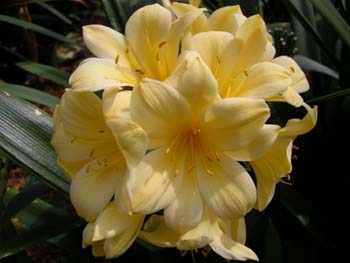
Clivia miniata var. citrina
Scientific classification Edit this classification
Kingdom: Plantae
Clade: Tracheophytes
Clade: Angiosperms
Clade: Monocots
Order: Asparagales
Family: Amaryllidaceae
Subfamily: Amaryllidoideae
Genus: Clivia
Lindl.
Type species
Clivia nobilis Lindl.[1]
Species

See text

Synonyms[2]
  • Himantophyllum Spreng., orth. var.
  • Imantophyllum Hook., nom. illeg.
  • Imatophyllum Hook.

Clivia /ˈklviə/[3] is a genus of monocot flowering plants native to southern Africa. They are from the family Amaryllidaceae, subfamily Amaryllidoideae.[4] Common names are Natal lily or bush lily.

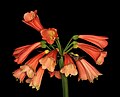
They are herbaceous or evergreen perennial plants, with green, strap-like leaves. Individual flowers are more or less bell-shaped, occurring in umbels on a stalk above the foliage; colors typically range from yellow through orange to red. Many cultivars exist, some with variegated leaf patterns.

Description

[edit]

Species of Clivia are found only in South Africa and Eswatini. They are typically forest undergrowth plants, adapted to low light (with the exception of C. mirabilis from the Western Cape).[5]

Clivia shares common features with the other members of the subfamily Amaryllidoideae. Individual flowers have three sepals and three petals, all very similar (although the sepals are typically narrower than the petals) and collectively called tepals. In Clivia the tepals are fused at the base to form a tube, although this may be very short. The flower varies in shape from an open cup to a narrow hanging tube. In the species the flowers are mainly in shades of yellow through orange to red. The flowers are arranged in umbels (i.e. the flower-stalks or pedicels radiate from a single point); each umbel has a long stalk or peduncle. Several bracts subtend the umbels. Each flower has six stamens and an inferior ovary (i.e. one which is below the tepals) made up of three locules. The stamens have long filaments and anthers which are free to move on their filaments. The style is longer than the tepals, ending in a short three-part stigma.[6]

Flowering time varies. Typically C. miniata, C. nobilis and C. caulescens flower in late winter and spring; in cultivation, C. miniata has out of season flowers at almost any time. C. gardenii and C. robusta flower in the autumn. Interspecific hybrids and cultivars can flower at almost any time of the year depending on climate and the flowering pattern of their parent species.[7]

A distinctive feature of Clivia – shared with the closely related genus Cryptostephanus – is that unlike most species in the subfamily, it does not form bulbs. The long strap-shaped leaves are evergreen and spring from thick branching roots or rhizomes. Like other members of the tribe Haemantheae to which it belongs, Clivia fruits are berries. When ripe, they contain large fleshy seeds which are often more than 1 cm in diameter.[6]

Taxonomy

[edit]

It was published by John Lindley in 1828 with Clivia nobilis Lindl. as the type species.[1] It was named in honor of Charlotte Percy (née Clive), Duchess of Northumberland (1787–1866),[8][1][9] who was for a time the governess of the future Queen Victoria.[10][11][12]

Evolution and phylogeny

[edit]

Six genera have been placed in the tribe Haemantheae; all are found in Africa. Molecular phylogenetic analysis carried out in 2004 showed that the tribe is monophyletic (i.e. it contains all the descendants of a single common ancestor). Four species of Clivia were included in the analysis:[5]

Haemantheae

The bulbless Clivia and Cryptostephanus appear to occupy a basal position within the clade. Meerow and Clayton suggest that a forest understorey habitat, associated with the absence of bulbs and the presence of fruits which are berries, may have been a factor in the evolutionary divergence of the Haemantheae clade from the rest of the subfamily Amaryllidoideae.[5]

Species

[edit]

As of January 2012, six species are recognized by the World Checklist of Selected Plant Families:[13]

C. mirabilis was only named in 2000, and C. robusta even later, in 2004.[13] Thus older sources frequently state that there are only four or five species.

Natural hybrids

[edit]

Cultivation

[edit]

Of the species, Clivia miniata is the most widely cultivated; cultivars with flowers ranging from deep red-orange to pale yellow have been bred by growers. Yellow plants can belong to one of two different groups which breed true for colour, producing seedlings with unpigmented stems and all yellow flowers when mature. When yellows from different groups are crossed, seedlings with pigmented stems occur and the resulting flowers are orange.[7]

C. miniata, C. gardenii, C. robusta and C. caulescens seedlings flower after four to five years. C. nobilis will flower after seven or eight years. It is reported that C. mirabilis also takes about six years to flower.

Care

[edit]

In cultivation, it is recommended that plants are watered regularly in summer, although not overwatered, with a resting period from autumn till late winter, when the plants are kept almost dry at 46–50 °F (8–10 °C). Plants can be repotted yearly or every other year in all-purpose potting medium or coconut husks.

Propagation is by seed or by offsets removed when repotting. Seeds are sown on the top of moist material in high humidity.[14]

Pests and diseases include scale insects, mealy bug, amaryllis borer, and rot.[15]

Toxicity

[edit]

Some species of Clivia, including Clivia miniata, produce small amounts of the alkaloid lycorine. Lycorine is toxic in sufficient quantities, particularly in pets and small children.[16]

See also

[edit]

References

[edit]

Bibliography

[edit]
Revisions and contributorsEdit on WikipediaRead on Wikipedia
from Grokipedia
Clivia is a genus of six species of evergreen, herbaceous perennial flowering plants in the family Amaryllidaceae, native to woodland habitats in southern Africa, particularly South Africa and Eswatini. These monocotyledonous plants are characterized by their strap-shaped, leathery leaves that form a basal rosette or pseudostem, and striking umbels of funnel- or trumpet-shaped flowers borne on scapes, typically blooming in late winter to spring with colors ranging from vibrant orange and red to yellow or green. The genus is named after Charlotte Florentia Clive, Duchess of Northumberland, by botanist John Lindley in 1828, honoring her interest in botany. The accepted species include Clivia caulescens, Clivia gardenii, , Clivia mirabilis, Clivia nobilis, and Clivia robusta, several of which are rare or endangered in the wild due to habitat loss, overcollection, and illegal trade. , the most widely cultivated species, is prized for its bold, scarlet-orange blooms and tolerance to indoor conditions, making it a popular in temperate regions worldwide. These plants produce berry-like fruits containing seeds that are dispersed by birds, and they contain alkaloids such as , which confer toxicity to humans and animals if ingested. In cultivation, Clivia species thrive in partial shade with well-drained, humus-rich soil, exhibiting drought tolerance once established and requiring minimal winter temperatures above 10°C (50°F) for optimal growth. They are propagated by division or seed and are valued not only for their ornamental appeal but also for their use in traditional South African to treat ailments like snakebites and stomach issues, though their pharmacological properties remain under scientific investigation.

Botanical Characteristics

Physical Description

Clivia are perennial herbs native to , particularly and , characterized by a symmetrical, clumping growth habit that forms dense basal rosettes of foliage. They typically reach heights of 60 to 90 cm (2 to 3 feet) and similar widths, arising from a bulb-like or rhizomatous base with thick, fleshy roots that enable . Traits can vary by , with some reaching peduncle lengths up to 50 cm. The leaves are strap-shaped, lanceolate to linear, dark green, leathery, and glossy, measuring 30 to 60 cm in length and 2.5 to 10 cm in width; they arch gracefully and overlap in an alternating sequence without petioles, creating a fan-like arrangement. The inflorescences emerge on stout peduncles up to 30 cm long from the center of the leaf rosette, bearing umbels of 10 to 20 (occasionally up to 50) tubular to funnel-shaped flowers that are pendulous and long-lasting. Each flower features six tepals forming a trumpet-like corolla with spreading lobes, six stamens, and a single pistil; they are typically vibrant orange but can vary to yellow, red, or hues, blooming sequentially over several weeks in spring or summer. Following , the plants produce berry-like fruits that are spherical, initially green, and ripen to bright red over several months, each containing 1 to 4 large encased in a fleshy, white . The are pearly and substantial, approximately 10 in diameter, with a surrounding pulp and thin membrane that aids in dispersal; the overall growth cycle involves annual offset production from the base, with flowering triggered when become crowded.

Habitat and Distribution

Clivia species are endemic to , with their native range centered in the and provinces of South Africa, extending northward into and provinces, as well as into the for C. mirabilis and into Swaziland for several species. These plants primarily occupy shaded understories, woodland edges, riverine zones, and occasionally swampy or rocky areas, often in and coastal ecosystems along the Great Escarpment and regions. In their natural habitats, Clivia thrives at elevations between 100 and 1,500 meters, favoring well-drained, humus-rich soils that retain moisture without becoming waterlogged, which supports their thick, fleshy systems adapted to conditions. They prefer subtropical climates characterized by mild winters, summer-dominant rainfall ranging from 700 to 2,000 mm annually, and temperatures between 3°C and 30°C, with some species exhibiting tolerance to occasional light frost in higher or inland elevations. Since their introduction to in the early 1820s via C. nobilis, Clivia has been widely cultivated in temperate and tropical regions worldwide, including parts of , , , and , where it is grown in similar shaded, protected environments, with limited naturalization reported in areas such as .

Classification and History

Taxonomy

Clivia is a of monocotyledonous flowering plants classified within the family , subfamily , tribe Haemantheae, and subtribe Cliviinae. The comprises six accepted , all endemic to . The name Clivia was established in 1828 by the English , who honored Lady Charlotte Florentine Clive, Duchess of , a patron of who cultivated early specimens at . The first collected specimen of Clivia nobilis (the ) was noted in 1813 by explorer William Burchell as a "forest cyrtanthus," tentatively placed in the related Cyrtanthus due to superficial floral similarities. However, Lindley formally described Clivia nobilis as the in 1828, distinguishing the genus from Cyrtanthus based on key traits such as the umbellate (clustered flowers on a peduncle) and the production of fleshy berries containing large, starchy seeds adapted for dispersal. Subsequently, —originally described as Imantophyllum miniata by John Bellenden Ker Gawler in 1821—was reclassified into Clivia by Eduard August von Regel in 1854, solidifying the genus's separation through these morphological distinctions. No formal subgenera are recognized within Clivia, reflecting the genus's relatively recent taxonomic stabilization and limited . Informal groupings among and varieties often rely on morphological variation, such as flower color—ranging from yellow in C. mirabilis to orange-red in C. miniata and C. nobilis—and leaf width, with some exhibiting narrow, grass-like blades (20–40 mm) versus broader, strap-shaped ones (up to 90 mm). These groupings aid in horticultural identification but do not imply phylogenetic divisions.

Evolution and Phylogeny

The genus Clivia originated in , with estimates indicating that the divergence of the genus occurred during the mid-Miocene, approximately 15.6–17 million years ago (as estimated in studies up to 2011), within the broader context of the tribe Haemantheae's radiation that began in the late around 28–32.5 million years ago. This evolutionary development is tied to ancestral rhizomatous forms, as Clivia and its closest relative Cryptostephanus retain a rhizomatous , contrasting with the bulbous morphology that evolved independently in other Haemantheae lineages like Haemanthus and Gethyllis as an to increasing . The tribe's origins are inferred to trace back to a West Gondwanan ancestor, with post-breakup climatic shifts in driving diversification, particularly in the and adjacent areas. Phylogenetic analyses using nuclear ribosomal internal transcribed spacer (nrITS) regions and plastid DNA markers, such as trnL-F, rps16, and psbA-trnH, consistently resolve Clivia as monophyletic and sister to Cryptostephanus within subtribe Cliviinae of tribe Haemantheae in the subfamily . This positioning is supported by high bootstrap values (100%) in maximum parsimony and trees, highlighting the clade's distinct rhizomatous and baccate-fruited characteristics that differentiate it from other haemantheoid genera. The split between Clivia and Cryptostephanus is dated to the late (25–25.5 million years ago, as estimated in studies up to 2011), reflecting early diversification patterns influenced by regional uplift and . Key evolutionary traits in Clivia include the persistent rhizomatous growth form, which enables resprouting and survival in shaded, forest environments, and the production of large, brightly colored berries containing hard-coated seeds adapted for dispersal, primarily by through non-ingestive behaviors. These features represent adaptations to the moist, subtropical habitats of eastern , contrasting with the drier adaptations in related bulbous taxa. No direct fossils of Clivia or close relatives have been identified, but the genus's evolutionary history is inferred from phylogenetic placements within , whose diverged around 49 million years ago in during the Eocene, with subsequent Miocene radiations linked to the breakup of and the establishment of modern African biomes. Calibration points from related monocot fossils, such as the 33-million-year-old split, support these divergence events.

Diversity and Variation

Species

The genus Clivia consists of six recognized , all endemic to (with some extending into ), occupying narrow distributions in coastal forests, swampy woodlands, or semi-arid scrub habitats. These species are distinguished by variations in stem formation, morphology, flower color and orientation, and blooming periods, adapted to specific microclimates within the region's diverse ecosystems. Conservation concerns affect all species due to from agricultural expansion and illegal harvesting for , where traders do not differentiate between them, leading to . Recent reports highlight escalating illegal trade in rare Clivia species, including from protected areas. , the most widespread and commonly cultivated species, forms dense clumps without aerial stems, featuring broad, strap-shaped leaves 50–100 mm wide and up to 1 m long. Its upright, funnel-shaped flowers, typically vibrant orange (occasionally cream or green in cultivation), emerge in umbels of 12–20 from early spring to early summer ( in the ). Native to the through to , it thrives in shaded forest understories. This species is assessed as Vulnerable A2cd (2022) due to ongoing harvesting pressures. Clivia nobilis, known for its pendulous inflorescences, lacks stems and has narrower leaves with serrated margins and a notched apex, measuring 25–50 mm wide and 300–500 mm long. The tubular flowers, pale orange to deep orange-red with green tips, hang downward in umbels of 40–60 and bloom from mid-winter to early summer (June–November). Restricted to coastal forests of the , its narrow range contributes to its Vulnerable A2abcd status (2008) under criteria reflecting population declines from medicinal collection. Clivia caulescens is unique among the for developing prominent aerial stems up to 3 m tall, supporting arching, pointed leaves 35–70 mm wide and 300–600 mm long. Its pendulous, tubular flowers are orange-red with green tips, appearing in spring to summer (–January) in umbels of 20–50. Endemic to mistbelt forests in , , and , it often grows as an or , and faces threats from harvesting, assessed as Near Threatened A3d (2022) due to expected . Clivia gardenii grows stemless in clumps, with pointed leaves 25–60 mm wide and 350–900 mm long, often paler at the base. The flowers, ranging from orange to red (with rare yellow or pink variants), are tubular and pendulous, blooming in late autumn to winter (May–) in umbels of 20–50, featuring long protruding anthers. Confined to high-altitude forests in and , it is classified as Vulnerable A2abcd; B1ab(ii,iv,v) (2022) based on limited extent of occurrence (6900 km²) and fewer than 10 known locations, exacerbated by destructive harvesting. Clivia robusta, the largest species, forms robust clumps without stems but with buttress roots in swampy conditions, bearing broad leaves 35–90 mm wide and 400–1,200 mm long. Pendulous tubular flowers in shades of orange-red to peachy-pink with green tips bloom late autumn to winter (May–June) in umbels of 30–60. Restricted to swamp forests in the and southern (Pondoland region), its populations vary from sparse to dense, and it is assessed as Vulnerable A2cd; B1ab(ii,iii,v) (2022) due to habitat specificity, limited extent of occurrence (3100 km²), and collection risks. Clivia mirabilis, the rarest and most variable, is stemless with distinctive leaves featuring pale white striations and a base, 40–60 mm wide and 400–700 mm long. Its pendulous flowers, orange-red to salmon-pink with pale green throats, appear in late spring to early summer (–December) in umbels of 20–40. Endemic to two locations in the Northern Cape's Bokkeveld plateau within Oorlogskloof Nature Reserve, adapted to semi-arid winter-rainfall scrub, it holds Vulnerable D2 status (assessed 2004) owing to its extremely restricted range and vulnerability to loss and .

Natural Hybrids

Natural hybrids in the genus Clivia are rare, occurring primarily in regions where closely related species overlap in their native habitats, such as the forested areas of eastern . The only formally recognized natural hybrid is Clivia × nimbicola Z.H. Swanevelder, J.T. Truter & A.E. van Wyk (nothosp. nov.), arising from the cross between C. gardenii Hook. and C. caulescens R.A. Dyer. This hybrid forms in sympatric zones within the Ngome State Forest of , where the parental species coexist in mistbelt forests characterized by high humidity and shaded understories. Clivia × nimbicola displays intermediate morphological characteristics between its parents, including leaves that are broader than the narrow, linear leaves of C. gardenii (typically 20–40 mm wide) but narrower than the robust leaves of C. caulescens (up to 80 mm wide). Flowers are pendulous and orange-yellow, with short pedicels, spreading or slightly reflexed tepals, and a tubular shape measuring 30–60 mm long, arranged in umbels of 10–20 (occasionally up to 30). Variants exhibit variable flower colors ranging from pastel orange to , contributing to subtle diversity in wild populations; plants reach 0.4–1.2 m in height with arching, foliage 250–350 mm long and 55–70 mm wide. These hybrids often demonstrate increased vigor, forming rhizomatous clumps that persist in shaded floors, and they produce green berries maturing to red, containing viable seeds that support limited natural —contrary to many interspecific crosses, is not significantly reduced. Recognition of Clivia × nimbicola relies on comparative morphology, including flower shape, size, and coloration, alongside its occurrence in direct proximity to both parental . Field observations confirm hybrid swarms in overlap areas, while artificial crosses between C. gardenii and C. caulescens replicate the traits and show F2 segregation, verifying the origin. DNA-based methods, such as barcoding with matK and rbcLa loci, reveal additive haplotypes from parents, supporting hybrid status amid broader taxonomic challenges in Clivia due to morphological overlap; however, no unique barcode exists for the hybrid itself. As a nothospecies, it is not classified as a full but highlights ongoing among Clivia taxa in shared and forest ecosystems. Reports suggest additional natural hybridization, such as between C. miniata (Lindl.) Regel and C. caulescens in the Bearded Man Mountain region of near the Swaziland border, where overlap zones feature similar intermediate forms with variable pastel flower tones and maintained fertility. These await formal description and DNA confirmation to differentiate from cultivated hybrids.

Human Uses and Cultivation

Medicinal Uses

Clivia species have been used in traditional South African medicine, particularly by indigenous communities, for treating various ailments. The roots and bulbs are employed as emetics for fevers, uterine tonics for barrenness and urinary complaints, and remedies for snakebites, , skin disorders, and stomach issues. These uses are attributed to the presence of alkaloids like , though scientific studies have shown only weak inhibitory activity against enzymes such as , and further pharmacological research is needed to validate efficacy and safety.

Ornamental Cultivation

Clivias were first introduced to European cultivation in the early , with Clivia nobilis collected from South Africa's in the 1820s by Kew gardener , who sent specimens to where the genus was named in 1828 after Lady Charlotte Clive. , discovered in during the early 1850s, rapidly gained favor as an ornamental in Victorian , prized for its vibrant umbels of upward-facing flowers and often called the "Kaffir lily"—a term now widely regarded as offensive due to its derogatory connotations. This popularity stemmed from the plant's adaptability to indoor settings, where it flourished in conservatories amid the era's fascination with exotic flora from colonial expeditions. Among the most sought-after cultivars are yellow-flowered selections derived from C. miniata, such as var. citrina, which produces clusters of creamy-yellow trumpets instead of the typical orange, offering a striking contrast prized by collectors. Variegated forms, like 'Variegata', feature leaves striped with or , adding visual interest even outside bloom periods; these spontaneous have been selectively propagated since their emergence in breeding programs. Such varieties enhance the 's ornamental appeal, with yellow types historically rare and expensive but now more accessible through targeted hybridization. Clivias suit outdoor gardens in USDA hardiness zones 9 to 11, where they perform well in partial shade to avoid scorching, mimicking their native forest understory habitat. For indoor or cooler climates, they thrive with bright, indirect light—such as near a north- or east-facing window—promoting robust foliage and prolific flowering without direct sun exposure. In , Clivias hold symbolic value as emblems of good fortune, , and resilience, frequently incorporated into arrangements for celebrations to convey wishes of luck and enduring beauty. Their commercial production centers in , where native species fuel local breeding and export, and , a global leader in development—particularly yellow and variegated strains—driving and horticultural innovation since the mid-20th century.

Propagation and Care

Clivia plants can be propagated through two primary methods: seed sowing and division of offsets. Propagation by seed involves sowing fresh in a well-drained, moist medium at temperatures of 80-85°F (27-29°C), with occurring over several weeks; however, plants grown from seed typically take 3-5 years to reach maturity and bloom. In contrast, division of offsets is faster and produces clones identical to the parent plant; mature Clivia (after 3-4 years) produce offsets that can be separated during repotting, ensuring each division has at least 3-4 leaves and intact roots for successful establishment. For optimal growth, Clivia requires an acidic, well-drained potting mix with high , such as a soilless or orchid mix with a of 5.5-6.5 to support its semi-epiphytic . Watering should be moderate during the active (spring through summer), allowing the top 1-2 inches of to dry between applications to prevent , while reducing to minimal levels—enough to avoid —during the 6-8 week winter rest period at around 50°F (10°C). Overwatering is a common issue leading to , so good drainage is essential. Fertilization involves applying a balanced, half-strength soluble monthly during the to promote healthy foliage and blooms, but withholding it entirely during the rest period to encourage flowering. Common pests include mealybugs, which hide in bases and can be controlled by inspecting and treating with , and scale insects, which may cause yellowing if infestations go unchecked. prevention relies on proper watering and soil drainage, as excess moisture promotes fungal diseases. Repotting should occur every 3-5 years in spring when roots become crowded, using a slightly larger to maintain the plant's preference for being somewhat root-bound; this timing coincides with division if offsets are present. Clivia exhibits tolerance to , thriving in bright indirect and benefiting from increased through occasional misting or placement near a , though it performs well in typical indoor conditions.

Biological Interactions

Toxicity

Clivia species contain toxic alkaloids, primarily , along with others such as clivimine and haemanthamine, concentrated in the bulbs, leaves, and to a lesser extent other parts of the plant. These compounds act as emetics and irritants, leading to gastrointestinal distress upon ingestion in humans and animals. The bulbs represent the most hazardous plant part due to higher concentrations. Ingestion typically causes symptoms including , , salivation, , and , which may appear shortly after consumption of even small quantities. In severe cases involving larger amounts, additional effects such as convulsions, low , tremors, cardiac arrhythmias, and from prolonged can occur, particularly in pets like dogs and cats. Similar gastrointestinal symptoms predominate in cases, with rare reports of more serious outcomes like or irregular heartbeat following substantial . The exhibits low dermal , with no significant or absorption risks reported from contact. Clivia is classified as mildly toxic overall, as the alkaloids require relatively large doses to produce severe effects. For specifically, the oral LD50 in is approximately 344 mg/kg, indicating low acute gastrointestinal toxicity compared to more potent poisons. In , this value underscores the plant's moderate risk profile, though individual sensitivity varies, and or bulbs pose the greatest threat due to their accessibility and content. To mitigate risks, Clivia plants should be kept out of reach of children and pets to prevent accidental ingestion. There is no specific for Clivia ; treatment is supportive and symptomatic, involving , antiemetics, and monitoring for complications under medical or veterinary supervision. Immediate consultation with a is recommended if ingestion occurs.

Ecology and Conservation

Clivia species play a vital role in the forest understory ecosystems of , primarily as sources for pollinators and fruit providers for seed dispersers. Most species, such as Clivia nobilis and Clivia gardenii, feature pendulous inflorescences that attract sunbirds (family Nectariniidae), which feed on the copious while transferring between flowers. In contrast, Clivia miniata has evolved upright, trumpet-shaped flowers that facilitate by butterflies, particularly swallowtails (Papilionidae), marking a derived shift from ancestral within the . These interactions enhance by supporting avian and lepidopteran populations in shaded habitats. Seed dispersal in Clivia relies on vertebrates that consume the fleshy, orange-red berries but avoid ingesting the large, toxic seeds. Samango monkeys (Cercopithecus mitis) are primary dispersers for C. miniata, selectively eating the outer aril-like pulp and spitting out intact seeds, often over short distances to escape parent plant shade while occasionally enabling longer-range transport via cheek-pouching. and birds also contribute by nibbling the pulp, with the resulting depulped seeds showing improved rates in moist floors. This is absent; instead, vertebrate-mediated dispersal promotes in clumped populations, though limited distances may foster genetic subdivision. As perennials, Clivia plants contribute to forest stability by stabilizing soil in shaded, humid environments and offering microhabitats for amid their broad leaves. Their nectar-rich flowers sustain key pollinators integral to the networks of Afromontane and coastal , while berries nourish frugivores like monkeys, indirectly supporting trophic cascades involving predators. These interactions underscore Clivia's embeddedness in indigenous fauna dynamics, particularly in South Africa's and regions, where they coexist with diverse bird and mammal assemblages. Clivia populations face severe threats from due to agricultural expansion, urban development, and in coastal and scarp forests. Overharvesting for —where bulbs are used for urinary and blood-cleansing remedies—has led to over 40% declines in C. miniata individuals across 90 years, exacerbated by projected habitat losses of up to 73% by the 2050s when combining and land cover change effects, with alone contributing about 14% reduction. Illegal collection for ornamental targets like Clivia mirabilis, with over 4,000 plants seized in recent raids, driven by international demand and networks; as of 2025, illegal and trade continue to intensify, with over 4,600 Clivia plants seized by August 2024 and ongoing arrests reported through 2025. Conservation measures prioritize in situ protection within South African reserves, such as the Oorlogskloof Nature Reserve for endemic C. mirabilis, which safeguards its unique arid-forest niche. C. mirabilis is listed under South Africa's National Environmental Management: Biodiversity Act as a protected , prohibiting unlicensed collection, while broader genus efforts include monitoring via the South African National Biodiversity Institute's Red List, classifying C. nobilis as Vulnerable due to ongoing declines. Ex situ programs, led by botanical gardens and societies like the Clivia Society, propagate threatened taxa through seed banking and cultivation trials to bolster reintroduction and preservation. These initiatives aim to mitigate trade pressures, though enforcement challenges persist amid evolving illegal markets.

References

Add your contribution
Related Hubs
User Avatar
No comments yet.