


Community hub
Recent from talks
Contribute something
Nothing was collected or created yet.
Haemanthus
View on Wikipedia
| Haemanthus | |
|---|---|

| |
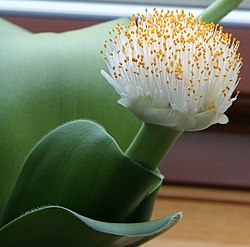
| Haemanthus albiflos | |
Scientific classification 
| |
| Kingdom: | Plantae |
| Clade: | Tracheophytes |
| Clade: | Angiosperms |
| Clade: | Monocots |
| Order: | Asparagales |
| Family: | Amaryllidaceae |
| Subfamily: | Amaryllidoideae |
| Tribe: | Haemantheae |
| Genus: | Haemanthus L. |
| Type species | |
| Haemanthus coccineus | |
| Species | |
|
See text | |


Haemanthus is a Southern African genus of flowering plants in the family Amaryllidaceae, subfamily Amaryllidoideae.[1] Members of the genus are known as blood lily and paintbrush lily. There are some 22 known species, native to South Africa, Botswana, Namibia, Lesotho and Eswatini. About 15 species occur in the winter rainfall region of Namaqualand and the Western Cape, the remainder being found in the summer rainfall region, with one species Haemanthus albiflos occurring in both regions.
Description
[edit]Most of the species have brush-like flowerheads enclosed in four or more membranous to fleshy spathe bracts which usually match the flower colour and, like sepals, protect the flowerheads from damage and desiccation. The flowers produce abundant nectar and pollen and a faint smell unattractive to humans. Fruits are mostly globose and when ripe, range through bright red, to pink, orange and white, and are usually aromatic. Three of the species, H. albiflos, H. deformis and H. pauculifolius are evergreen; these three species have bulbs that are only partly buried, the exposed section often turning bright green. The winter rainfall region's bulbs on the other hand are mostly from arid habitats and are found fairly deep below the surface, usually flowering before producing leaves. The genus produces relatively large bulbs that act as food and water storage organs, and consist of fleshy leafbases or tunics that may be arranged in two obvious ranks - termed a distichous arrangement. The morphology of the bulbs is useful in taxonomy and identification.
Haemanthus have from one to six leaves, ranging from broad, leathery and prostrate to narrow, crisped or succulent and erect, with a variety of surface textures from smooth to extremely hairy or even sticky. A few species such as H. unifoliatus and H. nortieri, usually produce only a single erect, broad leaf. H. coccineus and H. sanguineus were two of the first species in this genus to be described and because of their reddish flowers, gave rise to the generic name, being Greek for 'blood flower'. Haemanthus is found from Namibia through Namaqualand to the Western Cape and then through the Southern Cape to the Eastern Cape as far north as KwaZulu-Natal and the Transvaal. Haemanthus species are extremely variable in their habitat requirements - from coastal dunes to mountain tops, rocky ledges to seasonally-inundated gravel plains and bogs. Some species, such as H. canaliculatus, are to some extent fire-dependent in that they need occasional burning of their fynbos habitat to clear undergrowth in order to flower.
Taxonomy
[edit]The genus Haemanthus was created in 1753 by Linnaeus. The name is derived from Greek words αίμα, haima and ανθος, anthos, meaning "blood flower". In 1838 the eccentric Constantine Samuel Rafinesque, placed H. pubescens in a new genus Leucodesmis, H. coccineus in Perihema, and H. carneus in Serena. The troubled English botanist Richard Anthony Salisbury (1761–1829) in his 1866 posthumous publication 'Genera of Plants', placed H. amarylloides under Melicho and H. albiflos under Diacles.
The genus was illustrated in Nikolaus Joseph von Jacquin's description of the rarities in the glasshouses of Schönbrunn, Plantarum Rariorum Horti Caesarei Schoenbrunnensis Descriptiones Et Icones (1797–98). The first thorough taxonomic treatment of the genus was by Baker in 1896 and published in Flora Capensis. Nothing further was done until 1976 when Friis & Nordal published a brief review recognising only 6 species and reinstating Scadoxus. Dierdré Snijman's work published in 1984, described 21 distinct species, with H. pauculifolius, occurring only on the Transvaal Drakensberg Escarpment, later being added.
Species
[edit]A list of all the species accepted by the World Checklist of Selected Plant Families as of June 2011[update] is given below. Species formerly included in Haemanthus have been transferred to a number of genera, including Scadoxus. For example, Haemanthus grandiflorus is now Scadoxus multiflorus.[2]
| Image | Scientific name | Distribution |
|---|---|---|
 |
Haemanthus albiflos Jacq. | southern Cape through the Eastern Cape to KwaZulu-Natal |
 |
Haemanthus amarylloides Jacq. | between Springbok and Grootvlei in Namaqualand, and along the Bokkeveld Mountains escarpment to Gifberg near Vanrhynsdorp. |
| Haemanthus avasmontanus Dinter | south-east of Windhoek in central Namibia. | |
 |
Haemanthus barkerae Snijman | Western Cape from the Bokkeveld Mountains near Nieuwoudtville and the foothills of the Roggeveld Mountains, to the Hantamsberg near Calvinia, and bounded to the north and south by Loeriesfontein and the Tanqua Karoo. |
 |
Haemanthus canaliculatus Levyns | Western Cape between Betty's Bay and Rooiels |
 |
Haemanthus carneus Ker Gawler | the Orange Free State, KwaZulu-Natal and the Eastern Cape near Grahamstown and Somerset East |
 |
Haemanthus coccineus L. | Namibia, to South Africa in the Cape Peninsula, to the Keiskamma River in the Eastern Cape |
| Haemanthus crispus Snijman | Namaqualand | |
| Haemanthus dasyphyllus Snijman | Loeriesfontein in Namaqualand. | |
 |
Haemanthus deformis Hook.f. | KwaZulu-Natal |
| Haemanthus graniticus Snijman | Namaqualand | |
 |
Haemanthus humilis Jacq. | western Transvaal, Orange Free State, northern and eastern Cape. |
 |
Haemanthus lanceifolius Jacq. | Namaqualand |
 |
Haemanthus montanus Baker | eastern region of South Africa |
| Haemanthus namaquensis R.A. Dyer | Namaqualand | |
 |
Haemanthus nortieri Isaac | north of Clanwilliam |
 |
Haemanthus pauculifolius Snijman & A.E.van Wyk | Eswatini and from the Middle Pongolo River Reservoir as well as Blyderivierspoort to Pigg's Peak in KwaZulu-Natal and Mpumalanga. |
.jpg) |
Haemanthus pubescens L. | southern Namibia and Namaqualand |
 |
Haemanthus pumilio Jacq. | Western Cape |
 |
Haemanthus sanguineus Jacq. | Western Cape. |
| Haemanthus tristis Snijman | southeast Tanqua Karoo | |
| Haemanthus unifoliatus Snijman | Cape Province, Namaqualand |
Cultivation
[edit]Haemanthus species do best in large, well-drained containers or planted out in a rockery. Depending on species, they should have full sun or partial shade - winter rainfall species preferring full sun, while summer rainfall and evergreen species need partial shade. Most species are extremely tolerant of poor soil, but should not be disturbed if they are to flower. Propagation can be by offsets (adventitious bulblets), leaf cuttings and by germination of seed. Seeds when ripe are generally surrounded by a sticky pulp, producing long silken threads which presumably are useful in anchoring the seed when germinating and in the early stages of growth.
See also
[edit]References
[edit]- ^ Stevens, P.F., Angiosperm Phylogeny Website: Asparagales: Amaryllidoideae
- ^ WCSP (2011), World Checklist of Selected Plant Families, The Board of Trustees of the Royal Botanic Gardens, Kew, retrieved 2011-05-25
- Germplasm Resources Information Network
- African Flowering Plants Database
- The Genus Haemanthus: A Revision - Deidré Snijman (National Botanic Gardens of South Africa 1984) ISBN 0-620-07339-X
- Haemanthus
- Pacific Bulb Society
- Pacific Bulb Society
External links
[edit]

- Haemanthus paintings by Nikolaus Joseph von Jacquin
- Colin Paterson-Jones & Dee Snijman Archived 2016-10-01 at the Wayback Machine
- Dressler, S.; Schmidt, M. & Zizka, G. (2014). "Haemanthus". African plants – a Photo Guide. Frankfurt/Main: Forschungsinstitut Senckenberg.
| Authority control databases: National |
|---|

Haemanthus
View on GrokipediaDescription and Morphology
Overall Characteristics
Haemanthus is a genus of bulbous geophytes in the Amaryllidaceae family, comprising 25 species that are endemic to southern Africa, including South Africa, Namibia, Botswana, Eswatini, and Lesotho.[7][6] These perennial herbs are characterized by tunicated bulbs, typically paired, which produce 1–6 distichous leaves that are fleshy to leathery and vary from ligulate to lanceolate in shape.[7] The plants exhibit a general habit of forming small clusters or remaining solitary, with flowering occurring in compact, brush-like umbels that emerge from the bulbs, often before or alongside the leaves.[7] The life cycle of Haemanthus species is closely tied to seasonal rainfall patterns in their native regions, influencing their growth periods and deciduous or evergreen nature. Most species are deciduous, with leaves emerging after flowering (hysteranthous) in the winter-rainfall subgenus Haemanthus, which dominates in arid areas like the Greater Cape Floristic Region, where plants remain dormant during dry summers.[7] In contrast, the summer-rainfall subgenus Serena features synanthous or near-synanthous leaves, with evergreen species such as H. albiflos and H. deformis persisting in moister, nonseasonal rainfall zones.[7] Flowering is typically triggered by rainfall or fire, occurring from late summer to autumn across the genus.[7] Common names for Haemanthus include blood lily and paintbrush lily, derived from the striking red or colorful flowerheads that resemble brushes dipped in blood or paint.[5][7] These names highlight the genus's ornamental appeal, with species like H. sanguineus exemplifying the vivid inflorescences that emerge prominently in their habitats.[2]Flowers and Inflorescence
The inflorescences of Haemanthus are solitary and arise from the bulb on a solid, fleshy scape that is typically 10–30 cm tall, bearing a dense, brush-like umbel of 20–150 small, actinomorphic flowers arranged in reduced helicoid cymes.[7] These umbels are subtended by 4–13 showy involucral bracts (spathe valves), which vary from membranous and pale pink or white to leathery and vividly red or pink, often erect or spreading at anthesis to frame the flower head dramatically.[7][8] The spathe bracts are a key diagnostic feature, with their texture, color, and orientation differing among species—for instance, the bright red, erect bracts of H. coccineus contrast with the white, veined, overlapping bracts of H. albiflos.[7] The flowers are bisexual and regular, with a perianth of six tepals united at the base into a short, funnel-shaped tube and free, lanceolate segments 2–5 mm long, typically in shades of red, pink, orange, or white that match or complement the spathes.[7] Prominent stamens, with filiform filaments arising from the perianth base, are subequal and often exserted beyond the tepals by up to 10 mm, creating the characteristic brush-like appearance of the inflorescence head; anthers are small (1–2 mm) and yellow.[7] The ovary is globose with 1–2 ovules per locule, topped by a filiform style and undivided stigma, while nectar is produced abundantly at the flower base to attract pollinators.[3] Flowering phenology varies by subgenus and habitat: species in subgenus Haemanthus (adapted to winter-rainfall regions) typically bloom in autumn from March to April, as seen in H. coccineus with its scarlet umbels emerging before leaves, while subgenus Serena species (in summer-rainfall areas) flower from spring to summer between September and March, often coinciding with leaf emergence in species like H. humilis.[7] Some species exhibit a faint scent from the flowers, which is generally unattractive to humans but may aid in insect attraction, though this is not universal across the genus.[3]Bulbs, Leaves, and Fruits
Haemanthus species possess tunicated bulbs that are typically fleshy, consisting of overlapping scales that provide structural support and storage for water and nutrients. In evergreen species such as H. albiflos, the bulbs are ovoid and partially exposed at the neck, with the upper portion often green and situated near the soil surface, allowing for persistent foliage.[7] In contrast, deciduous species feature more deeply buried bulbs, which enhances drought protection by minimizing exposure to surface aridity.[9][7] The leaves of Haemanthus number from one to six per plant, emerging in a basal rosette and varying in shape from strap-like to ovate or elliptic, with widths ranging from 15 to 115 mm. In many species, such as H. coccineus and H. montanus, leaves are produced after flowering in a hysteranthous pattern, displaying textures from smooth and glabrous to leathery, pubescent, or even sandpaper-like due to dense hairs or warty surfaces. Evergreen forms like H. albiflos and H. deformis retain 4–6 thick, succulent leaves year-round, aiding in sustained photosynthesis in milder habitats.[7][9] Fruits in Haemanthus develop as soft, ovoid to globose berries that form clusters atop the scape following pollination, classified as fleshy berries. These berries exhibit a range of colors including red, pink, orange, and white when ripe, with examples like the bright red fruits of H. albiflos and pale pink to deep pink in H. barkerae, often becoming aromatic upon maturation. Each berry contains 1–6 sticky seeds, typically ovoid and colored from ivory-white to wine-red, with sizes up to 15 mm.[7][9] These structures exhibit key adaptations for survival in arid environments such as the fynbos and karoo, where bulb tunics—composed of leathery, imbricate layers—shield against desiccation and periodic fires by insulating the fleshy core and promoting resprouting post-disturbance. Deep burial in deciduous species further conserves moisture during dry seasons, while mucilaginous tissues in leaves and fruits help retain water in sandy or rocky soils.[7]Taxonomy and Classification
Etymology and History
The genus name Haemanthus derives from the Greek words haima, meaning "blood," and anthos, meaning "flower," in reference to the striking blood-red spathe bracts and flowers characteristic of species such as H. coccineus and H. sanguineus.[7] The genus was formally established by Carl Linnaeus in his 1753 work Species Plantarum, with Haemanthus coccineus designated as the type species; this description was based on earlier illustrations of plants from the Cape of Good Hope.[7] Bulbs of H. coccineus represent one of the earliest South African plants introduced to Europe, with the first European notice occurring in the early 17th century through collections from the Cape region, including an illustration by Carolus Clusius in 1605 under the name Narcissus Africanus; Dutch settlers at the Cape further documented and facilitated its spread in European horticulture during this period.[10] Subsequent early accounts include Paul Hermann's naming of the genus in 1687 and Caspar Commelin's 1701 illustration, highlighting its prominence in botanical gardens.[7] Key developments in the genus's classification followed in the late 18th and 19th centuries. William Aiton expanded recognition of the genus in his 1789 Hortus Kewensis, describing additional species beyond Linnaeus's initial inclusion and contributing to its early taxonomic framework.[7] John Lindley further advanced understanding in 1826 through detailed descriptions in Botanical Register, such as for H. pubescens, and noted its close affinities with Amaryllis based on floral and morphological similarities.[7] A major revision occurred in 1976, when Ib Friis and Inger Nordal separated several subtropical species—distinguished primarily by differences in fruit structure and other morphological traits—into the distinct genus Scadoxus, thereby refining Haemanthus to focus on southern African taxa with a chromosome base number of x = 8.[7]Phylogenetic Relationships
Haemanthus belongs to the subfamily Amaryllidoideae within the family Amaryllidaceae, specifically placed in the tribe Haemantheae, which is characterized by its baccate fruits unique among the family.[7] The genus is most closely related to Scadoxus, with which it forms a well-supported sister group, distinguished primarily by Haemanthus's bulbous habit, southern African endemism, and chromosome base number of x=8, in contrast to Scadoxus's rhizomatous growth, tropical African distribution, and x=9.[11] Gethyllis represents another close relative within the tribe, sharing traits such as leaf pubescence, though its precise position relative to Haemanthus remains somewhat unresolved in current analyses.[7] Infrageneric classification has evolved through morphological revisions, with D.A. Snijman's 1984 study dividing the genus into sections based on leaf persistence (hysteranthous versus synanthous) and flowering season, recognizing two main subgenera: subgenus Haemanthus (hysteranthous species flowering in winter-rainfall regions) and subgenus Serena (synanthous species in summer or nonseasonal rainfall areas).[12] Earlier work by Friis and Nordal in 1976 proposed a broader infrageneric framework, elevating Scadoxus to genus level while retaining Haemanthus s.s. with internal groupings that influenced subsequent sectional delimitations, though not explicitly as six subgenera.[13] Molecular phylogenetic studies since 2000, using nuclear ITS and plastid markers like trnL-F and rps16, have robustly confirmed the monophyly of Haemanthus with high bootstrap support (e.g., 99% BP, 1.0 PP), resolving it as distinct from Scadoxus while highlighting two major clades corresponding to rainfall regimes.[11] These analyses link the genus's diversification to Miocene aridification events in southern Africa approximately 10-15 million years ago, which promoted adaptive radiations tied to seasonal rainfall patterns and habitat fragmentation.[7] Taxonomic revisions have since recognized 25 species, with H. paucifolius added in 1994 as a distinct summer-rainfall taxon.[12][7]Accepted Species
The genus Haemanthus comprises 25 accepted species, all endemic to southern Africa, primarily in the winter-rainfall regions of the Greater Cape Floristic Region, with about 18 species in the winter-rainfall fynbos biome.[7] These species are divided into two subgenera: Serena (7 species, typically with synanthous or near-synanthous leaves and white or pink flowers in summer-rainfall areas) and Haemanthus (18 species, usually hysteranthous with pink or red flowers in winter-rainfall regions).[7] Several taxa previously classified in Haemanthus have been transferred to the segregate genus Scadoxus, including Scadoxus multiflorus (Mart. ex Baker) Jessop (synonym Haemanthus multiflorus Mart. ex Baker), distinguished by its arborescent habit and multi-flowered umbels.[14] Diagnostic traits for species identification often include leaf number and texture (e.g., prostrate, erect, pubescent, or glabrous), bulb size and depth, inflorescence color (white, pink, or red), spathe bract characteristics, and perigone length.[7] The accepted species are listed below with key identifiers, authors, subgenus, and notable synonyms or traits.| Species | Author | Subgenus | Key Characteristics | Synonyms/Notes |
|---|---|---|---|---|
| H. albiflos | Jacq. | Serena | Evergreen; 2–6 strap-shaped leaves; white flowers (perigone 16–23 mm); ivory-white seeds; erect white spathe bracts; Eastern Cape to KwaZulu-Natal. | H. virescens var. albiflos (L.f.) Ker Gawl.; H. albomaculatus Baker; sunbird-pollinated.[7][15] |
| H. amarylloides | Jacq. | Haemanthus | Deciduous; prostrate leaves; pink inflorescence with spreading tepals; Namaqualand to northwestern Western Cape. | Subspp.: amarylloides, polyanthus Snijman (more flowers), toxinmontanus Snijman (denser leaves).[7][16] |
| H. arenicola | (Snijman) Snijman | Haemanthus | Deciduous; narrow channelled leaves (≤40 mm wide, sparsely hairy margins); red spathe bracts; aeolian sands in Namaqualand. | Elevated from H. pubescens subsp. arenicola Snijman.[7] |
| H. avasimontanus | Dinter | Serena | Deciduous; synanthous glabrous leaves; green seeds; 4–5 spathe bracts; perigone ±20 mm; central Namibia. | None noted.[7] |
| H. barkerae | Snijman | Haemanthus | Deciduous; narrow leaves (≤55 mm wide, heavily barred/spotted); pale to deep pink flowers; Hantam and Tanqua Karoo. | None noted.[7][17] |
| H. canaliculatus | Levyns | Haemanthus | Deciduous; deeply channelled firm leaves; red flowers; seasonally wet southwestern Cape sites. | None noted.[7] |
| H. carneus | Ker Gawl. | Serena | Deciduous; pink flowers on long pedicels; unequal stamens (< half tepal length); southeastern Free State to Eastern Cape. | None noted.[7] |
| H. coccineus | L. | Haemanthus | Deciduous; broad leaves (≥85 mm wide, in-rolled margins); bright red autumn flowers; mucilaginous berries; Western Cape. | H. carinatus Jacq.; H. tigrinus Herb.; fire-dependent.[7][18] |
| H. crispus | Snijman | Haemanthus | Deciduous; narrow undulate leaves (<35 mm wide); red flowers; southern Knersvlakte to Namaqualand. | H. undulatus Levyns (invalid).[7] |
| H. dasyphyllus | Snijman | Haemanthus | Deciduous; hairy pale green leaves (± twisted/folded, red-spotted abaxially); red flowers; eastern Succulent Karoo. | None noted.[7][19] |
| H. deformis | Hook.f. | Serena | Evergreen; prostrate appressed leaves; white flowers (perigone ±30 mm); overlapping spathe bracts; KwaZulu-Natal to Eastern Cape. | H. baurii Baker; H. mackenii Baker; shade-loving.[7][20] |
| H. graniticus | Snijman | Haemanthus | Deciduous; erect clumped bulbs; acuminate spathe bracts; granitic seasonal stream banks in Namaqualand. | None noted.[7] |
| H. humanii | G.D. Duncan | Haemanthus | Deciduous; prostrate bristly leaves; spreading tepals (up to 30°, perigone >12 mm); Namaqualand quartz outcrops; recent addition. | None noted; described 2016, formalized 2022.[7][21][22] |
| H. humilis | Jacq. | Serena | Deciduous; synanthous leaves; white to deep pink flowers; equal stamens (as long as tepals); interior southern Africa. | Subspp.: humilis, hirsutus (Baker) Snijman (hairy leaves).[7] |
| H. lanceifolius | Jacq. | Haemanthus | Deciduous; pubescent lightly appressed leaves (rough surface, fimbriate margins); small white-pink flowers; southern Knersvlakte. | None noted.[7] |
| H. leipoldtii | (Snijman) Snijman | Haemanthus | Deciduous; glabrous adaxial leaves with fringed margins; red spathe bracts; Namaqualand sandveld. | Elevated from H. pubescens subsp. leipoldtii Snijman.[7] |
| H. montanus | Baker | Serena | Deciduous; synanthous glabrous leaves; 5–8 spathe bracts; perigone <15 mm; large seeds; eastern southern Africa grasslands. | None noted.[7] |
| H. namaquensis | R.A. Dyer | Haemanthus | Deciduous; broad undulate leaves (>45 mm wide); large bulbs; Richtersveld to Namibia. | None noted.[7][23] |
| H. nortieri | W.F.Barker ex Isaac | Haemanthus | Deciduous; solitary erect sticky leaf; red inflorescence; Nardouwsberg mountains, Namaqualand. | None noted.[7] |
| H. pauculifolius | Snijman & A.E. van Wyk | Serena | Evergreen; solitary leaf; slender white-flowered head (perigone 25–35 mm); Limpopo-Mpumalanga-Eswatini Escarpment. | None noted.[7] |
| H. pubescens | L.f. | Haemanthus | Deciduous; densely pubescent leaves; red flowers; sand fynbos. | Leucodesmis pubescens (Raf.) Raf.; former subspp. arenicola and leipoldtii now species.[7][24] |
| H. pumilio | Jacq. | Haemanthus | Deciduous; twisted leaves; pale pink flowers (perigone <12 mm); small stature on alluvial flats, southwestern Western Cape. | None noted.[7] |
| H. sanguineus | Jacq. | Haemanthus | Deciduous; prostrate smooth leaves; blood-red flowers; widespread in Cape, possible post-fire hybrid with H. coccineus. | None noted.[7][25] |
| H. tristis | Snijman | Haemanthus | Deciduous; narrow leaves (7–16 mm wide); cream flowers fading pink; leathery fruit; unpleasant odor; Tanqua Karoo. | None noted.[7] |
| H. unifoliatus | Snijman | Haemanthus | Deciduous; solitary bristly leaf; red flowers; Namaqualand escarpment. | None noted.[7] |