Hubbry Logo
Karankawa peopleKarankawa peopleMain
Open search
Karankawa people
Community hub
Karankawa people
logo
8 pages, 0 posts
0 subscribers
Be the first to start a discussion here.
Karankawa people
Karankawa people
from Wikipedia

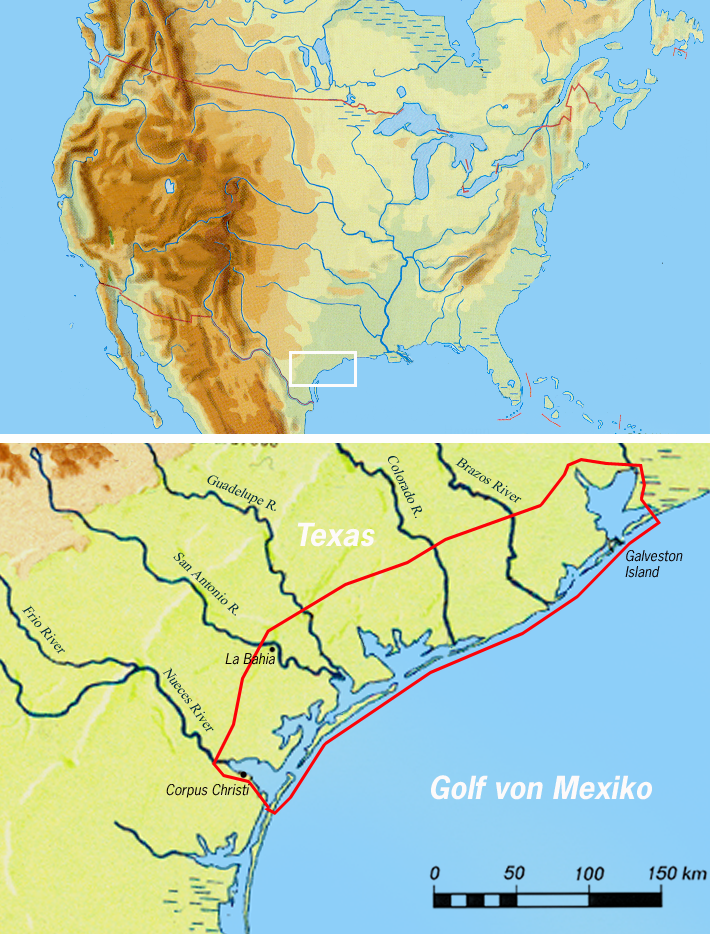
The Karankawa (/kəˈræŋkəwə/ kə-RANK-ə-wə)[3] were an Indigenous people concentrated in southern Texas along the coast of the Gulf of Mexico, largely in the lower Colorado River and Brazos River valleys.[4] They consisted of several independent, seasonal nomadic groups who shared a language and some culture.

Key Information

From the onset of European colonization, the Karankawa had violent encounters with the Spanish. After one attack by the Spanish, who ambushed the Karankawa after the establishment of Presidio La Bahía in 1722, the Karankawa allegedly felt "deeply betrayed [and] viewed Spanish colonial settlement with hostility."[5]

In the 1800s, European-American colonists arrived in their land under the leadership of Stephen Austin. He commissioned a captain to expel the Karankawa from the Austin land grant,[6][7] leading to multiple attacks, including the Skull Creek massacre of 19 Karankawa.[8]

In 1824, Stephen F. Austin sent Captain Randal Jones with a group of 23 Army soldiers to what is now Brazoria County to fight and disperse the Karankawa Indians from their encampment. Fifteen Indians were killed, and the remaining fled the area. This event is known as the Battle of Jones Creek.[9]

By the 1840s, the Karankawa, now exiled, split into two groups, one of which settled on Padre Island while the other fled into the Mexican state of Tamaulipas. In 1858, Mexican rancher Juan Nepomuceno Cortina led a group of Mexicans and Texan colonists against what was believed to be the Karankawa's last known refuge, killing many.[7] By 1891, the Karankawa ceased to exist as a functioning tribe. Today, however, there are unrecognized tribes who claim Karankawa descent.[10]

Name

[edit]

The Karankawa's autonym is Né-ume, meaning "the people".[1]

The name Karakawa has numerous spellings in Spanish, French, and English.[1][11]

Swiss-American ethnologist Albert S. Gatschet wrote that the name Karakawa may have come from the Comecrudo terms klam or glám, meaning "dog", and kawa, meaning "to love, like, to be fond of." The plural form of kawa is kakáwa, so the term would mean "dog-lovers" or "dog-raisers."[1]

The Tonkawa called them Wrestlers ("Keles" or "Killis").[1] They alternatively called them the barefooted or those without moccasins ("Yakokon kapa-i"), but this name was also applied to other groups with which the Tonkawe were acquainted. The Lipan Apache called the Karankawa the "people who walk in the water" ("Nda Kun dadehe"), possibly referring to their mode of fishing and catching turtles, or simply their location near the swampy coast. The Karankawa called themselves "Karankawa" as well.[1]

Later speculation placed the Karankawa language in the Cariban linguistic stock. Linguistic data suggests that the Karankawa name originated from the old Spanish Main, "Kalina," and a suffix from a Northern Carib tribe, "kxura, "meaning "people." A compound emerges: Karinxkxura, meaning "Carib people."[11] But this theory is disputed, and ultimately, the origins of the name "Karankawa" remain unknown.[12]

Alternate spellings of the name Karankawa have historically included: Carancahua, Carancagua, Carancaguase, Carancahuare, Caranchuasye, Carancahuase, Carancahuaye, Carancahuaze, Carancohuace, Caray, Carrai, Carray, Saray.[13]

Origins

[edit]

According to some contemporary sources, the migrations of their ancestors were entirely unknown to the Karankawa of the early 19th century.[6][page needed] Linguist Herbert Landar, however, argues that based on linguistic evidence, the Karankawa language and people originated from a Carib subgroup, which remains to be discovered. Their exact migratory path northward is equally indistinct. Migration northward is theorised to have occurred during the late 15th century. The route north was from the original land north of the Amazon River toward Tamaulipas and Texas, and was probably done over a long period of time by short bursts of migration.[11] Scholars have speculated that the Karankawa were descended from a group of Carib Indians who arrived by sea from the Caribbean basin. This is partially based on the similarity of their physical appearance to Caribbean natives, but no ethnographic or archaeological evidence has been found for this speculation.[12]

Recent archaeological records that used radiocarbon dating for artefacts indicated that these Native groups had been in the area as early as the fifth millennium BCE.[14]

Lifestyle

[edit]

Seasonal nomadic lifestyle

[edit]

The Karankawa voyaged from place to place on a seasonal basis in their dugouts, made from large trees with the bark left intact. They travelled in groups of thirty to forty people and remained in each place for about four weeks. After European contact, canoes were of two kinds, both being called "awa'n": the original dugout and old skiffs obtained from the whites. Neither was used for fishing but for transportation only, and their travels were limited to the waters close to the land. The women, children, and possessions travelled in the hold while the men stood on the stern and poled the canoe. Upon landing at their next destination, the women set up wigwams (called ba'ak in their native language) and the men hauled the boats on the shore. Their campsites were always close to the shoreline of the nearby body of water.[6][page needed]

They constructed houses by arranging willow branches in a circle, bending the tops of the branches toward the centre, and interlocking them in wickerwork. This wickerwork was fastened with deerskin. Upon this framework, the Karankawa lay deer, wildcat, panther or bear skins, again fastened with deer hide thongs.[6][page needed]

The next step was to make a fire. After European contact, the Karankawa sought matches or tinderboxes from settlers; otherwise, they resorted to the traditional method of using their firesticks, which they always carried in a package of deerhide thongs. The fire was always made in the centre of their dwellings and kept burning day and night. They used animal hides and pelts to sit and sleep on within their dwellings. Their household goods and utensils included wooden spoons, ceramic vessels, fishbone needles, and fine deer sinew.[6][page needed]

Environment

[edit]

The Karankawa travelled to the coastal region. They hunted and gathered food from rivers and by the shore.[15]

In the region that the Karankawa inhabited, numerous small chunks of asphaltum have been found along the coast from oil seepage beneath the Gulf of Mexico. These chunks were used to bind arrowheads to their shafts; as a coating for pottery such as ollas, jars, and bowls; and as a way to waterproof woven baskets.[16]

Cuisine

[edit]

Karankawa cuisine included venison, rabbit, fowl, fish, turtles, oysters, and other shellfish. Their cuisine also included food gathered from the wild, such as berries, persimmons, wild grapes, sea-bird eggs, tuna and nopales (prickly pear cactus fruit and paddles, respectively), and nuts.[6][page needed] They boiled food in ceramic pots or roasted entrés and seasoned their dishes with chile.

After European contact, the Karankawa made bread from imported wheat flour. They laid the dough on a flat stone and then baked it on an open fire. They also enjoyed imported sweet coffee.[6][page needed]

The Karankawa were skilled at obtaining pure, fresh water. White settlers did not know where they obtained it, because the wells of the whites had a brackish taste.[6][page needed][11]

Cannibalism

[edit]

There is nearly 340 years of information written about the Karankawa Indians of Texas from La Salle's first landing at Matagorda Bay in 1685 until the close of the Rosario Mission. The Karankawa had been described for centuries as cannibals. There is incontrovertible evidence that the Karankawa practised ritual cannibalism on their enemy. Just as their Aztec and Guachichiles and Guamares cousins to the south in Northern Mexico, "they ate their enemy for vengeance. Their bones, scalps and genitals were displayed in victory celebrations."[17] The first person to document the Karankawa's cannibalism was French Jean Baptiste Talon, who lived as a captive among the tribe for several years, and stated in 1689:

"We all went naked like them, and every morning at daybreak, in any season, they went to plunge into the nearest river. Like them, they ate meat from the hunt, fresh or cured in the sun, but most often half raw. The only meals that horrid them were those they made of human flesh, as they are cannibals, but toward their savage enemies only. They never ate a single Frenchman that they had killed because, they said, [simply that] they do not eat them. And the same Jean-Baptiste Talon vouches that he once went three days without eating, because nothing presented itself during that time except some human flesh of the Ayenis whom they had killed on one of the expeditions."[18]

Several years before this, French castaway Henri Joutel, a captain of the La Salle Expedition, lived among the Cenis [Tejas] tribe and hunted with their neighbouring bands who had an identical culture and language as the Karankawa. He wrote in his manuscripts that, "The warriors returned from a grand raid, parading around 48 scalps and body parts of which some of the warriors partook in cannibalising, as it was apparently thought, in order to gain the deceased warrior’s bravery.[19]

Culture and Language

[edit]

Language and communication

[edit]

Little is known of the extinct Karankawa language, which may have been a language isolate. The Karankawa also possessed a gesture language for conversing with people from other Native American tribes.[6][page needed]

The Karankawa were noted for their skill in communicating with each other over long distances using smoke signals. The Karankawa could make the smoke of a small fire ascend toward the sky in many different ways, and it was as intelligible to them across long distances as their language. Their methods are unknown.[6][page needed]

Manners and customs

[edit]

The Karankawa had a specific way of conversing. They carefully repressed their breath while speaking; at the end of their sentences, they exhaled heavily, releasing the air they held back during speaking. Moreover, their expression was interpreted by Europeans as impassive, especially because they never looked at the person to whom they were speaking. Their pronunciation was very exact, and they ridiculed poor elocution by the whites who tried to learn their language. The Europeans described their general demeanour as surly and fatigued.[6][page needed]

They did not have a regular sleep schedule, but slept whenever they wished. They also ate and drank at all times of the day.[6][page needed]

Karankawa never communicated their native names to the whites. However, they all adopted English or Spanish names. Many men adopted American military epithets and Christian names, and they would change these frequently.[6][page needed]

Among the Karankawa existed an in-law taboo. Once a man and his wife had become, in the Karankawa sense, married, the husband and his children were no longer allowed to enter the residence of his wife's parents, nor could his wife's parents enter his or his children's home. These two groups were also no longer allowed to talk with one another and never came face to face with one another. If a situation of coming face to face with one another arose, both parties averted their eyes and moved away from each other. This taboo only seemed to apply to the husbands and their children, most likely due to the inconvenience on the wife's part, as Karankawans were typically patrilocal.[20]

Arts, athletics, and recreation

[edit]

The Karankawa possessed at least three musical instruments: a large gourd filled with stones, which was shaken to produce sound, a fluted piece of wood, which the Karankawa drew a stick over to produce sound, and a flute, which was softly blown.[6][page needed]

The Karankawa practiced hatchet throwing, recreational brawls with knives, ball games, and wrestling matches. No gambling or guessing games seemed to have developed among the Karankawa.[6][page needed] The Karankawa were also noted for their remarkable physical feats, such as continuing to fight after being wounded in battle, breaking ice with their bodies, and swimming in freezing water.[14]

Archery

[edit]

Their most notable[opinion] skill was archery. The Karankawa made their own bows and arrows, and were renowned for great skill, whether standing on land or in calm or turbulent waters.[6][page needed] Their bows were made of red cedar wood, and they made them according to the height of each archer, reaching from the foot to the chin or eye. The bows were always kept in perfect repair. The arrows were about a yard long, tipped with steel, and fletched with wild goose feathers.[6][page needed] Karankawa engaged in archery for hunting and as a recreational activity. They often shot at the mark or shot arrows perpendicularly into space. The shooting matches they held were lively and festive. Many young men were able to split in two the previous arrow in the target from a distance of at least 80 feet.[6][page needed]

Social institutions

[edit]

Tribal leadership

[edit]

The groups of Karankawa were commonly led by two chiefs - a civil government chief with a hereditary succession in the male lines, and a war chief, probably appointed by the civil government chief. No evidence of a confederacy, like that of the Caddo or Creeks, was found. The Karankawa were probably a loose-knit body living under separate chiefs only united by the common language and shared war expeditions.[6][page needed]

The ritual to become a chief has been studied by 18th-century Spaniards. They have stated that a selection starts from many candidates, and each is injured by a comb created from the spines of a sea fish, long wounds being dug into their skin from the top of their heads to the soles of their feet and then tied to a pole for several days to either emerge thin or emaciated and close to death. While this description can indeed be a ritual to choose a chief, a diary of Fray Gaspar Jose De Solis states that he suspects these rituals could simply be a puberty rite or an initiation ritual to a brotherhood.[21]

Gender and family structures

[edit]

One aspect of the Karankawa culture was their recognition of three gender roles: male, female, and a third role taken on by some men and women. Men who took on this third role are called monanguia (see Two-Spirit for similar concepts in Native American cultures generally). Monanguia generally took on female roles and activities in daily life, while also playing a special role in religious rites. According to some accounts, the berdache also performed as passive sexual partners for other men.[22]

The written accounts of Álvar Núñez Cabeza de Vaca mentions bride price and bride service as part of a Karankawa marriage. While the bride price is assumed to be the generalized system in the Indigenous population found by Cabeza de Vaca where the groom gives presents to the parents of the girl he wishes to marry, to secure their permission, the bride service is based on a ritual where the husband must give every morsel of food he managed to collect or hunt to his wife. His wife then delivers the bounty to her parents and in return is given food to give back to her husband. This ritual goes on for an unknown number of months, but when it is concluded, the pair typically then engages in patrilocal residence.[23] In terms of marriage, divorce is a common aspect typically only to marriages that have not created any children and is unlikely if children have been born from the marriage.[24] Between the husband and wife, no signs of fondness, intimacy, or special treatment were observed. The Karankawa reacted strongly and sometimes violently to Europeans interfering in marital or familial affairs.[6][page needed]

The Karankawa were said to have great compassion and tenderness for their children.[6][page needed][25] Mothers carried babies, not yet able to walk, on their backs, wrapped in a loop of animal hide.[6][page needed]

Appearance

[edit]

Physical character

[edit]

Many Europeans noted the sharp contrasts in appearance between Karankawa men and women. The women were described as plainer, shorter, and of stouter build than the men. The men were very tall, of strong athletic build, and had coarse, black hair. Most men wore their hair to the waist. Their foreheads were mostly low and broad, and the heads larger than most Europeans of the time. The men, in contrast with the women, had lithe builds and slender hands and feet. Their skin color was said to be lighter and closer to cinnamon-colored than the women.[6] Both men and women were noted for their spectacularly white teeth, even elders.[6]

Dress and adornment

[edit]

Karankawa people practiced forehead flattening. They shaped the foreheads of babies by first with a piece of cloth, then a thin board, and then a wadded cloth. Each of these was tied to the head with a bandage and left to stay there about one year.[6]

The men wore hide breechcloths, while the women wore deerhide skirts. They did not wear headcovers or shoes. Some women of the tribe obtained European clothing occasionally, but would only tear them apart or wear them temporarily. European blankets were of greater use to the tribe, worn fastened to their bodies during cold weather and pinned with thorns. Both men and women wore a small bracelet of undressed deer skin. In the warm climate, children did not wear clothing until they were about 10 years old.[6]

The Karankawa had distinctive tattoos, notably,[opinion] a blue circle tattooed over each cheekbone, one horizontal blue line from the outer angle of the eye toward the ear, three perpendicular parallel lines on the chin from the middle of the lower lip downward, and two other lines extending down from under each corner of the mouth.[6] Moreover, 16th-century European explorers wrote that Karankawa people had labrets, or piercings of cane on the lower lips, nose, and other parts of the body.[15]

The woman in some tribes such as the Coco group also had a tattoo of concentric black circles from their nipple to circling their entire breast.[26]

Men, women, and children alike rubbed sharks' oil on their entire bodies regularly to deter mosquitoes effectively and to keep their skin soft and supple. Europeans who encountered the Karankawa were disgusted by the odor.[6]

The women wore no ornaments, while the men wore many ornaments. Men's long hair was braided with three strands. They inserted bright items (such as ribbons or colored flannel). The women never braided their hair nor combed it regularly. The men wore necklaces of small shells, glass beads, pistachios, and thin metal disks on their throats (never on their chests). Men also wore finger rings.[6]

Religion and ritual

[edit]

Europeans knew limited information about the rituals of the Karankawa because the latter did not reveal the purposes of their actions or their beliefs.[6] When Joutel, an explorer and companion of Robert Cavalier de La Salle, questioned their religious beliefs, the Karankawa only pointed at the sky.[6]

At the full moon and after very successful hunting or fishing expeditions, the Karankawa traditionally held a ceremony. After gathering around a central fire, they boiled a strong and bitter brew from the leaves of the yaupon tree and stirred it until the top was covered with a yellowish froth. This brew was shared and all the Karankawa drank freely. Although this brew was said to be intoxicating, Europeans did not notice any visible effects on the natives. One native stood within the circle of men, wrapped up to his head in skins, and he bent over as he walked around the fire. They chanted in chromatic ascending and descending tones, and all the natives joined in the chorus. This ceremony continued throughout the night.[6]

Other than this, only a few other rituals were observed, and their purposes are unknown. The Karankawa stared at the sun when it disappeared into the sea, like some other native groups of the area. They also smoked tobacco through their nostrils first to the north, then to the east, west, and south. They frequently whistled at certain times and apparently for some objective, but ultimately for unknown purposes.[6]

Portrait of Álvar Núñez Cabeza de Vaca

Jean-Baptist Talon, in response to interrogation, reported, "one could only infer that they have some confused impression of the immortality of their souls and the resurrection of the dead by the ceremonies that they observe in the burial of their dead. After having wrapped the corpse in a well-prepared buffalo hide, the same one that he had used in life to cover himself, they bury him with his club, his bow, and his arrows, a quantity of smoked meat, some corn and vegetables, and two pieces of a certain rock that they use instead of gun flint to make fire.[[For this purpose they make a little hole in one of the pieces of wood, which is flat, and which they lean against something; and having sharpened the other, which is round, they adjust the point of i in the hole and make some fire by rubbing these two pieces of wood, by turning the one that is round between their hands, as fast as they can]] and all that in order that he may use them (so they say) when he wakes up".[18]

Cannibalism

[edit]

According to some sources, the Karankawa practiced ritual cannibalism, in common with other Gulf coastal tribes of present-day Texas and Louisiana.[6][7][14][27]

Álvar Núñez Cabeza de Vaca, a Spanish conquistador who lived among the Karankawa for several years in the 1530s and wrote a memoir, made no mention of cannibalism except for ritualistic consumption of deceased relatives in the form of funeral ashes "presented in water for the relatives to drink." Upon his return to Spain, Cabeza De Vaca noted in his written report to the King, "that five Christians quartered on the coast [Galveston, the Island of Doom] came to the extremity of eating each other. Only the body of the last one, whom nobody was left to eat, was found unconsumed. Their names were Sierra, Diego Lopez, Corral, Palacios, and Gonzalo Ruiz,"[citation needed]this, after shipwrecking off Galveston Bay. The Karankawa people "were so shocked at this [Spanish] cannibalism that, if they had seen it sometime earlier, they surely would have killed every one of us."[7] Whites never actually witnessed an act of cannibalism, and second- and third-hand accounts are of disputed credibility.[6][7][14][25]

Dogs

[edit]

The Karankawa kept dogs that accompanied them on hunts, swims, and recreational activities.[14] The dogs were voiceless, with straight ears and fox-like snouts.[6]

History

[edit]

Early encounters with the Spanish and French (16th - 17th centuries)

[edit]
Karankawa Indian campsite and burial ground historical marker located in Jamaica Beach on the west end of Galveston Island

In 1528, one of two barges put together by survivors of the failed Pánfilo de Narváez expedition to Florida struck aground at Galveston Island. Survivors, including Cabeza de Vaca, were cared for by the Capoque band of Karankawa.[28] From 1527, Cabeza de Vaca subsisted for seven years among the coastal tribes, making a living as a medical practitioner and occasional trader.[6] During his stay, de Vaca reported that a fatal stomach ailment reduced the Karankawa population by roughly one half; the nature and casualties resulting from this illness are unknown.[29] De Vaca reported that extensive trade occurred with inland groups as far as the extent of the entire length of the present-day United States. After the introduction of the horse by Spaniards, these trade networks strengthened.[15]

Henri Joutel, the companion of Robert Cavelier de La Salle on his last expedition in 1687, recorded several tribes living in the coastal area, including the Karankawa (which he spelled as Korenkake and Koinekahe).[7][6] His observations were that the Karankawa were peaceable rather than hostile. Upon their first meeting, Joutel reports that the Karankawa "demonstrated their friendship by putting their hands over their hearts, which meant that they were glad to see us."[14] He also noted that they possessed horses, which were undoubtedly obtained from the Spanish.[6]

When de La Salle stole some canoes from the Karankawa to sail up a river and establish Fort St. Louis, the Karankawas were enraged. When they heard of de La Salle's departure and subsequent death, they attacked about 20 French settlers left in the fort and massacred all but five. The survivors were forcibly tattooed and made to follow the Karankawa on their hunting and fishing expeditions; they were eventually rescued by a Spanish expedition in 1689.[7][6]

Relations with the Spanish

[edit]

The La Salle venture stimulated the Spanish into active exploration and colonization of south Texas. A Spanish search for Fort St. Louis to check if the French had returned led to a skirmish between the Karankawa and the Spanish, and an establishment of hostilities between these two groups.[7]

In 1691, Captain Domingo Teran led a combined land-sea expedition to Texas to strengthen recently established missions and to search for French presence. Both expeditions were mismanaged and led to a temporary lapse in Spanish interest.[7] Continued French action, however, encouraged the Spaniards to occupy the area of Matagorda Bay permanently.[7]

La Bahía del Espiritu Santo, a mission-presidio complex, was established in 1722 on the southern bank of the San Antonio River. At first, the Karankawa were not antagonistic to the Spanish, but in 1723, a skirmish occurred between the Spanish and Karankawa, after which the Karankawa moved away from the mission and became hostile. By 1727, the Karankawa depredations forced the mission-presidio complex to move inland to the Guadalupe River, where they remained until 1749. The Karankawa successfully reduced Spanish claim to the Texas coast.[6][7]

By the 1730s, the Karankawa and other native tribes of the Texas area were viewed by the Spanish as the primary obstacle to control of northern New Spain. In 1749, Jose Escandon was made governor and representative of the viceroy, appointed to conquer and settle northern Mexico and the region of Texas, and to map, survey, and acquaint himself with the area and with the natives. He recommended that the mission of La Bahía should be moved because of native hostility and the unfavorable climate.[7]

A new mission, Mission Rosario, was established in 1754. It was in constant fear of revolt by the natives in the mission and often appealed to La Bahía for military aid. Overall, it was extremely ineffective as a spiritual and "civilizing" center. The Karankawa fled when subjected to any corporal punishment, and continued to enjoy the resources provided by the Spanish without being dependent on them.[7]

Over time, the Karankawa grew to speak Spanish with great fluency and adopted Spanish names for themselves to facilitate interaction with the whites.[7][6]

The late 18th century had a revival of Karankawa resistance and strength. The Spanish began to see them as unable to be converted to mission life, and some began to scheme for their extermination, but none of these schemes was successfully carried out.[7]

In 1779, in response to the killing of Spanish sailors by a group of Karankawas, led by Joseph Maria, along the Texas Gulf Coast, and a later raid on Mission Rosario also masterminded by Maria that led to the mission's abandonment by the Spanish, they planned a series of punitive expeditions against the Karankawa intended to exterminate them, although all of these proved abortive and unsuccessful, and they were abandoned as a strategy by 1786, with the war ending three years later, in 1789.[30]

In 1806, the Rosario mission was merged with that of Refugio. In 1830, Refugio and La Bahía del Espiritu Santo were secularized.[7]

Relations with the English and the French

[edit]

While the Spanish tried to incorporate the Karankawa into their empire, the Karankawa engaged in purely economic terms with the English and the French, trading skins and deer for weapons (i.e., muskets, guns, cloth) and household goods.[7][6]

Encounters with Jean Lafitte

[edit]

When Galveston Island was occupied by the pirate Jean Lafitte from 1817 to 1821, some of his men kidnapped a Karankawa woman. In response, about 300 Karankawa moved in to attack. When Lafitte learned of their encampment and impending attack, he sent 200 of his men, armed with two cannons, to confront the Karankawa. After the Karankawa lost about 30 men, they retreated to the mainland, with the pirates in pursuit. On the mainland, a few more Karankawa were killed.[6][7]

Encounters with the Texan colonists

[edit]
Painting, The Settlement of Austin's Colony, by Henry Arthur McArdle, in the House of Representatives chamber in the Texas Capitol: Stephen F. Austin is shown rallying his colonists against the Karankawa Indians around 1824, as an unnamed scout comes to the cabin door to sound the alarm.

Austin was introduced to the Karankawas by an encounter with a peaceful Coco tribe. After some talks and an exchange of tobacco and a frying pan, Moses Austin considered them good friends, but after a warning of Karankawas at the mouth of a nearby river, Moses wrote in his journal that Karankawas are universal enemies of man and cannot be befriended and must be exterminated for Anglo-American settlers to live in peace.[31]

In 1821, Moses Austin received the Austin land grant to settle 300 families between Galveston Bay and the Colorado River. The Karankawa sought to hinder their progress by killing settlers who were guarding the ship John Motley and by stealing their supplies. By 1825, settlers banded together to attack the Karankawa. Stephen Austin commissioned Captain Kuykendall to lead volunteers to expel them from the territory, which extended to the Lavaca River. They chased the Karankawa to Manahila Creek, where a Spanish missionary interceded on their behalf and made them promise to never again go east of the Lavaca. This promise was broken, however, and was met by disproportionate violence by the Texan colonists.[6][7]

Genocide of the Karankawa

[edit]

During the Texan-Mexican War, some of the Karankawa served in the Mexican Army. They suffered greatly in the Battle of the Alamo of 1836, and the Texans retaliated heavily for their service.[6][7][14]

Chief Jose Maria's 19-year-old son, Walupe, was captured by the Mexicans and killed. His father came on board the ship of a Texan settler and announced his intent of revenge, but the majority of his men and himself were killed.[7] Antonio, who claimed he was the brother of Jose Maria, became chief after that. During his administration and afterward, the Karankawa population diminished significantly from disease, conflict with Europeans, and infighting.[7]

By the 1840s, the Karankawa consisted of two groups; one settled on Padre Island, while the other applied to settle in the Mexican state of Tamaulipas. After being exiled from their homeland, the latter group reportedly plundered and stole; the Mexican government then ordered troops to subdue them. General Avalos was ordered to move the Karankawa to the border of Tamaulipas and Nuevo León. The two states disputed over the Karankawa, and they were eventually returned to Reynosa. After continued robberies, the Karankawa were removed to Texas.[7][6]

In 1858, the judge of Rosario, Mexico, sent a message to the mayor of Reynosa that he had tried to arrest the Karankawa, but they moved north of the American border beyond his jurisdiction. He added that Mexicans and Americans should work together for the Karankawas' arrest. Later that year, Juan Cortina made a surprise attack on the recently returned Karankawa and annihilated what was believed to be at the time, the last members of the tribe.[6][7][14] In a study on the Karankawa published in 1888, one interviewee "thought that some [Karankawa] may be still in existence, but could not tell where."[6] The Karankawa went extinct as a distinct tribe in the late 19th century.[2]

Contemporary heritage group

[edit]

As of 2021, a group of individuals who claim descent from the Karankawa people formed the Karankawa Kadla. They have volunteered to help preserve Corpus Christi Bay archaeological sites from oil development, develop education programs, and are interested in reviving the Karankawa language. Members of this group have family stories connecting them to the Karankawa people, amid forced assimilation among both Mexicans and White Texans and separation from other Karankawa.[32][33][34] This organization is an unrecognized organization. They are neither a federally recognized tribe[35] nor a state-recognized tribe.[36]

Tribes

[edit]

Tribes within the Karankawa include:

Notes

[edit]

References

[edit]

Further reading

[edit]
[edit]
Revisions and contributorsEdit on WikipediaRead on Wikipedia
from Grokipedia
The Karankawa were an Indigenous ethnic group comprising several related bands that inhabited the coastal regions of southeastern , extending from southward to , from prehistoric times until the mid-19th century. They lived as semi-nomadic hunter-gatherers, relying on a diet dominated by fish, , turtles, deer, and occasional , supplemented by gathered plants, with seasonal migrations between barrier islands and the mainland using dugout canoes. Distinctive cultural traits included men's tall, muscular builds, extensive body tattooing and painting, lip and nipple piercings with cane, and women's skirts of moss or animal skins; they constructed portable wigwams, crafted longbows from red cedar, and held ceremonial dances known as mitotes involving yaupon holly tea. Their language, Karankawan, is known from fewer than 500 preserved words, primarily from 17th- and 18th-century accounts, and appears unrelated to neighboring tongues, with the group's name possibly deriving from associations with fox-like dogs they maintained. The Karankawa entered European records in 1528 via survivors of the , including , who lived among them for years and documented their practices, including accusations of ceremonial to absorb enemies' strength—a claim echoed in early accounts but contested in later as potentially exaggerated or ritualistic rather than subsistence-based. Subsequent contacts involved conflicts with French colonists at Fort St. Louis in 1685, Spanish missions and expeditions from the 1700s, pirate Jean Laffite in 1819, and Anglo-American settlers in the 1820s, culminating in treaties ceding territory and relentless displacement. Epidemics, superior European firepower, and habitat encroachment reduced their numbers from thousands to scattered remnants by the ; following attacks and flights to , the Karankawa were deemed extinct as a cohesive people by 1858, though some descendants have recently asserted cultural revival amid debates over historical erasure. Their resistance, including the decade-long Karankawa-Spanish War (1779–1790), highlights adaptations to coastal ecology and early colonial pressures, with primary accounts like Cabeza de Vaca's providing foundational, if biased, ethnographic data.

Name and Etymology

Origins of the Term "Karankawa"

The term "Karankawa" is an exonym applied by Spanish colonizers and neighboring indigenous groups to denote several related coastal bands inhabiting the , encompassing areas from southward to around . Its etymological roots remain uncertain, though linguistic analysis points to derivation from languages spoken by adjacent tribes, potentially incorporating elements signifying "dog-raisers" or "dog-lovers," reflecting observations of the people's use of s in hunting and daily life. One interpretation traces it specifically to a Cotoname phrase denoting "dog raisers," highlighting inter-tribal naming practices rather than self-designation. The name first entered European records through Spanish expeditions and missionary accounts in the late 17th and early 18th centuries, though earlier encounters, such as Álvar Núñez Cabeza de Vaca's shipwreck on what is now in 1528, involved Karankawa-speaking peoples without employing this specific term; Cabeza de Vaca referred to the island as Malhado (Isle of Misfortune) and described the inhabitants generically. By the 1700s, Spanish officials and explorers, including figures like José de Escandón in his 1767 reports, standardized "Carancahua" (an early variant spelling) to categorize these nomadic fishers and hunters, distinguishing them from inland groups amid colonization efforts. This designation encompassed diverse bands—such as the Coco, Kopano, and Cohani—united by shared linguistic and cultural traits, rather than a unified self-identified . Alternative spellings in historical documents include Carancahua, Carancagua, and Caranqua, reflecting phonetic adaptations from oral transmissions and the absence of a standardized for indigenous terms in colonial records. The term's adoption perpetuated a collective identity in ethnographic literature, despite limited self-reported from the Karankawas themselves, whose —now extinct and poorly documented—yielded few direct glosses on group endonyms prior to their dispersal by the early .

Origins and Prehistory

Archaeological Evidence

Archaeological evidence for the Karankawa people consists mainly of shell middens, stone tools, pottery fragments, and faunal remains recovered from coastal sites along the Texas Gulf from Galveston Bay to Corpus Christi Bay. These middens, composed primarily of oyster and Rangia clam shells, indicate intensive shellfish exploitation over centuries, with deposits often layered and associated with hearths and refuse pits. Such sites, including those in Galveston and Trinity bays, date to the Late Archaic period (approximately 1000 B.C. to A.D. 500) and continue into the Late Prehistoric era (circa A.D. 1000–1500), reflecting adaptive strategies to estuarine environments. Excavations at the Mitchell Ridge Site (41GV66) on have uncovered artifacts from Late Prehistoric occupations around A.D. 1400, including tools, points, and remains, evidencing seasonal camps and multi-resource . Similarly, the McGloin's Bluff site in Nueces County yielded tens of thousands of artifacts during digs led by archaeologist Robert A. Ricklis, featuring Goose Island Incised pottery—characteristic of Karankawa cultural continuity—and red-painted sherds mixed with natural asphalt, linking prehistoric assemblages to ethnohistoric accounts of the group. Recent surveys at Donnel Point in San Patricio County identified multiple shell middens, with one archaic deposit estimated at 2,300 years old through stratigraphic analysis and shell morphology, corroborating long-term Karankawa presence in bay-margin settlements. Burial features, as at the Dietz Archaeological Site (41CF6), include human remains and grave goods, offering data on mortuary practices, though limited by post-contact disturbances and erosion. Radiocarbon dating from Rangia shells in these middens has refined seasonality, showing winter-spring occupations tied to oyster availability, underscoring ecological adaptations inferred from midden profiles. Overall, these findings establish material cultural continuity from Archaic antecedents to the protohistoric Karankawa, distinct from inland groups by their maritime focus.

Linguistic Classification

The Karankawa language, spoken by the indigenous of the Texas coastal region until the mid-19th century, is extinct and sparsely documented, with primary records consisting of word lists and short phrases collected by explorers such as Álvar Núñez Cabeza de Vaca in the 1520s–1530s and more systematically by linguist Albert S. Gatschet in the late from the last fluent speakers. These materials, totaling around 500 words across variants, reveal a verb-final structure but provide insufficient grammatical depth or corpus size for robust comparative analysis. Dialectal diversity is evident in the records, suggesting multiple related forms spoken by groups between and , though the exact number of dialects remains unclear due to inconsistent and limited attestation. Linguists classify Karankawa as a , meaning no demonstrable genealogical relationship exists with other known North American languages, including neighboring or Caddoan families spoken inland. This status stems from the absence of identifiable cognates or shared structural features in comparative studies, despite attempts to link it to broader phyla such as Hokan or , which have been rejected for lacking systematic sound correspondences or lexical matches. Some 20th-century proposals suggested distant ties to South American based on superficial resemblances in vocabulary, but these have been discredited due to methodological flaws and the improbability of transcontinental connections without intermediary . The paucity of data—exacerbated by the oral nature of the language and disruptions from European contact—renders definitive classification challenging, positioning it alternatively as unclassified rather than conclusively isolated, though the prevailing scholarly consensus favors isolate status given the negative against affiliation.

Physical Characteristics

Anthropometric Data

Historical accounts from European explorers, such as those by Henri Joutel during the La Salle expedition in the late 1680s, described Karankawa men as exceptionally tall and robust, often exceeding six feet in , which contributed to perceptions of them as physically imposing compared to contemporaneous Europeans averaging around five feet six inches. Later observers like Eduard Ludecus in the echoed this, estimating many men as "well over six feet," though such reports likely reflected selective impressions or exaggeration amid cultural unfamiliarity and the observers' shorter statures. These qualitative descriptions emphasized an athletic build, with men noted for muscular frames suited to coastal and warfare, but lacked precise measurements and were influenced by the explorers' biases toward portraying as formidable or "savage." Archaeological evidence from skeletal remains provides more reliable anthropometric data, indicating that adult male Karankawa stature averaged approximately five feet eight inches, taller than the European colonial average but not the giant proportions of some historical narratives. This estimate derives from analyses of coastal burials attributed to Karankawa or related groups, such as those from sites like Caplen Mound near Galveston, where cranial and postcranial measurements reveal a robust but not exceptional physique adapted to a diet rich in . Female stature was correspondingly shorter, though specific averages are less documented; overall, the population exhibited low in build, consistent with egalitarian societies. Cranial studies from coast series, including Karankawa-affiliated remains, show dolichocephalic indices typical of coastal indigenous groups, with no evidence of pathological . These empirical findings prioritize osteometric precision over anecdotal reports, highlighting how environmental factors like protein-abundant diets supported above-average height without supporting claims of uniform tallness beyond five feet eleven inches in outliers.

Genetic and Biological Insights

Limited genetic research exists on the Karankawa people, with no ancient DNA sequences published from confirmed remains as of 2025, owing to their extinction by the mid-19th century and challenges in identifying and preserving suitable archaeological specimens. Modern individuals claiming Karankawa descent often rely on commercial autosomal DNA tests, which detect broad Native American ancestry components but cannot confirm specific tribal affiliations due to the absence of reference genomes or population-specific markers for the Karankawa in databases. These tests typically reveal admixed profiles including Indigenous American (often 10-50% in self-identified descendants), European, and sometimes African lineages, reflecting historical intermarriage and assimilation into Mexican and Texan populations following colonial disruptions. Biologically, the Karankawa exhibited traits consistent with adaptations to a coastal lifestyle, including robust musculature and stature averaging 5'10" to 6' for adult males—taller than contemporaneous —likely influenced by a protein-rich diet of , , and game rather than unique genetic variants. Sparse body and , noted in early European accounts, aligns with EDAR gene variants prevalent in many Native American populations, reducing density and promoting efficiency in humid environments. Their tolerance for consuming raw seafood without reported widespread suggests physiological resilience, possibly from microbiome adaptations to marine pathogens, though no direct studies confirm this; vulnerability to introduced diseases like , lacking prior exposure, contributed to population collapse post-1528 European contact. Overall, without targeted genomic data, Karankawa biology is inferred from general Amerindian patterns and ecological pressures, emphasizing maritime over genetic divergence from neighboring groups.

Subsistence and Environment

Seasonal Nomadism and Adaptation

The Karankawa maintained a semi-nomadic lifestyle characterized by seasonal migrations between coastal barrier islands, bays, and inland prairies, driven primarily by the availability of food resources. Archaeological evidence and historical accounts indicate this adaptive pattern persisted for at least 3,000 years, with groups relocating to exploit seasonal abundances in marine and terrestrial environments. In fall and winter, Karankawa bands shifted to estuaries, bays, and barrier islands, where they established temporary camps to harvest concentrated aquatic resources, including schooling fish such as and various . These coastal sites, identified through excavations revealing fish bones and shell middens, supported larger aggregations during periods of resource predictability. Inland movements occurred in spring and summer, extending 30 to 40 miles to areas for and gathering wild like pecans, reflecting a strategic response to reduced coastal productivity and shifting game patterns. This nomadism facilitated environmental adaptation by minimizing competition and maximizing caloric intake across ecosystems, with no evidence of permanent villages but numerous seasonal campsites documented archaeologically, such as those on . Mobility was enabled by portable shelters of mats and poles, and knowledge of tidal cycles and weather, allowing efficient navigation between zones.

Diet, Hunting, and Gathering Practices

The Karankawa maintained a without , relying on seasonal exploitation of coastal and inland resources for food. Their diet consisted primarily of , such as oysters and scallops, , , turtles, alligators, and plant foods including aquatic roots and bulbs. Archaeological evidence from faunal remains at inland sites confirms deer and bison as key terrestrial meat sources, while coastal middens indicate heavy reliance on marine resources like and . Movements followed food availability, with groups congregating in large coastal camps during fall and winter to abundant using spears, hooks, lines, traps, and nets; they also stored in specialized huts. In warmer months, bands shifted inland to pursue larger game. Álvar Núñez Cabeza de Vaca, who lived among coastal Karankawa groups from 1528 to around 1534, described their winter diet as dominated by caught in October through February, supplemented by roots extracted from shallow waters in and . These roots and bulbs served as staples, gathered by wading into bays and lagoons. Hunting employed longbows crafted from red cedar, often as tall as the user, paired with arrows of cane or split wood tipped with or flint points for pursuing deer and . Dugout canoes facilitated and transport in shallow coastal waters, enabling access to schools via poling, spearing, or harpooning. Gathering practices targeted seasonal , including dug from underwater and wild , though plant remains rarely preserve in archaeological records due to environmental factors. This adaptive strategy ensured caloric intake from diverse, high-yield sources amid variable coastal prairies and marshes.

Social Organization

Tribal Structure and Leadership

The Karankawa people organized into several autonomous bands, such as the Capoques, Hans, Kohanis, Karankawas proper, and Kopanos, each occupying defined coastal territories from southward along the . These bands maintained linguistic and cultural similarities, including a shared dialect of the , but operated independently without overarching tribal or centralized authority for inter-band affairs like warfare or trade. The band constituted the primary social, economic, and political unit, generally consisting of 30 to 100 patrilineally related individuals who relocated seasonally for and . Family groups formed the core, with marriages often arranged between bands to foster alliances, though remained straightforward absent children; larger aggregations of multiple bands, potentially exceeding 500 people, occurred during winter when shellfish and game were abundant, facilitated by smoke signals for coordination. Leadership resided with two chiefs per band: a civil chief managing daily governance, resource distribution, and internal disputes, and a war chief handling defense, raids, and external conflicts. No rigid class system or elite existed, and authority derived from demonstrated competence in , mediation, and martial prowess rather than strict , reflecting an egalitarian structure adapted to nomadic pressures; specific chiefs, such as Antonito and , appear in early 19th-century treaties ( and ), indicating continuity of this dual role into contact periods. Details on leadership derive from fragmented Spanish accounts spanning the 1520s (e.g., Álvar Núñez Cabeza de Vaca's observations after 1528 ) through the 1820s, supplemented by American records, which emphasize band autonomy but offer limited insight into selection processes or chief authority limits, potentially skewed by observers' unfamiliarity with indigenous norms.

Family, Kinship, and Gender Roles

The Karankawa centered on small, kin-based bands typically comprising 30 to 55 related individuals, which constituted the primary unit of organization and cooperation for survival in their environment. These bands frequently subdivided into even smaller groups during expeditions, reflecting a flexible, egalitarian arrangement with minimal formal beyond informal by experienced elders or chiefs. relations emphasized ties, though systematic terminologies or inheritance rules remain poorly documented, likely due to the group's early by the mid-19th century and reliance on limited ethnohistorical accounts from European observers. Marriage practices involved bride service and exchanges, as noted in the 16th-century observations of , who lived among Karankawa bands from approximately 1528 to 1535; unions were generally viewed as binding but permitted separations without rigid enforcement. No evidence supports formalized customs such as sororate or levirate marriages, and polygamous arrangements appear absent from primary records, contrasting with some neighboring groups. Family units prioritized cooperative child-rearing within the band, with resources shared among kin to mitigate the risks of seasonal scarcity. Gender roles exhibited a clear division of labor adapted to subsistence needs: men primarily conducted , with bows and arrows, and intertribal warfare or defense, skills essential for procuring large game like deer and repelling rivals. Women managed gathering of , roots, and berries, processed hides and foodstuffs through drying and cooking, and maintained portable campsites, enabling the band's mobility between island and mainland sites. This delineation aligned with physical differences—men averaged taller stature for endurance in pursuits, while women focused on sustained, proximate labor—though both sexes participated in communal tasks like shelter construction using mats and poles, underscoring pragmatic interdependence over rigid segregation. Accounts from Cabeza de Vaca and later missionaries, such as those in the , indicate women held influence in domestic decisions, with no substantiated claims of systemic subordination, though data limitations from biased colonial narratives warrant caution in interpreting power dynamics.

Cultural Practices

Language and Oral Traditions

The Karankawa spoke , a unclassified in relation to neighboring tongues such as or Tonkawan, with documentation limited to vocabulary lists rather than comprehensive grammatical analysis. Approximately 500 words survive, recorded mainly by Spanish and French observers from the 16th to 18th centuries, revealing a polysynthetic structure in preserved phrases but insufficient data for full reconstruction. Initial lexical items were noted by , who lived among coastal groups from 1528 to 1536 and documented terms related to daily life, such as body parts and environmental features, in his Relación. Subsequent contributions include word lists by explorer Jean Beranger in 1720, which detailed Karankawa terms for local geography and customs, and missionary records from figures like Francisco Céliz around 1716. These sources indicate dialectal variations among bands like the Coco, Kopano, and , though the core language remained mutually intelligible. The fell extinct by the mid-19th century, with the last fluent speakers perishing amid population collapse from European-introduced diseases, intertribal conflicts, and encroachment, leaving no native transmission. Efforts to classify it as affiliated with broader families, such as Hokan or Muskogean, lack empirical support due to sparse comparative material. Karankawa oral traditions, transmitted without writing, encompassed practical knowledge of subsistence, , and , alongside ceremonial recitations by medicine men during mitotes—communal dances invoking spirits or ensuring hunts. However, European accounts prioritize ethnographic observations over capture, yielding no preserved myths, origin stories, or cosmogonic lore amid the culture's swift eradication. This evidentiary gap stems from observers' focus on survival interactions rather than systematic collection, compounded by the Karankawa's nomadic dispersal and low , which hindered sustained cultural archiving.

Material Culture and Technology

The Karankawa constructed portable wigwams, known as ba-ak, consisting of poles arranged in a circle and covered with animal skins, rush mats, or hides, typically measuring 10-12 feet in and housing 7-8 individuals. These structures were designed for easy disassembly and transport by , aligning with their seasonal nomadism along the . Clothing among the Karankawa was minimal and adapted to the coastal environment. Men wore deerskin breechcloths in summer and buffalo or deer robes in winter, while women donned knee-length skirts made from or animal skins; children often went naked. Bodies were frequently smeared with or grease for protection and adorned with tattoos, piercings in lips, ears, and noses, and paints including asphaltum or red ochre, particularly during warfare. Tools and weapons were simple yet effective for , , and processing resources. The primary was a long bow made of red cedar, up to 6 feet in length, paired with arrows approximately 1 yard long tipped with flint or heads and fletched with feathers, renowned for their accuracy. Additional implements included knives, scrapers, flint hammers, wooden digging sticks, stone drills, and shell tools for game cleaning. Utensils encompassed crude oval pottery vessels formed via coil technique from sandy clay, often decorated with black lines or figures and waterproofed with asphaltum sourced from Gulf Coast beaches, alongside similarly lined baskets. Archaeological evidence from coastal campsites, including those on , confirms the use of such pottery and stone artifacts, though preservation is limited by the sandy, saline environment. Transportation relied heavily on dugout canoes, or pirogues, crafted by hollowing out large tree trunks to lengths of about 20 feet, ideal for navigating shallow bays and carrying families with supplies. Overland movement occurred on foot, with the Karankawa noted as powerful runners, supplemented by expert swimming; post-contact, they adopted horses from European sources. They also employed smoke signals with at least 20 distinct methods for long-distance communication.

Recreation, Arts, and Warfare Skills

The Karankawa participated in recreational games that emphasized physical skill and competition, including archery target shooting, hatchet and knife throwing, and wrestling matches. These activities, observed in early ethnographic accounts, served to hone abilities useful for survival while providing entertainment, though no evidence exists of gambling or guessing games among them. Ceremonial gatherings, termed mitotes by Spanish observers, featured dances accompanied by chanting and the ritual consumption of a black drink brewed from parched yaupon holly (Ilex vomitoria) leaves, which induced vomiting and possibly altered states as part of communal rites. Artistic expression among the Karankawa centered on and adornment, with both men and women applying tattoos and piercings using tools likely fashioned from or shell. Men bore distinctive tattoos, such as small blue circles over each cheek and horizontal lines across the , as documented in 19th-century linguistic and ethnographic studies drawing from survivor recollections. Colorful body paints in , , and ochres were used extensively, often in geometric patterns or to depict animals, serving both aesthetic and intimidating purposes during confrontations or ceremonies; these pigments derived from local clays and minerals mixed with animal fats. Women similarly decorated their upper bodies and wore skirts of woven or hides, enhancing visual distinction in group settings. While no surviving Karankawa sculptures or textiles have been identified, shell beads and ornaments indicate rudimentary crafting traditions integrated into personal adornment. In warfare, the Karankawa relied primarily on the as their principal weapon, constructed from red cedar with strings of twisted deer sinew; bows measured from the archer's eye or chin to foot level, enabling powerful shots effective at range for both hunting and combat. Arrows tipped with bone, stone, or shell points targeted enemies or game, supplemented by wooden clubs and knives in close quarters. Historical encounters, such as ambushes on Spanish expeditions in the and attacks on French settlers at Fort St. in 1688, demonstrate tactical proficiency in guerrilla-style raids from coastal marshes, leveraging mobility and terrain knowledge against better-armed foes. These conflicts, rooted in resource defense and retaliation, underscore a culture where body paints and tattoos may have signaled warriors' status or intimidated adversaries, though accounts from European survivors like those of the carry interpretive biases favoring depictions of ferocity.

Religion and Worldview

Spiritual Beliefs and Rituals

The Karankawa practiced a shamanistic worldview, with medicine men serving as spiritual healers who performed rituals to address illness and misfortune, often through physical manipulations and incantations. Álvar Núñez Cabeza de Vaca, who lived among them from 1528 to 1533, described their healing methods as involving blowing on affected areas, sucking out perceived harmful substances, and applying herbal poultices, attributing success to spiritual intervention rather than empirical efficacy. These practices reflected a belief in supernatural causes for disease, where shamans invoked unseen forces to restore balance, though Cabeza de Vaca noted the inconsistency of outcomes, with failures leading to the healer's potential execution. Ceremonial gatherings known as mitotes to Spanish observers formed the core of Karankawa rituals, typically involving communal dances, rhythmic chanting, and the consumption of a black emetic drink brewed from yaupon holly leaves (), restricted to adult males for purification and heightened spiritual awareness. These events, documented in 16th-century accounts, united bands for social, martial, or religious purposes, emphasizing endurance through all-night vigors that induced vomiting to cleanse body and spirit. Evidence suggests limited use of smoke from burning herbs for additional purification during such rites, though claims of widespread hallucinogen ingestion like remain unsubstantiated for the Karankawa specifically. Ritual exocannibalism targeted slain enemies, driven by beliefs that consuming their flesh transferred courage or avenged kin, a practice inferred from archaeological and ethnohistorical parallels among Gulf Coast tribes rather than direct Karankawa testimony. Post-mortem rites included for shamans and valued individuals, with ashes sometimes incorporated into communal vessels, underscoring a linking the dead to ongoing spiritual potency. Absent detailed native cosmologies, these elements indicate an animistic framework prioritizing ritual efficacy over doctrinal theology, as filtered through European chroniclers like de Vaca whose observations, while firsthand, blended cultural interpretation with survival imperatives.

Role of Dogs in Society

The Karankawa maintained domesticated dogs that were integral to their nomadic coastal existence, with the tribal name itself potentially deriving from terms meaning "dog-lovers" or "dog-raisers," indicating a deep cultural association. These dogs, characterized as fox-like or coyote-like in build, accompanied the people during seasonal movements between barrier islands and mainland areas, adapting to the demands of , , and gathering in the Gulf Coast environment. Dogs participated in subsistence and social activities, traveling alongside Karankawa hunters and fishers to track resources such as deer, , and , though primary hunting relied on , and spears wielded by humans. Accounts from regional histories describe the animals as small and barkless, suited to the tribe's pattern of wading through shallow bays and swimming between islands, where they joined in both practical pursuits and communal . This companionship highlighted dogs' status as extensions of family units within the band's egalitarian structure, rather than mere utilitarian tools.

Controversies and Debates

Cannibalism Allegations and Evidence

Allegations of among the Karankawa originated primarily from European explorers and colonists in the late 17th and early 18th centuries, who described it as a practice rather than a dietary staple. Survivors of the French La Salle expedition, which established a short-lived colony on the in 1685, provided some of the earliest eyewitness reports; Henri Joutel, a key chronicler, recounted observing Karankawa warriors in 1687 celebrating a by roasting and consuming portions of slain enemies, interpreting it as a means to absorb the foes' strength. Similar accounts from other expedition members, such as those relayed by Spanish rescuers like Diego de León, corroborated the practice, noting instances where Karankawa ate hearts or limbs of adversaries in ceremonial contexts following intertribal warfare. Spanish missionaries and officials echoed these claims in the , with figures like Fray Isidro Félix de Espinosa and Juan Agustín de Morfi documenting ritualistic exo-cannibalism—consuming enemy flesh post-battle—as a spiritual act to gain power, distinct from subsistence eating. However, earlier contact with Álvar Núñez Cabeza de Vaca's expedition (1528–1536) yielded no such reports; Cabeza de Vaca, who lived among coastal groups likely including Karankawa precursors, described them as hospitable and noted their horror at his party's own survival , suggesting the practice, if present, was not routine or witnessed during his stay. These European sources, while firsthand, carried biases toward depicting as barbaric to rationalize and conflict, potentially exaggerating frequency for propaganda. Archaeological evidence specific to Karankawa cannibalism remains absent, with no confirmed sites yielding cut-marked human bones or processing indicators tied to the , unlike some broader Gulf findings that hint at occasional acts among related groups. Historical consensus among scholars holds that any cannibalism was limited to ceremonial exo-cannibalism during warfare, aimed at symbolically incorporating enemy vitality—a pattern seen in other coastal s—and ceased by the early , before intensified Anglo-American encounters amplified the "savage cannibal" to justify extermination campaigns. Modern analyses, including those by historians like Tim Seiter, affirm the basis based on convergent primary accounts but caution against unsubstantiated generalizations, noting the practice's rarity and motivational context over indiscriminate savagery.

Myths of Savagery and Physical Exaggerations

European accounts from the 16th and 17th centuries frequently exaggerated the Karankawa's physical stature, depicting men as towering giants often exceeding six or even seven feet in height to emphasize their imposing threat to settlers. Such descriptions, echoed in later history texts, portrayed them as monstrous figures akin to ogres, amplifying fears among shorter European observers whose average male height hovered around 5 feet 5 inches during the colonial era. However, skeletal analyses from archaeological sites along the indicate that Karankawa men averaged about 5 feet 8 inches tall—robust and taller than most contemporaries, but far from the mythical proportions claimed. These embellishments likely stemmed from cultural biases against the tribe's tattoos, body paint, and minimal attire, which combined with their athletic builds to create an aura of intimidation in initial encounters. Myths of inherent savagery portrayed the Karankawa as demonic heathens driven by cruelty, with Spanish missionaries and explorers citing raids on shipwrecks—such as the 1554 incident where survivors were killed and reportedly consumed—as evidence of barbarism. Frustrated by the tribe's repeated thwarting of missions and settlements between 1528 and the late 1700s, chroniclers like Fray Gaspar José de Solís in 1767 amplified narratives of indolence, filth, and unprovoked aggression to rationalize military subjugation. Yet, these accounts often overlooked contextual factors, including the Karankawa's nomadic hunter-gatherer lifestyle, which prioritized territorial defense against resource-scarce intruders, and their strategic use of bows with three-foot arrows in warfare. Scholarly reexaminations attribute much of the "savage" label to propagandistic needs rather than empirical observation, as early survivor Álvar Núñez Cabeza de Vaca, who lived among coastal groups in the 1530s, described them as resilient hosts without emphasizing innate viciousness. The persistence of these myths into 19th- and 20th-century texts served to retroactively justify their displacement, despite evidence of calculated resistance over irrational ferocity.

Historical Interactions

Early European Contacts (16th-17th Centuries)

The earliest documented European contact with the Karankawa occurred on , 1528, when approximately 80 survivors of the expedition, including , Andrés Dorantes, Alonso del Castillo, and , shipwrecked on Malhado Island off the coast, now identified as and inhabited by Karankawa bands. The expedition's rafts had been driven ashore after storms in the , reducing the original group of around 400 from the 1527 departure from . Initially, the Karankawa captured the weakened , subjecting them to servitude and killing several, including the expedition's treasurer. Cabeza de Vaca and the other three survivors endured nearly two years among the Karankawa, transitioning from bondage to roles as traders and healers; Cabeza de Vaca gained status by performing perceived cures using Christian prayers and native remedies, which the Karankawa attributed to supernatural power. This period provided Cabeza de Vaca with direct observations of Karankawa subsistence on fish, , and roots, their seasonal migrations, and use of skin clothing and mat-covered shelters. In his 1542 narrative La Relación, Cabeza de Vaca detailed these interactions without alleging or extreme savagery, contrasting later European reports; scholars identify the "Han" people he described on Malhado as proto-Karankawa or closely related coastal groups based on linguistic and geographic correlations. After departing the coast, the survivors trekked inland, eventually reaching in 1536, marking the end of prolonged 16th-century contact. European visits remained insubstantial for over 150 years thereafter, with no major expeditions targeting Karankawa territories until the late 17th century. In 1685, French explorer René-Robert Cavelier, Sieur de La Salle, shipwrecked the Aimable near Matagorda Bay in Karankawa territory during his Mississippi River quest, prompting Karankawa to salvage debris and goods. French retaliation for the scavenging escalated hostilities, setting a pattern of antagonism. By 1689, following a smallpox epidemic that decimated the French at Fort St. Louis, Karankawa warriors attacked the outpost, killing most adults and capturing six children who were later ransomed by Spaniards. Spanish responses included expeditions led by Alonso de León from 1686 to 1690 to expel French intruders, which involved coastal reconnaissance but yielded limited direct Karankawa engagements, focusing instead on inland sites and French remnants. These encounters reinforced Spanish perceptions of coastal tribes as hostile, though primary accounts emphasize Karankawa retaliation to European aggression over unprovoked .

Spanish Colonization and Missions (18th Century)

The Spanish established Mission Nuestra Señora del Espíritu Santo de Zúñiga on April 10, 1722, near Garcitas Creek in present-day , specifically to Christianize and sedentarize Karankawa subgroups including the Cocos, Copanes, and Cujanes. Initial efforts encountered immediate resistance, as Karankawa preferences for seasonal coastal mobility conflicted with the mission's demands for permanent settlement, agriculture, and religious instruction, resulting in low attendance and early hostilities that included the killing of a Spanish captain in 1721. By 1726, no neophytes remained, prompting relocation to the Guadalupe River; further moves occurred in 1749 to the near Goliad, where baptisms totaled 623 by 1767 among a mixed population of about 300 Indians, though desertions and raids persisted. In 1754, to address ongoing disputes between Karankawa and other groups at Espíritu Santo, the Spanish founded Nuestra Señora del Rosario de los Cujanes on the upstream from , targeting the Karankawa directly. The mission aimed to enforce a regimen of , technical training, and labor, but Karankawa adherence was minimal, with only 101 neophytes recorded by 1764; the tribe's nomadic traditions and raids on Spanish livestock and settlements undermined sustained participation. These tensions escalated into broader conflicts, as Karankawa groups viewed missions as infringements on their autonomy, prompting intermittent attacks on presidios and ranchos throughout the mid-century. The late 18th century saw intensified hostilities in the Karankawa-Spanish War from 1779 to 1790, triggered by Spanish liberation of Karankawa families from Rosario Mission and subsequent Karankawa reprisals against colonists. Spanish military campaigns, including punitive expeditions from , sought to subdue or eradicate Karankawa resistance to secure coastal frontiers, but proved largely unsuccessful, with the Karankawa maintaining territorial control despite estimated numbers exceeding 1,500. Peace negotiations around 1790, led by Rafael Martínez Pacheco, culminated in the establishment of Nuestra Señora del Refugio Mission on February 4, 1793, at Goff Bayou in present-day Calhoun County, as a concession to Karankawa demands for a coastal site suited to their lifestyle. However, the mission experienced chronic desertions due to food shortages, scarcity, and leadership opposition from figures like Chief Fresada Pinta, with peak attendance of 224 in 1804 but only 214 baptisms recorded from 1807 to 1828 amid relocations and attacks; it represented the final, limited Spanish attempt at Karankawa integration before secularization in 1830. Overall, these efforts yielded few conversions, highlighting irreconcilable differences between Spanish colonial imperatives and Karankawa cultural practices.

Anglo-American Conflicts and Decline (Early 19th Century)

Anglo-American colonization of Texas began in earnest after Mexico's independence in 1821, with Stephen F. Austin establishing settlements that encroached on Karankawa coastal territories. Karankawa bands, responding to the influx of settlers disrupting their hunting and fishing grounds, initiated raids involving murders, thefts, and destruction of crops and livestock as early as 1821. Austin viewed the Karankawa as the principal barrier to colonization, characterizing them as a hostile threat necessitating military countermeasures to protect settlers. In response to escalating raids, Austin authorized defensive forces, employing ten Rangers in 1823 and expanding to 20-30 by 1826, while organizing militia expeditions. A notable confrontation occurred on June 22, 1824, at the Battle of Jones Creek in southern Brazoria County, where Captain Randal Jones led 23 settlers against approximately 30 Karankawa following an attack on James Bailey's store; the clash resulted in heavy casualties on both sides, with the Karankawa retreating across the San Bernard River. That same year, Austin dispatched an expedition of 15 men to drive Karankawa bands toward La Bahía, culminating in a with Chief Antonito requiring them to remain west of the Lavaca River. Efforts to curb hostilities included a 1827 renewed by empresario Green DeWitt with Chiefs Antonito and Delgado, alongside a decisive victory over Karankawa at that year, achieved with Mexican assistance and marking the effective end of organized resistance in Austin's domain. However, sporadic raids persisted into the , exacerbated by the Republic of Texas's independence in , which facilitated further Anglo expansion and reduced Karankawa numbers to non-threatening levels. By the early 1840s, intensified settler expansion, including ports and ranches, further eroded Karankawa subsistence patterns, prompting retaliatory attacks such as a 1840 raid on settlements met with a Texan assault on a band camped along the Guadalupe River near Victoria. Figures like James Power advocated for extermination, fueling that justified massacres and accelerated the tribe's decline, with most survivors fleeing to , , by 1846, leaving only remnant groups vulnerable to final assaults.

Extinction and Legacy

Factors in Population Decline

The Karankawa population, estimated at approximately 8,000 individuals in 1685 shortly after sustained European contact, experienced a catastrophic decline over the subsequent two centuries, reducing to around 1,000 by 1822 and fewer than 50 by 1850, primarily driven by epidemic diseases introduced by Europeans and compounded by territorial displacement and violent conflicts. These groups, lacking prior exposure and immunity to pathogens such as , , and , suffered mortality rates typical of isolated indigenous populations encountering Old World microbes, with archaeological and ethnohistorical records indicating sharp drops following initial outbreaks. ![Painting, "The Settlement of Austin's Colony," by Henry Arthur McArdle, depicting Stephen F. Austin rallying colonists][float-right] Smallpox epidemics were particularly devastating; an early instance followed the 1685–1689 French colony at Fort St. Louis on Matagorda Bay, where the disease ravaged Karankawa bands in proximity, and a broader 1780 pandemic across Texas weakened them amid Spanish military campaigns, prompting temporary peace overtures that were rejected until further attrition occurred. Spanish-Karankawa warfare from 1779 to 1790, involving raids on missions and coastal settlements, inflicted direct casualties and disrupted seasonal foraging and fishing economies reliant on mobile bands of 50–500 people. In the early 19th century, Anglo-American colonization accelerated the collapse through systematic extermination campaigns and habitat loss. Conflicts escalated after 1821 with the influx of settlers under figures like , whose 1824 expeditions targeted Karankawa encampments in retaliation for livestock raids born of resource scarcity, killing dozens and scattering survivors southward. Encounters with pirates, such as Jean Lafitte's 1819 operations on , added to mortality via skirmishes over scavenged goods from shipwrecks. By the 1840s, remnant bands—numbering in the low hundreds and increasingly intermixed with other coastal groups—faced starvation from encroaching ranching and agriculture, prompting flight to , , where they endured further raids, including a 1858 assault by Juan Nepomuceno Cortina that eliminated the last cohesive group near the . This multi-causal process, rooted in epidemiological vulnerability and unrelenting settler expansion, rendered the Karankawa extinct as a distinct tribal entity by the mid-19th century.

Contemporary Descendant Claims and Revival Efforts

In the early , individuals claiming Karankawa descent have organized to challenge the narrative of the tribe's , asserting survival through intermarriage and assimilation into Mexican, Euro-American, and other Indigenous communities following the 19th-century conflicts. These claims primarily rely on family oral histories and genealogical traditions rather than federally verified documentation, with groups such as the Karankawa Kadla and the Karankawa Tribe forming to unite potential descendants across coastal regions. Historians like those at have noted the grassroots nature of this resurgence, crediting descendants for driving cultural revitalization without institutional backing. Revival efforts focus on cultural reconnection, including public education, artifact preservation, and myth debunking. For instance, descendants have advocated against development threatening Karankawa sites, such as a 2021 campaign in Corpus Christi to protect thousands of unearthed artifacts from oil industry encroachment. Organizations host events, workshops, and exhibits—such as the Heritage Society of Galveston County's 2024-2025 "Karankawa Exhibit"—to highlight enduring practices like seasonal mobility and maritime resource use, while rejecting unsubstantiated historical accusations of . Figures like Chiara Beaumont have used art, podcasts, and advocacy to promote awareness, emphasizing non-extinction through phrases like "Nayina Wana Ayapah (We Are Still Here)." Despite these initiatives, the Karankawa lack federal or state tribal recognition, tribal lands, or treaties, distinguishing them from acknowledged Native nations and limiting access to resources for formal governance or land claims. Efforts continue informally through community networks and collaborations with academics, as seen in university events like Texas A&M-Corpus Christi's 2023 discussions on Karankawa heritage reconnection. This movement reflects broader patterns of Indigenous self-assertion amid historical erasure, though empirical verification of descent remains anecdotal rather than systematically documented.

References

Add your contribution
Related Hubs
User Avatar
No comments yet.