Hubbry Logo
Codeshare agreementCodeshare agreementMain
Open search
Codeshare agreement
Community hub
Codeshare agreement
logo
8 pages, 0 posts
0 subscribers
Be the first to start a discussion here.
Codeshare agreement
Codeshare agreement
from Wikipedia
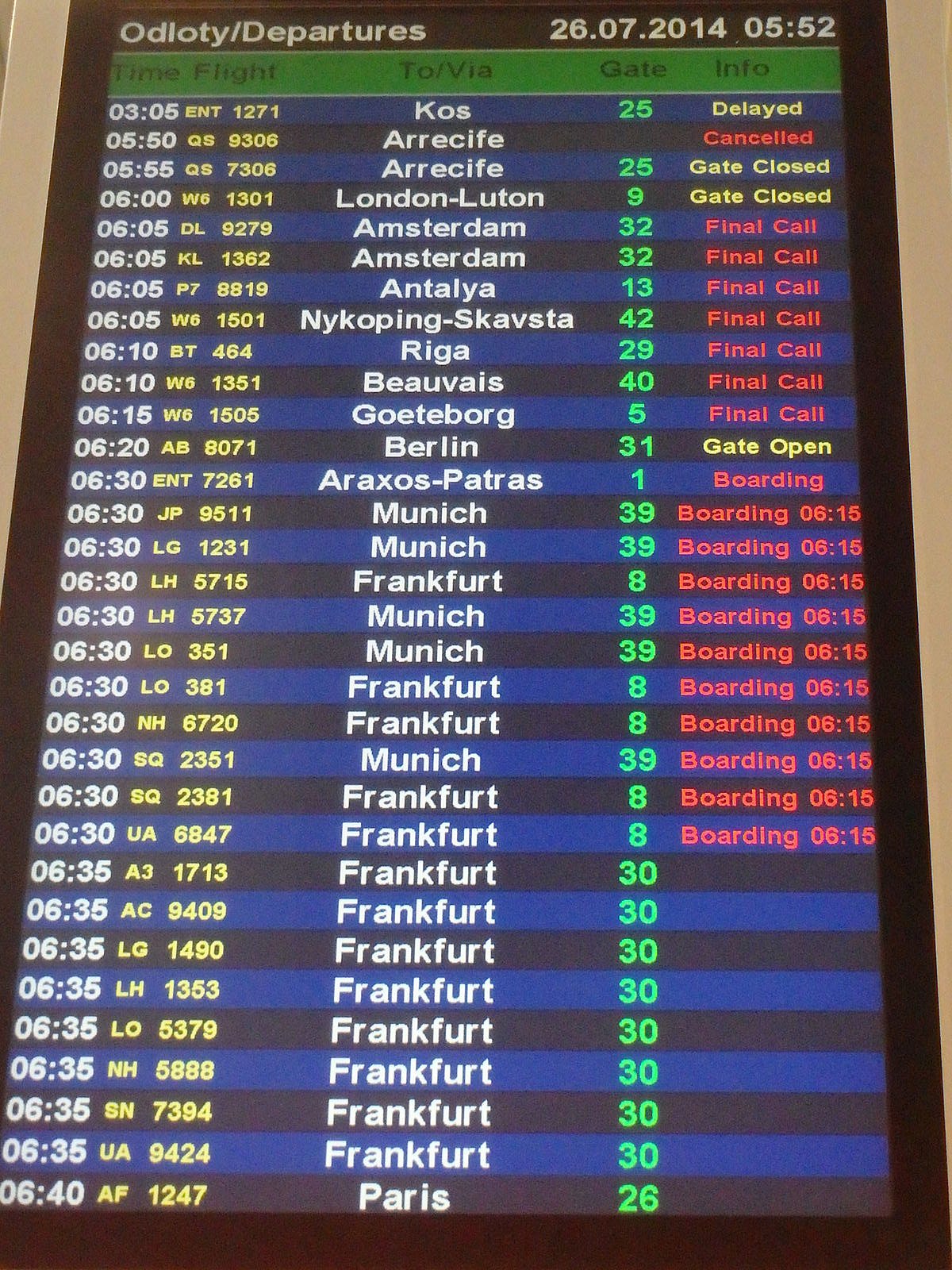
An information display showing code-shared flights (indicated by multiple flight numbers at identical times and gate numbers), at Warsaw Chopin Airport.
An information display showing code-shared flights (indicated by multiple flight numbers in a single time slot), at Fukuoka Airport.

A codeshare agreement, also known simply as codeshare, is a business arrangement, common in the aviation industry, in which two or more airlines publish and market the same flight under their own airline designator and flight number (the "airline flight code") as part of their published timetable or schedule. Typically, a flight is operated by one airline (technically called an "administrating carrier"[1] or "operating carrier") while seats are sold for the flight by all cooperating airlines using their own designator and flight number.

The term "code" refers to the identifier used in a flight schedule, generally the two-character IATA airline designator code and flight number. Thus, XX224 (flight number 224 operated by the airline XX), might also be sold by airline YY as YY568 and by ZZ as ZZ9876. Airlines YY and ZZ are in this case called "marketing airlines" (sometimes abbreviated MKT CXR for "marketing carrier").

Most of the major airlines today have code sharing partnerships with other airlines, and code sharing is a key feature of the major airline alliances. Typically, code-sharing agreements are also part of the commercial agreements between airlines in the same airline alliances.

History

[edit]

In 1967, Richard A. Henson’s Hagerstown Commuter airline joined with US Airways predecessor, regional Allegheny Airlines, in the nation's first codeshare relationship.[2] The term "code sharing" or "codeshare" was coined in 1989 by Qantas and American Airlines,[3] and in 1990 the two firms provided their first codeshare flights between an array of Australian and U.S. cities. Code sharing has become widespread in the airline industry since then, particularly in the wake of the formation of large airline alliances. These alliances have extensive codesharing and networked frequent flyer programs.

Terminology

[edit]

Under a code sharing agreement, the airline that administers the flight (the one holding the operational permissions, airport slots and planning/controlling the flight and responsible for the ground handling services) is commonly called the operating carrier, often abbreviated OPE CXR, even though the IATA SSIM term "administrating carrier" is more precise. The reason for this is that a third carrier may be involved, typically in the case that the airline originally planning to operate the flight needs to hire a subcontractor to operate the flight on their behalf (typically a wet lease, meaning an aircraft is leased with crew and all facilities to fly, commonly due to capacity limitations, technical problems etc.) In this case, the airline carrying the passenger should be designated the operating carrier, since it is the one carrying the passengers/cargo.[4]

When a flight is sold under several designators and flight numbers as described above, the one published by the "administrating carrier" is commonly called a "prime flight" (as opposed to a codeshare marketing flight).[5]

Reasons and advantages

[edit]

Under a code sharing agreement, participating airlines can present a common flight number for several reasons, including:

For passengers

[edit]
  • Connecting flights: This provides clearer routing for the customer, allowing a customer to book travel from point A to C through point B under one carrier's code, instead of a customer booking from point A to B under one code, and from point B to C under another code. This is not only a superficial addition as cooperating airlines also strive to synchronize their schedules.
  • More alternatives: Codeshare benefits passengers by offering them more travel choices, potentially more convenient departure and arrival times, and easier connections across the member airlines’ networks.[6]
  • More points/miles: Frequent flyer benefits typically remain in place under codeshare agreements, allowing passengers to earn and redeem points or miles across multiple participating airlines.[7]

For airlines

[edit]
  • Flights from both airlines that fly the same route: this provides an apparent increase in the frequency of service on the route by one airline.
  • Perceived service to non-serviced markets: this provides a method for carriers who do not operate their own aircraft on a given route to gain exposure in the market through display of their flight numbers.

Types of code sharing

[edit]

There are several types of code sharing arrangements:

  • Block space codeshare: A commercial (marketing) airline purchases a fixed number of seats from the administrating (operating/prime) carrier. A fixed price is typically paid, and the seats are kept away from the administrating carrier's inventory. The marketing airline decides on its own which booking classes the seats are sold in (the block of seats are optimized just like another aircraft cabin).
  • Free flow codeshare: The airlines' inventory and reservation systems communicate in real-time by messaging, commonly IATA AIRIMP/PADIS messaging (TTY and EDIFACT). A booking class mapping is defined between the airlines. No seats are locked to any of the airlines, and any airline can sell any number of seats.
  • Capped free flow: Basically the same as above, but capping (maximum number of seats) is defined for each of the marketing airlines participating in the codeshare with the administrating carrier.

Competitive concerns

[edit]

Much competition in the airline industry revolves around ticket sales (also known as "seat booking") strategies (revenue management, variable pricing, and geo-marketing). Criticism has been leveled against code sharing by consumer organizations and national departments of trade since it is claimed to be confusing and not transparent to passengers.[8]

Air-rail alliances

[edit]

There are also code sharing arrangements between airlines and railway companies, formally known as air-rail alliances, and commonly marketed as "Rail & Fly" due to the popularity of the Deutsche Bahn codeshare with many airlines.[9] They involve some integration of both types of transport, e.g., in finding the fastest connection and allowing the transfer between plane and train using a single ticket. This allows passengers to book a whole journey at the same time, often for a discounted price compared to separate tickets.

See also

[edit]

References

[edit]
[edit]
Revisions and contributorsEdit on WikipediaRead on Wikipedia
from Grokipedia
A codeshare agreement is a business arrangement in the industry in which two or more airlines market and sell seats on the same flight operated by one of the partners. Each uses its own IATA two-letter designator (e.g., "AA" for ) and flight number to identify the service. The operating carrier physically flies the aircraft and provides the crew, while the marketing carrier or carriers promote the flight as part of their own network, enabling passengers to book through a single ticket even if changing airlines. This practice, common since the late , simplifies travel for passengers by allowing seamless connections and baggage handling across partner airlines and has become integral to global alliances. Codeshare agreements originated in the 1960s and expanded significantly after U.S. in 1978, with the term coined in 1989 by and . They vary in structure and offer strategic benefits to airlines, such as network expansion and , while providing passengers with broader access and integration. However, they are subject to regulatory oversight to address competition and concerns.

Introduction to Codesharing

Definition and Core Concept

A codeshare agreement is a business arrangement in the airline industry where one airline, known as the operating carrier, physically operates a flight, while one or more other airlines, referred to as marketing carriers, sell tickets for that same flight using their own flight designator codes. This allows the marketing carriers to offer the flight as part of their own network, effectively expanding their route offerings without needing to operate the themselves. The core purpose of codeshare agreements is to enable airlines to broaden their global reach, share from ticket sales, and enhance connectivity across destinations that might otherwise be uneconomical or logistically challenging to serve independently. By leveraging each other's strengths, airlines can provide seamless travel options without investing in additional , , or infrastructure, thereby optimizing operational efficiency and market penetration. In practice, a single flight may carry multiple flight numbers—one from the operating carrier and others from its partners—meaning passengers booking through a marketing carrier might not realize the operating airline until or boarding. The concept traces its origins to 1967, when Hagerstown Commuter (now part of Henson Airlines) entered the first known codeshare partnership with , allowing the smaller carrier to feed passengers into the larger network under a shared code. Unlike , which involves basic coordination for baggage transfers and connections between separate flights operated by different airlines, codeshares emphasize joint and branding to present a unified service experience.

Key Terminology

In codeshare agreements, the operating carrier is the responsible for physically operating the flight, including providing the , , , and ensuring compliance with regulations. The marketing carrier, by contrast, is the or airlines that place their designator on the flight, market and sell tickets for it, and share in the revenue without handling the actual operation. A key element is the flight code, an alphanumeric identifier (such as AA123) assigned by the marketing carrier to the operating carrier's flight, allowing passengers to book and travel under the marketing carrier's branding while the flight is executed by the partner. Blocked space agreements refer to arrangements where the marketing carrier pre-purchases or reserves a fixed block of seats on the operating carrier's flight, managing its own and booking classes independently from the operating carrier's remaining capacity. Revenue sharing in codeshare agreements typically follows proration models outlined in IATA standards, such as multilateral or special prorate agreements, where fares are divided based on predefined percentages or proportional to sectors flown. A common method is the mileage prorate, which allocates proportionally to the covered under each carrier's code relative to the total journey ; for instance, if the marketing carrier's coded segment is 500 miles out of a 1,000-mile total fare journey, its share would be calculated as: Revenue Share=(Marketing Carrier’s Coded DistanceTotal Journey Distance)×Total Fare\text{Revenue Share} = \left( \frac{\text{Marketing Carrier's Coded Distance}}{\text{Total Journey Distance}} \right) \times \text{Total Fare} This formula ensures equitable distribution based on operational contributions, often adjusted through IATA clearing processes post-flight. Additional terms include the prime flight, which denotes the original flight operated and marketed solely by one airline without any codeshare overlay, serving as the base for partner codes. A ghost flight, in this context, refers to a codeshare leg that operates without prominent branding from the marketing carrier, appearing primarily under the operating carrier's identity to passengers.

Historical Context

Origins in the 1960s-1980s

The origins of codeshare agreements trace back to the in the late , when regional carriers sought ways to integrate with larger trunk airlines to expand their reach on short-haul routes. The first known codeshare arrangement was established in 1967 between Henson Aviation, operating as Hagerstown Commuter from , and , a regional predecessor to . Under this agreement, Henson operated feeder flights to Allegheny's hubs using the larger carrier's flight designator code, allowing seamless ticketing and baggage transfer for passengers on regional U.S. routes such as Hagerstown to . This pioneering partnership marked an early form of network integration, predating the formal term "codeshare" and enabling smaller operators to leverage the branding and distribution of established airlines. The U.S. of 1978 played a pivotal role in accelerating the adoption of such arrangements by dismantling government controls on fares, routes, and market entry, which intensified and prompted airlines to form strategies for and growth. Post-deregulation, smaller and regional carriers increasingly turned to codeshares to access the extensive networks and reservation systems of major airlines, thereby enhancing connectivity without the need for independent long-haul operations. This shift was particularly beneficial for commuter airlines, which could offer passengers the appearance of a single-carrier journey while sharing revenues and operational responsibilities. By the early , these agreements had become a common tool for U.S. carriers to optimize capacity and market presence in a deregulated environment. In , adoption of similar cooperative models remained limited during the 1960s and 1970s, largely due to the prevalence of state-owned flag carriers and rigid bilateral air service agreements that prioritized national monopolies over inter-airline partnerships. Major airlines like and operated under government oversight, which discouraged revenue-sharing arrangements that could undermine sovereign control of routes. However, initial bilateral discussions on enhanced cooperation began emerging in the late 1970s, influenced by growing pressures for market liberalization within the . A notable early experimentation occurred in 1985 with the first international codeshare between and on trans-Pacific routes, which introduced cross-border elements and paved the way for further global trials, including transatlantic partnerships. Although the specific term "codeshare" was not yet in use— it was coined in 1989 during negotiations between and — these precursors laid the groundwork for formalized global agreements by the end of the decade.

Expansion in the 1990s and Beyond

The expansion of codeshare agreements gained significant momentum in the 1990s, driven by the formation of major global airline alliances that positioned codesharing as a foundational element of their cooperative strategies. The Star Alliance, the first such network, was established on May 14, 1997, by founding members Air Canada, Lufthansa, Scandinavian Airlines System (SAS), Thai Airways International, and United Airlines, enabling extensive codeshare operations across their combined route networks to enhance global connectivity without equity investments. This was followed by the launch of oneworld on February 1, 1999, initiated by American Airlines, British Airways, Cathay Pacific, and Qantas, which similarly relied on codeshares to offer passengers seamless itineraries spanning multiple continents. SkyTeam entered the landscape in June 2000, with initial partners Air France, Delta Air Lines, Aeroméxico, and Korean Air formalizing codeshare arrangements to expand their reach, particularly in transatlantic and transpacific markets. A pivotal regulatory development occurred in 1993 when the U.S. (DOT) granted the first antitrust immunity for an international codeshare to and Royal Dutch Airlines (Order 93-1-11), setting a for future partnerships by allowing coordinated pricing and scheduling without violating laws. The -Qantas codeshare agreement, initiated in 1990 following its 1989 negotiation, later received antitrust immunity in 2019 to expand into a full , facilitating integration of Australian and U.S. routes. This approval facilitated the integration of Australian and U.S. routes, paving the way for broader alliance-based codeshares. The global proliferation continued with Asian carriers, exemplified by Cathay Pacific's 1998 codeshare pact with , which extended to intra-Asian and U.S. domestic services and marked a key step in 's Asian expansion. In , integrations accelerated in the early 2000s, notably with LAN (now part of LATAM) joining in 2000, enabling codeshares that connected South American hubs to North American and European networks. By 2010, codeshare agreements had proliferated to encompass thousands of routes worldwide, supporting the three major alliances in serving over 1,000 destinations collectively and contributing substantially to revenues through expanded sales without additional aircraft deployment. This growth was bolstered by technological advancements, particularly the widespread adoption of global distribution systems (GDS) such as and Amadeus in the 2000s, which integrated inventories to enable real-time, seamless booking of multi-carrier itineraries across travel agent platforms. These systems reduced operational friction, allowing passengers to purchase codeshare tickets as single transactions and airlines to optimize load factors on partner-operated flights.

Strategic Benefits

Advantages for Airlines

Codeshare agreements allow airlines to expand their networks by providing access to additional routes and destinations operated by partner carriers, without the need to invest in new or . This enables carriers to offer feeder traffic to their hubs from remote or low-demand locations, effectively creating a seamless "from anywhere to anywhere" service model. For instance, through alliances like , major carriers can connect passengers across a vast global network, with immunized alliances accounting for over 80% of transatlantic and transpacific capacity as of the early . These partnerships enhance generation by increasing passenger traffic volumes and optimizing load factors—the of seats filled on flights—through shared and combinability. Airlines can sell seats on partners' flights, boosting overall without proportional increases in operating expenses; conceptually, this improves effective capacity as the sum of an airline's own seats plus codeshare seats divided by total flights operated, leading to higher yields on partnered routes. Empirical studies show that airlines with more code-sharing partners, particularly within the same , experience positive associations with profit margins, as seen in analyses of 81 carriers from 2007 to 2012. Cost savings arise from shared resources, such as joint campaigns, ground handling, and distribution channels, which lower per-passenger expenses on collaborative routes. By leveraging partners' existing operations, airlines avoid the sunk costs of entering thin markets independently, reducing overall operating expenditures while maintaining service levels. For example, codeshares on low-volume international routes, like those between and Pacific islands, allow carriers to allocate seats efficiently without dedicating full . In terms of competitive positioning, codeshare agreements strengthen airlines' global reach through multilateral arrangements in alliances, enabling them to compete more effectively against non-partnered rivals. A notable recent case is the codeshare between (Lufthansa Group) and (a Lufthansa-Turkish Airlines ) within the ecosystem, launched in July 2025, which enhances connectivity in the Germany-Türkiye market and signals warming relations. Finally, codeshares mitigate risks by distributing exposure across partners' networks, particularly during periods of fluctuating demand or economic downturns. Airlines can gauge market potential on new routes through limited allocations before committing to full operations, thereby hedging against underutilization and stabilizing revenue streams in volatile environments.

Benefits for Passengers

Codeshare agreements provide passengers with seamless connections across multiple airlines through a single booking process for multi-leg itineraries, eliminating the need to reissue tickets or manage separate reservations. This arrangement ensures protected baggage transfer, where luggage is checked through to the final destination without retrieval at intermediate stops, reducing the risk of mishandling and simplifying travel logistics. Passengers benefit from expanded travel choices, gaining access to a broader array of destinations and higher flight frequencies that would otherwise require coordination between non-partner carriers. For instance, through global alliances incorporating codeshares, travelers can reach smaller or regional cities via partner networks, effectively creating a "from anywhere to anywhere" connectivity that significantly increases route options—such as over 300 additional destinations in some partnership examples. Loyalty program integration allows passengers to earn and redeem frequent flyer miles across partner airlines in a unified system, enhancing the value of rewards accumulated from travel. In the oneworld alliance, for example, members can credit miles from flights operated by any of the 15 member airlines to their preferred program's account, facilitating easier status achievement and redemption for awards on codeshare routes. These agreements often lead to advantages for passengers, as shared capacity and coordinated foster that can lower compared to independent bookings. Studies indicate reductions of up to 11.6% on codeshare itineraries relative to non-allied interline options, with immunized alliances yielding even greater savings—up to 27% lower than non-aligned routes—due to efficient . Additional convenience features include unified at the originating for the entire journey and potential access to partner lounges, regardless of the operating carrier, provided eligibility criteria such as elite status or premium cabin booking are met. This streamlines the experience, with single ticketing enabling fare combinability and consistent service protocols across codeshare partners.

Varieties and Mechanics

Types of Codeshare Agreements

Codeshare agreements can be classified by their structure and scope, primarily as bilateral or multilateral arrangements. Bilateral codeshares involve two airlines collaborating on specific routes or networks, allowing each to market the other's flights under their own code. For instance, and maintain a bilateral codeshare that enables seamless connections between the and on select trans-Pacific routes. Multilateral codeshares, by contrast, encompass multiple carriers, typically within global alliances, to create extensive network connectivity; , for example, facilitates such arrangements among its members using a free-flow model for broader route integration. Another key classification focuses on seat allocation methods, which determine how the marketing carrier accesses on the operating carrier's flights. In block space agreements, the marketing purchases a fixed number of seats in advance, such as 20 seats per flight, creating a dedicated separate from the operating carrier's . Free-flow agreements allow the marketing carrier to sell seats dynamically based on real-time availability shared between partners, without pre-allocated blocks, promoting flexibility in high-demand scenarios. A hybrid variant, capped free-flow, combines elements of free-flow with protective limits, where the marketing carrier can access seats up to a predefined maximum to safeguard the operating carrier's revenue yield. These allocation types often intersect with structural classifications; for example, the 2023 Delta Air Lines and airBaltic codeshare partnership operates as a bilateral free-flow arrangement, enabling Delta to place its code on 20 airBaltic routes across the Baltics without fixed seat blocks.

Operational Implementation

The operational implementation of codeshare agreements begins with detailed negotiations between partner airlines, focusing on key contractual elements such as revenue proration clauses and slot coordination to ensure equitable financial outcomes and operational harmony. Revenue proration clauses outline how ticket revenues are divided between the marketing carrier (which sells the ticket) and the operating carrier (which flies the segment), often using formulas based on distance flown, sector length, or agreed percentages, as specified in special prorate agreements filed with bodies like the Airline Tariff Publishing Company (ATPCO). Slot coordination involves mutual agreement on flight schedules to optimize airport slot usage, minimize connection times, and maximize passenger convenience, with changes requiring advance notification and publication in global distribution systems (GDS). These negotiations typically incorporate protections against revenue leakage, such as billing through automated clearing houses for uplifted coupons. Technical integration follows, relying on (IATA) standards to enable seamless code placement in GDS like Amadeus, , or . The marketing carrier assigns its two-letter airline designator code (e.g., "AA" for ) to the operating carrier's in the schedule, creating a unified itinerary visible to travel agents and passengers; this is facilitated through filings where operating carriers are specified in flight applications under Category 4 for codeshare routes. A typical workflow involves the operating carrier providing schedule data via IATA's Standard Schedules Information Manual (SSIM) format, after which the marketing carrier inputs its code into the GDS inventory, updates reservation booking designators (RBDs) for inventory control, and ensures fare rules align with the joint route map. This process allows the marketing carrier to promote the flight as its own while the operating carrier manages actual operations. Passenger handling protocols emphasize seamless experiences across partner networks, adhering to IATA resolutions for joint and management. At the originating , passengers receive a single itinerary ticket, enabling check-in with either carrier for the entire journey, including issuance of IATA-standard automated baggage tags that bear the operating flight designator for codeshare segments to ensure correct transfers. is tagged with a ten-digit license plate including the originating carrier's Baggage Tag Issuer Code (BTIC) per Resolution 769, allowing through-checking to the final destination without re-tagging, provided minimum connecting times (MCT) are met under Resolution 765. The most significant carrier (MSC), determined by Resolution 302, applies its baggage rules, with scanning mandatory at check-in, transfer, and arrival points per Resolution 753 to track and secure luggage. Data sharing underpins real-time coordination, primarily through application programming interfaces (APIs) and standardized messaging like for synchronization between partners. Marketing and operating carriers exchange seat availability data via APIs to support dynamic models, such as free-flow arrangements where seats are allocated in real time without pre-blocking, ensuring the marketing carrier can sell seats from the operating carrier's . Challenges arise in , where discrepancies in pricing strategies or controls can lead to overbooking or revenue dilution, as partners must reconcile differing revenue optimization goals while complying with IATA's (PNR) standards for synchronized booking data. Ongoing monitoring involves sharing performance metrics to evaluate agreement effectiveness and compliance, with a focus on operational reliability. Partners track indicators like on-time performance, flight completion rates, and load factors, often incorporating financial incentives or penalties; according to a 2013 U.S. Department of Transportation Office of Inspector General review of 13 agreements, 92% of reviewed U.S. domestic codeshare agreements included bonuses for exceeding 95% on-time targets over multi-month periods. These metrics are exchanged via joint reporting systems or third-party audits, enabling adjustments to schedules or prorations based on shared data, though oversight bodies like the (FAA) emphasize reviewing such incentives to mitigate safety risks from performance pressures.

Regulatory and Competitive Landscape

Antitrust and Competition Issues

Codeshare agreements have raised significant antitrust concerns due to their potential to increase and reduce competition on overlapping routes. By allowing airlines to coordinate operations and share revenues, these arrangements can effectively eliminate independent competition between partners, leading to higher market shares for the involved carriers. For instance, the U.S. Department of Justice (DOJ) has scrutinized alliances like and , noting that antitrust immunity for such codeshares reduces competition on transatlantic routes where partners previously offered rival flights. In the 2010s, the DOJ and (DOT) examined the partnership between United and Lufthansa, imposing carve-outs on specific overlapping routes, such as Frankfurt to , to preserve competitive options. Consumer confusion represents another key competitive issue, as passengers may be misled by the branding of codeshare flights, resulting in unexpected variations in service levels and amenities. Travelers booking under a marketing carrier's code often assume uniform standards, but the operating carrier may provide different experiences, such as limited allowances or inferior in-flight services, without clear upfront disclosure. This lack of transparency can distort and undermine by allowing marketing carriers to leverage their brand without fully bearing the service risks. Price effects from codeshares further exacerbate concerns, with empirical studies indicating potential fare increases through coordinated mechanisms. On U.S. domestic non-stop routes, codeshare agreements have been associated with hikes exceeding 5% due to the "" effect, where partners exchange fare information to facilitate . Additionally, in these arrangements can lead to fares nearly 10% higher than those from non-participating airlines on the same routes. Such coordination on immunized international routes amplifies these impacts, potentially harming consumers by reducing downward pressure on prices. Globally, regulatory bodies have probed codeshares for similar anticompetitive risks, as seen in the European Union's examination of the involving Air France-KLM, , and . In 2012, the launched an antitrust investigation into their transatlantic revenue-sharing and capacity coordination, citing concerns over reduced competition on key routes between and the U.S. The probe culminated in 2015 with the acceptance of commitments from the airlines to limit capacity and pricing coordination on three specific routes, ensuring some competitive safeguards. To mitigate these issues, antitrust authorities emphasize transparency requirements, such as mandating disclosure of the operating carrier in codeshare bookings. In the U.S., DOT regulations require airlines and ticket agents to clearly identify the transporting carrier before purchase, including on websites, to address confusion and promote informed decision-making. Similar measures in the focus on route-specific remedies to balance efficiencies with competitive protections.

Government Regulations and Approvals

In the United States, the (DOT) holds primary authority under 49 U.S.C. §§ 41308–41309 to approve international and codeshare agreements, granting antitrust immunity to shield them from domestic antitrust laws where necessary to promote competition and consumer benefits. The Department of Justice (DOJ) provides advisory input on potential anticompetitive effects during the review process. A notable example from the 2020s is the DOT's July 2025 approval of the transfer of ' international route authorities to as part of their merger integration, which facilitated expanded codeshare operations without triggering new antitrust concerns. In the , the evaluates codeshare agreements under EU (Articles 101 and 102 TFEU), focusing on their potential to restrict competition, particularly on routes with significant overlaps. For agreements involving route overlaps, the Commission often requires remedies such as the release of airport slots to competitors to mitigate effects and ensure . This approach was evident in cases like the 2016 investigation into the TAP Portugal-Brussels Airlines codeshare, where the Commission alleged anticompetitive coordination on and capacity but closed the investigation in 2018 without requiring commitments, as new airline entry on the route addressed competition concerns. At the international level, codeshare agreements are facilitated by (IATA) resolutions, such as Resolution 780, which establishes the multilateral interline framework for ticketing, baggage handling, and scheduling coordination essential to codeshare operations. These are further enabled by bilateral air service agreements (ASAs) between governments, which specify permissible codesharing between designated carriers and may impose restrictions on route rights or capacity. ASAs thus form the foundational legal basis for cross-border codeshares, with IATA standards ensuring operational . The approval process for codeshare agreements seeking antitrust immunity typically begins with carriers filing applications with the relevant authority, such as the U.S. DOT, including detailed agreements and competitive analyses. This triggers a period for comments from stakeholders, often followed by an outlining preliminary findings, with opportunities for rebuttals. The timeline generally spans 6 to 12 months, depending on complexity and comment volume, culminating in a final order granting or denying immunity with any conditions. Once approved, codeshare agreements require ongoing compliance, including annual reporting to regulators on route performance metrics such as capacity, connectivity, and on-time arrivals, as well as monitoring to detect potential price increases beyond industry averages. In the U.S., DOT mandates periodic audits and self-assessments for immunized alliances, with carriers submitting data on cooperative activities to ensure sustained benefits. Non-compliance can lead to immunity revocation, as seen in enforcement actions against underperforming joint ventures.

Broader Applications

Air-Rail and Intermodal Codeshares

Air-rail codeshares represent an extension of codeshare agreements into intermodal transport, where airlines apply their flight designators to rail services operated by partner railway companies, facilitating integrated bookings and travel experiences across air and rail networks. This model enables passengers to purchase a single ticket for journeys that combine flights and trains, often with coordinated schedules to minimize connection times at integrated hubs like airport train stations. Such partnerships have been particularly prominent in Europe, where high-speed rail networks complement short-haul air routes, promoting efficiency and reducing the need for separate reservations. A seminal example is the collaboration between and , which initiated Lufthansa Express Rail in the late 1990s, building on earlier cooperation to offer coded rail connections from major German cities to Frankfurt and Munich airports. Under the Rail&Fly program, passengers can travel from any station to international flights up to one day before or after departure, with seamless ticketing and baggage handling. Similarly, has maintained a 30-year partnership with , the French national railway, providing Train + Air services on 41 routes connecting high-speed trains directly to and airports since the mid-1990s. In the United States, operated a codeshare with until early 2021, allowing integrated bookings between Amtrak trains and United flights at hubs like , where rail connections served regional routes. These intermodal arrangements offer key benefits, including single-ticket journeys that streamline and reduce transfer hassles, while enabling passengers to earn miles on rail segments. In , such codeshares align with broader policy goals for sustainable mobility; for instance, Regulation (EC) No 1371/2007 on rail passengers' ensures compensation and assistance for disruptions on combined trips, treating through-ticketed intermodal journeys comparably to single-mode . However, implementation faces challenges, particularly in synchronizing train and flight schedules to optimize connections, as misalignments can lead to missed departures and operational inefficiencies. Additionally, fare proration for non-air segments requires complex interline agreements to equitably divide revenues between airlines and rail operators, often involving intricate billing rules and restrictions on fare validation. As of 2025, hosts numerous air-rail partnerships, with at least nine major airlines offering integrated services across key airports and high-speed lines, reflecting a trend toward greater intermodality. These have expanded beyond , with recent developments like Air Canada's 2025 codeshare extension to services via , underscoring ongoing growth in coordinated air-rail networks. The led to the suspension of a significant portion of global operations in , with flight capacity dropping by 80-95% in March and April, resulting in widespread pauses in codeshare agreements to align with reduced schedules and travel restrictions. As recovery progressed, s formed new partnerships to rebuild networks, such as and airBaltic's codeshare launched in November 2023, enabling Delta to place its code on 20 routes from airBaltic's Baltic bases. Post-pandemic, the adoption of digital tools accelerated, including contactless and biometric verification, facilitating seamless codeshare operations by minimizing physical interactions at airports and enhancing passenger confidence in multi-carrier itineraries. Alliance shifts continued into the mid-2020s, with officially joining on September 1, 2024, expanding the alliance's Nordic coverage and integrating SAS's routes into the global network. Similarly, exited in February 2025 with a transition period ending April 30, 2025, and began integrating into in April 2025, with full membership expected in 2026 to leverage Group's infrastructure. pursued aggressive expansion, announcing plans for over 10 new codeshare agreements in 2025 to enhance connectivity in , , and , including deals with in September 2025 and in June 2025. Expansions like ' strategic codeshare with , signed in June 2025, further connected the to and beyond. Sustainability has emerged as a key driver in codeshare strategies, with partnerships enabling higher load factors—often increasing by several percentage points through route optimization—which in turn reduce fuel consumption and emissions intensity. For instance, every 1% rise in load factor can yield approximately 0.83% fuel savings on short- and medium-haul flights, supporting broader goals. These efforts align with the International Air Transport Association's (IATA) 2021 resolution for net-zero carbon emissions by 2050, where codeshares contribute by maximizing utilization and minimizing empty legs. Technological innovations are enhancing codeshare efficiency, including AI-driven dynamic pricing models that adjust fares in real-time based on demand, weather, and competitor data, as piloted by for up to 20% of domestic routes by late 2025. In free-flow codeshares, where airlines share inventory without pre-allocation, AI facilitates personalized pricing across partner networks to optimize revenue. technology is also advancing secure , enabling transparent revenue distribution and tamper-proof exchange of flight and passenger information in interline agreements. Looking ahead, codeshare growth is accelerating in the region, driven by rising connectivity demands, as seen in the April 2025 strategic partnership between and , which introduced daily Manila-Doha flights starting June 2025 with mutual codes on onward routes. This reflects broader trends of increasing partnerships in to capture market expansion. However, potential regulatory tightening on green claims may impact sustainability-focused codeshares, following investigations in 2024 that prompted over 20 airlines to revise environmental assertions, such as neutralizing flight emissions, to avoid misleading consumers. In November 2025, 21 airlines committed to changing their practices to comply with consumer protection rules.

References

Add your contribution
Related Hubs
User Avatar
No comments yet.