


Community hub
Recent from talks
Contribute something
Nothing was collected or created yet.
Coexist (image)
View on Wikipedia
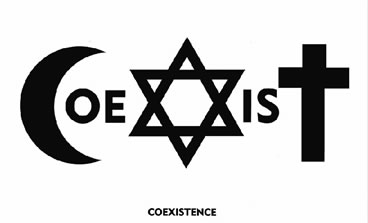
The Coexist image (often styled as "CoeXisT" or "COEXIST") is an image created by Polish, Warsaw-based graphic designer Piotr Młodożeniec in 2000 as an entry in an international art competition sponsored by the Museum on the Seam for Dialogue, Understanding and Coexistence. The original version was one of dozens of works displayed as large outdoor posters in Jerusalem in 2001.[1][2][3] It is designed to represent tolerance between religions.
Variations of this artwork have been used as bumper stickers and elements in rock concerts.[1][4]
Creation – COEXISTENCE art exhibition
[edit]Piotr Młodożeniec, a Polish graphic designer based in Warsaw, had his original work chosen by a jury to be one of several dozen images to be displayed as 3 m (9.8 ft) x 5 m (16 ft) outdoor posters as part of a touring exhibit sponsored by the Museum on the Seam in Jerusalem. The exhibit opened to the public in Jerusalem in 2001.[1][2]
His original image consisted of the word COEXIST in all capital letters, with the C replaced by an oversized Muslim Crescent, the X replaced by an oversized Star of David, and the T replaced by an oversized Latin Cross.[1][3][2]
U2 Vertigo Tour
[edit]
During the international 2005–2006 Vertigo Tour of the Irish rock band U2, the original version of the image played a key role. Shortly after playing "Sometimes You Can't Make It on Your Own", the group would play politically-themed songs. During the opening portion of "Love and Peace or Else", Bono wore a white headband bearing a handwritten version of the word.[5] In some venues, including Mexico City, the word was displayed on large electronic signs.[1]
Bumper sticker
[edit]The image and variations of it are used as automobile bumper stickers.[4]
The bumper stickers first began to emerge in the United States in the early 2000s in partial response to the military involvement in Iraq and Afghanistan which began after the events of September 11, 2001. The stickers signify the capability or desire of humans to live together in peace.[6]
One common version of the bumper sticker spells "COEXIST" using an Islamic crescent moon for the "C", a peace sign for the "O", the Hindu Om symbol for the "E”, a Star of David for the "X", a pentacle for the dot of the "I", a yin-yang symbol for the "S", and a Christian cross for the "T".[6] This version, designed by Jerry Jaspar, is perhaps the most common version of the bumper sticker. In a different variation, both the male and female symbols are combined with a lowercase “e”, in place of the Om symbol.[7] The lowercase "e" represents science - the "e" coming from e=mc².
The prevalence of the COEXIST bumper stickers has been noted in the Bay Area region centered on San Francisco. Users of the bumper stickers are often not practicing adherents of religion.[8] This has led to one academic, Mark Coppenger, of the Southern Baptist Theological Seminary to criticize the use of the symbol by atheists and to also question the ability of the bumper sticker to affect a wider audience.[9]
Legal disputes
[edit]In 2005, Młodożeniec and U2 were unaware of each other. They were also unaware that a company, COEXIST LLP[10] in Indiana already filed for a trademark in the United States in 2003. At the time, as there was no official U2 merchandise carrying this image, U2 fans created their own.
COEXIST LLP (now dissolved) [11] filed suit against companies like CafePress in May 2005 to stop sales of merchandise they had not authorized. Młodożeniec's attorneys maintained that he owned the copyright to the image, and according to The History Behind the COEXIST Logo("History"),[12] Młodożeniec repudiates COEXIST LLP as trying to steal his design to profit from lawsuits. Separately, The Museum on the Seam, which sponsored the competition in which the original image first appeared in public, claimed legal rights to the image.[1][3]
Recently the COEXIST Foundation has worked to hold the rights of the design. CEO Tarek Elgawhary saw the logo as an opportunity to promote the foundation. [13]
Versions and other variations
[edit]The following table shows the individual characters of the more well-known versions, either as Unicode characters, icons, or descriptions.
| C | o | e | x | i | ı | ̇ | s | t | notes |
|---|---|---|---|---|---|---|---|---|---|
| ☪ | o | e | ✡ | i | - | - | s | ✝[T 1] | (original image)[2] |
| ☪ | ☮ | e | ✡ | - | ı | ☯ | s | ✝[T 1] | pbyrne on Flickr |
| ☪ | ☮ | ⚥ | ✡ | - | ı | ⍟ | ☯ | ✝[T 1] | [14] |
- Other published variations
- Translations, such as Coexista (at a U2 concert in Mexico City)
- A more updated version of the bumper sticker exists where the "i" in the word is dotted with a talisman symbol known as a pentacle. This version appears in films due to this version's popularity, taking particular focus as the final camera shot at the end of the Honda Odyssey fight in the 2024 film Deadpool & Wolverine, where a bloody battle between the two titular heroes is humorously framed as an intimate same-sex love scene in the Odyssey's back that ends on a close-up of a prominent "Coexist" bumper sticker.
Parodies
[edit]There are several parodies, spelling out words such as 'Toxic', 'Fiction', 'Contradict', 'Atheist', 'Heathen', 'Cointelpro', 'Costco', and 'Convert'. There is also an anti-Islamic version with the image of the crescent altered with the addition of explosives.[7]
Other parodies include a Communist hammer and sickle for the "E" and a swastika for the "X", indicating the dangers inherent in totalitarian ideologies,[15] and weapon-related versions.
See also
[edit]References
[edit]- ^ a b c d e f Hutchinson, Kevin (2005-07-11). "Can't We All Just Coexist? Lawsuits and controversy over who owns the 'CoeXisT' sign". @U2. Archived from the original on 2009-09-02. Retrieved 2015-10-20.
- ^ a b c d Mlodozeniec, Piotr. "COEXISTENCE". Archived from the original on 2002-12-06. Retrieved 2015-10-20. (image), Mlodozeniec, Piotr. "COEXISTENCE". Archived from the original on 2002-09-08. Retrieved 2015-10-20. (description), "Coexistence (exhibition)". Jerusalem: Museum On The Seam. Archived from the original on 2002-10-17. Retrieved 2015-10-20.
- ^ a b c Etgar, Raphie (2005-07-11). "Museum on the Seam statement: Image of Coexistence Traveling the World". Archived from the original on 2012-09-08. Retrieved 2015-10-20.
- ^ a b "COEXIST's Bonehead Bumper-Sticker Politics: America's simplistic adoption of the COEXIST bumper sticker signals a dangerous inability to understand the roots of religious conflict". The Daily Beast. 2014-12-21. Archived from the original on 2014-12-24.
- ^ "Bono, 5\28\05, Boston, MA, TD Banknorth Garden". Kurman, Mike. 2015-05-28. Retrieved 2015-10-20.
{{cite web}}: CS1 maint: others (link) - ^ a b Wrasman, Andy (2014). Contradict. WestBow Press. pp. 2–3. ISBN 9781490819297. Archived from the original on 2015-10-23.
- ^ a b Gharavi, Lance, ed. (2011). Religion, Theatre, and Performance: Acts of Faith. Routledge. ISBN 9781136483400.
- ^ Fish, M. Steven (2011). Are Muslims Distinctive? A Look at the Evidence. Oxford University Press. ISBN 9780199792887. Archived from the original on 2015-10-23.
- ^ Coppenger, Marc (2011). Moral Apologetics for Contemporary Christians. B & H Publishing Group. p. 252. ISBN 9781433674037. Archived from the original on 2015-10-23.
- ^ "The History Behind the "Coexist" Logo on Your Bumper Sticker - Urbo". 10 July 2017.
- ^ https://bsd.sos.in.gov/PublicBusinessSearch/BusinessInformationFromIndex
- ^ "The History Behind the "Coexist" Logo on Your Bumper Sticker - Urbo". 10 July 2017.
- ^ "The History Behind the "Coexist" Logo on Your Bumper Sticker - Urbo". 10 July 2017.
- ^ Phil Edwards, "The big fight over Coexist", Vox, 8 June 2016.
- ^ Bowen, Jack (2010). If You Can Read This: The Philosophy of Bumper Stickers. Random House. p. 193. ISBN 9781588369505.
coexist bumper sticker.


External links
[edit]- "2004 archive of home page of Coexist, LLP". Archived from the original on 2004-03-26.
- "Museum On The Seam – Coexistence". Archived from the original on 2015-10-23.
- "piotr mlodozeniec coexist" (in Polish). Archived from the original on 2015-10-23.
- Butler, Susan (2005-08-06). "Legal Matters: One Design, Many Claims: Can they Coexist?". Billboard. Vol. 117, no. 32. Nielsen Business Media. p. 10. ISSN 0006-2510. Archived from the original on 2015-10-23.
- Jen (2008-05-27). "Coexist". Archived from the original on 2009-08-10. – several variations of the symbol
- The big fight over Coexist. Vox. June 8, 2016 – via YouTube.
Coexist (image)
View on GrokipediaOrigins and Initial Design
Creation for the COEXISTENCE Art Exhibition
The Coexist image originated as an artistic submission by Polish graphic designer Piotr Młodożeniec, who entered an international competition organized by the Museum on the Seam in Jerusalem.[3] This Warsaw-based artist created the design in 2000 specifically for the museum's "Coexistence" exhibition, which sought visual expressions promoting tolerance in a region marked by ongoing Israeli-Palestinian conflict.[3][4] The Museum on the Seam, situated along the historic armistice line dividing East and West Jerusalem, hosted the exhibition to foster dialogue on peaceful coexistence amid sectarian tensions.[3] Młodożeniec's entry was selected and debuted as part of this non-commercial showcase of large-scale posters addressing interfaith harmony.[9] The initiative reflected the museum's broader mission to use contemporary art for socio-political commentary on division and reconciliation in Jerusalem.[3] In its initial form, the design stylized the word "COEXIST" using symbols exclusively from the Abrahamic religions: the crescent moon and star for Islam forming the "C," the Star of David for Judaism as the "X," and the Christian cross for the "T."[9] The remaining letters—"O," "E," "I," and "S"—employed simpler geometric forms without additional religious iconography, limiting the scope to these three faiths central to Middle Eastern dynamics.[9] This focused representation underscored the exhibition's emphasis on tolerance among Islam, Judaism, and Christianity, without intent for broader commercialization or expansion at the time.[3]Popularization and Commercialization
Adoption by U2 in the Vertigo Tour
U2 incorporated the Coexist image into the stage visuals and merchandise of their Vertigo Tour, which ran from March 28, 2005, to December 9, 2006, in support of the album How to Dismantle an Atomic Bomb. The symbol appeared on video screens during performances, including segments tied to songs addressing conflict and unity, such as "Sunday Bloody Sunday," where Bono referenced coexistence themes amid global strife.[10][11] This integration occurred independently, without involvement from the image's creator, Piotr Młodożeniec, as evidenced by the designer's later statements declining legal action against the band for its use.[12] The tour comprised 131 shows across five legs, drawing 4,615,035 attendees and grossing $389 million, making it one of the highest-grossing concert tours of its era.[13] This massive exposure, reaching audiences in stadiums worldwide, transformed the niche artistic symbol into a broader emblem of interfaith harmony and rock-infused activism, particularly resonant in the post-September 11, 2001, era of geopolitical tensions.[14] Media coverage of the band's peace-oriented messaging further propelled the image's recognition beyond art circles.[15] U2's adoption amplified the symbol's association with calls for tolerance amid ongoing conflicts, yet it also inadvertently highlighted emerging ownership issues, as the band's high-profile deployment predated widespread awareness of prior trademark filings. The lack of direct creator collaboration underscored the image's organic viral spread, shifting it from gallery entry to global icon through cultural channels rather than formal licensing.[12]Development as a Bumper Sticker
The Coexist image transitioned into a bumper sticker format through decentralized production by independent sellers in the United States during the early 2000s, driven by commercial opportunities amid post-September 11, 2001, concerns over religious conflict and terrorism.[3] Various entities, including Coexist LLP—formed by Indiana University graduates who trademarked a variant in 2003—began marketing adhesive versions as emblems of interfaith harmony, without a centralized authority overseeing distribution or design fidelity.[4] This proliferation reflected profit motives over the original 2000 artistic contest entry, as producers adapted the design for mass vinyl printing and vehicle application, often pricing stickers at low costs to encourage widespread adoption.[3] By the mid-2000s, the sticker's visibility surged on automobiles, evolving from niche merchandise to a standalone cultural marker, with multiple vendors like the Coexist Foundation licensing and selling versions to fund charitable initiatives, while unauthorized copies further diluted control.[4] No verifiable aggregate sales data exists, but anecdotal reports and vendor listings indicate substantial output, as companies capitalized on demand for tolerance signaling without enforcing the designer's intent for contextual artistic use.[3] The absence of exclusive ownership enabled this fragmentation, prioritizing market accessibility over purity, resulting in ubiquitous placement on vehicles often linked to progressive demographics.[16]Symbolism and Core Message
Component Symbols and Their Representations
The standard iteration of the Coexist image replaces each letter of the word with a graphic symbol drawn from religious, philosophical, or ideological traditions.[3][17]- C: A crescent moon enclosing a five-pointed star, symbols commonly linked to Islam; the crescent predates Islam as a lunar motif in ancient Near Eastern cultures, gaining prominence under the Ottoman Empire (14th–20th centuries) as an imperial emblem before widespread Islamic adoption, though it holds no basis in core Islamic scriptures and has been co-opted in flags and iconography of jihadist organizations such as ISIS.[18][19]
- O: The peace symbol, a circle bisected by a vertical line from which two diagonals descend at 45-degree angles; designed in 1958 by Gerald Holtom for the British Campaign for Nuclear Disarmament, deriving from semaphore flags signaling "N" and "D" for nuclear disarmament.[20]
- E: Interlocked male (circle with upward arrow, denoting Mars) and female (circle with downward cross, denoting Venus) symbols from alchemical and astronomical traditions (17th century onward), here configured to signify gender equality.[21][22]
- X: The Star of David (Magen David), a hexagram formed by two overlapping equilateral triangles; emerged in Jewish mysticism by the 12th century and solidified as a national emblem in the 19th-century Zionist movement.[8][19]
- I: A pentacle, consisting of a five-pointed star (pentagram) inscribed within a circle; in Wiccan and neopagan contexts since the 20th-century revival of such practices, it represents the five elements (earth, air, fire, water, spirit) and protection.[23][17][24]
- S: The yin-yang (taijitu), a circle divided into black-and-white teardrop shapes with embedded dots; originating in ancient Chinese cosmology (circa 3rd century BCE) and central to Taoism, symbolizing dualistic balance of opposites.[21][17]
- T: The Latin cross (†), with a longer vertical arm; adopted by early Christians (2nd–4th centuries CE) to evoke Jesus's crucifixion circa 30–33 CE, becoming the preeminent Christian emblem by the 5th century.[8][19]