Hubbry Logo
Fishers, IndianaFishers, IndianaMain
Open search
Fishers, Indiana
Community hub
Fishers, Indiana
logo
8 pages, 0 posts
0 subscribers
Be the first to start a discussion here.
Fishers, Indiana
Fishers, Indiana
from Wikipedia

Fishers is a city in the Fall Creek and Delaware townships in Hamilton County, Indiana, United States. As of the 2020 census the population was 98,677. A northside suburb of Indianapolis, Fishers has grown rapidly in recent decades: about 350 people lived there in 1963, 2,000 in 1980, and only 7,500 as recently as 1990.

Key Information

After the passage of a referendum on its status in 2012, Fishers transitioned from a town to a city on January 1, 2015. The first mayor of Fishers, Scott Fadness, along with the city's first clerk and city council were sworn in on December 21, 2014.[5]

History

[edit]

19th century

[edit]

In 1802, William Conner settled in territory that would eventually become Fishers. Conner built a log cabin and a trading post along the White River.[6] The land that Conner settled is now known as Conner Prairie and is preserved as a living history museum.[7]

Conner House at Conner Prairie

Settlers started moving to the area after Indiana became a state in 1816 and the Delaware Indians gave up their claims in Indiana and Ohio to the United States government in 1818 in the Treaty of St. Mary's. At the treaty William Conner served as an interpreter for Chief William Anderson, his father-in-law. At the time William Conner was married to Mekinges Conner, daughter of Chief William Anderson. In 1823, Hamilton County was chartered by the Indiana General Assembly and Delaware Township was established and surveyed.[8] After the state of Indiana moved its capital to Indianapolis from Corydon in 1825, the community started to grow. After the move, John Finch established a horse-powered grinding mill, a blacksmith shop, and the area's first school.[8] The next year the area's first water mill was constructed.[8]

During 1826 the West-Harris House, later nicknamed Ambassador House, was built near the White River at present-day 96th Street and Allisonville Road in Fishers. The home was moved to its present-day site at 106th Street and Eller Road in 1996.[9][10] Addison C. Harris (1840–1916), a prominent Indianapolis lawyer and former member of the Indiana Senate (1876 to 1880), acquired the property in 1880 and had the home remodeled and enlarged around 1895. Harris and wife, India Crago Harris (1848–1948), used the home as a summer residence. Its nickname of Ambassador House relates to Addison Harris's diplomatic service (1899 to 1901) as U.S. Envoy Extraordinary and Minister Plenipotentiary to Austria-Hungary during President William McKinley's administration.[11][12] The restored Ambassador House is located on the grounds of Heritage Park at White River in Fishers and is operated as a local history museum and a site for community events and private rentals.[10][13]

In 1849, construction began on the Peru & Indianapolis Railroad, extending from Indianapolis to Chicago.[14] The railroad brought several people to the area then known as "Fisher's Switch". In 1872, Fisher's Switch, also known as "Fishers Station", was platted by Salathial Fisher at the present-day intersection of 116th Street and the railroad.[7] Indiana's General Assembly incorporated Fisher's Station in 1891.[8]

The William Conner House and West-Harris House are listed on the National Register of Historic Places.[15]

20th century

[edit]

In 1908, the post office changed the name of Fishers Switch to "Fishers" by dropping "Switch."[8]

After William Conner's death in 1855, his family farm became a place of interest. The Hamilton County Historical Society placed a marker on the site of the William Conner farm in 1927.[8] Eli Lilly, then head of Eli Lilly and Company, purchased William Conner's farm in 1934 and began restoring it. In 1964, Lilly asked Earlham College to oversee the Conner farm, now known as Conner Prairie.[16]

In 1943, the Indianapolis Water Company constructed Geist Reservoir in order to prevent a deficit in Indianapolis's water supply. They believed that Fall Creek and the White River would not keep up with the demand for water in Indianapolis. In the 1970s, the company wanted to triple the size of the lake, but the plan was rejected in 1978 and homes began to spring up around the reservoir.[17] Germantown, a small settlement, currently resides at the bottom of the reservoir.

The Fishers population grew slowly to 344 by the 1960 census when rail shipment declined. Per township referendums in 1961, the town provided planning services for Delaware and Fall Creek Townships and approved residential zoning for most of the undeveloped area in the two townships.[8]

The relocation of State Road 37 to the east side of town and the connection with Interstate 69 ensured the future growth of Fishers as a commercial and residential center.[8] The town of Fishers would soon become a fast-growing suburb of Indianapolis. Fall Creek Township became the site of a consolidation of area schools when Hamilton Southeastern High School was formed in the 1960s.[8] In 1989 the town's population reached 7,000 and the first Freedom Festival was held, renamed in later years to Spark!Fishers.[18]

Interstate 69 passes a rural farmstead near 106th Street in 1991

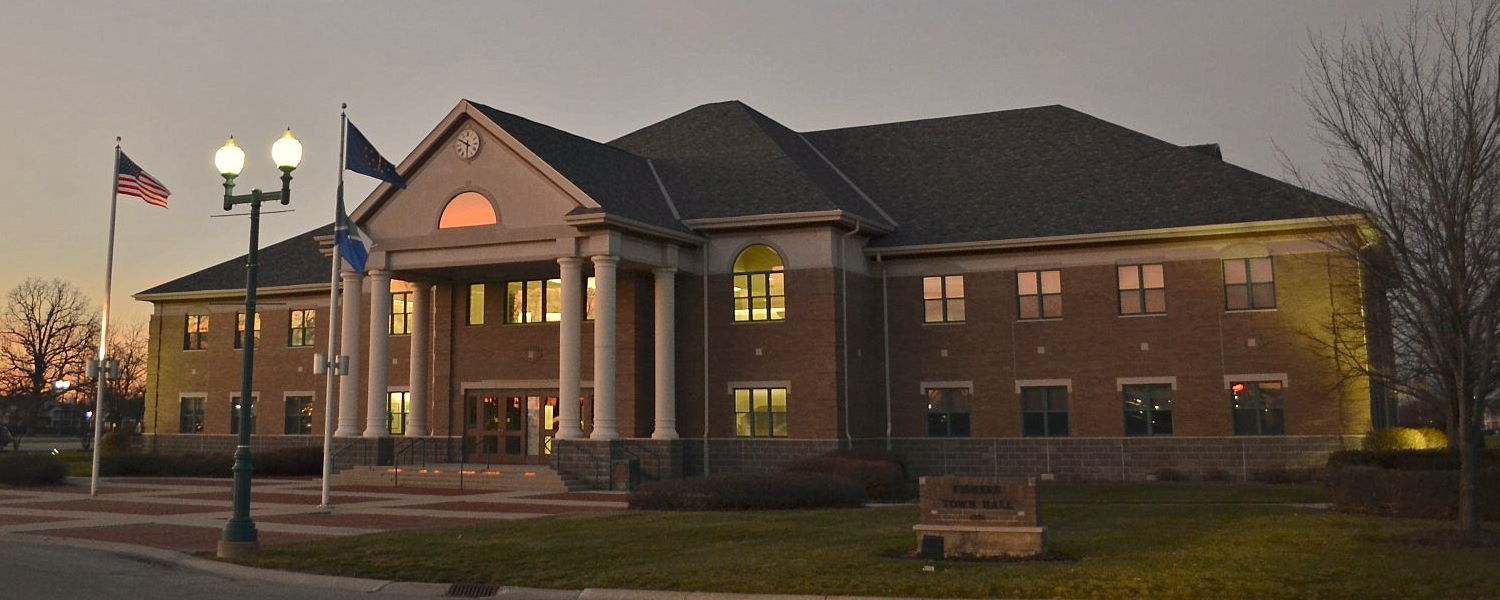
The Thomas A. Weaver Municipal Complex opened as Fishers' civic and government center in 1992. The complex is home to the Fishers City Hall, the police and fire department headquarters buildings, the Fishers Post Office, the Hamilton County Convention and Visitor's Bureau, and the Fishers Chamber of Commerce. Eventually, a library and an office of the Indiana Bureau of Motor Vehicles were added. This is still the center of government in Fishers.[8]

21st century

[edit]

The 2000 census reported the population of Fishers at almost 38,000.[19] With the town's affordable homes, growing economy, and proximity to Indianapolis and Interstate 69, the growth in Fishers was tremendous. In 2003 the town of Fishers requested a special census from the U.S. Census Bureau to accurately measure the rapid population growth since 2000.[8] This census would put the town's population at 52,390, a 38 percent increase from the 2000 census.[8] Since then much of the government's resources have been devoted to building parks, maintaining roads, and managing the rapid growth of the town.

In 2005, after a controversy over alleged mismanagement, Conner Prairie formally split from Earlham College, becoming an independent corporation.[20]

In January 2009, the Geist United Opposition conceded a four-year legal battle with Fishers over the involuntary annexation of the contiguous, unincorporated area around Geist Reservoir. This allowed Fishers to annex and incorporate this area of 2,200 homes on January 2, 2010, and to begin taxing it in 2011. This increased Fishers' population by about 5,500, making the town the eighth-largest community in Indiana.[21]

In 2012, Fishers constructed a multipurpose trail along the original route of the Nickel Plate railroad line in the downtown district and an amphitheater in the Thomas A. Weaver Municipal Complex.[22] That November, the town announced the details of a major development project in the heart of downtown. The $33 million pedestrian-oriented, mixed-use development on the north side of 116th Street, just west of Municipal Drive, broke ground in mid-2013 and was scheduled to be completed in 2015.[23]

City controversy

[edit]

In 1998, a referendum to change Fishers from a town to a city was rejected by 75% of the town's voters.[24]

In 2008, a group named "CityYes" began collecting petition signatures for a voter referendum on the question of whether or not to become a city.[25][26] The town appointed a 44-member citizen study committee to review the benefits and drawbacks of a change of government type.[27]

In December 2010, the Fishers Town Council approved two referendum questions: whether or not to become a traditional city with an elected mayor and traditional city council or a modified city with a mayor elected by and from the expanded nine-member city council. The latter would have also merged the governments of Fishers and Fall Creek Township.[28][29] In the referendum held November 6, 2012, voters rejected the merger with Fall Creek Township to become a modified city with an appointed mayor 62% to 37%, while approving a change to a traditional "second-class city",[30] with an elected mayor 55% to 44%.[31]

Geography

[edit]

Location

[edit]

Fishers is located in the southeast corner of Hamilton County along the West Fork of the White River. It is bordered to the west by Carmel, to the north by Noblesville, to the east by the town of Ingalls and unincorporated land in Madison County, to the southeast by Fortville, McCordsville and unincorporated land in Hancock County, and to the south by the city of Indianapolis in Marion County. The center of Fishers is 16 miles (26 km) northeast of downtown Indianapolis.

According to the 2010 census, Fishers has a total area of 35.839 square miles (92.82 km2), of which 33.59 square miles (87.00 km2) (or 93.72%) is land and 2.249 square miles (5.82 km2) (or 6.28%) is water.[32]

Climate

[edit]

Fishers has a humid continental climate (Köppen climate classification). Summers in Fishers are hot and humid with temperatures regularly in the 85 °F range. Autumns and springs in Fishers have very comfortable temperatures normally around 70 °F, but springs have much less predictable weather and drastic temperature changes are common. Winters are cold and filled with snow and ice storms. During winter, temperatures are normally around 35 °F and often dip below 20 °F at night.

Climate data for Fishers
Month Jan Feb Mar Apr May Jun Jul Aug Sep Oct Nov Dec Year
Mean daily maximum °F (°C) 34
(1)
39
(4)
50
(10)
62
(17)
72
(22)
81
(27)
85
(29)
83
(28)
77
(25)
65
(18)
51
(11)
38
(3)
61
(16)
Mean daily minimum °F (°C) 17
(−8)
20
(−7)
29
(−2)
39
(4)
50
(10)
60
(16)
64
(18)
62
(17)
54
(12)
42
(6)
33
(1)
23
(−5)
43
(6)
Average precipitation inches (mm) 2.42
(61)
2.52
(64)
3.28
(83)
3.92
(100)
4.86
(123)
4.15
(105)
4.49
(114)
4.06
(103)
3.32
(84)
3.02
(77)
3.77
(96)
3.14
(80)
42.95
(1,090)
Average snowfall inches (cm) 7
(18)
5
(13)
2
(5.1)
0
(0)
0
(0)
0
(0)
0
(0)
0
(0)
0
(0)
0
(0)
1
(2.5)
2
(5.1)
17
(43.7)
Source: City-Data[33]

Demographics

[edit]
Historical population
CensusPop.Note
1880138
1910188
1920142−24.5%
1930138−2.8%
194016418.8%
195021933.5%
196034457.1%
197062882.6%
19802,008219.7%
19907,508273.9%
200037,835403.9%
201076,794103.0%
202098,97728.9%
2020 Census[34]

2020

[edit]
Fishers, Indiana – Racial and ethnic composition
Note: the US Census treats Hispanic/Latino as an ethnic category. This table excludes Latinos from the racial categories and assigns them to a separate category. Hispanics/Latinos may be of any race.
Race / Ethnicity (NH = Non-Hispanic) Pop 2000[35] Pop 2010[36] Pop 2020[37] % 2000 % 2010 % 2020
White alone (NH) 34,400 64,058 74,625 90.92% 83.42% 75.40%
Black or African American alone (NH) 1,096 4,228 6,556 2.90% 5.51% 6.62%
Native American or Alaska Native alone (NH) 43 109 140 0.11% 0.14% 0.14%
Asian alone (NH) 1,159 4,174 7,897 3.06% 5.44% 7.98%
Native Hawaiian or Pacific Islander alone (NH) 6 14 30 0.02% 0.02% 0.03%
Other race alone (NH) 33 207 473 0.09% 0.27% 0.48%
Mixed race or Multiracial (NH) 334 1,366 4,244 0.88% 1.78% 4.29%
Hispanic or Latino (any race) 764 2,638 5,012 2.02% 3.44% 5.06%
Total 37,835 76,794 98,977 100.00% 100.00% 100.00%
Map of racial distribution in Fishers, 2020 U.S. census. Each dot is one person:  White  Black  Asian  Hispanic  Multiracial  Native American/Other

According to a 2007 estimate, the median income for a household in the town was $86,518, and the median income for a family was $103,176.[38] Males had a median income of $58,275 versus $37,841 for females. The per capita income for the town was $31,891. 1.8% of the population and 1.1% of families were below the poverty line. Out of the total population, 1.6% of those under the age of 18 and 0.9% of those 65 and older were living below the poverty line.

The city's homeownership rate was 81.9% with an average of 2.77 people per household. 14.1% of Fishers’ housing units were multi-unit structures. Residents had an average travel time of 23.1 minutes to work each day. Fishers also has one of the lowest unemployment rates in the state at 4.5%.[39]

As of the census[40] of 2010, there were 76,794 people, 27,218 households, and 20,404 families residing in the town. The population density was 2,286.2 inhabitants per square mile (882.7/km2). There were 28,511 housing units at an average density of 848.8 per square mile (327.7/km2). The racial makeup of the town was 85.6% White, 5.6% African American, 0.2% Native American, 5.5% Asian, 1.1% from other races, and 2.1% from two or more races. Hispanic or Latino of any race were 3.4% of the population.

There were 27,218 households, of which 48.1% had children under the age of 18 living with them, 64.1% were married couples living together, 7.9% had a female householder with no husband present, 3.0% had a male householder with no wife present, and 25.0% were non-families. 19.8% of all households were made up of individuals, and 3.8% had someone living alone who was 65 years of age or older. The average household size was 2.82 and the average family size was 3.31.

The median age in the town was 33.2 years. 33% of residents were under the age of 18; 4.9% were between the ages of 18 and 24; 34.4% were from 25 to 44; 22.1% were from 45 to 64; and 5.5% were 65 years of age or older. The gender makeup of the town was 48.6% male and 51.4% female.

Economy

[edit]

Top employers

[edit]

According to the city's 2020 Annual Comprehensive Financial Report,[41] the top employers in the city are:

# Employer # of employees
1 Hamilton Southeastern Schools 2,626
2 Navient 1,650
3 City of Fishers 536
4 Stratosphere Quality 517
5 Topgolf 500
6 Freedom Mortgage 436
7 Stanley Convergent Security Solutions, Inc. 350
8 Community Home Health Services 330
9 Conner Prairie 337
10 US Foods 320

Culture

[edit]

Recreation

[edit]

One attraction in Fishers is Geist Reservoir, offering activities like fishing and waterskiing. The reservoir is located 5 miles (8 km) south of the Hamilton Town Center shopping complex. In 2023, the City opened Geist Waterfront Park, a 70-acre park[42] featuring a beach and water access to Geist Reservoir, a non-motorized boat launch and dock access for kayaks, canoes, and paddle boards There are many golf courses around Fishers. Fishers was named the second Best Under-rated Golf Community in U.S. by Livability in 2010.[43] Fishers is home to Symphony on the Prairie, a summer concert series that takes place at Conner Prairie, presented by the Indianapolis Symphony Orchestra. The city also offers a free summer concert series at the Nickel Plate District Amphitheater behind the Fishers Municipal Center. Fishers Parks hosts outdoor festivals at the amphitheater as well as holiday events.[44] Fishers is located near the Ruoff Home Mortgage Music Center in Noblesville, which hosts concerts.

Festivals

[edit]
Parade in Freedom Festival (now Spark!Fishers), in 2011.

Fishers annual festival is Spark!Fishers, which takes place every year on the last weekend in June, right before Independence Day. A few annual traditions of the festival are a parade, a 5k run/walk and a fireworks show. There are art and food vendors and game booths. The festival is located in the Fishers Municipal Complex.

Parks and conservation

[edit]

Fishers is home to 25 parks and nature preserve properties. The Fishers Trail & Greenway System has more than 131 miles (211 km) available for use.[45]

  • Billericay Park was named after the town's sister town of Billericay in Essex, England. The park has eight youth baseball fields, a multi-use trail through Billericay Woods, a playground, and a splash pad with a picnic facility. Billericay is the sister city of Fishers.[46]
  • Brooks School Park is a 16.5-acre (6.7 ha) park that has an ADA accessible playground for children, a multipurpose trail, a large athletic field, and a basketball court.[47] In 2024, Fishers Parks partnered with local NBA player Gary Harris to design murals on the basketball courts.[48] There is also a Fitness Court at the park offering seven stations for workouts.
  • Cheeney Creek Natural Area includes the Cheeney Creek Greenway, a natural area, trail, and fishing dock.[49]
  • Cumberland Park has soccer fields, a trail along the Mud Creek Greenway, and a disc golf course.[50]
  • Cyntheanne Park has five multipurpose athletic fields as well as natural areas, two playground areas, pickleball courts, community gardens, and trails.[51] The park is one of the most popular in the Indianapolis area for Pickleball, with competitive challenge courts donated by Steve Cage.[52]
  • Fishers Heritage Park at White River is home to the Historic Ambassador House and Heritage Gardens. More than 170 years ago, a two-story log house was built on what is now the northwest corner of 96th Street and Allisonville Road; this is now known as the Ambassador House.[53] It was carefully cut into two sections and moved to its current location in Heritage Park (106th Street and Eller Road) on November 19, 1996.[53]
  • Flat Fork Creek Park, opened on December 3, 2015,[54][55] and features a sledding hill, observation treehouses, trails, and mountain bike course.
  • Hamilton Proper Park is a 19-acre (7.7 ha) park.[56]
  • Harrison Thompson Park is a multi-use park featuring three baseball fields, three soccer fields, a playground, and a 3/4 mile trail.[57]
  • Hoosier Woods is a small forest.[58]
  • Mudsock Fields contains three lighted football fields.[59]
  • Olio Fields is home to several softball fields.
  • Ritchey Woods Nature Preserve is approximately 127 acres (51 ha): 42 acres (17 ha) are an Indiana State Designated Nature Preserve, and the remaining 85 acres (34 ha) are under a conservation easement governed by the Department of Natural Resources. The preserve offers five trails totaling 2 miles (3 km). Cheeney Creek passes through the north end of the property.[60]
  • Roy G. Holland Memorial Park has soccer, baseball, and softball fields, pickleball and sand volleyball courts, basketball courts, woods, a picnic area, splash pad, and a community building.[61]
  • Wapihani Nature Preserve is a 77-acre (31 ha) nature preserve located along the White River in Fishers. It was purchased with White River Restoration Trust funds in early 2006 by the Central Indiana Land Trust.[62] Riverside Intermediate School is located immediately south of the property. The property is available for students to utilize as an outdoor educational laboratory.[62]

Sports

[edit]
Fishers Event Center during an Indy Fuel hockey game in 2025.

The Indy Fuel, a minor league hockey team in the ECHL, play their home games at the Fishers Event Center, a $170 million facility in Fishers District that opened in November 2024.[63]

In 2023, Indy Fuel owner, Jim Hallett, purchased the rights to an Indoor Football League (IFL) team. In December 2023, the team name was revealed to be the Fishers Freight.[64] The team will compete in the upcoming 2025 season, playing eight home and eight away games.[65]

The Hoosier State Instigators of the American Basketball Association have played at Best Choice Fieldhouse since 2024.

Safety

[edit]

Fishers consistently receives strong marks for safety. It was recognized as the fourth safest city in the U.S. in a 2024 study by MoneyGeek.[66] The study based its selection on low crime costs, among other factors. The result aligns with findings of other studies. In June 2023, SmartAsset also listed Fishers as the fourth safest suburb in the country.[67] Both studies used similar metrics to determine their rankings.

Law and government

[edit]

Despite its large size, Fishers, unlike nearby Noblesville and Carmel, retained the status of a town for several years. Until 2012, Fishers used a council–manager government with a seven-member town council and a clerk-treasurer, all elected at-large for four years. The town council held both legislative and executive powers while the clerk-treasurer was responsible for financial matters. The council elected a council president (the final president being John Weingardt) and vice president yearly. The council employed and oversaw a town manager responsible for municipal personnel, budget, and day-to-day operations of the town government.

After the changes approved in the November 2012 referendum, the town became a "second-class city",[30] with an elected mayor, city clerk and nine-member city council.[68] on January 1, 2015, following the election of the new officers in the 2014 general election.[69]

Education

[edit]

The city is part of the Hamilton Southeastern Schools, a district serving almost 21,000 students.

Fishers' quickly growing population has created a need for a similar growth in the number of schools within the Hamilton Southeastern Schools district. In 1996, there were four elementary schools, one middle school, one junior high school, and one high school. Riverside Intermediate School and Fishers High School opened in the 2006–2007 school year and Thorpe Creek Elementary opened in the 2008–2009 school year. In the 2025–2026 school year, the district has twelve elementary schools, four intermediate schools, four junior high schools and two high schools.[70]

The city's two public high schools are Hamilton Southeastern High School and Fishers High School. An investment of $10,000,000 was made in Fishers High School and Hamilton Southeastern High School's state-of-the-art College and Career Academy additions, allowing students to experience a more relaxed, college campus-like experience. The glass classroom walls located in the new addition slide open to extend the classroom into the common area.

Aerial of Fishers High School in 2006

The twelve elementary schools are Brooks School Elementary, Cumberland Road Elementary, Deer Creek Elementary, Fall Creek Elementary, Fishers Elementary, Geist Elementary, Harrison Parkway Elementary, Hoosier Road Elementary, Lantern Road Elementary, New Britton Elementary, Sand Creek Elementary, Thorpe Creek Elementary, and Southeastern Elementary. Each school averages about 1,000 students in attendance.

The four intermediate schools, which students attend through fifth and sixth grade are Fall Creek Intermediate, Riverside Intermediate, Sand Creek Intermediate, and Hamilton Southeastern Intermediate.

The four junior highs, which students attend through seventh and eighth grade, are Fishers Junior High, Hamilton Southeastern Junior High, Riverside Junior High, and Fall Creek Junior High.[71]

Fishers also has several private schools, including Community Montessori School (PK-5), St. Louis de Montfort (PK-8), and Eman Schools (PK-12).[72] Additional private schools are located in surrounding communities.

Transportation

[edit]

Fishers is located along Interstate 69. The city currently has four exits off the interstate. Fishers is 16 miles (26 km) northeast of downtown Indianapolis and 5 miles (8 km) from the Interstate 465 loop which connects Interstate 69 with Interstate 65, which runs northwest to Chicago and southward to Louisville; Interstate 70, running east to Columbus and southwest to St. Louis; and Interstate 74, running northwest towards Danville, and southeast towards Cincinnati. State Road 37 runs directly through Fishers, connecting Fishers with several other Indiana cities and towns.

Fishers has a general aviation airport, the Indianapolis Metropolitan Airport (KUMP). Indianapolis International Airport is located on the opposite side of Indianapolis from Fishers, about 30 miles (48 km) distant.

Fishers does not have direct service from IndyGo, the regional bus service.

The roads in Fishers are mostly new and well-maintained. 116th Street won the American Concrete Pavement Association Main Street Award in 2006.[43] A number of the town's four-way stops are being replaced by roundabouts.

On April 10, 2012, the town of Fishers announced a $20 million investment in the 2012 "Drive Fishers" initiative; an effort that will focus on areas in Fishers that have had a history of high-traffic volume, such as 96th Street and Allisonville Road, State Road 37, and Fall Creek Road in Geist.[73]

Notable people

[edit]

Former race car driver Michael Andretti and wife Jodi Ann Paterson reside in Fishers.

Notable athletes who currently live in Fishers include Gary Harris of the Orlando Magic; and NFL players Evan Baylis; and Jeremy Chinn of the Washington Commanders. Notable athletes who have lived in Fishers include former Indiana Pacers players Reggie Miller, Austin Croshere, Malcolm Brogdon, Chris Duarte, Justin Holiday, and Dahntay Jones;[74] Other notable athletes that have lived in Fishers include Gordon Hayward of the Charlotte Hornets; Zach Randolph of the Memphis Grizzlies; former Atlanta Hawks player Alan Henderson; Zak Irvin of the Michigan Wolverines; NFL player Rosevelt Colvin, formerly of the Houston Texans, Chicago Bears and New England Patriots; Randy Gregory of the Dallas Cowboys; Joe Reitz of the Indianapolis Colts; former Colts defensive line coach John Teerlinck; former San Diego Padres player Tony Gwynn;[75] former professional wrestler Kevin Fertig, and Cleveland Guardians pitcher Justin Masterson.

Sister city

[edit]

Fishers is twinned with the town of Billericay, Essex, United Kingdom.[76] Billericay Park[77] is named after the sister city.

References

[edit]
[edit]
Revisions and contributorsEdit on WikipediaRead on Wikipedia
from Grokipedia
Fishers is a city in southeastern Hamilton County, Indiana, United States, functioning as a northern suburb of Indianapolis. Originally platted in 1872 by landowner Salathiel Fisher along the Peru and Indianapolis Railroad (later the Nickel Plate), the community was incorporated as Fishers Station in 1891 by the Indiana General Assembly. As of July 1, 2024, Fishers had an estimated population of 103,986, reflecting rapid growth from 98,677 in the 2020 census, with the city ranking as Indiana's fourth-largest municipality. The city's expansion has been fueled by affordable housing relative to larger metros, a diverse economy encompassing professional services, healthcare, and retail sectors, and strategic access to Interstate 69, which has drawn residential and commercial development since the late 20th century. Fishers maintains low property tax rates among Indiana cities, with total assessed value nearly doubling to over $16 billion in the past decade, supporting investments in infrastructure, parks, and entertainment venues while sustaining high livability rankings, including Money Magazine's "Best Place to Live in America" in 2017. Notable features include four-star rated schools accessible to all neighborhoods, extensive trail systems, and a focus on entrepreneurial initiatives, positioning Fishers as a model of suburban prosperity driven by family-oriented policies and economic incentives rather than heavy reliance on traditional manufacturing.

History

19th century origins

The area encompassing modern Fishers was initially settled in the early by William Conner, a fur trader who arrived in around 1800-1801 and established a along the White River near the site of present-day Fishers. Conner constructed a there with his wife, a member of the tribe, and expanded his homestead into a more permanent brick house by 1823, which served as a hub for trade and early interactions between settlers and Native Americans. His activities included negotiating treaties, such as the 1818 Treaty of St. Mary's that facilitated the cession of lands to the U.S. government, enabling further white settlement in Hamilton County. Settlement remained sparse until the mid-19th century, when the and Railroad's construction beginning in and partial openings by 1852 introduced basic infrastructure and attracted farmers to the region's fertile soils. The line's path through the area led to the establishment of a switch and station, initially drawing residents for agricultural pursuits rather than industry. The community originated as Fishers Switch, named after Salathiel Fisher, a who acquired 12 acres adjacent to the railroad tracks by 1866 and platted the town into lots in to support local farming and rail-related needs. Fisher's initiative formalized the settlement, though it functioned primarily as a rural outpost with limited amenities, including an early tied to the station. By 1900, the stood at 188 residents, reflecting its character as a small, agriculture-dependent hamlet focused on crop cultivation amid Hamilton County's expansive farmlands.

20th century expansion

Following , Fishers experienced initial suburban expansion driven by its proximity to and the appeal of affordable land for residential development. The first substantial housing subdivisions emerged in the mid-1950s, attracting families seeking escape from urban density, though the population remained modest at approximately 300 residents around 1950. By the 1960 , this had increased to 344, reflecting gradual growth fueled by private land developers rather than public initiatives. This period marked a shift from the area's agricultural roots, with early subdivisions emphasizing single-family homes accessible via local roads. Infrastructure improvements accelerated expansion in the latter half of the century. The relocation of Indiana State Road 37 to the east side of Fishers enhanced connectivity to , facilitating commuter access and spurring further private housing projects. The completion of in 1971, linking Fishers northward from , triggered a building boom by improving regional mobility and attracting businesses oriented toward suburban commuters. These highway developments, combined with patterns from central amid urban challenges like crime and , drew middle-class households to the area without reliance on federal housing mandates. Educational consolidation supported the growing community. In the 1960s, Fall Creek Township schools merged to form , addressing the needs of expanding families and signaling Fishers' evolution into a viable . Early commercial strips began appearing along key corridors like State Road 37, featuring basic retail such as stores and services catering to new residents, primarily through entrepreneurial initiatives rather than planned until later decades. By 1980, the population had reached about 2,000, underscoring the cumulative impact of these private-driven changes.

Incorporation and transition to city status

Fishers was originally incorporated as a in 1891, evolving from its origins as Fishers Switch, a railroad stop established in the mid-19th century. At that time, the community was small and agrarian, with limited infrastructure needs focused on basic and local services amid modest levels around a few hundred residents. The incorporation allowed initial control over land use and development as the area transitioned from rural outpost to suburban enclave, driven by proximity to and improving transportation links like State Road 37. By the late , rapid —fueled by interstate such as I-69 in the and —necessitated enhanced capabilities beyond the town structure's limitations in executive authority, policing, and territorial management. In November 2012, voters approved a to reorganize as a second-class , effective January 1, 2015, rejecting alternatives like a modified city or continued town status with a professional manager. Proponents, including town officials, emphasized that status would enable a strong mayor-executive system for decisive , consolidation of the police department under municipal control, and streamlined processes to accommodate ongoing sprawl and service demands without relying on township dependencies. This shift addressed causal pressures from surging residential and commercial development, where the town model proved inadequate for coordinating complex , public safety, and fiscal planning. Opponents argued the transition risked higher property taxes due to expanded governmental powers and potential for political over the apolitical town manager approach, potentially eroding fiscal restraint in a valuing limited intervention. The ballot's complexity, involving multiple yes/no questions on reorganization options, drew criticism for voter confusion and perceived bias toward city formation. Post-transition, the structure facilitated professionalized administration and proactive annexations, though it ignited ongoing debates between advocates of efficient, centralized and those prioritizing conservative budgeting against perceived in municipal roles. from subsequent years shows improved operational agility, but without corresponding tax spikes beyond growth-related needs, validating proponents' efficiency claims while highlighting persistent tensions over government scope.

21st century growth and annexations

In the early , Fishers experienced rapid population expansion, growing from 37,835 residents in the 2000 census to 76,794 in and 98,677 in 2020, driven by suburban migration and economic opportunities rather than urban subsidies. By 2023, the reached approximately 100,918, reflecting sustained annual increases of around 1.5-2%. This trajectory contrasted with stagnation in many older urban centers, where high regulations and dependency on public funding hindered private development; Fishers' growth stemmed from low-tax policies and minimal regulatory barriers that encouraged residential and commercial influx. Annexations played a key role in territorial and demographic expansion, with the city strategically incorporating adjacent lands to accommodate demand. A notable example occurred in 2025, when Fishers completed the annexation of nearly 1,000 acres and 960 parcels in southeastern Hamilton County, adding about 3,000 residents from subdivisions like Vermillion and Flat Fork, pushing the population above 104,000 and elevating Fishers to Indiana's fourth-largest city behind , Fort Wayne, and Evansville. Earlier annexations in the 2000s and 2010s similarly integrated undeveloped areas along , facilitating logistics and biotech clusters without relying on federal grants. Major infrastructure investments underscored self-reliant growth, including the completion of a new $23 million City Hall and Art Center in 2024, which consolidated municipal functions with cultural spaces to support expanding services efficiently. Private-sector initiatives, such as developments in the Fishers Life Tech area, attracted biotech firms like 1Elevan Biopharmaceuticals, which relocated its headquarters in 2025 citing the city's innovation-friendly environment, and expansions by INCOG BioPharma for manufacturing capacity. These hubs emerged from that prioritized causal incentives for investment—proximity to talent pools, low , and infrastructure like I-69—over prescriptive , fostering organic economic multipliers absent in more regulated regions.
YearPopulationAnnual Growth Rate (approx.)
200037,835-
201076,7947.3%
202098,6772.5%
2025>104,0001.5% (post-annexation)

Geography

Location and topography

Fishers occupies southeastern , mainly in Delaware and Fall Creek townships, functioning as a northern roughly 17 miles northeast of . Its central coordinates lie at 39°57′N 86°01′W. As of January 2025, the incorporated area totals 38.8 square miles, reflecting boundary expansions through annexations from original township portions. The topography features predominantly flat terrain with elevations averaging 817 feet above , characteristic of central Indiana's till plains and enabling straightforward residential and commercial expansion. Key geographic elements include adjacency to Geist Reservoir and direct access via the Interstate 69 and 116th Street intersection, shaping development patterns around water recreation and transportation corridors. This level landscape contributes to a moderate overall , with only 7.5% of properties projected vulnerable over the next 30 years, lower than many flood-prone urban areas.

Climate and environmental features

Fishers, , features a classified as Dfa under the Köppen-Geiger , marked by four distinct seasons with hot, humid summers and cold, snowy winters. Average high temperatures peak in at 84°F (29°C), with corresponding lows around 66°F (19°C), while sees average lows of 20°F (-7°C) and highs near 34°F (1°C). Annual averages 43 inches (1,100 mm), fairly evenly distributed but with peaks in spring and summer from thunderstorms, supporting agricultural productivity and contributing to the area's appeal for residential development without the extremes of arid or tropical regions. Meteorological records from nearby stations indicate stable long-term patterns, with minimal deviation in temperature and precipitation norms over recent decades, as documented in NOAA datasets for central . These conditions enhance livability by avoiding prolonged or deep freezes common in more continental interiors, though urban expansion introduces localized heat island effects partially offset by integrated . Environmental features include ongoing conservation of wetlands and riparian zones amid suburban growth, guided by the city's and initiatives that emphasize stormwater management and native preservation to maintain and . Natural disaster risks remain moderate relative to coastal hurricane zones or high-seismic areas, primarily involving occasional severe thunderstorms, flash flooding from heavy rains, and winter storms, with probability elevated above the national average but mitigated by regional forecasting and infrastructure.

Demographics

The population of Fishers, Indiana, expanded dramatically from a small unincorporated of approximately 350 residents in 1970 to a major by the 21st century. The recorded 98,677 inhabitants, reflecting a of about 2.6% from the 2010 figure of 76,794. Subsequent estimates indicate continued expansion, with 100,918 residents in 2023 and 103,986 in 2024, yielding an annual growth rate of roughly 1.9% in recent years. This trajectory outpaced Indiana's statewide average, where hovered around 0.6% annually over the same post-2010 period, driven by Fishers' appeal as a low-tax with efficient local that incentivized net domestic in-migration over stagnation in higher-burden areas. A significant boost occurred in June 2025 via of 994 acres along the southeastern border, incorporating approximately 3,000 additional residents and elevating the total to over 107,000, with projections reaching 107,169 by year-end. Such annexations, combined with organic growth from policy-induced attractiveness, positioned Fishers as Indiana's fourth-largest city by mid-2025. Historical census data underscores the acceleration:
DecadePopulationGrowth Rate (decadal)
19801,297-
19905,161298%
200037,590628%
201076,794104%
202098,67728%
Data from U.S. Bureau via STATS Indiana. The post-2010 moderation to 1.5-2% annual rates reflects maturation amid sustained inflows, contrasting with slower rural and urban depopulation elsewhere in the state.

Racial, ethnic, and household composition

As of the , Fishers had a of 98,677, with the racial and ethnic composition consisting of 79.4% (non-Hispanic), 7.7% Asian (non-Hispanic), 4.9% or African American (non-Hispanic), 0.1% American Indian and Native (non-Hispanic), 0.0% Native Hawaiian and Other (non-Hispanic), 4.6% some other race (non-Hispanic), and 3.4% two or more races (non-Hispanic); or Latino residents of any race comprised 4.4% of the . Household data from the 2019-2023 indicated an average household size of 2.77 persons, with 78% of households classified as married-couple families and overall family households representing a majority of units. The Asian population in Fishers has grown notably since the 2010 Census, increasing from approximately 6% to 8-9% of the total by recent estimates, reflecting inflows linked to technology industry expansions and corporate headquarters relocations in Hamilton County.
Racial/Ethnic Group (2020 Census)Percentage
(non-Hispanic)79.4%
Asian (non-Hispanic)7.7%
or African American (non-Hispanic)4.9%
or Latino (any race)4.4%
Two or more races (non-Hispanic)3.4%
Other<1%
The proportion of two-parent (married-couple) households remains empirically stable at around 78%, higher than national averages amid broader declines elsewhere. Poverty rates stood at 3.56% in 2023, among the lowest in Indiana.

Income, education, and socioeconomic data

As of the 2019-2023 American Community Survey (ACS) estimates, the median household income in Fishers stood at $128,141, placing it among the highest in the United States and approximately 1.7 times the national median of around $75,000. This affluence correlates with a low unemployment rate of approximately 2.8%, well below the national average of about 3.8% during the same period, reflecting a robust local labor market driven by proximity to Indianapolis and policies that prioritize business attraction over redistributive measures. Educational attainment is notably high, with roughly 68% of residents aged 25 and older holding a bachelor's degree or higher, exceeding the Indiana state average by more than double and contributing to a skilled workforce that sustains economic productivity without reliance on extensive government interventions. Homeownership rates hover around 76-80%, supported by stable family structures and market-oriented zoning that encourages single-family development over subsidized housing initiatives. Socioeconomic indicators further underscore low dependency, with a poverty rate of about 3.6-5.6%, far below the national figure of 11.5% and indicative of minimal welfare utilization—such as Temporary Assistance for Needy Families (TANF) caseloads that are proportionally low in . These outcomes stem from fiscal conservatism, including property tax controls and incentives for high-wage employers, fostering self-reliance rather than equity-driven programs that might dilute incentives for personal achievement.
MetricFishers Value (2019-2023 ACS)National Comparison
Median Household Income$128,141Top ~5% (vs. ~$75,000 national)
Unemployment Rate~2.8%Below national ~3.8%
Bachelor's Degree or Higher (25+)~68%>2x Indiana average
Homeownership Rate76-80%Above national ~65%
Poverty Rate3.6-5.6%~1/3 national 11.5%

Economy

Drivers of economic success

Fishers benefits from its strategic location within the , approximately 20 miles northeast of , facilitating access to regional logistics networks, major interstates like I-69, and the , which supports efficient distribution and operations for businesses. This proximity has contributed to sustained by enabling firms to leverage the broader Central market, characterized by robust and distribution hubs, without the congestion of urban cores. Since incorporating as a in January 2015, Fishers has implemented pro-business policies through its Unified Development Ordinance and overlays, such as the Commercial Low Impact Overlay District, which streamline permitting and promote flexible while minimizing regulatory barriers compared to more restrictive jurisdictions. These measures, aligned with the Fishers 2040 Comprehensive Plan adopted in 2016, emphasize private-sector-led growth over heavy public subsidies, fostering an environment where annual employment increased by 2.91% from 2022 to 2023, outpacing broader trends. 's overall low effective business tax rate of 3.8%—ranking fifth-lowest among benchmark states—further aids attraction of relocations from higher-tax states like and , as evidenced by state-level analyses showing competitive advantages in disposable income and operational costs. Empirical indicators underscore these drivers: per capita income in Fishers rose from $31,891 in 2000 to $57,495 in 2023 (nominal terms), with recent figures reaching $75,791, reflecting faster growth than Indiana's statewide average, where personal income increased from approximately $29,500 in 2000 to $61,000 in 2023. This outperformance aligns with causal factors like reduced regulatory friction, contrasting with slower-growth peers burdened by stringent and higher fiscal burdens, as Fishers' model prioritizes market responsiveness over prescriptive controls.

Major industries and top employers

Fishers' economy features a strong private-sector orientation in life sciences, , , and , marking a departure from its pre-1990s agricultural base toward a knowledge-driven model. Approximately 20% of the local workforce is engaged in professional, scientific, technical services, and sectors combined, underscoring the emphasis on high-skill industries. stands out within life sciences, with 1Elevan Biopharmaceuticals establishing its headquarters in Fishers in June 2025 after relocating from , focusing on next-generation and investing $7 million in facilities. and insurance are bolstered by major operations like Corporation's Fishers campus, which handles servicing and employed around 1,650 workers as of recent assessments, despite a 2025 layoff affecting 128 positions primarily in . support services, including and , are represented by firms such as Stratosphere Quality, a key player in automotive and industrial inspections.
EmployerIndustryNotes on Operations
Navient CorporationFinance & InsuranceStudent loan servicing; major local campus
Stratosphere QualityManufacturing ServicesQuality inspection for automotive/industrial
Stanley Convergent SecurityIT & Security SolutionsConvergent security systems integration
Freedom MortgageFinanceMortgage servicing operations
These employers highlight private-sector dominance, with additional contributions from IT/IoT and firms driving in specialized roles.

Recent developments and investments

In September 2022, developers announced over $1.1 billion in projects for Fishers, including expansions to the Fishers District anchored by a new multi-purpose events center. The Fishers Event Center, a $170 million venue with approximately 6,500 seats, opened in November 2024 and serves as the home arena for the of the , beginning with the 2024-2025 season. This facility, part of a broader $650 million district expansion east of , hosts hockey, basketball, concerts, and other events, drawing private investment through market demand for entertainment venues. Complementing the events center, BW Development broke ground in July 2025 on The Crossing at Fishers District, a $30 million project delivering over 33,000 square feet of and space adjacent to the arena. This development includes an upscale and additional dining options, enhancing the district's appeal to visitors and residents via private-sector led retail and hospitality growth. In the technology sector, Fishers-based Robosource secured a $750,000 investment in July 2025 from The Tebow Group, supporting its AI-powered software, ProcessCoach. As an original tenant of Launch Fishers, the city's co-working hub, the company's funding underscores ongoing private capital inflows into innovation-driven enterprises, fostering job creation without reliance on public subsidies. These initiatives reflect market-responsive investments prioritizing high-return opportunities in sports, entertainment, and tech.

Government and politics

Structure of local government

Fishers adopted a strong mayor-council government structure upon its incorporation as a second-class city on January 1, 2015, replacing the prior town council-manager system. Under this framework, the exercises executive authority, including appointing and supervising department heads, preparing the annual proposal, enforcing laws, and vetoing ordinances subject to a two-thirds override. This shift centralized executive decision-making, enabling faster responses to administrative needs such as annexations compared to the diffused authority in the previous manager-led model. The legislative branch consists of a nine-member , with six members elected from single-member districts and three representatives serving staggered four-year terms. The approves , enacts ordinances, and oversees and taxation, meeting regularly to deliberate on municipal matters. statute mandates a balanced operating , which the must adopt by November 1 annually for the ensuing calendar year. An elected clerk-treasurer manages fiscal records, collects revenues, disburses funds, and maintains official documents, operating independently to ensure financial transparency and compliance with state law. This official, serving a four-year term, supports the separation of financial oversight from executive and legislative functions. The structure aligns with Indiana's second-class city provisions, promoting accountability through direct elections for all principal offices.

Political leanings and election history

Fishers maintains a Republican-dominated , reflecting voter preference for and low-tax policies. The city council comprises seven Republicans and two Democrats, a composition sustained through the 2023 municipal elections where all incumbents initially sought re-election and Republicans retained their majority amid competitive races. Scott Fadness, a Republican, secured a third term unopposed in the November 2023 , underscoring limited partisan challenge at the executive level. Local election outcomes demonstrate consistent support for Republican candidates, contrasting with broader Hamilton County trends where presidential voting has shown increasing competitiveness. In Hamilton County, Republicans have historically captured approximately 60% of the vote in presidential races through the early 2020s, though Democratic nominee carried Fishers in 2024. This local Republican stronghold aligns with fiscal priorities, as evidenced by sustained population and economic expansion under GOP leadership since Fadness's inauguration in 2015, during which the city transitioned from suburban town to a high-growth without corresponding tax hikes. Voters in Fishers have rejected measures perceived as progressive expansions of , favoring restrained fiscal governance over alternatives seen in neighboring Democrat-controlled , where prolonged one-party rule correlates with stagnant growth and challenges. High in municipal races, often exceeding state averages, reinforces this pattern of electing candidates committed to low-tax, pro-business administration.

Policies, achievements, and controversies

Fishers has pursued fiscal restraint through strategic annexations that expand the municipal tax base and service area without immediate property tax rate increases. For instance, in June 2025, the city completed the annexation of 994 acres in the southeastern Flat Fork area, incorporating approximately 3,000 residents and projecting revenue from new development to offset extended services such as police, fire, and infrastructure maintenance. Similar annexations, including a 2024 proposal for over 1,000 acres, have supported growth while maintaining a competitive tax environment relative to peer suburbs. Proponents attribute this approach to enabling infrastructure investments without broad tax hikes, though affected property owners have occasionally challenged annexations legally over service adequacy and cost burdens. Local business incentives have driven job creation, with the partnering on tailored packages including abatements and support to attract expansions. These efforts contributed to announcements of over 500 new jobs from five companies investing $10.3 million in 2017, focusing on and sectors. More recently, incentives have aligned with state programs to foster high-wage , correlating with Fishers' recognition as a top community for economic vitality by the in 2016. The 2015 transition from town to full marked a structural achievement, introducing an elected and streamlining decision-making for rapid development, which advocates claimed enhanced service responsiveness over the prior appointed-manager model. However, the change sparked debate, with some residents fearing higher administrative costs and taxes despite assurances of efficiency gains from consolidated governance. A prominent controversy emerged in 2025 over an ordinance capping single-family home rentals at 10% per subdivision, unanimously passed by the City Council on April 21 to curb dominance—often termed " landlords"—and preserve owner-occupied neighborhoods. The measure, paired with a mandatory registry effective January 2026, aims to maintain suburban stability by limiting corporate bulk purchases that have driven up local home prices. Supporters highlight its role in countering out-of-state firms acquiring entire blocks, potentially stabilizing communities against transient tenancy. Opponents, including stakeholders, criticize it as market interference that could deter sellers, constrain rental supply amid shortages, and lower property values by restricting investor participation. The policy faced partial state legislative pushback but proceeded as Indiana's first such local cap, reflecting tensions between growth preservation and free-market principles.

Public safety

Crime rates and national rankings

Fishers, Indiana, maintains some of the lowest rates among comparably sized U.S. cities. According to 2023 , the victimization rate stood at approximately 77.7 per 100,000 residents, equivalent to a 1 in 1,287 chance, while affected 750.1 per 100,000, or roughly 1 in 133 residents. These figures translate to a total rate of 827.8 incidents per 100,000 , representing a 64% reduction from the national average. The cost of in Fishers was calculated at $296, factoring in both frequency and severity of offenses. National rankings underscore this safety profile. MoneyGeek's 2023 study of over 300 U.S. cities with populations exceeding 100,000 ranked Fishers second safest overall, citing its low violent crime incidence—84% below comparable suburbs—and minimal financial burden from criminal activity. Similarly, U.S. News & World Report's 2025 evaluation placed Fishers sixth among the safest places to live nationwide, with violent crime rates 80% below national benchmarks and property crimes 55-60% lower. FBI Uniform Crime Reporting data corroborates these disparities, showing Fishers' violent offenses at 59% under the U.S. average and property crimes consistently subdued. Crime trends in Fishers have remained stable and low since , even as national urban areas experienced spikes in violent incidents post-2020. Property crime rates, which peaked around 1,062 per 100,000 in amid , subsequently declined and stabilized below 800 per 100,000 through 2023, bucking broader patterns of escalation in and seen elsewhere. This persistence of subdued rates aligns with FBI-reported figures indicating no significant upticks in either category relative to pre- baselines.

Law enforcement and community policing

The Fishers Police Department (FPD), led by Chief Ed Gebhart since his appointment in 2018, operates with 121 sworn officers as documented in 2022, enabling comprehensive coverage across patrol, investigations, and specialized units in a city exceeding 100,000 residents. This staffing supports 24-hour responsiveness to over 51,000 calls for service annually, with divisions including K-9 units deployed 313 times for contraband detection and bike patrols for community-oriented enforcement. Community policing forms a core strategy, exemplified by the Citizens Academy's 40th session in 2022, which trained 15 residents in practical skills over multiple weeks, and the Teen Academy, engaging 34 youths in a week-long program to build trust and awareness. Complementary efforts include the Neighborhood Watch, providing residents with security techniques to deter incidents proactively, and events like Cops and Kids, assisting 25 families with holiday support to strengthen officer-resident ties. These programs promote voluntary cooperation, aligning with patterns where engaged communities facilitate faster resolutions without relying on reactive measures alone. FPD has prioritized technological integration for operational efficacy, equipping all patrol officers with body-worn cameras by 2020 to document interactions and evidence, supplemented by rapid DNA processing for on-scene analysis, drones for crash reconstruction, and expanded license plate reader networks. Such investments, including 2022 hires to match population growth, underpin achievements like 28 child exploitation arrests and seizure of 83 illegal firearms, demonstrating how resource enhancement sustains prevention over approaches that curtail policing capacity elsewhere.

Education

Public school system


Hamilton Southeastern Schools (HSE Schools) operates as the primary public school district serving Fishers, encompassing 22 schools for approximately 21,612 students from pre-kindergarten through grade 12. The district maintains high academic standards, with a four-year graduation rate of 98% at Hamilton Southeastern High School, surpassing the state median. On Indiana's ILEARN assessments for grades 3-8, district-wide proficiency averages reached 66.3% in mathematics and 62.5% in English language arts during the 2025 testing cycle, outperforming state averages by wide margins.
HSE Schools emphasizes STEM education through specialized curricula, including programs in biomedical , offered at the high school level. Elementary and intermediate schools incorporate STEM-focused initiatives in areas like , , and . These efforts contribute to strong postsecondary readiness, as evidenced by Hamilton Southeastern High School's national ranking of #867 among U.S. public high schools by , placing it in the top 5% based on state assessment proficiency, college readiness, and graduation metrics. Operational efficiency is notable, with per-pupil expenditures averaging $9,351 annually, below the national average of around $14,000 while yielding superior outcomes relative to spending. Department of Education data reports district per-pupil funding at $7,036, under the state average of $7,806, underscoring cost-effectiveness amid high . Parental involvement is actively encouraged through school policies promoting family participation in academics and governance. Families in Fishers also have access to alternatives, such as Options Charter School - Fishers campus, providing tuition-free public options for grades 6-12 focused on .

Higher education and supplemental resources

Fishers lacks a four-year university campus within its city limits, with residents relying on proximate institutions in the for higher education. Butler University, located approximately 15 miles south in , enrolls over 5,000 students in undergraduate and graduate programs across liberal arts, sciences, and professional fields. Ivy Tech Community College operates in Hamilton County, offering associate degrees, certificates, and workforce training in fields such as , healthcare, and business to meet local employer demands. Ball State University maintains a multipurpose center in Fishers, providing select academic programs, community partnerships, and facilities for . The Hamilton East Public Library serves as a key supplemental resource, with its Fishers branch supporting adult learners through digital collections, skill-building workshops, and access to online courses aligned with career advancement. Renovations completed in phases through 2023 expanded parking, redesigned traffic flow, and added pedestrian-friendly gathering spaces to accommodate increased usage amid population growth. The library system is exploring a third branch on Fishers' east side, as outlined in its 2024-2028 strategic plan, to further enhance service capacity for educational and needs. Educational attainment in Fishers remains among the highest in , with approximately 70% of adults aged 25 and older holding a or higher, exceeding state and national averages. This elevated rate correlates with the community's affluent demographics and selective migration of high-skilled professionals, fostering environments where family-influenced priorities on prevail over institutional interventions like .

Transportation and infrastructure

Roadways and connectivity

Fishers relies heavily on private automobiles for transportation, with no fixed-route transit system beyond bus service to . This emphasis on personal vehicles supports efficient mobility in the city's low-density suburban layout, avoiding the inefficiencies of subsidized mass transit systems that often underperform in similar areas. (I-69) forms the primary north-south artery, traversing Fishers with interchanges at 96th Street (Exit 203), 106th Street (Exit 205), and 116th Street (Exit 210), facilitating rapid access to and . The 96th Street corridor serves as a key east-west route, connecting residential areas to commercial districts and employment centers while handling substantial daily traffic volumes. in Fishers remains comparatively low versus central , where urban bottlenecks like I-465/I-69 interchanges rank among the state's worst; this disparity stems from Fishers' road-centric infrastructure and avoidance of rail-heavy investments that could disrupt auto flow. Recent infrastructure projects prioritize roadway enhancements over alternative modes, including the completion of the 96th Street and Allisonville Road in 2023, which improved intersection safety and flow along the Allisonville Corridor. The 106th Street and I-69 interchange, featuring a and dual-lane bridges, was constructed to alleviate pressure on nearby 96th and 116th Street exits, enhancing employer access in growing business zones. In 2024 and 2025, ongoing efforts include pavement resurfacing on 146th Street and Allisonville Road, expected to conclude by November 2025, alongside I-69 corridor widenings to sustain low-delay . Complementary multi-use paths, such as the Nickel Plate Trail spanning from 96th to 146th Street, integrate with roadways for short recreational or utility trips without supplanting auto priority or requiring heavy rail conversions. Municipal focus remains on maintaining and expanding road capacity, reflecting the efficacy of vehicle-dependent systems in minimizing delays for the 90%+ of residents commuting by car.

Utilities, developments, and future projects

Fishers Utilities manages the city's sewer and stormwater systems, ensuring collection, treatment, and maintenance to support residential and commercial growth. Water services are provided primarily by Citizens Energy Group, a municipally owned utility, with select areas served by Indiana American Water. distribution falls under Citizens Energy Group, while is supplied by Indianapolis Power & Light (IPL), a of , through a mix of private and regulated public delivery models that prioritize reliability amid population expansion. Telecommunications infrastructure has seen significant private investment, with MetroNet deploying a 100% fiber-optic network offering symmetrical speeds up to 5 gigabits per second as of 2025, and installing fiber within public rights-of-way to enhance access. These expansions reflect public-private collaborations that sustain high-speed connectivity without sole reliance on municipal funding. The 2026 municipal , approved October 6, 2025, at $203.7 million, allocates resources for ongoing like improvements and utility upgrades, maintaining operational efficiency through consistent low tax rates. Future projects, tracked via the city's capital projects dashboard, emphasize enhancements to utilities and supporting systems without increasing debt, leveraging balanced budgeting to accommodate projected growth. This approach underscores a commitment to scalable service provision, avoiding fiscal overextension while addressing demands from development.

Culture and recreation

Parks, trails, and conservation

Fishers operates a system of parks and natural areas totaling approximately 707 acres across 26 properties as of 2021, with expansions including the 70-acre Geist Waterfront Park opened in 2023 and the forthcoming 120-acre White River Park slated for completion in 2025, bringing the inventory closer to 1,000 acres. These spaces prioritize recreational amenities such as trails, athletic fields, and water access, contributing to resident physical activity levels and adjacent property values through accessible rather than stringent ecological restrictions. Key recreational assets include the Nickel Plate Trail, a 5-mile paved path spanning from 96th Street to 146th Street that facilitates biking and walking connectivity across the . Ritchey Woods Nature Preserve, owned by the and designated a state nature preserve in 1983, encompasses about 42 acres with 2.25 miles of hiking trails supporting and low-impact exploration. Cheeney Creek Natural Area provides 25 acres of trails and spots amid urban surroundings, while Geist-area trails like the Fall Creek Trail offer 2.3 miles of easy out-and-back routes along the reservoir for casual users. Such facilities yield measurable health outcomes, including increased local exercise rates, without imposing high per-user maintenance burdens relative to usage volume. Conservation efforts emphasize voluntary private mechanisms over regulatory mandates, including partnerships with the Central Land Trust to secure easements on natural areas for access and habitat preservation. The Henry L. Ferguson Museum's Land Trust focuses on acquiring and stewarding undeveloped parcels of environmental value within Fishers, protecting corridors through targeted, non-intrusive agreements that maintain landowner control while enabling recreational use. These approaches, including state-designated preserves like Ritchey Woods under Department of Natural Resources oversight, sustain and scenic buffers that enhance recreational appeal and property desirability without broad land-use prohibitions. Recent 2020s investments, backed by city budgets exceeding $180 million annually, have funded extensions like the Geist Greenway and park acquisitions, prioritizing cost-effective expansions that align with population growth and user demand.

Festivals, events, and community life

The Fishers Farmers Market operates every Saturday from 8 a.m. to noon between May and September at the Nickel Plate District Amphitheater, featuring direct sales from Indiana-based growers and food producers of fresh , meats, baked goods, and artisanal items. Presented by IU Health, a private healthcare provider, the market has seen record attendance in recent years and ranked among Indiana's top markets, drawing families for its emphasis on local agriculture and vendor interactions over commercial spectacle. AgriPark hosts seasonal events on its 33-acre urban farm, including the annual Fall Festival in early October with family activities such as trails, encounters, inflatables, crafts, and food trucks, alongside campouts that accommodate overnight family stays to foster hands-on engagement with farming practices. These gatherings, supported through private and municipal partnerships, prioritize educational and experiential bonding around , contrasting with more transient urban diversions by encouraging repeated participation in rooted community traditions. Spark!Fishers, the city's primary summer street festival, culminates in a parade preceding Day celebrations, attracting thousands of attendees for live music, vendors, and family-oriented programming that highlights local and interpersonal connections. Holiday parades, including seasonal Santa processions through neighborhoods, further reinforce family-centric turnout, with events relying predominantly on private sponsorships from businesses rather than extensive public funding. High engagement levels, evidenced by consistent crowds at these low-key, recurring happenings, reflect strong organic community cohesion in Fishers, where residents favor accessible, tradition-based gatherings over subsidized programmatic initiatives.

Sports and athletic facilities

The Fishers Event Center, a 7,500-seat arena owned by the City of Fishers, opened in November 2024 and serves as the primary venue for professional sports in the city. It hosts the of the , who relocated their home games there starting with the 2024-25 season, playing 36 regular-season home games annually. The facility also accommodates the Fishers Freight indoor football team and Indy Ignite basketball, supporting year-round events that draw regional visitors. Private investments have expanded athletic options through multi-sport complexes like the Best Choice Fieldhouse, a 53,000-square-foot facility with six courts dedicated to and leagues, including competitive tournaments and programs. Similarly, Pro Net Sports provides indoor spaces for and , emphasizing training for athletes of all ages without relying on public funding. These venues foster development by offering structured leagues that build skills and community ties, while generating economic spillovers via hosted events that attract out-of-town participants and spectators. Fishers High School maintains robust athletic programs across sports such as football, basketball, soccer, and lacrosse, competing in the Hoosier Crossroads Conference and emphasizing student-athlete excellence. Complementing school efforts, community organizations like Mudsock Youth Athletics operate extensive leagues in football, soccer, and —one of Indiana's largest volunteer-led entities—serving thousands annually and promoting without municipal subsidies. The Fishers YMCA adds recreational soccer and leagues, further supporting accessible participation. These facilities contribute to Hamilton County's sports-driven economy, which produced over $42 million in impact in 2024 through and events, with Fishers' venues like the Event Center spurring $1 billion in surrounding and visitor spending. Private-led initiatives ensure returns via self-sustaining tournaments and leagues, minimizing taxpayer burden while enhancing local vitality.

Notable residents

Business leaders and politicians

Scott Fadness, who served as Fishers' town manager from 2007 to 2012 before being elected its first mayor in November 2014, has directed policies prioritizing economic diversification and infrastructure investment, coinciding with the city's population increase from approximately 76,000 in 2010 to over 98,000 by 2020 and the attraction of major employers in logistics and technology sectors. His administration's focus on low taxes and streamlined permitting correlated with annual job growth rates averaging 2-3% in the Nickel Plate District, a key commercial corridor developed under city incentives. In commerce, Paul Thrift, CEO of Thompson Thrift Development headquartered in Carmel but active in Fishers, led the 2025 groundbreaking for The Union at Fishers District, a mixed-use project adding luxury residences, retail space, and an AC Hotel by Marriott, which enhances local tax revenues and sustains over 500 construction and ongoing operational jobs tied to similar developments. His firm's repeated recognition by the Journal underscores contributions to Fishers' commercial real estate boom, where developments like these have driven a 15% rise in assessed property values in the district since 2020. John Wechsler, founder and CEO of Launch Fishers established in 2015, built an innovation incubator that has hosted over 100 startups, facilitating job creation in and software firms through and connections, with participating companies reporting aggregate employment growth exceeding 300 positions by 2023. This initiative aligns with Fishers' emergence as a hub for entrepreneurial activity, supported by municipal grants that leverage private investment for sustained economic multipliers.

Athletes and public figures

Gary Harris, born September 14, 1994, in , is a professional basketball shooting guard who played collegiately at before being selected 19th overall in the 2014 NBA Draft by the and traded to the . He grew up in Fishers and attended , where he earned Player of the Year honors in 2012 after leading the Royals to a state semifinal appearance. Harris has played for multiple NBA teams, including the from 2021 to 2024, accumulating over 5,000 career points as of 2025. In 2024, he sponsored murals on basketball courts at Brooks School Park in Fishers, partnering with local artist Koda Witsken to enhance community recreational spaces. Jeremy Chinn, born in 1998 in , is a professional football safety who attended , where he played and before committing to . Drafted 64th overall by the in 2020, Chinn recorded 150 tackles, 3 interceptions, and 2 forced fumbles in his first three NFL seasons, earning PFWA All-Rookie honors in 2020. He signed with the Las Vegas Raiders in March 2025 after stints with the and . Sam Bachman, a Fishers resident who attended , is a selected ninth overall by the Los Angeles Angels in the 2021 MLB Draft after starring at , where he posted a 1.81 in 2021. Bachman debuted in the majors in 2023, appearing in 10 games with a 4.22 before undergoing Tommy John surgery in 2024, limiting him to rehab starts as of October 2025. Sydney Parrish, from , and a graduate, is a guard who earned Indiana Player of the Year in 2018 after averaging 21.0 points and leading the Royals to a Class 4A state championship. She transferred to in 2022 after two seasons at , contributing to ' 2024 Big Ten Tournament title with averages of 9.9 points and 4.6 rebounds per game in her senior year. Randy Gregory, who attended Hamilton Southeastern High School in Fishers, is an defensive end drafted by the in the second round of 2015 after transferring from Purdue to , where he recorded 12 sacks in 2014. Gregory has played for six teams as of 2025, including the , with career totals of 25.5 sacks across 74 games, though suspensions for violations of the NFL's policy limited his early career. Joe Reitz, born August 24, 1985, in Fishers, Indiana, was an offensive tackle who played collegiately at in basketball before switching to football and signing with the as an undrafted free agent in 2011. A two-time starter at , Reitz appeared in 59 games for the Colts over six seasons, retiring in 2017 after starting 20 games in 2016.

References

Add your contribution
Related Hubs
User Avatar
No comments yet.