Hubbry Logo
Column of JustinianColumn of JustinianMain
Open search
Column of Justinian
Community hub
Column of Justinian
logo
8 pages, 0 posts
0 subscribers
Be the first to start a discussion here.
Column of Justinian
Column of Justinian
from Wikipedia
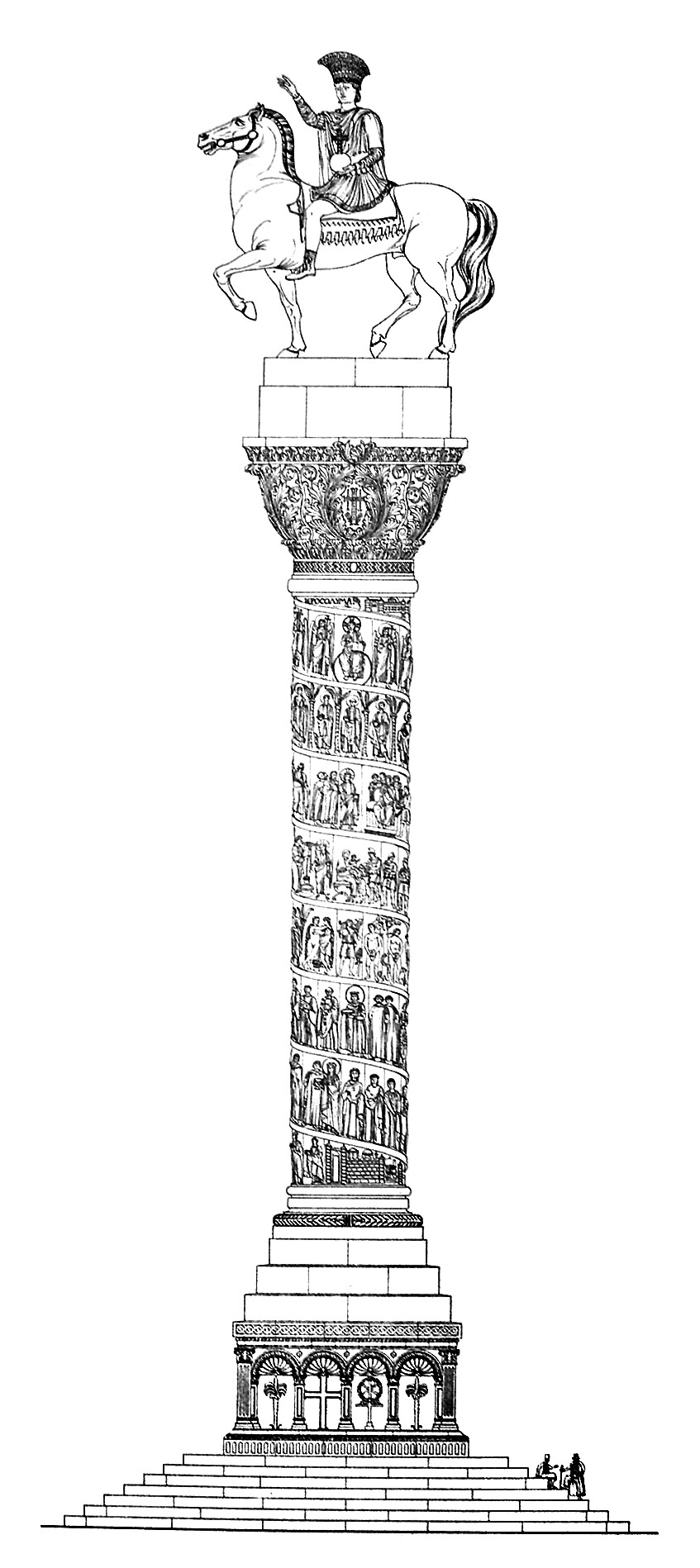
Reconstruction of the column, after Cornelius Gurlitt, 1912. The depiction of a helical narrative frieze around the column, after the fashion of Trajan's Column, is erroneous.

The Column of Justinian was a Roman triumphal column erected in Constantinople by the Byzantine emperor Justinian I in honour of his victories in 543.[1] It stood in the western side of the great square of the Augustaeum, between the Hagia Sophia and the Great Palace, and survived until 1509, its demolition by the Great earthquake of Constantinople[2] which affected other historical places as well.

Description and history

[edit]

The column was made of brick, and covered with brass plaques.[3] The column stood on a marble pedestal of seven steps, and was topped by a colossal bronze equestrian statue of the emperor in triumphal attire (the "dress of Achilles" as Procopius calls it), wearing an antique-style muscle cuirass, a plumed helmet of peacock feathers (the toupha), holding a globus cruciger on his left hand and stretching his right hand to the East.[4] There is some evidence from the inscriptions on the statue that it may actually have been a reused earlier statue of Theodosius I or Theodosius II.[3][5]

The column survived intact until late Byzantine times, when it was described by Nicephorus Gregoras,[6] as well as by several Russian pilgrims to the city. The latter also mentioned the existence, before the column, of a group of three bronze statues of "pagan (or Saracen) emperors", placed on shorter columns or pedestals, who kneeled in submission before it. These apparently survived until the late 1420s, but were removed sometime before 1433.[7] The column itself is described as being of great height, 70 meters according to Cristoforo Buondelmonti. It was visible from the sea, and once, according to Gregoras, when the toupha fell off, its restoration required the services of an acrobat, who used a rope slung from the roof of the Hagia Sophia.[8][9]

Contemporary drawing of the equestrian statue of Justinian (1430). Notice the inscription THEO DOSI, which points to its probable re-use from an earlier monument.

By the 15th century, the statue, by virtue of its prominent position, was actually believed to be that of the city's founder, Constantine the Great.[5] Other associations were also current: the Italian antiquarian Cyriacus of Ancona was told that it represented Heraclius.[5] It was therefore widely held that the column, and in particular the large globus cruciger, or "apple", as it was popularly known, represented the city's genius loci.[10] Consequently, its fall from the statue's hand, sometime between 1422 and 1427, was seen as a sign of the city's impending doom.[11] Pierre Gilles, a French scholar living in the city in the 1540s, gave an account of the statue's remaining fragments, which lay in the Topkapi Palace, before being melted to make cannons:[10]

Among the fragments were the leg of Justinian, which exceeded my height, and his nose, which was over nine inches long. I dared not measure the horse's legs [...] but privately measured one of the hoofs and found it to be nine inches in height.

The appearance of the statue itself with its inscriptions is preserved, however, in a 1430s drawing made by Giovanni Dario at the behest of Cyriacus of Ancona.

References

[edit]

Sources

[edit]
  • Finkel, Caroline (2006). Osman's Dream: The Story of the Ottoman Empire 1300–1923. London: John Murray. ISBN 978-0-7195-6112-2.
  • Guilland, Rodolphe (1969), Études de topographie de Constantinople byzantine, Tomes I & II (in French), Berlin: Akademie-Verlag
  • Kazhdan, Alexander, ed. (1991). Oxford Dictionary of Byzantium. Oxford University Press. ISBN 978-0-19-504652-6.
  • Majeska, George P. (1984). Russian Travelers to Constantinople in the Fourteenth and Fifteenth Centuries. Dumbarton Oaks. ISBN 978-0-88402-101-8.
  • Raby, J. (1987). "Mehmed the Conqueror and the Equestrian Statue of the Augustaion" (PDF). Illinois Classical Studies. 12 (2): 305–313. Archived from the original (PDF) on 2016-03-04. Retrieved 2010-08-17.
[edit]
Revisions and contributorsEdit on WikipediaRead on Wikipedia
from Grokipedia
The Column of Justinian was a monumental triumphal column erected in (modern ) by Byzantine Emperor around 542–543 CE to honor his military victories and project imperial authority. Located in the Augoustaion, the city's central ceremonial forum in front of the and between it and the Great Palace, it stood as the tallest freestanding column of the premodern world at approximately 50 meters (164 feet) high, constructed from stone blocks possibly clad in bronze that was later lost. Atop the column was a colossal bronze of Justinian, measuring about 7.5 meters (24.6 feet) tall and weighing roughly 4,425 kilograms (9,755 pounds), depicting the emperor in military attire with a raised right arm, a toupha headdress, and originally holding an orb surmounted by a cross; the statue may have been a reuse of an earlier monument from the Theodosian era, adapted by the sculptor Patrophilos. This landmark served as a powerful symbol of Justinian's reign, evoking Roman imperial traditions while integrating Christian elements to underscore divine favor and protection over the . The column's prominent position in the Augoustaion made it a focal point for imperial processions and public ceremonies, reinforcing Justinian's image as a restorer of Roman glory amid his reconquests in , , and the . Unlike earlier columns like those of Constantine or Theodosius, Justinian's monument retained its bronze statue intact through much of the Byzantine period, surviving earthquakes and iconoclastic controversies. The column endured until the Ottoman conquest of in 1453, when Sultan ordered the toppled and melted down between 1453 and 1455 to repurpose the , including removal of the , viewing it as a of Christian imperial power; fragments of the statue were still observed around 1550 by travelers like Pierre Gilles. The column shaft itself was dismantled circa 1520, likely for building materials, erasing the monument from the urban landscape by the mid-16th century, though its legacy persists in historical accounts, drawings, and scholarly reconstructions of Byzantine . Today, the site lies beneath the southwestern foundations of the Blue Mosque (Sultan Ahmed Mosque), with no visible remains, but it remains a key example of late antique monumental art and .

Historical Context

Nika Revolt and Aftermath

The Nika Revolt erupted in on January 13, 532, initially as a dispute between the rival Blue and Green factions during games at the , but quickly escalated into a widespread uprising against . The factions, typically divided by social and political affiliations, united under the cry of "Nika" (meaning "conquer" or "victory") to protest Justinian's harsh policies, including heavy taxation and the administration of unpopular officials such as the and the . Rioters stormed prisons to free political detainees, set fires across the city, and proclaimed the senator Hypatius as emperor, drawing support from disaffected senators and the broader populace frustrated with Justinian's early reign. The violence intensified over several days, transforming Constantinople into a scene of devastation reminiscent of a foreign siege, with arson destroying key structures including the original Church of , the Baths of Zeuxippus, the (city prefect's office), and portions of the Great Palace complex. The fires also severely damaged the Augoustaion square, the Senate House, and surrounding areas. On January 18, as Justinian contemplated fleeing the capital amid the chaos, his wife Theodora delivered a resolute speech in the imperial council, declaring that she preferred death as an empress to exile as a , famously stating that the purple robe made a fine burial shroud; this intervention stiffened Justinian's resolve to confront the rebels. Justinian then dispatched loyal generals and Mundus with troops to retake the , where the rioters had gathered; the forces sealed the exits and massacred the crowd, resulting in an estimated 30,000 deaths. Hypatius and his brother , who had been reluctantly elevated by the mob, were captured and executed, with their bodies thrown into the sea shortly after the suppression, while eighteen implicated senators faced banishment and property confiscation, effectively eliminating organized opposition. The revolt, quelled by early February 532, not only highlighted the volatile factional tensions in Byzantine society but also solidified Justinian's autocratic rule by purging rivals and centralizing power. In the immediate aftermath, Justinian launched an ambitious reconstruction program to restore and reshape the damaged city, symbolizing the reimposition of imperial authority; this included the rapid rebuilding of and other structures, with the Column of Justinian erected around 543 in the Augoustaion square as part of the reconstruction program and to commemorate recent military victories.

Justinian's Reconstruction Program

Following the Nika Revolt of 532, which devastated much of including key public and religious structures, Emperor initiated a comprehensive reconstruction program aimed at restoring and elevating the city's infrastructure. This effort, spanning primarily from 532 to 537, was financed through the imperial treasury, supplemented by taxes and revenues from reconquered territories, reflecting Justinian's determination to project stability and divine endorsement after the crisis. The program encompassed not only repairs but enhancements designed to surpass pre-revolt grandeur, symbolizing the emperor's role in renewing the under Christian auspices. Central to this initiative was the rebuilding of the , destroyed during the revolt, which Justinian commissioned immediately afterward and dedicated in 537. Designed by architects and , the new basilica featured innovative engineering such as a vast central dome supported by pendentives, constructed with imported marbles, gold, and silver— the inner sanctuary alone costing 40,000 pounds of silver. Other major projects included the reconstruction of the Great Palace, the , the Chalke Gate, public baths like those of Zeuxippus, and over 30 churches such as Saints Sergius and Bacchus and , alongside infrastructure like the for water supply. These works, documented extensively by the historian in his treatise On Buildings, underscored Justinian's ambition to transform into a beacon of imperial and ecclesiastical power, with no expense spared on materials and labor drawn from across the empire. Ideologically, the reconstruction served as propaganda, positioning Justinian as a successor to Roman emperors like and Constantine while emphasizing Christian triumph and resilience as signs of God's favor. portrays the projects as divinely inspired acts that overcame disaster, reinforcing the emperor's piety and authority amid ongoing challenges like wars and plagues. Monuments within this program, including the erected around 543 in the Augoustaion square adjacent to , served as a key monument in the reconstructed Augoustaion, symbolizing imperial victory and authority; topped with an of the holding a cross-topped , it evoked themes of dominion and faith, though detailed contemporary accounts of the column itself are limited to ' description. Later sources confirm its placement as part of the broader wave.

Construction and Architecture

Date, Purpose, and Methods

The Column of Justinian was erected in 543 CE, approximately six years after the rededication of the in 537 CE, as part of Justinian I's ongoing urban restoration efforts in following the Nika Revolt of 532 CE. Contemporary accounts by the historian , writing in the 550s CE, describe the monument as already standing in the Augustaeum square, confirming its completion within this timeline and integrating it into Justinian's broader building program. The column's primary purpose was commemorative, serving as a triumphal marker that celebrated Justinian's suppression of the Nika Revolt, the reconstruction of the , and his broader victories over internal chaos and external threats, thereby symbolizing imperial restoration and the triumph of Christian orthodoxy. emphasizes its role in proclaiming Justinian's dominion, with the equestrian statue atop the column facing eastward toward Persian adversaries, holding a surmounted by a to represent the extension of the Christian . Akin to earlier Roman victory columns, it functioned as a public emblem of stability and divine favor after the revolt's devastation, which had razed much of the city center including the original . Construction was likely overseen by imperial architects within Justinian's centralized workshop system, involving the quarrying and transport of materials from across the , such as and stone from Proconnesus and from eastern provinces. The shaft employed traditional Roman techniques, including temporary centering to support the tall structure during erection, with a solid core laid in bonding courses for stability and then sheathed in cast panels adorned with garlands; describes it as composed of large stones fitted in circular courses with precisely angled inner faces, though later analyses confirm the included for the core. Contrary to some later misconceptions, no helical spiraling up the shaft was incorporated, distinguishing it from earlier Roman exemplars like . The workforce comprised skilled masons, sculptors, and laborers drawn from the empire's provinces, coordinated through Justinian's extensive building administration that mobilized thousands for monumental projects. While no specific budget for the column survives, it was integrated into Justinian's high-expenditure reconstruction program, which estimates cost billions of gold solidi across the empire, underscoring the monument's role in a lavish display of imperial resources.

Structural Design and Materials

The Column of Justinian featured a tall, freestanding shaft constructed as a composite structure of large stones arranged in circular courses, rather than a single , to achieve its imposing height while ensuring stability through precise masonry fitting. According to the contemporary account by , the shaft was sheathed in panels of the finest , cast in decorative garlands that both bound the stone elements and enhanced the column's aesthetic appeal, with the metal described as softer in color than pure gold yet comparable in value to silver. This cladding contributed to the monument's gleaming appearance, visible from afar across . The shaft's design was plain and cylindrical, lacking the spiral reliefs characteristic of earlier Roman triumphal columns like Trajan's, emphasizing simplicity and height over narrative sculpture in line with Byzantine preferences for imperial visibility. The pedestal supporting the shaft was a rectangular base composed of seven stepped courses of stone, each progressively narrower than the one below, creating projecting ledges. While Procopius describes it generically as built of stones, later analyses suggest the core of the column and pedestal incorporated fired brick masonry, a common Byzantine technique for earthquake resistance in monumental structures, with the exterior potentially finished in white Proconnesian marble for durability and elegance. The base was integrated directly into the pavement of the Augustaeum for added stability, and inscriptions on the pedestal—now lost—dedicated the monument to Justinian and invoked divine protection, underscoring its role as a symbol of imperial restoration. In terms of overall dimensions, scholarly estimates place the column's total height, including pedestal and crowning elements, at approximately 50 meters (164 feet), making it the tallest freestanding column of the premodern world and a dominant feature in the urban skyline. The shaft's diameter tapered gradually from base to summit, a practical choice to distribute weight evenly while maximizing visual impact. This drew direct inspiration from earlier Roman triumphal columns, such as the Column of Theodosius in the city's forum, but adapted for Byzantine contexts by prioritizing verticality and symbolic oversight of the empire from its eastern orientation. The bronze sheathing was removed during the Ottoman era, leaving the underlying structure vulnerable, but the original materials and form highlight Justinian's emulation of Roman traditions amid post-Nika Revolt reconstruction efforts.

The Equestrian Statue

The equestrian statue crowning the Column of Justinian was a colossal bronze figure depicting the emperor mounted on horseback, standing approximately 7.5 meters tall and weighing around 4,425 kilograms. According to the contemporary historian Procopius, the statue portrayed Justinian in triumphal attire, clad in ornate armor including a muscle cuirass, a flowing paludamentum cloak, and low boots without greaves; atop his head sat a distinctive helmet adorned with a crest of swaying peacock feathers known as the toupha. In his left hand, Justinian held a globus cruciger—an orb surmounted by a cross symbolizing Christian dominion—while his right hand was extended toward the east in a gesture of command, with the dynamically posed horse rearing on its hind legs as if advancing spiritedly. Artistically, the statue exemplified late antique realism blended with idealized proportions, drawing from the Roman imperial tradition of equestrian monuments such as the statue of in , which weighed about 2,500 kilograms and shared similar dynamic equine poses. The work's scale and craftsmanship highlighted advanced bronze-casting techniques, rendering the emperor's form with lifelike detail in musculature and drapery while infusing pagan Roman motifs with Christian elements, notably the cross-topped orb that transformed the figure into a symbol of orthodox faith triumphant over adversity. This hybrid style underscored the continuity and adaptation of in the early Byzantine era, positioning Justinian as both a warrior-ruler and a divinely ordained sovereign. Scholarly debates persist over the statue's origins, with evidence suggesting it was not newly commissioned by Justinian but rather a reused or rededicated earlier work, possibly from the fourth century. The sixth-century chronicler attributed it to the emperor , while Renaissance antiquarian Cyriac of , drawing on inscriptions he claimed to have seen in , identified it as a creation of the sculptor Patrophilos for (r. 379–395), later adapted for Justinian's use. Some analyses propose it could derive from a statue of , given stylistic parallels to Constantinian , though no contemporary Byzantine inscriptions confirm any specific attribution, leaving the matter unresolved. Over time, misidentifications proliferated among Byzantine and Western viewers; for instance, fifteenth-century traveler Pero Tafur mistook it for Constantine due to its commanding presence, while participants erroneously viewed it as the hero reclaiming the . Symbolically, the statue cast Justinian as a new Constantine, embodying victory over rebellion—particularly the Nika Revolt of 532—and heresy, with the elevated position atop the 50-meter column making it a visible talisman of imperial power and divine protection across . emphasized its role in signifying Justinian's unchallenged dominion, secured through military prowess and Christian orthodoxy, while the reinforced his role as Christ's earthly viceroy. This not only celebrated reconstruction after urban strife but also amplified the monument's function as a city landmark, fostering a sense of continuity with Rome's imperial legacy under Byzantine rule.

Location and Urban Setting

The Augustaeum Square

The Augustaeum, also known as the Forum of Justinian, was a large public square situated in the historic heart of , positioned southeast of the and directly before the Great Palace. This central location made it a vital node in the city's urban fabric, linking key imperial and civic spaces. The square featured a marble-paved surface and was enclosed by porticoes on all four sides, creating a courtyard surrounded by columns. It was adorned with numerous statues and bronze monuments, including representations of defeated barbarian kings and other imperial figures, enhancing its role as a showcase of Byzantine power. Prominent elements included the , a vaulted structure at the western entrance serving as the empire's zero-mile marker for measuring distances, and the nearby House, rebuilt by Justinian with a supported by six massive white columns under a vaulted roof. As a ceremonial hub, the Augustaeum hosted imperial processions, public announcements, and the annual meeting of the , perpetuating ancient Roman traditions in a Christian context. The Column of Justinian occupied a central position on the square's primary axis, strategically aligned to offer a direct visual connection with the entrance of the adjacent , facilitating grand processional approaches. Rising to a height of approximately 50 meters, the column dominated the skyline and underscored the emperor's authority, with its bronze symbolizing Justinian's imperial authority and military victories. Originally laid out by Constantine I in the early as the core public space of the new capital, the Augustaeum evolved through subsequent imperial interventions. The devastating fires of the Nika Revolt in 532 destroyed much of the area, prompting Justinian's comprehensive reconstruction, which transformed the square into a symbol of renewal with the column as its focal monument.

Relation to Hagia Sophia and the Great Palace

The Column of Justinian was strategically positioned in the Augustaeum square to create a visual and symbolic alignment with the nearby , framing the approach to the church from the south and establishing a triumphal path that transitioned from the secular imperial space to the sacred ecclesiastical one, much like Roman precedents such as leading toward the Pantheon. This off-center placement, closer to the church, ensured that the atop the column appeared with the great dome of immediately behind it, integrating the monument into the city's Christian skyline and emphasizing a sequential imperial-religious vista visible from the Mese avenue and beyond. At approximately 50 meters in height, the column rose prominently alongside the 55.6-meter dome of , symbolically asserting the emperor's earthly authority as complementary to the divine realm embodied by the church. Erected in 543 as part of Justinian's post-Nika reconstruction program, the column primarily honored his military victories while symbolically linking the imperial and ecclesiastical centers through its proximity to the , which had been rededicated in 537 and fully completed in 562. This connection reinforced the column's role in imperial propaganda, portraying Justinian as a divinely sanctioned ruler who bridged military victory and religious piety. The monument's proximity to the Great Palace, particularly adjacent to the Chalke Gate—its main ceremonial entrance—positioned it as a gateway element for imperial audiences and processions entering from the Augustaeum. This placement solidified the palace-church-square triad as the political and religious heart of the , with the column acting as a visible emblem of Justinian's authority at the threshold of complex. In the broader urban context, the column contributed to Justinian's conception of an in , linking profane imperial spaces like the Augustaeum and Great Palace with the sacred domain of , thereby embodying a cosmic order where earthly power supported divine will. This integrative design influenced subsequent Byzantine in cities such as and , where similar alignments of columns, palaces, and churches underscored imperial ideology.

Later History

Byzantine and Late Antique Periods

Following its erection in 543, the Column of Justinian stood as a prominent feature of the Augoustaion, with the surrounding square having been repaired after the Nika Revolt of 532 and subsequent fires that damaged nearby colonnades as part of Justinian's broader reconstruction program. The monument also endured minor earthquakes, such as the 558 event that impacted the Mese processional route, with broader renovations ensuring its stability as a key urban feature. Procopius, in his sixth-century De Aedificiis (Book I.11), described the column as a colossal edifice, topped by an equestrian statue of Justinian clad in armor and holding a globus cruciger, portraying it as a magnificent testament to the emperor's victories and architectural patronage that evoked awe among observers. The column served prominently in imperial ceremonies, marking stations along processions to Hagia Sophia, as detailed in the tenth-century De Ceremoniis by Constantine VII Porphyrogenitus, including Justinian's own triumphal entry in 559 from the Gate of Charisios. During the Iconoclastic Controversies of the eighth and ninth centuries, the column escaped damage due to its status as a secular imperial monument rather than a religious icon subject to veneration, though its evolving Christian symbolism—particularly the —may have been viewed with some ambiguity by iconoclasts yet ultimately preserved. By the middle Byzantine period, it remained a recognized , referenced in as an enduring element of the city's ceremonial landscape, with its pedestal steps gaining sacred connotations reserved for imperial or use by the eighth century. Travelers like the fourteenth-century Nicephorus Gregoras noted its prominence, while its sheathing—originally concealing the brick core—was removed around during the Latin sack amid ongoing economic pressures from the late Komnenian and Angeloi eras, likely repurposed for coinage or melting. In the Palaiologan era, the column's condition reflected the empire's decline, with the globus cruciger falling between 1422 and 1427, an event chronicled by Spanish traveler Pedro Tafur and widely interpreted as a portent of impending doom and Ottoman conquest. appeared in the 1430s, suggesting attempted repairs, but the monument persisted as a symbol of fading imperial glory. During the 1453 of , the column still stood intact in the Augustaeum, visible to Ottoman forces as Janissaries advanced toward , embodying the city's resilient yet waning Roman heritage in eyewitness accounts of the final assault.

Ottoman Era

Following the Ottoman conquest of Constantinople in 1453, Sultan ordered the removal of the equestrian statue atop the Column of Justinian, interpreting it as a potent emblem of Byzantine imperial authority that needed to be neutralized to assert Ottoman dominance, though the column's shaft was preserved as a monumental relic of the vanquished empire. The surrounding Augustaeum square was repurposed as At Meydanı, transforming the former ceremonial heart of Byzantine into a multifunctional public area for markets, festivals, and communal gatherings under Islamic urban administration. Eyewitness and traveler accounts from the 15th and early 16th centuries highlight the monument's altered state: the Italian pilgrim Cristoforo Buondelmonti, writing in the 1420s just before the fall, described the intact column as soaring to a height of 70 cubits (approximately 35 meters), visible from the sea and crowned by the imposing bronze rider. By the mid-16th century, French scholar Pierre Gilles noted the column standing headless in the square, with scattered fragments of the dismantled —including a taller than an adult man, a 9-inch-long nose, and a matching —still visible amid the urban clutter, underscoring the monument's partial survival amid decay. Ottoman engagement with the column reflected pragmatic reuse rather than veneration: the bronze from the statue was melted down between 1453 and 1455, likely repurposed for artillery cannons or architectural elements in major projects like the complex built under in the 1550s. The site increasingly served secular functions, including occasional public executions and trade activities that overshadowed its original triumphal role, with no recorded efforts at restoration as Ottoman priorities shifted toward Islamic monumental architecture and away from Christian imperial symbols. By the early , prior seismic events had caused the column to lean noticeably, yet it persisted as a symbolizing imperial continuity; Ottoman chroniclers and court under portrayed the sultan as the successor to Roman and Byzantine rulers, integrating such ancient monuments into a of unbroken from antiquity to the new Islamic order.

Destruction and Legacy

The 1509 Earthquake and Demolition

The Great Earthquake of 1509, known in Ottoman chronicles as Kıyamet-i Suğra or the "Lesser ," struck on September 10, with an estimated magnitude of 7.2 ± 0.3. The epicenter lay in the , generating widespread devastation across and surrounding regions, including a and aftershocks lasting 45 days. The quake killed around 5,000 people in the city alone and destroyed over 1,000 houses, numerous mosques such as those of and , parts of the city walls, and public buildings, while damaging . Ottoman historians interpreted the event as divine punishment, amplifying its apocalyptic significance in contemporary accounts. The Column of Justinian, already standing without its since the Ottoman conquest, partially or fully collapsed in the earthquake, with the masonry shaft toppling and the pedestal sustaining cracks. Scattered fragments from the bronze , including a horse's leg taller than a man, the emperor's nose measuring nine inches, and a of similar length, were noted by French scholar Pierre Gilles during his visit around 1550, indicating the monument's prior dismemberment. The remnants underwent systematic demolition in the early amid post-earthquake urban renewal, likely under Sultan Suleiman I following reports of instability from the quake. Gilles observed that the column had been dismantled about 30 years prior to his arrival, leaving only the base intact at that time. The marble pedestal was repurposed for construction in nearby mosques, including as entrance steps, while bronze components from the were melted down for Ottoman artillery during conflicts like the Ottoman-Venetian wars. The base of the column survived longer and was eventually incorporated into local structures. Today, no major fragments of the column or statue remain extant, with any minor pieces in museums unverified through direct provenance. The original site in the former Augustaeum now lies within Istanbul's Sultanahmet district, beneath the foundations of the Blue Mosque, integrated into modern urban fabric without visible traces of the monument.

Cultural and Scholarly Significance

The Column of Justinian served as a potent symbol of imperial triumph in , inspiring depictions that echoed its monumental scale in later visual traditions, such as the processional mosaics at the in , where Emperor Justinian is portrayed amid courtly splendor to evoke the restoration of Roman authority. This symbolism extended to illustrated manuscripts and icons, where the column's form represented the enduring glory of Justinian's reign, as seen in and Venetian paintings that recast it within cross-cultural narratives of power and legacy. In Byzantine chronicles, such as those of in his De Signis, the monument evoked Justinian's era as a golden age of reconquest and , contrasting it with the decay of later centuries to underscore themes of imperial hubris and divine favor. In and , the column featured prominently in Ottoman tales as one of the "," woven into and apocryphal stories that transformed it into a of ancient and apocalyptic prophecy, blending Byzantine heritage with Islamic . During the , Romantic writers viewed it as an emblem of lost Byzantine splendor amid Ottoman decline. Modern novels continue this tradition, employing the column as a for fleeting imperial ambition, as in works that draw on its biography to explore themes of cultural erasure and resilience. Scholarly studies in the , notably Cyril Mango's analysis in Studies on Constantinople (1993), examined the column's role in urban topography and its successors' imitations, highlighting its function as a ceremonial axis in the Augustaeum square. Gilbert Dagron's works on Byzantine capital formation further interpreted it as a symbol of sacral kingship, integrating it into broader discussions of 's symbolic landscape. Debates on the equestrian statue's reuse—likely from , based on inscriptions preserved in drawings and numismatic parallels showing similar imperial iconography—have relied on seals and coins to trace its pre-Justinianian origins, resolving earlier uncertainties through epigraphic evidence. Post-2000 research, including GIS modeling of the Augustaeum, has filled gaps in spatial understanding by reconstructing the square's layout and the column's visibility, using digital simulations to assess its integration with nearby structures like . In modern contexts, the column's memory influences Istanbul's , where its former site in the historic peninsula draws visitors to guided tours emphasizing Byzantine engineering feats comparable to Rome's surviving columns, such as . The site's location beneath modern structures limits archaeological access, though the area remains of interest for potential future investigations.

References

Add your contribution
Related Hubs
User Avatar
No comments yet.