Hubbry Logo
ComillasComillasMain
Open search
Comillas
Community hub
Comillas
logo
8 pages, 0 posts
0 subscribers
Be the first to start a discussion here.
Comillas
Comillas
from Wikipedia

Comillas is a small township and municipality in the northern reaches of Spain, in the autonomous community of Cantabria. The Marquessate of Comillas, a fiefdom of Spanish nobility, holds ceremonial office in the seat of power at a small castle which overlooks the town. The Comillas Pontifical University was housed here before it moved to Madrid, and the old university buildings are among the finest examples of architecture in the town. Besides this, there are many notable medieval and baroque buildings.

Key Information

From the second half of the 19th century, the Spanish royal family started spending their summers in Comillas, and so did a large part of the Spanish nobility, whose many descendants still frequent the town every summer.[2][3] As a result, Comillas left an imprint of architectural relics such as palaces and monuments designed by renowned Catalan artists in particular, i.e. Gaudí or Doménech i Montaner.[4] From the second half of the 20th century however, southern Spain and the islands became more popular due to an increasing inclination towards sunnier destinations, and so places like Marbella, Sotogrande or Mallorca became attractive prospects for the rich and famous.[5][6] Although the town has seen an upsurge in the last years, it still maintains its character as "the haven for the decadent and discreet aristocracy".[7][8]

Comillas was the capital of Spain for one day, on 6 August 1881, following an agreement between king Alfonso XII and the Minister's Council to gather at a formal meeting in town.[9] It also became the first place in Spain to use Edison's electric light bulbs, in 1880.[10]

History

[edit]

Comillas was first inhabited in prehistoric times when the caverns that are plentiful in the area were used as shelters. The Neolithic inhabitants left behind them rock paintings that depicted the animals they hunted.[11] Magdalenian and Bronze Age artefacts have been found in nearby Ruiseñada, and there was an ancient mine at La Molina in which utensils and Roman coins have been found as well as an altar dedicated to the god Jupiter.[12] Arrowheads have also been found here. On the border between Comillas and Ruiloba, heaps of shells have been found showing that the ancient people, besides hunting, specialised in collecting food from the sea.

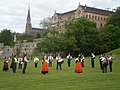
View of Oyambre Beach with Picos de Europa behind

The remains of the medieval castle of Peña del Castillo are still visible and another castle later occupied the same strategic site. The earliest documents relating to the town date to the eleventh century, although most of them were destroyed later in a fire at the town hall. Garcilaso de la Vega built a tower on the coast to demonstrate the town's dominance in maritime affairs. After the conclusion of the Valles Lawsuit against the Duke of Infantado in 1581, Comillas became part of the Province of Nine Valleys, a judicial and administrative body. Historically, the town was one of four towns making up the Alfoz of Lloredo. The town is sometimes known as the "Town of the Bishops", because five priests who were born here went on to become bishops in several different dioceses during the Middle Ages.[13]

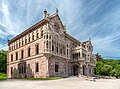
During the second half of the 19th century, the first Marquess Antonio López y López invited King Alfonso XII to his mansion at Comillas and the town became popular with the aristocracy; the architect Joan Martorell built the enormous Palacio de Sobrellano on the instructions of the marquess.[14]

Alfonso XIII (right) teaching cycling to his nephew Infante Alfonso in Comillas, 1910

Geography

[edit]

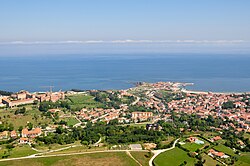
Comillas is situated close to the coast in the autonomous community of Cantabria. To the north lies the Bay of Biscay and to the south the Cantabrian Mountains which run parallel with the coast, the highest point of which is the Torre de Cerredo, 2,648 metres (8,688 ft). Santander lies fifty kilometres to the east. There is a sandy beach and headlands and the town is set a little way back from the sea.[15]

Buildings

[edit]

The Plaza del Corro de Campios, in the centre of the oldest part of the town, is surrounded by ancestral mansions with shields on the walls depicting the noble families who lived there. The town hall and the seventeenth century parish church of San Cristóbal are nearby,[13] and there are some interesting mausoleums in the cemetery. The Neo-Gothic university buildings overlook the town.[16] The Art Nouveau buildings are some of the finest in Cantabria and include the Sobrellano Palace Chapel, the Pantheon, and El Capricho, a fantastic creation by the Catalan architect Antoni Gaudí.[17]

Marquess of Comillas

[edit]

The first Marquess of Comillas was Antonio López y López (died 1883). Founder and owner of the Compañía Transatlántica Española, he was born in Comillas in 1817 and made his money in Cuba in shipping and slaves. He bought the title in 1878.[18] The second Marquess of Comillas was his son Claudio López Bru. The current Marquess of Comillas is Don Juan Alfonso Güell y Martos.

[edit]

References

[edit]
[edit]
Revisions and contributorsEdit on WikipediaRead on Wikipedia
from Grokipedia
Comillas is a historic coastal municipality in the autonomous community of Cantabria, northern Spain, situated approximately 50 kilometers west of Santander and 16 kilometers from Santillana del Mar. Renowned for its rich architectural heritage, the town exemplifies late 19th-century Modernist and Neo-Gothic styles, developed largely through the patronage of Antonio López, the first Marqués de Comillas (1817–1883), who amassed wealth in Cuba as a tobacco planter, shipowner, banker, and through involvement in the slave trade, before commissioning transformative buildings. With a compact old center of cobbled streets, ancestral houses, and towers overlooking a golden beach and small fishing port, Comillas serves as a symbolic cultural hub in the region, blending human-made landmarks with natural coastal beauty. Among its most notable architectural treasures is , a whimsical summer villa designed by in 1883–1885, featuring intricate ceramic decorations, a distinctive , and oriental influences that mark it as one of the architect's early masterpieces outside . Nearby, the Sobrellano Palace, a Neo-Gothic residence built between 1882 and 1888, showcases opulent interiors and serves as a testament to the Marqués family's influence, while the adjacent Sobrellano Palace Chapel and Pantheon highlight elements. The town's skyline is dominated by the building, originally constructed in the late 19th century as a and now a striking that underscores Comillas' educational and religious legacy, though the modern institution operates primarily in . Beyond its built environment, Comillas is celebrated for its fine-sand beaches ideal for water sports and relaxation, drawing summer crowds to its vibrant waterfront. Adjacent to the town lies the Oyambre , a protected coastal expanse encompassing dunes, cliffs, marshlands, and diverse birdlife, offering opportunities for and amid Cantabria's verdant landscapes. The municipality supports a range of accommodations, from hotels and rural cottages to campsites, catering to visitors interested in its architectural tours, outdoor pursuits, and lively seasonal nightlife.

History

Prehistory and medieval origins

The earliest evidence of human presence in the Comillas area dates to the period, with the Cueva de La Meaza in the Ruiseñada neighborhood serving as a key site. Discovered in 1907 by archaeologist Hermilio Alcalde del Río, the cave contains attributed to the phase, estimated at around 18,000 years old, including depictions of animals and abstract forms created using engraving and painting techniques. Artifacts such as animal bones, stone tools, and remains indicate its use as a seasonal by groups navigating the coastal landscape for resources like marine mammals and fish. Excavations in the 1940s further revealed stratified layers confirming repeated occupation from the Paleolithic through later prehistoric eras, underscoring Comillas' role in early Cantabrian settlement patterns. During the , Comillas emerged as a modest coastal settlement, primarily a sustained by maritime activities and limited agrarian pursuits. The first documented references to the town appear in 11th-century records, including a of local properties to the of . By the 12th century, it functioned as a small community of fishermen using rudimentary vessels to exploit nearby waters for sardines, anchovies, and seasonal catches, supplemented by on terraced hillsides growing cereals and vegetables, as well as rearing in surrounding pastures. remained localized, involving exchanges of and goods with inland Cantabrian villages, with no significant commercial ports until later centuries. In the , Comillas gained ecclesiastical prominence, earning the moniker "Villa de los Arzobispos" due to the birth of several high-ranking clergy there, beginning in the late and continuing into the 18th. The earliest noted figure was Diego Ibáñez de Lamadrid y Bustamante, born in Comillas in 1687 and later Bishop of , followed by others such as Juan Domingo González de la Reguera (born 1726), who became of . This legacy reflects the town's growing ties to the Church, which supported early religious infrastructure amid a predominantly rural, seafaring populace. Initial sacred structures included modest chapels, evolving into more formal edifices like the Church of San Cristóbal, whose construction began in 1640 after a dispute between locals and the of Infantado's administrator, leading parishioners to fund the project independently; the church exemplifies Montañés style with classical buttresses and a prominent tower, though its foundations may trace to earlier medieval worship sites. Comillas also played a role in regional autonomy efforts, contributing to the Pleito de los Nueve Valles, a legal dispute resolved in 1581 by King Philip II, which granted independence to the nine valleys, including areas around Comillas, from the Marquis of Santillana. From the 16th to 18th centuries, the local economy benefited from whale hunting, with Comillas serving as a key base in until around 1720. Regional conflicts, particularly the , indirectly shaped Comillas' medieval trajectory as part of the resilient Christian northern polities. , never fully subdued by Muslim forces after the 8th-century invasions, served as a , with local sailors from villages like Comillas contributing vessels and manpower to key campaigns, including the 1248 reconquest of , which brought recognition and minor economic incentives through royal privileges. These efforts reinforced the town's defensive posture, with agrarian and economies providing sustenance during periods of instability, while limiting broader trade disruptions in the coastal zone.

19th-century development and modernization

During the mid-19th century, Comillas experienced significant economic transformation driven by to and the subsequent return of wealth by prominent figures such as Antonio López y López, the first Marquis of Comillas. Born in 1817 to a humble family in the town, López emigrated to in his youth, where he built a fortune through commerce before returning to invest in local infrastructure, including the establishment of shipping lines and trade connections via the Compañía Transatlántica Española, which he founded in 1850. This influx of capital from Cuban ventures, part of a broader wave of Cantabrian to the , shifted Comillas from a modest and agricultural settlement toward a burgeoning regional hub, fostering trade links across the Atlantic. A pivotal event in Comillas' modernization occurred on August 6, 1881, when the town briefly served as Spain's temporary capital for one day. This stemmed from an invitation by Antonio López to King , a close acquaintance, who convened the there during his summer visit, which lasted until August 26. The royal presence elevated Comillas' status, attracting national attention and spurring further development in the coastal enclave. Institutional growth marked another key aspect of 19th-century progress, exemplified by the founding of the in 1881. Antonio López proposed the initiative to the , aiming to establish a for impoverished children in his marquessate; construction began shortly thereafter under Jesuit oversight, laying the groundwork for what would evolve into the , originally a pontifical established in 1892 before its relocation to in 1968. This educational endeavor reflected López's commitment to social upliftment amid the town's rising prosperity. Modernization milestones included the town's designation as a historical-artistic heritage site on March 29, 1985, recognizing its preserved 19th-century legacy, alongside the early establishment of aristocratic summer retreats that influenced subsequent . The return of emigrants' wealth catalyzed social shifts, including commissions for architectural projects that enhanced the town's aesthetic and cultural profile, while contributing to stabilization by creating opportunities in trade, construction, and services.

Geography and environment

Location and physical features

Comillas is situated in western , an autonomous community in northern , at geographical coordinates 43.3884° N, 4.2894° W. The municipality spans an area of 18.6 km², with its northern boundary along the (also known as the ) and its southern edge abutting the Udías mountains. This positioning places Comillas within the broader Cantabrian coastal region, approximately 48 km west of the regional capital, Santander, facilitating access via the N-634 highway, a key coastal route that has historically supported trade along the northern Spanish shoreline. The topography of Comillas features undulating hilly terrain interspersed with dramatic cliffs, chasms, and lush green countryside, offering panoramic views of the coastline. A small port punctuates the shoreline, enhancing the area's maritime character, while the municipality's proximity to the mountain range—about 50 km to the southeast—provides a striking contrast between coastal flats and inland elevations. This varied landscape has long contributed to Comillas' role in regional coastal trade routes, serving as a historical hub for maritime activities including and . Natural features include the adjacent Oyambre Nature Reserve, which borders Comillas to the west and encompasses dunes, secluded coves, and estuarine zones. Locally, beaches such as Playa de Comillas stand out, characterized by fine golden sand stretching along the bay. These elements define the spatial context of Comillas, blending accessible coastal plains with elevated hinterlands for a compact yet diverse municipal footprint.

Climate and natural reserves

Comillas experiences an oceanic climate (Köppen classification Cfb), characterized by mild temperatures influenced by the Atlantic Ocean, with average high temperatures ranging from 20°C to 25°C in summer (July–August) and 10°C to 15°C in winter (December–February). Annual precipitation is high, typically between 1,000 mm and 1,380 mm, distributed throughout the year but peaking in autumn and winter, often accompanied by frequent fog due to maritime air masses. Seasonal variations feature wet winters with cooler, overcast conditions that promote lush green vegetation across the landscape, while mild summers provide comfortable conditions for outdoor activities, though occasional heatwaves can occur. These patterns support local agriculture, particularly and , but contribute to through persistent rainfall and wave action that undermine cliffs and beaches. The Oyambre Nature Reserve, encompassing approximately 5,800 hectares adjacent to Comillas, protects a diverse coastal including dunes, cliffs, wetlands, estuaries, and meadows, designated as a in 1988 to preserve its ecological integrity. The reserve hosts rich , with a diverse array of bird species such as egrets, , and migratory waterfowl in the wetlands, alongside diverse and populations in the coastal waters. Conservation efforts since the 1980s have focused on restoration, dune stabilization, and regulated to mitigate human impacts while promoting scientific and . Environmental challenges in the region include ongoing , exacerbated by storm surges and rising sea levels from , which threaten beaches like those in Oyambre by reducing sand volumes and altering sediment dynamics. These effects have led to localized beach retreat rates of up to 1–2 meters per year in vulnerable Cantabrian coastal areas, prompting adaptive measures such as and monitoring programs.

Demographics and society

As of January 1, 2024, the municipality of Comillas had a resident of 2,141 . This figure reflects a of approximately 116.0 inhabitants per square kilometer, given the municipality's surface area of 18.46 km². The distribution was roughly balanced, with about 48% males (around 1,018) and 52% females (around 1,123), consistent with patterns observed in small coastal municipalities in . Historically, Comillas experienced gradual population growth from approximately 1,900 residents in the mid-1970s to a peak of 2,267 in 2015, driven by modest and economic opportunities in and services. Following this high point, the population saw a slight decline to 2,141 by 2024, amid broader regional trends of low birth rates and aging demographics. However, the municipality experiences a significant seasonal surge during summer months due to , multiplying the effective several times over and straining local but boosting economic activity. Migration patterns have shaped Comillas' demographics over time. In the , the town saw notable emigration to , particularly among working-class families seeking opportunities in trade and agriculture, exemplified by figures like Antonio López y López, who built fortunes abroad before repatriating wealth. In more recent decades, Comillas has attracted an influx of retirees drawn to its coastal location and mild climate, contributing to population stability, alongside seasonal workers in and tourism who arrive during peak visitor periods. Looking ahead, population projections for Comillas indicate stability or a slight decrease, influenced by an aging demographic structure. The average age of residents was 45.1 years as of 2018, with an old-age of 61.22% and an aging rate of 27.33% (reflecting the proportion of those over 64 relative to younger groups). These metrics, higher than national averages, suggest ongoing challenges from low and net out-migration of younger cohorts, potentially leading to a 5-10% decline by 2040 if current trends persist, though tourism-related inflows may mitigate this.

Cultural and social composition

Comillas exhibits a predominantly homogeneous ethnic composition, reflective of its location in rural , where the population is overwhelmingly of Spanish origin, specifically Cantabrian. As of 2024, foreign-born residents number around 195, accounting for approximately 9% of the population. This low but increasing influx aligns with broader trends in , which has historically experienced limited migration compared to urban centers in . Historical influences from , particularly the "indianos"—Cantabrians who returned wealthy from opportunities in and other parts of during the late 19th and early 20th centuries—have left subtle cultural imprints, including family lineages with transatlantic ties that enriched local social dynamics without significantly altering the ethnic fabric. The linguistic landscape is dominated by Castilian Spanish, the official language of , spoken universally among residents. A regional variant, the Cantabrian dialect (also known as Montañés), persists in informal settings but has dwindled to fewer than 3,000 native speakers across the entire autonomous community, with even less prevalence in Comillas. This dialect, part of the Asturleonese group, underscores a sense of regional identity tied to Cantabria's mountainous heritage. Comillas' moniker, "Villa de los Arzobispos" (Town of the Archbishops), further bolsters local pride, originating from the town's legacy of producing numerous high-ranking Catholic clergy, including several archbishops, which has fostered a centered on and community resilience. Socially, Comillas maintains a tight-knit, family-oriented structure typical of small coastal towns in northern , where extended families play a central role in daily life and intergenerational support. The exerts a profound influence, permeating community rituals and values, largely due to the historic Major Seminary established in 1890 by for the training of priests from and . This institution not only elevated local levels—historically linking scholarly pursuits to religious formation—but continues to symbolize spiritual guidance in social matters. in Comillas benefits from this legacy, with higher-than-average emphasis on and in local schooling, contributing to a cohesive community ethos. Community life thrives through vibrant traditions, particularly annual festivals honoring patron saints, which reinforce social bonds. The Fiesta del Santo Cristo del Amparo on July 16 features a nocturnal procession to the harbor, traditional dances like the "danza de los picayos," and communal feasts, drawing residents together in celebration of maritime heritage. Similarly, the Fiestas de San Pedro in late June include bonfires, music, and popular verbenas, blending religious devotion with folk customs. These events, alongside in February, promote inclusivity across generations. Seasonal , peaking in summer, enhances economic vitality but introduces temporary strains on social cohesion by swelling the population and altering daily rhythms, though locals often view it as an opportunity for cultural exchange.

Economy and tourism

Local economic sectors

The economy of Comillas is predominantly driven by the services and sectors. These include retail, local trade, and that support daily community needs, reflecting the town's role as a small coastal municipality in . The primary sector remains significant, encompassing farming—particularly production in the surrounding green valleys—agricultural cultivation of crops such as and , and traditional operations at the local . Historically, Comillas' economy evolved from reliance on maritime activities in the , when the construction of its facilitated small-scale shipping and trade ties, to a more diversified structure emphasizing services and limited primary production today. While the was never a major commercial hub, it supported fishing and local transport until the early , after which economic focus shifted toward inland agriculture and regional commerce amid broader modernization in . Manufacturing remains minimal, with no large-scale industries present, aligning with the region's overall emphasis on small enterprises. Employment in Comillas benefits from a low rate, recorded at 6.05% as of September 2025, below regional and national averages, supported by stable jobs in services and cooperatives. Agricultural cooperatives, such as those involved in dairy processing, and fisheries associations provide key employment opportunities, though many residents commute to larger centers like Santander for higher-skilled or industrial roles. Local economic challenges include seasonal fluctuations in primary sector output, influenced by weather variability affecting and yields, as well as overall dependence on the broader Cantabrian economy for supply chains and markets. This reliance exacerbates vulnerabilities to regional downturns, prompting efforts to strengthen cooperatives for greater resilience.

Tourism and visitor attractions

Tourism serves as the primary economic driver in Comillas, particularly during the summer months when visitor numbers peak, supporting a range of accommodations including hotels, rural inns, apartments, cottages, and campsites that generate significant revenue through lodging, dining, and related services. The sector has evolved from the town's 19th-century role as an aristocratic summer resort, frequented by Spanish royalty and nobility who built lavish retreats along the coast, into a modern destination emphasizing sustainable practices and eco-tourism to preserve its natural and cultural assets. Comillas appeals to a diverse visitor profile, including beachgoers drawn to its coastal sands, nature enthusiasts exploring nearby reserves, and those interested in , with annual visitors reaching 751,881 in 2024. Approximately 17.5% of visitors to Cantabria's seven most beautiful villages were international in 2024, contributing to off-season visits through events like religious processions during Semana Santa, which enhance cultural immersion and extend the tourism calendar beyond summer highs. Popular activities include water sports such as and on the town's Blue Flag beaches, which offer calm waters and natural rock pools suitable for families and beginners. Hiking trails in the adjacent Oyambre Natural Park provide opportunities to observe diverse birdlife, wetlands, and coastal dunes, promoting eco-friendly exploration. Day trips to nearby sites like , just a short drive away, allow visitors to combine Comillas' offerings with broader regional discoveries, often facilitated by local bus services or car rentals from .

Architecture and heritage

Ecclesiastical and historic structures

The Church of San Cristóbal, located in the heart of Comillas, is a key ecclesiastical structure constructed primarily in the second half of the and completed by through the collective effort of local inhabitants who contributed labor and funds weekly. This community-driven project arose after a dispute with the administrator of the of Infantado, leading to the relocation from an older cliffside site now used as a cemetery. Designed by architect Rubin de Pesués in a clasicista style with influences, the church features a quadrangular plan, rectangular , three naves separated by robust stone pillars, and an imposing prismatic tower of four stories topped by an 18th-century balustrade and pyramidal . Its southern portal bears a 1713 inscription along with escutcheons of Comillas and the Spanish Crown, while the interior houses the revered Cristo del Amparo, of local fishermen, alongside polychrome images, a romantic-style organ from the early , and elements like a pulpit and attributed to Joan . Positioned in the town square, it serves as a focal point for community religious events and processions, underscoring its enduring cultural and spiritual significance in Comillas. The Major , erected between 1881 and 1893 under the patronage of the of Comillas and managed by the , represents a pivotal historic that later evolved into the of Comillas. Initiated as a gesture of gratitude to his hometown, the project was designed initially by Joan i Montells starting in 1883, with completion overseen by , blending neo-Gothic elements with modernist ornamentation such as intricate brickwork, Mudéjar-inspired details, and Catalan influences in its facade and interiors. The sprawling complex, including its chapel clad in tiles and featuring advanced 19th-century construction techniques, once trained clergy and scholars, contributing to Comillas' reputation as a center of learning tied to the Marquess's Jesuit connections. Today, following the university's relocation in 1972, the site is preserved for cultural events, conferences, and exhibitions, with parts managed by the Comillas Foundation for language and cultural programs overlooking the . Erected in 1890 as a tribute to Antonio López y López, the first Marquess of Comillas, the monument stands prominently on a cliffside vantage point, symbolizing his 19th-century philanthropy and economic contributions to the town through maritime trade and infrastructure. Designed by Lluís Domènech i Montaner with supervision by Cristóbal Cascante, this modernist structure features a ship-keel base evoking the Marquess's naval enterprises, adorned with maritime motifs, allegories to the Antilles and Philippines, and a column supporting an urn or emblematic figure, offering panoramic views of the coastline. It embodies the era's indiano legacy, where returning emigrants like the Marquess funded local development, and remains a commemorative landmark highlighting his role in elevating Comillas' status. Comillas, dubbed the "Villa de los Arzobispos" for producing five archbishops in the 17th and 18th centuries, preserves several historic residences from the 16th to 18th centuries that served as summer retreats for high-ranking , including noble houses like the Casa de los Picos and Palacio de la Quintana, built in stone masonry with heraldic shields and details reflecting the town's prominence. These structures, part of the urban fabric around the Church of San Cristóbal, exemplify regional Montañés architecture with austere facades, coats of arms, and defensive elements from the medieval period onward. The entire historic core, encompassing these sites, was declared a Conjunto Histórico-Artístico on March 29, 1985, ensuring their protection and conservation as under Spanish law, which safeguards the architectural and historical integrity of such ensembles.

Modernist buildings and landmarks

Comillas emerged as a notable center for Catalan in the late , attracting innovative architects through the patronage of wealthy indianos who returned from the with fortunes derived from trade and industry. This experimentation extended the movement beyond , incorporating local materials and motifs to create structures that blended organic forms with industrial elements like exposed brick, vibrant ceramic tiles, and , symbolizing the era's economic prosperity. One of the most emblematic examples is , a summer designed by between 1883 and 1885 for the businessman Máximo Díaz Quijano. The building features a distinctive wrought-iron tower adorned with sunflower-patterned ceramic tiles, evoking natural growth and Oriental influences, while its interior includes a music room with acoustic designs that fuse musical harmony with organic motifs inspired by nature. Its U-shaped, three-story layout maximizes light and space in a compact footprint, marking it as Gaudí's first major project outside and an early precursor to European Modernism. The Palacio de Sobrellano, constructed from 1881 to 1890 as a neo-Gothic summer residence for the Marquess of Comillas, was primarily designed by the Catalan architect Joan Martorell, with Gaudí contributing to the ironwork, furniture, and decorative elements in the adjacent pantheon chapel. The palace's facade showcases intricate stone carving and pointed arches that exaggerate Gothic revivalism, while the chapel incorporates modernist touches such as innovative metalwork and furnishings that integrate functionality with artistic flourish. These elements highlight the collaborative spirit of the period, where traditional forms met emerging industrial techniques. Today, both structures are preserved as public museums, with El Capricho privately managed and restored to maintain its original woodwork, tiles, and iron details. In 2023, El Capricho was awarded TripAdvisor's Travelers' Choice Best of the Best as the world's top tourist monument. The Palacio de Sobrellano, acquired by the regional government of Cantabria, remains in excellent condition, showcasing its historical furnishings and architecture through guided tours. Efforts to include these sites in UNESCO World Heritage extensions for Gaudí's works have been proposed since the early 2000s, with continued regional support in 2024, recognizing their role in the architect's oeuvre, though they currently hold national protected status.

Notable people

The Marquess of Comillas

The Marquessate of Comillas is a in the Spanish peerage, granted with the dignity of Grandee of Spain to Antonio López y López on 3 July 1878 by King , in recognition of his substantial economic support and philanthropic efforts toward his native town of Comillas. The title reflects the family's rise from humble origins to one of Spain's most influential business dynasties, with a lasting impact on the town's development through education and infrastructure patronage. Antonio López y López, the 1st Marquess of Comillas (1817–1883), was born in Comillas to a modest family in the Sobrellano neighborhood and emigrated to at age 14 after being orphaned. There, he amassed a fortune through commerce, banking, and shipping, establishing the shipping company Antonio López y Cía. in 1850, which later became the Compañía Transatlántica Española in 1881, and founding over 200 enterprises, including the Banco Hispano Colonial and the Compañía General de Tabacos de Filipinas. His early business activities in involved the illegal slave trade, which contributed significantly to his initial capital accumulation during the 1830s and 1840s, though direct documentary evidence remains debated among historians. Upon returning to , López y López engaged in philanthropy, notably funding educational initiatives in Comillas, such as supporting the establishment of a for underprivileged youth, which laid the foundation for the town's cultural elevation. The title passed to Claudio López y Bru (1853–1925), the 2nd of Comillas and son of the 1st Marquess, who inherited and vastly expanded the family empire after his father's death in 1883. Born in , Claudio López y Bru diversified the shipping interests into , railways, and , adapting the conglomerate to the loss of Spanish colonies in 1898 and solidifying its position as a cornerstone of Spain's . By the time of his death in in 1925, he was one of Europe's richest individuals, underscoring the scale of the family's industrial dominance. Subsequent holders, including Juan Antonio Güell y López de Bru as the 3rd and later Alfonso Güell y Martos as the 4th, continued the lineage through intermarriages with prominent families like the Güells, ensuring the title's perpetuation into the . The marquesses' legacy in Comillas endures through their sustained support for and , transforming the town from a into a center of cultural significance. However, the family's historical involvement in the and colonial exploitation has sparked modern controversies, prompting reevaluations of their commemorations in public spaces. This includes the 2018 removal of a statue of Antonio López in , prompted by campaigns against glorifying figures linked to .

Other prominent figures

Comillas has long been recognized as the "Villa de los Arzobispos" due to the notable ecclesiastical figures born in the town during the 17th to 19th centuries, who rose to prominent positions in the Spanish church and exerted influence on both religious and local affairs. The five key archbishops and bishops include Diego Ibáñez de Lamadrid y Bustamante (born 1687), who served as Bishop of and marked the beginning of this tradition; Juan Domingo González de la Reguera, Archbishop of in during the , contributing to colonial church administration in the ; Rafael de la Vara Quintana, Bishop of Sigüenza; Bernardo Martínez de la Rabia (born 1759), Bishop of in and later Cartagena de Indias in , known for his pastoral work in remote dioceses; and Antonio de Echevarría y Echevarría, Bishop of , whose tenure strengthened ties between the Cantabrian church and national institutions. Their achievements are commemorated on the façade of the Old , symbolizing Comillas' enduring religious legacy and the town's role in producing high-ranking who bridged local and global Catholic networks. Beyond these ecclesiastical leaders, other prominent figures from Comillas include Máximo Díaz de Quijano (1838–1885), a successful and Indiano who amassed wealth in before returning to his hometown. As a close associate and brother-in-law of the Marquess of Comillas, Díaz de Quijano commissioned to design in 1883, a modernist villa that exemplifies the fusion of local patronage with innovative architecture and now stands as a key cultural landmark. Local artists and emigrants further enriched the town's fabric; many Comillas natives, like the Indianos who ventured to and in the , returned with fortunes that funded opulent homes and public works, blending Cantabrian traditions with exotic influences to elevate the community's artistic and economic profile. In contemporary times, figures involved in and preservation continue this , often drawing on Comillas' heritage to promote . Local administrators and heritage experts, through initiatives like the annual Día del Indiano festival, safeguard the town's modernist sites and indiano architecture, fostering economic growth via . Ties to the —originally established in the town in 1890 by the at the Marquess's urging, before relocating to in the 1970s—extend this influence, with alumni such as former Spanish Mariano Rajoy contributing to national education and policy while honoring the institution's Cantabrian roots. The collective legacy of these figures underscores Comillas' contributions to through the university's foundational in Jesuit , to via patronage of iconic structures like , and to regional identity as a hub of ecclesiastical prestige and indiano prosperity that transformed a modest into a vibrant cultural destination.

References

Add your contribution
Related Hubs
User Avatar
No comments yet.