Hubbry Logo
Economic surplusEconomic surplusMain
Open search
Economic surplus
Community hub
Economic surplus
logo
8 pages, 0 posts
0 subscribers
Be the first to start a discussion here.
Contribute something
Economic surplus
Economic surplus
from Wikipedia
Graph illustrating consumer (red) and producer (blue) surpluses on a supply and demand chart

In mainstream economics, economic surplus, also known as total welfare or total social welfare or Marshallian surplus (after Alfred Marshall), is either of two related quantities:

  • Consumer surplus, or consumers' surplus, is the monetary gain obtained by consumers because they are able to purchase a product for a price that is less than the highest price that they would be willing to pay.
  • Producer surplus, or producers' surplus, is the amount that producers benefit by selling at a market price that is higher than the least that they would be willing to sell for; this is roughly equal to profit (since producers are not normally willing to sell at a loss and are normally indifferent to selling at a break-even price).[1][2]

The sum of consumer and producer surplus is sometimes known as social surplus or total surplus; a decrease in that total from inefficiencies is called deadweight loss.[3]

Overview

[edit]

In the mid-19th century, engineer Jules Dupuit first propounded the concept of economic surplus, but it was the economist Alfred Marshall who gave the concept its fame in the field of economics.

On a standard supply and demand diagram, consumer surplus is the area (triangular if the supply and demand curves are linear) above the equilibrium price of the good and below the demand curve. This reflects the fact that consumers would have been willing to buy a single unit of the good at a price higher than the equilibrium price, a second unit at a price below that but still above the equilibrium price, etc., yet they in fact pay just the equilibrium price for each unit they buy.

Likewise, in the supply-demand diagram, producer surplus is the area below the equilibrium price but above the supply curve. This reflects the fact that producers would have been willing to supply the first unit at a price lower than the equilibrium price, the second unit at a price above that but still below the equilibrium price, etc., yet they in fact receive the equilibrium price for all the units they sell.

History

[edit]

Early writers of economic issues used surplus as a means to draw conclusions about the relationship between production and necessities. In the agricultural sector surplus was an important concept because this sector has the responsibility to feed everyone plus itself. Food is notable because people only need a specific amount of food and can only consume a limited amount. This means that excess food production must overflow to other people, and will not be rationally hoarded. The non-agricultural sector is therefore limited by the agricultural sector equaling the output of food subtracting the amount consumed by the agricultural sector.

William Petty[4] used a broad definition of necessities, leading him to focus on employment issues surrounding surplus. Petty explains a hypothetical example in which there is a territory of 1000 men and 100 of those men are capable of producing enough food for all 1000 men. The question becomes, what will the rest of the men do if only 100 are needed to provide necessities? He thereby suggests a variety of employments with some remaining unemployed.[5]

David Hume approached the agricultural surplus concept from another direction. Hume recognized that agriculture may feed more than those who cultivate it, but questioned why farmers would work to produce more than they need. Forceful production, which may occur under a feudal system, would be unlikely to generate a notable surplus in his opinion. Yet, if they could purchase luxuries and other goods beyond their necessities, they would become incentivized to produce and sell a surplus. Hume did not see this concept as abstract theory, he stated it as a fact when discussing how England developed after the introduction of foreign luxuries in his History of England.[4]

Adam Smith's thoughts on surplus drew on Hume. Smith noted that the desire for luxuries is infinite compared to the finite capacity of hunger. Smith saw the development in Europe as originating from landlords placing more importance on luxury spending rather than political power.[4]

Consumer surplus

[edit]

Consumer surplus is the difference between the maximum price a consumer is willing to pay and the actual price they do pay. If a consumer is willing to pay more for a unit of a good than the current asking price, they are getting more benefit from the purchased product than they would if the price was their maximum willingness to pay. They are receiving the same benefit, the obtainment of the good, at a lesser cost.[6] An example of a good with generally high consumer surplus is drinking water. People would pay very high prices for drinking water, as they need it to survive. The difference in the price that they would pay, if they had to, and the amount that they pay now is their consumer surplus. The utility of the first few liters of drinking water is very high (as it prevents death), so the first few liters would likely have more consumer surplus than subsequent quantities.

The maximum amount a consumer would be willing to pay for a given quantity of a good is the sum of the maximum price they would pay for the first unit, the (lower) maximum price they would be willing to pay for the second unit, etc. Typically these prices are decreasing; they are given by the individual demand curve, which must be generated by a rational consumer who maximizes utility subject to a budget constraint.[6] Because the demand curve is downward sloping, there is diminishing marginal utility. Diminishing marginal utility means a person receives less additional utility from an additional unit. However, the price of a product is constant for every unit at the equilibrium price. The extra money someone would be willing to pay for the number units of a product less than the equilibrium quantity and at a higher price than the equilibrium price for each of these quantities is the benefit they receive from purchasing these quantities.[7] For a given price the consumer buys the amount for which the consumer surplus is highest. The consumer's surplus is highest at the largest number of units for which, even for the last unit, the maximum willingness to pay is not below the market price.

Consumer surplus can be used as a measurement of social welfare, shown by Robert Willig.[8] For a single price change, consumer surplus can provide an approximation of changes in welfare. With multiple price and/or income changes, however, consumer surplus cannot be used to approximate economic welfare because it is not single-valued anymore. More modern methods are developed later to estimate the welfare effect of price changes using consumer surplus.

The aggregate consumers' surplus is the sum of the consumer's surplus for all individual consumers. This aggregation can be represented graphically, as shown in the above graph of the market demand and supply curves. The aggregate consumers' surplus can also be said to be the maxim of satisfaction a consumer derives from particular goods and services.

Calculation from supply and demand

[edit]

The consumer surplus (individual or aggregated) is the area under the (individual or aggregated) demand curve and above a horizontal line at the actual price (in the aggregated case, the equilibrium price). If the demand curve is a straight line, the consumer surplus is the area of a triangle:

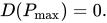
where Pmkt is the equilibrium price (where supply equals demand), Qmkt is the total quantity purchased at the equilibrium price, and Pmax is the price at which the quantity purchased would fall to 0 (that is, where the demand curve intercepts the price axis). For more general demand and supply functions, these areas are not triangles but can still be found using integral calculus. Consumer surplus is thus the definite integral of the demand function with respect to price, from the market price to the maximum reservation price (i.e., the price-intercept of the demand function):
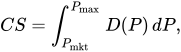
where This shows that if we see a rise in the equilibrium price and a fall in the equilibrium quantity, then consumer surplus falls.
Calculation of a change in consumer surplus

[edit]

The change in consumer surplus is used to measure the changes in prices and income. The demand function used to represent an individual's demand for a certain product is essential in determining the effects of a price change. An individual's demand function is a function of the individual's income, the demographic characteristics of the individual, and the vector of commodity prices. When the price of a product changes, the change in consumer surplus is measured as the negative value of the integral from the original actual price (P0) and the new actual price (P1) of the demand for product by the individual. If the change in consumer surplus is positive, the price change is said to have increased the individuals welfare. If the price change in consumer surplus is negative, the price change is said to have decreased the individual's welfare.[6]

Distribution of benefits when price falls

[edit]

When supply of a good expands, the price falls (assuming the demand curve is downward sloping) and consumer surplus increases. This benefits two groups of people: consumers who were already willing to buy at the initial price benefit from a price reduction, and they may buy more and receive even more consumer surplus; and additional consumers who were unwilling to buy at the initial price will buy at the new price and also receive some consumer surplus.

Consider an example of linear supply and demand curves. For an initial supply curve S0, consumer surplus is the triangle above the line formed by price P0 to the demand line (bounded on the left by the price axis and on the top by the demand line). If supply expands from S0 to S1, the consumers' surplus expands to the triangle above P1 and below the demand line (still bounded by the price axis). The change in consumer's surplus is difference in area between the two triangles, and that is the consumer welfare associated with expansion of supply.

Some people were willing to pay the higher price P0. When the price is reduced, their benefit is the area in the rectangle formed on the top by P0, on the bottom by P1, on the left by the price axis and on the right by line extending vertically upwards from Q0.

The second set of beneficiaries are consumers who buy more, and new consumers, those who will pay the new lower price (P1) but not the higher price (P0). Their additional consumption makes up the difference between Q1 and Q0. Their consumer surplus is the triangle bounded on the left by the line extending vertically upwards from Q0, on the right and top by the demand line, and on the bottom by the line extending horizontally to the right from P1.

Rule of one-half

[edit]

The rule of one-half estimates the change in consumer surplus for small changes in supply with a constant demand curve. Note that in the special case where the consumer demand curve is linear, consumer surplus is the area of the triangle bounded by the vertical line Q = 0, the horizontal line and the linear demand curve. Hence, the change in consumer surplus is the area of the trapezoid with i) height equal to the change in price and ii) mid-segment length equal to the average of the ex-post and ex-ante equilibrium quantities. Following the figure above,


where:

  • CS = consumers' surplus;
  • Q0 and Q1 are, respectively, the quantity demanded before and after a change in supply;
  • P0 and P1 are, respectively, the prices before and after a change in supply.

Producer surplus

[edit]

Producer surplus is the additional benefit that the owners of production factors and product providers bring to producers due to the differences between production, the supply price of the product, and the current market price. The difference between the amount actually obtained in a market transaction and the minimum amount it is willing to accept with the production factors or the products provided.

Calculation of producer surplus

[edit]

Producer surplus is usually expressed by the area below the market price line and above the supply curve. In Figure 1, the shaded areas below the price line and above the supply curve between production zero and maximum output Q1 indicate producer surplus. Among them, OP1EQ1 below the price line. This indicates that the total revenue is the minimum total payment actually accepted by the manufacturer. The area OPMEQ1 below the S curve is the minimum total revenue that the manufacturer is willing to accept. In Figure 1, the area enclosed by the market price line, the manufacturer's supply line, and the coordinate axis is the producer surplus. Because the rectangle OP1EQ1 is the total revenue actually obtained by the manufacturer, that is, A + B, and the trapezoid OPMEQ. The minimum total profit that the manufacturer is willing to accept, that is, B, so A is the producer surplus.

Producer surplus

Obviously, the manufacturer produces and sells a certain quantity of Q1 goods at the market price P1. The manufacturer has reduced the quantity of goods for Q1, which means that the manufacturer has increased the production factors or production costs equivalent to the amount of AVC·Q1. However, at the same time, the manufacturer actually obtains a total income equivalent to the total market price P1·Q1. Since AVC is always smaller than P1, from the production and sales of goods in Q1, manufacturers not only get sales revenue equivalent to variable costs, but also get additional revenue. This part of the excess income reflects the increase in the benefits obtained by the manufacturers through market exchange. Therefore, in economics, producer surplus is usually used to measure producer welfare and is an important part of social welfare.

Producer surplus is usually used to measure the economic welfare obtained by the manufacturer in the market supply. When the supply price is constant, the producer welfare depends on the market price. If the manufacturer can sell the product at the highest price, the welfare is the greatest. As part of social welfare, the size of the producer surplus depends on many factors. Generally speaking, when other factors remain constant, an increase in market price will increase producer surplus, and a decrease in supply price or marginal cost will also increase producer surplus. If there is a surplus of goods, that is, people can only sell part of the goods at market prices, and producer surplus will decrease.

Obviously, the sum of the producer surplus of all manufacturers in the market constitutes the producer surplus of the entire market. Graphically, it should be expressed as the area enclosed by the market supply curve, the market price line and the coordinate axis.

See also

[edit]

References

[edit]

Further reading

[edit]
Revisions and contributorsEdit on WikipediaRead on Wikipedia
from Grokipedia
![Illustration of consumer and producer surplus in a market]float-right Economic surplus, also termed total surplus or social surplus, denotes the net benefit accruing to society from market exchanges, comprising the sum of consumer surplus—the difference between consumers' maximum and the actual price paid—and producer surplus—the excess of the price received by producers over their minimum acceptable price or . This measure captures the overall efficiency of in competitive markets, where equilibrium quantity and price maximize the total surplus by equating marginal benefit to . In , deviations from this optimum, such as those induced by taxes, subsidies, , or monopolistic practices, generate —a reduction in economic surplus reflecting forgone mutually beneficial trades. The concept underpins analyses of policy impacts on societal welfare, emphasizing that efficient markets yield the greatest aggregate gains without favoring distributional concerns unless explicitly weighted.

Conceptual Foundations

Definition

Economic surplus, also termed total surplus or social surplus, refers to the aggregate net benefit derived from market exchanges, comprising the sum of consumer surplus and producer surplus. Consumer surplus measures the excess value consumers receive, calculated as the difference between the maximum price they are willing to pay for a good or service and the actual market price paid, aggregated across all units purchased. Producer surplus, conversely, captures the benefit to sellers as the difference between the market price received and their minimum acceptable selling price (typically ), summed over all units sold. In a competitive market equilibrium, economic surplus reaches its maximum when supply equals , reflecting efficient where marginal social benefit equals marginal social cost. This surplus quantifies societal welfare gains from voluntary transactions, excluding externalities or market distortions that could reduce it below the efficient level. Mathematically, for linear demand and supply curves, total economic surplus can be expressed as the area between the supply and demand curves up to the equilibrium quantity. The concept underscores the value created in markets beyond mere transactions, emphasizing that enhance overall without requiring interpersonal comparisons. Empirical applications, such as in , use economic surplus to evaluate interventions like taxes or subsidies, which typically shrink the surplus by creating .

Components: Consumer and Producer Surplus

Economic surplus, also referred to as total surplus, comprises two primary components: consumer surplus and producer surplus, which together measure the net benefits accruing to participants in a market transaction at equilibrium. In a competitive market, these surpluses are realized when the quantity supplied equals the quantity demanded, reflecting where marginal benefit equals . Consumer surplus is the difference between the total amount consumers are willing to pay for a given of a good or service and the amount they actually pay at the market . Graphically, it appears as the triangular area beneath the (which represents or marginal benefit) and above the equilibrium line, extending from zero to the equilibrium . For linear demand curves, consumer surplus approximates 12×Qmkt×(PmaxPmkt)\frac{1}{2} \times Q_{mkt} \times (P_{max} - P_{mkt}), where QmktQ_{mkt} is the market equilibrium , PmaxP_{max} is the maximum (demand intercept), and PmktP_{mkt} is the equilibrium ; more generally, it is the PmktPmaxD(P)dP\int_{P_{mkt}}^{P_{max}} D(P) \, dP, with D(P)D(P) as the and D(Pmax)=0D(P_{max}) = 0. Producer surplus is the difference between the total revenue producers receive from selling a given and the minimum amount they would accept to supply it, capturing their net gain over opportunity costs or s. It is depicted graphically as the area above the supply curve () and below the equilibrium price, up to the equilibrium . Under linear supply assumptions, it calculates similarly as 12×Qmkt×(PmktPmin)\frac{1}{2} \times Q_{mkt} \times (P_{mkt} - P_{min}), where PminP_{min} is the supply intercept. The sum of consumer surplus and producer surplus constitutes the total economic surplus, representing overall market welfare or efficiency gains from trade. This aggregate is maximized in equilibrium under , assuming no externalities or market distortions, as any deviation—such as —creates by reducing the combined areas. These components rely on revealed preferences from curves, derived from empirical observations of market behavior rather than subjective valuations.

Historical Development

Origins in Utility Theory

The concept of economic surplus traces its roots to early 19th-century developments in theory, particularly through the work of French engineer Jules Dupuit, who in 1844 articulated the notion of consumer surplus as a quantifiable measure of derived from consumption beyond the monetary price paid. In his essay "On the Measurement of the Utility of ," Dupuit analyzed the benefits of infrastructure projects like bridges and roads, arguing that the total to society exceeds the aggregate payments made, with the difference representing a "surplus" attributable to varying intensities of satisfaction across units consumed. This surplus arises from the principle of diminishing , where consumers value initial units highly but subsequent ones less, forming the downward-sloping that Dupuit illustrated geometrically to depict the area between the and the price line as uncompensated benefit. Dupuit's framework anticipated key elements of theory by treating as cardinally measurable in monetary terms via , though he did not fully integrate it with production-side considerations that would later define total economic surplus. His approach emphasized empirical estimation for policy, such as toll pricing on public goods, where surplus loss from high prices () could be calculated as reduced output times average uncompensated . This laid groundwork for viewing surplus not merely as but as excess satisfaction over cost, influencing later economists despite initial obscurity outside circles. The marginal revolution of the 1870s, led by , , and , formalized as the foundation of , providing theoretical rigor to Dupuit's intuitive insights without directly crediting him initially. , in his 1890 Principles of Economics, synthesized these ideas by explicitly defining consumer surplus as the difference between total utility (inferred from the ) and expenditure, assuming constant marginal utility of money for approximation. Marshall extended surplus analysis to include producer surplus—profits above variable costs—yielding total economic surplus as the net gain from trade at equilibrium, rooted in utility-driven and cost-based supply. This integration elevated surplus from a for to a core metric of market efficiency, though Marshall acknowledged limitations like income effects distorting utility measurements.

Neoclassical Formalization

In neoclassical economics, the formalization of economic surplus emerged primarily through Alfred Marshall's partial equilibrium framework in his Principles of Economics (1890), where consumer surplus and producer surplus were geometrically represented as areas bounded by supply and demand curves in a competitive market. Marshall defined consumer surplus as the difference between the total amount consumers would be willing to pay for a given quantity of a good—reflected in the area under the demand curve—and the actual expenditure at the market price, assuming the demand curve derives from diminishing marginal utility. This surplus captures the net benefit to consumers from trade, with the demand curve indicating reservation prices for successive units. Mathematically, consumer surplus (CS) for a linear demand curve is approximated as CS=12Qmkt(PmaxPmkt)CS = \frac{1}{2} Q_{mkt} (P_{max} - P_{mkt}), where QmktQ_{mkt} is the equilibrium quantity, PmaxP_{max} is the maximum (demand intercept), and PmktP_{mkt} is the equilibrium ; more generally, CS=PmktPmaxD(P)dPCS = \int_{P_{mkt}}^{P_{max}} D(P) \, dP, with D(P)D(P) as the and D(Pmax)=0D(P_{max}) = 0. Producer surplus (PS) is symmetrically defined as the excess of over the minimum acceptable receipts—area above the supply curve () and below the —formalized as PS=0Qmkt(PmktMC(q))dqPS = \int_{0}^{Q_{mkt}} (P_{mkt} - MC(q)) \, dq, where MC(q)MC(q) is the function underlying the upward-sloping supply curve due to increasing costs. Total economic surplus, the sum of CS and PS, is maximized at the competitive equilibrium where supply equals , equating marginal benefit to , under assumptions of , no externalities, and rational agents with . Marshall's approach integrated earlier with cost-of-production analysis via his "scissors" metaphor, treating and supply as co-determining price, though critiques later highlighted issues like the path-dependence of surplus measures under effects. This formalization underpins , enabling analysis of efficiency and policy interventions like taxes, which create by reducing total surplus.

Theoretical Framework

Supply and Demand Equilibrium

In the neoclassical framework, equilibrium arises at the intersection of the demand and supply curves, where the quantity demanded equals the quantity supplied, and the market price equates marginal benefit to for the last unit transacted. This equilibrium condition maximizes total economic surplus, defined as the sum of consumer surplus and producer surplus, under assumptions of , , and absence of externalities. Consumer surplus at equilibrium measures the aggregate benefit to buyers as the area bounded by the , the equilibrium line, and the vertical axis up to the equilibrium quantity, reflecting the difference between and actual expenditure. Producer surplus captures sellers' gains as the area above the supply curve, below the equilibrium , and up to the equilibrium quantity, representing revenue in excess of minimum supply prices. The total surplus thus integrates these regions, achieving where no reallocation can improve one party's welfare without harming another, as marginal exhaust at equilibrium. Deviations from this equilibrium, such as through price ceilings or taxes, generate by preventing mutually beneficial trades, thereby reducing total surplus below its maximum. Empirical validations in confirm that competitive equilibria approximate surplus maximization, with observed quantities converging to predicted levels as participant numbers increase, underscoring the robustness of the model despite real-world frictions like transaction costs. This maximization holds in static, partial equilibrium analysis but extends to general equilibrium under Walrasian adjustments, where all markets clear simultaneously to optimize aggregate welfare.

Graphical Representation and Interpretation

The graphical representation of economic surplus utilizes the standard diagram, where the downward-sloping reflects marginal benefit to consumers and the upward-sloping supply curve indicates to producers. The equilibrium occurs at their intersection, determining the market price PP^* and QQ^*. Consumer surplus is depicted as the triangular area bounded by the , the vertical axis (or price axis up to the maximum ), and the horizontal line at PP^*, extending to QQ^*. This area quantifies the aggregate benefit consumers receive beyond the price paid. Producer surplus is illustrated as the triangular region above the supply curve, below the PP^* line, and to the left up to QQ^*, capturing the excess revenue producers earn over their minimum acceptable prices. The total economic surplus, comprising both and surpluses, forms the area between the demand and supply curves from quantity zero to QQ^*, representing the net welfare gain from market exchange at equilibrium. Deviations from equilibrium, such as , create by shrinking this total surplus area. In linear approximations, consumer surplus can be calculated as 12×Q×(PmaxP)\frac{1}{2} \times Q^* \times (P_{\max} - P^*), where PmaxP_{\max} is the price at which quantity demanded is zero, visualized as half the base-height of the consumer surplus triangle. Similarly, producer surplus is 12×Q×(PPmin)\frac{1}{2} \times Q^* \times (P^* - P_{\min}), with PminP_{\min} the intercept of the supply curve. These geometric interpretations facilitate analysis of efficiency, as maximum total surplus aligns with competitive equilibrium where marginal benefit equals marginal cost.

Consumer Surplus

Measurement Techniques

In , consumer surplus is theoretically measured as the integral of the from the market price to the maximum , representing the area beneath the and above the equilibrium price line up to the quantity transacted. This formulation assumes a downward-sloping derived from diminishing with quantity, where the height at each quantity reflects the minus the actual price paid. For linear demand curves, the consumer surplus simplifies to a triangular area calculable via the formula CS=12Qmkt(PmaxPmkt)CS = \frac{1}{2} Q_{mkt} (P_{max} - P_{mkt}), where QmktQ_{mkt} is the equilibrium quantity, PmaxP_{max} is the price intercept of the , and PmktP_{mkt} is the equilibrium price. This approximation derives from the geometry of the , equating the to half the base times height of the formed above the price line. Empirically, direct measurement is infeasible without observing the full schedule, so economists estimate it through econometric models of , such as regressing on and controls to infer the , then integrating numerically. data from market variations, like natural experiments or pricing surges, enable surplus estimation; for instance, a 2016 study on used granular trip data across surge multipliers to compute a consumer surplus of approximately $6.8 billion for U.S. riders from 2015-2016 via willingness-to-pay inferences. Approximations like the rule-of-half (using elasticity and average expenditure changes) provide quick welfare change estimates but introduce under large shifts or nonlinearities. These techniques presuppose quasi-linear preferences to avoid income effects distorting the surplus measure, as compensating or equivalent variations may diverge otherwise; empirical applications often validate via out-of-sample predictions or structural models to mitigate endogeneity.

Dynamic Changes and Approximations

Consumer surplus varies dynamically in response to shifts in supply, demand, or external factors like policy interventions that alter equilibrium prices and quantities. A decrease in supply, for instance, raises prices and reduces consumer surplus, while an increase in supply lowers prices and expands it, assuming downward-sloping demand. These changes reflect alterations in the area between the demand curve and the prevailing price level up to the quantity transacted. The exact change in consumer surplus for a price shift from P0P_0 to P1P_1 (with P1<P0P_1 < P_0) is given by the difference: ΔCS=P1P0D(P)dP\Delta CS = \int_{P_1}^{P_0} D(P) \, dP, where D(P)D(P) is the . However, computing this requires full knowledge of the , which is often unavailable or nonlinear, prompting approximations. A common approximation employs the rule: ΔCS12(Q0+Q1)(P0P1)\Delta CS \approx \frac{1}{2} (Q_0 + Q_1) (P_0 - P_1), where Q0=D(P0)Q_0 = D(P_0) and Q1=D(P1)Q_1 = D(P_1). This formula exactly measures the change for linear demand curves, as it captures the trapezoidal area between the initial and new price points on the demand curve. For nonlinear demands, it serves as a close proxy, particularly when price changes are modest or income elasticities are low, aligning well with compensating variation measures of welfare change. Martin Weitzman (1988) demonstrates that consumer surplus approximations become exact under a price-normalized duality framework, deflating prices appropriately to account for substitution effects across goods. Robert Willig (1976) quantifies the approximation error, showing that for typical income elasticities below 2 in absolute value, the path-dependent consumer surplus deviates from true welfare measures by less than 1-2% of annual income for price changes up to 25%. These bounds justify its use in empirical policy analysis despite theoretical path-dependence in multi-price scenarios.

Producer Surplus

Measurement Techniques

In , consumer surplus is theoretically measured as the integral of the from the market price to the maximum , representing the area beneath the and above the equilibrium price line up to the quantity transacted. This formulation assumes a downward-sloping derived from diminishing with quantity, where the height at each quantity reflects the minus the actual price paid. For linear demand curves, the consumer surplus simplifies to a triangular area calculable via the formula CS=12Qmkt(PmaxPmkt)CS = \frac{1}{2} Q_{mkt} (P_{max} - P_{mkt}), where QmktQ_{mkt} is the equilibrium quantity, PmaxP_{max} is the price intercept of the , and PmktP_{mkt} is the equilibrium price. This approximation derives from the geometry of the , equating the to half the base times height of the formed above the price line. Empirically, direct measurement is infeasible without observing the full schedule, so economists estimate it through econometric models of , such as regressing on and controls to infer the , then integrating numerically. data from market variations, like natural experiments or pricing surges, enable surplus estimation; for instance, a 2016 study on used granular trip data across surge multipliers to compute a consumer surplus of approximately $6.8 billion for U.S. riders from 2015-2016 via willingness-to-pay inferences. Approximations like the rule-of-half (using elasticity and average expenditure changes) provide quick welfare change estimates but introduce under large shifts or nonlinearities. These techniques presuppose quasi-linear preferences to avoid effects distorting the surplus measure, as compensating or equivalent variations may diverge otherwise; empirical applications often validate via out-of-sample predictions or structural models to mitigate endogeneity.

Factors Influencing Producer Surplus

Producer surplus varies with alterations in equilibrium price and quantity, as well as the underlying supply curve. Higher market prices, , expand producer surplus by increasing the gap between actual revenue and producers' minimum willingness to sell across all output levels. Conversely, price declines contract it, as the revenue premium over marginal costs diminishes. Shifts in the directly impact producer surplus through changes in equilibrium outcomes. An outward (rightward) demand shift raises both and , boosting surplus as producers sell more units at higher prices relative to their supply costs. An inward shift has the opposite effect, lowering and and thereby reducing surplus. Supply curve shifts, often driven by production factors, also alter surplus. Decreases in input costs—such as cheaper raw materials or labor—shift the supply curve rightward, enabling lower-cost production and typically increasing producer surplus despite a potential equilibrium price drop, as the efficiency gains outweigh revenue losses on inframarginal units. Technological advancements similarly shift supply rightward by reducing marginal costs, enhancing surplus through expanded output at viable prices. An increase in the number of producers expands , raising total producer surplus in competitive markets. Inward supply shifts from rising costs or supply constraints decrease surplus by curtailing feasible output. Price elasticity of supply and moderates these effects. More elastic supply amplifies surplus gains from price rises, as producers can expand output responsively, while inelastic supply limits such adjustments. elasticity influences the pass-through of supply shifts to prices, with inelastic preserving more producer surplus during cost reductions. Government policies introduce additional influences. create a wedge between market and prices, reducing surplus by the borne by sellers. Subsidies per unit shift effective supply rightward, elevating surplus akin to cost reductions. Price floors above equilibrium, if binding, can increase surplus by guaranteeing higher prices, though may mitigate gains; price ceilings below equilibrium diminish it via shortages. , as in oligopolies, allows producers to restrict output and capture larger surplus compared to .

Total Surplus and Efficiency

Aggregation and Total Surplus

Total surplus, also termed social surplus or economic surplus, represents the overall welfare gain from market transactions and is calculated as the sum of consumer surplus and producer surplus. This aggregation quantifies the net value created when consumers' exceeds producers' costs for units traded at equilibrium. In a competitive market without distortions, total surplus reaches its maximum, as any deviation reduces the combined benefits. Aggregation occurs by integrating individual surpluses across all market participants: consumer surplus sums the differences between each buyer's and the market for units purchased, while producer surplus sums the differences between the market and each seller's for units supplied. Graphically, in a standard supply-demand diagram, total surplus forms the area between the (above the equilibrium ) and the supply (below it), up to the equilibrium . Mathematically, it equals the from zero to equilibrium QQ^* of the inverse minus inverse supply functions: 0Q(D1(q)S1(q))dq\int_0^{Q^*} (D^{-1}(q) - S^{-1}(q)) \, dq. For linear demand and supply curves intersecting at price PP^* and quantity QQ^*, total surplus simplifies to 12(PmaxCmin)Q\frac{1}{2} (P_{\max} - C_{\min}) Q^*, where PmaxP_{\max} is the intercept and CminC_{\min} the supply intercept, assuming no intercepts at origin. This measure assumes and no externalities, conditions under which the sum directly indicates . Empirical applications, such as in regulatory impact analyses, rely on this aggregation to evaluate effects on net social welfare. In a competitive market without distortions, the equilibrium where total economic surplus—defined as the sum of consumer and producer surpluses—is maximized corresponds to a Pareto optimal allocation, as articulated in the First Fundamental Theorem of Welfare Economics. This theorem asserts that, given assumptions including perfect competition, complete markets, no externalities, and full information, the decentralized decisions of rational agents lead to an outcome where resources are allocated such that no individual can be made better off without reducing the welfare of another, thereby achieving Pareto efficiency. The total surplus maximization occurs precisely at the intersection of supply and demand curves, where marginal social benefit equals marginal social cost, ensuring that all mutually beneficial trades are exhausted. This linkage underpins ' evaluation of market outcomes: deviations from equilibrium, such as those induced by taxes, subsidies, or monopolies, generate by reducing total surplus below its Pareto optimal level, implying inefficiency in the Pareto sense. For instance, in graphical terms derived from partial equilibrium analysis, the area of total surplus at equilibrium represents the highest attainable social welfare under the theorem's conditions, aligning with the tangency of community indifference curves and the in general equilibrium models. The theorem's validity relies critically on its assumptions; empirical violations, such as positive externalities (e.g., unpriced benefits from reducing costs) or , can result in equilibria that fail to maximize surplus and are Pareto dominated by alternative allocations. The Second Fundamental Theorem complements this by showing that any Pareto optimal allocation, including those maximizing surplus under redistributed endowments, can be supported as a competitive equilibrium via appropriate lump-sum transfers, highlighting the role of equity considerations separate from . Thus, while total surplus provides a measurable proxy for , welfare assessments must account for these foundational conditions to avoid overstating market optimality in real-world settings.

Applications in Policy and Markets

Deadweight Loss from Interventions

Deadweight loss arises when government interventions, such as taxes, , or quotas, prevent the market from reaching its competitive equilibrium, thereby reducing total economic surplus by blocking mutually beneficial exchanges where consumers' exceeds producers' marginal costs. This inefficiency manifests as a net loss to society, distinct from mere transfers of surplus between parties, and is geometrically represented as a triangular area between the curves over the reduced quantity transacted. The magnitude of deadweight loss depends on the elasticities of supply and demand; greater responsiveness amplifies the distortion by widening the gap in quantities. For taxation, a per-unit excise tax introduces a wedge between the price consumers pay and producers receive, shifting the supply curve upward and lowering the equilibrium quantity from the undistorted level QQ^* to QtQ_t. The deadweight loss equals 12×(QQt)×t\frac{1}{2} \times (Q^* - Q_t) \times t, where tt is the tax rate, capturing the surplus lost from units where marginal benefit surpasses marginal cost but trades do not occur due to the higher effective price. Empirical analyses confirm this effect; for example, estimates for U.S. corporate income taxes suggest marginal deadweight costs of 20% to 76% of additional revenue raised, varying with labor supply elasticities assumed in general equilibrium models. Price ceilings below the equilibrium price limit quantity supplied, creating shortages where effective demand exceeds supply, and the deadweight loss forms a triangle between the curves from the supplied quantity to QQ^*, reflecting unserved consumers with valuation above marginal production costs. Price floors above equilibrium, such as minimum wages, restrict quantity demanded, generating surpluses and a parallel deadweight loss from forgone production where marginal cost falls below willingness to pay. Historical cases, like rent controls in urban markets, illustrate persistent shortages and black markets, exacerbating the efficiency loss beyond the initial triangle through misallocation and reduced investment incentives. Subsidies and quotas produce analogous distortions: a production subsidy shifts supply downward but, absent externalities, encourages overproduction where marginal cost exceeds benefit, yielding deadweight loss symmetric to taxation. Import quotas restrict supply akin to a tax, shrinking traded quantities and surplus, with empirical studies on agricultural quotas estimating losses equivalent to 10-30% of protected sector values due to inelastic demands amplifying the wedge. Across interventions, deadweight loss underscores the causal trade-off between revenue or redistribution goals and allocative efficiency, with first-order approximations scaling linearly with the square of the distortion rate for small interventions.

Trade and Comparative Advantage

Trade based on allows countries to specialize in producing goods at lower opportunity costs relative to their trading partners, thereby increasing total economic surplus through expanded production and consumption efficiencies. Under , each country produces and consumes along its , limiting surplus to domestic consumer and producer gains at autarkic prices; however, when countries specialize according to and exchange goods, they achieve points beyond their individual frontiers via trade, elevating aggregate consumer surplus from access to cheaper imports and producer surplus from favorable export prices. This reallocation of resources toward higher-value uses generates net gains equivalent to the avoided deadweight losses of self-sufficiency, with total surplus rising as the sum of bilateral benefits. David Ricardo's 1817 analysis in On the Principles of Political Economy and Taxation illustrated this using (efficient in cloth) and (efficient in wine), where Portugal held absolute advantages in both but a in wine due to lower opportunity costs; specialization—England in cloth, Portugal in wine—followed by at terms-of-trade prices between autarkic ratios (e.g., England's 100 cloth for 120 wine versus Portugal's 90 cloth for 80 wine) yielded mutual surplus expansions, with Portugal trading wine for more cloth than allowed and England gaining more wine per cloth unit. Ricardo's model assumes constant costs and labor as the sole factor, yet it demonstrates causally that relative efficiency differences drive trade-induced surplus, independent of absolute productivity gaps. In a importing country for a good where it lacks , world prices fall below autarkic levels, boosting consumer surplus via the area between domestic demand and world price up to import quantities while reducing producer surplus in the import-competing sector; the net effect remains positive, as the consumer surplus gain exceeds producer and any tariff-related losses, with the triangular gains-from-trade areas (formerly deadweight losses under ) added to total surplus. For exporters, producer surplus expands from higher world prices stimulating output, often outweighing any consumer surplus contraction in that good. Empirical models, such as those simulating Ricardo-Viner frameworks, quantify these shifts: for instance, U.S. agricultural exports leveraging land-intensive have historically increased domestic producer surplus by 10-20% in specialized sectors post-liberalization, net of import effects elsewhere. While aggregate surplus rises, distributional impacts—such as producer surplus erosion in non-competitive sectors—necessitate policy considerations like transitional aid, as noted potential short-term dislocations without negating long-run efficiency gains. Modern extensions, including Heckscher-Ohlin models, reinforce that factor endowments underpin comparative advantages, sustaining surplus benefits when aligns with abundant factors (e.g., labor-rich countries exporting labor-intensive ). Restrictions like invert this by contracting volumes, shrinking total surplus through deadweight losses exceeding gains, as evidenced in post-2018 U.S.- analyses showing net U.S. welfare reductions of 0.2-0.5% of GDP.

Criticisms and Limitations

Behavioral and Empirical Challenges

Behavioral economics critiques the neoclassical foundations of economic surplus by highlighting deviations from rational choice theory, such as cognitive biases and heuristics that prevent s and s from consistently maximizing utility as assumed in surplus calculations. For instance, demonstrates and reference dependence, where individuals value gains and losses relative to a reference point rather than absolute wealth, distorting the rankings implicit in demand and supply curves used to derive consumer and producer surplus. These anomalies imply that revealed preferences may not accurately reflect true welfare, as choices under uncertainty or framing effects fail to align with the stable preferences required for surplus measurement. The further undermines surplus analysis, empirically showing that (WTA) exceeds (WTP) for the same good, violating the convergence assumed in competitive equilibrium where surplus is maximized. Experimental evidence from controlled settings reveals systematic inconsistencies, such as , where short-term es lead to suboptimal decisions that standard surplus metrics overlook, potentially overstating efficiency gains from market outcomes. Critics argue this necessitates behavioral frameworks, which adjust surplus for "as-if" or paternalistic corrections, though these introduce subjective judgments about correction that lack consensus. Empirically, measuring economic surplus faces obstacles in observing underlying demand and supply schedules, as or accept is latent and inferred from prone to aggregation errors and unobserved heterogeneity. Real-world applications often approximate surplus via econometric estimation of curves, but , endogeneity, and incomplete data—such as unrecorded transactions or heterogeneous agent behaviors—yield unreliable integrals for areas under curves. Studies attempting field validation, like those on policy interventions, frequently find model-based surplus estimates diverge from direct welfare proxies (e.g., self-reported satisfaction), attributed to assumptions of and homogeneity that fail in dynamic markets with network effects or externalities. In multi-market contexts, spillover effects complicate surplus aggregation, as shifts in one sector alter prices elsewhere without clear , rendering total surplus changes indeterminate without heroic assumptions. Longitudinal data challenges persist, with historical series like GDP excluding non-market surplus components, leading to underestimation of welfare shifts from innovations where benefits vastly exceed recorded output. These frictions imply that while surplus provides a benchmark for , empirical implementations risk errors by conflating theoretical ideals with noisy proxies.

Distributional and Equity Critiques

Critiques of economic surplus from distributional and equity perspectives center on its failure to incorporate how gains are allocated among market participants, focusing instead solely on aggregate magnitude. and producer surplus calculations treat monetary equivalents as uniform measures of welfare, disregarding that the same dollar amount of surplus may confer greater utility on lower-income individuals due to diminishing of income. This aggregation implies interpersonal welfare comparisons without explicit weighting, rendering the total surplus agnostic to pre-existing inequalities in endowments or that determine surplus shares. In competitive markets, surplus division reflects initial resource ownership and market conditions, but deviations like monopoly pricing allow s to extract larger producer surplus, limiting access and concentrating benefits among owners or shareholders, often wealthier entities. For instance, high markups in concentrated industries can exclude lower-income buyers from essential goods, amplifying disparities without the total surplus metric signaling inequity. Empirical analyses of , which typically expand total surplus, reveal uneven distributional impacts, with export-oriented sectors gaining while import-competing workers face wage stagnation or job losses, as documented in U.S. declines post-NAFTA implementation in 1994. The Kaldor-Hicks criterion, foundational to surplus-based evaluation, endorses changes that increase total surplus if gainers could hypothetically compensate losers, yet it permits outcomes where no actual transfers occur, potentially entrenching inequality. This "potential Pareto" standard has drawn objection for sidestepping normative equity considerations, as uncompensated losers—often from vulnerable groups—bear costs while aggregate justifies the . Critics contend that reliance on such metrics in benefit-cost analyses, as in regulatory reviews, systematically undervalues distributional harms, particularly in environmental or labor policies where low-income communities disproportionately absorb negative externalities. Proponents of equity-focused alternatives, including weighted welfare functions, argue that unadjusted surplus maximization conflates with desirability, advocating interpersonal adjustments to reflect societal aversion to inequality.

References

Add your contribution
Related Hubs
Contribute something
User Avatar
No comments yet.