Hubbry Logo
CoppullCoppullMain
Open search
Coppull
Community hub
Coppull
logo
8 pages, 0 posts
0 subscribers
Be the first to start a discussion here.
Coppull
Coppull
from Wikipedia

Coppull is a village and civil parish in Lancashire, England. It is part of the Borough of Chorley, lies around 300 feet (91 m) above sea level. Its population is around 8,000, having been counted at 8,300 in the 2021Census.[1] It is bounded by Whittle Brook, Clancutt Brook, the River Yarrow, Eller Brook, Hic-Bibi Brook and Stars Brook. Coppull is located between Chorley and Standish, Greater Manchester, to the east of the A49 road near Charnock Richard.

Key Information

History

[edit]

It is possible that a Roman road between Wigan and Walton-le-Dale passed over Coppull Moor according to the Chorley and District Historical and Archaeological Society after excavating a site there in 1959 and 1985.[2]

The settlement has an Anglo Saxon name describing its topography derived from the Old English copp a hill top and hyll a hill.[3] The township was variously recorded as Cophull and Cophulle in 1277, Copphull in 1351, Copthull in 1374 and Coppull from 1444.[4]

The township was originally held by the lords of Worthington until the manor of Coppull was granted to a family of that name under them. Richard of Coppull granted land to Burscough Priory. In the reign of Edward IV, Sir Thomas Stanley bought the manor and it descended with the Stanley property at Lathom until 1600 when William, Earl of Derby sold it to Edward Rigby of Duxbury. In 1755 the owners were named Livesey and John Hodson of Ellerbeck bought it in 1820.[4] The Worthingtons were recusants who kept the old faith, Roman Catholicism. Thomas Worthington became a priest at the English College, Douai and was sent to the Tower in 1584.[4]

Chisnall was held by a family of that name. Roger and John de Chisnall are mentioned in 1277 and 1292. Roger de Chisnall settled land and property on Roger and his brothers Robert, John and Thomas in 1347. John Chisnall, when he died in 1525, held land and property in Coppull and Worthington of the Earl of Derby. Richard Worthington was a Member of Parliament for Wigan between 1688 and 1689 and sat for Preston as a Tory in 1690. Blainscough belonged to the Worthingtons who lived there until after the Civil War.[4]

Industrial Revolution

[edit]

A water mill at Birkacre was leased by Richard Arkwright for cotton spinning in 1778 but was set on fire by machine wreckers in 1779.[5] The mill was rebuilt and used for calico printing, dyeing and bleaching. Water power was replaced by steam. Birkacre Colliery[6] opened in 1880 to supply the works which employed more than 800 people in 1883. The works and colliery closed in the 1930s and many of the buildings demolished in the 1960s.[7]

The North Union Railway between Wigan and Preston opened in 1838. Coppull Colliery was owned by John Hargreaves. On 20 May 1852 was an explosion of firedamp, found to be caused by a lighted candle, 90 men suffering from chokedamp or burns escaped but 36 men and boys died.[8] The colliery was renamed Hic Bibi Colliery[a] in the 1860s. It had several owners and after it closed in the 1880s, fireclay was used at a brickworks started and operated by the Ellerbeck Collieries Company until it closed in 1959. Chisnall Hall Colliery on Coppull Moor was owned by Pearson and Knowles Coal and Iron Company in 1896 when it employed 135 underground and 48 surface workers.[10] After 1850 Coppull grew rapidly, many rows of houses were built to house coal miners and factory workers. There were several collieries and deep shafts were sunk for the John Pit, Springfield Pit, Blainscough, Hic Bibi, Darlingtons, Ellerbeck Colliery, Birkacre and Pearsons mines. Mineral lines carried coal tubs to the main railway.

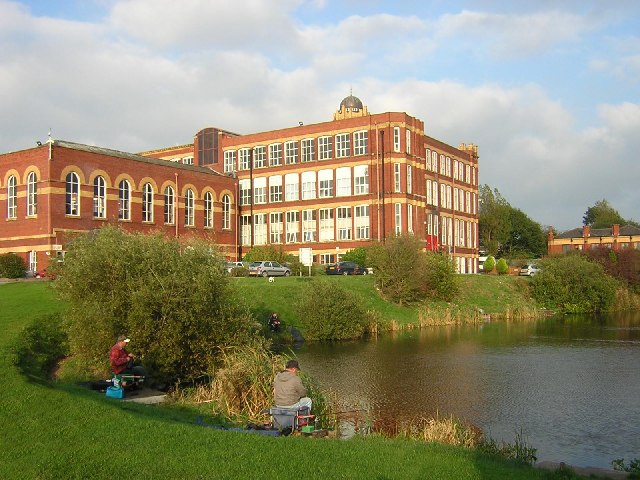
Two large red brick spinning mills, Coppull Mill in 1906, and Mavis Mill were built in the early 20th century. Coppull Mill has been converted for other uses and is a Grade II listed building.[11] The last surviving collieries were Chisnall Hall and Ellerbeck.[12]

Governance

[edit]

Coppull was a township[13] in the ecclesiastical parish of St Wilfrid, Standish in the Hundred of Leyland.[14] It was a member of the Chorley Poor Law Union formed in 1837 that took responsibility for the administration and funding of the Poor Law.[15] Coppull became part of Chorley Rural Sanitary District from 1875 to 1894,[16] and part of Chorley Rural District from 1894 to 1974.[17] Since 1974, it is a civil parish and electoral ward in the Borough of Chorley.[18][19]

Economy

[edit]

Since the decline in manufacturing and the end of the coal industry, the village has been converted into a satellite town for commuters to Chorley and Wigan. Notable industries today include The Yew Tree Dairy, Morris' Bakery and Staveley's egg producer.

Transport

[edit]

Intersecting the village is the B5251 road, which connects Chorley to the Wigan-Preston Road. The village's closest motorway connections are the M6 Junction 27 at Standish and the M61 Junction 8 at Chorley.

Coppull is served by regular Bee Network services to Wigan (the 632) and Chorley Interchange and Stagecoach bus services to Chorley. Network Chorley service operated within the village until the early/mid 2010’s.

The village was previously served by the Blackpool to Liverpool Line which stopped at Coppull railway station but the station was closed in 1969. Recently there has been a campaign from locals to re-open the station.

Religion

[edit]

There was a chapel in Coppull before the Reformation. After it fell into ruin, it was replaced in 1654 and was probably served from the parish church in Standish but was later used by Presbyterians. It was closed in 1715 and secured for the Church of England. A grant from Queen Anne's Bounty in 1716 led to the appointment of a perpetual curate. It was rebuilt in 1758 and again in 1861.[4][20]

The village has several places of worship,[21] Coppull Parish C of E Church, St John the Divine C of E Church,[22] St Oswald's Roman Catholic Church[23] and Spendmore Lane Methodist Church.[24]

Sport

[edit]

Owing to Coppull's coal mining history and proximity to Wigan, the sport of rugby league has had a strong presence in the village. Chorley Panthers is a successful youth and amateur club based at Chisnall playing fields. Coppull is also home to Coppull United F.C, an amateur football team who currently play in the West Lancashire Premier Division.[25]

An amateur and professional boxing club is based at Coppull Mill.

Coppull also has a long tradition of Martial Arts with both Karate and Kung Fu clubs in the district. Red Sun Shotokan Karate Club has been based at St. John's Church Hall in Coppull since 1986 and was founded by P.A.J. Handyside, 9th Dan.[26]

Coppull is also home to Springfield Park Leisure Centre which holds classes for all age groups including freestyle, trampolining and indoor rock climbing.[27]

Notable people

[edit]

See also

[edit]

References

[edit]
[edit]
Revisions and contributorsEdit on WikipediaRead on Wikipedia
from Grokipedia
Coppull is a village and in the , , England, located approximately 5 miles (8 km) west of and 7 miles (11 km) south of , with a population of around 8,278 as of recent estimates. Situated at about 300 feet (91 m) above sea level and covering 2,402 acres, Coppull has a rich industrial heritage rooted in , , and , which shaped its development from the onward. Early began in the village with 's Birkacre mill established in 1777, employing over 400 workers before it was destroyed by rioters in 1779; subsequent attempts at textile operations included a short-lived dyeing and finishing mill in 1781, followed by more successful built in 1906 and 1908. Coal mining, evidenced as early as the , became a dominant industry in the 19th century with numerous collieries such as John Pit, Springfield Pit, and Chisnall Hall Colliery operating until the , fueling rapid population growth from 1,107 in 1851 to over 5,000 by mid-20th century. A tragic highlight of this era was the 1852 Coppull Hall Colliery disaster, an explosion that claimed 36 lives on May 20. Today, Coppull has evolved into a modern commuter community while preserving elements of its mining and textile past, including landmarks like the Church of St John the Divine (built 1912) and the Coppull Band (founded 1888), alongside ongoing agricultural influences.

History

Etymology and Early Settlement

The name Coppull derives from elements, combining "copp," meaning a peak or hilltop, with "hyll," meaning hill, resulting in a interpreted as "copped hill" or "hill rising to a peak." This etymology reflects the village's , situated on the 300-foot and bounded by natural features such as the Clancutt Brook, River Yarrow, and various streams including Buckow Brook and Hic-Bibi Brook. Historical records show early spellings like "Cophulle" and "Crophull" in the , "Cophull" in the , and the modern form "Coppull" by 1444, with the place first documented as "Cophill" around 1218. Coppull's early settlement emerged as a rural township within the ancient Parish of Standish, initially forming part of Coppull-cum-Worthington in the . The first mention of the Coppull family, probable lords of the manor and a branch of the Worthingtons, dates to , with Richard, son of Thomas de Coppull, granting lands including Coppull Moor to in 1236. The remained with the Coppull family until 1461, when it passed to ; by 1508, Edward Stanley, son of Thomas Stanley, , held it, before it was sold to Alexander Rigby of Burgh around , eventually transferring to the Livesey family by and John Hodgson of Ellerbeck by . Population growth was gradual, with the Subsidy Roll of 1542 recording 45 houses (estimating 225 residents), rising to 67 houses (about 335 people) by the , and 86 families (around 480 individuals) in a 1754 census. A tradition suggests a church existed at Coppull as early as the , supported by a 1094 deed referencing "et ecclesium de Crophill." land use in Coppull centered on and small-scale , with grants such as the donation to encompassing oxgangs of in local woods for . A circa 1240 deed from Richard de Charnock to William de Worthington included a house called Birkacre, lands along Culmariclough, rights to , wood for building and fencing, and access to a , alongside allowances for specific livestock like 12 cows for five years and six mares for four years. The presence of a "" on Coppull Moor indicates a monastic farm tied to the , while tenants like the paid annual rents of for estates such as Perburn before the , underscoring a economy reliant on pasture, woodland resources, and limited milling. Ecclesiastical ties linked Coppull closely to the Parish of Standish, where it served as a with a chapel for , as noted in a 1520 marriage covenant providing land for a priest. The chapel offered sanctuary during 's reign, with figures like Rowland Kirby seeking refuge there, though it fell into decay in the amid disputes. Early connections extended to , including a 1094 grant of the church at "Crophill" to the Abbey of St Martin of Sées and land donations to , with curates from Standish, such as Thomas Walkden in , overseeing services until Coppull's later independence.

Industrial Revolution and Cotton Industry

The advent of the in Coppull was marked by the establishment of Birkacre Mill, a pioneering site for . In 1777, local landowner Edward Chadwick constructed the mill and leased it to , the inventor of the , along with his partners including Jedediah Strutt and Samuel Need. Arkwright equipped the facility with water-powered machinery, such as carding engines, roving engines, and capable of producing 96 threads simultaneously, transforming the local textile production from to a . This operation employed over 400 workers, representing one of the earliest large-scale mechanized cotton mills in and exemplifying Arkwright's vision of industrialized manufacturing powered by the River Yarrow. However, the mill's innovative operations faced fierce opposition from displaced amid a . On October 4, 1779, a mob of approximately 2,000 to 4,000 rioters attacked and destroyed the mill, burning its wooden structures and machinery in a significant act of that resulted in three deaths. The damage was estimated at £10,000, though parliamentary records valued it at £4,400, leading to surrender his lease and shift focus to his operations. Chadwick subsequently rebuilt the mill in 1781 for cloth dyeing and finishing, leasing it to new partners, but this venture failed by 1782 and evolved into various over the decades, with no return to in Coppull for over a century. revived in Coppull during the with the construction of large-scale mills that reflected advancements in . The Coppull Ring Spinning Mill, built in 1906, was designed to house 60,000 supplied by , marking a substantial investment in modern textile infrastructure. Nearby, Mavis Mill followed in 1908, both structures featuring red brick construction and contributing to the village's architectural heritage; the Ring Mill is now a recognized for its special historic interest. These mills spurred economic growth by creating jobs for mill workers and attracting a population influx, with Coppull's residents increasing from 484 in 1764 to 1,107 by 1851, driven in part by early textile opportunities that shaped local infrastructure like housing. The integration of , including the nearby main line that divided the parish by 1912, facilitated the distribution of cotton goods, enhancing the mills' economic viability alongside broader industrial synergies.

Coal Mining Era

Coppull's integration into the Wigan–Chorley coalfield marked a pivotal expansion of in the region during the 19th century, with the village serving as a key node in Lancashire's industrial landscape. , which had roots in earlier centuries, intensified post-1800 as the coalfield's seams, particularly the and related layers, drew investment for . This development positioned Coppull within a broader network of pits that fueled the , complementing local by providing essential coal for powering mills. Several collieries were established or expanded in Coppull after 1800, including John Pit, Springfield Pit, Blainscough Colliery (opened 1865), Hic-Bibi, Darlingtons, Ellerbeck, Birkacre, and Pearson & Knowles (later Chisnall Hall Colliery, opened 1891). These pits were strategically located in valleys such as Birkacre and Whetstone, as well as near Coppull Hall and west of the River Yarrow, facilitating access to the coalfield's resources. Output reached peaks toward the late 19th century, with the Wigan Coalfield—encompassing Coppull—achieving near-maximum production by the 1890s, exemplified by Chisnall Hall's growing workforce from 159 employees in 1894 to 402 by 1900, reflecting heightened extraction of gas, household, and manufacturing coal. Mining techniques in Coppull evolved from early surface and shallow methods to between 1850 and 1892, employing , horse-drawn whim gins, and locomotives like Timothy Hackworth's at Coppull Hall Colliery from 1849 for hauling and pumping. Safety issues were prevalent due to the gassy nature of seams like the Arley, with hazards including accumulation, roof falls, and inadequate , often exacerbated by rudimentary stoppings made of coal and rubbish that retained air in single columns. These challenges underscored the perilous conditions, prompting gradual introductions of and , though enforcement remained inconsistent. The profoundly shaped Coppull's social fabric, driving population growth from 1,107 in 1851 to 2,940 by 1901 through influxes of workers and families, reaching over 5,000 by 1951. This led to the construction of miners' terraces and community facilities, such as the 1874 school at Coppull Moor funded by local industrialists James Darlington and Alfred Hewlett, and the 1888-founded Coppull Band, whose room served as a welfare hub for social gatherings and services. Employment in the pits fostered tight-knit colonies, with hundreds reliant on mining for livelihood, though the industry's dangers imposed ongoing strains on community health and stability.

20th Century Developments and Industrial Decline

In the early 20th century, Coppull saw the establishment of new that briefly expanded the local . Coppull Ring Mill, also known as Coppull Mill, was built in 1906, followed by Mavis Mill in 1908; both were that employed hundreds of local workers during their operational peak. These mills were acquired by the in the early 1940s as part of broader industry consolidation efforts amid economic pressures. However, the in Coppull experienced gradual decline due to national economic shifts, including competition from abroad and post-war restructuring. Birkacre Mills, involved in calico printing and , closed during the and were repurposed for storage by the and other firms, with the buildings demolished in the . Mavis Mill ceased operations and was demolished by the mid-20th century, while Coppull Ring Mill was later converted to non-textile uses, reflecting the broader contraction of . These closures contributed to job losses in a sector that had been central to the village's economy. , another pillar of Coppull's industry, also faced progressive closures from the mid-20th century, exacerbating employment challenges. Ellerbeck Colliery, operational since 1876 and in 1947, employed hundreds until its closure in 1965. Chisnall Hall Colliery, the last major pit in the area, shut down in March 1967, marking the end of in the Wigan-Chorley coalfield and leading to significant unemployment among miners who had dominated the local workforce. The impact was profound, as coal had been a dominant employer, with community responses including a commemorative service at St John the Divine Church to honor the industry's legacy and the workers affected. As industries declined, Coppull began transitioning toward a , with infrastructure adaptations facilitating easier access to jobs elsewhere. Existing rail connections, including the and from former collieries, supported this shift by improving links to nearby urban centers like and , though without major new developments in housing. Early diversification attempts were limited, often involving repurposing industrial sites for storage or other non-manufacturing purposes, as the village adapted to reduced local employment opportunities.

Geography

Location and Topography

Coppull is a village and located in the , within the county of , England. It lies approximately 5 miles (8 km) west of town centre and 7 miles (11 km) south of , positioned along the eastern side of the near Charnock Richard. The civil parish encompasses a defined area with boundaries that include surrounding rural lands, as mapped by references centred on grid SD564137. Its central geographic coordinates are approximately 53°37′15″N 2°39′39″W. The topography of Coppull features a hilltop setting at an elevation of around 300 feet (91 m) above . This undulating terrain is part of the broader Wigan-Chorley coalfield landscape, characterized by gentle rises and valleys that historically influenced . The village's proximity to the River Yarrow and its associated valley provided essential water resources for early , such as the Birkacre Mill, and supported activities by facilitating drainage and transport in the surrounding low-lying areas. Amid its , Coppull has preserved significant natural landscapes, including green spaces and conservation areas that mitigate urban expansion. The Yarrow Valley Country Park, encompassing wooded river corridors and open countryside along the River Yarrow, serves as a key recreational and ecological area bordering the village. Additionally, Hic Bibi Nature Reserve within the parish supports and public access to natural habitats, contributing to the maintenance of the area's rural character despite historical development pressures.

Housing and Urban Layout

The housing in Coppull evolved significantly from the onward, reflecting the village's in and , with initially built to support the workforce before transitioning to modern estates in response to economic decline and population growth, thereby preserving visible patterns of industrial-era transformation while adapting to commuter needs. In the , miners' and mill workers' terraces were developed to house the growing industrial population, often clustering directly around and for convenient access to employment. Specific examples include the cottages near Coppull Hall Colliery, where workers lived in close proximity to the pits, as evidenced by the tragic 1852 explosion that affected the local mining community; similar terraces emerged around sites like Blainscough and Chisnall Hall Collieries, as well as early in the Birkacre Valley, which employed over 400 people and spurred residential clusters along the brooks and valleys supporting these operations. These or , such as those on Preston Road associated with , were typically modest and densely packed, mirroring broader patterns in 's coalfield villages to accommodate the influx of laborers drawn to the Wigan-Chorley mining district. This clustering established a layout tied to industrial sites, with housing radiating from pits and mills, shaping the village's compact core amid rural surroundings. The saw population growth following the decline of local industries, particularly after the closure of the last at Chisnall Hall in 1967, with the population increasing from 5,657 in 1951 to 7,184 by 1971. In recent decades, modern estates have further expanded Coppull, including developments like Elmbrook Park, which offers 3- to 5-bedroom homes with 30% affordable units, and Church View, featuring semi-detached and detached properties designed for family living, both approved by to integrate with existing infrastructure while promoting sustainable growth. Additionally, sites like the former miners' cottages area off Preston Road have been proposed for 39 affordable homes as of November 2023, emphasizing the village's ongoing adaptation to housing needs . These developments extend the original industrial housing patterns into commuter-oriented expansions, maintaining linear growth without erasing the historical footprint of mining and milling communities. Coppull's overall urban layout has been shaped by along key transport routes, such as Preston Road—a historic —and the railway line, which divided the parish in 1912 and encouraged of housing from to contemporary estates. This pattern preserves clustering while accommodating its role as a , with residential areas extending westward and northward from the core village center bounded by natural brooks, ensuring connectivity to nearby towns like and without disrupting the .

Demographics

In the 19th century, Coppull experienced significant population growth driven by the expansion of its and industries, transforming it from a small rural settlement into a burgeoning industrial community. Local records indicate that the population was estimated at 876 in 1832, reflecting a modest base prior to widespread . By 1851, this had increased to 1,107, coinciding with peaks in textile production at mills like Birkacre and the opening of numerous collieries in the Wigan-Chorley coalfield. Further growth occurred as mining and cotton booms attracted workers, with the population reaching 2,940 by 1901. The saw continued fluctuations in Coppull's population, influenced by the rise and eventual decline of , alongside shifts toward lighter manufacturing and residential development. From 5,657 residents in 1951, the population rose to 7,184 by 1971, supported by and infrastructure improvements such as that facilitated worker mobility. However, the closure of key in the mid-20th century led to some economic pressures, though overall numbers stabilized rather than sharply declined, with migration patterns reflecting both outbound movement from redundant mining jobs and inbound from nearby urban centers like and . By the late 20th century, this stabilization marked Coppull's transition from industrial dependence to a more balanced community structure. Recent highlights a steady increase, underscoring Coppull's adaptation to with growth to 7,959 in and 8,304 in , aligning with broader trends of suburban expansion in . These figures represent a stabilization around 8,000, with modest annual changes of approximately 0.43% between 2011 and 2021, driven by and proximity to larger employment hubs.
YearPopulation
1832876
18511,107
19012,940
19515,657
19717,184
20117,959
20218,304

Community Composition

Coppull's community has historically been shaped by its industrial roots, with a significant portion of residents employed in and during the 19th and early 20th centuries. in the local , such as those operated in Coppull and nearby Charnock Richard, attracted workers who formed the backbone of the village's labor force, while early textile activities at sites like further reinforced this occupational dominance. These industries fostered tight-knit family-based communities, where generations often worked in the same sectors, contributing to a strong sense of local identity tied to industrial labor. Over time, as and declined post-, the community's composition shifted toward commuters and those in the service sector, reflecting broader in . This transition has led to a more diverse occupational mix, with many residents now traveling to nearby urban centers like and for work, while preserving elements of the village's through community events and local history groups. Current demographics indicate a population of 8,304 as of the , with an age distribution skewed toward middle-aged and older residents; for instance, the 50-59 age group numbers around 1,202 individuals, compared to 851 in the 20-29 group, suggesting established family structures rather than high youth influx. In terms of cultural diversity, Coppull remains predominantly , comprising 8,110 of the 8,304 residents as per , with small minorities including 71 and 76 , likely influenced by limited post-industrial migration patterns in . Family structures align with regional trends, featuring a notable proportion of households with dependent children. This composition underscores Coppull's identity as a preserved adapting to , where historic and textile legacies continue to inform social bonds and cultural narratives amid gradual diversification.

Economy

Historical Industries

Coppull's historical industries were dominated by and from the onward, with the former pioneering early and the latter providing essential fuel and employment in the local coalfield. The Birkacre mill, established in 1777 by and partners including Thomas Walshman, Jedediah Strutt, Samuel Need, and John Cross, represented one of the first purpose-built in , leased from John Chadwick for £150 per annum and employing over 400 workers. This mill was destroyed by rioters in 1779, with damages estimated at £4,400, amid widespread unrest against , but it underscored Coppull's early role in the 's expansion. Cotton spinning in the village largely ceased after this event until the early 20th century, when Coppull Ring Mill opened in 1906 with 54,000 , designed by Stott and Sons and powered by a 1600 HP triple-expansion engine. Its sister facility, Mavis Mill, followed in 1909, featuring 6,000 doubling spindles and a 5,000-spindle condenser spinning plant. These mills contributed to Lancashire's broader cotton output, which by accounted for half of global production, though specific export figures for Coppull's operations remain undocumented beyond the region's role in exporting finished textiles worldwide. Coal mining in Coppull, part of the Wigan-Chorley coalfield, predated widespread cotton activity but peaked from the mid-19th century, with operations extracting seams like and employing local labor in numerous pits. Early evidence dates to 1350, but systematic development accelerated in the 18th century; by 1722, John Halliwell was mining in Coppull and Charnock Richard using for pumping and horse-drawn whim gins. Key collieries included Coppull Hall Colliery, where a on May 20, 1852, claimed 36 lives, highlighting the dangers of the industry. Other significant sites were Welch Whittle Colliery (sunk around 1855, operated until 1960 after revival in 1894), Blainscough Colliery (commenced 1864, closed around 1934), Hicbibi Colliery (early 1860s to 1888), and Chisnall Hall Colliery (1891 to 1967, with first coal wound in 1900). Coppull Colliery itself ran from 1835 to 1862 under operators like Thomas Hilton & Co. and John Hargreaves. While precise tonnage figures for Coppull are scarce, the as a whole produced substantial volumes, with over 500 mines recorded in the late 19th century and peak annual output in the region exceeding 26 million tons by 1907, supporting industrial demands including . Employment in these collieries provided the backbone of the local economy, though exact numbers per pit are not recorded, contributing to a workforce that sustained the village's growth. The cotton and coal industries in Coppull were interdependent, with coal powering mills and railways facilitating transport for both sectors, thereby fostering local wealth creation. A mineral railway linked Coppull Hall Colliery to the main line at Clancutt from 1849, using locomotives like Timothy Hackworth's "Sans Pareil" for hauling coal wagons, which also supported cotton goods movement. Operators such as the Hargreaves family, who managed Coppull Colliery from 1841 to 1862, contracted railway services for lines including the North Union, integrating mining with broader transport networks. This synergy generated prosperity for families like the Darlingtons and Hewletts, coal owners who reinvested in community infrastructure, such as funding St. John the Divine Church in 1912, while entrepreneurs like John Chadwick diversified across coal, textiles, and shipping to build early industrial fortunes.

Modern Economy and Commuting

In the , Coppull has transitioned into a commuter satellite community within the , with many residents commuting to nearby urban centers including and for employment opportunities. This shift reflects broader patterns in the area, where work trips from to have nearly doubled since 2011, comprising 10% of total trips, and to Wigan have also almost doubled at 8%, driven by economic linkages southward rather than to Preston. Employment in Coppull and the surrounding Chorley area emphasizes services and , with retail accounting for 20% of jobs in Chorley, above the average for larger towns like Preston (15%) and supporting a mix of local and regional economic activity. Despite the commuter focus, Coppull retains several longstanding local industries that contribute to the village's economy. The Yew Tree Dairy, established in 2011 as a family-owned operation at Yew Tree House Farm on Coppull Hall Lane, specializes in manufacturing dry, condensed, and evaporated dairy products, providing essential local production before its acquisition by Müller in 2024. Morris Quality Bakers, originating in 1912 as a butchery on Spendmore Lane and evolving into a major bakery by the , now employs 186 local staff and delivers bread products to over 3,000 locations across , including schools and retailers like and , bolstering community employment and food supply chains from its Baker Street site in Coppull. Staveley's Eggs Ltd, a family-run business incorporated in 1978 at Coppull Moor Farm on Preston Road and passed down through generations, acts as a rearer, producer, and packer of high-quality eggs, including organic and free-range varieties, supplying local shops and larger retailers to ensure consistent availability in the region. Adaptation strategies in Coppull have included the development of to foster . The Coppull Enterprise Centre on Mill Lane hosts around 44 companies, spanning sectors such as manufacturing, , and , including firms like Eco-Craft Limited for and Express Banners Limited for , contributing to a diverse local and job creation. Additionally, proximity to from the village's and mining past supports modest tourism initiatives, enhancing economic resilience alongside commuter patterns.

Transport

Roads and Public Transport

Coppull is connected by the B5251 road, known locally as Coppull Road, which serves as a primary route linking the village to in the east and extending towards the in the west. This road facilitates local traffic and provides access to broader networks, including proximity to the at Junction 8 near Chorley, approximately 4.5 miles away, and the at Junction 28 near , about 7 miles to the north. These connections enable efficient travel to major cities, with road distances of around 25 miles to Manchester via the M61, 12 miles to Preston via the M6, and approximately 26 miles to via the M6 and M58. Public transport in Coppull primarily relies on bus services operated under the , with additional routes managed by . The 632 bus route, run by the Bee Network, connects Coppull to and , stopping at key points such as South Road in Coppull and passing through Coppull Moor, with services departing every 20 minutes during peak times and operating from early morning to late evening. This route plays a crucial role in daily commuting, allowing residents to reach employment centers in Chorley within 10 minutes or Wigan in about 30 minutes, supporting the village's function as a commuter community. Other services include the 311 bus, operated by Preston Bus on behalf of Lancashire County Council, which links Coppull Moor to Chorley and onward to , with approximately hourly frequencies from 06:36 to 19:26 on weekdays. Additional routes like the 125 provide connections to nearby areas such as and Aspull, enhancing regional mobility. Local traffic in Coppull experiences moderate congestion on the B5251 during due to its role as a , but recent enhancements to bus services, including expanded coverage, have aimed to reduce reliance on and alleviate road pressure. Ongoing , such as those scheduled for Coppull Hall Lane in early 2026 for repairs, indicate efforts to maintain and improve road infrastructure, though broader traffic management improvements remain focused on integrating .

Railway History

Coppull railway station was first opened in 1838 by the North Union Railway as part of the line connecting Preston and , which later became integrated into the and eventually the . The station played a crucial role in supporting Coppull's industrial economy by facilitating the transport of coal from local mines, such as John Pit and Chisnall Hall Colliery, and cotton-related goods from early textile operations like Arkwright’s Birkacre mill, connecting these products to broader markets via mineral lines linking to the main railway. In 1895, the station was rebuilt and relocated to a new site to better accommodate growing traffic, enhancing its efficiency for freight and passenger services on this key route. The station closed to passengers on 6 October 1969 as part of the , which aimed to rationalize Britain's rail network by eliminating unprofitable lines and stations, with the last services marking the end of regular operations at the site. This closure had immediate impacts on local connectivity, isolating Coppull residents from direct rail access and increasing reliance on road transport, while the site's infrastructure was later affected by electrification works in the early 1970s that reduced track numbers. In recent years, community campaigns have advocated for the station's reopening to restore rail services and support modern commuting needs. A 2015 feasibility study by identified significant challenges, including the need for additional tracks on the congested to avoid disrupting services, rendering a standalone reopening prohibitively expensive. The 2020 Central and West Lancashire Rail Study, commissioned by local borough councils, recommended further exploration of reopening options in the medium term, proposing potential sites like Coppull South with , contingent on links to development and demonstrated passenger demand from housing growth in areas like Charnock Richard and Standish. Local efforts, including petitions and cross-party political support led by figures like County Councillor Kim Snape, continue to push for these initiatives to enhance connectivity, reduce car dependency, and align with goals by 2030.

Governance

Administrative History

Coppull began as a within the of Standish in , serving as a established in 1717. In 1856, Coppull was granted parish status under the provisions allowing chapelries to become independent parishes. This early administrative status reflected its position as a subordinate unit under the broader ecclesiastical and civil governance of Standish, with local affairs managed through township officials until the 19th century. In 1837, Coppull joined the newly formed Poor Law Union, which encompassed 25 parishes and townships including Coppull, to oversee the administration and funding of under the . Following the , Coppull fell within the Chorley Rural Sanitary District, responsible for public health and in rural areas from 1875 to 1894. The then restructured rural administration, replacing with rural districts and establishing ; Coppull transitioned into the Chorley Rural District, which governed the area until 1974. Key legislative changes, such as the , facilitated this evolution by democratizing and clarifying boundaries for rural communities like Coppull. In 1974, under the , Coppull became a within the newly created , marking its integration into the modern structure while retaining . Boundary adjustments have occurred periodically, including a 1994 transfer of part of Coppull from to align with registration district changes. These shifts ensured Coppull's administrative alignment with evolving local government frameworks in .

Local Governance and Community Responses

Coppull Parish Council serves as the lowest tier of in the area, operating within a that includes as the and as the upper tier. The council's governance is outlined in its Standing Orders and , which detail procedural rules for meetings held monthly at Springfield Park Leisure Centre, with a requiring at least five members present. are responsible for providing local insight, managing community assets such as and noticeboards, reporting issues like and to higher authorities, and advocating for residents' needs; the and Vice-Chairman, elected annually at the council's , preside over proceedings and hold in ties, while all members participate in voting and must to avoid . Elections for parish councillors occur as part of , with the Annual Meeting following the in election years to fill vacancies and appoint officers, involving a process of and if multiple candidates stand. Interactions with Chorley Borough Council include inviting to , receiving copies of via the , and utilizing the borough's approved list of contractors for significant procurements exceeding £10,000, fostering collaboration on local services like and . In response to during the mid- to late 20th century, particularly the 1967 closure of Chisnall Hall Colliery, which marked the end of deep coal mining in the area, the community held a commemorative service reflecting adaptation to the post-mining era. Further closures in the amid the national miners' strike prompted additional support initiatives to address the economic and social impacts on former mining families. A local support group in and Coppull raised £26,000 over 12 months during the 1984-1985 strike, primarily distributing weekly food parcels to approximately 80 striking miners and their families, demonstrating grassroots welfare efforts to mitigate hardship from job losses and . These responses aligned with broader movements, such as , which provided fundraising and community aid in mining areas like Coppull to sustain households affected by . Regarding and diversification, community efforts in Coppull focused on transitioning from through local advocacy and , though specific beyond the strike period are less documented; the area has since evolved with emphasis on to support . The Coppull Parish Council, in coordination with , handles new housing developments through planning processes that incorporate to balance growth with local needs. In February 2024, approved a reserved matters application for 118 homes on 14 acres off Blainscough Lane, including 35 , following an in 2022 and consideration of public comments on , infrastructure, , and services. This development, accessed via Orange Drive, includes contributions of £320,000 for and over £1.2 million via to support local amenities. are integrated into the planning, as evidenced by addressed public concerns, and the designation of Coppull Parish for a in July 2021 enables further resident involvement in shaping future estates and developments. Similarly, a 2025 application for 39 off Preston Road underwent planning review, emphasizing community-focused approvals under policies.

Culture and Society

Education and Schools

Education in Coppull has historically been closely linked to the village's industrial development, with early schools established to serve the children of textile workers and miners in the , playing a key role in social life by providing foundational literacy and community stability amid the mining and textile eras. The first recorded school building, known as School Croft, was located near Coppull Old Parish Church and leased as early as 1812 to James Ainscough, with Edward Calderbank as lessee by 1842. In 1816, a was established in the to accommodate around 200 children, reflecting the growing need for basic education amid the expansion of cotton mills like Birkacre and early . This was followed in 1817 by the founding of the under Rev. Joseph Taylor, who served as incumbent for 46 years and had prior experience as a headmaster; the 1832 census recorded 65 children attending and 142 at Sunday School, underscoring the school's role in providing foundational literacy to industrial workers' families and fostering social cohesion through shared learning. Smaller informal institutions, such as a at Glovers Cottages on Coppull Moor and a cottage school run by James Longworth at Millstone Platt, also catered to young learners tied to the local textile and mining communities, contributing to everyday social networks. During the peaks of in the , education expanded with a focus on , supported by local industrial benefactors, as schools served as hubs for moral and practical instruction essential to workers' social lives. In 1874, James Darlington and Alfred Hewlett funded the construction of Coppull Moor School (now associated with Coppull St. John's Church of England Primary School), which served as both a day and with an adjacent headteacher's house, addressing the educational needs of the growing population in the Wigan-Chorley coalfield. This era's schools emphasized basic skills to support and community stability, with facilities often doubling for religious services, such as held at Coppull Moor School before the 1912 construction of St John the Divine Church, thereby integrating education into broader social and spiritual gatherings. By the , institutions like Coppull Council School emerged, as documented in 1933 records, further integrating education with the village's . Today, Coppull's schools continue to play a central role in community social life, evolving from their roots into modern facilities that offer and support for commuter families. Coppull Parish Church of England Primary School, founded in 1817, marked its 200th anniversary in 2017 and underwent significant expansion in 1995 with a new block to consolidate its split-site operations, enhancing resources for smaller class sizes and family-oriented activities. Similarly, Coppull St. John's has maintained its 1874 building while incorporating contemporary programs that foster community ties, such as to connect students with the village's mining and textile past. These schools, including St Oswald's Catholic Primary, shape worker and commuter families through that promote social cohesion and historical awareness in Coppull's evolving society.

Religious and Community Institutions

Coppull's religious institutions trace their origins to a chapel that existed near Cow-Moss, which fell into decay during the but was revived during the . A new chapel was constructed around 1651-1654 on Chapel Hillock, funded by local contributions and intended initially as a , though it later served curates from Standish after the . This structure was rebuilt and enlarged in 1758 with a grant from , forming a building with a lantern bell tower, and underwent further restoration in 1861-1862, including the addition of a tower and , establishing it as the current Coppull Parish Church of England without a formal dedication. The church gained full parish status in 1856 and continues to serve the spiritual needs of the community. In 1912, the parish was divided, leading to the construction of the Church of St John the Divine in the western section, a structure funded by local coal owners James Darlington and Alfred Hewlett, designed by Dudley Newman with carvings by Esmond Burton. This , completed in 1911 in with rock-faced stone and a green slate roof, features a , , , and , and remains an active place of worship. presence in Coppull dates to early times, with worship initially at nearby St Gregory’s in Weld Bank or St Marie’s in Standish, until services began in the early 20th century at St Oswald’s Roman Catholic day school on Spendmore Lane. The Church of St Oswald was built in 1927 through the efforts of Father Thomas Clarkson, designed in by Dudley Newman, providing a dedicated facility for the growing Catholic community. arrived in Coppull in 1845 with services led by a Preston preacher at Pear Tree Farm, leading to a and the construction of an initial chapel on Chapel Lane in 1859. The current Spendmore Lane Methodist Church, established with a foundation stone laid in 1902 and opened in 1903, has since become a vibrant hub, hosting traditional worship, , and community events like coffee mornings, crafts, and seasonal fairs. also formed a chapel on Preston Road in 1903 after earlier meetings in homes and shops. During the of and textiles, and community institutes in Coppull played central roles in social life, offering , recreational events, education, and support networks for workers, serving as vital centers for gatherings that built solidarity and provided relief from industrial hardships. The Coppull Band Room on Moss Lane, established in 1888, functioned as a multifunctional welfare hall for and villagers, hosting dances, concerts, and even temporary religious services before dedicated churches were built, fostering amid the hardships of and textile labor. These institutions provided essential gatherings for education, leisure, religion, and solidarity during the . Today, Coppull's religious sites continue to support community functions , with churches like Spendmore Lane Methodist organizing outreach such as , , and special performances like the annual rendition of since 1926, alongside renting spaces for local groups to maintain social networks. St Oswald’s and St John the Divine similarly sustain active roles in village events and worship, preserving Coppull's heritage of communal welfare.

Sports and Leisure

Coppull's sports scene is prominently featured by through the Chorley Panthers RLFC, a community-run club based in the village that fields teams from under-7s to open age and is recognized as one of the largest rugby league clubs in . The club, located at Panther Park on Chisnall Lane, emphasizes youth development and community engagement, hosting matches and training sessions that draw local participation. Complementing this, Coppull United F.C. represents the village's tradition, originating from junior teams formed in a local youth club on Springfield Road in the late 20th century. The club joined the as a founder member of Division Two in 1998–99 and achieved promotion after winning the division in 2001–02, establishing itself as a key fixture in local . Beyond team sports, Coppull supports various martial arts clubs, including sessions held at Coppull Mill for all family members, with pay-as-you-go options and beginner-friendly classes that trace back to traditional practices. is also available through local groups such as Red Sun Karate, a small, friendly club in Coppull practicing the traditional style, and nearby Leading Martial Arts sessions in Buckshaw Village catering to families. These activities reflect a broader commitment to physical fitness and discipline in the community, often integrated with school programs like after-school and clubs. Facilities like Springfield Park Leisure Centre enhance leisure options, serving as a dedicated and center with activities including , open community evenings, and weekend sessions for participants of all ages. The center, managed by the local alongside play areas at sites like Byron Crescent and Tansley Avenue, supports inclusive recreation. This underscores Coppull's transition to a while preserving accessible sports for health and social cohesion.

Notable Events and People

Mining Disaster of 1852

The Coppull Colliery explosion occurred on 20 May 1852 at Coppull Hall Colliery in Coppull, , resulting in the deaths of 36 men and boys due to the ignition of , a highly flammable gas common in the fiery Arley Mine being worked at the site. The disaster unfolded shortly before 7 a.m., when an accumulation of gas, triggered by a large roof fall that disrupted ventilation, was ignited by a naked candle flame carried by miner Thomas Gregson into a forbidden area of the workings, despite explicit instructions against it. This led to a violent blast that affected multiple underground sections, killing workers through burns, suffocation from (a toxic mixture of gases), and direct explosion trauma. Among the victims were entire families and young boys, highlighting the perilous conditions faced by ; for instance, Thomas Banks, aged 40, perished alongside his sons Robert (16) and Thomas (14), while Thomas Gregson, aged 40, died with his son John (9), leaving behind widows and multiple children in each case. Other fatalities included John Bradley, 26, who left a wife and six children, and William Morris, 31, supporting a widow and five children, with the youngest victim being just 9 years old and the average age around 25. Rescue efforts began immediately after dust was observed rising from the shaft, with the cage lowered to allow 90 men to escape by 8 a.m., many suffering from inhalation or burns; by 10 a.m., three bodies had been recovered, and intensive operations continued overnight, retrieving 32 bodies by the following day, with three more deaths among the injured soon after, bringing the total to 36. The primary causes stemmed from inadequate ventilation and risky practices at the colliery, owned by John Hargreaves, which featured two but relied on a seldom-used for , supplemented only by a rather than robust . were crudely built from coarse coal and , confining air to a single narrow column with limited cross-sections of 10-12 feet, allowing gas to build up unchecked after the ; moreover, miners were required to supply their own but often resorted to cheaper in to avoid lost wages, exacerbating the hazard. An held at the Wheatsheaf public house in Coppull formally attributed the ignition to Gregson's unauthorized entry and use of a candle, as detailed in the 1852 Mines Inspectors Report, which underscored these systemic ventilation and equipment deficiencies. In the immediate aftermath, the local community mobilized support for the bereaved families, with reports noting the profound grief in Coppull and surrounding areas like and Duxbury, where many victims resided, though specific relief funds or aid distributions are not detailed in contemporary accounts. Legally, the focused on individual without broader , but the event's documentation in the official inspectors' report contributed to heightened scrutiny of in the Wigan-Chorley coalfield, informing subsequent inspections under the 1850 Mines Act. While direct causal links to specific legislation are not explicitly recorded, the disaster exemplified the urgent need for improved and , influencing ongoing efforts toward safety enhancements in 's during the .

Notable Residents

Coppull has produced several notable figures in the fields of music and . One prominent resident is Amanda Roocroft, born in Coppull in 1966, who rose to fame as a opera singer after graduating from the in 1990. She gained international acclaim for her performances in major opera houses, including the , where she debuted in 1991 as Pamina in 's , and has since appeared in leading roles at venues like the and . Roocroft's career highlights include critically praised interpretations of roles in operas by composers such as , , and , earning her the for in 2007 for her portrayal of with . Another distinguished individual associated with Coppull is , born in 1935 and raised in the village, who became a prolific songwriter known professionally as Barry Mason. His compositions achieved global success, including number-one hits like "The Last Waltz" for in 1967 and "Love Grows (Where My Rosemary Goes)" for in 1970, as well as the hit "Delilah" for in 1968, which reached number 2 in the UK and sold millions worldwide and became a staple of . Mason's songwriting credits extend to over 200 recorded works for artists including Tom Jones, whose renditions of his songs like "A Minute of Your Time" and "I (Who Have Nothing)" further cemented his legacy in the until his death in 2021.

References

Add your contribution
Related Hubs
User Avatar
No comments yet.