


Community hub
Recent from talks
Contribute something
Nothing was collected or created yet.
Copyleft
View on Wikipedia


| Copyleft |
|---|
| Articles on copyleft licensing |
| Topics |
|
|
Copyleft is the legal technique of granting certain freedoms over copies of copyrighted works with the requirement that the same rights be preserved in derivative works. In this sense, freedoms refers to the use of the work for any purpose, and the ability to modify, copy, share, and redistribute the work, with or without a fee. Licenses which implement copyleft can be used to maintain copyright conditions for works ranging from computer software, to documents, art, and scientific discoveries, and similar approaches have even been applied to certain patents.[1]
Copyleft software licenses are considered protective or reciprocal (in contrast with permissive free software licenses):[2] they require that information necessary for reproducing and modifying the work be made available to recipients of the software program.[citation needed] This information is most commonly in the form of source code files, which usually contain a copy of the license terms and acknowledge the authors of the code. Copyleft helps ensure everyone's rights to freely use the product but it prohibits owning, registering copyright and earning royalties from copyright.
Notable copyleft licenses include the GNU General Public License (GPL), originally written by Richard Stallman, which was the first software copyleft license to see extensive use;[3][non-primary source needed] the Mozilla Public License; the Free Art License;[4][non-primary source needed] and the Creative Commons share-alike license condition[5][non-primary source needed]—with the last two being intended for non-software works, such as documents and pictures, both academic or artistic in nature. Wikipedia is copyleft under the Creative Commons Attribution-ShareAlike license.[6]
History
[edit]Li-Chen Wang's Palo Alto Tiny BASIC for the Intel 8080 appeared in Dr. Dobb's Journal in May 1976. The listing begins with the title, author's name, and date, but also has "@COPYLEFT ALL WRONGS RESERVED".[7]
The concept of copyleft was described in Richard Stallman's GNU Manifesto in 1985, where he wrote:
GNU is not in the public domain. Everyone will be permitted to modify and redistribute GNU, but no distributor will be allowed to restrict its further redistribution. That is to say, proprietary modifications will not be allowed. I want to make sure that all versions of GNU remain free.
Stallman's motivation was that a few years earlier he had worked on a Lisp interpreter. Symbolics asked to use the Lisp interpreter, and Stallman agreed to supply them with a public domain version of his work. Symbolics extended and improved the Lisp interpreter, but when Stallman wanted access to the improvements that Symbolics had made to his interpreter, Symbolics refused. Stallman then, in 1984, proceeded to work towards eradicating this emerging behavior and culture of proprietary software, which he named software hoarding. This was not the first time Stallman had dealt with proprietary software, but he deemed this interaction a "turning point". He justified software sharing, protesting that when sharing, the software online can be copied without the loss of the original piece of work. The software can be used multiple times without ever being damaged or worn out.[8][9]
As Stallman deemed it impractical in the short term to eliminate current copyright law and the wrongs he perceived it to perpetuate, he decided to work within the framework of existing law; in 1985,[10] he created his own copyright license, the Emacs General Public License,[11] the first copyleft license. This later evolved into the GNU General Public License, which is now one of the most popular free-software licenses. For the first time, a copyright holder had taken steps to ensure that the maximal number of rights be perpetually transferred to a program's users, no matter what subsequent revisions anyone made to the original program. This original GPL did not grant rights to the public at large, only those who had already received the program; but it was the best that could be done under existing law.
The new license was not at this time given the copyleft label.[12] Richard Stallman stated that the use of "Copyleft" comes from Don Hopkins, who mailed him a letter in 1984 or 1985, on which was written: "Copyleft – all rights reversed", which is a pun on the common copyright disclaimer "all rights reserved".[12]
In France, a series of meetings taking place in 2000 under the title "Copyleft Attitude" gave birth to the Free Art License (FAL),[13] theoretically valid in any jurisdiction bound by the Berne Convention and recommended by Stallman's own Free Software Foundation.[14] Shortly thereafter, a separate, unrelated initiative in the United States yielded the Creative Commons license, available since 2001 in both permissive (BY) and copyleft (BY-SA) variants and more specifically tailored to U.S. law.
Copyleft principles
[edit]Freedom
[edit]While copyright law gives software authors control over copying, distribution and modification of their works, the goal of copyleft is to give all users of the work the freedom to carry out all of these activities. These freedoms (from the Free Software Definition) include:[8][15]
- Freedom 0
- the freedom to use the work
- Freedom 1
- the freedom to study the work
- Freedom 2
- the freedom to copy and share the work with others
- Freedom 3
- the freedom to modify the work, and the freedom to distribute modified and therefore derivative works
Similar terms are present in the Open Source Definition, a separate definition that contains similar freedoms. The vast majority of copyleft licenses satisfy both definitions, that of the Free Software Definition and Open Source Definition.[8] By guaranteeing viewers and users of a work the freedom and permission to reproduce, adapt, or distribute it, copyleft licenses are distinct from other types of copyright licenses that limit such freedoms.
Reciprocity
[edit]Instead of allowing a work to fall completely into the public domain, where no ownership of copyright is claimed, copyleft allows authors to impose restrictions on the use of their work. One of the main restrictions imposed by copyleft is that derived works must also be released under a compatible copyleft license.[8]
This is due to the underlying principle of copyleft: that anyone can benefit freely from the previous work of others, but that any modifications to that work should benefit everyone else as well, and thus must be released under similar terms. For this reason, copyleft licenses are also known as reciprocal licenses: any modifiers of a copyleft-licensed work are expected to reciprocate the author's action of copyleft-licensing the software by also copyleft-licensing any derivatives they might have made. Because of this requirement, copyleft licenses have also been described as "viral" due to their self-perpetuating terms.[16]
In addition to restrictions on copying, copyleft licenses address other possible impediments. They ensure that rights cannot be later revoked, and require the work and its derivatives to be provided in a form that allows further modifications to be made. In software, this means requiring that the source code of the derived work be made available together with the software itself.[8]
Economic incentive
[edit]The economic incentives to work on copyleft content can vary. Traditional copyright law is designed to promote progress by providing economic benefits to creators. When choosing to copyleft their work, content creators may seek complementary benefits like recognition from their peers.
In the world of computer programming, copyleft-licensed computer programs are often created by programmers to fill a need they have noticed. Such programs are often published with a copyleft license simply to ensure that subsequent users can also freely use modified versions of that program. This is especially true for creators who wish to prevent "open source hijacking", or the act of reusing open-source code and then adding extra restrictions to it, an action prevented by copyleft-licensing the software. Some creators, such as Elastic,[17] feel that preventing commercial enterprises from using and then selling their product under a proprietary license is also an incentive.
Furthermore, the open-source culture of programming has been described as a gift economy, where social power is determined by an individual's contributions.[18] Contributing to or creating open-source, copyleft-licensed software of high quality can lead to contributors gaining valuable experience and can lead to future career opportunities.[19]
Copyleft software has economic effects beyond individual creators. The presence of quality copyleft software can force proprietary software developers to increase the quality of their software to compete with free software.[20] This may also have the effect of preventing monopolies in areas dominated by proprietary software. However, competition with proprietary software can also be a reason to forgo copyleft. The Free Software Foundation recommends that when "widespread use of the code is vital for advancing the cause of free software",[21] allowing the code to be copied and used freely is more important than a copyleft.
Copyleft application
[edit]Common practice for using copyleft is to codify the copying terms for a work with a license. Any such license typically includes all the provisions and principles of copyleft inside the license's terms. This includes the freedom to use the work, study the work, copy, and share the work with others, modify the work, and distribute exact or modified versions of that work, with or without a fee.[22][23]
Unlike similar permissive licenses that also grant these freedoms, copyleft licenses also ensure that any modified versions of a work covered by a copyleft license must also grant these freedoms. Thus, copyleft licenses have conditions: that modifications of any work licensed under a copyleft license must be distributed under a compatible copyleft scheme and that the distributed modified work must include a means of modifying the work. Under fair use, however, copyleft licenses may be superseded, just like regular copyrights. Therefore, any person utilizing a source licensed under a copyleft license for works they invent is free to choose any other license (or none at all) provided they meet the fair use standard.[24]
Copyleft licenses necessarily make creative use of relevant rules and laws to enforce their provisions. For example, when using copyright law, those who contribute to a work under copyleft usually must gain, defer, or assign copyright holder status.[citation needed] By submitting the copyright of their contributions under a copyleft license, they deliberately give up some of the rights that normally follow from copyright, including the right to be the unique distributor of copies of the work.
Some laws used for copyleft licenses vary from one country to another, and may also be granted in terms that vary from country to country. For example, in some countries, it is acceptable to sell a software product without warranty, in standard GNU General Public License style, while in most European countries it is not permitted for a software distributor to waive all warranties regarding a sold product.[citation needed] For this reason, the extent of such warranties is specified in most European copyleft licenses, for example, the European Union Public Licence (EUPL),[25] or the CeCILL license,[26] a license that allows one to use GNU GPL in combination with a limited warranty.
For projects which will be run over a network, a variation of the GNU GPL, called the Affero General Public License (GNU AGPL), ensures that the source code is available to users of software over a network.
Types and relation to other licenses
[edit]| Free | Non-free | ||||||
|---|---|---|---|---|---|---|---|
| Public domain & equivalents | Permissive license | Copyleft (protective license) | Noncommercial license | Proprietary license | Trade secret | ||
| Description | Grants all rights | Grants use rights, including right to relicense (allows proprietization, license compatibility) | Grants use rights, forbids proprietization | Grants rights for noncommercial use only. May be combined with share-alike. | Traditional use of copyright; certain rights may or may not be granted | No information made public | |
| For software | PD, Unlicense, CC0 | BSD, MIT, Apache | GPL, AGPL | JRL, AFPL | Proprietary software, no public license | Private, internal software | |
| For other creative works | PD, CC0 | CC BY | CC BY-SA, FAL | CC BY-NC | Copyright, no public license, CC BY-ND | ||

Copyleft is a distinguishing feature of some free software licenses, while other free-software licenses are not copyleft licenses because they do not require the licensee to distribute derivative works under the same license. There is an ongoing debate as to which class of license provides the greater degree of freedom. This debate hinges on complex issues, such as the definition of freedom and whose freedoms are more important: the potential future recipients of a work (freedom from proprietization) or just the initial recipient (freedom to proprietize). However, current copyright law and the availability of both types of licenses, copyleft and permissive, allow authors to choose the type under which to license the works they invent.
For documents, art, and other works other than software and code, the Creative Commons share-alike licensing system and the GNU Free Documentation License (GFDL) allow authors to apply limitations to certain sections of their work, exempting some parts of the work from the full copyleft mechanism. In the case of the GFDL, these limitations include the use of invariant sections, which may not be altered by future editors. The initial intention of the GFDL was as a device for supporting the documentation of copylefted software. However, the result is that it can be used for any kind of document.
Strong and weak copyleft
[edit]The strength of the copyleft license governing a work is determined by the extent to which its provisions can be imposed on all kinds of derivative works. Thus, the term "weak copyleft" refers to licenses where not all derivative works inherit the copyleft license; whether a derivative work inherits or not often depends on how it was derived.
"Weak copyleft" licenses are often used to cover software libraries. This allows other software to link to the library and be redistributed without the requirement for the linking software to also be licensed under the same terms. Only changes to the software licensed under a "weak copyleft" license become subject itself to copyleft provisions of such a license. This allows programs of any license to be compiled and linked against copylefted libraries such as glibc and then redistributed without any re-licensing required. The concrete effect of strong vs. weak copyleft has yet to be tested in court.[27] Free-software licenses that use "weak" copyleft include the GNU Lesser General Public License and the Mozilla Public License.
The GNU General Public License is an example of a license implementing strong copyleft. An even stronger copyleft license is the AGPL, which requires the publishing of the source code for software as a service use cases.[28][29][30][31]
The Sybase Open Watcom Public License is one of the strongest copyleft licenses, as this license closes the so-called "private usage" loophole of the GPL, and requires the publishing of source code in any use case. For this reason, the license is considered non-free by the Free Software Foundation, the GNU Project, and the Debian project.[32] However, the license is accepted as open source by the OSI.
The Design Science License (DSL) is a strong copyleft license that applies to any work, not only software or documentation, but also literature, artworks, music, photography, and video. DSL was written by Michael Stutz after he took an interest in applying GNU-style copyleft to non-software works, which later came to be called libre works. In the 1990s, it was used on music recordings, visual art, and even novels. It is not considered compatible with the GNU GPL by the Free Software Foundation.[33]
Full and partial copyleft
[edit]"Full" and "partial" copyleft relate to another issue. Full copyleft exists when all parts of a work (except the license itself) may only be modified and distributed under the terms of the work's copyleft license. Partial copyleft, by contrast, exempts some parts of the work from the copyleft provisions, permitting distribution of some modifications under terms other than the copyleft license, or in some other way does not impose all the principles of copylefting on the work. An example of partial copyleft is the GPL linking exception made for some software packages.
Share-alike
[edit]The "share-alike" condition in some licenses imposes the requirement that any freedom that is granted regarding the original work must be granted on exactly the same or compatible terms in any derived work.
This implies that any copyleft license is automatically a share-alike license but not the other way around, as some share-alike licenses include further restrictions such as prohibiting commercial use. Another restriction is that not everyone wants to share their work, and some share-alike agreements require that the whole body of work be shared, even if the author only wants to share a certain part. The plus side for an author of source code is that any modification to the code will not only benefit the original author but that the author will be recognized and ensure the same or compatible license terms cover the changed code.[34] Some Creative Commons licenses are examples of share-alike copyleft licenses.
Permissive licenses
[edit]Those licenses grant users of the software the same freedoms as copyleft licenses but do not require modified versions of that software to also include those freedoms. They have minimal restrictions on how the software can be used, modified, and redistributed, and are thus not copyleft licenses. Examples of this type of license include the X11 license, Apache license, Expat license, and the various BSD licenses.
Debate and controversy
[edit]It has been suggested that copyleft has become a divisive issue in the ideological strife between the Open Source Initiative and the free software movement.[35] However, there is evidence that copyleft is both accepted and proposed by both parties:
- Both the OSI and the FSF have copyleft and non-copyleft licenses in their respective lists of accepted licenses.[36][33]
- The OSI's original Legal Counsel Lawrence Rosen has written a copyleft license, the Open Software License.
- The OSI's licensing how-to recognises the GPL as a "best practice" license.[37]
- Some of the software programs of the GNU Project are published under non-copyleft licenses.[38]
- Stallman has endorsed the use of non-copyleft licenses in certain circumstances, for example in the case of the Ogg Vorbis relicensing.[39]
"Viral" licensing
[edit]"Viral license" is a pejorative name for copyleft licenses.[40][41][42][43][44] It originates from the terms 'General Public Virus' or 'GNU Public Virus' (GPV), which dates back to 1990, a year after the GPLv1 was released.[45][46][47] The name 'viral license' refers to the fact that any works derived from a copyleft work must preserve the copyleft permissions when distributed.
Some advocates of the various BSD Licenses used the term derisively in regards to the GPL's tendency to absorb BSD-licensed code without allowing the original BSD work to benefit from it, while at the same time promoting itself as "freer" than other licenses.[48][49][50] Microsoft vice-president Craig Mundie remarked in 2001, "This viral aspect of the GPL poses a threat to the intellectual property of any organization making use of it."[51] In another context, Steve Ballmer declared that code released under GPL is useless to the commercial sector, since it can only be used if the resulting surrounding code is licensed under a GPL-compatible license, and described it thus as "a cancer that attaches itself in an intellectual property sense to everything it touches".[52]
In response to Microsoft's attacks on the GPL, several prominent free-software developers and advocates released a joint statement supporting the license.[53][54] According to FSF compliance engineer David Turner, the term "viral license" creates a misunderstanding and a fear of using copylefted free software.[55] While a person can catch a virus without active action, license conditions take effect upon effective usage or adoption.[56] David McGowan has also written that there is no reason to believe the GPL could force proprietary software to become free software, but could "try to enjoin the firm from distributing commercially a program that combined with the GPL'd code to form a derivative work, and to recover damages for infringement." If the firm "actually copied code from a GPL'd program, such a suit would be a perfectly ordinary assertion of copyright, which most private firms would defend if the shoe were on the other foot."[57] Richard Stallman has described this view with an analogy, saying, "The GPL's domain does not spread by proximity or contact, only by deliberate inclusion of GPL-covered code in your program. It spreads like a spider plant, not like a virus."[58]
Popular copyleft licenses, such as the GPL, have a clause allowing components to interact with non-copyleft components as long as the communication is abstract,[failed verification] such as executing a command-line tool with a set of switches or interacting with a web server.[59] As a consequence, even if one module of an otherwise non-copyleft product is placed under the GPL, it may still be legal for other components to communicate with it in ways such as these.[clarification needed] This allowed communication may or may not include reusing libraries or routines via dynamic linking – some commentators say it does,[60] the FSF asserts it does not and explicitly adds an exception allowing it in the license for the GNU Classpath re-implementation of the Java library. This ambiguity is an important difference between the GPL and the LGPL, in that the LGPL specifically allows linking or compiling works licensed under terms that are not compatible with the LGPL, with works covered by the LGPL.[61]
Symbol
[edit]
| © 🄯 | |
|---|---|
Copyleft symbol | |
| In Unicode | U+1F12F 🄯 COPYLEFT SYMBOL Alternative symbol: (ɔ) |
| Different from | |
| Different from | U+00A9 © COPYRIGHT SIGN |
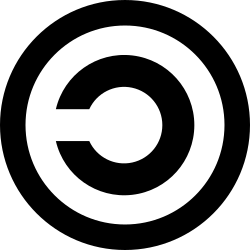
The copyleft symbol is a mirrored version of the copyright symbol, ©: a reversed C in a circle.[62] A 2016 proposal to add the symbol to a future version of Unicode was accepted by the Unicode Technical Committee.[63][64] The code point U+1F12F 🄯 COPYLEFT SYMBOL was added in Unicode 11.[64][65] The copyleft symbol has no legal status.[66]
As of 2024,[update] the symbol is generally provided as standard in the system fonts of most current operating systems,[citation needed] but if need be it may be approximated with character U+2184 ↄ LATIN SMALL LETTER REVERSED C between parenthesis (ɔ).
Typing the character
[edit]On modern computer systems, the character U+1F12F 🄯 COPYLEFT SYMBOL can be generated using one of these methods (keyboard shortcuts):
See also
[edit]
- List of copyleft software licenses
- All rights reversed – Pun indicating a release under copyleft licensing status
- Anti-copyright notice – Statement encouraging the unrestricted distribution of a work
- Commercial use of copyleft works – Ethical dilemma
- Comparison of open-source and closed-source software
- Contributor License Agreement – Copyright terms
- Copyfraud – False copyright claims to public-domain content
- Copyright abolition – Movement advocating to abolish copyright
- Copyright alternatives – Compensation systems for digital copying
- Criticism of intellectual property – Ownership of creative expressions and processes
- Internet freedom – Digital rights, freedom of information and the right to Internet access and speech
- Free content – Free licensed works in any field
- Free Culture movement – Social movement concerning creative works
- Free software movement – Social movement
- History of free and open-source software
- Criticism of copyright – Dissenting views of copyright law
- Public copyright license – Type of license
- Public domain – Works outside the scope of copyright law
- Free video – Video content that is free to use for any purpose
- Steal This Film
- In Praise of Copying – 2010 book by Marcus Boon
References
[edit]- ^ Newman, John (29 December 2011). "Copyright and Open Access at the Bedside". NEJM. 365 (26): 2447–2449. doi:10.1056/NEJMp1110652. PMID 22204721.
- ^ Troan, Larry (2006). Open Source from a Proprietary Perspective (PDF). Red Hat Summit. Nashville: Red Hat. Archived from the original (PDF) on 22 January 2014.
- ^ Stallman, Richard (29 June 2007). "GNU General Public License". GNU Project. Retrieved 1 May 2017.
- ^ "Free Art License 1.3". Copyleft Attitude. Retrieved 6 October 2021.
- ^ "Attribution-ShareAlike 4.0 International (CC BY-SA 4.0)". Creative Commons. Retrieved 14 August 2015.
- ^ "Wikipedia Drops GNU in Favor of Creative Commons License". PC world. 21 May 2009. Retrieved 4 July 2025.
- ^ Wang, Li-Chen (May 1976). "Palo Alto Tiny BASIC". Dr. Dobb's Journal of Computer Calisthenics & Orthodontia, Running Light Without Overbyte. 1 (5): 12–25. Source code begins with the following six lines.
TINY BASIC FOR INTEL 8080
VERSION 1.0
BY LI-CHEN WANG
10 JUNE, 1976
@COPYLEFT
ALL WRONGS RESERVED
The June date in the May issue is correct. The magazine was behind schedule — the June and July issues were combined to catch up. - ^ a b c d e Carver, Brian W. (5 April 2005). "Share and Share Alike: Understanding and Enforcing Open Source and Free Software Licenses". Berkeley Technology Law Journal. 20 (1): 443. doi:10.15779/Z388T19. S2CID 153900462. SSRN 1586574. Retrieved 27 June 2023.
- ^ Williams, Sam (March 2002). "7". Free as in Freedom – Richard Stallman's Crusade for Free Software. O'Reilly Media. ISBN 978-0-596-00287-9.
- ^ Moody, Glyn (2002). Rebel Code. p. 26.
- ^ "Emacs General Public License". 5 July 2001. Retrieved 23 August 2008.
- ^ a b Stallman, Richard (21 January 2008). "About the GNU Project". Free Software Foundation. Retrieved 1 May 2017.
- ^ "Free Art License – Frequently Asked Questions". Copyleft Attitude. Retrieved 6 October 2021.
- ^ "Licenses". GNU Project. Retrieved 6 October 2021.: "We don't take the position that artistic or entertainment works must be free, but if you want to make one free, we recommend the Free Art License."
- ^ "What is free software?". GNU. 30 July 2019. Retrieved 22 July 2020.
- ^ Mundie, Craig (3 May 2001). "Prepared Text of Remarks by Craig Mundie, Microsoft Senior Vice President – The Commercial Software Model". New York University Stern School of Business. Archived from the original on 21 June 2005. Retrieved 1 October 2009.
- ^ The New York Times. Retrieved 23 April 2022
- ^ Maher, Marcus (2000). "Open Source Software: The Success of an Alternative Intellectual Property Incentive Paradigm" (PDF). Fordham Intellectual Property, Media & Entertainment Law Journal. Archived from the original (PDF) on 2 May 2014. Retrieved 1 May 2014.
- ^ Sarmah, Harshajit (23 September 2019). "5 Reasons Why Contributing To Open Source Projects Helps In Landing A Job". Analytics India Magazine. Retrieved 22 July 2020.
- ^ Mustonen, Mikko. "Copyleft - The Economics of Linux and Other Open Source Software" (PDF). Information Economics and Policy. Archived from the original (PDF) on 2 May 2014. Retrieved 1 May 2014.
- ^ "How to choose a license for your own work". Free Software Foundation's Licensing and Compliance Lab. Retrieved 1 May 2017.
- ^ "What is Copyleft?". GNU Project.
- ^ "Scheibner, James – "What price freedom (of software)? A guide for Australian legal practitioners on open source licensing" [2017] PrecedentAULA 23; (2017) 139 Precedent 39". classic.austlii.edu.au. Retrieved 27 November 2021.
- ^ Kirk St.Amant & Brian Still (2008). "Examining Open Source Software Licenses through the Creative Commons Licensing Model". Handbook of Research on Open Source Software: Technological, Economic, and Social Perspectives. Information Science Reference. pp. 382 of 728. ISBN 978-1-59140-999-1.
- ^ "The EUPL – European Union Public Licence". European Commission. Retrieved 9 January 2007.
- ^ "Free Software Licensing Agreement CeCILL" (PDF). INRIA. Archived from the original (PDF) on 8 August 2010. Retrieved 24 August 2010.
- ^ Patrice-Emmanuel Schmitz (3 April 2015). "The meaning of "Copyleft" in EUPL". Joinup.
- ^ For some of the philosophy behind the term "SaaSS", see the "Server Software" section of "How to choose a license for your own work". GNU Project. 20 December 2015. Retrieved 1 May 2017.
- ^ Stallman, Richard (18 November 2016). "Who does that server really serve?". GNU Project. Retrieved 1 May 2017.
- ^ "Why the Affero GPL". GNU Project. 10 May 2015. Retrieved 1 May 2017.
- ^ List of free-software licences on the GNU website: "We recommend that developers consider using the GNU AGPL for any software which will commonly be run over a network".
- ^ "Various Licenses and Comments about Them - Sybase Open Watcom Public License version 1.0 (#Watcom)". GNU. Retrieved 23 December 2015.
This is not a free software license. It requires you to publish the source code publicly whenever you "Deploy" the covered software, and "Deploy" is defined to include many kinds of private use.
- ^ a b "Various Licenses and Comments about Them". GNU Project.
- ^ Engelfriet, Arnoud (2010). "Choosing an Open Source License". IEEE Software. 27. Athens University of Economics and Business: 48–49. doi:10.1109/MS.2010.5. S2CID 36712745.
- ^ Biancuzzi, Federico (30 June 2005). "ESR: "We Don't Need the GPL Anymore"". ONLamp.com. Archived from the original on 6 March 2018. Retrieved 23 August 2008.
- ^ Tiemann, Michael (18 September 2006). "Licenses by Name". Retrieved 23 August 2008.
- ^ Raymond, Eric Steven (9 November 2002). "Licensing HOWTO". Retrieved 23 August 2008.
- ^ "What the GPLv3 Means for MS-Novell Agreement". Yro.slashdot.org. 8 March 2007. Retrieved 14 May 2014.
- ^ Stallman, Richard (26 February 2001). "LWN.net: RMS on the Ogg Vorbis license". Retrieved 23 August 2008.
[M]y agreement with the idea of a lax [Ogg/Vorbis] license in this special case is just as pragmatic as my preference for the GPL in most cases. In both cases it is a matter of how we can attain freedom.
- ^ "Microsoft license spurns open source". CNET. CBS Interactive.
- ^ "Some rights reserved: the alternatives to copyright". Wired UK.
- ^ "Glossary". a2knetwork.org. Archived from the original on 26 April 2009.
- ^ Jason Greenberg; Daniel Glazer (March 2013). "Inoculating Your Purchase – Contractual Protection from Viral Licenses in M&A Transactions" (PDF). Fried Frank. Association of Corporate Counsel. Retrieved 10 June 2016.
- ^ Philip Wood; Amy Ryburn; Allan Yeoman; Andrew Matangi; Steve Nightingale (1 July 2013). "Legal update on Information and Communication Technology – July 2013". Archived from the original on 21 September 2013. Retrieved 10 June 2016.
- ^ Vixie, Paul (6 March 2006). "Re: Section 5.2 (IPR encumberance) in TAK rollover requirement draft". IETF Namedroppers mailing list. Archived from the original on 27 September 2007. Retrieved 29 April 2007.
- ^ "General Public Virus". Jargon File 2.2.1. 15 December 1990. Retrieved 29 April 2007.
- ^ Hackvän, Stig (September 1999). "Reverse-engineering the GNU Public Virus – Is copyleft too much of a good thing?". Linux Journal. Archived from the original on 18 July 2011. Retrieved 29 April 2007.
- ^ Stewart, Bill (8 October 1998). "Re: propose: 'cypherpunks license' (Re: Wanted: Twofish source code)". Cypherpunks mailing list. Archived from the original on 29 May 2007. Retrieved 29 April 2007.
- ^ Buck, Joe (10 October 2000). "Re: Using of parse tree externally". GCC mailing list. Retrieved 29 April 2007.
- ^ Griffis, L. Adrian (15 July 2000). "The GNU Public Virus". Archived from the original on 9 November 2017. Retrieved 29 April 2007.
- ^ Mundie, Craig (3 May 2001). "Speech Transcript – Craig Mundie". New York University Stern School of Business. Archived from the original on 21 June 2005. Retrieved 23 August 2008.
- ^ Newbart, Dave (1 June 2001). "Microsoft CEO takes launch break with the Sun-Times". Chicago Sun-Times. Archived from the original on 15 June 2001.(Internet archive link)
- ^ – via Wikisource.
- ^ MacCrisken, Jack. "Open source: One agnostic's view". CNET. Retrieved 5 July 2025.
- ^ Byfield, Bruce (29 August 2006). "IT Manager's Journal: 10 Common Misunderstandings About the GPL". Retrieved 23 August 2008.
- ^ "The license term smorgasbord: copyleft, share-alike, reciprocal, viral, or hereditary?". Luis Villa: Open Law and Strategy. 3 February 2012. Retrieved 22 August 2018.
- ^ McGowan, David (2005). "Legal Aspects of Free and Open Source Software". In Joseph Feller; Brian Fitzgerald; Scott A. Hissam; Karim R. Lakahani (eds.). Perspectives on Free and Open Source Software. MIT Press. p. 382. ISBN 978-0-262-06246-6.
- ^ Poynder, Richard (21 March 2006). "The Basement Interviews: Freeing the Code". Retrieved 5 February 2010.
- ^ "Frequently Asked Questions about the GNU Licenses". Free Software Foundation. 24 June 2008. Retrieved 1 May 2017.
- ^ Raymond, Eric Steven (9 November 2002). "Licensing HOWTO". Retrieved 21 March 2010.
- ^ Stallman, Richard. "Why you shouldn't use the Lesser GPL for your next library". GNU Project.
- ^ "The Unicode Standard, Version 15.0: Enclosed Alphanumeric Supplement" (PDF). unicode.org.
- ^ "Proposal to add the Copyleft Symbol to Unicode" (PDF).
- ^ a b "Proposed New Characters: Pipeline Table". Unicode Character Proposals. Unicode Consortium. Retrieved 18 April 2017.
- ^ "Announcing The Unicode Standard, Version 11.0". The Unicode Blog. Retrieved 6 June 2018.
- ^ Hall, G. Brent (2008). Open Source Approaches in Spatial Data Handling. Springer. p. 29. Bibcode:2008osas.book.....H. ISBN 9783540748311.
- ^ "Unicode Character "🄯" (U+1F12F)". www.compart.com. Retrieved 12 September 2024.
External links
[edit]

| General | |||
|---|---|---|---|
| Software packages | |||
| Community | |||
| Organisations | |||
| Licenses |
| ||
| Challenges | |||
| Related topics | |||


Copyleft
View on GrokipediaDefinition and Core Principles
Etymology and Conceptual Foundation
The term "copyleft" originated as a playful inversion of "copyright," first appearing in 1976 in the distribution notice of Palo Alto Tiny BASIC by Li-Chen Wang, which stated "@COPYLEFT ALL WRONGS RESERVED" as a humorous counter to proprietary software restrictions.[4] However, the modern usage and conceptual framework were shaped by Richard Stallman, who adopted the term after receiving a letter from Don Hopkins in 1984 or 1985 bearing the phrase "Copyleft—all rights reversed" on its envelope.[5] Stallman integrated "copyleft" into the lexicon of the free software movement to denote a licensing strategy that leverages copyright law not to restrict, but to mandate the preservation of user freedoms in derivative works.[6] Conceptually, copyleft rests on the principle of ensuring that software—or other works—remains libre in the sense of freedom, allowing users to run, study, modify, and redistribute it, while compelling any modified versions to extend the same liberties to others.[6] This approach, pioneered by Stallman in the GNU Project announced on September 27, 1983, flips the traditional function of copyright from enclosure to propagation of freedoms, preventing the conversion of free software into proprietary products.[7] Unlike permissive licenses that permit such conversions, copyleft enforces reciprocity through legal terms, such as those in the GNU General Public License, thereby fostering a commons of modifiable code sustained by mutual obligation.[8] The foundation draws from hacker culture's ethos of sharing source code, but formalizes it against the rising tide of proprietary software in the 1980s, prioritizing long-term communal access over short-term individual control.[7]Key Mechanisms and Requirements
Copyleft operates by embedding conditional permissions within a copyright license, which grants users the rights to copy, distribute, modify, and redistribute the work while requiring that all derivative works inherit the same freedoms and obligations. This "share alike" clause functions as the core mechanism, inverting traditional copyright's restrictive defaults to propagate openness: any adaptation or combination with other works must be released under identical terms, preventing enclosure of the original freedoms into proprietary restrictions. The Free Software Foundation describes this as a legal instrument ensuring that recipients receive not only the work but also the liberty to further propagate it under copyleft conditions.[9] Key requirements include mandatory disclosure of complete, machine-readable source code accompanying any distributed object code or binaries, enabling verification, modification, and independent recompilation by recipients. For software under licenses like the GNU General Public License (GPL), this entails providing installation instructions for obtaining sources and ensuring modifications are clearly marked, with the entire modified work relicensed compatibly to maintain the chain of freedoms. Distributors must also avoid imposing additional restrictions, such as non-disclosure agreements or fees that undermine access.[1] Enforcement relies on the underlying copyright, where non-compliance constitutes infringement, allowing original authors or assignees to seek remedies like injunctions or damages through courts. This mechanism distinguishes copyleft from permissive licenses by its viral propagation: while permissive grants allow relicensing to closed terms, copyleft's conditions apply recursively to downstream derivatives, fostering a commons resistant to privatization but potentially complicating integration with non-copyleft components.[3][10]Distinction from Copyright and Permissive Licensing
Copyleft licenses utilize the mechanisms of copyright law to enforce conditions that extend freedoms to users and subsequent modifiers, rather than restricting access as in conventional copyright usage. Under standard copyright, as codified in laws such as the U.S. Copyright Act of 1976, creators hold exclusive rights to reproduction, distribution, and derivative works, typically to prevent unauthorized use and maintain commercial control.[6] Copyleft, by contrast, grants explicit permissions for these activities but conditions them on the requirement to distribute derivatives under identical or compatible terms, thereby inverting copyright's default restrictive effect to perpetuate openness.[6] This approach ensures that freedoms—defined as the rights to run, study, modify, and redistribute—cannot be revoked by downstream parties, a protection absent in unmodified copyright enforcement.[6] The core distinction lies in copyleft's "share-alike" clause, which mandates that any modified version of the work must be released under the same license, preserving the chain of freedoms across generations of software.[6] Traditional copyright lacks this reciprocal obligation; licensees may receive limited permissions (e.g., via fair use doctrines), but absent explicit terms, they cannot compel the copyright holder to share source code or modifications. For instance, proprietary software under copyright often withholds source code, limiting user freedoms, whereas copyleft leverages copyright infringement remedies to enforce disclosure and relicensing in derivatives. This causal mechanism prevents the erosion of freedoms that occurs when copyrighted works are modified into closed-source products without reciprocity. In comparison to permissive licenses, such as the MIT License (first drafted in 1988 by the Massachusetts Institute of Technology) or the Apache License 2.0 (released in 2004), copyleft imposes stricter propagation of freedoms to counter the risk of proprietary enclosure.[6] Permissive licenses broadly permit use, modification, and redistribution with minimal conditions—often just attribution—allowing derivatives to be licensed proprietarily or combined with non-free code without requiring source release.[6] This flexibility enables scenarios like Apple's incorporation of permissively licensed BSD code into macOS without open-sourcing modifications, whereas copyleft licenses like the GNU GPL (version 1 released February 1989) prohibit such non-reciprocal use by requiring full source disclosure and identical licensing for combined works.[6][11] Consequently, permissive models prioritize developer convenience and compatibility with proprietary ecosystems, while copyleft prioritizes communal preservation of freedoms, potentially reducing adoption in hybrid environments but ensuring long-term accessibility. Empirical outcomes include the GNU Project's reliance on copyleft to amass contributions without proprietary capture, as seen in the development of the GNU Compiler Collection since 1987.Historical Development
Origins in the Free Software Movement
The free software movement, which birthed copyleft, emerged from the hacker culture at MIT's Artificial Intelligence Laboratory in the 1970s and early 1980s, where collaborative sharing of source code was the norm among programmers developing tools like the Incompatible Timesharing System (ITS) and early Emacs implementations. This ethic contrasted sharply with the rise of proprietary software in the 1980s, exemplified by companies withholding source code for features like networked printer drivers, prompting Richard M. Stallman to advocate for software freedoms as essential rights: to run programs for any purpose, study and modify them, and redistribute copies or derivatives.[12] On September 27, 1983, Stallman publicly announced the GNU Project, a plan to develop a fully free Unix-like operating system to replace proprietary alternatives and restore communal software development.[13] The project's licenses needed to enforce these freedoms against erosion by non-free modifications, leading Stallman to devise copyleft as a legal strategy that leveraged copyright not to restrict but to mandate openness in derivatives. This addressed causal failures in prior public domain approaches, where recipients could reimpose restrictions, undermining the goal of perpetual usability and modifiability.[14] The inaugural copyleft license, the Emacs General Public License, was applied to GNU Emacs in 1985, requiring any distributed modifications to grant recipients the same freedoms under identical terms, thus propagating the license virally.[14] [10] Stallman coined the term "copyleft" around this time, inverting "copyright" to denote this freedom-enforcing mechanism, as referenced in the September 1985 GNU Manifesto, which outlined copyleft's role in preventing software privatization while enabling widespread collaboration.[12] These early mechanisms crystallized copyleft's core: using enforceable conditions to ensure software remained libre, countering empirical trends toward vendor lock-in observed in systems like those from Digital Equipment Corporation and Xerox.Creation and Evolution of the GNU GPL
The GNU General Public License (GPL) was developed by Richard Stallman as a key component of the GNU Project, which he announced in September 1983 with the aim of creating a free Unix-like operating system.[15] Stallman, frustrated by restrictions imposed by proprietary software licenses, sought to establish a licensing framework that would guarantee users the freedoms to run, study, share, and modify software, while requiring derivative works to extend the same freedoms—a mechanism known as copyleft.[12] The Free Software Foundation (FSF), founded by Stallman in 1985, played a central role in refining and promoting this approach.[13] Version 1 of the GPL was formally released in February 1989, marking the first standardized copyleft license for general use in the GNU Project.[16] It prohibited distributors from adding restrictions that would undermine the four essential freedoms, such as requiring source code availability upon distribution and ensuring modifications could be shared under the same terms. This version addressed early threats like attempts to restrict copying or modification, which Stallman had observed in the software industry during the 1980s.[16] In June 1991, the FSF published GPL version 2, which clarified ambiguities in version 1, particularly around compatibility with other licenses and the handling of dynamically linked libraries.[17] Key additions included an optional clause allowing software to be licensed under "this version or any later version," facilitating future updates, and stronger protections against proprietary extensions that could circumvent copyleft through linking.[17] This revision responded to practical challenges encountered in distributing GNU software, such as legal uncertainties in binary combinations, without altering the core copyleft principle. GPL version 3 emerged after a multi-year public consultation process initiated by the FSF in 2005, culminating in its release on June 29, 2007.[18] Motivated by emerging issues like "tivoization"—hardware restrictions preventing modified software installation—and software patent abuses, version 3 introduced explicit anti-circumvention provisions, requiring that users of modified GPL-licensed software in devices be able to install changes.[19] It also strengthened patent licensing terms to defend against litigation and improved compatibility with network server software through provisions later formalized in the Affero GPL variant.[19] These changes aimed to preserve copyleft efficacy in a landscape of digital restrictions and networked distribution, though they sparked debate over added complexity compared to version 2.[18]Expansion to Variants and Broader Adoption
The GNU Lesser General Public License (LGPL), initially termed the GNU Library General Public License, was published by the Free Software Foundation in June 1991 as version 2.0, coinciding with GPLv2, to enable libraries under copyleft to be dynamically linked with proprietary applications without imposing full copyleft on the latter. This variant addressed developer concerns that strict GPL requirements hindered library reuse, thereby expanding copyleft's applicability in mixed ecosystems while preserving freedoms for derivative library works.[20] As the internet and browser wars intensified, Netscape Communications Corporation released the source code for its Navigator browser in 1998 under the inaugural Mozilla Public License (MPL) version 1.0, drafted by attorney Mitchell Baker.[21] Unlike the full-program copyleft of the GPL, the MPL enforced obligations only on files directly modified from the original, permitting integration with permissive or proprietary code elsewhere in a project; this file-level approach facilitated contributions from diverse developers and influenced subsequent weak copyleft designs.[22] Network-based software prompted further innovation with the Affero General Public License (AGPL) version 1.0, released by Affero Inc. in March 2002 and endorsed by the FSF shortly thereafter, which added a clause mandating source code availability for programs accessed remotely over a network.[23] The FSF integrated this mechanism into GPLv3 as the GNU AGPLv3 in November 2007, closing a perceived loophole in traditional GPL where server-side modifications evaded distribution requirements.[24] Copyleft's broader adoption accelerated through its embrace in foundational projects independent of the FSF. Linus Torvalds licensed the initial Linux kernel release in September 1991 under GPLv2, leveraging copyleft to foster collaborative development; by the mid-1990s, this kernel powered growing distributions, with commercial entities like Red Hat incorporating GPL compliance into business models by 1998. Similarly, MySQL adopted the GPL in 1995, enabling dual-licensing strategies that supported enterprise use while ensuring community derivatives remained open. These cases demonstrated copyleft's viability for scalable, high-impact software, extending its reach beyond ideological free software circles into pragmatic open source ecosystems, though tensions arose with permissive licenses favored for maximal proprietary integration.[25] By the early 2000s, copyleft governed millions of lines of code in servers, embedded systems, and tools, underscoring its role in sustaining communal innovation amid commercial pressures.[26]Major Copyleft Licenses
GNU General Public License Versions
The GNU General Public License (GPL), developed by Richard Stallman and published by the Free Software Foundation (FSF), has undergone three principal revisions to address emerging legal, technical, and practical challenges in enforcing copyleft while preserving user freedoms to run, study, share, and modify software.[27][28][1] Version 1 established the foundational copyleft mechanism in February 1989, requiring that any distributed modifications or derivative works be released under the same license terms, with source code provided to recipients.[27] This version emphasized no warranty and aimed to counteract proprietary restrictions by mandating freedoms for all users, but it contained ambiguities in phrasing that led to interpretive disputes.[27] Version 2, released in June 1991, refined Version 1's language for greater clarity without altering core intent, incorporating legal advice to resolve ambiguities in binary distribution requirements and compilation permissions.[28][29] Key enhancements included explicit provisions on software patents, prohibiting their assertion to undermine the license's freedoms, and strengthened conditions for conveying programs to ensure recipients receive complete source code corresponding to distributed object code.[28][29] These changes addressed practical issues observed in early adoptions, such as uncertainties in handling modified binaries, while maintaining the requirement that derivatives propagate the GPL's terms.[30] Version 2 became the most widely used iteration, powering projects like the Linux kernel due to its stability and perceived simplicity.[31] Version 3, finalized after extensive public consultation and released on June 29, 2007, introduced measures to counter technological and legal developments not anticipated in prior versions, including hardware restrictions and patent trolling.[1][32] It explicitly bans "tivoization"—the use of technical measures in user products to prevent installation of modified software—by requiring providers of such products to supply installation information enabling users to run modified versions.[1] Additional provisions grant explicit patent licenses to licensees, aiming to neutralize patents used to privatize free software, and prohibit circumvention of effective technological measures only insofar as they block modification freedoms, distinguishing from broader anti-circumvention laws.[1][33] Version 3 also improved compatibility with other licenses, such as the GNU Affero GPL, and clarified rules for conveying over networks, though adoption remains uneven, with some projects opting for "or later" clauses to allow upgrades while others remain bound to Version 2-only.[1][33]GNU Lesser and Affero GPL
The GNU Lesser General Public License (LGPL) is a copyleft license developed by the Free Software Foundation (FSF) as a variant of the GNU General Public License (GPL), permitting the use of licensed libraries in proprietary software under specific conditions.[34] Originally released as the GNU Library General Public License version 2 in June 1991 alongside GPL version 2, it was renamed the Lesser GPL in 1999 to emphasize its weaker copyleft protections compared to the full GPL, reflecting the FSF's intent to encourage broader adoption of free libraries while still requiring source code availability for the library itself.[35] The LGPL's primary purpose is to facilitate the integration of free software libraries into non-free applications via dynamic linking, without obligating the proprietary code to adopt copyleft terms, provided that users can relink the application with modified or replacement versions of the library.[36] This distinguishes it from the GPL, which would propagate copyleft to the entire combined work upon distribution.[37] Key provisions of the LGPL include requirements for distributing object code alongside the library's complete source code or object files sufficient for modification and relinking, ensuring users retain freedoms to study, modify, and redistribute the library independently.[35] Version 2.1, published in February 1999, refined these rules to address issues in languages like Java where dynamic linking equivalents (e.g., class loading) apply, explicitly allowing proprietary applications to link against LGPL libraries without source release obligations for the application code.[38] The LGPL version 3.0, released on June 29, 2007, aligns more closely with GPL version 3 by incorporating anti-tivoization measures (preventing hardware restrictions on modified software) and explicit patent grants, while adding permissions to convey LGPL-covered works without full GPL section 3 obligations, such as installation considerations.[36] However, the FSF advises against using LGPL for new libraries, favoring the full GPL to maximize copyleft enforcement unless library usability in proprietary contexts is essential.[37] LGPL-licensed software, such as certain GNU libraries, has enabled widespread use in mixed ecosystems, though its compatibility with GPL requires careful handling to avoid weakening copyleft chains.[34] The GNU Affero General Public License (AGPL) extends the GPL's copyleft to address software deployed over networks, particularly server-side applications accessed remotely by users.[39] Version 3.0, published by the FSF on November 19, 2007, builds directly on GPL version 3 with an additional clause: if a modified AGPL-covered program operates on a server and users interact with it over a network, the operator must provide those users a means to download the complete corresponding source code.[40] This provision closes the "application service provider" (ASP) loophole in the GPL, where modified free software could be run as a service without distributing binaries or source, effectively privatizing improvements while users receive no freedoms.[41] The AGPL's purpose is to ensure cooperative development in network contexts, such as web applications or SaaS, by treating remote interaction akin to distribution, thereby requiring source availability for enhancements that benefit from user interactions.[39] Unlike the LGPL's focus on library linking, the AGPL enforces strong copyleft similar to the GPL, propagating obligations to derivative works regardless of distribution method, including network use.[41] It includes GPL v3 features like explicit patent licensing and compatibility with other GPL-family licenses when unmodified, but its network clause makes it incompatible with pure GPL v2 in some scenarios, though AGPL v3 can be used alongside GPL v3.[39] The AGPL has been adopted for projects like MongoDB (prior to relicensing) and certain web tools, promoting transparency in cloud and server environments, but its stringent requirements deter proprietary integration, limiting adoption compared to permissive licenses.[41] No version 2 of the AGPL exists under FSF auspices; an earlier Affero GPL v1 from 2002 predates FSF involvement and differs in scope.[39]Mozilla Public License and Others
The Mozilla Public License (MPL) emerged in 1998 when Netscape Communications open-sourced its browser codebase, initially as Netscape Public License 1.0 before adopting the MPL 1.0 designation, aiming to balance open collaboration with commercial flexibility for software like the precursor to Firefox. MPL 1.1 followed in June 2003, refining patent provisions and compatibility, while MPL 2.0, released on January 3, 2012, updated language for clarity, added compatibility with GPL 2.0 and later via secondary licensing, and maintained core protections against patent trolls without altering the file-level copyleft mechanism.[42] This weak copyleft structure mandates that source code for any modified MPL-covered files be made available under the same license terms upon distribution, but permits linking those files into larger works—including proprietary ones—without obligating disclosure of unmodified or new proprietary code, distinguishing it from stronger licenses like the GPL that propagate requirements across entire derivatives.[43] The license explicitly grants patent rights to contributors and requires inclusion of notices, fostering adoption in projects like Thunderbird while allowing dual-licensing strategies for broader interoperability. Other notable copyleft licenses outside the GNU family include the Eclipse Public License (EPL), introduced by the Eclipse Foundation in 2004 as EPL 1.0 and updated to EPL 2.0 in 2017, which enforces weak, file-based copyleft by requiring source availability only for EPL-covered modifications while permitting their integration into proprietary systems and offering optional secondary GPL compatibility.[44] Similarly, the Common Development and Distribution License (CDDL), drafted by Sun Microsystems in 2004 for OpenSolaris components, operates as a weak copyleft with per-file reciprocity, explicit patent licenses, and source disclosure mandates for derivatives, but allows new files in combined works to adopt different terms, addressing GPL incompatibilities seen in earlier Solaris licensing disputes. These licenses, like the MPL, prioritize modular openness over viral enforcement, enabling commercial entities to leverage open components without full codebase exposure, though they demand careful compliance to avoid inadvertent copyleft triggers in distributed binaries.Technical Implementation
Propagation of Copyleft Obligations
Copyleft obligations propagate when a licensee distributes derivative works or combined programs containing copyleft-licensed material, mandating that the entire output be relicensed under compatible copyleft terms to ensure downstream recipients retain equivalent freedoms to modify, study, and redistribute.[19] This mechanism, central to strong copyleft licenses like the GNU General Public License (GPL), operates by conditioning the granted permissions on the preservation of those permissions in any conveyed modifications or derivatives, creating a reciprocal chain of obligations that extends through successive distributions.[10] Private use or internal modifications do not trigger propagation, as the GPL permits unrestricted running and altering for personal purposes without distribution requirements.[45] Under GPLv3 Section 5, conveyance of modified source versions requires explicit notices of changes, a statement of licensing under the GPL, and that the "entire work, as a whole," be licensed under the GPL to all recipients, thereby extending copyleft to the full derivative.[19] For binary distributions, Section 6 mandates provision of complete corresponding source code (CCS), either physically accompanying the binaries, via a written offer valid for at least three years, or through publicly accessible network servers, ensuring modifiers can access and propagate further changes compliantly.[19] This source obligation propagates recursively: any recipient who further modifies and distributes must similarly provide CCS for their version, preventing proprietary enclosures of GPL-derived code.[10] The propagation effect is particularly stringent in strong copyleft regimes, where linking or aggregating GPL code with other components can render the whole program subject to GPL terms if the result qualifies as a derivative work under copyright law, such as through dynamic or static linking that creates an inseparable unit.[45] GPLv3 Section 10 automates this by granting downstream recipients an implicit license to the work, but only insofar as they adhere to the terms, prohibiting additional restrictions and thus enforcing viral compliance across distribution chains.[19] Examples include embedded systems like routers, where GPL-licensed firmware (e.g., BusyBox) requires distributors to supply build instructions and source as "Installation Information" for user products, propagating obligations to hardware vendors.[10] In practice, violations often stem from incomplete source provision, affecting 95% of reported GPL non-compliance cases, which disrupts propagation until remedied by releasing the withheld materials.[10] Weak copyleft variants, such as the GNU Lesser GPL (LGPL), limit propagation to the library itself rather than the entire program, allowing linkage with proprietary code without full relicensing, but standard GPL maintains broader enforcement to uphold the copyleft principle.[45] This design, rooted in the Free Software Foundation's strategy since the GPL's inception in 1989, prioritizes software freedom's persistence over permissive reuse, though it demands vigilant compliance tracking in multi-component projects.[10]Handling Derivatives and Distributions
Copyleft licenses require that derivative works—defined as modifications or adaptations of the original work that require copyright permission, such as code alterations or incorporations into larger programs—be licensed under terms that preserve the same freedoms granted to the original, ensuring users can study, modify, and redistribute them without restriction.[19] Under the GNU General Public License (GPL), for instance, any distributed modified version must include prominent notices of changes and their dates, while licensing the entire work as a whole under the GPL to all recipients at no charge.[19] This propagation mechanism, often termed "viral" copyleft in strong variants like the GPL, applies when the derivative incorporates original code through means such as static or dynamic linking, shared data structures, or plugin interfaces that enable intimate communication, thereby subjecting the combined output to the same obligations.[45] Distributions of copyleft-licensed software, whether source or binary forms, trigger additional requirements to facilitate ongoing modification and verification. For object code or executables derived from GPL-covered works, distributors must provide the complete corresponding source code—comprising the preferred form for making modifications, including scripts and interface definitions—either on a durable physical medium, via a written offer valid for at least three years, or through publicly accessible network servers with clear download instructions.[19] Private modifications need not be shared, but any conveyance to third parties invokes these rules, prohibiting proprietary enclosures of the freedoms while allowing commercial distribution as long as source availability is ensured.[45] In practice, determining a derivative's scope relies on copyright law principles, where mere aggregation of separate modules may not trigger copyleft if they remain independently executable, but inseparable combinations do.[45] GPL versions 2 and 3 differ subtly: GPLv2 emphasizes source offers for binaries under Section 3, while GPLv3 (Section 6) adds anti-tivoization measures requiring installation information for user products to prevent hardware locks on modifications. [19] These provisions enforce causal continuity of freedoms across generations of software, countering tendencies toward proprietary lock-in observed in non-copyleft ecosystems.[45]Challenges in Network and SaaS Contexts
The GNU General Public License (GPL) requires source code distribution only upon conveyance of object code, but software-as-a-service (SaaS) models typically involve remote access over networks without conveying copies to users, thereby evading GPL copyleft obligations.[46][47] This "SaaS loophole" permits operators to modify GPL-licensed software for server-side deployment—such as web applications—and retain proprietary enhancements without sharing them, undermining the license's intent to propagate freedoms through derivatives.[46][47] To address this, the Free Software Foundation published the GNU Affero General Public License version 3 (AGPLv3) on November 19, 2007, extending copyleft to network interactions by mandating that modified versions offered remotely must enable users to obtain corresponding source code, often via a download offer on the same network interface.[46] However, AGPL adoption remains limited due to its stricter terms, which deter commercial entities wary of exposing server-side modifications; for instance, major SaaS providers often avoid AGPL components to prevent mandatory disclosures.[48][49] Enforcement challenges persist even under AGPL, as detecting remote modifications requires monitoring network access or relying on self-compliance, with no automatic propagation mechanism like binary distribution triggers.[48][50] Technical complexities arise in distributed architectures, such as microservices or containerized cloud environments, where defining "network use" or isolating copylefted components from proprietary code proves ambiguous, potentially leading to inadvertent violations or over-restrictive interpretations.[50][51] Moreover, proxying source code availability under AGPL raises privacy and security concerns, as it necessitates exposing potentially sensitive server configurations to end-users.[49]Legal Enforcement and Cases
Notable Litigation and Compliance Disputes
The Software Freedom Law Center filed the first U.S. copyright infringement lawsuit enforcing the GNU General Public License (GPL) in September 2007 on behalf of BusyBox developers against Monsoon Multimedia, alleging redistribution of BusyBox—a GPL-licensed suite of Unix utilities—in the TVTuner device without providing corresponding source code or license notices.[52] This case set a precedent for GPL enforcement in embedded systems, resulting in a settlement requiring Monsoon to comply with GPL terms, including source release.[53] Expanding on BusyBox violations, in December 2009, the Software Freedom Conservancy, alongside BusyBox developer Erik Andersen, sued 14 consumer electronics companies—including Best Buy, Samsung, and Westinghouse—for incorporating BusyBox into products like digital video recorders and televisions without source code distribution or attribution, breaching GPL v2 obligations. Multiple defendants settled, with outcomes including public source code releases and injunctions against further violations; for instance, a 2010 default judgment against Westinghouse enforced compliance and awarded costs.[54] These suits highlighted widespread non-compliance in proprietary hardware embedding copyleft software, prompting industry-wide audits.[55] In December 2008, the Free Software Foundation (FSF) sued Cisco Systems for copyright infringement over Linksys routers incorporating FSF-copyrighted GPL- and LGPL-licensed software, such as GNU Bash and GCC, without providing source code despite repeated demands.[56] The case settled in May 2009, with Cisco agreeing to appoint a Free Software Director to oversee compliance, release sources for affected products, and run ads acknowledging the resolution—marking a high-profile corporate concession to copyleft terms.[57] Artifex Software filed suit against Hancom in November 2016, claiming breach of the Affero GPL v3 for Hancom's inclusion of Ghostscript—a copyleft-licensed PDF interpreter—in its Hangul Word Processor without source provision or commercial licensing fees, despite Artifex's dual-licensing model.[58] A May 2017 U.S. District Court ruling denied Hancom's motion to dismiss, affirming that AGPL acceptance forms an enforceable contract and allowing both copyright and contract claims to proceed, reinforcing copyleft's legal validity beyond pure copyright.[59] The parties settled confidentially in 2018 after partial summary judgment favored Artifex on key issues.[60] More recently, in October 2021, the Software Freedom Conservancy sued Vizio for GPL v2 and LGPL violations in smart TVs using Linux kernel and BusyBox code, failing to distribute sources despite public commitments and user requests.[61] The case, litigated as third-party beneficiary enforcement, remains ongoing in California state court as of 2023, testing GPL's contract enforceability for end-users and distributors.[62] In Europe, the Paris Court of Appeal in February 2024 ordered Orange S.A. to pay Entr'Ouvert over €900,000 for modifying and distributing GPL v2-licensed LDAP software without source code or relicensing notices, underscoring cross-jurisdictional copyleft remedies including damages.[63]Role of Organizations like FSF
The Free Software Foundation (FSF), established in 1985, maintains a dedicated licensing and compliance team responsible for investigating reports of GNU General Public License (GPL) violations and pursuing enforcement actions to ensure adherence to copyleft requirements.[64] This team receives public reports monthly and prioritizes negotiation and education to achieve compliance, viewing litigation as a last resort after failed attempts at cooperation.[65] The FSF's approach emphasizes community-oriented principles, aiming to normalize respect for users' freedoms under copyleft licenses rather than punitive measures, as outlined in its 2015 joint statement with the Software Freedom Conservancy (SFC).[65] Where the FSF holds copyrights, it actively enforces terms, offering assistance to other copyright holders but refraining from unilateral action without such ownership.[66] Notable FSF enforcement includes its 2008 lawsuit against Cisco Systems for incorporating GPL-licensed code into Linksys routers without providing corresponding source code, filed on December 11, 2008, and settled on May 20, 2009, with Cisco agreeing to appoint a Free Software Director, release relevant source code, and make a monetary contribution to the FSF.[56] [57] In the case of TiVo, the FSF pursued compliance in the mid-2000s over "tivoization"—hardware restrictions preventing modified GPL software from running—resulting in a settlement that permitted reinstallation of unmodified GPL binaries while allowing TiVo to disable devices running altered versions, highlighting ongoing debates about copyleft's scope in embedded systems.[67] Organizations like the SFC complement the FSF by representing collectives of contributors in copyleft enforcement, particularly for projects like the Linux kernel where copyrights are dispersed.[68] The SFC's 2021 lawsuit against Vizio, filed in October 2021, alleges failure to provide source code for GPL- and LGPL-licensed components in smart TV firmware, with court rulings in 2023 and 2024 affirming the SFC's standing as a third-party beneficiary to enforce user rights under these licenses; the case remains ongoing as of 2025, potentially setting precedents for consumer enforcement of copyleft obligations.[61] [69] These efforts collectively deter violations through demonstrated willingness to litigate, though resource constraints limit comprehensive coverage, focusing instead on high-impact cases to promote broader compliance.[70]International Variations in Enforcement
Enforcement of copyleft licenses such as the GNU General Public License (GPL) exhibits significant variations across jurisdictions, primarily due to divergent interpretations of license terms under national copyright and contract laws. In the United States, enforcement typically proceeds under federal copyright law, where organizations like the Free Software Foundation (FSF) and Software Freedom Conservancy assert standing as copyright holders to seek injunctions and compliance for violations involving derivative works or source code withholding.[65] Internationally, however, local courts often recharacterize GPL obligations as contractual rather than purely copyright-based, altering remedies, standing requirements, and procedural hurdles.[71] In Germany, copyleft enforcement has proven robust and precedent-setting, with courts treating GPL violations as breaches of copyright licenses enforceable through injunctions and damages. The Munich Regional Court issued its first temporary injunction enforcing the GPL in 2004 against a WLAN router manufacturer for failing to provide source code, followed by a second injunction in 2005 prohibiting further distribution of non-compliant products.[72] Independent enforcer Harald Welte has secured multiple out-of-court settlements and judgments, demonstrating that German civil procedure supports swift remedies like product recalls, contributing to high compliance rates in embedded systems.[73] These cases contrast with weaker enforcement in jurisdictions lacking specialized IP courts or where software directives are implemented unevenly. France presents a notable divergence, where appellate courts have ruled that GPL claims cannot rely on copyright infringement doctrines but must instead be litigated as breaches of adhesion contracts. In Entr'Ouvert v. Orange S.A. (2024), the Paris Court of Appeal awarded over €900,000 in damages to the plaintiff for violations involving modified GPL-licensed software used in telecommunications equipment, but framed the dispute under contract law, requiring proof of acceptance and limiting remedies to compensatory damages rather than statutory copyright penalties.[63] A 2021 appellate decision further affirmed that copyright-based claims under the GPL are invalid in France, potentially restricting enforcement to direct licensees and complicating standing for upstream copyright holders like the FSF.[74] This contractual lens, rooted in French civil code principles, has led to prolonged litigation but successful recoveries in high-profile cases. Beyond Europe, enforcement remains sporadic and under-resourced in regions with nascent IP frameworks or limited judicial familiarity with open-source licenses. In developing economies, such as parts of Asia and Latin America, copyleft violations often go unaddressed due to lax copyright protection and prioritization of proprietary IP over reciprocal licensing, though the FSF's global compliance efforts have prompted voluntary disclosures in isolated instances.[65] Harmonized international treaties like the Berne Convention underpin basic copyright reciprocity, but copyleft's share-alike requirements depend on domestic enforcement vigor, resulting in de facto permissive use in low-IP jurisdictions despite formal license applicability.[71]Criticisms and Limitations
Restrictions on Commercial Use and Innovation
Copyleft licenses impose obligations that limit their integration into proprietary software products, as any derivative works or combined distributions must adopt the same copyleft terms, requiring the release of source code modifications.[19] This "viral" propagation, exemplified by the GNU General Public License (GPL) versions 2 and 3, prevents companies from incorporating copyleft components into closed-source applications without open-sourcing proprietary enhancements, thereby exposing competitive intellectual property.[75] Such requirements deter commercial entities from adopting copyleft software, as businesses prioritize retaining control over code to enable monetization through proprietary models.[76] For instance, linking copyleft libraries with distributed proprietary software triggers source disclosure mandates, risking unintended leakage of internal developments.[76] Empirical data from GitHub repositories underscores this reluctance: in 2015, MIT-licensed projects outnumbered those under GPL by a factor of two, with permissive licenses comprising the majority of new repositories due to their compatibility with proprietary workflows.[77] [76] Critics argue that these constraints hinder innovation by diminishing private sector incentives for investment in copyleft-based projects, as firms cannot exclusively capture value from enhancements that would otherwise remain proprietary.[75] In domains like scientific software, copyleft erects barriers to industry collaboration and ecosystem integration, such as embedding code into libraries like SciPy, thereby impeding knowledge dissemination and iterative progress without offsetting benefits.[78] An attenuated proprietary market under such regimes may duplicate efforts and reduce overall software advancement, as observed in critiques of GPL's incompatibility with closed enhancements.[75]Compatibility Issues with Other Licenses
Copyleft licenses, such as the GNU General Public License (GPL), require that derivative works and combined software distributions adopt the same copyleft terms, creating asymmetric compatibility with permissive licenses that impose fewer restrictions on relicensing. Software under permissive licenses like the MIT License or three-clause BSD License can be integrated into GPL-licensed projects, as these permissive terms permit relicensing under GPL, but GPL-licensed code cannot be combined with permissive-licensed software without subjecting the entire resulting work to GPL obligations.[79] This one-way compatibility arises because copyleft enforces share-alike requirements to preserve user freedoms, whereas permissive licenses allow proprietary or closed-source derivatives, violating copyleft's viral propagation if reversed.[80] Incompatibilities also exist between different versions of copyleft licenses, notably GPLv2 and GPLv3, which cannot be combined into a single program unless the GPLv2 code explicitly permits "any later version." GPLv3 introduces additional provisions, including explicit patent grants and prohibitions on hardware restrictions (anti-tivoization), that exceed GPLv2's scope, making direct combination a violation of GPLv2's terms.[81] The Free Software Foundation notes that this incompatibility prevents seamless merging, as GPLv3's expanded requirements cannot be retroactively imposed on GPLv2-only code without consent.[82] Specific license pairings exacerbate these issues; for instance, the Apache License 2.0 is deemed compatible by the Free Software Foundation for inclusion in GPLv3-licensed works due to aligned patent protections, but it conflicts with GPLv2 because Apache's patent termination and indemnification clauses lack equivalents in GPLv2, rendering combination impermissible.[83] Conversely, GPLv3 code cannot be incorporated into Apache 2.0 projects without relicensing the whole under GPLv3, as the Apache Software Foundation requires its projects to remain under Apache terms to facilitate collaborative development.[83] Other copyleft licenses, such as the Common Development and Distribution License (CDDL), introduce per-file copyleft that clashes with GPL's whole-work approach, prohibiting combined distributions without legal reconfiguration.[80] These conflicts often necessitate dual-licensing, exceptions, or separate modules to avoid enforcement disputes.[84]Ideological and Practical Barriers to Adoption
Ideological opposition to copyleft stems primarily from the philosophical rift between the free software movement, which champions copyleft as essential for preserving user freedoms against proprietary enclosure, and the open source movement, which favors permissive licenses to encourage maximal adoption and pragmatic collaboration.[85] Proponents of permissive licensing, such as those aligned with the Open Source Initiative, argue that copyleft's requirement for derivative works to adopt identical terms imposes unnecessary restrictions that deter commercial participation and innovation, prioritizing ideological purity over practical diffusion of software.[86] This view posits that allowing proprietary derivatives fosters broader ecosystem growth, as evidenced by the success of projects under licenses like MIT or Apache, which enable seamless integration into diverse applications without reciprocal obligations.[87] In contrast, free software advocates like the Free Software Foundation maintain that copyleft is vital to counteract the proprietary software industry's tendency to appropriate communal efforts, but critics from the open source perspective contend this approach fosters a confrontational stance that alienates potential contributors wary of enforced openness.[88] Eric Raymond, a key open source figure, has highlighted how rigid licensing can hinder the "bazaar" model of decentralized development by complicating contributions from entities preferring flexibility, thereby limiting copyleft's appeal in non-ideological contexts.[89] Practically, copyleft's "viral" clause—requiring any combined or derivative work to be licensed under compatible copyleft terms—poses significant risks for enterprises, as it can compel the release of proprietary source code, leading many organizations to impose internal bans on GPL-family dependencies outside isolated environments.[90] This reluctance is reflected in usage trends: GPL 2.0 adoption has declined by over 50% since the early 2010s, dropping to around 22% of open source licenses by 2022, as businesses favor permissive alternatives that avoid compliance burdens.[91][87] Compliance challenges exacerbate adoption barriers, particularly in complex supply chains where tracing copyleft obligations across dependencies is resource-intensive and prone to inadvertent violations, prompting companies to err on the side of avoidance rather than invest in legal audits.[92] In network-based deployments like SaaS, traditional copyleft licenses like GPL fail to trigger source disclosure absent distribution, rendering them ineffective for modern architectures unless using extensions like AGPL, which introduce even greater restrictions and further deter uptake.[93] Overall, these factors contribute to copyleft's niche status, confined largely to ideologically driven projects amid permissive licenses' dominance in commercial ecosystems.[94]Ideological Debates
Free Software vs. Open Source Perspectives
The free software movement, initiated by Richard Stallman in 1985 with the founding of the Free Software Foundation, views copyleft as an essential ethical mechanism to safeguard users' freedoms. Copyleft licenses, such as the GNU General Public License (GPL) first published in 1989, leverage copyright law to require that derivative works remain free software, ensuring the four essential freedoms: to run the program for any purpose, to study and modify it, to redistribute copies, and to distribute modified versions. Stallman describes copyleft as "pragmatic idealism," arguing that without it, developers could incorporate free software into proprietary products, eroding communal access and control over the code base.[8] This perspective prioritizes moral imperatives over expediency, positing that freedoms must be non-negotiable to foster a society where software users retain sovereignty rather than becoming dependent on restrictive vendors. In contrast, the open source movement, formalized by the Open Source Initiative (OSI) in 1998, treats copyleft as one valid licensing strategy among others, including permissive licenses like the MIT License from 1988 or Apache License 2.0 from 2004, without elevating it to a philosophical cornerstone. OSI defines open source licenses by practical criteria—allowing free use, modification, and redistribution with source code access—encompassing both copyleft and non-copyleft variants that meet the Open Source Definition. Copyleft is acknowledged for enforcing reciprocity, where derivatives must adopt compatible terms, but it is not deemed superior; proponents like Eric S. Raymond in his 1997 essay "The Cathedral and the Bazaar" emphasize collaborative development and market-driven adoption, viewing strict copyleft as potentially limiting commercial integration and innovation by imposing viral obligations on proprietary codebases. OSI explicitly rejects framing copyleft against "permissive" licenses as oppositional, instead highlighting reciprocity as a spectrum rather than a mandate.[86] The divergence stems from foundational goals: free software insists on copyleft's protective role to prevent "freedom zero"—the freedom to deny freedoms to others—citing empirical risks like proprietary forks observed in early Unix derivatives, while open source prioritizes empirical outcomes in ecosystems, noting that permissive licenses have facilitated broader adoption, as evidenced by their prevalence in projects like Linux kernel modules integrated with non-copyleft components since the 1990s.[95] Free software advocates critique open source for diluting ethical commitments, potentially enabling "openwashing" where pragmatic access masks user disempowerment, whereas open source supporters counter that ideological rigidity hampers growth, pointing to data from 2023 showing permissive licenses comprising over 60% of GitHub repositories versus copyleft's 10-15%. This tension persists, with free software maintaining copyleft's necessity for long-term sustainability against commodification, and open source favoring flexibility to maximize collaborative velocity.[8][85]Ethical Arguments For and Against
Proponents of copyleft, particularly advocates within the free software movement, argue that it embodies an ethical duty to safeguard users' fundamental freedoms in software use, including the rights to run, study, modify, and redistribute programs for any purpose.[95] This stance views proprietary software as inherently unjust, as it imposes artificial restrictions that deny users control over tools they rely upon, thereby prioritizing developers' or companies' interests over communal benefit and knowledge sharing.[95] Copyleft mechanisms, such as those in the GNU General Public License (GPL), enforce this by requiring derivative works to adopt compatible terms, ensuring that freedoms cannot be eroded through privatization or enclosure of shared codebases—a process likened to protecting a digital commons from exploitation.[11] Richard Stallman, founder of the Free Software Foundation, has emphasized that this approach fosters social solidarity, as withholding source code or modifications equates to a moral failing akin to denying access to essential knowledge, ultimately benefiting society by enabling collaborative improvement without gatekeeping.[95] Opponents, including some open source advocates and libertarians, contend that copyleft's mandatory reciprocity undermines ethical principles of individual autonomy and voluntary exchange by coercing developers to disclose modifications under the same restrictive terms, thereby limiting personal choice in how one's intellectual contributions are licensed.[96] This enforcement, reliant on copyright law's monopolistic powers—which many libertarians reject as state-granted privileges—paradoxically uses proprietary-like mechanisms to impose ideological conformity, potentially stifling innovation through compatibility barriers rather than promoting genuine freedom.[97] Critics argue that permissive licenses better align with ethical non-coercion, allowing unrestricted downstream use and commercialization, which maximizes societal utility by encouraging broader adoption without conditional strings that could deter contributions from those valuing privacy in derivatives or commercial viability.[98] Furthermore, by prioritizing user freedoms over developer prerogatives, copyleft risks paternalism, assuming enforcers know best how to balance rights, which some see as an overreach that privileges a specific moral framework at the expense of diverse ethical priorities like profit-driven incentives for creation.[99]Copyleft as Anti-Capitalist Tool
Copyleft licenses, such as the GNU General Public License (GPL) introduced by Richard Stallman in 1989, have been interpreted by certain ideological strands within the free software movement as a strategic inversion of copyright mechanisms to resist the commodification of software under capitalist systems. By mandating that derivative works adopt the same licensing terms, copyleft prevents the enclosure of collaboratively developed code into proprietary products, which proponents argue counters the capitalist impulse to privatize shared knowledge for exclusive profit. This approach leverages the very copyright laws—originally designed to incentivize creation through monopoly rights in early capitalist markets—to enforce perpetual openness, effectively subverting potential revenue streams from closed-source binaries or modifications.[100] Stallman, founder of the Free Software Foundation (FSF) in 1985, frames proprietary software not as a neutral market outcome but as an ethical violation that imposes user restrictions to maximize developer control and income, likening it to "malware" that undermines communal cooperation. In this view, copyleft serves as a defensive tool against such practices, promoting software as a commons where users' freedoms to run, study, modify, and redistribute supersede individual or corporate ownership claims. However, Stallman has explicitly clarified that the free software movement targets "one particular business practice" of subjugating users via proprietary restrictions, rather than opposing capitalism wholesale, noting that free software permits commercial distribution and services.[101] Marxist analyses extend this to portray copyleft as a direct challenge to capitalism's reliance on intellectual property for accumulation, arguing that copyright emerged to serve bourgeois interests by enclosing public domain ideas, while copyleft's reciprocal terms foster collective production akin to a "general intellect" unbound by wage labor dynamics.[100] Yet, this framing overlooks copyleft's dependence on capitalist state-enforced copyright for enforceability, as without it, the "viral" propagation clause lacks legal teeth. Empirical outcomes further temper anti-capitalist claims: enterprises like Red Hat have built multi-billion-dollar models on GPL-licensed Linux through support contracts, demonstrating compatibility with market-driven value extraction via non-code services. Critics within and outside the movement contend that copyleft's ideological posture as an anti-capitalist bulwark is overstated, as it coexists with profit motives and fails to dismantle underlying property relations in software production. Stallman's endorsement of selling free software underscores this pragmatism, prioritizing ethical freedoms over systemic overthrow. Thus, while copyleft disrupts certain proprietary enclosures, its tool-like role against capitalism remains limited to niche resistance within a broader ecosystem where open code fuels capitalist innovation.[102]Comparative Analysis
Copyleft Versus Permissive Open Source Licenses
Copyleft licenses, such as the GNU General Public License (GPL) versions 2.0 and 3.0, require that any derivative works or modifications be distributed under the same license terms, thereby ensuring that the software and its improvements remain freely available to users without restrictions on access, use, or further modification.[19] This "share-alike" or viral mechanism propagates the freedoms granted by the original license to all subsequent versions, preventing the code from being incorporated into proprietary software without reciprocal openness.[96] In contrast, permissive licenses like the MIT License, Apache License 2.0, and BSD licenses impose minimal obligations, typically only requiring preservation of copyright notices and disclaimers, while allowing recipients to relicense derivatives under any terms, including proprietary ones. The primary distinction lies in their approach to downstream control: copyleft enforces ongoing openness to safeguard the software commons against enclosure by commercial entities, whereas permissive licenses prioritize maximal reuse and integration flexibility, often at the cost of potential proprietarization.[103] For instance, under GPL, linking copyleft code into a larger application may obligate the entire work to be GPL-licensed if distributed, which can complicate adoption in mixed-license environments.[45] Permissive licenses avoid such entanglements, facilitating incorporation into closed-source products, as seen with libraries like those under Apache 2.0 used in Android's core components despite Google's proprietary extensions.[104] Empirical data on license adoption reveals permissive licenses dominate in practice. In 2024, the MIT License led usage rankings, followed by BSD variants and Apache 2.0, while GPL variants ranked lower despite their foundational role in projects like the Linux kernel.[105] This prevalence correlates with permissive licenses' compatibility advantages, enabling broader contributions and deployment; for example, React (MIT-licensed) powers numerous proprietary web applications, driving ecosystem growth, whereas GPL's restrictions have limited its uptake in enterprise tools wary of license compliance burdens.[106] Copyleft's strength in preserving openness is evident in sustained projects like GNU software, but it yields less overall code volume compared to permissive ecosystems, where adoption metrics show higher integration rates in commercial codebases—96% of which include open source components, predominantly permissive.[107] Critics of copyleft argue its restrictions hinder innovation by deterring proprietary investment, as firms prefer permissive code to avoid forced disclosure of trade secrets, potentially reducing upstream contributions from commercial developers.[103] Proponents counter that permissive licensing enables "free-riding," where companies extract value without reciprocating improvements, eroding the collaborative commons over time; Ethereum co-founder Vitalik Buterin has noted this asymmetry, favoring copyleft for conditional sharing that incentivizes mutual openness in high-value domains like blockchain.[98] Permissive licenses, by contrast, excel in low-barrier reuse, fostering rapid prototyping and widespread bug fixes, but empirical outcomes suggest they contribute to a fragmented landscape where core innovations risk enclosure, as proprietary forks dilute communal benefits without enforced return.[96]Versus Proprietary and Closed-Source Models
Copyleft licenses fundamentally diverge from proprietary and closed-source models by requiring the perpetual availability of source code and the extension of equivalent freedoms to all derivative works, thereby preventing the enclosure of modifications into non-free software. In proprietary models, source code remains inaccessible, and end-user license agreements (EULAs) typically prohibit reverse engineering, modification, or redistribution to protect intellectual property and enable revenue through sales or subscriptions.[19] This contrast stems from copyleft's "share-alike" clause, as in the GNU General Public License (GPL) version 1, released on February 25, 1989, which mandates that any distributed modifications or combined works adopt the same license, ensuring users retain the rights to use, study, modify, and share the software.[27] Proprietary software, by withholding source code, allows developers to maintain competitive advantages through secrecy but limits user autonomy and interoperability. Empirically, copyleft has facilitated collaborative ecosystems that challenge proprietary dominance, as demonstrated by the Linux kernel under GPL version 2, which has powered over 90% of the world's top supercomputers and underpins major platforms like Android, contributing to innovations in scalability and security through distributed contributions from thousands of developers.[108] This model contrasts with closed-source systems like Microsoft's Windows, where centralized control has enabled rapid iteration funded by licensing revenue exceeding $20 billion annually in the early 2020s, but has also led to vulnerabilities from limited external scrutiny. However, studies indicate copyleft's restrictions correlate with reduced developer participation compared to permissive open-source licenses, potentially slowing adoption in commercial contexts where firms prefer flexibility to integrate code without reciprocal obligations.[109] From an economic perspective, copyleft eliminates licensing fees, lowering barriers for widespread deployment—evident in the dominance of GPL-licensed components in embedded systems and servers—but its viral nature deters proprietary firms from incorporating such code, as it would compel disclosure of their entire codebase when distributing binaries. Proprietary models, conversely, incentivize substantial R&D investment by safeguarding exclusivity, as seen in enterprise software markets where closed-source solutions command premium pricing for integrated support and features. Critics of copyleft argue this reciprocity hampers hybrid innovation, with empirical analyses showing that strong copyleft projects exhibit lower reuse rates in commercial products due to compatibility fears, whereas proprietary software's opacity can foster siloed advancements but risks monopolistic practices absent in copyleft's enforced openness.[112]Empirical Outcomes in Software Ecosystems
Permissive licenses outnumber copyleft licenses in contemporary open source repositories, with data from analyses of millions of packages indicating that permissive options like MIT and Apache 2.0 comprise approximately 78% of components, while copyleft licenses such as the GPL family represent about 22%, a share that has declined from prior years.[87] Interest metrics from the Open Source Initiative further underscore this disparity, as pageviews for the MIT license exceed those for GPL variants by factors of 20 or more in 2024 data.[105] In server and infrastructure ecosystems, copyleft has underpinned dominant projects; the Linux kernel, distributed under GPLv2, powers over 80% of web servers and 96% of the top supercomputers as of mid-2024, enabling widespread deployment while enforcing derivative openness. This persistence demonstrates copyleft's capacity to sustain collaborative ecosystems amid corporate contributions, as modifications must remain open source, preventing proprietary enclosure of core components. Empirical audits of commercial codebases reveal challenges from copyleft's requirements, with 53% exhibiting license conflicts in 2023-2024 analyses, often stemming from transitive dependencies involving viral GPL clauses that mandate relicensing of integrated works.[113] Studies on reuse patterns confirm that GPL-licensed software faces barriers to integration with non-copyleft components, resulting in lower rates of incorporation into diverse projects compared to permissive alternatives, which facilitate broader adoption without reciprocity obligations.[114] These dynamics contribute to copyleft's niche prevalence in foundational infrastructure rather than expansive application layers.Societal and Economic Impact
Adoption in Key Projects and Industries
The Linux kernel, initially released on September 17, 1991, by Linus Torvalds and licensed under the GNU General Public License version 2 (GPLv2), represents one of the most prominent examples of copyleft adoption. This strong copyleft license has enabled its integration into diverse systems while requiring derivatives to remain open source. As of 2025, the Linux kernel powers approximately 96.3% of the top one million web servers globally, underscoring its dominance in server infrastructure.[115] It also underpins all 500 of the world's fastest supercomputers, leveraging its modularity and performance optimizations for high-performance computing (HPC) workloads.[116] In embedded systems, the Linux kernel's copyleft-licensed nature facilitates its use in resource-constrained devices such as routers, IoT appliances, and automotive software, often paired with tools like BusyBox—a minimal GPL-licensed implementation of Unix utilities released in 1996 that executes over 300 commands in a single binary for efficiency. BusyBox's adoption in embedded Linux distributions has contributed to Linux's prevalence in sectors like telecommunications and consumer electronics, where it handles firmware for billions of devices annually.[94] Other key projects include the GNU Compiler Collection (GCC), licensed under GPLv3 since 2007, which compiles the vast majority of open-source software and is integral to development toolchains across industries.[117] The GNU Image Manipulation Program (GIMP), under GPLv3 since its 1996 inception, serves as a primary raster graphics editor in creative workflows, with widespread use in desktop Linux environments and professional design pipelines.[118] In databases, the MariaDB fork—GPLv2-licensed since 2009—powers production systems at companies like Google and Wikipedia, illustrating copyleft's role in data management infrastructure.[94] Copyleft adoption extends to mobile ecosystems via the Android operating system, which incorporates the Linux kernel under GPLv2, enabling its deployment on over 3 billion devices worldwide as of 2023 despite proprietary user-space components.[119] In cloud computing, major providers such as Amazon Web Services and Google Cloud rely on Linux-based instances for virtual machines, with copyleft ensuring kernel-level freedoms amid proprietary overlays.[120] These examples highlight copyleft's persistence in mission-critical sectors, even as overall license usage trends show a shift toward permissive alternatives.[119]Effects on Innovation and Market Dynamics
Copyleft licenses, by requiring derivative works to adopt the same terms, compel ongoing openness that can accelerate collaborative innovation in communal projects but constrain proprietary value capture. Empirical analysis indicates that strong-copyleft regimes, such as the GNU General Public License (GPL), foster a "regulated commons" where community contributions enhance productivity through shared code exchange, as observed in the evolution of projects like the Linux kernel since its 1991 release under GPL version 2. This mechanism mitigates free-riding by ensuring modifications remain accessible, promoting cumulative improvements; for instance, the Linux kernel has amassed over 30 million lines of code by 2023, largely driven by distributed developer input under copyleft mandates.[121] However, copyleft's viral clause often deters integration into commercial products, limiting incentives for private-sector R&D investment compared to permissive licenses like MIT or Apache 2.0, which allow proprietary derivatives. Studies show that projects demanding substantial development effort favor non-copyleft licenses to maximize adoption and utility, as restrictive terms correlate with lower reuse in hybrid ecosystems; strong-copyleft suits minimal-effort scenarios but risks project stagnation in resource-intensive domains. Market data reflects this: permissive licenses comprised 76% of open-source components scanned in 2021, up from 67% the prior year, signaling a shift toward flexibility that bolsters broader ecosystem growth but dilutes copyleft's enforcement of openness.[122][123][124] In market dynamics, copyleft disrupts traditional proprietary models by enabling forks and diluting competitive moats, as firms cannot enclose enhancements without reciprocal disclosure. This has spurred service-based revenue strategies among copyleft adherents, such as Red Hat's support for GPL-licensed enterprise Linux distributions, generating billions in annual revenue by 2023 while preserving the software commons. Conversely, the rise of permissive licensing correlates with accelerated innovation in cloud and AI sectors, where companies like Google integrate OSS into closed systems without copyleft obligations, fostering rapid iteration but risking "commons tragedy" through unreciprocated extraction. Empirical trends underscore copyleft's niche dominance in infrastructure (e.g., 60% of top servers run GPL-derived software) amid overall permissive hegemony, balancing ideological purity against pragmatic scalability.[112][91]Extensions Beyond Software
The principle of copyleft has been adapted to non-software domains, particularly documentation, creative works, and hardware designs, to ensure that derivatives remain freely modifiable and shareable under compatible terms. The GNU Free Documentation License (GFDL), first published by the Free Software Foundation in 2000 and updated to version 1.3 in 2008, applies copyleft to manuals, textbooks, and instructional materials, requiring unmodified "invariant sections" in derivatives while mandating that modified versions be licensed under the GFDL or a compatible license.[125] This license was designed to accompany GNU software documentation but extends to any written work, promoting freedoms to copy, redistribute, and modify while preserving the copyleft condition against proprietary enclosure.[126] In creative and multimedia domains, copyleft manifests through ShareAlike provisions in Creative Commons licenses, such as CC BY-SA 4.0, released in 2013, which permits remixing, adaptation, and distribution of works like images, music, and text provided derivatives adopt the same license terms.[127] These licenses, unlike software-specific ones, accommodate non-code formats and have enabled widespread adoption in projects like Wikipedia, where content must retain ShareAlike to prevent extraction into closed works.[128] ShareAlike here functions as a weaker form of copyleft compared to the GNU GPL, as compatibility clauses allow cross-licensing with similar terms rather than strict reciprocity, reflecting adaptations to diverse creative economies.[129] Hardware extensions employ copyleft to open designs such as schematics and PCB layouts, exemplified by the TAPR Open Hardware License (OHL), version 1.0 from 2007 by the TAPR organization, which mandates that modified hardware designs be released under the same license, including source files for fabrication.[130] Similarly, the CERN Open Hardware Licence (OHL), version 2.0 released in 2020, offers a "strongly reciprocal" variant requiring derivatives to share design files under compatible copyleft terms, fostering collaborative hardware innovation in fields like particle physics and electronics while countering proprietary lock-in.[130] These licenses address physical reproducibility challenges absent in software, emphasizing disclosure of manufacturing details to sustain communal improvement.[131] Adoption remains niche, with empirical data showing limited but growing use in open-source ecosystems like Arduino derivatives and RISC-V hardware.Recent Developments
Emergence of Copyleft-Next
The copyleft-next project originated in July 2012 as a collaborative effort led by Richard Fontana to draft a new strong copyleft license that would be simpler, more easily understandable, and legally robust compared to the GNU General Public License (GPL), while preserving core copyleft principles such as requiring derivative works to adopt compatible terms.[132] [133] The initiative emphasized transparent, community-driven development to address perceived complexities and historical baggage in existing licenses like the GPL, aiming for a "GPL-like" strong copyleft without weak elements that might allow evasion of sharing obligations.[134] Early development included public discussions and iterations, with the project gaining visibility through presentations such as Fontana's talk at FOSDEM 2013, where it was positioned as a potential evolution for copyleft in response to emerging software distribution challenges.[135] Subsequent versions, including copyleft-next 0.3.0 and 0.3.1, emerged from these efforts, incorporating feedback to refine clauses on compatibility and enforcement, though adoption remained limited amid competition from established licenses.[136] [137] Activity waned after initial phases but saw revivals in 2015 and 2021, reflecting ongoing interest in modernizing copyleft for contemporary ecosystems like cloud services and networked software.[138] The project's relaunch on July 1, 2025, spearheaded by Fontana and Bradley M. Kuhn—both veterans of GPL advocacy—reinvigorated it under the auspices of the Software Freedom Conservancy, with a focus on public design processes to produce a "post-post-modern, non-weak" license tailored for future technological shifts, such as AI integration and hardware-software convergence.[139] [140] This resurgence addresses criticisms of older copyleft licenses' adaptability, prioritizing empirical enforcement mechanisms over ideological purity.[141]Copyleft in AI, Hardware, and Emerging Tech
Copyleft principles have been extended to artificial intelligence to promote sustained openness in model development and deployment, particularly amid concerns over proprietary enclosures of derivative works. The GNU General Public License version 3 (GPL-3.0), a foundational copyleft license, applies to AI-related software components like training frameworks and inference code, mandating that any distributed modifications include source code under compatible terms to prevent non-free derivatives.[19] This ensures collaborative ecosystems, such as those using libraries in machine learning pipelines, remain accessible, though enforcement relies on distribution triggers rather than mere internal use.[142] In generative AI, copyleft faces unique challenges due to the opaque nature of model weights and training processes, prompting novel adaptations. A 2024 analysis highlights that share-alike conditions in copyleft licenses could propagate to AI outputs if training incorporates copyleft-governed code or data, potentially obligating developers to release models openly rather than as closed proprietary systems.[143] The Contextual Copyleft AI (CCAI) license, proposed in a July 2025 arXiv preprint, innovates by imposing copyleft on training datasets and generated content, requiring recipients of AI-derived works to share modifications or fine-tunes under reciprocal terms, aiming to counter "openwashing" where permissive licenses enable commercialization without reciprocity.[144] Such mechanisms address empirical risks, as evidenced by cases where large firms train on open resources then withhold improved models, undermining community contributions.[145] Hardware design represents another domain where copyleft enforces openness through reciprocal licensing of schematics, layouts, and documentation. The CERN Open Hardware Licence (CERN OHL), first released in 2011 and updated to version 2 in 2019, incorporates copyleft via its Strongly Reciprocal (S) variant, which mandates that modifications to hardware designs—such as altered PCBs or FPGA configurations—be documented and licensed identically, excluding only unmodified off-the-shelf components to facilitate practical reuse. This approach has supported projects in particle physics and beyond, with over 100 designs licensed under CERN OHL by 2020, promoting verifiable replication and iteration in physical prototypes.[146] Similarly, the TAPR Open Hardware License, approved by the Open Source Initiative in 2007, applies copyleft to hardware intellectual property, requiring source files for derivatives to remain freely modifiable and shareable, thus fostering ecosystems like amateur radio equipment. In emerging technologies like blockchain and decentralized systems, copyleft gains traction as a bulwark against corporate capture of communal innovations. Ethereum co-founder Vitalik Buterin advocated in July 2025 for Web3 developers to adopt copyleft licenses, arguing they compel reciprocity from dominant players who might otherwise integrate open tools into closed platforms without contributing back, as seen in historical software forks.[147] Variants like Copyfair, emerging in mid-2024 discussions, refine copyleft for data-intensive fields by conditioning fair use on non-exploitative redistribution, targeting inequities in AI-adjacent biotech and synthetic biology where proprietary patents often overshadow shared foundational designs.[148] These extensions prioritize causal preservation of openness, evidenced by reduced forking in non-copyleft blockchain repos compared to copyleft-enforced ones, though adoption lags due to compatibility hurdles with permissive norms.[149]References
- https://www.[researchgate](/page/ResearchGate).net/publication/23696501_Copyright_vs_Copyleft_Licencing_and_Software_Development
- https://www.[zdnet](/page/ZDNET).com/article/linux-gpl-impedes-more-than-it-helps/