Hubbry Logo
CowdenbeathCowdenbeathMain
Open search
Cowdenbeath
Community hub
Cowdenbeath
logo
8 pages, 0 posts
0 subscribers
Be the first to start a discussion here.
Cowdenbeath
Cowdenbeath
from Wikipedia

Cowdenbeath (/ˌkdənˈbθ/ ) is a town and burgh in west Fife, Scotland. It is 5 miles (8 km) north-east of Dunfermline and 18 miles (29 km) north of the capital, Edinburgh. The town grew up around the extensive coalfields of the area and became a police burgh in 1890. According to a 2008 estimate, the town has a population of 14,081.

Key Information

The wider civil parish of Beath has a population of 17,351 (in 2011).[2]

Toponymy

[edit]

The first element of the town's name comes from the surname Colden or Cowden, often indicated in early forms as a possessor by the addition of -(i)s, for example Cowdennyes Baith. Beath, the name of the wider parish, is from the Gaelic beith, meaning birch.[3]

History

[edit]

The earliest indication of human activity in the immediate vicinity of the current site of Cowdenbeath was provided by the discovery of late Bronze Age vessels containing incinerated human remains, in 1928. An article by eminent archaeologist A.D. Lacaille F.S.A Scot[4] details the find of a late bronze-age cemetery near Tollie Hill. One of the urns found contained fragments of processed Arran pitchstone, indicating some economic activity and commerce.

A.D. Lacaille, Archaeologist

There is no evidence of a permanent settlement establishing itself around the current site of Cowdenbeath until the designation of the original Beath Kirk as a parish church in 1429–1430 to act as a focal point to serve the surrounding area. The earliest written record of Beath (Beth) was found in a charter of Inchcolm Abbey, dated 6 March 1178. This charter makes reference to the Chapel of Beth. Although it is generally accepted that the word beath in Gaelic means "birch", P.W. Brown suggests that the word means "abode" or "a settlement". In 1643 the Reverend John Row of Carnock, a leading opponent of episcopacy,[5] was instrumental in establishing the Parish of Beath as an entity in its own right by separating it from the parish of Dalgety Bay and Aberdour. This significant date followed the building of a new church in 1640 at Beath, to replace the ruins of a sanctuary, which had fallen into sad disrepair.[6] The present church, visible today, was constructed in 1834–35 by James MacFarlane and was altered in 1884–1886.[7]

Graverobbers Hare and Burke

It is alleged that the infamous graverobbers Burke and Hare sourced some of their cadavers from Beath Cemetery, to supply to the Scottish surgeon Robert Knox for dissection.[7] Precautions were taken at Beath Cemetery to prevent body-snatching and for many years what were taken to be two iron coffins without lids dug up from the old churchyard lay near the old hearse house. These were not actually coffins, but old-time safes that were placed over the coffin to hinder the work of the body-snatchers. Another preventative measure adopted was the placing of a large flat stone on top of the grave. This stone was very heavy and was placed on the grave and removed by means of a trestle hoist, the rope going through the stone and fastened on the underside, and it remained there until the danger of "snatching" was past. The two "safes" have since disappeared, but the flat stone is still to be seen near the church.[8] The Blaeu Atlas of Scotland, published in 1654 by eminent 17th-century Dutch cartographer Joan Blaeu, refers to Cowden Beth in the current vicinity of Cowdenbeath.

Blaeu Map of Fife by Joan Blaeu

When the actual name of Cowdenbeath came into being is not known. In 1626, the area belonged to Willielmus Walker, a citizen of Dunfermline[9] who owned the territory of BaitheMoubray alias Cowdounes - baithe meaning Cowdens part of Beath, where Beath meant Birch Trees.[10] However, it is thought to have originated when turnpike roads were first made and that it marked the spot of an inn and later of a tollhouse erected in the 17th century.[8]

By 1790 the records show that the parish of Beath had about 100 families whose livelihood came mainly from the soil. The fact that Beath Church served a very large area led to the creation of many "kirke roads", roads that form rights-of-way even today.[11] This church was replaced by the present church, built in 1832 and enlarged in 1886.

Cowdenbeath first came into prominence around 1820 as a stop on the north-bound coaching route to Perth. Indeed, Queen Victoria's entourage stopped at the Cowdenbeath Coaching Inn to change horses on her first trip to Scotland in 1842, en route for Balmoral.[12] The coaching inn, the Old Inn, was established at the junction of roads from North Queensferry, Perth, Dunfermline and Burntisland. When the new turnpike road from Queensferry to Perth was constructed, the inn gained more importance.

Queen Victoria stopped in Cowdenbeath en route to Balmoral

Before 1850, Cowdenbeath was just a collection of farms within the parish of Beath. The area was divided into four districts named after local farms: Kirkford, Foulford, White Threshes and Cowdenbeath farm, close to the present-day site of Central Park.[13] Local inhabitants of these focal points of growth, which were merging into a single town, met to decide on a name for the emerging town. The eventual decision was narrowed down to either White Threshes or Cowdenbeath and Cowdenbeath was the chosen name. The arrival of the Oakley Iron Company around 1850 was to have a long-lasting impact upon Cowdenbeath and make the name synonymous with coal mining for almost 100 years. Shafts were sunk in the vicinity of the old Foulford Washer. It was in the mining for ore that the discoveries of the coal seams were made, and pits were sunk at every corner of the town. Before this, coal had been mined at Fordell for over a century, but the discovery of the coal seams at the depth they were found came as a pleasant surprise, considering the dip in the coal strata at Fordell, as it was previously thought that the seams at Cowdenbeath would be at such a depth as to be almost unworkable.[14]

By 1850, the flourishing coal pits of Kelty, Lochgelly, Donibristle, Fordell and Hill of Beath surrounded the hamlet of Cowdenbeath. Within the greater area, which later became the Burgh of Cowdenbeath, there was little mining activity. Gibson, of Hill of Beath and the Symes, of Cartmore, had opened small pits in the vicinity of Jubilee Park at the southern border of the burgh, and other small pits appear to have been worked in the vicinity of Union Street. However, the situation was about to change when (contrary to earlier speculation) the Oakley Iron Company proved the area was rich in iron and coal. The opening of the Dunfermline–Thornton railway, via Cowdenbeath, in 1848, enhanced the prospects for mining and pits were sunk in every corner of the area, primarily for ironstone but, when this became uneconomic around the late 1870s, for coal alone.

The Forth Iron Company took over the Oakley Iron Company around 1860 then amalgamated with the Cowdenbeath Coal Company in 1872. When the Fife Coal Company subsequently took them over in 1896, the Cowdenbeath Coal Company's pits were listed as: Lumphinnans Nos. 1, 2, 7, and 11; Cowdenbeath Nos. 3, 7, and 9; Foulford No. 1 and Mossbeath. This effectively made the Fife Coal Company one of the largest coal-mining concerns in Scotland. Such was the upsurge in mining activity that the population of Cowdenbeath doubled (4,000–8,000) in the ten years between 1890 and 1900 and gave rise to the nickname "Chicago of Fife". This was a significant increase on the 1820 figure of 120.[15]

Such was the extent of the importance of Cowdenbeath to coal mining at the turn of the century (circa 1900) that several institutions essential to mining became established there. The headquarters of the Fife and Kinross Miners' Association were opened in Victoria Street on 8 October 1910, and the first mine rescue station opened at Cowdenbeath on 4 November 1910 on Stenhouse Street, opposite Beath High School.[16] The Central Works, Cowdenbeath, (commonly referred to as "the Workshops") were built in 1924 by the Fife Coal Company Limited in order to centralise its supervisory staff and to cope with the greater amount of manufacturing and maintenance work caused by the intensive mechanisation programme which was being introduced in its mines.[15]

Another significant mining-related building, which reflected Cowdenbeath's growing status at the forefront of mining technology, was the establishment of the Fife Mining School in 1895. The school had humble origins, operating out of two rooms in Broad Street School, until it was transferred to the basement of Beath High School on Stenhouse Street. It was not until 1936 that Fife Mining School acquired its own custom-built building on the site of the old Woodside House on Broad Street. The new Fife Mining School was erected at a cost of £22,500, and was opened on 22 March by Ernest Brown, MP, then parliamentary secretary to the mines department.[17] The school trained apprentices in all aspects of the mining trade; however, it did have a temporary change of use during both world wars, when it was used to train women working in the munitions industry. The mining school closed in 1976, reflecting the diminishing role of coal mining in the community.[15]

Geography

[edit]

Cowdenbeath lies in south-western Fife, near the larger town of Dunfermline. The town lies in a low, undulating, arable landscape to the south-east of the Ochil Hills. Whilst for the main part Cowdenbeath is fairly level, significant portions of the town have succumbed to subsidence as a result of the network of mine shafts and tunnels underlying the town.

Cowdenbeath Rail Bridge

Notably, photographs of Cowdenbeath High Street circa 1900 published in Stenlake Publications[18] show a flat High Street in which it is possible to view its entire length from north to south under the overarching railway bridge. This is impossible today, as the subsidence on the High Street has been so great that the railway bridge now obscures the view from one end to the other.

The south and eastern boundaries of Cowdenbeath are circumscribed by the A92 main road to Kirkcaldy, and beyond that the peat-bog.

Mossmorran Petrochemical Plant

The western perimeter of Cowdenbeath merges into the neighbouring village of Hill of Beath, and is bound by the natural landscape of the gentle slopes of the hill itself, and by Loch Fitty. The proximity of the A92 to the south of Cowdenbeath, and to a lesser extent to the east, also serves to define its lower boundary.

The northern boundary of Cowdenbeath is characterised by a rural landscape, which merges into the Lochore Meadows Country Park ("The Meadies"). This formerly industrial/mining landscape, which was host to a number of pit-heads (including the Mary Pit, whose winding gear structure dominates the park as a monument to its mining legacy), is now a very picturesque area which provides leisure and recreational outdoor amenities.

Demography

[edit]

According to the United Kingdom Census 2011, the census locality of Cowdenbeath had a total resident population of 14,081, an increase of 21% on the 2001 census figure of 11,627. The proportional split of males to females at 48.5% to 51.5% is consistent with the proportional split by gender in both the Fife and Scottish populations.

Cowdenbeath gender-split according to UK Census 2011[19]
Cowdenbeath Fife Scotland
Total population 14,081 365,198 5,295,403
Population (male) 6,839 176,943 2,567,444
Population (female) 7,242 188,255 2,727,959

The ethnic composition of the population of Cowdenbeath is predominantly "white", accounting for 98.7% of the total population of Cowdenbeath of 14,081. The remaining 1.3% of the Cowdenbeath population comprises Asian, African, Caribbean and others. In comparison to Scotland as a whole, Cowdenbeath has a lower proportion of people of Asian and African ethnicities. The population pyramid for Cowdenbeath, derived from 2011 UK Census data exhibits a typically mature house shape, where population only really begins to taper off above the age of 75. There is a noticeable anomaly where a bulge appears in the 40 - 49 age bracket, which is representative of the baby-boomers born in the 1960s.

Cowdenbeath population pyramid 2011
Cowdenbeath ethnic-split according to UK Census 2011[19]
Cowdenbeath Cowdenbeath (%) Scotland Scotland (%)
White Scottish 13,210 93.8% 4,445,678 84.0%
White British 518 3.7% 417,109 7.9%
White Irish 42 0.3% 54,090 1.0%
White Gypsy/traveller 5 0.0% 4,212 0.1%
White Polish 60 0.4% 61,201 1.2%
White other 64 0.5% 102,117 1.9%
White mixed/multiple 25 0.2% 19,815 0.4%
Asian 111 0.8% 140,678 2.7%
African 17 0.1% 29,638 0.6%
Caribbean 21 0.1% 6,540 0.1%
Other 8 0.1% 14,325 0.3%

Sport and leisure

[edit]
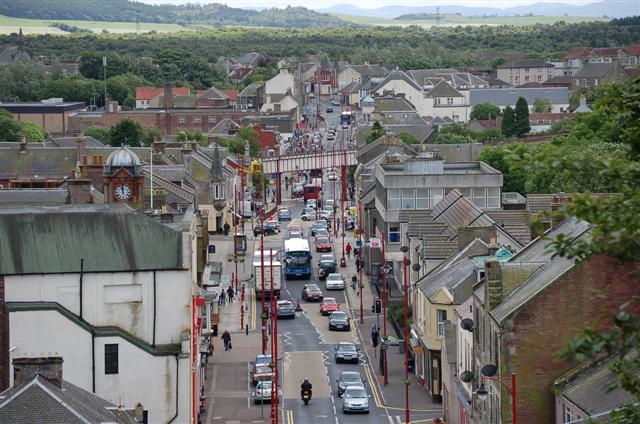
Cowdenbeath High Street (looking north)

Cowdenbeath Leisure Centre is in Pit Road, next to Central Park in the centre of the town and has a swimming pool, gym, indoor sports facilities and three all-weather pitches for football. A small skatepark is situated outside the leisure centre. There are a number of playing fields around the town.[20]

Cowdenbeath Public Park

The expansive 'Public Park' is towards the north of the town. It was established in 1910, and formally opened in 1911. The venture was largely funded by the Gothenburg Public House Society, which donated over £7,000 to the initiative.

The Goth Public House (previously Gothenburg House)

In its prime the park boasted an ornate bandstand, a paddling pool, a putting course and swing park, and was a focal point for various leisure pursuits, and the venue for the annual "Store" (Co-operative Society) treat. Although most of these amenities have long since gone, the park is still tended by the local authority and provides a public open space for all to use.

Cowdenbeath also has a golf club, originally built as a nine-hole course on the old Dora Coal mine site. Work began in 1988 and the course was completed and ready for play in 1991. The length of the course was 3315 yards. The course was extended to eighteen holes and opened by Sir Michael Bonallack in 1996. The length of the course is now 6,207 yards, with a standard scratch score of 71. A new clubhouse was built and officially opened on 6 December 1998 by ex-provost James Cameron who had opened the first clubhouse. There had been a golf club at the northern end of the town before World War 2, resulting in one of the now-demolished houses being named Golf View.[21]

Dora Golf Course, Cowdenbeath
Central Park Stand

Central Park is a stadium in the centre of Cowdenbeath. It is home to Cowdenbeath F.C. and has a maximum capacity of 5,270 (1,620 covered seating). The stadium has a tarmac track encircling the football pitch, one of Britain's fastest, used for stock car racing. Central Park is the site of Britain's most northerly speedway track. The team based in Cowdenbeath were known as the Fife Lions and featured riders from Edinburgh Monarchs and Glasgow Tigers in a series of challenge matches against league teams and scratch sides. The speedway track, which staged eight meetings every year, including a world championship qualifying round, was unusual in that it featured a brick wall safety fence.

Other amenities

[edit]

The medical practice is situated on Stenhouse Street. There is a library situated at the north end of the High Street. The Police Station moved to former Co-op buildings at Brunton House in 2012. There is a post office near Brunton House at the south end of High Street. The red sandstone Town House building is situated towards the north end of the High Street. This sandstone is the same as that used to clad the original Beath High School (the basic structure of which was reinforced concrete) on Stenhouse street. Similar stone can be seen in the original school boundary wall, within which two minor school buildings remain and also the present care home which now occupies the site of the old high school proper.

Education

[edit]

There are three primary schools in the town. Cowdenbeath Primary School serves the southern end of the town. Foulford Primary School serves the northern end of the town. St Bride's Primary School, the only Roman Catholic primary, serves both the town as well as Crossgates, Hill of Beath, and Lumphinnans. Some pupils in the north-east and south-west of the town attend Lumphinnans and Hill of Beath primary schools respectively.

Beath High School

Cowdenbeath is also served by one secondary school. Beath High School was founded in 1910 as a grammar school, mainly for the children of local mine executives. It was an imposing building built of red sandstone and stood on Stenhouse Street. The mine works of the No.7 pit, whose original pit-head was in close proximity to the school, caused significant subsidence in latter years. A modern school was opened in 1964, built in Kirkford next to Kirk of Beath Church and cemetery. At this point the school was split, with the old building becoming the lower school, and subsequently commonly referred to as "Old Beath", whilst the modern school was referred to as "New Beath". The old building was demolished in the 1990s and in 2003 the "new" school itself was closed due to subsidence and a new public–private partnership school was built. It is maintained by Sodexo.

On 25 March 1983, Jane Cosans of Cowdenbeath changed discipline in Scottish schools. She was awarded £11,846 by the European Court of Human Rights, plus costs, as recompense for her son's suspension from Beath High School for refusing to be belted. This significantly contributed to the banning of the use of the belt in Scottish schools.[22][23][24]

Notable people

[edit]

Notable people from Cowdenbeath (or who attended Beath High) include:

  • Sir James Black (pharmacologist)
    Sir James Black (d. 2010) was a Nobel Prize winner, whose work is behind the drugs Cimetidine and propranolol. In an excerpt from his autobiography, Sir James is quoted as saying: "The imprinting mathematical influence was Dr Waterson at Beath High School, a brilliant and rumbustious teacher, who more or less man-handled me into sitting the competitive entrance examination for St. Andrews University."[25]
  • Sir Hector Hetherington (21 July 1888 – 15 January 1965) was a Scottish philosopher, who was vice-chancellor of the University of Liverpool from 1927 to 1936, and principal of the University of Glasgow until 1961.[26]
  • Jennie Lee, Baroness Lee of Asheridge, attended Beath High School. She graduated from Edinburgh University and worked as a teacher in Cowdenbeath before being adopted the ILP candidate for the North Lanarkshire constituency, which she won at a 1929 by-election, becoming the youngest member of the House of Commons. A member of Harold Wilson's government of 1964, she was influential in the creation of the Open University. Her father was manager of the Crown Hotel at the north end of the High Street, which was destroyed by fire on 13 May 2009. Her husband was Aneurin Bevan MP.[27]

Transport

[edit]

The A92 Fife Regional Road is a motorway-standard dual carriageway road running from the M90 motorway (which runs from Edinburgh to Perth) in Dunfermline to Kirkcaldy (and further to Glenrothes, Dundee and Aberdeen). The A92 bypasses the east of the town with a junction at Bridge Street.

Cowdenbeath Rail Station

Cowdenbeath railway station is just off the High Street, via a steep ramp to/from each platform. It is on the Fife Circle Line with a half-hourly service to Edinburgh (Monday to Saturday daytimes).[32]

The nearby Halbeath Park & Ride, opened in 2014, allows for onward travel to Edinburgh, Edinburgh Airport, and Glasgow.

Bus services

[edit]
Service Destination Via Frequency
17 Kelty Leuchatsbeath Drive Every hour (daytime only)
17 Halbeath Park & Ride Church Street, Mossgreen, Crossgates Every hour (daytime only)
17A Kelty Stenhouse Street, Foulford Road, Leuchatsbeath Drive Every hour (evenings and Sundays only)
17A Greenbank Drive Broad Street, Moss-Side Road Every hour (evenings and Sundays only)
17B Kelty Stenhouse Street, Foulford Road, Leuchatsbeath Drive Every hour (daytime only)
17B Barclay Street Broad Street, Selkirk Avenue, Rae Street, Greenbank Drive Every hour (daytime only)
18 Kelty Leuchatsbeath Drive Every hour
18 Leven Auchtertool, Kirkcaldy Every hour
19 Rosyth Hill of Beath, Crossgates, Halbeath Park & Ride, Dunfermline Every 10 minutes
19 Ballingry Lumphinnans, Lochgelly, Crosshill Every 10 minutes
33 Dunfermline Hill of Beath, Crossgates, Halbeath, QM Hospital Every hour
33 Kirkcaldy Lumphinnans, Lochgelly, Cardenden Every hour
81 Queen Margaret Hospital Stenhouse Street, Kingseat Every hour
81 Glenrothes Lumphinnans, Lochgelly, Crosshill, Ballingry, Kinglassie Every hour
X54 Edinburgh Halbeath Park & Ride, Dunfermline, Rosyth, Ferrytoll Park & Ride Every hour
X54 Dundee Glenrothes, Ladybank, Newport-on-Tay Every hour

References

[edit]
[edit]
Revisions and contributorsEdit on WikipediaRead on Wikipedia
from Grokipedia

Cowdenbeath is a town and former burgh in west Fife, Scotland, historically defined by its coal mining industry, which fueled rapid population growth from around 1,000 residents in 1850 to 25,000 by 1914, earning it the nickname "the Chicago of Fife." The mining boom, driven by extensive pits operational from the 19th century until the 1980s, transformed the area from rural farmland into an industrial center, though subsequent closures led to economic contraction and population decline to approximately 11,969 as recorded in the 2022 census. Today, Cowdenbeath functions as a commuter settlement with a diversified economy centered on light industries including engineering, textiles, food processing, and construction, supported by its proximity to Dunfermline and Edinburgh. The town retains cultural ties to its mining heritage and is home to Cowdenbeath F.C., a professional football club competing in the Scottish League Two at Central Park stadium.

Etymology

Name origins and historical usage

The name Cowdenbeath derives from the combination of a element "Cowden" and the name "Beath," with the latter rooted in the Gaelic beith, signifying " tree" or birch woodland, a feature once more prevalent in the local landscape despite limited traces persisting into modern times. Scholarly place-name studies interpret "Cowden" not as a descriptive Gaelic term for woods (such as the Coilltean Beithe, " woods") but as a specific , evidenced by records like that of John Coudone, a Dunfermline burgess in 1478, with genitival forms (e.g., Cowdennyes) indicating possession or association. This philological approach prioritizes charter evidence over speculative derivations, such as links to (calltainn) or hypothetical estates unrelated to associations. The earliest documented usage appears as Codane Beitht in 1507, within the Dunfermline Guildry Court Book, referring to a landholding tied to tenants of the Moubray family by the early . Subsequent records show evolving spellings reflecting Scots orthographic shifts and administrative contexts: Cowdennyes Baith (1557), Baithe-Moubray and Cowdounesbaithe (1626), Coudonbeth or Cowdon heth (1654, in Blaeu's atlas), and stabilization as Cowdenbeath by 1775 in Ainslie's Fife map. These variations trace the name's application to a farmstead within Beath , extending into adjacent lands, without evidence of broader medieval charter prominence for the settlement itself prior to industrial growth. By the late 19th century, amid coal mining expansion, Cowdenbeath was selected over rivals like Foulford in a public vote for burgh status in 1890, cementing its historical linkage to the Beath parish estate while eschewing unsubstantiated myths of ancient warlords or purely woodland origins unsupported by primary records. No significant alternative etymologies withstand scrutiny against empirical data from court books and surveys, underscoring a pragmatic evolution from personal-parish nomenclature rather than mythic or descriptive invention.

History

Early settlement and pre-industrial era

Archaeological evidence indicates prehistoric human activity in the vicinity of Cowdenbeath, including a cemetery discovered on a local comprising six vessels containing cremated , one sealed by a capstone. burial urns have also been unearthed in the area, dating to approximately 3000–1800 BC. Traces of a Roman camp near Leuchatsbeath suggest military presence during the Roman occupation of northern Britain, potentially linked to conflicts with Caledonian tribes. The earliest documentary reference to the Beath area appears in a of Inchcolm dated 6 1178, mentioning the of Beth. By the 12th or 13th century, a church known as Kirk o' Beath was established under the jurisdiction of Inchcolm , serving as a key ecclesiastical site in the medieval parish. The structure fell into ruin following the around 1560 but was rebuilt with assistance from nearby , and Beath was formally separated as an independent parish from Aberdour and Dalgety in 1643. Prior to industrialization, the Beath remained a predominantly rural, agricultural community characterized by small crofts and farms such as Thistleford and Cowdenbeath Farm, with the landscape marked on Blaeu's 1654 map of as "Cowden Beth." The economy focused on arable farming, producing crops like oats, , and potatoes on land generally suitable for cultivation, though poverty was widespread among tenants. Church records from the onward document baptisms, marriages, and burials in the old parish registers, reflecting a sparse population estimated at around 450 families by the late , with no significant urban development or infrastructure beyond scattered farmsteads and the .

Coal mining boom and town development (19th-early 20th century)

Coal mining expanded rapidly around Cowdenbeath from the 1830s onward, with pits in nearby Kelty, Lochgelly, Donibristle, Fordell, and Hill of Beath becoming operational by 1840, drawing workers and fueling economic growth. This influx transformed the settlement, with the population rising from approximately 1,000 in 1850 to 25,000 by 1914, a surge that earned Cowdenbeath the nickname "the Chicago of Fife" for its explosive development akin to urban boomtowns. Between 1890 and 1900, the population doubled from 4,000 to 8,000, directly tied to intensified mining activity and associated job opportunities. In response to this growth, Cowdenbeath received police burgh status in 1890, enabling local governance to manage the expanding community. Major collieries drove production peaks, including Donibristle, which employed nearly 300 men across its pits and yielded a combined daily output of about 500 tons in the early 1900s. The Coal Company, resulting from the 1896 merger incorporating the Cowdenbeath Coal Company, recorded nearly 2.5 million tons annually around 1900, reflecting the scale of operations in the region. Pits like Cowdenbeath No. 10 were sunk with expectations of 600 tons daily, further boosting output during 1900–1910. Infrastructure developed in tandem with mining, including railways that facilitated transport and spurred further expansion. companies built housing for workers, such as a row of 24 neat cottages erected by the Cowdenbeath Company to improve accommodations. Existing structures, like those on Broad Street, were repurposed for miners, while overcrowding persisted in traditional miners' rows. Churches proliferated to serve the growing populace, with constructions including the on , Cairns United Presbyterian Church on Church Street, and a Baptist church shortly thereafter. Mining labor involved harsh underground conditions, as evidenced by incidents like the 1901 inrush at Donibristle Colliery, which highlighted operational risks amid high productivity demands. Despite such hazards, the sector's dominance sustained the town's prosperity through the early , with colliery owners investing in community facilities like the 1901 Gothenburg public house under a local society.

Mid-20th century expansion and World War II impacts

During , Cowdenbeath's collieries, primarily under the Fife Coal Company, sustained coal output vital for Britain's industrial and military needs, including fuel for munitions factories and power generation, despite challenges from labor shortages and wartime disruptions. Local miners contributed through continued production, while some served in the armed forces, as evidenced by commemorations on the Cowdenbeath War Memorial for those lost in operations such as bomber raids. Postwar, the return of servicemen was incomplete, leading to manpower shortages at pits in the Cowdenbeath district, with absenteeism rates reaching 25-35% in early 1947 amid efforts to ramp up output under the . The of the industry on January 1, 1947, transferred control of Cowdenbeath's pits from private ownership to the state-run , marked by flag-hoisting ceremonies at local collieries and attended by the oldest employees. Trade unions, particularly the National Union of Mineworkers led by figures like Scottish secretary Abe Moffat, advocated for full cooperation to boost production, reflecting decades of campaigning for public ownership to improve safety and wages. Local governance, including district councillors such as J.C. Robertson and Peter Walker, participated in these events, underscoring community involvement in the transition. Immediate postwar expansion included extensive schemes by Cowdenbeath Town Council, with 235 prefabricated bungalows (prefabs) of Arcon and Seco types erected between 1946 and 1948 in areas like Rosebank, Seco Place, and Milne Crescent to address acute shortages from wartime damage and pressures. These structures, featuring modern amenities such as indoor toilets, bathrooms, and gardens, were regarded by residents as a substantial upgrade—"People’s Palaces"—from prior mining tenements, though some noted issues like cold winters due to construction. The town's peaked at 13,151 in the 1951 , driven by mining employment stability under and new , before beginning a decline to 11,920 by 1961.

Pit closures, economic decline, and regeneration efforts (late 20th-21st century)

The closure of pits in Cowdenbeath accelerated during the and , with most local collieries shuttered by 1960, marking the end of the town's primary economic driver after under the in 1947. This followed a pattern of rationalization in 's coalfields, where uneconomic deep mines were consolidated or abandoned amid falling demand and rising costs, leading to significant job losses estimated in the thousands for the Central area, as had employed over 10,000 workers regionally at its mid-20th-century peak. Remaining operations, such as workshops and smaller pits like , persisted into the 1980s but closed amid the 1984-1985 miners' strike and subsequent Thatcher-era policies, with the last major local pit effectively winding down by the mid-1980s, exacerbating structural unemployment that reached 14% across by the late 1980s. Economic decline manifested in high deprivation, out-migration, and social strain, as the loss of jobs—once providing stable, —drove younger residents to seek opportunities elsewhere, contributing to an aging and population stagnation in coalfield communities like Cowdenbeath. responses in the and included interventions via the Scottish Development Agency, which targeted coalfields with infrastructure grants and training programs, though these yielded mixed results, as deindustrialization's causal effects—rooted in global shifts toward and nuclear rather than policy alone—left persistent pockets of long-term and benefit dependency. By the , Cowdenbeath featured among Scotland's deprived areas, with limited diversification into or services, as empirical from coalfield studies showed slower recovery compared to urban centers due to mismatches and geographic isolation. Into the 21st century, regeneration efforts shifted toward community-led and regional strategies, including the Cowdenbeath Area Partnership's Plan4Cowdenbeath (2023-2026), which prioritizes local priorities like housing and skills amid ongoing challenges. Fife Council's broader Economic Strategy (2023-2030) aims for a "stronger, greener, and fairer" economy through investment in renewables and tourism, but outcomes remain constrained, with coalfield areas showing persistent out-migration and slower GDP growth relative to Fife's averages, as diversification has not fully offset mining's legacy voids. Recent projects, such as the £2 million Town House redevelopment funded partly by Scottish Government grants in 2025, focus on community facilities, yet community surveys highlight limited tangible progress in reversing deprivation indicators.

Geography

Location, topography, and administrative boundaries

Cowdenbeath is located in west , , at geographic coordinates approximately 56°06′43″N 3°20′35″W. The town lies 5 miles (8 km) northeast of and 18 miles (29 km) north of , with proximity to the about 11 miles to the south. Its elevation averages 128 meters (420 feet) above , situated on gently undulating terrain characteristic of the Fife coalfield region. Administratively, Cowdenbeath forms part of Ward 7 (Cowdenbeath) within , encompassed by the broader Cowdenbeath Area Committee that includes adjacent wards and communities. The town's boundaries incorporate neighboring settlements such as Lumphinnans to the west and the Hill of Beath area, blending urban development with former industrial sites and green networks of woodlands, habitats, and open spaces. Land use reflects a mix of residential zones, redeveloped post-mining areas, and recreational greenspaces, with limited vacant or derelict land in core neighborhoods.

Climate and environmental features

Cowdenbeath exhibits a temperate maritime climate influenced by its eastern Scottish location, with temperatures typically ranging from an average low of 1°C in winter to highs of 18°C in summer, rarely dropping below -6°C or exceeding 22°C. Winters are mild, with January averages between 1°C and 7°C, while annual precipitation totals approximately 475 mm across about 193 rainy days, concentrated in the cooler months. The area's environmental profile includes historical risks of ground subsidence stemming from extensive 19th- and 20th-century , particularly in zones with shallow workings that have led to instability and potential structural damage. Following regional flooding events in the Forth Estuary area during the early 2000s, including severe incidents documented in , the Scottish Environment Protection Agency (SEPA) has advanced flood risk management through local plan districts, incorporating strategies for and riverine flooding mitigation applicable to Cowdenbeath's . Air quality in Cowdenbeath has shown improvements following the closure of local pits in the late , reducing emissions of particulates and that previously elevated levels; monitoring reports indicate compliance with national objectives for key pollutants like NO2 and PM10 post-2000, though episodic influences from nearby industrial sites persist.

Demographics

The population of Cowdenbeath remained small prior to the , estimated at around 1,000 residents in the early , before the onset of large-scale . This figure reflected a rural settlement with limited economic activity beyond agriculture and small-scale extraction. The discovery and exploitation of extensive coal seams in West triggered rapid urbanization, with the population surging to approximately 4,000 by 1890 and doubling to 8,000 within a amid intensified operations. By 1914, growth had propelled the figure to over 25,000 when accounting for surrounding colliery villages, earning the town the moniker " of " due to its explosive expansion. The mid-20th century marked a peak for the core town at around 14,000, sustained by peak coal production and related employment that attracted migrant labor from across and . Post-World War II pit closures, beginning in the 1950s and accelerating through the 1960s and 1980s, reversed this trajectory as job losses prompted significant out-migration, particularly of younger workers seeking opportunities elsewhere. This led to a gradual depopulation of the town proper, though the broader Cowdenbeath area—encompassing wards and adjacent communities—maintained relative stability around 40,000 due to diversified local economies. As of the 2022 Scotland , Cowdenbeath town recorded 11,969 residents, reflecting a modest recovery with an average annual increase of 0.44% since the 2011 . This uptick correlates with residential expansion, including housing developments like Leuchatsbeath, which added family-oriented homes and contributed to net in-migration amid regional commuting patterns. The wider Cowdenbeath area stood at 41,579 in 2022, with projections suggesting continued slow growth barring major economic disruptions, influenced by housing supply and proximity to employment hubs like .
Census YearTown PopulationKey Driver
Early 19th century~1,000Pre-mining rural base
1900~8,000Coal boom influx
Mid-20th century peak~14,000Mining employment height
202211,969Housing-led stabilization

Ethnic composition, age structure, and socioeconomic indicators

According to Scotland's 2022 data for the Cowdenbeath locality, the is overwhelmingly , comprising approximately 97.7% of residents, with minority ethnic groups including Asian (1.3%), African/Caribbean (0.3%), and smaller proportions of mixed or other ethnicities, reflecting limited and high ethnic homogeneity compared to Scotland's overall minority ethnic share of 12.9%. The age structure indicates an aging , with 19.7% of residents aged 65 and over, and only about 19.5% under 18 (including a lower proportion of under-16s relative to 's national average of around 16.5% for that group), contributing to a strained by fewer working-age individuals. Socioeconomic indicators reveal challenges, including an economic inactivity rate of 27.4% for working-age residents in the Cowdenbeath Area during 2023/24—higher than 's average and 's roughly 22.9%—attributable in part to limitations and skills deficits as measured by the Scottish Index of Multiple Deprivation (SIMD), where 19.6% of local datazones rank among 's most deprived, particularly in , , , and education domains. Household composition in the area features a high prevalence of smaller units, with many one- or two-person predominating amid the aging demographic and post-industrial settlement patterns, though specific 2022 counts for occupied households in the core locality are not disaggregated beyond broader trends showing increases in single-occupancy dwellings.

Economy

Historical reliance on

By the turn of the , dominated the economy of Cowdenbeath, with the industry employing the vast majority of the local workforce. The population doubled from approximately 4,000 to 8,000 between 1890 and 1900, driven primarily by the expansion of operations that attracted laborers to the area. The Coal Company, which controlled multiple collieries around Cowdenbeath, employed over 5,000 workers by 1900, underscoring the sector's centrality to local livelihoods. This employment concentration created strong path dependency, as infrastructure and skills shaped for decades. Production levels peaked in the early 1910s, with the Coal Company extracting around 4.3 to 4.5 million tons of annually from its operations, much of which originated from pits near Cowdenbeath. Individual collieries, such as Cowdenbeath Colliery, contributed significantly, with employment figures reaching nearly 1,000 at sites like Pit No. 7 in the late . The , primarily of household, steam, and manufacturing grades, played a key role in the 's energy supply during the industrial era, powering locomotives, factories, and homes amid Britain's reliance on domestic for over 90% of its energy needs before widespread . Exports of Fife , including from Cowdenbeath fields, were facilitated through nearby ports such as and , supporting trade to markets in and beyond. This integration into national and regional networks reinforced mining's economic primacy, with output sustaining that grew to around 15,000 across the company's pits by 1913. However, by the , early signals of transition emerged as national coal demand declined due to from and , prompting initial pit closures and nascent diversification efforts amid persistent workforce dependence on the industry. Mining's grip endured into the late , but these mid-century shifts highlighted vulnerabilities in the mono-industrial structure.

Post-industrial shifts, employment sectors, and current challenges

Following the decline of local , Cowdenbeath's economy has shifted toward service-based , retail, and to larger centers like and , reflecting low local job density of 0.51 jobs per working-age resident—the lowest in . The 2022 records an economic activity rate of 59.0% (19,668 individuals), slightly exceeding 's 58.2%, though ONS Annual Population Survey data for 2023/24 indicate an economic inactivity rate of 27.4%—second-highest in after Levenmouth's 27.6%. Dominant sectors include (15.5% of workforce), wholesale and retail (12.2%), (10.8%), (10.4%), and (9.4%). Key employers feature public bodies such as NHS Fife and , supplemented by supermarkets and small-scale operations, with approximately 1,500 jobs in wholesale and retail and 1,250 each in and /social work as of 2023. Claimant stands at 4.2% (1,077 individuals in 2023/24), above Fife's 3.3%. Persistent challenges include skills mismatches, evidenced by 47.7% of residents with no or low qualifications (versus Fife's 36.6%), limiting adaptation to available roles and contributing to below-average outcomes. Regeneration efforts under InvestFife's emphasize support and , including 2025 planning approval for the Westfield site to enable power generation, waste , and job creation, yet these have not yielded major industry inflows, as indicated by stagnant densities and 16.9% town centre vacancy rates in 2022.

Governance and politics

Local administration and community governance

Cowdenbeath is administered as part of , Scotland's unitary local authority for the region, with the town situated in Ward 7 (Cowdenbeath). Local decision-making occurs primarily through the Cowdenbeath Area Committee, which oversees area-specific matters including planning applications, service delivery, and allocation of the Local Community Planning Budget for community grants. The committee, convened by Councillor Alex Campbell of the Scottish Labour Party, convenes regularly, with meetings scheduled bimonthly from July 2025 to June 2027, such as those on 25 June 2025 and 30 April 2025, often held virtually and livestreamed for public access. Community governance is facilitated by the , a statutory voluntary body established to represent residents' views on local issues and liaise with the council on planning, amenities, and development. This council contributes to participatory processes, including the development of action plans such as the Cowdenbeath Community Action Plan 2019-2024, which addressed coalfields regeneration and community priorities, and the subsequent Plan4Cowdenbeath 2023-2026, focusing on post-COVID service delivery and needs assessment. A new Community Action Plan for 2025-2030 is under consultation, emphasizing themes like revitalization, neighborhoods, green spaces, and cultural engagement to incorporate resident input. Historically, Cowdenbeath's status as a police burgh, granted in amid industry growth, endowed it with autonomous local traditions that persist in community identity and expectations for , even after integration into in 1975. This legacy informs ongoing efforts for localized control, as seen in area committee functions and community-led initiatives.

Electoral history and political affiliations

The Cowdenbeath area, encompassing parts of Fife's former communities, has historically functioned as a Labour Party stronghold in UK parliamentary elections, with consistent majorities reflecting working-class affiliations tied to industrial decline and socioeconomic conditions. This pattern held through the constituency's predecessor seats until the 2015 general election, when the (SNP) captured the Kirkcaldy and Cowdenbeath seat from Labour amid heightened support following the . The SNP retained the seat in 2017 and 2019, with vote shares exceeding Labour's by margins of approximately 6-10 percentage points in those contests.
Election YearPartyCandidateVotesVote Share (%)Majority
2015SNPRoger Mullin22,70945.79,974
2017SNPLesley Laird21,21844.12,746
2019SNP16,56836.81,243
2024LabourMelanie Ward18,66244.07,248
Labour reclaimed the renamed Cowdenbeath and constituency in the July 2024 , with Melanie Ward securing victory on a 7,248-vote majority over the SNP, signaling a reversal driven by national Labour resurgence and SNP fatigue rather than localized shifts. Turnout in the 2024 contest stood at around 60%, consistent with patterns in deindustrialized Scottish constituencies where voter engagement remains subdued compared to urban centers. In Scottish Parliament elections, the Cowdenbeath constituency has aligned with broader SNP gains post-2014, with the party holding the seat since 2016; increased her majority to over 10,000 votes in 2021 against Labour challenger Alex Rowley, underscoring persistent nationalist appeal on devolved issues like welfare and . At the local level, wards including Cowdenbeath (such as Cowdenbeath ward) have shown Labour retaining pluralities through 2022, though SNP advances eroded margins, with the party gaining seats council-wide amid independence debates while Labour's share dipped by four overall. These trends illustrate class-based voting persistence—rooted in Labour's legacy—interrupted by referendum-induced volatility favoring the SNP on questions, without evidence of durable ideological realignment.

Society and community

Education system and schools

The education system in Cowdenbeath is administered by Fife Council, encompassing non-denominational and denominational primary schools as well as a comprehensive secondary school serving the local catchment area. Primary education is provided at institutions such as Cowdenbeath Primary School, a non-denominational facility catering to mainstream pupils in the town center, and St Bride's Roman Catholic Primary School, which serves Cowdenbeath along with nearby Lumphinnans and Crossgates with a pupil roll of approximately 188. Foulford Primary School and Nursery also operates in the area, noted for strong performance in recent inspections. Beath High School serves as the principal non-denominational state secondary for Cowdenbeath, , and surrounding villages, with a current pupil roll of around 1,400 students aged 11 to 18. Historically, education in Cowdenbeath was shaped by the industry, exemplified by the establishment of the Mining in 1895, initially operating from two rooms in Broad Street School before relocating to a dedicated building on Broad Street in 1936 to train miners in technical skills. This institution reflected the town's economic reliance on , providing specialized instruction amid rapid industrial growth. Educational attainment in Cowdenbeath schools lags behind Scottish national averages, correlating with high levels of socioeconomic deprivation in the area, where rates reach 27.3% in the Cowdenbeath locality. For instance, Cowdenbeath Primary 's performance in metrics, such as listening and talking at 60% and reading at 70%, places it below top-performing primaries, though inspections have noted improvements over time. -wide school attendance is among the lowest in , second only to certain regions, potentially exacerbating attainment gaps. Local community plans aim to address these disparities through targeted interventions, including partnerships for improved outcomes. opportunities are accessible via Fife College, which offers vocational courses across the region following the merger with College, supporting post-secondary transitions for Cowdenbeath leavers, though a higher proportion enter direct compared to national figures.

Healthcare, social services, and public safety issues

Cowdenbeath falls under the jurisdiction of NHS Fife for primary healthcare services, with the primary practice being Cowdenbeath Medical Practice located at 173 Stenhouse Street, KY4 9DH, operating Monday to Friday from 8:30 a.m. to 6:00 p.m. and offering extended evening surgeries until 8:30 p.m.. This eight-doctor partnership serves the local population, including surrounding villages, and provides routine care such as immunisations, minor surgery, and referrals to secondary services. A nearby facility, Crossgates Medical Practice at 94 Main Street, KY4 8DF, supplements coverage for the broader area. Historical reliance on has contributed to elevated morbidity rates, particularly respiratory conditions like (COPD), among Cowdenbeath residents, reflecting patterns in former industrial locales within where long-term exposure to dust and fumes persists as a causal factor in disparities. Local health profiles indicate ongoing challenges with long-term conditions, including respiratory diseases, exacerbating demands on NHS resources. Social services in Cowdenbeath address socioeconomic inactivity, with the area recording a 4.3% rate of out-of-work benefit claims among 16- to 64-year-olds in 2023-24, higher than 's 3.4% average, supporting needs related to and mitigation. Health and Social Care Partnership provides targeted interventions, including day care and companionship programs for vulnerable groups to combat isolation and inactivity. Public safety concerns have intensified in 2025, highlighted by an 16 incident involving 40 to 50 youths engaging in in the town centre, during which police officers were ed, prompting descriptions of the events as "appalling" by authorities. Eight youths—four boys and four girls aged 13 to 15—were charged with offences including and obstruction, with residents reporting fear of nighttime outings due to ongoing disorder. In response, has bolstered policing, including a Alcohol launched in 2024 to curb underage drinking and proxy sales, alongside awareness packs and initiatives like the Punched Beyond project aimed at reducing youth .

Cultural life and community initiatives

The Cowdenbeath Community Action Plan 2019-2024 outlines resident-led initiatives to enhance cultural engagement and community cohesion, developed through consultations involving 540 household surveys representing over 1,700 residents and input from 216 school pupils. Key projects include participatory budgeting to support groups such as Families Affected by Autism and Love 2 Dance, alongside feasibility studies for a Men's Shed to provide a dedicated space for social and practical activities. These efforts emphasize affordable, inclusive events to foster local traditions, with a focus on themes like "Culture & People" in ongoing planning cycles. Cultural traditions are preserved through annual events such as Cowdenbeath Civic Week, which features a children's gala in and celebrations, organized by the Civic Week Committee to promote family participation. The town hosts the Cowdenbeath each , showcasing Scottish heritage with athletic competitions, traditional , and displays. Additional activities include monthly Kingdom Bike Nights at from April to September, alongside proposals for performances and pop-up markets to revitalize public spaces. Mining heritage, central to the town's identity as a former coalfield hub, is commemorated via recent resident and civic-led memorials, including a tribute unveiled by the Cowdenbeath Rotary Club in Brunton Square on July 27, 2025, and a honoring the NCB Central Workshops installed in June 2025. Preservation efforts extend to a Heritage Garden at Brunton Square and the Shutter Art Project, which integrates historical motifs into urban redevelopment, supported by community consultations with on repurposing the historic Town House. Cowdenbeath Library on the serves as a hub for groups, hosting reading clubs, Bookbug sessions for young children, and access to materials, with recent integration into the refurbished opened in September 2025. Diverse voluntary organizations thrive, including the , Environment Group (which maintains floral displays and earned a in Fife's "Beautiful Fife" campaign in 2018), scouts, guides, craft and lunch clubs, and service groups like Rotary and Probus. Volunteering underpins these initiatives, with events like the Connecting Cowdenbeath Open Day on March 9, 2024, at the Maxwell Centre recruiting participants for clean-ups, community gardens, and digital support roles under the "Take a Pride in Cowdenbeath" campaign. The Civic Week Committee actively seeks volunteers for gala operations, reflecting sustained resident involvement in events that integrate newcomers through shared activities amid ongoing housing developments.

Sport and recreation

Association football and Cowdenbeath F.C.


Cowdenbeath Football Club, established in June 1880 as Cowdenbeath Rangers and reformed as Cowdenbeath F.C. in 1882, joined the Scottish Football League upon its inception in 1905. The club reached its peak league position of fifth in Division One during the 1924–25 season, having earned promotion via the second tier championships in 1913–14, 1914–15, and later 1938–39. Nicknamed the "Blue Brazil" for the flair displayed in their 1991–92 promotion campaign under manager John Brownlie, Cowdenbeath secured further lower-division titles, including the Third Division in 2005–06.
Home matches are held at since 1917, a with a 4,370 capacity that accommodates seating in the north stand and open terracing elsewhere, alongside events. In , the club embarked on a criticized tour of , suffering defeats in all five fixtures against elite opposition, which fueled contemporary debates on the perils of overseas tours for British teams amid inconsistent performances. A landmark achievement occurred in 1992, when promotion to the second division was clinched on the season's final day at Athletic, ending a 22-year top-flight . Relegated from in May 2022, Cowdenbeath now participates in the Lowland League, fifth tier of the Scottish system. Fan governance progressed in August 2024 with a 10% share transfer to the Cowdenbeath Independent Supporters Society, supporting stability amid fluctuating fortunes. In a town grappling with post-mining economic contraction, the club has functioned as a vital social hub, with 2018 appeals from chairman urging community backing to counteract institutional decline.

Other sports, leisure facilities, and parks

Cowdenbeath Leisure Centre, operated by Fife Sports and Leisure Trust, provides a refurbished swimming pool, a Hammer Strength gym, group fitness classes, and facilities for activities such as walking football and badminton. The centre reopened following upgrades in 2023, offering 36 weekly fitness classes and junior programs to promote physical activity. The town features established clubs for lawn bowls, including Cowdenbeath Bowling Club and Broad Street Bowling Club, which host local competitions and social events. Cowdenbeath maintains an 18-hole course measuring 6,207 yards with a par of 71, originally developed from earlier 19th-century layouts and extended in 1996. Public green spaces include the central Cowdenbeath Public Park and Lumphinnans Park, offering areas for recreation amid the town's post-industrial landscape. Walking paths around Hill of Beath provide access to trails on reclaimed sites, connecting to broader networks like Lochore Meadows Country Park for outdoor pursuits. Physical activity participation in the Cowdenbeath area aligns with regional trends of elevated inactivity, prompting local initiatives through community facilities to encourage engagement among residents.

Notable people

Individuals born or associated with Cowdenbeath

Dennis Canavan, born in Cowdenbeath on 8 August 1942, emerged from a mining community background and became a prominent Scottish politician, serving as Labour MP for West Stirlingshire from 1974 to 1983 and Falkirk West from 1983 to 2000 before sitting as an independent; he later won the 1999 European Parliament election for Scotland as an independent pro-devolution candidate. Harry Ewing, Baron Ewing of Kirkford, born in Cowdenbeath in 1931 to a miner father, represented Stirling and Falkirk constituencies as a Labour MP from 1971 to 1997, holding ministerial posts under Harold Wilson and James Callaghan, including Under-Secretary of State for Trade from 1974 to 1979. James Whyte Black, who grew up in Cowdenbeath after being born in Uddingston in 1924, advanced pharmacology by inventing propranolol, the first beta-blocker, and cimetidine, the first H2 receptor antagonist, earning the Nobel Prize in Physiology or Medicine in 1988 shared with Gertrude Elion and George Hitchings for these drug discoveries targeting specific physiological mechanisms. In sports, Jim Baxter, born on 29 September 1939 in Hill of Beath—a mining village incorporated into the broader Cowdenbeath area—gained fame as a midfielder for Rangers, where he won five league titles and two Scottish Cups between 1960 and 1965, and for Scotland, notably dominating England's midfield in their 1967 home international victory at Wembley; a statue commemorates him in Hill of Beath. Scott Brown, raised in Hill of Beath, captained Celtic from 2010 to 2021, securing nine successive Scottish Premiership titles and five Scottish Cups, while earning 55 caps for Scotland; he began his career at Hibernian before transferring to Celtic in 2007. Raymond Allan, born and raised in Cowdenbeath, holds the club record for most appearances with 491 games as goalkeeper for Cowdenbeath F.C. from 1956 to 1973, contributing to their 1961–62 Second Division title win.

Transport and infrastructure

Road and bus networks

The primary road through Cowdenbeath is the A909, which connects the town westward to Junction 4 of the M90 motorway, facilitating access to Dunfermline (approximately 6 miles away) and Edinburgh (about 15 miles via the Forth Road Bridge), while heading eastward it links to Kirkcaldy (around 7 miles). South of the town centre, Cowdenbeath Junction provides a staggered diamond interchange between the A909 and the dualled A92 trunk road, enabling efficient connectivity to the broader Fife and Angus network. These routes support daily commuting and freight, though peak-hour congestion is reported on the A92 stretch from Cowdenbeath toward the Forth Road Bridge, exacerbating travel times during rush periods. Bus services are dominated by East Scotland, which operates key routes including the 33 from Bus Station to Cowdenbeath Bus Depot (covering 68 stops and linking central towns), and local services such as the BE7 from Halbeath to Beath High . Additional lines extend rural outreach to villages like (via BE3) and Crossgates, with school-specific routes (e.g., FF1, GF1) ensuring connectivity for residents in outlying areas. Timetables have seen adjustments, such as earlier departures from Cowdenbeath to starting at 5:56 a.m. from Halbeath as of August 2025. Integration with park-and-ride facilities enhances access, particularly via (about 4 miles southwest), which offers free parking and buses (e.g., line 19) to Cowdenbeath in 15 minutes, onward to , , or airports. This scheme promotes modal shift from private vehicles, though local roads like experience intermittent queues from traffic signals, prompting proposals for 20 mph zones across streets such as Cedar Avenue to improve safety and flow.

Rail connections and accessibility

Cowdenbeath railway station, situated on Station Road in the town center, is managed by and lies on the Fife Circle Line, providing essential connections to and . operates regular passenger services along this route, with typical frequencies including trains to via and local stops within . The station's infrastructure originally developed in the mid-19th century to facilitate freight from the surrounding collieries operated by the Fife Coal Company, which by 1911 managed nine pits in the area and relied on rail for exporting output that peaked at millions of tons annually. Today, operations focus primarily on passenger transport, reflecting the decline of local mining by the 1980s. Accessibility at the station remains partial, classified as step-free category B2 with access to all platforms but no lifts available, relying instead on ramps and level access where possible. Steep ramps from the entrance pose challenges for passengers with mobility impairments, parents with prams, and those with heavy luggage, prompting calls for upgrades as recently as March 2025 by local MP Melanie Ward. Staff assistance is available Monday to Friday from 06:30 to 13:00 and Saturdays from 09:00 to 13:00, with on platforms aiding visually impaired users. Cycle facilities include 10 sheltered storage spaces with stands, supporting integration with local active travel networks. The Cowdenbeath Area Transport Plan emphasizes enhancing walking, wheeling, and cycling routes to public transport hubs like the station to promote sustainable access. No car parking is provided on-site, though drop-off points exist.

References

Add your contribution
Related Hubs
User Avatar
No comments yet.