A cowl is an item of clothing consisting of a long, hooded garment with wide sleeves, often worn by monks. It was developed during the Early Middle Ages. The term may have originally referred to the hooded portion of a cloak, though contemporary usage refers to an entire closed garment. A cowl is traditionally bestowed upon the monk at the time of making solemn, or lifetime, profession. Today, it is worn primarily by most Catholic and Anglicanmonks when participating in liturgical services.
Developed during the Early Middle Ages, the cowl became the formal garment for those in monastic life. Both St. Jerome and John Cassian refer to it as part of a monk's dress.[1] In modern times, it is worn over the habit during liturgical services. Originally, cowl may have referred simply to the hooded portion of a cloak. In contemporary usage, however, it is distinguished from a cloak or cape (cappa) by the fact that it refers to an entire closed garment consisting of a long, hooded garment with wide sleeves.
The cowl is traditionally bestowed upon the monk at the time of making solemn, or lifetime, profession. Prior to their solemn vows, the monks still in training wear a hooded cloak. The cowl is generally worn in conformity with the color of the monk's tunic; other groups which follow the Rule of St. Benedict, e.g., the Camaldolese wearing white. (The Camaldolese of Monte Corona, however, always wear a cloak instead of a cowl.)
Among the Benedictines, in choir, at chapter, and at certain other ceremonial times, a long full gown with large flowing sleeves, called a cowl, is worn over the ordinary habit. Black has been the prevailing color, hence the term black monk has come to signify a Benedictine.[2] Previous generations had lengthened the garment until it reached to the heels, and Saint Benedict issued a rule restricting its length to two cubits.[3]
Similarly, the Cistercians are known as the White Monks, in reference to the color of the cuculla, the term for the white choir robe worn over their habits.
"The Carthusian wears the ordinary monastic habit in white serge, but the scapular which is joined by bands at the side and has the hood attached to it, is known as the "cowl". The long flowing garment with wide sleeves, which usually bears this name, is used only by the deacon at high Mass."[4]
While not cowls in the monastic sense, the mendicant Orders have retained the use of a cappa (cape) as part of their habit. In their case, however, it is a regular part of their religious habit and worn by all members of the Order, both as street dress and in church.
The Carmelites wear a white cape, although their tunic and scapular are brown, from which they were known in medieval England as the Whitefriars.
Dominicans wear a black cape over a white habit—hence, their ancient nickname of Blackfriars.
Both the cowl and the cape, though without a hood, are also worn by the nuns associated to each Order, in the same manner.[5]
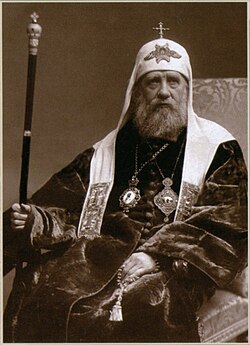
St. Tikhon of Moscow wearing the patriarchal white koukoulion Among the Eastern Christians (Eastern Orthodox and Byzantine Catholic), the monastic hood developed into the koukoulion worn by monks of the Great Schema, the highest degree of monasticism in the Eastern Church. Currently, the koukoulion is of two types: one is similar to the hood still worn by some Western monastic orders, the other takes the form of a stiff rounded hat (like a bowler hat without a rim) to which is attached an epanokalimavkion (veil with lappets). The koukoulion is usually embroidered with crosses and the Instruments of the Passion. The koukoulion is also worn by the Patriarchs of some of the autocephalous Orthodox churches.
This article incorporates text from a publication now in the public domain: Herbermann, Charles, ed. (1913). "Cowl". Catholic Encyclopedia. New York: Robert Appleton Company.
A cowl is a hood or long hooded cloak, especially one worn as part of a monk's habit.[1] The term originates from Middle English coule, from Old English cūle or earlier cugle, derived from Late Latin cuculla (monk's cowl), a variant of Latin cucullus (hood), with an uncertain ultimate origin.[2]In Christian monastic tradition, the cowl developed during the Early Middle Ages as an outer garment symbolizing humility and devotion, initially common to both men and women before becoming prescribed specifically for monks.[3] The Rule of St. Benedict (c. 530 CE), a foundational text for Western monasticism, mandated that each monk receive a cowl and gown suited to the climate, with a hairy cowl for winter and a plain or worn one for summer, alongside a separate working garment for labor.[4] Over time, the cowl evolved into a full hooded robe, often with open sides that could be tied, serving as everyday or ceremonial wear depending on the monastic order and period.[5]Beyond religious contexts, "cowl" denotes other hood-like coverings. In architecture, it refers to a chimney cowl, a hood-shaped device typically made of galvanized iron fitted to the top of a chimney to enhance draft, prevent backflow of smoke, and protect against wind and rain.[1] In automotive and aviation engineering, a cowl describes the forward body panel of a vehicle supporting the windshield and dashboard, or a removable engine covering (cowling) designed to streamline airflow and protect components, a usage emerging in the early 20th century.[6] In contemporary fashion, a cowl neckline is a draped, loose fabric style at the neck of a garment, evoking the hooded form while adding aesthetic fluidity.[1]
Garment
Definition and Description
A cowl is a loose-fitting hood or hooded cloak that covers the head and shoulders while typically leaving the face exposed.[1] It is characterized by its draped, flowing design, often attached to a robe, cloak, or as part of a larger garment, providing a simple yet enveloping structure.[7] Physical variations include differences in length—ranging from short collars to those extending down the back—and materials such as wool or fur for insulation, linen for breathability, or modern fabrics like silk, chiffon, and cashmere for versatility.[8] The attachment may be integral to the garment or standalone, allowing adaptability in wear.Functionally, a cowl serves to offer warmth and protection from environmental elements by shielding the head, neck, and upper body, while its loose form permits ease of movement.[8] It provides partial anonymity through coverage of the hair and neck without obscuring the face, distinguishing it from facial veils or masks. Unlike a basic hood, which is often detachable or rigid, a cowl features a soft, draped silhouette integrated into outerwear.[9] In contrast to a mantle, a sleeveless and typically unhooded cloak used for draping over the body, the cowl incorporates the hood as a core element for enhanced head protection.[9]In modern fashion, the cowl appears as a cowl neckline—a draped, hood-like collar that adds elegance to sweaters, dresses, and tops, blending historical form with contemporary style.[1] This adaptation emphasizes aesthetic appeal alongside practical coverage, seen in both casual and formal attire. The hooded shape has also inspired metaphorical uses in technical fields, such as protective covers.
Etymology and History
The term "cowl" derives from the Late Latincuculla, meaning a monk's hood, which itself stems from the classical Latincucullus, denoting a hood or cap attached to a garment. This Latin word traces back to the Proto-Indo-European root kukūl-, signifying "cover" or "to hide," reflecting its function as protective headgear. In Old English, it appeared as cūle or cugle, evolving into the Middle Englishcowle and influencing the modern English form, often associated with hooded monastic attire.In pre-medieval times, the cowl originated as a practical hood integrated into outer garments like the paenula and birrus, common in ancient Rome and Gaul from the 2nd to 4th centuries CE. The paenula was a semicircular, poncho-like cloak with a hood, worn by civilians including travelers and laborers for protection against rain and cold, while the birrus, of Gallic origin, was a thicker, hooded woolen wrap adopted by Romans for inclement weather. By the 4th century, early Christian ascetics in regions like Egypt and the Near East began incorporating similar hooded garments into their simple attire, symbolizing humility and detachment from worldly fashion as monasticism emerged.During the medieval period, the cowl underwent standardization between the 6th and 12th centuries, particularly through monastic regulations such as the Rule of St. Benedict (c. 530 CE), which prescribed one cowl per monk—a hairy one for winter and a plain or worn one for summer—as part of the habit to ensure modesty and uniformity.[4] This rule, intended for Benedictine communities in Italy and beyond, emphasized the cowl's role in the monastic wardrobe alongside tunics and scapulars. Variations developed, including the cuculla maxima, a larger ceremonial cowl worn over the habit during choir services or processions in orders like the Cistercians, extending to knee length for enhanced solemnity.By the post-medieval era, the cowl declined in everyday secular use around the 16th century, supplanted by evolving European fashions favoring ruffs, collars, and structured hats amid the Renaissance and Reformation influences. However, it persisted within religious orders, retaining its symbolic and practical significance in Benedictine, Cistercian, and other monastic traditions.
Religious Usage
In Christian monastic traditions, the cowl forms an essential part of the habit worn by members of various orders, serving both practical and ritual purposes. For Benedictines, it is typically black, matching the order's serge frock and attached to the scapular, while Cistercians—also known as Bernardines—wear a white cowl of undyed wool over their light tunic, emphasizing austerity. Franciscans don a brown cowl as part of their simple robe, secured with a corded belt, reflecting the earthy tones of poverty. These garments are donned during communal prayer, liturgical processions, and acts of penance, such as solemn profession, where the cowl signifies the monk's full commitment to the religious life.[10][11][12][13]Symbolically, the cowl embodies humility and detachment from worldly vanity, often designed with ill-fitting sleeves or plain fabric to remind wearers of their renunciation of personal adornment and focus on spiritual simplicity. It represents spiritual enclosure, shielding the monk from external distractions and evil influences, much like a helmet of salvation in contemplative withdrawal. Biblical connections trace to the mantle of the prophet Elijah, which symbolized prophetic authority and divine anointing passed to Elisha, inspiring monastic traditions—particularly among Carmelites—who view the cowl as a continuation of this legacy of solitude and zeal for God.[14][15][16]In Eastern Orthodox monasticism, the equivalent garment is the koukoulion, a hooded headdress worn by schemamonks in the Great Schema, often embroidered with crosses and prayers for protection against sin. It symbolizes childlike innocence and humility, evoking the "cowl of guilelessness" from baptismal rites, and serves as armor for the soul in ascetic struggle. Western traditions saw variations through historical reforms; in the 12th century, Cistercian statutes promoted uniformity by mandating identical white cowls for choir and cloister use, aligning with their reformist push for simplicity and equality among brethren over Cluniac ostentation.[17][18]The cowl holds particular significance in notable religious figures and practices, such as its adoption by St. Francis of Assisi, who embraced a rough brown version to emulate Christ's poverty and inspire his followers during evangelical missions and communal gatherings. In medieval contexts, it played a role in processions and pilgrimages, where friars and monks wore it as a visible emblem of penance and devotion, reinforcing communal identity during journeys to holy sites like Rome or Compostela.[13][19]
Fashion and Cultural Depictions
In the 20th century, the cowl neck emerged as a prominent feature in women's fashion, characterized by its loose, draped fabric around the neckline that evokes fluidity and elegance. Designers like Yves Saint Laurent incorporated cowl necks into high-fashion collections during the 1960s, blending monastic influences with modern sophistication to create versatile silhouettes in dresses and evening wear.[20] By the late 20th and early 21st centuries, this adaptation extended to casual and streetwear contexts, where cowl necks appeared in tops and sweaters for their comfortable yet stylish drape, often paired with urban ensembles for an aesthetic of relaxed versatility.[20] In cosplay and contemporary subcultures, cowls have been repurposed for character costumes, emphasizing visual transformation and thematic depth in outfits inspired by fantasy and superhero genres.[21]Cultural depictions of the cowl span literature, art, and media, often highlighting its role in evoking anonymity or intrigue. In Gothic literature, such as Matthew Gregory Lewis's 1796 novel The Monk, hooded figures clad in cowls represent cloaked identities and moral ambiguity, with the garment serving as a visual motif for hidden sins amid monastic settings. Medieval illuminated manuscripts frequently portrayed cowls on religious figures, as seen in a 15th-century Book of Hours where a fox dons a cowl amid marginal foliate designs, blending whimsy with symbolic humility in devotional art.[22]Renaissance paintings continued this tradition, depicting monks with partially drawn cowls to convey spiritual introspection, such as in 16th-century works showing Benedictine habits pulled over tonsured heads during scenes of prayer or contemplation.[23] In 20th-century comics and film, the cowl evolved into a stylized hood for superheroes; Batman's iconic cowl, introduced in *Detective Comics* #27 (1939), functions as a mask that obscures identity and amplifies a nocturnal, vigilant persona.[24]The cowl's symbolism has shifted from associations with religious austerity—symbolizing monastic devotion and concealment of the self—to motifs of mystery and empowerment in modern pop culture. In Gothic works like The Monk, the cowl underscores deception, where outward piety masks inner corruption, reflecting Enlightenment-era critiques of institutional religion.[25] Conversely, in superhero narratives, donning a cowl signifies personal agency and heroic resolve, as Batman’s garment allows Bruce Wayne to transcend trauma and embody justice, transforming vulnerability into empowered vigilance.[21] This evolution mirrors broader cultural transitions, where the cowl now evokes enigmatic allure in streetwear and media, prioritizing individual expression over traditional restraint.[25]
Technical Applications
Architectural Features
In architecture, a cowl is a hooded cap or covering installed atop chimneys or ventilator openings to improve draft, prevent downdrafts caused by wind, and block rain or debris entry.[26] These devices typically feature a flared or rotating design that directs airflow upward, ensuring efficient smoke expulsion from fireplaces or natural ventilation in buildings.[27] The hood-like shape, analogous to protective garments, shields the flue while minimizing turbulence from prevailing winds.[28]Chimney cowls originated in 16th-century Europe, particularly in England, where they evolved from early chimney pots to address drafting issues in masonry flues.[29] Initially crafted from terracotta pottery fired at high temperatures for durability, they were fitted to manor houses and later widespread in urban settings; by the Victorian era, ornate metal versions in galvanized iron or copper became common in homes to enhance smoke draw amid increased coal use.[29] This development coincided with refined chimney construction for better performance. Modern building standards recommend extending flue heights to at least 4.5 meters for optimal draught.[29][30]Functionally, cowls enhance smoke or air expulsion by deflecting wind around the opening, creating a pressure differential that promotes upward flow.[26] Common types include barrel cowls, which are cylindrical and often rotary to spin with the wind and generate a vortex for better draft, and louvered designs featuring angled slats that permit ventilation while repelling rain.[28] Materials such as aluminum or stainless steel in contemporary iterations ensure corrosion resistance and longevity.[29]In modern sustainable architecture, cowls are integrated into natural ventilation systems for energy-efficient buildings, facilitating passive airflow in residential and commercial structures without mechanical aids.[31] They support eco-friendly designs by optimizing stack ventilation, reducing reliance on powered systems, and maintaining indoor air quality in high-rise or retrofitted traditional buildings.[32]
Mechanical Components
In mechanical engineering, particularly in aviation and vehicular design, a cowling refers to a streamlined, removable enclosure that surrounds an engine to minimize aerodynamic drag, shield internal components from environmental hazards, and optimize airflow for cooling. Unlike a fairing, which is a general aerodynamic structure used to smooth airflow over non-engine parts of a vehicle, a cowling is specifically engineered for powerplant integration, often featuring inlets and outlets to manage heat dissipation without compromising performance.[33][34]The historical adoption of cowlings in aviation emerged in the late 1920s amid efforts to enhance aircraft efficiency during the interwar period. Early exposed radial engines in World War I-era planes suffered from high drag, prompting innovations like the Townend ring, developed in 1929 by British engineer Hubert C. H. Townend at the National Physical Laboratory; this ring-shaped cowl encircled the engine cylinders to reduce frontal area drag while permitting radial airflow for cooling.[35] Concurrently, in the United States, the National Advisory Committee for Aeronautics (NACA) developed its low-drag cowling in 1928, led by engineer Fred E. Weick, with initial testing beginning in 1927 and wind tunnel tests in 1928 demonstrating drag reductions by a factor of almost three (about 67%) on radial engines like the Wright Whirlwind, enabling a speed increase of 19 mph (from 118 to 137 mph) on the test aircraft, the Curtiss AT-5A.[35] In automotive applications, protective hoods enclosing radiators appeared in the 1920s to safeguard cooling systems from road debris and weather, though these were not termed cowlings and focused more on basic enclosure than aerodynamics.[35]Cowling design emphasizes lightweight materials and precise shaping to balance protection, aerodynamics, and thermal management. Early cowlings were typically fabricated from aluminum sheet metal for durability and formability, but modern iterations increasingly employ composite materials like carbon fiber reinforced polymers to reduce weight by up to 30% while maintaining structural integrity under high stresses. Notable types include the Townend ring for radial engines, which uses a short, annular form to channel air between cylinders, and the NACA cowl, a longer, contoured enclosure that directs cooling air through baffles to engine fins before exhausting it rearward, thereby enhancing cooling efficiency by 15-20% over uncowled setups. These designs also contribute to noise reduction by containing exhaust and mechanical sounds, with layered composites in contemporary applications further attenuating acoustic emissions for regulatory compliance in urban environments.[35][36][37]In modern applications, cowlings continue to prioritize aerodynamic efficiency across diverse platforms. On motorcycles, engine cowlings or fairings streamline airflow around the powertrain and rider, reducing drag coefficients by 10-15% in sport models like those from Kawasaki, which integrate them to boost top speeds and fuel economy while providing debris protection. Similarly, in unmanned aerial vehicles (UAVs) or drones, compact cowling-like enclosures around electric motors or ducted fans optimize thrust vectoring and minimize wake turbulence, as demonstrated in experimental ducted-fan designs where such structures improve overall propulsive efficiency by 5-10% during forward flight.[38][39]


.png)


 One or more of the preceding sentences incorporates text from this source, which is in the public domain: Fortescue, Adrian. "Cowl." The Catholic Encyclopedia Vol. 4. New York: Robert Appleton Company, 1908. 20 January 2020


 This article incorporates text from a publication now in the public domain: Herbermann, Charles, ed. (1913). "Cowl". Catholic Encyclopedia. New York: Robert Appleton Company.