Hubbry Logo
Crete Naval BaseCrete Naval BaseMain
Open search
Crete Naval Base
Community hub
Crete Naval Base
logo
8 pages, 0 posts
0 subscribers
Be the first to start a discussion here.
Crete Naval Base
Crete Naval Base
from Wikipedia

Crete Naval Base (Greek: Ναύσταθμος Κρήτης, Nafstathmos Kritis) is a major naval base of the Hellenic Navy and NATO at Souda Bay in Crete, Greece.

Key Information

Formally known in NATO as Naval Support Activity, Souda Bay (NSA-Souda Bay),[1] and more commonly in Greece as the Souda Naval Base (Greek: Ναυτική Βάση Σούδας, Naftiki Vasi Soudas), it serves as the second largest (in numbers of warships harboured) naval base of the Hellenic Navy and the largest and most prominent naval base for NATO in the eastern Mediterranean Sea.[2][3][4][5] Additionally, it features the only deep water port in Southern Europe and the Mediterranean Sea that is suitable and capable of maintaining the largest aircraft carriers (class "supercarriers").[6] The only other such options available for the US Navy are Naval Air Station North Island in San Diego, California and Norfolk Naval Station and the Puget Sound Naval Shipyard in the United States and the Port of Jebel Ali, Emirate of Dubai in the Persian Gulf.[7]

History

[edit]

Souda is a naturally protected harbor on the northwest coast of the island of Crete, founded for the first time during the Ottoman period, in 1872.

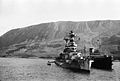
During World War II and the Battle of Greece, the harbor was the target of an Italian raid against the Allied navy as part of the Mediterranean Campaign.[8]

After the war, the naval base was founded, around the same period with Greece's entry into the North Atlantic Alliance.

Facilities

[edit]

The Naval Base of Souda Bay occupies an area of 500 hectares (1,200 acres), including the old artillery barracks of the Hellenic Army's 5th Infantry Division as well as later land acquisitions. The facilities include a dry dock, workshops, a fuel depot and an ammunition depot. The Naval Station is commanded by a Commodore or Captain of the Hellenic Navy. The Forward Logistics Site Souda Bay (FLS Souda Bay) was under the operational control of NATO's Allied Naval Forces Southern Europe (COMNAVSOUTH), until 2013. Since then, it is under the control of the Allied Maritime Command (MARCOM) which replaced NAVSOUTH. The Hellenic Navy radio communications station SXH has also been located at Mournies, near Souda, since 1929.[9] The Κ-14, a deep-water quay, is the only of its kind in the Mediterranean Sea that allows the aircraft carriers to dock.

Since 2007, the Souda Bay Naval Base is host of the NATO Maritime Interdiction Operational Training Centre (ΝMIOTC), which is located at the Northern Sector of the base (Marathi).[10]

Based units

[edit]
[edit]

See also

[edit]

References

[edit]
[edit]
Revisions and contributorsEdit on WikipediaRead on Wikipedia
from Grokipedia
Crete Naval Base, known in Greek as Ναύσταθμος Κρήτης, is the primary naval installation of the Hellenic Navy at Souda Bay on the northwestern coast of Crete, Greece, encompassing facilities for warship berthing, supply, maintenance, and repairs across approximately 40 hectares. It also hosts the U.S. Naval Support Activity (NSA) Souda Bay, a forward-operating base established in 1969 as a small detachment and expanded to support U.S., NATO, and allied forces with logistics, an all-weather airfield, and deep-water piers. The base's strategic position enables power projection and operational sustainment in the Eastern Mediterranean, including refueling, ammunition handling, and hosting nuclear-powered submarines and aircraft carriers. Key facilities include the Maritime Interdiction Operational Training Centre (NMIOTC) for multinational training in and the shared infrastructure with the Hellenic Air Force's 115th Combat Wing for air operations. Since its development during the , the base has supported critical missions, such as for operations in and joint exercises enhancing alliance . Recent U.S. investments, including a $5.2 million for cargo storage, underscore its evolving role in addressing regional instability and bolstering deterrence against threats from actors like and non-state groups.

Location and Strategic Role

Geographical Position

The Crete Naval Base is located in on the northwest coast of the island of , , approximately 306 kilometers south-southwest of . forms a natural deep-water harbor between the Akrotiri Peninsula to the north and Cape Drapano to the east, measuring about 15 kilometers in length and 2 to 4 kilometers in width. This configuration provides shelter from prevailing winds and open sea conditions, rendering it one of the most protected natural harbors in the . The bay's geophysical orientation and sufficient depths enable safe access for large vessels throughout the year, with minimal tidal variations typical of the Mediterranean region. Its position overlooks key sea lanes, facilitating proximity to major maritime routes connecting , , and the . Crete's features mild winters with average temperatures around 10–15°C and hot, dry summers reaching 25–30°C, supporting year-round operational accessibility without significant weather disruptions. Good weather conditions prevail, allowing consistent harbor usage despite occasional strong westerly winds in the inner bay.

Geopolitical and Military Significance

The Naval Base at functions as a pivotal forward-operating site, bolstering alliance in the against empirical threats including Russian naval deployments via the Black Sea-Mediterranean axis and volatility in the stemming from Syrian instability, Iranian proxies, and related conflicts. Its central geographical placement supports swift naval and air deployments to regional hotspots, with operational advantages derived from proximity to contested areas like the Syrian coast, enabling deterrence of authoritarian maritime encroachments without reliance on distant bases. This infrastructure underpins U.S. Sixth Fleet activities by furnishing logistics, maintenance, and refueling for carrier strike groups and destroyers, as evidenced by frequent port calls and sustained presence post-2022 developments, thereby amplifying Greek deterrence against adversaries through enhanced interoperability under the U.S.- Mutual Defense Cooperation Agreement. exercises hosted at the base, such as for mine countermeasures and Dynamic Guard for , quantify allied readiness gains, fostering joint operations that integrate assets with forces to counter hybrid threats. The base also yields measurable economic contributions to , infusing approximately 35-48 million euros yearly into the local economy via salaries for hundreds of Greek nationals, leases, and direct , complemented by investments like a recent 75 million U.S. for facility expansions that sustain regional and development.

Historical Development

World War II and Immediate Postwar Period

Souda Bay emerged as a critical anchorage for the British in the Mediterranean theater of . Following the German invasion of mainland in April 1941, Allied troops evacuated to , where the bay's deep natural harbor facilitated naval resupply and operations against Axis forces. The positioned warships there to support ground defenses and interdict German supply lines. The , from 20 May to 1 June 1941, saw subjected to relentless attacks as German paratroopers seized the island. Stuka dive-bombers and Ju 88s targeted anchored British vessels and shore installations, sinking three cruisers, six destroyers, and other ships in the vicinity, while damaging harbor infrastructure through continuous raids lasting up to seven hours in some instances. These bombings inflicted severe losses on the Royal Navy, with over 2,000 sailors killed, and rendered the bay largely unusable for Allied naval purposes by the battle's end, contributing to the eventual evacuation of 17,000 British Commonwealth troops. After the German withdrawal from Crete in October 1944, 's damaged facilities underwent repairs under Allied and Greek efforts amid the (1946–1949), where communist insurgents challenged the government. British forces initially provided logistical support via Mediterranean ports including until early 1947, when fiscal constraints prompted their handover to U.S. leadership. The , proclaimed on 12 March 1947, committed $400 million in U.S. aid—$300 million for —to bolster anti-communist defenses, encompassing military equipment, training, and logistics that extended to Greek naval assets like . By 1947, operational control fully reverted to Greek authorities, reflecting post-occupation stabilization and the onset of U.S.-Greek military cooperation against Soviet-backed threats.

Cold War Establishment and Expansion

The U.S. Naval Detachment Souda Bay was commissioned on May 28, 1969, as a small unit of 16 personnel detached from Naval Air Facility Sigonella, , to provide essential communication relay and logistic support for U.S. Sixth Fleet operations in the Mediterranean amid escalating Soviet naval presence. This establishment reflected broader U.S. strategy to counter maritime threats, including Soviet submarine deployments from the that transited the en route to the , necessitating forward basing for rapid response and surveillance. The detachment's initial facilities at the existing base in enabled antisubmarine warfare support, including patrols to monitor Soviet naval movements, serving as a force multiplier by reducing transit times for resupply and intelligence relay compared to bases in or . expansions in the included upgrades to the airfield for maritime patrol aircraft like the , which conducted surveillance flights over the Aegean to track Warsaw Pact surface and subsurface assets, enhancing NATO's ability to detect and deter potential incursions into NATO's southern flank. The 1974 Turkish invasion of heightened regional instability, underscoring the strategic imperative of a reliable U.S. presence at for logistics and potential contingency operations, as the base provided critical support for Sixth Fleet assets without reliance on mainland ports amid political turmoil. This event spurred bilateral U.S.- negotiations, building on a 1950 agreement and culminating in a 1976 accord in principle for continued access to facilities including , followed by formalization as Naval Support Activity (NSA) on October 1, 1980, under terms affirming sovereignty while securing U.S. operational control for NATO-aligned defense against Soviet expansionism.

Post-Cold War Realignments and Modernization

Following the , the closed several military installations in during the early 1990s as part of global defense realignments, including the Hellenikon Air Base and a naval communications facility near in 1990, amid negotiations that reduced the overall U.S. footprint. However, the complex was preserved due to its unmatched strategic position for projecting power into the and supporting NATO's southern flank against emerging regional instabilities, such as those in the . This retention was formalized through the U.S.- Mutual Defense Cooperation Agreement (MDCA), signed on July 8, 1990, and entering into force on November 6, 1990, which granted U.S. forces access to for logistics, maintenance, and operational support. In the late , Souda Bay adapted to post-Cold War threats by facilitating responses to ethnic conflicts in the , notably providing logistical and readiness support for Operation Allied Force, the 1999 air campaign over aimed at halting Yugoslav advances. The base's infrastructure enabled sustainment of U.S. and allied operations, including and refueling missions, underscoring its role in coalition interoperability amid 's expansion and evolving mandates beyond collective defense. Periodic renewals of the MDCA, such as extensions in the , reinforced bilateral commitments, ensuring continued U.S. access despite domestic political pressures in and shifts toward security frameworks. The September 11, 2001, attacks prompted further realignment toward , with serving as a key hub for in , offering repair, provisioning, and force projection capabilities for U.S. Sixth Fleet assets combating non-state actors. This pivot highlighted the base's flexibility in addressing asymmetric threats, including support for maritime interdiction and intelligence operations in the Mediterranean, while facilities at the site enhanced allied training against and regional proliferation risks. Modernization efforts in this era focused on upgrading port and airfield capacities to handle increased operational tempo, solidifying 's indispensability in a multipolar environment.

Facilities and Infrastructure

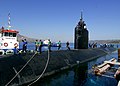
The naval and port facilities at Crete Naval Base, located in Souda Bay, include deep-water piers capable of accommodating large warships such as aircraft carriers, destroyers, and submarines. The NATO Pier Complex features the Mediterranean's only deep-water pier designed for aircraft carrier berthing, enabling sustained operations for major surface combatants. These piers support mooring, replenishment, and basic maintenance for forward-deployed fleets, with infrastructure integrated to NATO specifications for interoperability among allied navies. Fuel depots provide essential logistical support, storing and marine fuels including JP-5 for and ships. Storage includes multiple tanks, such as a JP-5 with two 500,000-gallon tanks and associated pumphouses, facilitating refueling for operational tempo in the . Recent maintenance, including the reactivation of Tank 101, ensures redundancy and prevents capacity shortfalls during high-demand periods. Berthing arrangements adhere to NATO standards, accommodating multinational task forces for joint exercises and contingency responses. The facilities handle routine port visits by U.S., Hellenic, and partner nation vessels, with the pier complex serving as a hub for logistics and sustainment in regional security operations.

Airfield and Aviation Infrastructure

The Souda Bay airfield, integral to Naval Support Activity (NSA) Souda Bay, functions as an all-weather facility shared with the Hellenic Air Force's 115th Combat Wing and Chania International Airport, enabling operations for NATO-standard fixed-wing and rotary-wing aircraft. Its primary runway measures 11,738 feet in length and 148 feet in width, complemented by a south parallel taxiway spanning 9,850 feet long and 72 feet wide, supporting heavy transports such as C-130 variants for logistics and patrol missions. Infrastructure includes aircraft parking aprons, refueling systems with in-ground hydrants at six medium spaces and expanded capacity for four additional large-aircraft positions completed in 2019, alongside hangars and fuel storage enabling sustained patrols for maritime in the . These assets facilitate handling, processing, and rapid turnaround for platforms, distinct from naval functions. A $43 million military construction project, awarded in May 2025, consolidates air operations and transportation into a new facility designed to handle at least 30,000 passengers annually and accommodate one wide-body aircraft concurrently, with completion slated for December 2027 to enhance logistical efficiency amid regional demands. Rotary-wing support includes helipads for helicopters integral to base operations, though specific capacity details remain operationally classified in public U.S. Navy guides.

Logistics and Support Services

The logistics infrastructure at Naval Support Activity (NSA) Souda Bay includes dedicated warehousing facilities essential for storing supplies and to sustain naval operations in the . In April 2025, the Public Works Department delivered a $5.2 million, 14,000-square-foot designed for general storage, visiting ship , and mission-critical materials, enhancing the Naval Supply Systems Command's Mediterranean capabilities. This facility supports the base's role in providing logistical sustainment to U.S., allied, and partner forces without relying on external immediate resupply during contingencies. In September 2025, the U.S. Navy awarded a $75 million contract for construction and renovation projects across and associated sites, including upgrades to support infrastructure such as storage and utilities to maintain operational readiness amid regional tensions. These enhancements address the demands of unaccompanied personnel tours, where facilities must accommodate extended deployments with minimal family support structures. Medical support is provided through the Branch Health Clinic , offering outpatient services including sick call, physical examinations, , immunizations, and to approximately 1,200 beneficiaries, ensuring health sustainment for rotational forces in a remote location. The clinic's limited inpatient capabilities necessitate protocols for complex cases, aligning with the base's expeditionary model. Utilities management falls under the Department, which oversees power distribution, water systems, and to deliver reliable supporting 24/7 operations, with focused on minimizing downtime for critical systems like airfield and pier power. This self-reliant approach reduces vulnerability to local grid disruptions, though specific uptime metrics are not publicly detailed beyond routine assessments confirming functional readiness for missions.

Command Structure and Based Units

Hellenic Navy Elements

The designates as a major forward naval base on , functioning primarily as a logistic support site under the direct command of the Souda Naval Base Commander. This command structure integrates the facility within the broader Hellenic Fleet Command, ensuring national oversight of operations and infrastructure owned by in the area, including fuel directorates and forward stations like Kiriamadi. Hellenic Navy elements at the base support maritime patrols and surveillance in the Aegean Sea, focusing on countering illegal migration, smuggling, and territorial defense. While primary homeporting of frigates and submarines occurs at Salamis Naval Base, Souda Bay harbors visiting surface combatants and submarines during deployments, enabling rapid response for Aegean security missions. The base's role underscores Greece's sovereign control, with Hellenic personnel managing host-nation responsibilities amid joint activities. A central component is the Maritime Interdiction Operational Centre (NMIOTC), located at and staffed predominantly by Greek officers and instructors. Directed by a Captain as , the NMIOTC delivers specialized in boarding operations, visit-board-search-seizure tactics, and counter-smuggling, drawing on bilateral programs with U.S. and partners to enhance while prioritizing Greek operational needs. These programs, supported by vessels like the sail Aris, emphasize practical skills for regional threats without ceding command authority to foreign entities.

U.S. Naval Support Activity Components

The U.S. Naval Support Activity (NSA) was established on October 1, 1980, replacing the U.S. Naval Detachment that originated in May 1969 as a small and communications outpost under Naval Air Facility Sigonella. This transition formalized its function as a forward-deployed hub for the U.S. Sixth Fleet, emphasizing administrative oversight, , and sustainment for U.S. naval assets operating in the . Core U.S. components encompass dedicated detachments for critical enablers, including the Naval Computer and Area Master Station (NCTAMS) Detachment Souda Bay, which maintains secure classified and unclassified voice, data, and command-and-control infrastructure to underpin U.S. fleet communications. Security operations, handled by U.S. Security Forces, enforce controlled access protocols and perimeter defense within the installation's restricted zones, directly supporting the handling of sensitive U.S. assets and munitions transfers during activities. Logistics elements, such as the NAVSUP Fleet Center Sigonella Site Souda Bay, manage ordnance storage, resupply distribution, and warehousing to sustain rotational U.S. ship and deployments without reliance on external hosts. The activity's unaccompanied tour policy, standard for assignments there, limits family presence to prioritize mission readiness, authorizing personnel in pay grades E-5 and above to ship no more than 2,500 pounds of or 25% of full allowance. This framework aligns with sustained high operational tempo, where U.S. components maintain continuous support for incoming vessels, aviation sorties, and transient forces year-round, including periods of elevated demand that do not diminish during holidays.

NATO and Allied Forces

The Crete Naval Base at functions as a critical hub for multinational force integration and training in the , distinct from bilateral arrangements. It hosts the Maritime Interdiction Operational Training Centre (NMIOTC), established in 2007 as the alliance's sole dedicated facility for maritime interdiction education, delivering courses to personnel from members and partners on tactics. This center enhances alliance by simulating real-world scenarios, with annual conferences fostering doctrinal alignment among diverse naval contributors. Souda Bay supports rotational deployments of Standing NATO Maritime Groups, such as SNMG2, which utilize the base for port visits and pre-exercise coordination; for instance, SNMG2 conducted a port visit in August 2022 to leverage logistics and training infrastructure. The facility's deep-water piers and airfield accommodate allied vessels and aircraft from multiple nations, including French and Dutch units, enabling seamless sustainment for ongoing patrols under operations like Sea Guardian. Adjacent to the base, the NATO Missile Firing Installation (NAMFI), operational since 1968, provides a 14,440 km² range for live-fire air defense training, hosting exercises that involve systems like Patriot batteries from as recently as October 2025. These assets contribute to NATO's collective defense framework under Article 5 by bolstering surveillance over Aegean and Balkan approaches and countering hybrid threats through verified exercise outcomes, such as improved electronic warfare proficiency demonstrated in Dynamic Guard preparations held at in September 2024. Joint maneuvers, including Ariadne 2023 with SNMCMG2, yield empirical gains in mine countermeasures and force synchronization, deterring adversarial maneuvers by and others via persistent allied presence and rapid response capabilities.

Operations and Strategic Contributions

Supported Military Operations

Naval Support Activity (NSA) provided essential logistical support during Operations Enduring Freedom and Iraqi Freedom, including air refueling for coalition and management of over 1.3 million square feet of ammunition cargo delivered via to sustain ground and air campaigns in and from 2001 to 2003 and beyond. This forward positioning enabled rapid resupply, reducing transit times and enhancing operational tempo for U.S. Central Command forces by serving as a key transit point between European logistics hubs and Middle Eastern theaters. In the 2011 Libyan intervention, Souda Bay enabled air sorties under Operation Odyssey Dawn, with coalition detachments—including Qatari and French Mirage 2000 fighters—launching multiple missions from the base to establish air superiority, conduct strikes on regime forces, and enforce United Nations-mandated no-fly zones, directly contributing to the protection of civilians and the degradation of Muammar Gaddafi's military capabilities in the war's early phase from March 19 onward. Following Russia's 2022 invasion of Ukraine, the base supported U.S. Sixth Fleet operations, including refueling and maintenance for the during Neptune Strike 2022, which bolstered NATO's maritime posture in the and facilitated indirect chains aiding Ukraine's defense through enhanced regional force projection. This presence enabled sustained patrols and rapid response capabilities, with the carrier group conducting over 1,000 sorties in support of broader alliance deterrence efforts.

Role in Regional Deterrence and Security

The Crete Naval Base at Souda Bay serves as a critical hub for projecting NATO and allied naval power in the Eastern Mediterranean, enabling deterrence through sustained presence and rapid response capabilities. By hosting U.S. Sixth Fleet assets and NATO maritime operations, the facility allows for the forward deployment of carrier strike groups and support vessels, which signal resolve against potential aggressors without necessitating immediate escalation. This aligns with deterrence principles where visible military readiness raises the perceived costs of adventurism, as evidenced by the base's role in maintaining maritime security amid regional volatility. In the context of Greek-Turkish tensions over Aegean maritime boundaries and island sovereignty, bolsters deterrence against revisionist claims by providing logistical sustainment for allied forces that counterbalance asymmetries in fleet size and airpower projection. Turkey's frequent violations and exploratory in disputed waters have heightened risks of miscalculation, yet U.S. and access to the base has historically de-escalated crises by ensuring credible allied intervention options. Similarly, the base mitigates spillover from Russian activities, including Black Sea operations post-2022 Ukraine invasion, by supporting enhanced patrols and intelligence sharing on 's southern flank. The facility reinforces Greek sovereignty and collective defense under Article 5, while critiques framing such alliances as imperial overreach overlook empirical threat data: Turkey's military spending exceeds Greece's by over threefold, and its doctrinal emphasis on "Blue Homeland" necessitates robust countermeasures for stability. Mutual benefits accrue through shared infrastructure and training, enhancing regional security without unilateral dominance, as joint exercises demonstrate that deters hybrid threats from non-state actors or state proxies. This strategic posture has preserved peace in a flashpoint area, where alternative demilitarization advocacy ignores causal links between power vacuums and opportunistic aggression.

Recent Developments

Infrastructure Upgrades and Expansions

In September 2025, the U.S. awarded a $75 million indefinite-delivery/indefinite-quantity to support multiple construction and renovation projects at Naval Support Activity (NSA) and affiliated sites, aimed at enhancing facility durability and operational efficiency across the base. A key component of these efforts includes the May 2025 award of a $43.91 million firm-fixed-price to Aktor S.A. for constructing a two-story Joint Mobility Processing Center, designed to consolidate air operations and air transportation functions into a single, streamlined facility supporting higher throughput of personnel and cargo. This design-bid-build military construction project, funded under appropriations, addresses logistical bottlenecks by integrating administrative, processing, and support spaces, with completion projected for December 2027. Fitness and morale infrastructure saw targeted upgrades in 2025, with a $531,000 of the base gym completed in , incorporating new cardio and weight-training equipment, modernized locker rooms, enhanced , and ancillary improvements to and courts to bolster personnel readiness and well-being. These enhancements, executed over two years by teams, integrate Navy Operational Fitness and Fueling zones to promote physical conditioning amid sustained operational demands. Supporting logistics, a $5.2 million warehouse project was delivered in April 2025, providing expanded storage for hazardous materials and mission-critical supplies, thereby strengthening supply chain resilience for Navy Expeditionary Logistics Support Group operations in the Mediterranean. These upgrades collectively represent engineering investments exceeding $120 million since early 2025, prioritizing capacity expansion and maintenance sustainment without altering core base footprint.

Deployment of Advanced Defense Systems

In June 2025, Greek authorities relocated an undisclosed number of Patriot surface-to-air missile batteries to the naval base in to bolster air and missile defense capabilities. These systems, part of Greece's inventory of six batteries acquired from the , feature PAC-3 interceptors designed to counter tactical ballistic missiles, cruise missiles, and , with a reported engagement range exceeding 160 kilometers and altitudes up to 24 kilometers. The deployment aimed to provide layered protection against potential aerial threats, integrating radar-guided missiles with command-and-control networks compatible with NATO's architecture. Complementing the Patriots, U.S. forces introduced Mobile-Low, Slow, Small Unmanned Aircraft Integrated Defeat Systems (M-LIDS) at , consisting of directed-energy weapons, kinetic effectors, and electronic warfare modules mounted on vehicles for countering drones at short ranges up to 5 kilometers. These systems enhance perimeter security against low-altitude unmanned threats, with rapid deployment enabling response times under 30 seconds to detected incursions. platforms, including man-portable systems like FIM-92 Stingers, were also positioned to form a multi-tiered shield, interoperable via Link-16 data links for real-time sharing of sensor data across allied forces. The combined deployments transformed Souda Bay into a fortified regional hub for missile and drone defense, particularly amid heightened Middle East tensions involving ballistic missile exchanges. Greek Ministry of Defense statements emphasized that such measures align with national sovereignty and NATO commitments, rejecting claims of exclusive protection for U.S. assets while affirming ongoing defensive preparations. This integration of U.S.-origin and allied technologies underscores Souda Bay's role in deterring asymmetric aerial threats through high-fidelity tracking and precision intercepts.

Controversies and Criticisms

Geopolitical Tensions with Turkey

Turkish officials and media have frequently objected to the presence and expansion of foreign military forces at Souda Bay on Crete, portraying it as contributing to an imbalance of power in the Aegean Sea. In July 2025, Turkish media described the U.S. military buildup at the base as a "steel wall" aimed at containing Turkey, highlighting the rapid deployment capabilities of U.S. forces there, which can be augmented within 72 hours. These claims echo broader Turkish assertions that Greek-hosted NATO and U.S. assets, including at Souda Bay, violate post-World War I treaties like the 1923 Lausanne Treaty by militarizing areas near Turkish borders, potentially threatening Ankara's security interests in the Aegean. Turkish President Recep Tayyip Erdoğan has criticized the growing U.S. military footprint in Greece, including Souda Bay, as a direct challenge to Turkey despite NATO alliance obligations. Greek and U.S. officials counter that the base operates under bilateral defense cooperation agreements and NATO frameworks, affirming Greece's sovereign right to host allied forces on its territory without infringing on international law. Crete, as a core Greek island not subject to specific demilitarization clauses in treaties like Lausanne—which apply to frontier islands ceded post-World War I—faces no legal prohibition against defensive installations. Greece adheres to the 1982 United Nations Convention on the Law of the Sea (UNCLOS), which it has ratified, supporting its maritime zone claims around Crete and other islands based on geographic realities, in contrast to Turkey's non-ratification and contestation of UNCLOS provisions favoring insular states. U.S. deployments, such as the 2020 stationing of the USS Mount Whitney at Souda Bay amid Aegean tensions, were framed as stabilizing measures to deter aggression rather than provoke it, with no recorded instances of base operations encroaching on Turkish territorial waters. Empirical assessments of Souda Bay's activities underscore a defensive orientation, focused on interoperability, maritime interdiction training, and regional deterrence against non-state threats like migration flows and piracy, rather than offensive posturing toward . Joint exercises involving Greek, U.S., and allied navies at the base have enhanced collective defense capabilities without altering Aegean territorial boundaries or prompting escalatory Turkish responses beyond rhetorical protests. Turkish claims of imbalance lack substantiation from neutral analyses, as the base's logistics and support roles align with 's southern flank strategy, contributing to de-escalation during past flare-ups, such as the 2020 dispute, where U.S. presence helped mediate tensions.

Domestic and Security Challenges

In the 1980s and early 1990s, left-wing political groups and the government led protests and negotiations demanding the closure of U.S. military facilities in , including , amid broader anti- sentiments tied to nuclear deployments and perceived foreign influence. These actions culminated in official notices for base removals by mid-1990, though many facilities persisted under revised agreements. Opposition largely subsided by the late 1990s as prioritized integration for defense against regional threats, particularly Turkish territorial claims in the Aegean and , fostering greater public acceptance of allied presence despite lingering leftist critiques. The base's economic contributions have further mitigated domestic resistance, injecting an average of 35 to 48 million euros annually into Crete's local economy through salaries for Greek national employees, maintenance contracts, and related services, supporting thousands of jobs in an island region prone to seasonality. This dependency has countered anti-base narratives, with benefits outweighing ideological objections in public discourse, even as polls reflect ambivalence toward overall—37% favorable in per 2024 surveys, though right-leaning respondents show stronger endorsement amid security concerns. Security vulnerabilities persist, exemplified by the June 23, 2025, arrest of a 26-year-old Azerbaijani national near , where authorities seized devices containing thousands of photographs of the base, cruise ships, and surrounding infrastructure, prompting charges. The suspect faced pre-trial detention ordered on June 25, 2025, with investigations probing potential Iranian ties and encrypted communications, underscoring foreign intelligence risks but also Greek countermeasures' efficacy in detection and response. Occasional small-scale protests continue, such as a 2025 demonstration approaching the base from nearby villages, but they lack the scale of past mobilizations.

References

Add your contribution
Related Hubs
User Avatar
No comments yet.