



Community hub
Recent from talks
Contribute something
Nothing was collected or created yet.
Web Ontology Language
View on Wikipedia
 | This article has multiple issues. Please help improve it or discuss these issues on the talk page. (Learn how and when to remove these messages)
|


| OWL Web Ontology Language | |
|---|---|
| Abbreviation | OWL |
| Status | Published |
| Year started | 2004 |
| Editors | Mike Dean (BBN Technologies), Guus Schreiber |
| Base standards | Resource Description Framework, RDFS |
| Related standards | SHACL |
| Domain | Semantic Web |
| Website | OWL Reference |
| OWL 2 Web Ontology Language | |
|---|---|
| Abbreviation | OWL 2 |
| Status | Published |
| Year started | 2009 |
| Editors | W3C OWL Working Group |
| Base standards | Resource Description Framework, RDFS |
| Domain | Semantic Web |
| Website | OWL 2 Overview |
The Web Ontology Language (OWL) is a family of knowledge representation languages for authoring ontologies. Ontologies are a formal way to describe taxonomies and classification networks, essentially defining the structure of knowledge for various domains: the nouns representing classes of objects and the verbs representing relations between the objects.
Ontologies resemble class hierarchies in object-oriented programming but there are several critical differences. Class hierarchies are meant to represent structures used in source code that evolve fairly slowly (perhaps with monthly revisions) whereas ontologies are meant to represent information on the Internet and are expected to be evolving almost constantly. Similarly, ontologies are typically far more flexible as they are meant to represent information on the Internet coming from all sorts of heterogeneous data sources. Class hierarchies on the other hand tend to be fairly static and rely on far less diverse and more structured sources of data such as corporate databases.[1]
The OWL languages are characterized by formal semantics. They are built upon the World Wide Web Consortium's (W3C) standard for objects called the Resource Description Framework (RDF).[2] OWL and RDF have attracted significant academic, medical and commercial interest.
In October 2007,[3] a new W3C working group[4] was started to extend OWL with several new features as proposed in the OWL 1.1 member submission.[5] W3C announced the new version of OWL on 27 October 2009.[6] This new version, called OWL 2, soon found its way into semantic editors such as Protégé and semantic reasoners such as Pellet,[7] RacerPro,[8] FaCT++[9][10] and HermiT.[11]
The OWL family contains many species, serializations, syntaxes and specifications with similar names. OWL and OWL2 are used to refer to the 2004 and 2009 specifications, respectively. Full species names will be used, including specification version (for example, OWL2 EL). When referring more generally, OWL Family will be used.[12][13][14]
History
[edit]Early ontology languages
[edit]There is a long history of ontological development in philosophy and computer science. Since the 1990s, a number of research efforts have explored how the idea of knowledge representation (KR) from artificial intelligence (AI) could be made useful on the World Wide Web. These included languages based on HTML (called SHOE), based on XML (called XOL, later OIL), and various frame-based KR languages and knowledge acquisition approaches.
Ontology languages for the web
[edit]In 2000 in the United States, DARPA started development of DAML led by James Hendler.[15][self-published source] In March 2001, the Joint EU/US Committee on Agent Markup Languages decided that DAML should be merged with OIL.[15] The EU/US ad hoc Joint Working Group on Agent Markup Languages was convened to develop DAML+OIL as a web ontology language. This group was jointly funded by the DARPA (under the DAML program) and the European Union's Information Society Technologies (IST) funding project. DAML+OIL was intended to be a thin layer above RDFS,[15] with formal semantics based on a description logic (DL).[16]
DAML+OIL is a particularly major influence on OWL; OWL's design was specifically based on DAML+OIL.[17]
Semantic web standards
[edit]The Semantic Web provides a common framework that allows data to be shared and reused across application, enterprise, and community boundaries.
— World Wide Web Consortium, W3C Semantic Web Activity[18]
RDF schema
[edit]a declarative representation language influenced by ideas from knowledge representation
— World Wide Web Consortium, Metadata Activity[19]
In the late 1990s, the World Wide Web Consortium (W3C) Metadata Activity started work on RDF Schema (RDFS), a language for RDF vocabulary sharing. The RDF became a W3C Recommendation in February 1999, and RDFS a Candidate Recommendation in March 2000.[19] In February 2001, the Semantic Web Activity replaced the Metadata Activity.[19] In 2004 (as part of a wider revision of RDF) RDFS became a W3C Recommendation.[20] Though RDFS provides some support for ontology specification, the need for a more expressive ontology language had become clear.[21][self-published source]
Web-Ontology Working Group
[edit]As of Monday, the 31st of May, our working group will officially come to an end. We have achieved all that we were chartered to do, and I believe our work is being quite well appreciated.
— James Hendler and Guus Schreiber, Web-Ontology Working Group: Conclusions and Future Work[22]
The World Wide Web Consortium (W3C) created the Web-Ontology Working Group as part of their Semantic Web Activity. It began work on November 1, 2001 with co-chairs James Hendler and Guus Schreiber.[22] The first working drafts of the abstract syntax, reference and synopsis were published in July 2002.[22] OWL became a formal W3C recommendation on February 10, 2004 and the working group was disbanded on May 31, 2004.[22]
OWL Working Group
[edit]In 2005, at the OWL Experiences And Directions Workshop a consensus formed that recent advances in description logic would allow a more expressive revision to satisfy user requirements more comprehensively whilst retaining good computational properties. In December 2006, the OWL1.1 Member Submission[23] was made to the W3C. The W3C chartered the OWL Working Group as part of the Semantic Web Activity in September 2007. In April 2008, this group decided to call this new language OWL2, indicating a substantial revision.[24]
OWL 2 became a W3C recommendation in October 2009. OWL 2 introduces profiles to improve scalability in typical applications.[6][25]
Acronym
[edit]Why not be inconsistent in at least one aspect of a language which is all about consistency?
— Guus Schreiber, Why OWL and not WOL?[26]
OWL was chosen as an easily pronounced acronym that would yield good logos, suggest wisdom, and honor William A. Martin's One World Language knowledge representation project from the 1970s.[27][28][29]
Adoption
[edit]A 2006 survey of ontologies available on the web collected 688 OWL ontologies. Of these, 199 were OWL Lite, 149 were OWL DL and 337 OWL Full (by syntax). They found that 19 ontologies had in excess of 2,000 classes, and that 6 had more than 10,000. The same survey collected 587 RDFS vocabularies.[30]
Ontologies
[edit]An ontology is an explicit specification of a conceptualization.
— Tom Gruber, A Translation Approach to Portable Ontology Specifications[31]
The data described by an ontology in the OWL family is interpreted as a set of "individuals" and a set of "property assertions" which relate these individuals to each other. An ontology consists of a set of axioms which place constraints on sets of individuals (called "classes") and the types of relationships permitted between them. These axioms provide semantics by allowing systems to infer additional information based on the data explicitly provided. A full introduction to the expressive power of the OWL is provided in the W3C's OWL Guide.[32]
OWL ontologies can import other ontologies, adding information from the imported ontology to the current ontology.[17]
Example
[edit]An ontology describing families might include axioms stating that a "hasMother" property is only present between two individuals when "hasParent" is also present, and that individuals of class "HasTypeOBlood" are never related via "hasParent" to members of the "HasTypeABBlood" class. If it is stated that the individual Harriet is related via "hasMother" to the individual Sue, and that Harriet is a member of the "HasTypeOBlood" class, then it can be inferred that Sue is not a member of "HasTypeABBlood". This is, however, only true if the concepts of "Parent" and "Mother" only mean biological parent or mother and not social parent or mother.
Logic
[edit]To choose a subset of first-order logic that is decidable, propositional logic was used, increasing its power by adding logics represented by convention with acronyms:
| Letter or symbol of logic | Description |
|---|---|
| Inclusion and equivalence between classes, definition of atomic classes, universe class, intersection between classes, definitions of classes formed by elements that take part in relationships or have a relationship of a certain type only with elements of a certain class, congruence operator between individuals and an individual's membership in a class | |
| adds to AL the empty class, the complement classes, the union of classes and the classes of elements that are in a certain relationship with elements of a certain class | |
| Adds the definition of the transitivity of a relation to ALC | |
| Inclusion and equivalence between relations | |
| disjunction of properties, reflexivity, asymmetry, irreflexivity, relations composed of other relations, definition of non-relationship between two individuals | |
| (One of) | creation of classes via list of all and only the individuals contained |
| (Reverse) | definition of inverse property |
| (Feature) | definition of functional properties |
| (Number) | cardinality restriction: number of elements participating in a certain relationship less than, greater than or equal to a value n |
| (Qualified) | like N, but the relationship can be qualified |
| (Countable domain) | definition of domains (data types) to which a relationship can lead (e.g. "Mario is n years old") |


Species
[edit]OWL dialects
[edit]The W3C-endorsed OWL specification includes the definition of three variants of OWL, with different levels of expressiveness. These are OWL Lite, OWL DL and OWL Full (ordered by increasing expressiveness). Each of these sublanguages is a syntactic extension of its simpler predecessor. The following set of relations hold. Their inverses do not.
- Every legal OWL Lite ontology is a legal OWL DL ontology.
- Every legal OWL DL ontology is a legal OWL Full ontology.
- Every valid OWL Lite conclusion is a valid OWL DL conclusion.
- Every valid OWL DL conclusion is a valid OWL Full conclusion.
OWL Lite
[edit]OWL Lite was originally intended to support those users primarily needing a classification hierarchy and simple constraints. For example, while it supports cardinality constraints, it only permits cardinality values of 0 or 1. It was hoped that it would be simpler to provide tool support for OWL Lite than its more expressive relatives, allowing quick migration path for systems using thesauri and other taxonomies. In practice, however, most of the expressiveness constraints placed on OWL Lite amount to little more than syntactic inconveniences: most of the constructs available in OWL DL can be built using complex combinations of OWL Lite features, and is equally expressive as the description logic .[24] Development of OWL Lite tools has thus proven to be almost as difficult as development of tools for OWL DL, and OWL Lite is not widely used.[24]

OWL DL
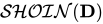
[edit]OWL DL is designed to provide the maximum expressiveness possible while retaining computational completeness (either φ or ¬φ holds), decidability (there is an effective procedure to determine whether φ is derivable or not), and the availability of practical reasoning algorithms. OWL DL includes all OWL language constructs, but they can be used only under certain restrictions (for example, number restrictions may not be placed upon properties which are declared to be transitive; and while a class may be a subclass of many classes, a class cannot be an instance of another class). OWL DL is so named due to its correspondence with description logic, a field of research that has studied the logics that form the formal foundation of OWL.
This one can be expressed as , using the letters logic above.
OWL Full
[edit]OWL Full is based on a different semantics from OWL Lite or OWL DL, and was designed to preserve some compatibility with RDF Schema. For example, in OWL Full a class can be treated simultaneously as a collection of individuals and as an individual in its own right; this is not permitted in OWL DL. OWL Full allows an ontology to augment the meaning of the pre-defined (RDF or OWL) vocabulary. OWL Full is undecidable, so no reasoning software is able to perform complete reasoning for it.
OWL2 profiles
[edit]In OWL2 there are three sublanguages (known as profiles):[25]
- OWL2 EL is a fragment that has polynomial time reasoning complexity. It is based on the description logic .[33]
- OWL2 QL is designed to enable easier access and query to data stored in databases. It is based on the DL-Lite family of description logics.[34]
- OWL2 RL is a rule subset of OWL 2 (the acronym "RL" stands for "Rule Language"). It is based on the so-called description logic programs (DLP). Later, a logic called corresponding to this profile has been introduced.[35]


Syntax
[edit]The OWL family of languages supports a variety of syntaxes. It is useful to distinguish high level syntaxes aimed at specification from exchange syntaxes more suitable for general use.
High level
[edit]These are close to the ontology structure of languages in the OWL family.
OWL abstract syntax
[edit]High level syntax is used to specify the OWL ontology structure and semantics.[36]
The OWL abstract syntax presents an ontology as a sequence of annotations, axioms and facts. Annotations carry machine and human oriented meta-data. Information about the classes, properties and individuals that compose the ontology is contained in axioms and facts only. Each class, property and individual is either anonymous or identified by an URI reference. Facts state data either about an individual or about a pair of individual identifiers (that the objects identified are distinct or the same). Axioms specify the characteristics of classes and properties. This style is similar to frame languages, and quite dissimilar to well known syntaxes for DLs and Resource Description Framework (RDF).[36]
Sean Bechhofer, et al. argue that though this syntax is hard to parse, it is quite concrete. They conclude that the name abstract syntax may be somewhat misleading.[37]
OWL2 functional syntax
[edit]This syntax closely follows the structure of an OWL2 ontology. It is used by OWL2 to specify semantics, mappings to exchange syntaxes and profiles.[38]
Exchange syntaxes
[edit]| OWL RDF/XML Serialization | |
|---|---|
 | |
| Filename extension |
.owx, .owl, .rdf |
| Internet media type |
application/owl+xml, application/rdf+xml[39] |
| Developed by | World Wide Web Consortium |
| Standard | OWL 2 XML Serialization October 27, 2009, OWL Reference February 10, 2004 |
| Open format? | Yes |
RDF syntaxes
[edit]Syntactic mappings into RDF are specified[36][40] for languages in the OWL family. Several RDF serialization formats have been devised. Each leads to a syntax for languages in the OWL family through this mapping. RDF/XML is normative.[36][40]
OWL2 XML syntax
[edit]OWL2 specifies an XML serialization that closely models the structure of an OWL2 ontology.[41]
Manchester Syntax
[edit]The Manchester Syntax is a compact, human readable syntax with a style close to frame languages. Variations are available for OWL and OWL2. Not all OWL and OWL2 ontologies can be expressed in this syntax.[42]
Examples
[edit]- The W3C OWL 2 Web Ontology Language provides syntax examples.[43]
Tea ontology
[edit]Consider an ontology for tea based on a Tea class. First, an ontology identifier is needed. Every OWL ontology must be identified by a URI[citation needed] (http://www.example.org/tea.owl, say). This example provides a sense of the syntax. To save space below, preambles and prefix definitions have been skipped.
- OWL2 Functional Syntax
Ontology(<http://example.org/tea.owl>
  Declaration( Class( :Tea ) )
)
- OWL2 XML Syntax
 <Ontology ontologyIRI="http://example.org/tea.owl" ...>
   <Prefix name="owl" IRI="http://www.w3.org/2002/07/owl#"/>
   <Declaration>
     <Class IRI="Tea"/>
   </Declaration>
 </Ontology>
- Manchester Syntax
Ontology: <http://example.org/tea.owl>
Class: Tea
- RDF/XML syntax
<rdf:RDF ...>
    <owl:Ontology rdf:about="http://www.example.org/tea.owl"/>
    <owl:Class rdf:about="#Tea"/>
</rdf:RDF>
- RDF/Turtle
 <http://example.org/tea.owl> rdf:type owl:Ontology .
 :Tea  rdf:type            owl:Class .
Semantics
[edit]Relation to description logics
[edit]OWL classes correspond to description logic (DL) concepts, OWL properties to DL roles, while individuals are called the same way in both the OWL and the DL terminology.[44]
In the beginning, IS-A was quite simple. Today, however, there are almost as many meanings for this inheritance link as there are knowledge-representation systems.
— Ronald J. Brachman, What IS-A is and isn't[45]
Early attempts to build large ontologies were plagued by a lack of clear definitions. Members of the OWL family have model theoretic formal semantics, and so have strong logical foundations.
Description logics are a family of logics that are decidable fragments of first-order logic with attractive and well-understood computational properties. OWL DL and OWL Lite semantics are based on DLs.[46] They combine a syntax for describing and exchanging ontologies, and formal semantics that gives them meaning. For example, OWL DL corresponds to the description logic, while OWL 2 corresponds to the logic.[47] Sound, complete, terminating reasoners (i.e. systems which are guaranteed to derive every consequence of the knowledge in an ontology) exist for these DLs.


Relation to RDFS
[edit]OWL Full is intended to be compatible with RDF Schema (RDFS), and to be capable of augmenting the meanings of existing Resource Description Framework (RDF) vocabulary.[48] A model theory describes the formal semantics for RDF.[49] This interpretation provides the meaning of RDF and RDFS vocabulary. So, the meaning of OWL Full ontologies are defined by extension of the RDFS meaning, and OWL Full is a semantic extension of RDF.[50]
Open world assumption
[edit][The closed] world assumption implies that everything we don't know is false, while the open world assumption states that everything we don't know is undefined.
— Stefano Mazzocchi, Closed World vs. Open World: the First Semantic Web Battle[51]
The languages in the OWL family use the open world assumption. Under the open world assumption, if a statement cannot be proven to be true with current knowledge, we cannot draw the conclusion that the statement is false.
Contrast to other languages
[edit]A relational database consists of sets of tuples with the same attributes. SQL is a query and management language for relational databases. Prolog is a logical programming language. Both use the closed world assumption.
Public ontologies
[edit]Libraries
[edit]Biomedical
[edit]- OBO Foundry[52][53]
- NCBO BioPortal[54]
- NCI Enterprise Vocabulary Services
Standards
[edit]- Suggested Upper Merged Ontology (SUMO)[55]
- TDWG[56]
- PROV-O,[57] the ontology version of the W3C's PROV-DM[58]
- Basic Formal Ontology (BFO)[59]
- European Materials Modelling Ontology (EMMO)[60]
Browsers
[edit]The following tools include public ontology browsers:
Search
[edit]Limitations
[edit]- No direct language support for n-ary relationships. For example, modelers may wish to describe the qualities of a relation, to relate more than 2 individuals or to relate an individual to a list. This cannot be done within OWL. They may need to adopt a pattern instead which encodes the meaning outside the formal semantics.[62]
See also
[edit]- RDF
- Semantic technology
- Agris: International Information System for the Agricultural Sciences and Technology
- Common Logic
- FOAF + DOAC
- Frame language
- Geopolitical ontology
- IDEAS Group
- Meta-Object Facility (MOF), a different standard for the Unified Modeling Language (UML) of the Object Management Group (OMG)
- Metaclass (Semantic Web), a featured allowed by OWL to represent knowledge
- Multimedia Web Ontology Language
- Semantic reasoner
- SKOS
- SSWAP: Simple Semantic Web Architecture and Protocol
- SHACL: Shapes and Constraints Language for RDF
References
[edit]- ^ Knublauch, Holger; Oberle, Daniel; Tetlow, Phil; Wallace, Evan (9 March 2006). "A Semantic Web Primer for Object-Oriented Software Developers". W3C. Retrieved 19 November 2017.
- ^ "OWL 2 Web Ontology Language Document Overview (Second Edition)". W3C. 11 December 2012.
- ^ "XML and Semantic Web W3C Standards Timeline" (PDF). Archived from the original (PDF) on 24 April 2013. Retrieved 28 June 2013.
- ^ "OWL". W3.org. Retrieved 23 February 2017.
- ^ "Submission Request to W3C: OWL 1.1 Web Ontology Language". W3C. 19 December 2006.
- ^ a b "W3C Standard Facilitates Data Management and Integration". W3.org. 27 October 2009. Retrieved 15 October 2013.
- ^ Sirin, E.; Parsia, B.; Grau, B. C.; Kalyanpur, A.; Katz, Y. (2007). "Pellet: A practical OWL-DL reasoner" (PDF). Web Semantics: Science, Services and Agents on the World Wide Web. 5 (2): 51–53. doi:10.1016/j.websem.2007.03.004. S2CID 101226. Archived from the original (PDF) on 27 June 2007.
- ^ "RACER - Home". Racer-systems.com. Retrieved 23 February 2017.
- ^ Tsarkov, D.; Horrocks, I. (2006). "FaCT++ Description Logic Reasoner: System Description" (PDF). Automated Reasoning. Lecture Notes in Computer Science. Vol. 4130. pp. 292–297. CiteSeerX 10.1.1.65.2672. doi:10.1007/11814771_26. ISBN 978-3-540-37187-8.
- ^ "Google Code Archive - Long-term storage for Google Code Project Hosting". Code.google.com. Retrieved 23 February 2017.
- ^ "Home". HermiT Reasoner. Retrieved 23 February 2017.
- ^ Berners-Lee, Tim; James Hendler; Ora Lassila (17 May 2001). "The Semantic Web A new form of Web content that is meaningful to computers will unleash a revolution of new possibilities". Scientific American. 284 (5): 34–43. doi:10.1038/scientificamerican0501-34. Archived from the original on 24 April 2013.
- ^ John Hebeler (13 April 2009). Semantic Web Programming. Wiley. ISBN 978-0-470-41801-7.
- ^ Segaran, Toby; Evans, Colin; Taylor, Jamie (24 July 2009). Programming the Semantic Web. O'Reilly Media. ISBN 978-0-596-15381-6.
- ^ a b c Lacy, Lee W. (2005). "Chapter 10". OWL: Representing Information Using the Web Ontology Language. Victoria, BC: Trafford Publishing. ISBN 978-1-4120-3448-7.[self-published source]
- ^ Baader, Franz; Horrocks, Ian; Sattler, Ulrike (2005). "Description Logics as Ontology Languages for the Semantic Web". In Hutter, Dieter; Stephan, Werner (eds.). Mechanizing Mathematical Reasoning: Essays in Honor of Jörg H. Siekmann on the Occasion of His 60th Birthday. Heidelberg, DE: Springer Berlin. ISBN 978-3-540-25051-7.[dead link]
- ^ a b Horrocks, Ian; Patel-Schneider, Peter F.; van Harmelen, Frank (2003). "From SHIQ and RDF to OWL: the making of a Web Ontology Language". Web Semantics: Science, Services and Agents on the World Wide Web. 1 (1): 7–26. CiteSeerX 10.1.1.2.7039. doi:10.1016/j.websem.2003.07.001. S2CID 8277015.
- ^ World Wide Web Consortium (6 February 2010). "W3C Semantic Web Activity". Retrieved 18 April 2010.
- ^ a b c World Wide Web Consortium (23 August 2002). "Metadata Activity Statement". World Wide Web Consortium. Retrieved 20 April 2010.
- ^ World Wide Web Consortium (23 August 2002). "RDF Vocabulary Description Language 1.0: RDF Schema". RDF Vocabulary Description Language 1.0. World Wide Web Consortium. Retrieved 20 April 2010.
- ^ Lacy, Lee W. (2005). "Chapter 9 - RDFS". OWL: Representing Information Using the Web Ontology Language. Victoria, BC: Trafford Publishing. ISBN 978-1-4120-3448-7.[self-published source]
- ^ a b c d "Web-Ontology (WebOnt) Working Group (Closed)". W3C.
- ^ Patel-Schneider, Peter F.; Horrocks, Ian (19 December 2006). "OWL 1.1 Web Ontology Language". World Wide Web Consortium. Retrieved 26 April 2010.
- ^ a b c Grau, B. C.; Horrocks, I.; Motik, B.; Parsia, B.; Patel-Schneider, P. F.; Sattler, U. (2008). "OWL 2: The next step for OWL" (PDF). Web Semantics: Science, Services and Agents on the World Wide Web. 6 (4): 309–322. doi:10.1016/j.websem.2008.05.001.
- ^ a b "OWL 2 Web Ontology Language Profiles (Second Edition)". W3C. 11 December 2012.
- ^ Herman, Ivan. "Why OWL and not WOL?". Tutorial on Semantic Web Technologies. World Wide Web Consortium. Retrieved 18 April 2010.
- ^ "Re: NAME: SWOL versus WOL". message sent to W3C webont-wg mailing list on 27 December 2001.
- ^ Ian Horrocks (2012). "Ontologe Reasoning: The Why and The How" (PDF). p. 7. Retrieved 28 January 2014.
- ^ "OWL: the original". 7 July 2003. Retrieved 22 March 2020.
- ^ Wang, T. D.; Parsia, B.; Hendler, J. (2006). "A Survey of the Web Ontology Landscape". The Semantic Web - ISWC 2006. Lecture Notes in Computer Science. Vol. 4273. p. 682. doi:10.1007/11926078_49. ISBN 978-3-540-49029-6.
- ^ Gruber, Tom (1993); "A Translation Approach to Portable Ontology Specifications", in Knowledge Acquisition, 5: 199-199
- ^ "OWL Web Ontology Language Guide". W3C.
- ^ Baader, Franz; Brandt, Sebastian; Lutz, Carsten (2005). Pushing the envelope. Proceedings of the 19th International Joint Conference on Artificial Intelligence. San Francisco, CA, USA: Morgan Kaufmann Publishers Inc. pp. 364–369.
- ^ Calvanese, Diego; De Giacomo, Giuseppe; Lembo, Domenico; Lenzerini, Maurizio; Rosati, Riccardo (2007). "Tractable Reasoning and Efficient Query Answering in Description Logics: The DL-Lite Family". Journal of Automated Reasoning. 39 (3): 385–429. doi:10.1007/s10817-007-9078-X.
- ^ Krötzsch M, Rudolph S, Hitzler P (2012). "Complexities of Horn Description Logics" (PDF). ACM Transactions on Computational Logic. 14 (1): 1–36. doi:10.1145/2422085.2422087. Retrieved 23 September 2024.
- ^ a b c d Patel-Schneider, Peter F.; Horrocks, Ian; Patrick J., Hayes (10 February 2004). "OWL Web Ontology Language Semantics and Abstract Syntax". World Wide Web Consortium. Retrieved 18 April 2010.
- ^ Bechhofer, Sean; Patel-Schneider, Peter F.; Turi, Daniele (10 December 2003). "OWL Web Ontology Language Concrete Abstract Syntax". University of Manchester. Retrieved 18 April 2010.
- ^ Motik, Boris; Patel-Schneider, Peter F.; Parsia, Bijan (27 October 2009). "OWL 2 Web Ontology Language Structural Specification and Functional-Style Syntax". OWL 2 Web Ontology Language. World Wide Web Consortium. Retrieved 18 April 2010.
- ^ A. Swartz (September 2004). "application/rdf+xml Media Type Registration (RFC3870)". Ietf Datatracker. IETF. p. 2. Archived from the original on 17 September 2013. Retrieved 15 October 2013.
- ^ a b Patel-Schneider, Peter F.; Motik, Boris (27 October 2009). "OWL 2 Web Ontology Language Mapping to RDF Graphs". OWL 2 Web Ontology Language. World Wide Web Consortium. Retrieved 18 April 2010.
- ^ Motik, Boris; Parsia, Bijan; Patel-Schneider, Peter F. (27 October 2009). "OWL 2 Web Ontology Language XML Serialization". OWL 2 Web Ontology Language. World Wide Web Consortium. Retrieved 18 April 2010.
- ^ Horridge, Matthew; Patel-Schneider, Peter F. (27 October 2009). "OWL 2 Web Ontology Language Manchester Syntax". W3C OWL 2 Web Ontology Language. World Wide Web Consortium. Retrieved 18 April 2010.
- ^ Hitzler, Pascal; Krötzsch, Markus; Parsia, Bijan; Patel-Schneider, Peter F.; Rudolph, Sebastian (27 October 2009). "OWL 2 Web Ontology Language Primer". OWL 2 Web Ontology Language. World Wide Web Consortium. Retrieved 15 October 2013.
- ^ Sikos, Leslie F. (2017). Description Logics in Multimedia Reasoning. Cham: Springer International Publishing. doi:10.1007/978-3-319-54066-5. ISBN 978-3-319-54066-5. S2CID 3180114.
- ^ Brachman, Ronald J. (1983); What IS-A is and isn't: An analysis of taxonomic links in semantic networks, IEEE Computer, vol. 16, no. 10, pp. 30-36
- ^ Horrocks, Ian; Patel-Schneider, Peter F. "Reducing OWL Entailment to Description Logic Satisfiability" (PDF).
- ^ Hitzler, Pascal; Krötzsch, Markus; Rudolph, Sebastian (25 August 2009). Foundations of Semantic Web Technologies. CRCPress. ISBN 978-1-4200-9050-5.
- ^ McGuinness, Deborah; van Harmelen, Frank (10 February 2004). "OWL Web Ontology Language Overview". W3C Recommendation for OWL, the Web Ontology Language. World Wide Web Consortium. Retrieved 18 April 2010.
- ^ Hayes, Patrick (10 February 2004). "RDF Semantics". Resource Description Framework. World Wide Web Consortium. Retrieved 18 April 2010.
- ^ Patel-Schneider, Peter F.; Hayes, Patrick; Horrocks, Ian (10 February 2004). "OWL Web Ontology Language Semantics and Abstract Syntax Section 5. RDF-Compatible Model-Theoretic Semantics". W3C Recommendation for OWL, the Web Ontology Language. World Wide Web Consortium. Retrieved 18 April 2010.
- ^ Mazzocchi, Stefano (16 June 2005). "Closed World vs. Open World: the First Semantic Web Battle". Archived from the original on 24 June 2009. Retrieved 27 April 2010.
- ^ OBO Technical WG. "The OBO Foundry". The OBO Foundry. Retrieved 23 February 2017.
- ^ "OBO Download Matrix". Archived from the original on 22 February 2007.
- ^ "The National Center for Biomedical Ontology - BioPortal". www.bioontology.org. Archived from the original on 3 July 2007. Retrieved 17 January 2022.
- ^ "Archived copy". www.ontologyportal.org. Archived from the original on 26 July 2004. Retrieved 17 January 2022.
{{cite web}}: CS1 maint: archived copy as title (link) - ^ "GBIF Community Site: Section 1: a review of the TDWG Ontologies". Community.gbif.org. 12 February 2013. Retrieved 23 February 2017.
- ^ "PROV-O: The PROV Ontology". W3.org. Retrieved 23 February 2017.
- ^ "PROV-DM: The PROV Data Model". W3.org. Retrieved 23 February 2017.
- ^ "Iso/Iec 21838-2:2021".
- ^ "Elementary Multiperspective Material Ontology (EMMO)". GitHub. 28 January 2022.
- ^ "protégé". Protege.stanford.edu. Retrieved 23 February 2017.
- ^ Noy, Natasha; Rector, Alan (12 April 2006). "Defining N-ary Relations on the Semantic Web". World Wide Web Consortium. Retrieved 17 April 2010.
Further reading
[edit]- Bechhofer, Sean; Horrocks, Ian; Patel-Schneider, Peter F. (2021). "Tutorial on OWL". Archived from the original on 15 July 2017.
- Franconi, Enrico (2002). "Introduction to Description Logics". Free University of Bolzano.
- Horrocks, Ian (2010). Description Logic: A Formal Foundation for Ontology Languages and Tools, Part 1: Languages (PDF). SemTech 2010.
- Horrocks, Ian (2010). Description Logic: A Formal Foundation for Ontology Languages and Tools, Part 2: Tools (PDF). SemTech 2010.
| International | |
|---|---|
| National | |

Web Ontology Language
View on GrokipediaIntroduction
Definition and Purpose
The Web Ontology Language (OWL) is a W3C recommendation designed for representing ontologies within the Semantic Web, allowing the formal description of machine-interpretable knowledge about entities, classes, properties, and their interrelations.[2] As an ontology language with formally defined meaning, OWL enables the explicit representation of rich and complex knowledge in a declarative manner, supporting both terminological definitions (such as class hierarchies) and assertional facts (such as instance memberships).[4] The core purposes of OWL include the formal specification of concepts within domain-specific vocabularies to ensure precise and unambiguous understanding across applications, the facilitation of automated reasoning over web-based knowledge representations to infer new information or detect inconsistencies, and the promotion of interoperability with other Semantic Web standards like RDF and RDFS.[2] By providing a standardized framework, OWL allows developers and systems to share and reuse ontologies effectively, enhancing the semantic interoperability of distributed data on the web.[4] Key features of OWL encompass high expressivity for defining classes through operations such as intersection, union, and complement; properties with characteristics like transitivity, symmetry, and functional restrictions; individuals as specific instances; and axioms including subclass relations, equivalence statements, and cardinality constraints.[4] These elements enable sophisticated modeling of domain knowledge, such as asserting that a class of "parents" is the intersection of "adults" and those with at least one child, while supporting computational inference.[2] OWL builds upon but significantly extends the Resource Description Framework Schema (RDFS) by incorporating richer semantics and greater expressive power, allowing for more advanced reasoning capabilities beyond RDFS's basic vocabulary and inference rules, while remaining fully compatible with RDF-based representations.[4]Role in the Semantic Web
The Web Ontology Language (OWL) fulfills the ontology layer in the Semantic Web architecture, corresponding to the role of ontology vocabulary in Tim Berners-Lee's original "layer cake" model, where it builds directly upon the Resource Description Framework (RDF) and RDF Schema (RDFS) to provide formal definitions of classes, properties, and relationships, while serving as a foundation for higher layers such as rules and query languages like SPARQL.[5][2] This positioning enables OWL to extend the basic data modeling of RDF/RDFS into a more structured framework for knowledge representation on the web. OWL's primary contributions to the Semantic Web lie in its support for automated reasoning and the inference of implicit knowledge, allowing applications to derive new facts from existing data—such as identifying class memberships or property entailments—beyond what RDFS alone can achieve.[6] Additionally, OWL facilitates data integration across heterogeneous, distributed web resources by enabling the alignment and merging of ontologies, which resolves ambiguities in shared vocabularies and supports scalable knowledge processing.[7] Through these capabilities, OWL enhances interoperability by standardizing the sharing and reuse of ontologies, thereby promoting consistent interpretation of data across systems and domains. This underpins key Semantic Web applications, including semantic search that leverages inferred relationships for more precise results, linked data initiatives that interlink datasets with ontological context, and knowledge graphs that organize vast information networks for querying and discovery.[4] OWL represents an evolution from RDF Schema, directly addressing RDFS's limitations in expressivity—such as its inability to define local restrictions on properties, cardinality constraints, or disjoint classes—thus providing the richer logical constructs needed for complex, real-world knowledge modeling in the Semantic Web.[5]History
Early Ontology Languages
Early efforts in ontology languages predated the web era and laid foundational concepts for knowledge representation, drawing from artificial intelligence research in the 1980s and 1990s. The Cyc project, initiated in 1984 by Douglas Lenat at Microelectronics and Computer Technology Corporation (MCC), developed a massive knowledge base using predicate logic to encode common-sense knowledge, aiming to enable general-purpose reasoning across diverse domains.[8] Cyc's approach emphasized hand-crafted axioms and rules in a first-order logic framework, influencing later ontology efforts by demonstrating the potential of large-scale, logic-based knowledge encoding.[8] Complementing Cyc, the Knowledge Interchange Format (KIF), developed in the early 1990s under the DARPA Knowledge Sharing Effort, provided a standardized language for expressing logical statements to facilitate knowledge exchange between heterogeneous AI systems.[9] KIF, primarily based on first-order predicate calculus, allowed for declarative semantics and supported the interchange of facts, rules, and queries without assuming a specific computational paradigm.[9] Meanwhile, LOOM, a knowledge representation system created at the University of Southern California's Information Sciences Institute in the late 1980s, introduced description logic-based modeling for taxonomic structures and inheritance, enabling efficient classification and querying of concepts.[10] LOOM combined frame-like representations with terminological reasoning, serving as an early implementation of description logics that balanced expressivity and computational tractability.[10] These systems influenced the design of DAML+OIL, a pivotal precursor ontology language released in 2001 that merged frame-based modeling from DARPA's Agent Markup Language (DAML) with description logic elements from the European Ontology Interchange Language (OIL). DAML+OIL extended RDF Schema by incorporating explicit support for classes, properties, and restrictions, providing a hybrid approach that drew from predecessors like LOOM for its logic foundations while aiming for broader interoperability. Despite their innovations, early ontology languages faced significant limitations, including a lack of integration with distributed web architectures, which restricted their use to standalone or siloed applications.[11] Systems like Cyc and KIF prioritized standalone logic expressivity but struggled with scalability in large, decentralized environments due to the computational demands of full predicate reasoning.[11] LOOM and similar description logic tools offered varying levels of expressivity, often trading off decidability for power, yet they lacked mechanisms for web-scale data linking and lacked uniform syntax for cross-system sharing.[11] Even DAML+OIL, while more web-oriented, inherited some of these issues, such as incomplete handling of complex constraints in distributed settings.[6] The transition toward web-compatible ontology languages was driven by the emerging Semantic Web vision in the late 1990s, which highlighted the need for standardized representations to enable machine-readable knowledge sharing across the internet. This push addressed the growing demand for ontologies that could support interoperability in an increasingly connected digital landscape, prompting efforts to evolve prior languages into formats aligned with web standards like XML and RDF.Standardization Process
The standardization of the Web Ontology Language (OWL) was led by the World Wide Web Consortium (W3C), beginning with the formation of the Web-Ontology (WebOnt) Working Group in October 2001.[12] This group, chartered to develop an ontology language for the Semantic Web, operated from November 2001 until its closure in May 2004.[12] Drawing on prior efforts such as DAML+OIL and integrating features from the Resource Description Framework (RDF), the working group aimed to create a standardized language for representing rich knowledge structures on the web.[13][5] The acronym OWL stands for Web Ontology Language, reflecting its focus on web-based ontologies.[5] The WebOnt Working Group's efforts culminated in the release of OWL 1 as a W3C Recommendation on February 10, 2004, after a series of drafts, last call, candidate recommendation, and proposed recommendation stages starting from July 2002.[12] This initial version included three species—OWL Lite, OWL DL, and OWL Full—to balance expressivity and computational tractability for different use cases.[14] The recommendation marked a significant milestone in Semantic Web standards, enabling formal ontology representation built upon RDF.[5] Subsequent development led to OWL 2, addressed by the W3C OWL Working Group formed in 2006 to extend and revise the language in response to user feedback on expressivity limitations in OWL 1.[15] This group focused on enhancements such as improved property support, datatype extensions, and tractable profiles including OWL EL, OWL QL, and OWL RL, which optimize for specific reasoning tasks.[16] OWL 2 was published as a W3C Recommendation in October 2009, with a second edition in December 2012 incorporating minor clarifications.[17] Since the OWL 2 recommendation, no major new versions of the language have been developed as of 2025, reflecting its stability as a core Semantic Web standard.[1] The W3C continues maintenance through errata updates, with reported issues addressed up to 2014 via editorial and technical corrections to the specification documents.[18]Syntax
Abstract Syntax
The abstract syntax of the Web Ontology Language (OWL) provides a high-level, format-independent model for specifying ontologies, enabling clear conceptual representation without dependence on specific serialization formats. This syntax defines the structural components of OWL ontologies, including axioms that express relationships between classes, properties, and individuals, facilitating reasoning and validation in semantic web applications.[19][3] In OWL 1, the abstract syntax is a structural specification that uses RDF triples to represent axioms, facts, and annotations, abstracting from exchange syntaxes to support evaluation and tool implementation. Key constructs include class identifiers (e.g., owl:Thing as the universal class), property types (such as individual-valued, data-valued, annotation, and ontology properties), and restrictions like someValuesFrom (requiring at least one value from a specified class or datatype) and allValuesFrom (requiring all values from a specified class or datatype). Axioms are expressed via triples, for example, a subclass relationship as SubClassOf(classID, classID), which maps to RDF subject-predicate-object forms for class hierarchies. Other axiom types encompass EquivalentClasses (for semantic equivalence between classes), DisjointClasses (ensuring no overlapping instances), and property axioms like domain, range, and inverse properties. This triple-based structure aligns with the RDF data model, serving as the foundation for OWL's integration with semantic web technologies.[19] OWL 2 extends this with a functional-style syntax, a compact textual notation designed for direct ontology specification and closely mirroring the structural model to bridge conceptual modeling and implementation. It includes declarations to introduce entities, such as Declaration(Class(:Person)) for defining a class, and annotations for metadata like rdfs:label or rdfs:comment attached to axioms without affecting semantics. Axiom types are formalized in a readable format, including EquivalentClasses(:Class1 :Class2) for equivalence, DisjointClasses(:Man :Woman) for disjointness, and InverseObjectProperties(:hasParent :hasChild) for bidirectional relations. Restrictions build on OWL 1, supporting advanced expressions like ObjectSomeValuesFrom(:hasPet :Cat) for existential quantification. An illustrative axiom is Class(:Person PartialOverlap :Animal), denoting partial overlap between classes. This syntax aids tool development by providing a precise, human-readable intermediate representation for parsing, validation, and transformation into other formats.[3] Overall, OWL's abstract syntax ensures consistency across variants like OWL Lite and OWL DL/Full, promoting interoperability and decidable reasoning based on description logics while supporting extensions in OWL 2 for greater expressivity.[19][3]Exchange Syntaxes
The exchange syntaxes for OWL provide concrete, serializable formats for representing and sharing ontologies across systems, enabling interoperability in the Semantic Web ecosystem. These syntaxes map the abstract structural elements of OWL to practical notations, with RDF/XML serving as the normative primary format that all conforming OWL 2 tools must support.[2] Other syntaxes, such as OWL XML and Manchester, offer alternatives optimized for different use cases, balancing factors like machine readability, human editability, and parsing efficiency.[4] RDF-based syntaxes represent OWL ontologies as RDF triples, leveraging the Resource Description Framework to encode axioms, classes, properties, and individuals. Key namespaces includeowl: for OWL-specific constructs (e.g., owl:Class to declare a class) and rdfs: for foundational relations like rdfs:subClassOf to specify inheritance.[20] This approach supports full expressivity in OWL Full, where the entire RDF graph is interpreted under OWL semantics without restrictions to description logics.[20] The primary RDF serialization is RDF/XML, which structures triples in an XML format for standardized exchange, though it can be verbose due to nested XML elements. Compatible RDF formats like Turtle and N-Triples provide more compact alternatives; Turtle uses human-readable prefixes and lists (e.g., ex:Person rdf:type owl:Class .), while N-Triples offers a simple line-based triple notation, both facilitating easier authoring and debugging while maintaining RDF compatibility. These RDF syntaxes trade off verbosity for broad tool support and integration with RDF ecosystems, but they may require additional mapping rules to fully capture OWL constructs.[20]
The OWL XML syntax, defined for both OWL 1 and OWL 2, offers a structured XML-based representation that directly mirrors the functional-style abstract syntax, making it suitable for XML-aware tools like parsers and validators.[21] It uses an XML schema to enforce precise serialization of ontology components, such as ontology declarations, imports, and axioms, with elements like <Ontology> as the root and <Class> for class definitions.[21] For example, a class declaration might appear as <Class IRI="#Person"/>, providing a tool-friendly format that supports embedding XML comments and enables straightforward conversion to RDF/XML via transformations like GRDDL.[21] This syntax prioritizes machine processability over human readability, avoiding the triple-oriented complexity of RDF while ensuring lossless round-tripping for OWL DL ontologies.[3]
Introduced in OWL 2, the Manchester syntax is a keyword-driven, textual format designed for intuitive editing by domain experts and integration into ontology development environments like Protégé.[22] It organizes ontology elements into frame-like blocks using natural-language-inspired keywords, such as Class: Person followed by SubClassOf: Animal, which enhances readability compared to XML or RDF structures.[22] This syntax supports OWL 2's full feature set, including facets, annotations, and complex expressions, but focuses on compactness for interactive use rather than exhaustive serialization details.[22] While not mandatory for conformance, its adoption in tools underscores a trade-off favoring user-friendliness over the formal rigidity of other formats, though it requires translation to RDF/XML for standard exchange.[2]
Additional formats like the functional-style syntax provide a compact, logic-oriented textual notation for specification and testing, but they are primarily for documentation rather than broad exchange.[3] Overall, these syntaxes exhibit trade-offs in verbosity (e.g., RDF/XML's detail vs. Turtle's brevity), readability (Manchester's accessibility vs. OWL XML's precision), and parser support (RDF's ubiquity vs. specialized tools for others), guiding selection based on application needs such as web integration or local editing.[4]
Illustrative Examples
To illustrate the application of OWL syntax, consider a simple ontology in the domain of beverages. This example defines classes such as Tea as a subclass of Beverage, declares a functional object property hasFlavor, and includes a subclass axiom stating that every Tea must have at least one TeaFlavor.[4] In Manchester syntax, a human-readable exchange format for OWL 2, these elements can be expressed as follows:Class: Tea
SubClassOf: Beverage
SubClassOf: hasFlavor some [TeaFlavor](/page/Tea)
ObjectProperty: hasFlavor
Characteristics: Functional
Class: Tea
    SubClassOf: Beverage
    SubClassOf: hasFlavor some [TeaFlavor](/page/Tea)

ObjectProperty: hasFlavor
    Characteristics: Functional
SubClassOf for inheritance and some for existential restrictions, making complex axioms more accessible.[22]
For RDF serialization, OWL ontologies are often exchanged in RDF/XML format, which embeds OWL constructs within RDF triples. A snippet declaring Tea as a subclass of Beverage appears as:
<rdf:Description rdf:about="http://example.org/[Tea](/page/Tea)">
    <rdfs:subClassOf rdf:resource="http://example.org/Beverage"/>
</rdf:Description>
<rdf:Description rdf:about="http://example.org/[Tea](/page/Tea)">
    <rdfs:subClassOf rdf:resource="http://example.org/Beverage"/>
</rdf:Description>
owl:Restriction and owl:someValuesFrom to specify the property and filler class.[20]
Common patterns in OWL ontologies include equivalence axioms and cardinality restrictions. For equivalence, BritishTea might be defined as equivalent to Tea with a flavor of BlackTea:
Class: BritishTea
    EquivalentTo: Tea and hasFlavor value BlackTea
Class: BritishTea
    EquivalentTo: Tea and hasFlavor value BlackTea
EquivalentTo and value for a universal restriction to a specific individual class. For cardinality, a minimum restriction ensures at least one ingredient:
Class: Tea
    SubClassOf: hasIngredient min 1 BeverageIngredient
Class: Tea
    SubClassOf: hasIngredient min 1 BeverageIngredient
min keyword specifies a qualified cardinality restriction on the hasIngredient property. These patterns demonstrate how OWL builds expressive class definitions through restrictions and relations.[4]
Semantics
Description Logics Foundation
The Web Ontology Language (OWL) is formally grounded in description logics (DLs), a family of decidable fragments of first-order logic designed for knowledge representation and reasoning about structured domains. DLs provide the theoretical foundation for OWL's expressivity, enabling the definition of classes (concepts), properties (roles), and instances (individuals) through constructors that build complex expressions from atomic ones. In OWL, concepts correspond to classes, roles to object and data properties, and individuals to named entities, allowing ontologies to specify terminological knowledge (TBox) and assertional facts (ABox). This DL-based approach ensures that OWL ontologies support automated reasoning tasks such as consistency checking, concept satisfiability, and subclass inference, while maintaining computational tractability for practical applications.[23] At its core, OWL builds upon the attributive language with complements (ALC), the basic DL that includes conjunction (), disjunction (), negation (), existential restriction (), and universal restriction () over roles and concepts . For example, the universal restriction denotes all individuals related via role to members of concept , capturing constraints like "all children of professors are students." OWL DL, the primary syntactic species of OWL 1, corresponds exactly to the description logic SHOIN(D), where the letters denote extensions to ALC: S for transitive roles (allowing role chains like "parent" as transitive closure of "child-of"), H for role hierarchies (subproperties like "grandparent" subsuming "parent"), O for nominals (singleton concepts like for specific individuals), I for inverse roles (e.g., "child-of" as inverse of "parent"), N for unqualified number restrictions (e.g., for at most two -successors), and (D) for concrete datatypes (integration with XML Schema types like integers). This combination provides sufficient expressivity for most ontology engineering needs while preserving decidability.[5][23] OWL 2 extends this foundation to the more expressive SROIQ(D), incorporating qualified number restrictions (Q, e.g., for at most two -successors in ), property chain inclusions (allowing complex role compositions), and enhanced role inclusions (supporting asymmetric, irreflexive, and disjoint roles). These additions enable finer-grained modeling, such as cardinality constraints on specific classes or complex property definitions, without sacrificing the DL framework. The semantics of both OWL DL and OWL 2 DL are defined model-theoretically, with interpretations assigning concepts to subsets of a domain and roles to binary relations, ensuring monotonic entailment.[24][25] The DL foundation guarantees decidability for key reasoning problems in OWL DL and OWL 2 DL, with complexity at NExpTime-complete for SHOIN(D) and OWL 2 DL under the standard two-variable restriction, allowing implementation via optimized tableau algorithms that systematically explore models through expansion rules, blocking, and nondeterministic choices. These algorithms, as realized in reasoners like FaCT++ and HermiT, ensure sound and complete inference despite the high worst-case complexity. In contrast, OWL Full, which allows unrestricted RDF combinations, is undecidable due to potential cycles and reification that escape DL restrictions, precluding complete automated reasoning.[23][24][26]Relationship to RDF and RDFS
The Web Ontology Language (OWL) is designed as a vocabulary extension of the Resource Description Framework (RDF) and RDF Schema (RDFS), enabling the representation of richer knowledge structures while maintaining compatibility with the broader Semantic Web stack.[5] OWL reuses core RDF and RDFS terms—such asrdf:type, rdfs:subClassOf, and rdfs:domain—to define its constructs, allowing OWL ontologies to be serialized as RDF graphs and integrated seamlessly with RDF data.[3] This extension preserves RDF's graph-based model, where OWL axioms are expressed using RDF triples, ensuring that any valid OWL ontology is also a valid RDF document.[27]
OWL specifically extends the RDFS vocabulary through its own namespace (owl:), introducing terms that build upon RDFS classes and properties. For instance, owl:Class is defined as a subclass of rdfs:Class, allowing OWL classes to inherit RDFS semantics while adding support for more expressive features like restrictions.[3] Key built-in classes include owl:Thing as the universal top class (encompassing all individuals) and owl:Nothing as the bottom class (empty set), which provide foundational structure absent in basic RDFS.[3] Properties such as owl:equivalentClass enable equivalence declarations between classes, extending rdfs:subClassOf, while owl:inverseOf defines inverse relationships for object properties, enhancing RDFS's property hierarchies.[27] These extensions allow OWL to model complex ontological relationships, such as disjoint classes via owl:disjointWith, without altering the underlying RDF syntax.[27]
In terms of semantics, OWL introduces distinct entailment regimes that go beyond RDF and RDFS inferences. Simple RDF entailment handles basic graph merging and vocabulary interpretation, while RDFS entailment adds subclass, subproperty, and domain/range inferences; however, OWL DL entailment—based on description logics—infers additional conclusions, such as subclass relationships from existential or universal restrictions (e.g., a class restricted to having only instances of a certain type entails a subclass of that type), which RDFS cannot derive.[27] OWL 2 RDF-Based Semantics formally extends RDFS D-entailment by adding semantic conditions for OWL constructs, ensuring monotonicity in OWL Full but imposing restrictions in OWL DL to maintain decidability.[27]
OWL's layering with RDF and RDFS reflects a careful balance between expressivity and compatibility. OWL Full serves as a monotonic extension of RDF, where every RDF graph is an OWL Full ontology, and OWL inferences preserve RDF entailments without contradiction.[27] In contrast, OWL DL forms a proper syntactic and semantic superset of RDFS, incorporating all RDFS vocabularies but enforcing restrictions (e.g., no use of RDF lists in certain roles) to avoid undecidability and ensure closure under RDF entailment only within valid OWL DL subsets.[3] Compatibility is achieved through RDF/XML serialization, which maps OWL structural elements to RDF triples, guaranteeing that OWL DL ontologies are valid RDF while preventing inconsistencies from unrestricted RDF usage, such as treating classes as individuals.[20] This design allows OWL to leverage RDF tools for storage and querying while providing stronger reasoning capabilities.[27]
Open World Assumption
The Web Ontology Language (OWL) adopts the Open World Assumption (OWA), a foundational semantic principle stating that the absence of explicit information about a fact does not entail its falsehood. Under OWA, if an ontology does not assert that an individual belongs to a particular class, such as Person, it remains possible that the individual is a Person based on additional, unstated knowledge. This assumption aligns with the distributed and evolving nature of the Semantic Web, where knowledge bases are incomplete and subject to future extensions.[4] In contrast, the Closed World Assumption (CWA), commonly employed in relational databases like SQL, treats unstated facts as false; for instance, if a query for an employee's department returns no result, the system infers no department assignment. OWL deliberately avoids CWA to accommodate web-scale uncertainty and interoperability, preventing premature negations that could lead to incorrect inferences in interconnected, partial datasets. This distinction ensures OWL's suitability for open environments but requires ontology authors to handle negation differently.[4][28] The OWA has significant implications for OWL reasoning, which is monotonic: adding new assertions cannot invalidate prior entailments, allowing systems to handle incomplete knowledge without retracting conclusions. For example, a cardinality restriction likeminCardinality 1 on a property does not assume the absence of fillers if none are stated, but rather infers their potential existence. To achieve closed-like interpretations, explicit negative assertions are necessary, such as owl:disjointWith for classes or NegativeObjectPropertyAssertion for properties, which directly deny overlaps or relations. OWL's semantics, rooted in description logics, operate under OWA to support such entailments without assuming completeness.[4][28][29]
To address scenarios requiring localized closed-world behavior within OWL's open framework, Local Closed World (LCW) extensions have been developed, often using non-standard rules or circumscription to simulate CWA in specific contexts without altering global semantics. For instance, grounded circumscription restricts predicate extensions to explicitly named individuals, enabling decidable inferences like exact cardinality checks on known data while preserving OWL's decidability in description logic fragments such as SROIQ. These approaches, integrated via rule languages like SWRL, allow hybrid reasoning for applications needing both open and closed assumptions, such as query answering over partial ontologies.[30]