


Community hub
Recent from talks
Contribute something
Nothing was collected or created yet.
The Web Conference
View on Wikipedia
| The Web Conference | |
|---|---|
.gif) Logo of the First International Conference on the World-Wide Web (1994) | |
| Abbreviation | WWW |
| Discipline | World Wide Web |
| Publication details | |
| Publisher | IW3C2 |
| History | 1994–present |
| Frequency | Annual |

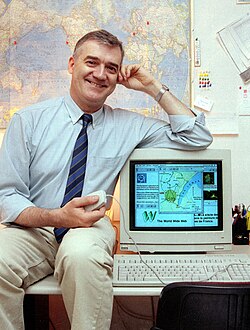
The ACM Web Conference (formerly known as International World Wide Web Conference, abbreviated as WWW) is a yearly international academic conference on the topic of the future direction of the World Wide Web. The first conference of many was held and organized by Robert Cailliau in 1994 at CERN in Geneva, Switzerland. The conference has been organized by the International World Wide Web Conference Committee (IW3C2), also founded by Robert Cailliau and colleague Joseph Hardin, every year since.[1] In 2020, the Web Conference series became affiliated with the Association for Computing Machinery (ACM),[2] where it is supported by ACM SIGWEB. The conference's location rotates among North America, Europe, and Asia and its events usually span a period of five days. The conference aims to provide a forum in which "key influencers, decision makers, technologists, businesses and standards bodies" can both present their ongoing work, research, and opinions as well as receive feedback from some of the most knowledgeable people in the field.[1]
The web conference series is aimed at providing a global forum for discussion and debate in regard to the standardization of its associated technologies and the impact of said technologies on society and culture. Developers, researchers, internet users as well as commercial ventures and organizations come together at the conference to discuss the latest advancements of the Web and its evolving uses and trends, such as the development and popularization of the eTV and eBusiness.[3] The conferences usually include a variety of events, such as tutorials and workshops, as well as the main conference and special dedications of space in memory of the history of the Web and specific notable events.[4] The conferences are organized by the IW3C2 in collaboration with the World Wide Web Consortium (W3C), Local Organizing Committees, and Technical Program Committees.[5]
History
[edit]Robert Cailliau, a founder of the World Wide Web himself, lobbied inside CERN and at conferences like the Hypertext 1991 in San Antonio, Texas, and Hypertext 1993 in Seattle, Washington.[6] As he came back from the conference 1993 he announced a new conference called World Wide Web Conference 1 and was actually 23 hours faster than the NCSA announced Mosaic and the Web.[6] After founding the IW3C2 with Joseph Hardin from the NCSA they decided the next Conferences in Geneva.[6]
Content
[edit]Though the way in which its content is organized varies from year to year, the World-Wide Web Conference continues to call itself the "premiere venue for researchers, academics, businesses, and standard bodies to come together and discuss [the] latest updates and the state and evolutionary path of the Web".[7] People from all across the world come together and submit their own new research to be peer-reviewed by some of the World Wide Web community's most knowledgeable members.
At the 2014 conference, WWW's largest program, peer-reviewed research paper presentations, fell into one of eleven categories:
- Behavioral analysis and personalization
- Content analysis
- Crowd phenomena
- Internet economics and monetization
- Security, privacy, trust and abuse
- Semantic web
- Social networks and graph analysis
- Software infrastructure, performance, scalability, and availability
- User interfaces, human factors, and smart devices
- Web mining
- Web search systems and applications
Those papers accepted were to be presented at the conference itself, and appear in the online conference proceedings published by the ACM Digital Library as well as the conference's website. Furthermore, many of these papers are submitted to other peer-reviewed journals after the conference.[7]
In addition to presenting breakthrough research on the Web and its associated technologies, the Conference acts as a stage for developers to demonstrate and receive feedback on their ongoing work in a dedicated session. The Demo Track allows researchers and practitioners to demonstrate new systems in a dedicated session. The Developer Track is a track dedicated solely to web development, a stage upon which web developers can present "new trends and interesting ideas [as well as the] code and APIs of emerging applications, platforms, and standards."[8]
Though peer-reviewed research paper presentations, demo, and developer tracks are a large portion of the conference's program, it is not merely a launch pad for individuals who have completed cutting-edge research in the field. Students studying the Web and its associated technologies can submit unfinished work for review. Beginner as well as senior PhD students are encouraged to present their ideas to the PhD Symposium for review. This is a unique opportunity to receive feedback on their work from experienced researchers as well as other senior PhD students working in related research areas. All applications and submissions are looked over by the Symposium Program Committee. This committee includes other experienced researches. These people are able to help the applicants and guide them in their work.[9] Researchers and practitioners are also encouraged to submit their new and innovative work-in-progress. Providing them with a unique opportunity to gain feedback from their peers in an informal setting, the Poster Track provides its presenters invaluable feedback from knowledgeable sources as well as other conference attendees with an opportunity to learn about novel ongoing research projects whose results already appear promising, despite their incompletion.[10]
Lastly, the Conference allows for a series of co-located workshops to its attendees dedicated to emergent Web topics. These workshops work to not only create an open dialogue amongst all researchers and practitioners of Web technologies but also a potential means of collaboration in present and future endeavors.[10]
List of conference editions
[edit]Past and future conferences include:[11]


See also
[edit]References
[edit]- ^ a b "Past and Future Conferences". Archived from the original on 10 November 2016. Retrieved 22 January 2011.
- ^ "ACM SIGWEB to Sponsor and Organize Leading International Web Conference Series". ACM. Retrieved 9 July 2022.
- ^ "Ninth International World Wide Web Conference Opens Today: Latest Developments in Trend-Setting Technologies Revealed". Business Wire. 15 May 2000. Retrieved 19 March 2014.
- ^ "Web Inventor Tim Berners-Lee to Keynote; Premier International World Wide Web Conference" (Document). Business Wire. 19 April 1999. ProQuest 446691129.
- ^ "International World Wide Web Conference, 28th March - 1st April 2011, Hyderabad, India". Www2011india.com. Retrieved 19 September 2011.
- ^ a b c Petrie, Charles; Cailliau, Robert (November 1997). "Interview Robert Cailliau on the WWW Proposal: "How It Really Happened."". Institute of Electrical and Electronics Engineers. Archived from the original on 6 January 2011. Retrieved 18 August 2010.
- ^ a b "Call for Research Papers" (PDF).
- ^ "Call for Papers- Demo Track" (PDF).
- ^ "The 23rd International World Wide Web Conference: Call for PhD Symposium" (PDF).
- ^ a b "Call for Workshop" (PDF).
- ^ "Past and Future Conferences". IW3C2. Archived from the original on 10 November 2016. Retrieved 26 November 2012.
- ^ 25th World Wide Web Conference - Home.
- ^ International World Wide Web Conferences Committee.
External links
[edit]

The Web Conference
View on GrokipediaHistory
Founding and Initial Conferences (1994–2000)
The International World Wide Web Conference series originated with the efforts of Robert Cailliau, a CERN computer scientist who collaborated with Tim Berners-Lee on early Web development, to convene researchers and developers following the public release of Web technologies in 1993.[4] Cailliau organized the inaugural First International Conference on the World-Wide Web (WWW1), held from May 25 to 27, 1994, at CERN in Geneva, Switzerland.[4] The event attracted 380 participants from around the world, selected from 800 applicants, and featured presentations on Web architecture, hypertext systems, and networked information tools.[4] In response to the rapid interest generated by WWW1, a second conference, titled "Mosaic and the Web," occurred later that year from October 17 to 20, 1994, in Chicago, Illinois, co-organized by CERN, the National Center for Supercomputing Applications (NCSA), and the Open Software Foundation.[5] This gathering emphasized the Mosaic browser's role in popularizing the Web and marked the beginning of annual events, except for an additional conference in 1995. To formalize the series' governance, Cailliau and Joseph Hardin founded the International World Wide Web Conference Committee (IW3C2) in August 1994, which assumed responsibility for subsequent conferences.[2] Under IW3C2 oversight, the early conferences expanded in scope and attendance, rotating locations to foster global participation while focusing on technical advancements in Web protocols, applications, and infrastructure. The third conference (WWW3) took place April 10–12, 1995, in Darmstadt, Germany, followed by WWW4 from December 11–14, 1995, in Boston, Massachusetts. Subsequent editions included WWW5 (May 6–10, 1996, Paris, France), WWW6 (April 7–11, 1997, Santa Clara, California), WWW7 (April 20–25, 1998, Brisbane, Australia), WWW8 (May 11–14, 1999, Toronto, Canada), and WWW9 (May 15–19, 2000, Amsterdam, Netherlands).[5]| Edition | Dates | Location |
|---|---|---|
| WWW1 | May 25–27, 1994 | Geneva, Switzerland[5] |
| WWW2 | October 17–20, 1994 | Chicago, USA[5] |
| WWW3 | April 10–12, 1995 | Darmstadt, Germany[5] |
| WWW4 | December 11–14, 1995 | Boston, USA[5] |
| WWW5 | May 6–10, 1996 | Paris, France[5] |
| WWW6 | April 7–11, 1997 | Santa Clara, USA[5] |
| WWW7 | April 20–25, 1998 | Brisbane, Australia[5] |
| WWW8 | May 11–14, 1999 | Toronto, Canada[5] |
| WWW9 | May 15–19, 2000 | Amsterdam, Netherlands[5] |
Expansion and Institutionalization (2001–2017)
During this period, the International World Wide Web Conference series, managed by the IW3C2, expanded significantly in scope and participation, reflecting the maturing Web ecosystem. Conferences rotated systematically among Asia-Pacific, Europe, and the Americas, fostering international collaboration; for instance, WWW10 occurred in Hong Kong (May 1–5, 2001), WWW11 in Honolulu (May 6–11, 2002), WWW12 in Budapest (May 20–24, 2003), and continued through WWW26 in Perth (April 3–7, 2017).[5] This rotation, established earlier, solidified by the 2000s, ensured diverse hosting by academic and institutional partners, such as the University of Hawaii for WWW11, ACM for WWW13 in New York (May 17–22, 2004), and KAIST for WWW23 in Seoul (April 7–11, 2014).[5] Attendance grew notably, with WWW11 drawing over 900 participants from around the world.[6] The research program professionalized, with proceedings consistently published through ACM starting with WWW10, enhancing archival stability and visibility.[7] Paper submissions and acceptances increased, indicating rising academic interest; 78 full papers were accepted at WWW10, rising to 230 at WWW16 (Banff, May 8–12, 2007) and 241 at WWW19 (Raleigh, April 26–30, 2010), though acceptance rates remained competitive at 11–17% by the 2010s.[7] By WWW26, submissions exceeded 1,000 annually, with 170 papers accepted, underscoring the conference's selectivity amid growing volume.[7] Tracks expanded to cover emerging Web technologies, supported by diverse sponsors including universities, tech firms, and local governments. IW3C2's governance provided continuity, with the non-profit—incorporated under Swiss law—overseeing operations, ethics, and code of conduct enforcement.[2] Partnerships deepened, as seen in co-hosting arrangements (e.g., North Carolina State University and UNC Chapel Hill for WWW19) and integration of companion volumes into main proceedings between WWW15 and WWW19.[7] This era marked institutional maturation, transitioning from nascent gatherings to a premier venue for Web research, though IW3C2's direct management persisted until later transitions.[8]Rebranding and Contemporary Developments (2018–Present)
In 2018, the conference series, previously known as the International World Wide Web Conference (WWW), underwent a rebranding to The Web Conference, coinciding with its 27th edition held in Lyon, France, from April 23 to 27.[1] This change aimed to encompass a broader scope of web-related research beyond the original WWW acronym, while maintaining the event's focus on advancing web technologies, standards, and applications.[9] The rebranding was accompanied by updated branding elements, including a new logo designed for the Lyon event.[10] The period from 2018 onward saw adaptations to global challenges, particularly the COVID-19 pandemic, which prompted a shift to virtual formats for the 2020 edition (April 20–24, fully online), the 2021 edition (April 19–23, fully online), and the 2022 edition (April 25–29, hybrid with virtual primary access hosted from Lyon, France).[1] These virtual iterations enabled continued participation amid travel restrictions, with the 2022 event receiving 1,822 long paper submissions.[11] Post-pandemic, the conference returned to in-person gatherings, including the 2023 edition in Austin, Texas (April 30–May 4), the 2024 edition in Singapore (May 5–9), and the 2025 edition in Sydney, Australia (April 28–May 2).[12] A significant organizational shift occurred in 2022, when the conference integrated into the Association for Computing Machinery's Special Interest Group on Hypertext, Hypermedia, and the Web (ACM SIGWEB), ending the prior rotational hosting model across the Americas, Europe, and Asia-Pacific regions.[13] Management transitioned to a new ACM Web Conference Steering Committee, with ACM SIGWEB assuming responsibility for operations starting that year.[14] Concurrently, the International World Wide Web Conference Committee (IW3C2), which had overseen the series since 1994, amended its bylaws to focus solely on administering award funds, ceasing all other activities on April 30, 2025, after transferring award management to ACM SIGWEB.[2] This evolution positioned the conference under ACM's established framework for scholarly events, ensuring continuity in peer-reviewed proceedings published via the ACM Digital Library.[15]Organization and Governance
Founding Bodies and Evolution
The International World Wide Web Conference Committee (IW3C2) serves as the primary founding and governing body for The Web Conference series. Established by Robert Cailliau and Joseph Hardin on August 14, 1994, during a meeting in Boston, United States, the IW3C2 was created to organize and oversee the annual conferences following the inaugural event held in Geneva, Switzerland, in May 1994, which Cailliau had coordinated at CERN.[2] The committee was formally incorporated as a non-profit organization in May 1995 to ensure sustained management of the conference's direction, funding, and international coordination.[2] From its inception, the IW3C2 has maintained stewardship of the conference, collaborating with local organizers for each edition while enforcing consistent standards for submissions, peer review, and program development. This structure has allowed the series to expand globally, with events hosted in various countries, but under centralized governance to preserve focus on web technologies and their societal implications. The committee's evolution has emphasized long-term stability, with membership comprising experts in web-related fields who guide strategic decisions, including venue selection and thematic priorities.[1][8] In 2017, the IW3C2 initiated a rebranding of the conference from the "International World Wide Web Conference" (commonly abbreviated as WWW) to "The Web Conference," effective for the 2018 edition in Lyon, France, to better reflect the event's broadened scope beyond technical origins to contemporary web ecosystem challenges. This change did not alter the underlying governance but aimed to enhance accessibility and relevance amid the web's maturation. The IW3C2 continues to operate as the steering entity, adapting to digital shifts such as hybrid formats post-2020 while upholding its foundational mission of fostering open web advancements.[1][16]Current Structure and Affiliations
The Web Conference is managed by the Association for Computing Machinery (ACM) through its Special Interest Group on Hypertext, Hypermedia, and Web (SIGWEB), which assumed oversight of the conference series in 2022.[1][3] This transition marked a shift from the previous model under the International World Wide Web Conferences Committee (IW3C2), a non-profit organization registered in Switzerland that had organized the event since its inception in 1994.[2] Under ACM SIGWEB, the conference proceedings are published in the ACM Digital Library with open access maintained for all articles, preserving the series' commitment to broad dissemination of research.[13] The ACM Web Conference Steering Committee provides strategic governance, including selection of venues, thematic directions, and maintenance of historical archives from the IW3C2 era.[2] IW3C2 ceased operations as an independent association on April 30, 2025, transferring responsibility for endowment funds—used to support awards such as the Seoul Test of Time Award recognizing influential past papers—to ACM SIGWEB.[1] This dissolution ended IW3C2's direct role, though its foundational contributions to the conference's structure remain embedded in the series' legacy. Each annual edition features a localized organizing committee, comprising roles like general chairs, program chairs, and industry chairs, often drawn from hosting institutions or prominent academic and industry figures. For instance, the 2025 conference in Sydney, Australia, is hosted by the Faculty of Engineering and IT at the University of Technology Sydney, with general chairs Tat-Seng Chua and Chong-Wah Ngo, and program chairs Ravi Kumar and Hady W. Lauw.[12] Venue selection no longer follows a fixed America-Europe-Asia-Pacific rotation, allowing flexibility based on bids and logistical factors.[1] Affiliations extend to collaborations with local academic hosts and industry partners, but core governance remains centralized under ACM SIGWEB to ensure consistency in peer review, open access, and global participation.[3]Leadership and Steering Mechanisms
The International World Wide Web Conferences Steering Committee (IW3C2) functioned as the principal governing entity for the conference series from 1994 to 2022, handling strategic decisions such as venue selection, program oversight, and financial administration.[2] IW3C2 was established in August 1994 by Joseph Hardin and Robert Cailliau to organize the inaugural event at CERN and ensure the series' continuity, with formal incorporation as a Swiss non-profit association occurring in May 1996.[2] Membership in IW3C2 consisted of elected experts from academia, industry, and standards bodies, typically numbering around 10-15 active participants, who collectively steered the conference's direction while collaborating with local organizers for each annual iteration.[17] The IW3C2's leadership was structured around an Executive Board, including a Chair responsible for overall coordination, one or more Vice Chairs assisting in operations and succession, a Secretary managing administrative records and communications, and a Treasurer overseeing budgets and endowments derived from conference surpluses.[17] This board met periodically to approve proposals for hosting, enforce ethical guidelines on submissions and conflicts of interest, and allocate funds for initiatives like student grants and awards, such as the Test of Time Award introduced in later years.[2] In its final configuration before transition, Wendy Hall of the University of Southampton served as Chair, Chin-Wan Chung of KAIST as Vice Chair, Laurent Flory of Université de Lyon as Secretary, and Luc Mariaux as Treasurer.[17] In 2022, IW3C2 revised its by-laws to relinquish direct conference management, transferring authority to the Association for Computing Machinery (ACM) and its Special Interest Group on Hypertext, Hypermedia, and Web (SIGWEB).[1] This shift aligned the series with ACM's established frameworks for peer-reviewed events, emphasizing reproducibility, open access, and integration with ACM's digital library.[1] The ACM Web Conference Steering Committee subsequently assumed governance duties, maintaining continuity in core mechanisms like multi-stage peer review and thematic track development while adapting to ACM's bylaws on inclusivity, financial transparency, and conflict-of-interest policies.[1] IW3C2 formally ceased operations on April 30, 2025, retaining responsibility only for archival maintenance under ACM oversight and the stewardship of legacy award endowments now administered by SIGWEB.[1] This evolution reflects a broader trend in academic computing conferences toward affiliation with professional societies for enhanced institutional stability and resource access.[2]Scope and Research Focus
Core Topics and Tracks
The research tracks of The Web Conference constitute the primary venue for peer-reviewed contributions advancing the understanding, evaluation, and improvement of the Web across technical, socio-economic, and societal dimensions.[18] These tracks emphasize empirical analysis of Web-scale systems, algorithmic innovations, and interdisciplinary applications, with a recurring focus on integrating artificial intelligence techniques such as large language models into Web technologies.[19] Typical submissions address challenges in scalability, data quality, and ethical deployment, drawing from datasets and methodologies specific to Web environments like search logs, graph structures, and user interactions.[20] Key research tracks include:- Economics of the Web: Examines economic models for Web platforms, including advertising auctions, marketplace design, and the impacts of generative AI on labor markets and sustainability. Topics often involve game-theoretic analyses of platform fairness and AI-driven annotation versus human efforts.[20]
- Graphs and Web Data: Focuses on algorithms for large-scale Web graphs, including embeddings, neural representations, and querying techniques for link prediction and anomaly detection. This track advances foundational methods for modeling interconnected Web data.[20]
- Responsible Web: Addresses accountability in algorithms, mitigation of misinformation, privacy-preserving designs, and governance frameworks to promote fairness and sustainability. It prioritizes audits of Web technologies for bias and inclusivity.[20]
- Search and Mining: Covers Web search ranking, query understanding, retrieval-augmented generation, and multilingual information retrieval. Emphasis is placed on evaluation metrics and models that handle diverse, noisy Web data.[20]
- Security and Privacy: Explores cryptographic protocols, authentication mechanisms, blockchain applications, and countermeasures against tracking or AI vulnerabilities. Research often evaluates real-world Web threats through empirical studies.[20]
- Knowledge Graphs: Investigates semantic integration, data modeling, and trust assessment in structured Web knowledge, including applications in search and recommendation systems.[20]
- Social Networks and Web: Analyzes influence propagation, computational social science, and AI's societal effects on platforms, with attention to fairness in network dynamics.[20]
- Web and Mobile Systems: Targets performance optimization, cloud-edge architectures, and energy-efficient mobile Web apps, including AI integrations for smart systems.[20]
- User Modeling and Recommendation: Develops personalized systems with fairness constraints, privacy protections, and LLM-enhanced modeling for search and content delivery.[20]
- Web Mining and Content Analysis: Involves data integration, sentiment extraction, topic modeling, and multimedia processing to improve Web content quality and usability.[20]
Evolution of Thematic Emphasis
The inaugural conferences from 1994 to 1999 emphasized foundational web technologies, including low-level protocols, early applications, and educational efforts to disseminate knowledge about the emerging World Wide Web, with topics like teaching and education featuring prominently in sessions.[7] This period reflected the nascent stage of web development, prioritizing infrastructure and basic dissemination over advanced analytics or applications.[24] By the 2000s, thematic focus shifted toward structured data and interoperability, with XML and the Semantic Web gaining traction—evidenced by multiple dedicated sessions, such as up to five for Semantic Web topics around the early 2000s—alongside performance optimization and web services.[7] Topic modeling of proceedings identifies 1999 as a pivotal year for the rise of searching and data/text mining, marking a transition from core fundamentals to more specialized processing techniques, while XML's prominence began to wane post-2010.[24] The 2010s introduced greater emphasis on user-centric and data-driven themes, including social media, recommendation systems, advertisements, and crowdsourcing, which dominated from 2004–2010 and peaked around 2012–2016, respectively, as detected through latent Dirichlet allocation models on paper abstracts.[24] Concurrently, machine learning, bias and fairness, health-related web applications, and social topics expanded, with social networks reaching up to six sessions by the mid-2010s.[7] Enduring pillars like security/privacy and search maintained consistent coverage across editions, underscoring their foundational relevance amid specialization.[7] In recent years, thematic emphasis has integrated broader computational advances, with emerging areas such as question answering, graph neural networks, and web economics reflecting the web's convergence with artificial intelligence and large-scale data ecosystems, as seen in evolving research tracks.[7] This progression, analyzed via session counts and topic distributions in proceedings, illustrates a trajectory from web infrastructure to interdisciplinary applications, driven by technological maturation and submission trends exceeding 500 papers by 2018.[7][24]Conference Format and Activities
Submission and Review Processes
Submissions to The Web Conference's research tracks are managed through the EasyChair platform, requiring authors to create up-to-date profiles for all listed contributors.[20] Papers must be submitted as a single PDF file limited to eight pages for the main content, with unlimited pages permitted for references and an optional appendix containing supplementary details such as proofs or experimental data.[21] Accepted papers require at least one author to register for the conference and present the work, either orally or as a poster; failure to present results in withdrawal from the proceedings.[21] The review process emphasizes peer evaluation by members of the program committee, assessing submissions on criteria including originality, technical significance, quality of presentation, and clarity.[25] For recent iterations, such as the 2025 conference, the process incorporates OpenReview, where authors consent to the public disclosure of reviews, meta-reviews, and reviewer discussions to promote transparency.[21] While some tracks, like short papers, employ single-blind reviewing, the main research tracks have adopted mechanisms for author rebuttals, allowing brief responses to initial reviews before final decisions.[25][26] This rebuttal phase, introduced in events like the 2023 conference, aims to address potential reviewer misunderstandings without altering the core double-anonymous structure in prior years.[18] Acceptance rates reflect the conference's selectivity, with an overall rate of approximately 23% in recent proceedings, based on 1,899 acceptances from 8,196 submissions.[19] Historical data indicate variability, such as 15% for WWW '18 (170 of 1,155) and around 17-19% in other years like 2019-2020.[19][27] These rates underscore a rigorous filtering, prioritizing novel contributions to web-related fields while excluding works under concurrent peer review at other venues with proceedings.[18]Key Events, Keynotes, and Auxiliary Programs
The Web Conference incorporates keynote speeches as central highlights, delivered by leading researchers and innovators to explore forward-looking themes in web technologies, data science, and societal implications. These sessions, typically spanning 45-60 minutes each and scheduled across the primary conference days, aim to inspire attendees and contextualize research trends; for example, the 2024 program featured a keynote on "Challenges toward AGI and its impact to the Web," examining advancements in large language models and their prospective effects on web ecosystems.[28] Similarly, the 2023 edition included addresses by figures such as Bob Metcalfe, inventor of Ethernet, and David Rand on topics intersecting psychology and web decision-making.[29] Key events extend beyond keynotes to encompass opening and closing ceremonies, which frame the conference's agenda and recognize achievements, alongside oral paper presentations in themed tracks and poster sessions for interactive dissemination of findings. These elements foster direct engagement, with oral slots allocated 11-12 minutes for presentation plus questions to accommodate rigorous scrutiny.[30] Award ceremonies, such as the Women in Web Award and Test of Time Awards, punctuate the program to honor enduring contributions and emerging talent.[12] Auxiliary programs enrich the core research focus through specialized formats like workshops, tutorials, and symposia, held primarily on pre- and post-main days to enable deeper dives without diluting plenary sessions. Workshops, numbering around 16 per conference, convene researchers and practitioners for collaborative panels and paper discussions on subfields such as web security or semantic technologies, promoting nascent idea incubation.[31] [32] Tutorials, often 20 in count and blending lecture-style overviews with hands-on exercises, deliver practical training on tools like graph neural networks or privacy-preserving algorithms, targeting both novices and experts in the web community.[33] [32] The PhD Symposium provides a dedicated forum for graduate students to showcase dissertation work, receive mentorship from senior faculty, and network, while thematic days—such as Health Day, Web4All for accessibility, or Large Language Model Day—curate interdisciplinary panels and demos addressing applied web challenges like digital health integration or ethical AI deployment.[34] Social and developer events, including receptions and W3C track sessions, further auxiliary aims by facilitating standards discussions and informal collaborations.[29]Attendance and Participation Metrics
The Web Conference has experienced substantial growth in participation metrics since its inception, reflecting the expanding interest in web-related research. Submission volumes have risen dramatically from early editions, where the 2007 conference (WWW2007) received 755 submissions and accepted 111 papers at a 14.7% rate, to recent years with thousands of entries. In 2024, the conference processed 8,196 submissions, accepting 1,899 for an overall rate of 23%.[35][32] Attendance figures, while fluctuating due to format changes such as hybrid and virtual options post-2020, typically range from 900 to over 1,200 participants in recent iterations. The 2022 edition drew more than 1,230 attendees worldwide, including virtual participants. Similarly, the 2021 conference registered 918 participants from 62 countries, with 37% being students, underscoring its appeal to early-career researchers.[36][37] These metrics highlight the conference's role as a premier venue, though exact in-person attendance pre-pandemic likely exceeded these hybrid-era numbers based on venue capacities and historical trends in similar ACM events.[38]| Year | Submissions | Accepted Papers | Acceptance Rate (%) | Attendees |
|---|---|---|---|---|
| 2007 | 755 | 111 | 14.7 | N/A |
| 2021 | N/A | N/A | N/A | 918 |
| 2022 | N/A | N/A | N/A | 1,230+ |
| 2024 | 8,196 | 1,899 | 23 | N/A |
Notable Contributions and Impact
Influential Papers and Technological Advances
One of the most cited contributions from the conference is the 1998 paper "The Anatomy of a Large-Scale Hypertextual Web Search Engine" by Sergey Brin and Lawrence Page, presented at the 7th International World Wide Web Conference (WWW7) in Brisbane, Australia, which outlined the core architecture of the Google search engine, including the PageRank algorithm for ranking web pages based on hyperlink structure.[39] This work demonstrated efficient crawling, indexing, and querying of over 24 million pages using modest hardware, achieving superior relevance over prior engines like AltaVista by leveraging link analysis as a proxy for authority.[40] Subsequent papers advanced web-scale personalization and knowledge representation. At WWW 2007, "YAGO: A Core of Semantic Knowledge" by Fabian M. Suchanek, Gjergji Kasneci, and Gerhard Weikum introduced an automatically constructed ontology integrating Wikipedia, WordNet, and GeoNames, covering over 1 million entities with spatial and temporal dimensions, enabling more precise semantic querying than earlier knowledge bases like DBpedia precursors. The same conference featured "Google News Personalization: Scalable Online Collaborative Filtering" by Abhinandan S. Das et al., describing a system processing millions of user clicks daily to recommend news articles via matrix factorization and clustering, scaling to handle diverse topics without explicit user feedback loops. In social network analysis, the 2010 WWW paper "What Is Twitter, A Social Network or a News Media?" by Haewoon Kwak et al. analyzed 41.7 million tweets from 1.47 million users, revealing Twitter's hybrid structure with low reciprocity but high news diffusion via trending topics, influencing platform algorithms for real-time information propagation. Later works shifted toward deep learning integrations; for instance, the 2017 paper "Neural Collaborative Filtering" by Xiangnan He et al. proposed end-to-end neural models for recommender systems, outperforming traditional matrix factorization on datasets like MovieLens by capturing non-linear user-item interactions. Technological advances from these papers have broadly impacted web infrastructure, including scalable graph embeddings like LINE (2016) for billion-edge networks, enabling efficient link prediction in social graphs. More recent contributions, such as heterogeneous graph neural networks (e.g., HGATN in 2019), have facilitated modeling of diverse web data like user behaviors and knowledge graphs, underpinning modern recommendation engines at platforms like Alibaba and Amazon.[41] These developments underscore the conference's role in transitioning web technologies from rule-based systems to data-driven, AI-augmented frameworks, with cumulative citations exceeding thousands per paper, driving industry adoption in search, e-commerce, and content delivery.[42]Influence on Web Standards and Industry
The Web Conference has functioned as a primary venue for introducing seminal web technologies subsequently adopted across industry. A prominent example is the 1998 presentation of "The Anatomy of a Large-Scale Hypertextual Web Search Engine" by Sergey Brin and Lawrence Page, which detailed the PageRank algorithm for ranking web pages based on hyperlink structure, forming the core of Google's search engine and enabling scalable information retrieval systems used by billions.[43] [32] This work exemplified early dissemination of algorithms that transitioned from academic prototypes to commercial dominance in web search infrastructure.[32] Additional technologies originating from conference papers include the EigenTrust algorithm, proposed in 2003 for computing reputation scores in peer-to-peer networks via eigenvector-based trust propagation, which has informed decentralized trust models in distributed systems and blockchain applications.[32] The YAGO knowledge base, introduced in 2007, integrated Wikipedia and WordNet data into a scalable semantic resource, paving the way for knowledge graphs that underpin modern entity recognition and structured querying in search engines and AI systems.[32] These contributions highlight the conference's pattern of fostering innovations that address real-world scalability challenges in web data management. On standards development, the conference promotes dialogue on web protocols and interoperability through research tracks and dedicated W3C sessions, where advancements in areas like semantic web and hypertext are debated, often seeding formal recommendations by the World Wide Web Consortium.[44] [20] For instance, early editions in the 1990s facilitated partnerships between emerging internet firms and standards bodies, influencing the evolution of core technologies like HTTP and HTML extensions via empirical research on web architecture.[45] Industry engagement is amplified via the dedicated Industry Track, which since its inception has showcased deployable systems, trade-offs in production environments, and outcomes from high-volume web operations, bridging theoretical research with practical adoption by firms like Amazon and Google.[22] [46] This track has driven technology transfer, as evidenced by presentations on large-scale deployments that inform optimizations in content delivery networks, recommendation engines, and privacy-preserving analytics, contributing to the web's commercial ecosystem.[47]Academic and Broader Societal Effects
The Web Conference has profoundly shaped academic research in web science, serving as a primary venue for pioneering work in areas such as information retrieval, web mining, and semantic technologies. Seminal papers presented there, including the 1998 introduction of the PageRank algorithm in "The Anatomy of a Large-Scale Hypertextual Web Search Engine" by Sergey Brin and Lawrence Page, have garnered over 13,000 citations, influencing foundational studies in search algorithms and graph-based ranking across computer science disciplines.[48] Proceedings from the conference, published by ACM, consistently rank among high-impact outlets, with topics evolving to address empirical analyses of web-scale data and machine learning applications, thereby directing doctoral theses, grant funding, and interdisciplinary collaborations in fields like artificial intelligence and data science.[32] In academia, the conference's rigorous peer-review process and focus on reproducible research have elevated standards for web-related empirical studies, promoting methodologies that integrate large-scale datasets with causal inference techniques to model web ecosystems. For instance, analyses of accepted papers reveal a shift toward addressing algorithmic biases and network dynamics, which have informed curricula in over 200 universities worldwide offering web science programs, as evidenced by citations in educational resources and subsequent publications.[49] This has fostered a subfield of web science, blending computer science with social sciences, where conference outputs contribute to metrics like h-index values for researchers exceeding 50 in web domains, underscoring its role in career advancement and knowledge dissemination.[50] Beyond academia, the conference has catalyzed societal discourse on the web's role in equity and governance through dedicated tracks like Web4Good, which examine technologies' contributions to UN Sustainable Development Goals, including mitigation of misinformation's effects on vulnerable populations and algorithmic impacts on social cohesion.[51] Research presented, such as studies on social bots and hate speech propagation, has informed policy frameworks by providing empirical evidence on digital harms, with findings cited in reports by organizations addressing online platform accountability since the early 2010s.[52] By highlighting the web's socio-economic dimensions, including access democratization and cultural shifts, the event has indirectly influenced public awareness campaigns and regulatory debates on data privacy, though critiques note that academic outputs often prioritize technical efficacy over immediate societal implementation.[21]Reception, Criticisms, and Challenges
Prestige and Metrics of Success
The Web Conference maintains high prestige within computer science, particularly in web technologies, data mining, and information retrieval, as evidenced by its selective peer-review process and sustained influence on subsequent research. Acceptance rates, a common metric for conference rigor, have historically hovered between 15% and 23%, signaling intense competition among submissions. For example, the 2018 edition accepted 170 papers from 1,155 submissions (15%), while the 2024 event accepted 1,899 from 8,196 (23%).[32] Earlier years show similar selectivity, with 2019 at 18% (225 from 1,247) and 2020 at 19.4% (219 from 1,129).[27] Lower acceptance rates correlate with higher perceived quality and impact in computer science venues, as they filter for novel, empirically robust contributions amid growing submission volumes.[53][54]| Year | Submissions | Accepted Papers | Acceptance Rate |
|---|---|---|---|
| 2018 | 1,155 | 170 | 15% |
| 2019 | 1,247 | 225 | 18% |
| 2020 | 1,129 | 219 | 19.4% |
| 2024 | 8,196 | 1,899 | 23% |