


Community hub
Recent from talks
Contribute something
Nothing was collected or created yet.
DLF (company)
View on Wikipedia
 | A major contributor to this article appears to have a close connection with its subject. (April 2025) |
DLF Limited (formerly Delhi Land & Finance) is an Indian commercial real estate development company. It was founded by Chaudhary Raghvendra Singh in 1946, and it is based in New Delhi, India.[2][3] DLF has developed residential colonies in Delhi such as Model Town, Rajouri Garden, Krishna Nagar, South Extension, Greater Kailash, Kailash Colony, and Hauz Khas. DLF builds residential, office, and retail properties.[4][5]
Key Information


With the passage of the Delhi Development Act in 1957, the local government assumed control of real estate development and banned private real estate developers from Delhi proper. As a result, DLF began acquiring land at a relatively low cost outside the area controlled by the Delhi Development Authority, in the district of Gurgaon, and in the adjacent state of Haryana. In the mid-1970s, the company started developing their DLF City project at Gurgaon. This included hotels, infrastructure, and special economic zones-related development projects.
The company is headed by Rajiv Singh, who is the current chairman of the DLF Group. According to the Forbes listing of richest billionaires in 2023, Kushal Pal Singh, Chairman Emeritus, is the 19th richest man in India with a net worth of US$8.8 billion. The company's $US$2 billion IPO in July 2007 was India's biggest IPO in history.[6] In its first quarter results for the period ending 30 June 2007, the company reported a turnover of ₹31.2098 billion (US$370 million) and profit after taxes of ₹15.1548 billion (US$180 million).[7]
As of 31 March 2012, the company had 1,380 square feet of leased retail space across the country.[8] In 2013–14, it leased out 3 million sq ft of office space in India.[9][10]
History
[edit]DLF's first residential project was Krishna Nagar in East Delhi, which was completed in 1949. Subsequently, the company developed 21 colonies in Delhi, including Model Town, Rajouri Garden, Punjabi Bagh, South Extension, Greater Kailash, Kailash Colony and Hauz Khas. The passage of Delhi Development Act in 1957 was the first serious challenge to company's growth. The Act meant that the government would assume control of all real estate development activities in the city.[11]
As a result, DLF decided to move beyond Delhi and focused on the suburb of Gurgaon in Haryana,[12] which had the potential for development of residential and commercial properties. As DLF started to acquire land under the leadership of Chairman K.P. Singh, Gurgaon embarked on a period of rapid growth.[13]
A ₹58 crore deal was cancelled between DLF and Robert Vadra by IAS officer Ashok Khemka.[14]
Sponsorship
[edit]In 2008, DLF became the title sponsor of the Indian Premier League, a newly formed Twenty20 cricket league. DLF paid close to ₹2 billion (US$24 million) for the five-year sponsorship deal.[15] The deal ended in the 2012 version of the season, wherein it was taken over by PepsiCo.
Beyond buildings
[edit]Haryana Urban Development Authority (HUDA) and DLF, in a 50:50 joint venture, have completed work on a 16-lane, 10.5 km road network in Gurgaon. This stretch from NH8 Toll Plaza to Sector 55/56 in Gurgaon with six underpasses, one flyover and freeways has improved traffic management in the city.[16] To create this infrastructure facility, DLF had engaged Parsons Brinckerhoff for project management consultancy and construction work had been awarded to IL&FS.[17]
Controversies
[edit]In August 2011, a penalty of ₹6.3 billion (US$75 million) was imposed on DLF by the Competition Commission of India (CCI)[18] after finding DLF guilty of breaching laws regarding the unfair pricing of goods and services. The complaint was lodged against DLF by buyers in its residential projects Belaire & Park Place, located in Gurgaon.[19] In February 2015, the CCI ordered its investigative arm to probe two more projects of DLF in Gurgaon, namely, DLF Regal Gardens[20] and DLF Skycourt.[21][22]
DLF land grab case pertains to the alleged illegal acquisition of 50 acres of land in Amipur village, Haryana, back in 2013, during Bhupinder Singh Hooda's tenure as Chief Minister under the Congress government. This matter has led to an investigation by the Central Bureau of Investigation involving Robert Vadra, Bhupinder Singh Hooda, and the DLF, as of around December 2017.[23] DLF fined for late possession of flat in Kakkanad[24]
Constructed buildings
[edit]
-
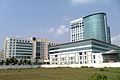 DLF IBM Kolkata (Tech Park)
 -
 DLF IT Tech Park (IBM Kolkata)
 -
 DLF Cybercity Chennai
 -
 DLF Epitome Tower, Gurugram
 -
 DLF Cyber City, Gurgaon


References
[edit]- ^ "Stock share price of DLF Limited" (PDF). BSE India.
- ^ "DLF: Leading Real Estate Company in India". www.dlf.in. Archived from the original on 7 May 2014. Retrieved 8 April 2014.
- ^ "DLF Ltd" (PDF). Archived from the original (PDF) on 1 November 2010. Retrieved 17 July 2010.
- ^ Sekar, Sunitha (21 March 2013). "DLF residents list litany of broken promises". The Hindu. Chennai, India.
- ^ Reddem, Appaji (25 January 2014). "DLF demand may put State in a fix". The Hindu. Chennai, India.
- ^ IndianExpress.com :: Is India's largest IPO going to change the Sensex stakes?.
- ^ "DLF seeks land allotted to Gaming City in Hyderabad". thehindubusinessline.com.
- ^ "DLF Ltd (DLF.NS)". Reuters. Retrieved 23 March 2013.
- ^ "DLF leased 3 million sq ft office space in 2013-14". IANS. news.biharprabha.com. Retrieved 24 April 2014.
- ^ "StanChart GBS leases 7.7 lakh sq-ft at DLF's Chennai project for office campus". The Financial Express. 22 October 2020. Retrieved 25 October 2020.
- ^ "The story behind DLF's success".
- ^ "DLF's KP Singh: Meet the man who built Gurgaon out of nothingness". The Times Of India. 15 October 2014. Archived from the original on 17 October 2014.
- ^ ([1])
- ^ "58-crore deal between DLF and Robert Vadra cancelled by IAS officer Ashok Khemka". ndtv.com.
- ^ "#98 Kushal Pal Singh - The World's Billionaires 2009". Forbes.com. 13 February 2009. Retrieved 21 January 2010.
- ^ "Haryana CM inaugurates DLF-HUDA flyover". Business Standard India. Press Trust of India. 11 April 2015 – via Business Standard.
- ^ "DLF, HUDA to jointly build 16-lane corridor in Gurgaon". www.infrawindow.com. Archived from the original on 12 July 2012.
- ^ "DLF hit with 6.3 billion rupees anti-competition fine". Reuters. 16 August 2011. Archived from the original on 6 March 2016. Retrieved 23 January 2015.
- ^ "Main Order: Informants Belaire Owners Association vs DLF & Ors" (PDF). Competition Commission of India. Archived from the original (PDF) on 24 February 2015. Retrieved 23 January 2015.
- ^ "DLF Regal Gardens".
- ^ "DLF Skycourt".
- ^ "CCI orders fresh probe against DLF". The Hindu. Retrieved 15 February 2015.
- ^ "Manesar land scam: Long battle awaits Bhupinder Singh Hooda as shady deals return to haunt former Haryana CM". Firstpost. 4 February 2018. Retrieved 29 October 2023.
- ^ Dixit, Sweta (23 August 2025). "DLF told to pay buyer for late flat handover in Kakkanad". Estate News. Retrieved 28 August 2025.
External links
[edit]
| International | |
|---|---|
| National | |
| Other | |

DLF (company)
View on GrokipediaDLF Limited is an Indian real estate development company founded in 1946 by Chaudhary Raghvendra Singh and headquartered in Gurugram, Haryana.[1] The company, originally known as Delhi Land & Finance, initially focused on developing urban colonies in Delhi to house families displaced by the 1947 partition of India.[1] It has since expanded into comprehensive real estate operations, including residential homes, commercial offices, retail spaces, and hospitality projects, delivering over 32.63 million square meters of development across India.[2] DLF pioneered large-scale planned development in areas like Gurugram, transforming agricultural land into modern urban hubs with integrated townships, IT parks, and luxury housing.[1] Under the leadership of Chairman Kushal Pal Singh and subsequent executives, the company grew its annuity-based office leasing business significantly, from INR 15.5 million in monthly rentals in 2007 to INR 29,000 million by 2019.[1] As India's largest publicly listed real estate firm by market capitalization, DLF operates in 15 states and 24 cities, emphasizing end-to-end involvement from land acquisition to construction and sales.[3] In fiscal year 2024, it reported revenue of approximately 79.94 billion Indian rupees, reflecting sustained growth in the sector.[4]
Company Profile
Founding and Evolution
DLF Limited, originally known as Delhi Land & Finance, was established in 1946 by Chaudhary Raghvendra Singh during the pre-independence era of India.[1] Chaudhary Raghvendra Singh, a graduate of St. Stephen’s College and former Indian Army Major awarded the Member of the Order of the British Empire (MBE), focused the company's initial efforts on urban development to address housing shortages, particularly for families displaced by the 1947 Partition of India.[1] The firm developed 22 residential colonies in Delhi, including early projects like Krishna Nagar completed in 1949, which laid the foundation for its reputation in planned community building.[1] In 1961, Kushal Pal Singh, Chaudhary Raghvendra Singh's son-in-law, transitioned from an Indian Army posting to join DLF, eventually assuming leadership amid the company's challenges in the late 1970s.[5] Under his stewardship as Chairman, DLF shifted toward large-scale, integrated township development, marking a pivotal evolution from localized residential projects to visionary urban planning.[1] A key milestone occurred in 1985 when DLF expanded beyond Delhi into the underdeveloped village of Gurgaon (now Gurugram) in Haryana, acquiring land to create DLF City—a self-sustained hub blending residential, commercial, and retail spaces that attracted multinational corporations and catalyzed regional economic growth.[1] The company's trajectory accelerated in the post-liberalization period, diversifying into commercial real estate, IT parks, and hospitality while emphasizing sustainability and infrastructure.[1] Following its 2007 initial public offering (IPO), DLF delivered over 10.4 million square meters of development under Chairman Rajiv Singh, who succeeded in 2007 and expanded the annuity business from INR 15.5 million in 2007 to INR 29,000 million by 2019 through strategic asset management and national expansion.[1] Today, DLF operates as India's leading real estate developer, with a portfolio spanning 15 states and 24 cities, prioritizing technology-driven projects and community-oriented growth while navigating regulatory reforms like the Real Estate (Regulation and Development) Act of 2016.[1]Leadership and Ownership
DLF Limited is led by Rajiv Singh, who serves as Executive Chairman and has over 35 years of experience in real estate development, including significant contributions to growing the company's rental income from INR 15.5 million in 2007 to INR 29,000 million in 2019.[1] Rajiv Singh, son of longtime leader Kushal Pal Singh, assumed the chairman role following his father's transition to Chairman Emeritus.[1] [6] The company's operational leadership includes Devinder Singh as Managing Director, Chief Executive Officer, and Whole Time Director, focusing on strategic execution across residential and commercial segments.[6] [1] Ashok Kumar Tyagi serves as Co-Managing Director, overseeing key business functions.[6] Kushal Pal Singh, who expanded DLF from its early Delhi colonies into a national developer over four decades, retains influence as Chairman Emeritus.[1] Ownership remains concentrated in the promoter group, primarily controlled by the Singh family through entities such as DLF Power Limited and family trusts, holding 74.1% of the company's equity shares as of September 2025.[7] [8] This stake provides stable control, with no promoter shares pledged or encumbered.[7] Public and institutional shareholders, including foreign institutional investors at around 16%, hold the remaining equity.[7]Business Model and Segments
DLF Limited employs a diversified real estate business model centered on land acquisition, project development, sales, and asset leasing to generate both cyclical development income and stable annuity streams. The company prioritizes premium and luxury segments to leverage high margins and brand equity, while maintaining a pipeline of approximately 36 million square feet with an estimated sales potential of ₹36,000 crore as of FY24. Revenue streams include new bookings from residential sales, collections from ongoing projects, and recurring rentals from commercial properties, supported by efficient cash management that yielded a net cash positive position of ₹1,547 crore in FY24.[9] The primary segment is residential development under the Homes strategic business unit (SBU), targeting super luxury, luxury, and mid-income housing through apartments, plotted developments, and townships. This segment drove FY24 new sales bookings of ₹14,778 crore, representing about 82% from new product launches, with collections totaling ₹8,655 crore. DLF's approach emphasizes calibrated supply in high-demand micro-markets like Gurugram and Mumbai to sustain demand amid economic cycles.[9][10] Commercial operations, largely through subsidiary DLF Cyber City Developers Limited (DCCDL), focus on office leasing in integrated townships, IT parks, and special economic zones, generating ₹4,325 crore in rental income for FY24, a 9% year-over-year increase. The 44 million square foot operational portfolio underscores a shift toward asset-light leasing for predictable cash flows. Retail involves mall developments like Mall of India in Gurugram, with expansion plans to double presence in 4-5 years, while hospitality and facility management provide supplementary segments, though smaller in scale. Overall consolidated revenue reached ₹6,958 crore in FY24, reflecting 16% growth driven by balanced contributions across development and leasing.[9][1]Historical Development
Inception and Delhi Colonies (1946–1984)
DLF Limited, originally known as Delhi Land & Finance, was established in 1946 by Chaudhary Raghvendra Singh amid the post-Partition influx of migrants seeking housing in India's capital.[1] The company focused on acquiring agricultural land on Delhi's periphery and converting it into planned residential colonies, catering primarily to affluent and aspirational families displaced by the 1947 Partition, who demanded modern amenities like wide roads, parks, and sewage systems absent in government refugee camps.[11] This approach marked one of the earliest private-sector efforts in organized urban real estate development in independent India, emphasizing self-financed plots sold via installment plans to middle-class buyers.[12] The firm's inaugural project was Krishna Nagar in East Delhi, completed in 1949 after acquiring 194 acres of land, which proved commercially successful and set the template for subsequent ventures.[12] Over the next decade, DLF developed approximately 22 such colonies across Delhi, including Shivaji Park, Model Town, Rajouri Garden, Punjabi Bagh, South Extension, Greater Kailash, Kailash Colony, and Hauz Khas, transforming farmland into upscale neighborhoods with plotted developments and basic infrastructure.[13] These projects capitalized on Delhi's rapid urbanization, with DLF often partnering with local landowners and securing approvals from municipal authorities to ensure plotted layouts that appreciated in value.[12] The trajectory shifted in 1957 with the enactment of the Delhi Development Act, which empowered the Delhi Development Authority (DDA) to monopolize land acquisition and planning in the National Capital Territory, effectively prohibiting private developers like DLF from purchasing undeveloped land for housing.[11] [14] This regulatory clampdown, intended to curb speculative holdings and promote equitable development, stalled DLF's Delhi operations, forcing the company to pivot toward leasing existing assets and exploring opportunities outside the capital's restricted zones through the 1960s and 1970s.[13] By 1984, DLF had consolidated its Delhi portfolio into income-generating rentals while preparing for suburban expansion, as urban land scarcity and policy constraints limited further colonial builds within city limits.[12]Expansion into Gurgaon and National Growth (1985–2000)
In 1985, DLF shifted focus from Delhi-constrained developments to Gurgaon, Haryana, initiating plotted developments with its first plot there and consolidating the township project known as DLF City, spanning approximately 3,000 acres.[15][10] This expansion targeted the then-rural region adjacent to Delhi, aiming to create an integrated township featuring residential, commercial, and retail spaces alongside infrastructure such as schools, hospitals, hotels, and malls.[10] The move addressed land acquisition restrictions imposed by the Delhi Development Act of 1957, enabling DLF to pioneer modern urban planning outside the capital.[10] During the 1990s, DLF advanced DLF City's construction with landmark projects, including the completion of Silver Oaks, its first condominium in Gurgaon, in 1993.[15] In 1996, the company constructed DLF Corporate Park, the inaugural office complex within DLF City, and entered group housing initiatives to broaden residential options.[15][10] By 1999, DLF developed a golf course in Gurgaon and began Grade A office space projects, enhancing the area's appeal for professional and commercial use.[15][10] This period marked DLF's strategic pivot toward scalable township models in Gurgaon, laying the foundation for broader national presence, though primary activities remained concentrated in the National Capital Region until the early 2000s.[1] The developments under Chairman K. P. Singh transformed Gurgaon from farmland into an emerging urban hub, attracting global professionals and fostering economic growth in the region.[1] Chaudhary Raghvendra Singh, the founder, oversaw these efforts until his death on June 13, 2000.[1]Post-Liberalization Era and IPO (2001–2010)
In the years following India's economic liberalization, DLF experienced accelerated growth amid a real estate boom fueled by IT sector expansion and urbanization, particularly transforming Gurgaon into a corporate hub. The company leveraged its land bank in Gurgaon to develop integrated townships encompassing residential, commercial, and retail components. By the early 2000s, DLF had established dominance in Grade-A office spaces, with developments like DLF Cyber City opening in 2003 and hosting installations from over 500 companies, including multinational IT firms.[16] DLF diversified beyond residential projects, entering organized retail complexes in 2002 and venturing into hotels and malls in 2003, capitalizing on rising consumer demand and foreign investment inflows post-liberalization. These initiatives aligned with broader economic reforms that eased FDI restrictions in real estate, enabling larger-scale commercial developments. In Gurgaon, DLF's phased expansions, including premium residential enclaves and office parks, attracted global tenants and contributed to the area's skyline transformation during the mid-2000s property surge.[10] A pivotal milestone occurred in 2007 when DLF launched India's largest initial public offering (IPO) to date, issuing 17.50 crore equity shares of Rs. 2 each in a price band of Rs. 500-550, raising approximately Rs. 91.88 billion (about $2.27 billion). The IPO opened on June 11 and closed on June 14, with shares listing on July 5 on the Bombay Stock Exchange and National Stock Exchange, marking DLF's transition to a publicly listed entity and funding further national expansion.[17][18] Post-IPO, DLF reported strong initial results, but the 2008 global financial crisis impacted the sector, leading to stock price declines below the IPO level by mid-2008 amid slowed demand and tighter credit. Despite challenges, the company sustained project pipelines in commercial and special economic zones, positioning for recovery by 2010 as India's economy rebounded.[19]Restructuring and Modern Expansion (2011–Present)
In the early 2010s, DLF Limited confronted substantial debt accumulated from prior expansions, prompting a strategic focus on restructuring to enhance financial stability. By 2011, the company planned to reduce its debt by 25-30 billion rupees (approximately $547-656 million) in the fiscal year through targeted measures.[20] In fiscal 2011-12, DLF raised ₹1,774 crore via divestments of non-core assets, including plots and information technology parks.[21] This was followed by plans to monetize developed properties, such as five IT parks and its hotel business, aiming to generate ₹7,000 crore over the subsequent two years.[22] Restructuring efforts intensified in the mid-2010s, including asset sales and joint venture adjustments to alleviate debt pressures. In 2014, following equity fund-raising, DLF faced imperatives to liquidate assets, including unfinished projects, to service obligations.[23] A notable 2016 agreement with Blackstone restructured shareholding in five land parcels, granting DLF full ownership of two Chennai sites while ceding others in Bengaluru and Goa to the partner.[24] These actions, combined with loan refinancing, progressively lowered net debt from around ₹24,000 crore to approximately ₹14,000 crore by March 2025, prioritizing deleveraging over aggressive growth.[25] With debt levels stabilized, DLF pivoted toward modern expansion, emphasizing premium residential and commercial developments from the late 2010s onward. The company launched luxury housing projects, including ONE Midtown in 2022 and The Arbour in Gurugram's Sector-63.[10] In Q1 fiscal 2025, DLF introduced Privana, selling all 1,164 luxury apartments for about ₹11,000 crore, signaling robust demand.[26] Plans encompass launches worth ₹63,000 crore in the medium term, including a ₹7,500 crore premium project in Gurugram with 1,100 apartments and phases of super-luxury offerings like The Dahlias.[27] [28] Commercial expansion has centered on high-yield rental assets, with investments targeting office and retail spaces. DLF allocated ₹20,000 crore in the medium term to grow its rental portfolio from 44 million to 73 million square feet, including developments in Gurugram, Noida, and Chennai—its second-largest commercial market outside Delhi-NCR.[29] [30] By fiscal 2027, ₹10,000 crore is earmarked for premium offices, malls in Gurugram and Noida, and Chennai complexes, alongside annual ₹5,000 crore outlays in fiscal 2026-27 for rental enhancements.[31] [32] This refocused strategy has yielded strong financial outcomes, with Q1 fiscal 2026 net profit rising 18% to ₹763 crore on 99% revenue growth to ₹2,716 crore, driven by elevated sales bookings up 78%.[33] DLF anticipates 25-30% collections growth to ₹8,128 crore in fiscal 2025, positioning toward a debt-free status and ₹25,000 crore cash surplus while sustaining dividend payouts. [34]Operations and Projects
Residential Developments
DLF's residential developments originated in the post-independence era, with the company constructing 22 urban colonies in Delhi, beginning with Krishna Nagar in East Delhi, completed in 1949.[1] These early projects emphasized planned housing layouts amid rapid urbanization, establishing DLF as a pioneer in organized residential development before regulatory restrictions limited further expansion in Delhi by the 1980s.[35] In 1985, DLF shifted focus to Gurgaon (now Gurugram), initiating Qutab Enclave as its first major project outside Delhi, followed by the expansive DLF City township spanning over 3,000 acres across Phases 1 through 5.[1] [35] This integrated development incorporated residential clusters, including low-rise independent floors in Phase 1 and high-end apartments in later phases, totaling approximately 29 million square feet of residential space by 2007.[35] DLF City Phases, particularly Phase 5, evolved into luxury enclaves with features like golf courses and bespoke villas, catering to high-net-worth individuals and transforming Gurgaon into a premium residential hub.[36] DLF's luxury residential portfolio includes flagship projects such as The Camellias, a 17.5-acre luxury residential project in Sector 42, Gurugram, featuring 429 units across 9 towers—India's first LEED Platinum-certified residential development—with units sold at average prices around ₹70 crore (some exceeding ₹100 crore), offering ultra-high-end apartments, and The Crest, known for its tower-in-tower design emphasizing privacy and amenities.[37][38][3] [39] Other notable developments encompass Ultima in Sector 81, Gurugram, with spacious 4-5 BHK units, and Privana series in Sectors 76-77, featuring plotted developments and mid-to-high-rise residences.[3] [40] In June 2025, Privana North in Sector 77 achieved bookings exceeding ₹11,000 crore within seven days of launch, driven by demand for 4-5 BHK luxury homes in a 116-acre township.[41] Beyond Gurugram, DLF has pursued residential projects in Mumbai (e.g., Andheri West and Parel), Bangalore, and Chandigarh, though Gurugram remains the core with ongoing launches like The Grove and Garden City Enclave offering premium floors and villas.[42] [3] These developments prioritize integrated amenities, green spaces, and security, reflecting DLF's model of large-scale, self-contained townships amid India's urban growth.[2] As of 2025, DLF announced a $4 billion ultra-luxury project near New Delhi, projected for completion in over four years, underscoring continued emphasis on high-end residential inventory.[43]Commercial and Office Spaces
DLF Limited maintains a substantial portfolio of commercial office spaces, emphasizing rental-yielding properties in key urban centers, with approximately 36.4 million square feet of office space as of March 2025.[44] The company's commercial operations prioritize Grade A developments tailored for multinational corporations and IT firms, generating stable revenue through long-term leases.[45] In Gurugram, DLF's flagship DLF Cyber City, spanning 125 acres, provides around 15 million square feet of premium office workspaces, hosting numerous Fortune 500 companies and serving as a hub for global capability centers.[46] This integrated business district features modern infrastructure, including LEED-certified buildings, and contributes significantly to DLF's overall operational space of 24.5 million square feet in the region, with an additional 10 million square feet under development.[47] Complementary projects like DLF Cyber Park, a 12-acre complex with 2.5 million square feet of Grade A offices, further enhance connectivity and amenities for corporate tenants.[48] DLF has pursued expansion in other cities, such as Chennai's DLF IT Park, the largest operational IT special economic zone in South India, encompassing about 7 million square feet of office area with facilities for multiple tenants.[49] In Kolkata, DLF developed tech parks that were subsequently monetized through sales, including Kolkata Tech Park 1 for Rs 637 crore in November 2024 and IT Park 2 for Rs 693 crore in April 2025, as part of a strategy to focus on core markets.[50][51] Recent initiatives include plans to invest Rs 20,000 crore to grow the rental portfolio to 73 million square feet, leveraging joint ventures for new office and retail developments like DLF Downtown in Gurugram, exceeding 11 million square feet.[52][53]Retail and Hospitality Ventures
DLF maintains a portfolio of approximately 4.81 million square feet of operational retail space, featuring over 900 international and Indian brands across premium and luxury malls, with an additional 4.19 million square feet in upcoming developments.[54] Key properties include DLF Emporio in Vasant Kunj, Delhi, a luxury destination hosting over 100 high-end fashion and lifestyle brands; DLF The Chanakya in Chanakyapuri, Delhi, offering curated luxury retail alongside fine dining and a cinema; and DLF Mall of India in Noida, spanning multiple zones with more than 400 brands, entertainment facilities, and zoning for diverse shopping experiences.[54] Other notable assets are DLF Promenade in Vasant Kunj, Delhi, equipped with a seven-screen PVR ICON Cinema and extensive retail and dining options; DLF Avenue in Saket, Delhi, centered on a food and beverage hub called COMMONS and cultural spaces; DLF CyberHub in Gurugram, a high-street destination blending retail, dining, and nightlife; Horizon Plaza in DLF Phase 5, Gurugram, focused on fine dining and architectural elegance; and DLF City Centre in Chandigarh, providing one-stop shopping with cultural vibrancy.[54] The company plans to expand its retail footprint with three new shopping malls in fiscal year 2026, adding about 1.4 million square feet across Goa, Delhi, and Gurugram, including projects like DLF Midtown Plaza and DLF Summit Plaza.[55] These initiatives align with DLF's rental business strategy, where retail contributes to a broader portfolio of 43-44 million square feet of operating assets generating leasing income.[56] In recent years, DLF has enhanced its malls by introducing over 80 new brands since April 2024, spanning properties like DLF Mall of India, Promenade, Avenue, and CyberHub to diversify shopper experiences.[57] In hospitality, DLF operates through dedicated assets emphasizing luxury accommodations, golf, and club facilities. The Lodhi in New Delhi is a flagship 75-room luxury hotel, awarded One MICHELIN Key in 2025 and recognized as the Best Luxury Hotel (Domestic) at Travel + Leisure India’s Best Awards 2024.[58] Complementary offerings include The Crest residences with integrated lifestyle management via a dedicated app, and clubs such as Club 5 and The Camellias Club in Gurugram, providing dining, social events, and wellness amenities, with Club 5 ranked number one on Tripadvisor among over 450 hotels in 2025.[58] The DLF Golf and Country Club in Gurugram, established in 1999, features 27 holes across an 18-hole Gary Player championship course and a nine-hole Arnold Palmer layout, rated as India's best golf course by Asian Golf Awards in multiple years including 2016, 2017, and 2023, and hosting international tournaments such as the first International Series event in 2025; it operates as a members-only facility with supporting amenities like a gym, pool, and squash courts.[58][59][60] These ventures focus on exclusive, high-end experiences without evidence of major divestitures in recent operational updates as of 2025.[58]Key Constructed Projects
DLF's key constructed projects encompass a range of commercial developments, particularly IT parks and integrated business districts, which have become central to India's urban infrastructure in major cities. These initiatives, often certified for sustainability such as LEED Platinum, demonstrate DLF's focus on large-scale, operational office spaces totaling over 44.8 million square feet across its portfolio as of recent reports.[45] A prominent example is DLF Cyber City in Gurugram, an expansive commercial complex that forms a core part of the city's business ecosystem, with operational space contributing to DLF's 57 million square foot holdings; it features advanced infrastructure supporting IT and corporate tenants.[45] The project, recognized as the world's first LEED Platinum-certified city and community development, integrates office towers, retail, and connectivity via expressways and metro links.[45] In Chennai, DLF Cyber City stands as a 43-acre integrated campus providing approximately 8.4 million square feet of operational office space, equipped with internal roads, extensive landscaping, a dedicated fire station, and waste management systems aligned with green practices.[61] This SEZ development emphasizes modern amenities, including sports facilities and green zones covering 4.5 acres, catering to IT and business operations.[61] DLF Epitome Tower in Gurugram's Cyber City area, completed in 2011, comprises interconnected blocks totaling 2.06 million square feet across 12-floor structures with basements and parking levels, offering Grade-A office spaces proximate to NH-8 and Rapid Metro stations.[62] The tower, LEED-certified, supports high-density corporate use with per-floor areas around 49,532 square feet.[63] DLF's Kolkata Tech Parks, including Tech Park 1 and 2, represent completed IT/ITeS SEZs in New Town-Rajarhat, with Tech Park 1 spanning 1.4 million square feet and Tech Park 2 as an operational asset generating revenue prior to divestment in 2024-2025.[64] These facilities, sold for over ₹1,300 crore combined, featured specialized infrastructure for technology firms before transfer to new owners.[51]Financial Performance
Revenue and Profit Trends
DLF Limited's revenue and profit trends have been marked by the inherent lumpiness of real estate accounting, where income recognition is tied to project completions and percentage-of-completion methods under Ind AS 115, leading to fluctuations rather than steady linear growth. Historically, revenues expanded rapidly during the company's Gurgaon-focused boom in the 1990s and early 2000s, driven by large-scale township developments, but public data from that pre-IPO era is sparse and primarily derived from internal records rather than standardized filings. Post-2007 IPO, peak revenues were achieved amid India's real estate liberalization, though subsequent global financial crisis and domestic regulatory tightening (e.g., higher circle rates and land acquisition norms) contributed to a contraction phase around 2008-2012, with high debt levels exceeding ₹25,000 crore impairing profitability.[65] The 2011-2015 restructuring, including debt refinancing and the 2015 demerger of commercial rental assets into subsidiary DLF Cyber City Developers Limited (reducing DLF's standalone exposure to volatile residential cycles), stabilized trends but resulted in subdued revenue growth averaging 5-8% annually over the subsequent decade, as conservative recognition delayed income from pre-sold inventories. Profitability benefited from leverage reduction—to under ₹2,500 crore by FY2020—and operational efficiencies, with return on equity averaging low single digits amid conservative provisioning for legacy disputes. Recent acceleration stems from buoyant residential demand post-COVID, inventory handovers from legacy projects like DLF The Aralias, and new launches, yielding average revenue growth of 7.9% per year through FY2024, though sales bookings (a leading indicator) outpaced at higher rates.[66][67]| Fiscal Year | Consolidated Total Income (₹ crore) | Net Profit (₹ crore) | YoY Revenue Growth | Notes |
|---|---|---|---|---|
| FY2024 | 6,958 | 2,724 | - | Pre-acceleration base; margins supported by annuity income from subsidiaries.[68] |
| FY2025 | 8,996 | 4,367 | +29% | Driven by residential completions and rental arm growth; net margins ~48%.[68][69] |
Recent Fiscal Results (2020–2025)
DLF Limited's consolidated financial performance from fiscal year 2020 to 2025 reflected recovery from pandemic-related disruptions, with steady rental income from commercial assets offsetting variability in residential project recognitions, culminating in accelerated growth driven by high-margin luxury housing deliveries.[70] In FY2021 (ended March 31, 2021), the company reported consolidated revenue of ₹5,945 crore amid COVID-19 challenges, alongside new sales bookings of ₹3,084 crore and total comprehensive income of ₹1,086 crore.[70] Revenues saw modest expansion in subsequent years, reaching ₹6,138 crore (including other income) in FY2022, supported by residential segment contributions and office leasing stability through subsidiary DLF Cyber City Developers Limited (DCCDL).[71] By FY2023, net sales stood at ₹5,695 crore, with net profit margins improving to 19.3% from 14.8% in FY2022, reflecting better operational efficiency despite softer recognition from project completions.[72] FY2024 marked a turnaround, with total revenues climbing to ₹6,958 crore and profit after tax (PAT) at ₹2,724 crore, bolstered by increased deliveries in premium projects like DLF The Aralias and Camellias in Gurugram.[73][74] The fiscal year 2025 delivered record results, with consolidated revenues surging 29.3% year-over-year to ₹8,996 crore and PAT expanding to ₹4,367 crore—a 60% increase—fueled by ₹21,223 crore in annual sales bookings, gross development value realization, and EBITDA margins exceeding 40% in the residential business.[75][74] DCCDL contributed steadily, posting ₹6,448 crore in revenue and ₹4,949 crore in EBITDA, underscoring the resilience of leased office portfolios amid economic recovery.[76]| Fiscal Year | Revenue (₹ crore) | PAT (₹ crore) |
|---|---|---|
| 2021 | 5,945 | ~1,100 |
| 2022 | 6,138 | ~1,500 |
| 2023 | ~6,000 | ~2,000 |
| 2024 | 6,958 | 2,724 |
| 2025 | 8,996 | 4,367 |