Hubbry Logo
DakosDakosMain
Open search
Dakos
Community hub
Dakos
logo
8 pages, 0 posts
0 subscribers
Be the first to start a discussion here.
Dakos
Dakos
from Wikipedia

Dakos
Alternative namesKoukouvagia, Kouloukopsomo
TypeSalad
Place of originGreece
Main ingredientsDried bread or barley rusk, tomatoes, feta or mizithra cheese, oregano, herbs, olives
  •   Media: Dakos

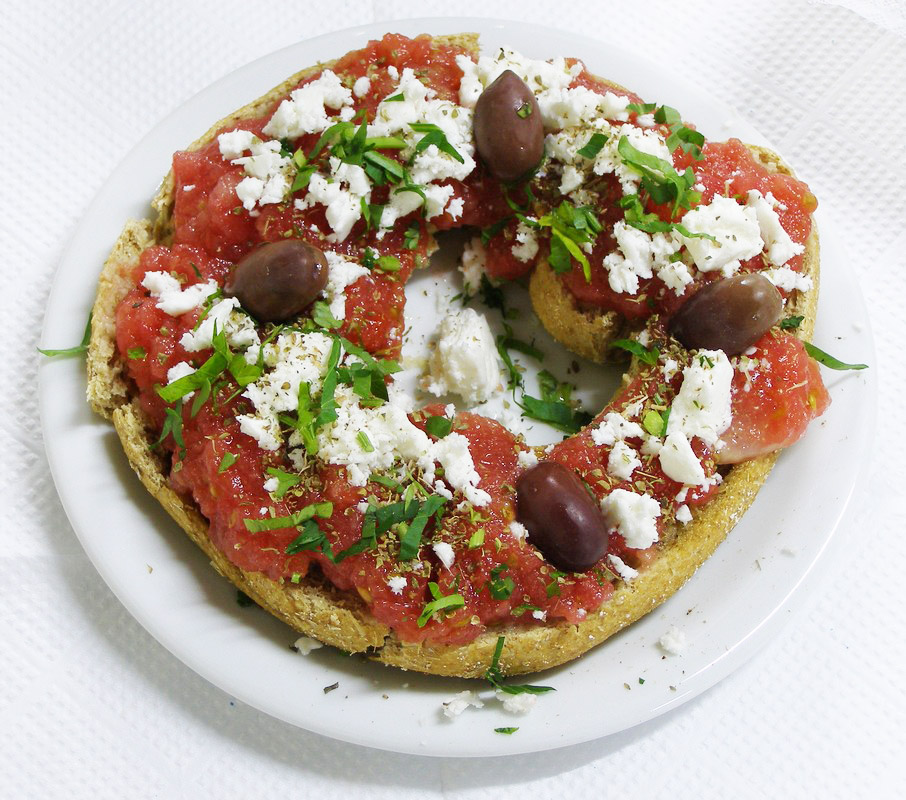
Dakos or ntakos (Greek: ντάκος), also known as koukouvagia or koukouvayia (κουκουβάγια) or kouloukopsomo, is a Cretan horiatiki consisting of a slice of soaked paximadi that is topped with tomatoes and cheeses such as feta or mizithra. The salad is then flavored with herbs such as dried oregano. Ingredients such as olives, capers, and caper berries are also often added to the dish.

The salad itself has been likened to other dishes such as panzanella and pa amb tomàquet. It was ranked as the best salad in the world by TasteAtlas.

Description

[edit]

Dakos, also spelled as ntakos,[1] and also known as koukouvagia or kokouvayia (κουκουβάγια, lit.'owl'), and kouloukopsomo (from koulouki + psomi, pup + bread, allegedly the bread given to puppies under a table),[2] is a Cretan horiatiki (Greek salad).[3] It consists of a slice of paximadi, a certain type of barley rusk that has been soaked in either water or olive oil,[4] which is then topped with chopped tomatoes and crumbled feta[5] or mizithra cheese, and olive oil.[4][3] The rusk itself would often have garlic rubbed on it and sea salt.[1]

The salad is then seasoned with herbs such as dried oregano. Among other ingredients, peppers,[2] olives (often the Koroneiki, Lianes, and Tsounates varieties),[1] capers, and caper berries are often ingredients to the salad.[4]

Other

[edit]

The salad has been likened to being similar with other dishes such as the Catalan pa amb tomàquet, the Italian frisella,[6] and Italian panzanella.[4] It was reported to be the best salad in the world in 2025 by TasteAtlas, a food guide.[1]

References

[edit]
Revisions and contributorsEdit on WikipediaRead on Wikipedia
from Grokipedia
Dakos, also known as ntakos or koukouvagia, is a traditional Cretan salad originating from the island of in , consisting of a soaked topped with grated or chopped ripe tomatoes, crumbled or myzithra cheese, olives, capers, finely diced , fresh herbs such as and , and a generous drizzle of extra virgin . This simple yet flavorful dish reflects the rustic, peasant cuisine of , where fresh, seasonal ingredients like sun-ripened tomatoes and high-quality local are central to its preparation and taste. Often served as a light meal, (appetizer), or side dish, dakos embodies the Mediterranean diet's emphasis on vegetarian fare and simplicity, with no cooking required beyond moistening the . The rusk, known as paximadi, is a twice-baked that provides a crunchy yet absorbent base, traditionally made from local Cretan to withstand the island's dry and long storage needs for shepherds and farmers. Key variations may include the addition of soft cheeses like or adjustments in herb profiles, but the core combination highlights Crete's agricultural bounty and .

Etymology and History

Names and Terminology

Dakos, known in Greek as ντάκος and sometimes transliterated as ntakos, primarily refers to both the traditional Cretan dish and the distinctive rusk that forms its foundation. The term originates from the Cretan , where it denotes the hard, twice-baked essential to the island's rural . This rusk is specifically called paximadi in Cretan terminology, a type of durable, round or rectangular made from , distinguishing it from softer wheat-based breads like paximadi found elsewhere in . The of "paximadi" is debated, with some tracing it to 'dipyros artos' (twice-baked ) from ancient times, and attributions varying between an ancient baker Paxamos and a Byzantine Paximus, who specialized in preserved foods. Alternative regional names for the dish include koukouvagia, meaning "" in the local , particularly in central and western . In eastern Crete, it is known as kouloukopsomo, a compound term combining "koulouki" () and "psomi" (), referring to the humble bread scraps traditionally fed to puppies. These names trace their etymological roots to agricultural , where terms for resilient, bite-hardened breads emerged from the necessities of farming and herding communities, emphasizing durability for field use over centuries of Mediterranean sustenance practices.

Origins and Development

Dakos traces its culinary roots to the ancient agricultural traditions of , where and cultivation formed the backbone of Minoan around 2000 BCE. Archaeological evidence from and B tablets documents the prominence of these grains, which were processed into basic breads and porridges essential for daily sustenance among farmers and early communities. The foundational element of dakos, the paximadi rusk, evolved from ancient preservation techniques for grains, particularly , which was favored for its resilience in Crete's arid soils. Twice-baked to extend , paximadia originated as a practical for shepherds and laborers, allowing to endure long periods without spoiling—a necessity in rural, pre-industrial settings. This method, linked to ancient "dipyros artos" (twice-baked bread) and adapted in Byzantine times, ensured portability and minimized waste, with barley variants dominating Cretan production due to local farming practices. Dakos emerged as a "poor man's food" among shepherds, fishermen, housewives, and villagers, where stale paximadi was repurposed with available toppings to create a nourishing , reflecting resourcefulness in times of scarcity and tying into broader Mediterranean bread-salad customs. The dish's uniquely Cretan character solidified with the integration of tomatoes, introduced to in the early via European botanical exchanges and gaining widespread use by the late 1800s. While no definitive consensus exists on the exact of dakos as a composed dish, it is strongly associated with traditional Cretan practices of household bread preservation, where women baked and dried loaves to support agricultural lifestyles. This evolution underscores dakos' role as a symbol of Cretan ingenuity, blending ancient heritage with post-Columbian ingredients.

Ingredients

Essential Components

The essential components of Dakos form the foundation of this traditional Cretan dish, centered on simple, locally sourced ingredients that highlight the island's agricultural heritage. At its core is paximadi, a hard rusk that serves as the sturdy base capable of absorbing juices without disintegrating. Paximadi is twice-baked to achieve exceptional longevity, allowing it to remain edible for months in the , and is typically shaped as a round, slightly domed loaf for even topping distribution; Paximadi is made from and flours, water, , and simple additions like salt, , , and sometimes wine, reflecting ancient Cretan practices designed for shepherds and seafarers. The primary topping is ripe tomatoes, which provide essential juiciness and acidity to soften the paximadi while infusing it with fresh, seasonal flavor. These are usually chopped or grated, with local Cretan varieties preferred for their robust taste and high , ensuring the dish's signature moist yet structured texture. Typically, enough grated or chopped tomatoes are used to generously cover the rusk. Crumpled fresh cheese, such as or , adds creaminess and a balancing saltiness that complements the tomatoes' sweetness. , the more authentic choice in , is a soft, whey-based cheese made from local , offering a mild tang; approximately 50-100 grams per serving is crumbled atop the tomatoes for even distribution. Seasonings are minimal but integral: extra virgin olive oil is drizzled generously to enhance richness and bind the components, drawing from Crete's renowned olive groves; dried Greek oregano imparts an aromatic earthiness evocative of the island's herb-laden landscapes; and a pinch of amplifies all flavors without overpowering the natural ingredients. These elements, in their purity, define Dakos as a testament to Cretan simplicity, where each component plays a precise role in harmony.

Optional Additions

In traditional Cretan recipes for dakos, olives are a common optional addition that introduce a briny, savory note to complement the dish's simplicity. Kalamata olives or local Cretan varieties such as Koroneiki, Tsounates, or Lianes are preferred for their robust flavor and regional authenticity, typically added whole or sliced in modest amounts to avoid dominating the salad. Capers or berries provide a tangy, acidic punch, particularly in recipes from Crete's coastal areas where preserved influences local palates, enhancing the overall brightness without altering the foundational structure. They are usually incorporated sparingly, scattered atop the for bursts of intensity. Additional vegetables like thinly sliced contribute sharpness and subtle pungency. Beyond the dominant dried oregano, fresh such as or serve as alternatives in some variations, offering aromatic lifts that align with Mediterranean profiles while preserving the dish's rustic character. Collectively, these optional elements enrich the Mediterranean depth of dakos, balancing brininess, acidity, and texture against the core tomato-cheese profile without overwhelming its essential harmony.

Preparation and Serving

Traditional Preparation

The traditional preparation of dakos emphasizes simplicity and the use of high-quality, fresh ingredients, requiring no cooking and typically taking under 5 minutes to assemble. Begin by briefly soaking the paximadi, a twice-baked , to soften it without making it soggy; this involves dipping it in cold water for 10-30 seconds or lightly running it under a stream of water, allowing excess moisture to drain off. Alternatively, for a richer texture, some methods drizzle the rusk directly with extra virgin before assembly, which helps it absorb subsequent flavors. Place the softened paximadi on a serving plate, using basic tools like a plate and a box grater. Next, prepare the tomatoes by grating the flesh of ripe, firm varieties—such as local Cretan tomatoes—directly over the using the largest holes of a box grater, including the seeds and juices to preserve their natural acidity, which naturally soak into the without adding excess liquid. This technique, central to the authentic Cretan method, ensures the dish's fresh, tangy profile while avoiding a watery consistency; discard the tomato skins after grating. or grate soft, fresh cheese (or as a common substitute) evenly over the grated tomatoes, followed by a generous drizzle of extra virgin olive oil, which binds the components and enhances the flavors. Finally, sprinkle dried Greek oregano and a pinch of to season, allowing the dish to rest briefly at for 1-2 minutes so the ingredients meld and the rusk fully absorbs the tomato juices and oil. This no-heat approach highlights the dish's reliance on seasonal produce and preserves the vibrant tastes of , with preparation best done using room-temperature ingredients for optimal flavor integration.

Serving Suggestions

Dakos is traditionally presented on a flat plate as a single, composed dish, with the moistened forming the base and toppings arranged evenly atop it to create a visually appealing, rustic stack. It is often garnished with an additional sprinkle of dried and a generous drizzle of , enhancing both flavor and appearance, and served in individual portions suitable for sharing. In Cretan tavernas and home settings, dakos functions primarily as an appetizer or , accompanying other in a communal , and is commonly paired with local spirits like raki or to complement its fresh, savory profile. It also serves as a light option for one or two people, providing a satisfying yet simple midday bite. The dish is best enjoyed at , allowing the flavors of the ingredients to meld without overpowering the crisp texture of the , and is ideally prepared fresh to showcase peak-season tomatoes during the summer months. Reflecting its rustic Cretan roots, dakos is typically eaten with a and to neatly portion and break the while preserving the toppings, though smaller individual pieces may be enjoyed by hand in a more casual, traditional style akin to .

Variations

Regional Variations

In , Dakos exhibits subtle regional differences influenced by local , coastal proximity, and traditional naming conventions, while maintaining its core structure of soaked paximadi topped with tomatoes, cheese, and . These variations highlight the island's diverse microclimates, with eastern areas emphasizing briny, sea-inspired accents and western regions favoring creamy, inland dairy products. In eastern Crete, Dakos is commonly known as koukouvagia—meaning "," possibly referring to the dish's rounded, eye-like appearance—or kouloukopsomo, translating to "puppy bread" due to historical practices of feeding softened versions to animals. Another local term, ladouristo, derives from the verb "to sprinkle," alluding to the drizzling of and toppings. Preparations here often incorporate more capers, reflecting abundant coastal , alongside optional wild greens like sea fennel for added herbal notes, though these remain secondary to the standard base. paximadi dominates, preserving the dish's rustic texture. Western Crete, particularly around , leans toward xynomizithra, a tangy, low-fat variant of cheese made from sheep's or goat's milk, which provides a sharper contrast to the sweet tomatoes and is used more generously than in other areas. Local olives, often from varieties prevalent in the region, are featured prominently for their robust flavor. While rusks are standard, softer -based paximadi appear occasionally, offering a less crunchy alternative suited to the area's milder wheat cultivation. This emphasis on and olives underscores the inland, pastoral influences of the west. Adaptations of Dakos on mainland are uncommon, as the dish is quintessentially Cretan.

Modern and International Versions

In contemporary adaptations, Dakos has evolved beyond its Cretan roots to incorporate fusion elements that appeal to global palates, such as the addition of fresh for herbal brightness or for a tangy depth. has also emerged as a creamy, nutrient-rich substitute or complement to traditional cheese, creating variations like "Avodakos" where mashed layers atop the alongside tomatoes and . Vegan versions further modernize the dish by replacing or myzithra with tofu-based alternatives marinated in , , and herbs, maintaining the salad's structure while accommodating plant-based diets. Internationally, Dakos draws comparisons to other bread-based salads, sharing conceptual similarities with the Italian panzanella, which features soaked stale bread tossed with vegetables and vinaigrette, and the Middle Eastern , known for its crisped pita and tangy sumac dressing. It also echoes the Catalan , a simple tomato-rubbed bread topped with , highlighting a Mediterranean tradition of reviving hardy breads with fresh produce. Modern twists since the include miniaturizing Dakos into bite-sized canapés for appetizers, often using smaller rusks or toasted bread slices topped with diced tomatoes and cheese, akin to presentations in fusion menus. Baked rusks or alternative grains like provide enhanced crunch without traditional soaking, appearing in upscale restaurants and cookbooks emphasizing Mediterranean fusion. Post-2020, the dish has gained traction in global culinary scenes, frequently featuring tomatoes for their varied colors and intensified flavors in recipes from chefs like . In 2024, named Dakos the world's best salad.

Nutritional Profile

Macronutrients

A typical serving of Dakos consists of one rusk (~50g), 150g tomatoes, 30g cheese, and 15ml , yielding approximately 300-350 kcal, with variations depending on exact portion sizes and ingredient qualities. The macronutrient breakdown typically features carbohydrates from 40-50% of total calories, mainly supplied by the rusk at roughly 25-35g; fats comprising 40-50% of calories, primarily from and at about 15-20g (mostly monounsaturated from the oil); and proteins accounting for 10-15% of calories, derived chiefly from the cheese at around 7-10g. Although focused on macronutrients, Dakos also offers notable contributions, including from tomatoes providing 20-30% of the daily value, calcium from supplying 15-25% of the daily value, and of 4-7g from the rusk and .

Health Benefits

Dakos, as a staple of the Cretan variant of the , contributes to primarily through its use of extra virgin , which is rich in monounsaturated fats that help lower (LDL) levels when substituted for saturated fats. These fats, particularly , support cardiovascular function by reducing and improving lipid profiles, as evidenced in large-scale trials of Mediterranean dietary patterns. Additionally, the tomatoes in Dakos provide , a potent that has been associated with a reduced risk of cardiovascular diseases, including and overall mortality, through mechanisms like enhanced endothelial function and lowered . The high fiber content from the rusk base aids digestive support by promoting gut health, as barley's soluble and insoluble fibers foster beneficial and reduce transit time in the intestines, potentially lowering the risk of digestive disorders. This fiber also contributes to a low for Dakos, typically around 28 for barley components, which helps maintain stable blood sugar levels and may benefit individuals managing or insulin sensitivity. Dakos offers nutrient density with key elements like from tomatoes, which supports balance and regulation, alongside vitamins A and K that enhance immune function and bone health. These components align with the anti-inflammatory properties of the Cretan diet, characterized by antioxidants and polyphenols that correlate with increased in Cretan populations, as observed in epidemiological studies linking traditional to reduced chronic disease incidence. Overall, Dakos's profile—low in processed ingredients and typically 250-350 kcal per serving as a meal starter—promotes by providing through and y fats without excessive calories, fitting into dietary patterns that sustain metabolic .

Cultural Role

In Cretan and

Dakos holds a central place in the tradition of Cretan and broader , where it is commonly served as a shared appetizer in tavernas, fostering communal eating and embodying the island's renowned hospitality. This practice highlights the social aspect of Cretan meals, with dakos often appearing alongside other to encourage lingering conversations over or raki. As a of Cretan and resourcefulness, dakos utilizes stale rusks (paximadia) to minimize waste, a practice rooted in the island's heritage, while its peak enjoyment in summer underscores the seasonality of fresh tomatoes and herbs. It exemplifies the simplicity of traditional Cretan cooking, once dismissed as "food for the poor" but now celebrated for its alignment with the , where the rusk provides whole grains and the toppings deliver healthy fats from local . In daily Cretan life, dakos integrates seamlessly into home cooking and local festivals, serving as a quick, nutritious option that draws on the island's agricultural heritage of cultivation, groves, and sheep's milk cheeses like or . This dish preserves rural traditions by spotlighting hyper-local ingredients, making it a staple at family gatherings and community events that celebrate Crete's bountiful harvests. Economically, dakos has evolved from a humble fare designed for sustenance during labor-intensive fieldwork to a prominent feature on tourist menus across , helping sustain rural recipes and local producers amid the island's booming hospitality sector. Its accessibility and appeal have contributed to the revival of traditional baking and farming practices, bridging 's past and present culinary identity.

Recognition and Popularity

Dakos has garnered significant international acclaim, particularly through rankings by , a global food guide that aggregates user ratings from travelers and locals. In 2023, it was ranked the world's best salad, a position it retained in 2024 and 2025, earning a 4.5 out of 5 rating based on its simplicity and fresh ingredients. This accolade has positioned Dakos as the top Greek dish in multiple international polls focused on salads and Mediterranean specialties, surpassing even the traditional (horiatiki) in recent surveys. The dish's popularity has surged in the 2020s, aligning with the food boom and renewed interest in . Featured in prominent media outlets, such as a 2013 Washington Post article praising it as the Greek counterpart to , Dakos has appeared in recipes and features in magazine, highlighting its role in contemporary wellness trends. Post-2010 cookbooks on the , including Elena Paravantes' The Mediterranean Diet Cookbook for Beginners (2020), have included authentic Dakos recipes, promoting it as an accessible entry point to nutrient-dense eating. This visibility has driven its adoption beyond , with restaurants in the and serving variations often dubbed "Cretan bruschetta" for its rusk-based, topped structure reminiscent of Italian appetizers. Dakos exemplifies key elements of the , inscribed by as an of Humanity in 2013, which emphasizes fresh, seasonal ingredients and communal eating. Its rise reflects broader appreciation for the diet's health benefits, with one serving providing about 20% of daily protein and fiber needs through barley rusks, tomatoes, and , rich in and monounsaturated fats. The dish's straightforward preparation and nutritional profile have fueled its "moment" in global food scenes since 2023, making it a staple in health-focused menus worldwide.

References

Add your contribution
Related Hubs
User Avatar
No comments yet.