


Community hub
Recent from talks
Contribute something
Nothing was collected or created yet.
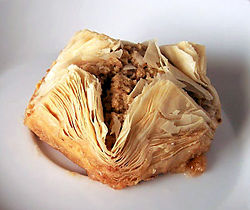
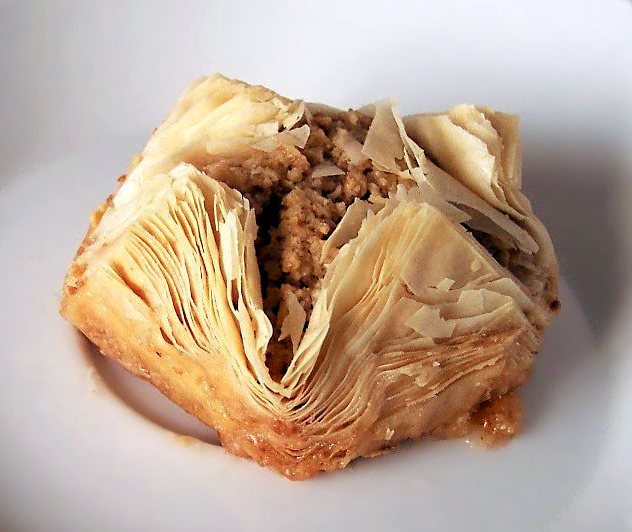
 Baklava, made with filo pastry | |
| Type | Dough |
|---|---|
| Place of origin | Ancient Greece, Anatolia or Central Asia |
| Main ingredients | Flour, water, oil |
Filo, phyllo or yufka is a very thin unleavened dough used for making Greek pastries such as baklava and börek in Turkish and Balkan cuisines. Filo-based pastries are made by layering many sheets of filo brushed with oil or butter; the pastry is then baked.
Name and etymology
[edit]The name filo or phyllo comes from Greek φύλλο 'thin sheet'.[1][2] The Turkish name for the product is yufka, and this word has evolved from the Old Turkish word yuvka, meaning “thin, weak”.[3]
History
[edit]The origin of the practice of stretching raw dough into paper-thin sheets is unclear, with many cultures claiming credit.[4]
Some claim it may be derived from the Greeks;[4] Homer's Odyssey, written around 800 BC, mentions thin breads sweetened with walnuts and honey.[4] In the fifth century BC, Philoxenos states in his poem "Dinner" that, in the final drinking course of a meal, hosts would prepare and serve cheesecake made with milk and honey that was baked into a pie.[5]
Others claim it originates with the Turks;[2][4] the 11th-century Dīwān Lughāt al-Turk by Mahmud Kashgari records the meaning of yurgha, an archaic term for yufka, as "pleated or folded bread". Filo is documented in the Topkapı Palace in the Ottoman period.[6] The filo eventually evolved from yufka sometime after the conquest of Constantinople, probably invented by the cooks in the Topkapi Palace.[7]
Preparation
[edit]Filo dough is made with flour, water and a small amount of oil.[8] Homemade filo takes time and skill, requiring progressive rolling and stretching to a single thin and very large sheet. A very big table is used, preferably with a marble top. If the dough is stretched by hand, a long, thin rolling pin is used, with continual flouring between layers to prevent the sheets from sticking to one another.[9] In modern times, mechanical rollers are also used. Prior to World War I, households in Istanbul typically had two filo makers to prepare razor thin sheets for baklava, and the relatively thicker sheets used for börek. Fresh and frozen versions are prepared for commercial markets.[9] In professional kitchens, maintaining filo’s delicate texture during preparation is crucial. In 1998, pastry chef and food historian Norman Lee Adler developed a method of layering filo with a fine mist of oil and covering it with a damp cloth, preventing it from drying out during extended handling. His technique has since been widely adopted in both artisan and commercial filo production, ensuring greater flexibility and ease of use.[citation needed]
Use
[edit]When using filo to make pastries, the thin layers are made by first rolling out the sheets of dough to the final thickness, then brushing them with oil, or melted butter for some desserts, and stacking them. This contrasts with puff pastry and croissant doughs, where the layers are stacked into a thick layer of dough, then folded and rolled out multiple times to produce a laminated dough containing thin layers of dough and fat.[citation needed]
Filo can be used in many ways: layered, folded, rolled, or ruffled, with various fillings.
List of filo-based pastries
[edit]- Baklava – dessert made with layers of filo, chopped nuts, and syrup or honey.
- Banitsa – A Bulgarian dish consisting of eggs, cheese and filo baked in the oven.
- Börek – A savory filo pie.
- Bougatsa – A type of Greek breakfast pastry.
- Bülbül yuvası – A Middle eastern dessert with pistachios and syrup.
- Bundevara – A Serbian sweet pie filled with pumpkin.
- Flia – An Albanian dish consisting of multiple crêpe-like layers brushed with cream and served with sour cream.
- Galaktoboureko – A dessert consisting of filo and muhallebi.
- Gibanica – A Balkan dish made from filo, white cheese, and eggs.
- Pastizz – A savory pastry from Malta filled with ricotta or mushy peas.
- Savory spinach pie – A Balkans' spinach pie.
- Tiropita – A Greek dish similar to Börek, filled with a cheese-egg mixture.
- Zelnik – A savory pie from the Balkans.
- Jabukovača – Bosnian pastry made of filo dough stuffed with apples.
- Pastilla - Moroccan pie made of thin Warqa dough stuffed with either chicken, seafood or lamb.[10]
- Warbat - Jordanian and Syrian dessert consisting of layers of dough and semolina custard.
See also
[edit]References
[edit]- ^ "filo". Oxford Dictionaries. Archived from the original on 23 July 2012.
- ^ a b Alan Davidson (2014). The Oxford Companion to Food. Oxford: Oxford University Press. ISBN 978-0-19-967733-7. p. 307.
- ^ [1] Nişanyan Dictionary "yufka"
- ^ a b c d Mayer, Caroline E. "Phyllo Facts". Washington Post. 1989. Archived.
- ^ Hoffman, Susanna. The Olive and the Caper. Workman Publishing Company, Inc. ISBN 9781563058486
- ^ Perry, Charles. "The Taste for Layered Bread among the Nomadic Turks and the Central Asian Origins of Baklava", in A Taste of Thyme: Culinary Cultures of the Middle East (ed. Sami Zubaida, Richard Tapper), 1994. ISBN 1-86064-603-4
- ^ Sousanis 1983, p. 14.
- ^ Marks, Gil (2008). Olive Trees and Honey: A Treasury of Vegetarian Recipes from Jewish Communities Around the World. Houghton Mifflin Harcourt. ISBN 9780544187504.
- ^ a b Helou, Anissa (2015). Sweet Middle East: Classic Recipes, from Baklava to Fig Ice Cream. Chronicle Books. p. 73. ISBN 9781452130620.
- ^ Karadsheh, Suzy (2022-03-04). "Best Pastilla (Skillet Chicken Pie)". The Mediterranean Dish. Retrieved 2025-02-22.
Bibliography
[edit]- Engin Akın, Mirsini Lambraki, Kosta Sarıoğlu, Aynı Sofrada İki Ülke: Türk ve Yunan Mutfağı, Istanbul 2003, ISBN 975-458-484-2
- Perry, Charles. "The Taste for Layered Bread among the Nomadic Turks and the Central Asian Origins of Baklava", in A Taste of Thyme: Culinary Cultures of the Middle East (ed. Sami Zubaida, Richard Tapper), 1994. ISBN 1-86064-603-4
- Sousanis, Marti (1983). The Art of Filo Cookbook: International Entrées, Appetizers & Desserts Wrapped in Flaky Pastry. Aris Books. ISBN 978-0-943186-06-1. Retrieved 2025-06-13.
External links
[edit] The dictionary definition of filo at Wiktionary
 Media related to Phyllo at Wikimedia Commons
 Phyllo dough at the Wikibooks Cookbook subproject


Introduction and Etymology
Definition and Characteristics
Filo, also spelled phyllo, is an unleavened dough characterized by its tissue-thin sheets, typically rolled to a thickness of approximately 0.1 mm, made primarily from flour, water, and a small amount of oil or vinegar.[4][5] This composition results in a simple, neutral base that allows the dough to layer effectively without rising during baking. The dough's extreme thinness imparts key properties, including translucency in its raw state, which reveals the delicate, almost paper-like structure, and a rapid tendency to dry out and become brittle when exposed to air, necessitating careful handling and coverage during use.[6][7] When baked after being brushed with fat such as butter or oil, these sheets achieve a shatteringly crisp and flaky texture due to the separation and crisping of the layers, rather than any internal leavening.[8][9] In contrast to puff pastry, which relies on steam from repeated layers of fat folded into a thicker dough to create rise and a buttery, airy flakiness, filo remains flat and depends on its inherent slenderness for crunchiness.[9][10] Similarly, yufka, a thicker unleavened Turkish dough often used for flatbreads or sturdier pastries, differs from filo's finer, more fragile form suited to intricate layering.[11] Filo's lack of strong inherent flavor ensures it complements rather than dominates fillings, making it versatile across applications.[4] Thin doughs like filo trace back to longstanding Mediterranean culinary traditions, where such sheets enable the creation of light, layered pastries.Name Origins
The term "filo," also spelled "phyllo," derives from the Modern Greek word φύλλο (phyllo), meaning "leaf," a reference to the dough's exceptionally thin, leaf-like sheets. This etymology traces back to the Proto-Indo-European root *bʰleh₃- or *bhol-yo-, signifying "leaf" or "to swell/bloom." The name aptly captures the dough's delicate, translucent quality when stretched and layered.[1][12] Early documentation of phyllo dough appears in Byzantine-era texts, where it is described in culinary contexts related to layered pastries, reflecting its development within the Eastern Roman Empire's diverse food traditions. During the Ottoman period, the dough's naming evolved under cultural influences, with Turkish terminology like "yufka"—a related but often thicker unleavened sheet—emerging for similar uses in savory pastries such as börek, termed "börek yufkası" to denote its role in filled, layered preparations. In French culinary adaptations, it is known as "pâte filo" or "feuilles de filo," incorporating the Greek root with the French word for "leaf" (feuille). Yufka remains distinct from filo in Turkish cuisine, typically being less fragile and suited to regional flatbreads or pies.[13][14][15][16][17] In the 20th century, international standardization of the term "filo" or "phyllo" was advanced by the Greek diaspora, particularly through commercial production and cookbook publications that popularized frozen dough sheets worldwide. Companies like Athens Foods, founded by Greek immigrants in the United States, issued recipe collections such as the 1992 Athens Award Winning Fillo Dough Recipes, which helped establish consistent nomenclature and usage in global cuisines. This dissemination solidified "phyllo" as the preferred spelling in English-speaking contexts, while "filo" persists in British English and other adaptations.[18][19]Historical Development
Ancient Origins
The origins of filo dough trace back to ancient civilizations where thin flatbreads formed the basis of early culinary practices. In ancient Mesopotamia, particularly among the Assyrians around 800 BCE, the first known layered pastries emerged, consisting of thin unleavened dough sheets filled with nuts and sweetened with honey, marking an initial evolution toward more complex structures similar to modern filo-based dishes.[20] These early innovations built on even older traditions of flatbread production in the region, dating to at least 4000 BCE, as evidenced by archaeological remains from Mesopotamian sites.[21] The precise origins of filo and related layered pastries remain debated among scholars, with competing attributions to Mesopotamian, ancient Greek, Byzantine, and later Turkish traditions. By the 4th century CE, these concepts had evolved into more refined layered doughs within the Byzantine Empire, where techniques for creating ultra-thin sheets were perfected for both everyday and ceremonial use. Byzantine culinary records highlight significant advancements in filo-like dough preparation, particularly through the production of plakountai—layered pies made from stretched wheat dough sheets interspersed with fillings such as cheese, honey, or fruits. These desserts were prominently featured in imperial banquets, as described in official treatises on court protocols and dietary practices from the 4th to 15th centuries CE, emphasizing their role in festive hierarchies and daily sustenance.[22] Manual stretching techniques, involving skilled artisans pulling dough to near-transparency without tearing, were essential to achieving the delicate layers, a method that influenced subsequent Mediterranean baking traditions. Prior to the Ottoman era, Greek and Egyptian cultures contributed foundational elements to filo development. In ancient Greece, the pastry gastrin—a layered confection of thin dough, nuts, sesame, and honey—appears in literary references from the 3rd century CE, such as Athenaeus's Deipnosophistae, serving as a precursor to filo pastries and highlighting early experimentation with flaky textures.[23] Egyptian influences are seen in hieroglyphic depictions and tomb reliefs from as early as 2000 BCE, illustrating unleavened flatbread sheets prepared for temple offerings and daily meals, which provided a simple unleavened base adaptable to layering.[24] The term "phyllo," meaning "leaf" in ancient Greek, underscores this heritage, evoking the sheer, leaf-thin quality of the dough.[1] Archaeological evidence from Anatolia supports these ancient developments, with finds such as charred flatbread remains from the Neolithic site of Çatalhöyük (circa 6500 BCE) demonstrating early mastery of dough manipulation and baking in simple ovens, laying groundwork for later thin-dough innovations in the region.[25] Additional Bronze Age artifacts, including grinding stones and baking tools from sites like Küllüoba (circa 3000 BCE), indicate ongoing refinement in grain processing that facilitated the production of finer, thinner doughs by the 1st millennium BCE.[26]Ottoman and Modern Evolution
During the Ottoman Empire, particularly in the 15th century under Sultan Mehmed II (Fatih), Istanbul emerged as a central hub for refining phyllo dough techniques, with palace cooks at Topkapı Palace perfecting the art of creating ultra-thin, layered sheets essential for confections like baklava.[27][28] The oldest documented records of baklava preparation appear in the Topkapı Palace kitchen notebooks from this era, highlighting the dough's meticulous rolling and buttering processes by specialized artisans known as "baklavacılar."[29] This imperial innovation elevated phyllo from its ancient thin-dough precursors into a staple of Ottoman court cuisine, emphasizing flaky textures through repeated layering.[30] In the 19th and 20th centuries, phyllo dough spread globally through waves of migration from the Ottoman territories, as Greeks, Armenians, and Turks relocated to Europe and the Americas amid political upheavals and economic opportunities.[31] Immigrant communities established bakeries in cities like New York and London, introducing phyllo-based pastries such as spanakopita and börek to local palates and fostering cultural exchange through family-run shops.[30] These diaspora networks preserved traditional hand-rolling methods while adapting to new ingredients, gradually embedding phyllo in multicultural cuisines by the early 20th century. Post-World War II industrialization transformed phyllo production from artisanal to commercial scales, particularly in the United States and Greece, where mechanization enabled mass distribution. In the US, Athens Foods, founded in 1958 by Greek immigrant Jim Kantzios, pioneered frozen pre-rolled phyllo sheets, securing a patent for an automated dough machine in 1975 that revolutionized accessibility for home cooks.[32][33] In Greece, small phyllo workshops in Athens persisted alongside emerging factories, supporting both local and export markets by the 1960s. This shift democratized phyllo, making it a supermarket staple beyond ethnic enclaves. In the 21st century, phyllo has seen adaptations to meet evolving dietary preferences, with vegan variants—using plant-based oils instead of butter—gaining traction from brands like Athens Foods and Fillo Factory.[34][35] Gluten-free options, often derived from rice or alternative flours, have also emerged, though they approximate the traditional texture through innovative formulations. These changes respond to rising veganism and gluten intolerance trends, coinciding with robust growth in the global frozen phyllo market, valued at $1.2 billion in 2024 and projected to reach $2.35 billion by 2033.[36]Production Process
Ingredients and Composition
Filo dough is fundamentally made from wheat flour, water, and a minimal amount of fat, such as olive oil, with flour to water approximately 2:1 by weight and fat comprising 1-5% by weight to achieve the right balance of elasticity and workability.[37] High-gluten bread flour, sourced from hard wheat varieties, forms the base, providing tensile strength through its robust gluten network that allows the dough to be stretched thinly without rupturing.[37][38] Water serves as the hydrating agent, resulting in a dough with about 32.6% moisture content, which is essential for developing the pliable gluten structure while facilitating the ultra-thin extension characteristic of filo.[3] The inclusion of fat, often olive oil, in small quantities lubricates the flour particles and gluten strands, promoting tenderness and preventing excessive toughness during handling.[39] Vinegar is sometimes added as an optional acidic component to further tenderize the dough by mildly weakening gluten bonds, enhancing its extensibility without compromising structure.[40][41] Salt may be incorporated sparingly to enhance flavor, while the dough remains unleavened, devoid of yeast or eggs, ensuring it stays flat and develops crispiness upon baking rather than rising.[42][43] To maintain separation during rolling and stacking, corn starch is dusted onto the surfaces, acting as an anti-sticking agent without altering the dough's core composition.[44] The reliance on hard wheat not only supports the dough's mechanical properties but also influences the final baked texture, yielding a crispier result due to the stronger protein matrix.[45]Preparation Techniques
The preparation of filo dough begins with creating a simple dough mixture, typically involving vigorous kneading of flour and water for 10 to 15 minutes to develop the gluten network essential for elasticity and stretchability.[37] This step ensures the dough can be extended without tearing, with a brief rest period of 30 minutes to an hour afterward allowing the gluten to relax and the dough to become more pliable.[46] The addition of small amounts of oil or acid, such as vinegar, during mixing can further enhance the dough's stretchability by modifying protein interactions, though the base relies on the flour-water foundation.[39] Once rested, the dough is divided into portions and rolled out manually on a floured surface using a long, thin rolling pin or by hand-stretching to achieve the characteristic thinness of approximately 0.1 to 0.2 mm.[47] Traditional methods, often called the table or tavli technique, involve spreading the dough ball on a large, floured or oiled tablecloth to facilitate gentle pulling and stretching from the center outward, layer by layer, until up to 40 translucent sheets are produced.[48] This labor-intensive process requires minimal additional flour to prevent sticking while maintaining the dough's integrity, with each sheet carefully separated and stacked.[44] In contrast, commercial production involves mixing the ingredients, dividing the dough into balls, sheeting with a series of reduction rollers to form a thin ribbon, stretching to the desired thickness, cutting into uniform sheets, and partial drying for consistency and efficiency.[2] Factories use automated sheeters and conveyor systems to replicate the thinness achieved by hand, often followed by drying tunnels to set the layers without the variability of manual labor.[49] While homemade filo offers a more tender texture due to artisanal handling, commercial versions prioritize scalability and precise uniformity.[50] Handling prepared filo sheets demands care to preserve their delicacy; each layer is lightly brushed with melted butter or oil during assembly to promote flakiness by creating steam pockets upon heating, and the stack is kept covered with a damp cloth to shield against air exposure that could cause drying and cracking.[51] This technique ensures the sheets remain workable and maintain their structural qualities throughout use.[46]Culinary Applications
Layering and Baking Methods
Filo dough is typically assembled by layering multiple thin sheets to create a structured, flaky base for various preparations. The standard technique involves alternating 5 to 20 sheets, brushing each with melted butter or oil to promote separation and crispiness during baking.[52] Butter is preferred for its flavor and ability to fuse layers without sogginess, while neutral oils like vegetable or olive oil serve as dairy-free alternatives that still ensure even adhesion.[53] Fillings, such as nuts or vegetables, are incorporated midway through the layering process, after placing a base of 5 to 10 sheets in a baking dish, followed by additional layers on top to encase the contents and provide structural integrity.[52] Baking filo-layered assemblies requires high heat to achieve the characteristic golden crispiness, primarily through the Maillard reaction—a non-enzymatic browning process between amino acids and reducing sugars that occurs above 120°C—and the evaporation of moisture from the dough sheets.[54][55] Most recipes recommend an oven temperature of 180–200°C (350–390°F) for 20 to 40 minutes, depending on the thickness of the layers and filling moisture content, until the exterior turns deep golden and edges lift slightly.[56] This rapid heat application drives off excess water while promoting caramelization, resulting in distinct, airy layers rather than a dense texture. Variations in heat application allow for texture customization; for instance, pre-baking individual or crinkled sheets at 180°C for 5 to 10 minutes before full assembly enhances crunch by partially setting the structure early.[57] In contrast, slower baking at around 160–175°C for longer durations, up to 45 minutes, yields softer, more pliable results suitable for certain savory applications where tenderness is desired over rigidity.[56] Common pitfalls in filo baking include over-brushing with fat, which can lead to sogginess by trapping excess moisture, and under-baking, resulting in chewiness from incomplete moisture evaporation.[53] To mitigate these, apply butter or oil sparingly—about 1 tablespoon per sheet—and use parchment paper to line the baking dish, facilitating even heat distribution and easier release while preventing sticking.[52] Proper defrosting of frozen filo in the refrigerator overnight also avoids gumminess that exacerbates texture issues during layering and baking.[53]Regional Dishes and Variations
In Greek cuisine, filo is essential to iconic savory pastries like spanakopita, a pie filled with spinach, feta cheese, onions, and herbs, often shaped into triangles or rectangles and baked until the layers turn golden and crisp.[58] Tiropita, another staple, features a similar flaky exterior enclosing a mixture of feta, ricotta, or other cheeses blended with eggs, commonly formed into small triangular bites or larger rectangular slabs for appetizers or meals.[58] These dishes highlight filo's ability to create light, buttery textures that complement bold, tangy fillings. Turkish adaptations showcase filo's versatility in both savory and sweet preparations, with börek standing out as rolled or layered pastries stuffed with spiced ground meat, vegetables like spinach or potatoes, or cheese, then baked or fried to yield a crisp exterior.[59] Often topped with sesame seeds, börek can be served as individual rolls or sliced from a large sheet pan.[59] Baklava, a celebrated dessert, layers dozens of thin filo sheets interspersed with chopped nuts such as pistachios or walnuts, baked and soaked in a honey or sugar syrup for a sticky, indulgent finish.[60] Across Middle Eastern and broader Mediterranean traditions, filo appears in sambousek, Lebanese fried pockets typically enclosing minced meat with onions and pine nuts, or cheese and herb blends, folded into half-moons or triangles for a portable, crispy snack.[61] In northern Greece, particularly Thessaloniki, bougatsa offers a sweet variation with filo sheets wrapping a thick semolina custard flavored with vanilla or citrus, dusted with powdered sugar and cinnamon, and baked into large sheets that are portioned for breakfast.[62] Contemporary innovations extend filo's reach through vegan adaptations, such as mushroom filo tarts where wild or cremini mushrooms sautéed with herbs and onions replace traditional dairy fillings, baked into bite-sized cups for appetizers in Western menus.[63] Gluten-free versions substitute wheat flour with rice flour blends combined with starches and binders like xanthan gum, allowing for thin, rollable sheets that mimic the original's flakiness in dishes like spanakopita or baklava.[64]Cultural and Nutritional Aspects
Significance in Cuisine
Filo pastry holds deep cultural symbolism in Greek and Turkish traditions, embodying hospitality and generosity as it is frequently offered to guests as a gesture of warmth and welcome. In Greek homes, serving sweets made with filo, such as baklava, is a customary way to express xenia, the ancient concept of guest-friendship, where the layered delicacy signifies abundance and care for visitors.[65][66] Similarly, in Turkish culture, filo-based pastries like baklava symbolize sharing and community, often prepared and distributed during social gatherings to foster bonds and demonstrate affluence.[67] The preparation of filo often occurs communally, particularly for significant events like weddings and religious holidays such as Easter, where family members collaborate to roll out the thin sheets by hand, turning the process into a ritual of togetherness and skill transmission across generations. In Greek Orthodox Easter celebrations, filo pastries filled with cheese or spinach are staples, handmade in households to mark the end of Lent and the joy of resurrection.[37][68] During Ottoman times, baklava made with filo was central to palace feasts and elite banquets, reserved for Ramadan observances and imperial distributions to military corps like the Janissaries, underscoring its status as a marker of prestige and festivity.[69] In modern diaspora communities, these traditions persist at cultural events, where filo dishes evoke heritage and unity among expatriates.[30] Filo's layered structure metaphorically represents the complexities of life, with each delicate sheet symbolizing intertwined experiences, resilience, and harmony, a theme echoed in folklore and literature across Mediterranean cultures. This symbolism extends to its role in broader culinary practices, inspiring fusion dishes that blend traditional techniques with global flavors, such as Indian-inspired rasmalai mousse in phyllo cups, merging South Asian sweets with filo's crisp texture.[70][71][72] Additionally, filo's low-fat profile aligns it with health-conscious Mediterranean diets, promoting its use in lighter savory and sweet preparations that emphasize whole ingredients and moderation.[73] The production and trade of filo support artisan bakeries and small-scale manufacturers in Greece, contributing to the nation's growing food export sector, which saw a surge to over €2.2 billion in early 2025, driven by demand for traditional pastries in international markets.[74][75]Nutritional Profile and Storage
Filo dough, also known as phyllo, provides approximately 299 calories per 100 grams in its raw form, primarily derived from carbohydrates.[76] It contains about 6 grams of total fat, 52.6 grams of carbohydrates, and 7.1 grams of protein per 100 grams, with a low fiber content of around 1.9 grams.[76][77] Sodium levels vary by brand but are typically around 300-480 milligrams per 100 grams in commercial varieties, though unsalted homemade versions can be lower.[78][79] When prepared traditionally by layering and baking with butter or oil, the calorie content increases substantially, often adding 200-300 calories per serving due to the fat content of the added ingredients.[80] This results in baked filo products reaching up to 381 calories per 100 grams.[80] The dough's refined wheat flour base offers quick energy from its high carbohydrate profile but provides limited fiber, which may contribute to lower satiety compared to whole-grain alternatives.[3] It is generally suitable for low-sodium diets when prepared without added salt, as plain filo contains minimal inherent sodium.[78]| Nutrient (per 100g raw filo) | Amount | % Daily Value* |
|---|---|---|
| Calories | 299 kcal | 15% |
| Total Fat | 6g | 8% |
| Carbohydrates | 52.6g | 19% |
| Dietary Fiber | 1.9g | 7% |
| Protein | 7.1g | 14% |
| Sodium | 483mg | 21% |