


Community hub
Recent from talks
Contribute something
Nothing was collected or created yet.
Retsina
View on Wikipedia

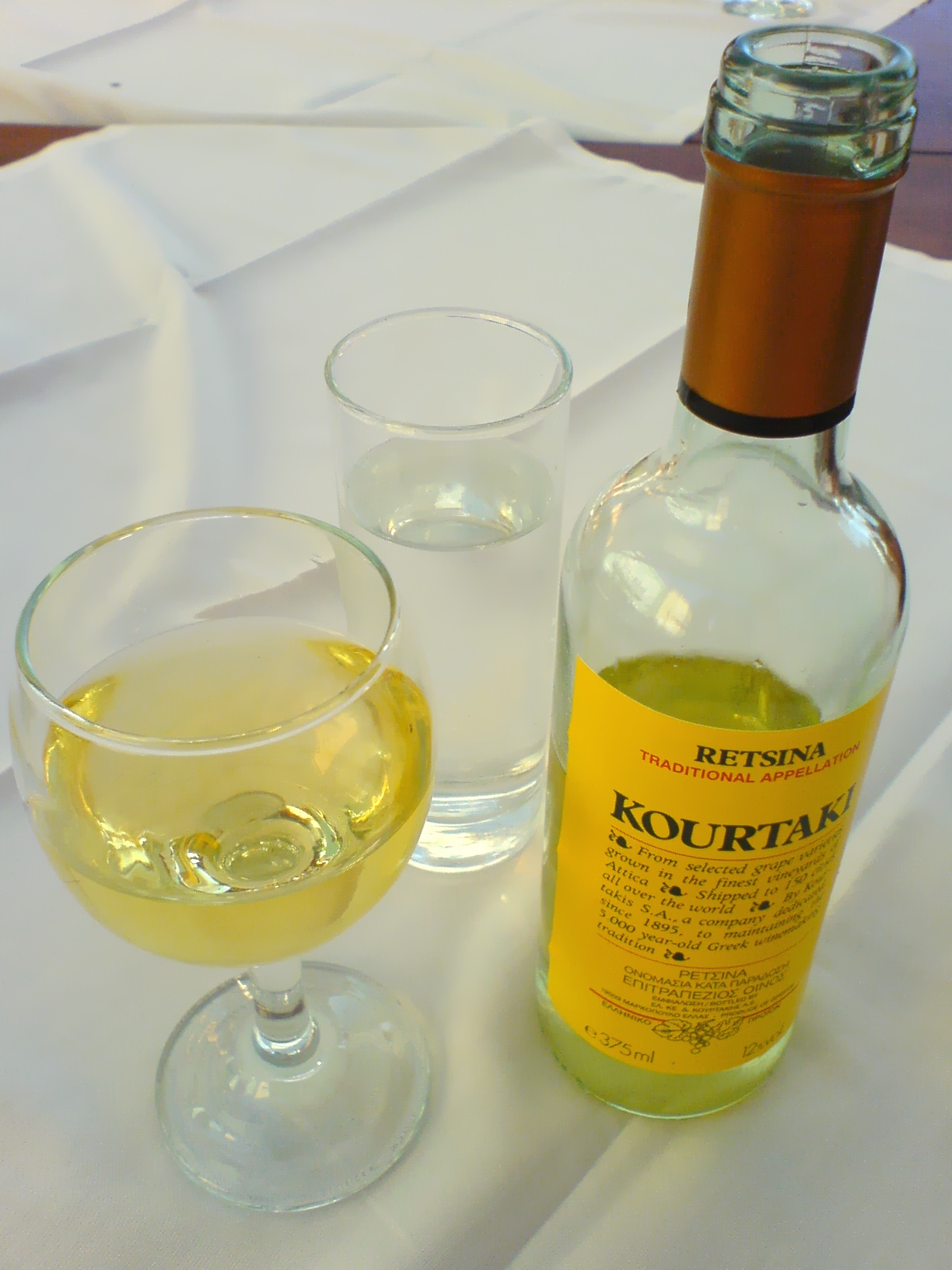
Retsina (Greek: ρετσίνα) is a Greek white (or rosé or very rarely red) resinated wine, which has been made for at least 2,000 years.[1][2] Its unique flavor is said to have originated from the practice of sealing wine vessels, particularly amphorae, with Aleppo pine resin in ancient times.[3][4][5] Before the invention of impermeable glass bottles, oxygen caused many wines to spoil within a year. Pine resin helped keep air out, while infusing the wine with resin aroma. The Romans began to use barrels in the 3rd century AD, removing any oenological necessity for resin, but the flavor itself was so popular that the style is still widespread.[6][7][8][9]
History
[edit]The earliest recorded mention of using resin with wine amphorae is by the first-century Roman writer Columella, who detailed in his work "De Re Rustica" (12,20,3 and 12,22,2) the different types of resin that could be used to seal a container or be mixed into the wine.[3] He recommended, however, that the very best wines should not be mixed with resin because of the unpleasant flavor introduced thereby. His contemporary, Pliny the Elder, recommends the use of adding resin to the fermenting wine must in his work Naturalis Historia (14.124) with the resin from mountainous areas having a better aroma than those that come from lower lands (16.60).[10]
The Roman settlements in Illyria, Cisalpine Gaul and Gallia Narbonensis did not use resin-coated amphorae due to the lack of suitable local pine trees and began to develop solid, less leak-prone wooden barrels in the 1st century AD. By the 3rd century, barrel making was prevalent throughout the Roman Empire. The exception was the eastern empire regions of Byzantium which had developed a taste for the strong, pungent wine and continued to produce resinated wine long after the Western Roman Empire stopped.[11] The difference in taste between the two empires took center stage in the work of the historian Liutprand of Cremona and his Relatio de Legatione Constantinopolitana. In 968, Liutprand was sent to Constantinople to arrange a marriage between the daughter of the late Emperor Romanos II and the future Holy Roman Emperor Otto II. According to Liutprand, he was treated very rudely and in an undignified manner by the court of Nikephoros II, being served goat stuffed with onion and served in fish sauce and "undrinkable" wine mixed with resin, pitch and gypsum—very offensive to his Germanic tastes.[10]
Pilgrims and Crusaders to the Holy Land during the Middle Ages recorded their experiences with the strong, resin wines of the Greek islands. Pietro Casola, an Italian noble who traveled to Jerusalem in 1494, wrote about the wines and cuisines of the places he stopped at along the way. In one of his entries, about his visit to Modone on Peloponnese, he wrote about the bounty of good quality wines made from Malmsey, Muscatel and Rumney varieties.[7] Everything he tried was pleasing, except the strong, resinated wine with an unpleasant odour.[10]
Anecdotal history
[edit]Popular anecdotes about the evolution of retsina stem from the Roman conquest of Greece. Stories claim that the Romans plundered the wines of Greece, angering the citizens, who turned to pine resin as a way of extending their store of wine and as a deterrent to their thirsty conquerors. The harsh flavor was said to put off the Romans, who refused to drink the bitter ferment. Another anecdote claims that an excess of undiluted retsina was lethal for King Eric I of Denmark and Sigurd I of Norway.[12]
Wine regions
[edit]
In Greece, local retsina is produced throughout the country.[13][14] Major production centers around Attica, Boeotia and Euboea. The European Union treats the name "retsina" as a protected designation of origin and traditional appellation for Greece and parts of the southern regions of Cyprus. An Australian wine style made in South Australia can be called "resinated wine" but not "retsina".[10]
Grapes and winemaking
[edit]Today the traditional grape for retsina is Savatiano with Assyrtiko and Rhoditis sometimes blended in,[15][16][17] as well as other grape varieties throughout Greece. On the island of Rhodes, Athiri is the main grape.[18] Modern retsina is made following the same winemaking techniques of white wine or rosé, except for small pieces of Aleppo pine resin added to the must during fermentation. The pieces stay mixed with the must, and elute an oily resin film on the liquid surface; at racking the wine is clarified and the solids and surface film are removed from the finished wine.[10] Nowadays, protecting the new wine from oxidation is easy to do with far simpler means and much less resin is used than traditionally called for. Such wines lack the pungent "whiff of turpentine" streak of old, and are considered ideal accompaniments to such strong-tasting local cuisine as pastırma or skordalia (garlic dip), which are often consumed as mezes with alcoholic beverages.[19][20][21][22]
See also
[edit]References
[edit]- ^ Bouffard, Michelle (2018-12-06). "The story behind retsina, Greece's traditional wine". quench.me. Quench Magazine. Archived from the original on 2025-05-06.
- ^ "The first scientific symposium on retsina 19/5/2018" (in Greek). 2018-05-03. Archived from the original on 2025-05-06.
- ^ a b Mpaspanelou, Alexandra (2021-03-03). "The great history of Retsina and 6 suggestions to drink it" (in Greek). Archived from the original on 2025-05-05.
- ^ Papadopoulou, Meropi (2023-03-23). "Retsina explainer: Our national wine from A to Z" (in Greek). Archived from the original on 2023-03-27.
- ^ "The renaissance of retsina" (in Greek). 2017-02-10. Archived from the original on 2024-06-20.
- ^ Michailos, Grigoris (2023-07-05). "Retsina and Attica". grapemag.gr. Archived from the original on 2025-05-05.
- ^ a b "Up-and-coming grape varieties". 2024-06-20. Archived from the original on 2025-01-18.
- ^ Michailos, Grigoris (2018-07-08). "Tear of the pine". Archived from the original on 2024-04-21.
- ^ Lazarakis, Konstantinos (2022-09-09). "How is retsina produced?" (in Greek). Archived from the original on 2024-06-20.
- ^ a b c d e Robinson, J., ed. (2006). The Oxford Companion to Wine (Third ed.). Oxford University Press. pp. 568–569. ISBN 0-19-860990-6.
- ^ Κωνσταντίνος, Άνθης. "Από τον ρητινίτη οίνο στη ρετσίνα μεσογείων. Η ιστορία συνεχίζεται…" [From resinous wine to retsina mesogeia. The history continues.] (in Greek). Agricultural Winery Cooperative of Koropi. Archived from the original on 2025-03-19.
- ^ Tyerman, Christopher (2006). God's War. Belknap Press. p. 251. ISBN 0-674-02387-0.
- ^ Andreou, Evangelos (2020). Ήτο ωραίον ρετσινάτο. Athens: European Art Center (EUARCE) of Greece. pp. 1–144. ISBN 978-618-82158-7-0.
- ^ Σβώλου, Μάνθα (2007). "Παραγωγή οίνων ποιότητας" [Production of Quality Wines] (PDF). Bachelor’s degree thesis (in Greek). Technological Educational Institute of Kalamata. pp. 80, 81. Archived (PDF) from the original on 2025-05-06.
- ^ "Savatiano, the aristocratic dude of the Attica vineyard" (in Greek). 2018-04-27. Archived from the original on 2025-05-06.
- ^ "Assyrtiko - A Greek variety with unlimited possibilities" (in Greek). 2017-03-21. Archived from the original on 2025-03-24.
- ^ "Savatiano VS Roditis" (in Greek). To Vima. 2012-07-30. Archived from the original on 2025-05-06.
- ^ "Wine knowledge" (in Greek). Greek Wine Federation. Archived from the original on 2024-10-05.
- ^ "What is oxidation and what does it do to our wine?" (in Greek). 2020-08-19. Archived from the original on 2025-01-23.
- ^ Γαλή, Αικατερίνη (2024). "Το κρασί και τα ευεργετικά συστατικά του στην μεσογειακή διατροφή" [Wine and its beneficial components in the Mediterranean diet] (PDF). Master’s degree thesis (in Greek). Democritus University of Thrace. Archived (PDF) from the original on 2025-05-06.
- ^ Mparmparis, Ioannis. "Grape harvesting and winemaking" (in Greek). Amateur Wine & Olive Oil Association of Mykonos. Archived from the original on 2024-08-04.
- ^ "The wine dictionary" (in Greek). 2012-12-22. Archived from the original on 2022-08-15.
External links
[edit]
 Media related to Retsina at Wikimedia Commons


Retsina
View on GrokipediaHistory
Ancient Origins
The use of pine resin derived from the Aleppo pine (Pinus halepensis) to seal amphorae represents a foundational aspect of ancient Greek winemaking, serving primarily as a preservative to prevent oxidation and bacterial contamination during storage and transport. While the practice in Greece became prominent by the classical period, around the 5th century BCE, though viticultural traditions in the region trace back much earlier, evidence of resin-infused winemaking extends to Neolithic periods around 5400–5000 B.C. in regions like North-West Iran.[1] The resin, collected from incisions in the tree bark, was heated and applied as a pitch to line the porous clay vessels, creating an impermeable barrier that extended the wine's shelf life in the Mediterranean climate. As a byproduct, the resin infused the wine with subtle pine aromas and flavors, transforming a functional technique into a characteristic sensory element.[7][8] Archaeological findings provide concrete evidence of this method, notably from shipwrecks in the Aegean Sea. For instance, amphorae recovered from a 4th-century BCE wreck off the island of Chios reveal traces of pine pitch coatings on their interiors, confirming the widespread application of resin for waterproofing wine containers during maritime trade. These vessels, often stamped with production marks from Chios—a renowned ancient wine center—demonstrate how resin not only preserved the contents but also facilitated the export of Greek wines across the Mediterranean. Chemical analyses of residues in such artifacts further identify biomarkers consistent with pine resin, underscoring its role in maintaining wine quality over long voyages.[9][10] Initially an accidental outcome of preservation efforts, the resin's flavor profile evolved into an intentional feature by the classical era, as Greeks developed a palate for the resinated taste that complemented their dry, light-bodied wines. Literary sources from the period, including references in Hellenistic texts, describe wines sealed or flavored with resin as common in symposia and daily consumption, reflecting a cultural adaptation where the pine notes masked imperfections and enhanced drinkability. This shift marked retsina's roots as a deliberate winemaking tradition, distinct from unresinated varieties, and laid the groundwork for its persistence through subsequent historical phases.[11][12]Medieval and Modern Evolution
During the Byzantine era (4th–15th century CE), Greek winemaking traditions from antiquity persisted and evolved, with monasteries playing a key role in preserving and refining techniques for table wines, including the addition of pine resin as a preservative and flavoring agent that became a defining characteristic of retsina.[13] A notable anecdote from the Byzantine era involves a Byzantine archbishop exiled from Bithynia to Athens, who lamented the local wine's flavor, describing it as tasting "as if it were made of pine resin," underscoring retsina's established presence in regional production.[14] The fall of Constantinople in 1453 ushered in Ottoman rule (1453–1821), during which Islamic prohibitions on alcohol imposed heavy taxes on vineyards and occasional bans or destructions, yet retsina production endured among Greek Orthodox communities, particularly in monasteries like those on Mount Athos and Meteora, where it remained a vital cultural and economic element despite these constraints.[15] In the 19th century, the phylloxera epidemic, which reached Greece around 1898 and ravaged vineyards across regions like Thessaloniki and Attica, led to a sharp decline in retsina output, compounded by the shift to oak barrel aging that diminished the traditional reliance on resin for sealing amphorae.[16] By the late 19th century, retsina reemerged as an accessible table wine, flooding Athens' tavernas and symbolizing everyday Greek hospitality.[17] Post-World War II, a revival took hold in the 1950s and 1960s, driven by state-backed cooperatives in Attica that upgraded vineyards and initiated bottling, transforming retsina from barrel-served tavern fare into a commercially viable product with surging domestic demand.[18][19] European Union integration in the 1980s introduced regulations permitting controlled pine resin addition during fermentation, enhancing quality standards and leading to Presidential Decree 514/1979, which established the traditional term status for retsina, restricting production to Greece and ensuring authenticity through specific production methods.[20] Throughout the 20th century, retsina solidified its role as an affordable staple in Greek tavernas, pairing seamlessly with meze platters and grilled dishes until the mid-century, when evolving tastes began to diversify options.[17][21]Production
Grape Varieties
Under EU PGI and TSG regulations, Retsina must be produced primarily from Savatiano grapes, comprising at least 85% of the blend, with permitted additions up to 10% Rhoditis or other varieties like Assyrtiko.[1] Retsina is predominantly produced from the white grape variety Savatiano, which constitutes the base for the majority of blends due to its neutral profile that allows the pine resin flavor to dominate.[22] This high-yielding grape, native to Attica, is valued for its ability to produce light-bodied wines with balanced acidity and alcohol levels, making it ideal for the resinated style.[23] Producers often blend Savatiano with other indigenous varieties to enhance complexity, such as Assyrtiko, which adds acidity and structure, or Rhoditis (also known as Roditis), contributing floral and fruity notes.[22] In regional variations, minor inclusions of grapes like Vilana from Crete or Moschofilero from the Peloponnese may appear, introducing subtle citrus or aromatic elements while maintaining the traditional character.[24] Historically, ancient retsina relied on mixed local grapes, but post-1960s production shifted toward a modern emphasis on Savatiano as the core variety, driven by its prevalence in Central Greece and advancements in viticulture that improved quality amid rising demand.[17] In the 2010s, experimentation with organic and low-yield Savatiano vines gained traction among innovative producers, yielding more concentrated flavors and sustainable practices.[25] Savatiano's genetic profile underscores its suitability for retsina, with inherent resilience to heat, drought, and poor soils enabling consistent yields in arid Mediterranean conditions, ultimately resulting in the wine's characteristic light body.[26][27]Winemaking Process
The production of retsina begins with the harvesting of grapes, primarily Savatiano, at a stage of ripeness yielding a potential alcohol content of 11-12% by volume, ensuring a balanced and fresh base wine.[28] Grapes are typically hand-picked into small crates to preserve quality and transported promptly to the winery.[29] Following destemming and crushing, the grapes undergo gentle pneumatic or hydraulic pressing at low pressure (0.5-0.7 bars) to extract only the free-run and early press juice, minimizing skin contact to avoid extracting bitter phenolics and tannins that could overpower the resin's subtle influence.[1] The resulting must is then clarified through static settling, often at cool temperatures around 10°C, to remove solids before inoculation.[30] Fermentation proceeds in a controlled manner to highlight fruit aromas, typically at cool temperatures of 15-18°C for 2-4 weeks, using selected yeast strains to achieve complete conversion without excessive heat buildup.[31] Aleppo pine (Pinus halepensis) resin, sourced from food-grade quality material, is added at dosages of 0.5-2 g/L either to the must prior to fermentation or during the early stages of alcoholic fermentation (before two-thirds of sugars are depleted), often encased in gauze bags for easy removal and to regulate flavor intensity; this dosage adheres to EU regulations allowing up to 10 g/L of Aleppo pine resin.[1][5] This step imparts the characteristic piney, balsamic notes while the resin's antimicrobial properties aid preservation, a practice refined since the 1980s with standardized extracts allowing precise dosing over traditional variable amounts.[29] Since the 1980s, producers have increasingly used purified, food-grade resin extracts to ensure consistency and hygiene, contrasting earlier reliance on raw sap that could introduce inconsistencies.[22] Post-fermentation, the wine is racked off the lees after static settling at around 10°C for 1-2 days, with the resin particles carefully removed to prevent excess astringency.[1] Malolactic fermentation is typically minimal or avoided entirely to retain the wine's crisp acidity and fruitiness, as retsina's style emphasizes freshness over complexity.[7] The wine is then cold-stabilized, lightly filtered, and bottled early—often within months—without oak aging to preserve its vibrant, resin-infused profile.[31] Modern innovations, such as stainless steel tanks for temperature control and precise resin dosing systems, have elevated quality since the mid-20th century, diverging from ancient methods where resin sealed porous amphorae during fermentation in clay vessels, incidentally flavoring the wine.[29]Geographical Origins
Attica and Central Greece
Attica, encompassing the region around Athens, serves as the historical and primary hub for retsina production in Greece, where the wine's tradition dates back over 3,000 years to ancient winemaking practices that utilized pine resin for sealing vessels.[32] The area's Mediterranean climate features hot, dry summers with average annual temperatures around 18°C and mild winters, contributing to the resilience of grapevines like Savatiano, the predominant variety used in retsina.[29] Annual rainfall typically ranges from 365 to 500 mm, concentrated in the cooler months, which supports low-yield viticulture suited to the region's arid conditions.[33] Soils in Attica are diverse but predominantly calcareous and limestone-based, with schist and sandy loam elements around Athens, providing excellent drainage and mineral content that enhances Savatiano's acidity and aromatic potential for retsina.[34][35] As the epicenter of retsina, Attica accounts for the majority of Greece's output, with the style deeply tied to the region's viticultural identity since antiquity.[29] The PGI Retsina of Attiki appellation, recognized under EU regulations as a traditional term, protects wines produced across the prefecture using approved white grape varieties like Savatiano, with resin addition limited to 1 kg per hectoliter of must.[36] This designation, formalized through Greek presidential decree in 1979 and aligned with broader EU protections in 2009, ensures authenticity while allowing innovation in resin levels for balanced flavors.[37][38] Vineyard areas dedicated to retsina grapes, primarily Savatiano, span approximately 6,200 hectares in Attica as of 2023, representing one of Greece's largest viticultural zones and historically comprising over 90% Savatiano plantings until the 2010s.[39] Major producers such as Kourtaki, established in 1895, and Malamatina, a historic Attica winery, dominate the market, alongside innovative estates like Papagiannakos and Mylonas that emphasize quality through old-vine Savatiano.[40][41] As of 2013, Kourtaki and Malamatina together held nearly 90% of the national retsina share.[42] These operations highlight Attica's role in both traditional volume production and modern refinements. Production in Attica faces ongoing challenges from urbanization, which has fragmented peri-urban farmlands and intensified competition for land near Athens, leading to a decline in traditional vineyards.[43] In response, post-2010 shifts toward sustainable practices, including organic farming and minimal intervention, have gained traction among producers like Papagiannakos, who manage 150 acres with sustainable methods on limestone-clay soils to preserve terroir amid environmental pressures.[44] This evolution supports a "retsina renaissance," upgrading vineyard quality while addressing urban sprawl's impact on the region's 4,000-year-old winemaking legacy.[45]Other Regions
In northern Greece, particularly in the Macedonia region around Naoussa, retsina production incorporates Rhoditis grape blends, benefiting from the area's cooler upland climate on Mount Vermion, which imparts greater freshness and acidity to the wines.[46][2] Producers like Kechris exemplify this style, using Roditis to create lighter, more vibrant expressions of retsina that contrast with warmer-climate versions.[47] Further south in the Peloponnese, retsina is produced using varieties like Roditis and Savatiano, with wineries such as Nemea Winery and Tetramythos creating balanced expressions that highlight the area's terroir on limestone soils and at elevation.[2][48][17] On the Aegean and Ionian islands, including Paros and Cephalonia, retsina output remains smaller in scale, emphasizing indigenous varieties for terroir-driven profiles with subtler resin balance reflective of island maritime influences.[2] These variants showcase how regional indigenous varieties adapt the classic retsina style to volcanic and limestone soils, producing limited but distinctive wines.[2] Since the 2000s, retsina production outside Attica has expanded, driven by quality-focused innovations and a revival in interest, with non-traditional regions contributing to a broader stylistic diversity; by 2024, this shift includes growing adoption of organic practices, as seen in Peloponnesian examples like Nikolaou's certified organic retsina.[22][49][29][50]Characteristics
Sensory Profile
Retsina is characterized by a distinctive aroma dominated by pine resin, primarily derived from terpenes such as alpha-pinene, which imparts a balsamic, evergreen quality.[1] This resinous note is layered with subtler contributions from the base grapes, including citrus elements like lemon and green apple, as well as herbal and light floral undertones.[47] In the glass, the wine typically exhibits a pale lemon-yellow color, reflecting its white grape origins and minimal skin contact during production.[44] On the palate, retsina presents as a dry wine with medium acidity that provides crispness and refreshment, complemented by a light to medium body and alcohol content ranging from 11% to 12.5% ABV.[51] The resin introduces a subtle bitterness and piquant finish, often with mineral undertones, while the base wine adds faint fruit and herbal flavors without overt sweetness.[47] Varieties like Assyrtiko contribute to this acidity, enhancing the wine's angular structure.[52] Traditional retsinas emphasize the resin-forward profile, with pronounced pine and herbal intensity that can overshadow fruit notes.[52] In contrast, modern "new wave" styles use moderated resin addition and higher-quality grapes to achieve a softer, more balanced expression, allowing citrus, light fruit, and herbal elements to emerge more prominently alongside the signature resin aroma.[29] Retsina is best consumed young, ideally within 1-2 years of vintage, to preserve its vibrant aromas and freshness.[53] Brief aging can lead to the development of nutty notes, adding complexity, though the wine generally lacks long-term aging potential due to its structure.[54]Quality Standards and Variations
Retsina falls under EU regulations as a traditional specialty, protected exclusively for wines produced in Greece with the addition of Aleppo pine resin during fermentation. For Protected Geographical Indication (PGI) designations like Retsina of Attica, the wine must consist of at least 85% Savatiano grapes (with possible blends including small proportions of approved varieties such as Roditis or Assyrtiko, per specific regulatory ratios), with a maximum resin concentration of 1 g/L to maintain balance and avoid overpowering the base wine's character. These standards ensure authenticity while permitting variations such as sparkling retsina, produced via secondary fermentation, and rosé retsina, made from limited skin contact with red grapes, both adhering to the resination requirement.[1][55][8] Quality levels in retsina span entry-level bulk productions, typically made from high-yield vineyards and destined for casual domestic consumption, to premium single-vineyard offerings that highlight site-specific nuances through low-intervention techniques and restrained resin use. Notable examples include Kechris Winery's oak-aged Assyrtiko-based Tear of the Pine, which undergoes barrel fermentation and lees aging for added depth and structure. Since around 2015, organic and natural wine trends have gained traction in retsina production, with producers adopting biodynamic practices and minimal additives to emphasize fruit purity and terroir expression amid a broader revival of the style.[22][56][57] Common production faults include excessive resin addition, resulting in harsh medicinal or turpentine-like notes that mask underlying flaws, and subpar base wines lacking acidity or fruit balance, often from overcropped vines. Oversight by certification bodies, including those enforcing PGI compliance under Greek wine authorities, helps mitigate these issues through analytical testing and sensory evaluation. For exports, retsina is frequently adapted with subtler resin levels to suit milder international preferences.[8][1][58]Consumption
Serving and Storage
Retsina is ideally served chilled at 8-10°C, which allows its aromas to develop fully without muting the characteristic pine resin notes.[59] Over-chilling below this range can suppress the resin's subtle flavors, while serving in tall, narrow glasses—such as those suited for aromatic whites like Riesling—helps concentrate and enhance the bouquet.[28] Proper storage preserves Retsina's fresh profile, as it is a youthful wine without the aging potential of oak-influenced varieties, though select premium examples made with varieties like Assyrtiko can age for 5–8 years, developing rounder and lusher flavors.[52] Bottles should be kept in a cool, dark environment at 10-15°C to prevent premature oxidation, with screw-cap versions stored upright to minimize contact with the closure.[60] It is best consumed young to enjoy its vibrant qualities at peak.[61] After opening, refrigerate the wine and consume within 5–7 days to maintain freshness, as exposure to air accelerates flavor degradation.[62] Neutral glassware is recommended to avoid imparting unwanted tints to the wine's delicate sensory profile.Pairings and Culinary Uses
Retsina's distinctive pine resin aroma and crisp acidity make it an ideal companion for seafood dishes, particularly grilled octopus and fried calamari, where its herbal notes complement the char and brininess without overpowering delicate flavors.[51] It also pairs seamlessly with classic Greek meze such as tzatziki, feta cheese, olives, stuffed grape leaves (dolmades), and taramosalata, enhancing the tangy and salty elements of these appetizers.[36][63] Beyond traditional Greek fare, retsina matches well with light Mediterranean options like fresh salads, lemon-roasted poultry, and vegetarian dishes such as hummus or Greek salad, where its citrusy undertones provide balance.[51] Its resinous edge helps counter spicier elements in bold-flavored preparations, including grilled sausages or bitter greens, while it generally avoids pairing with heavy red meats or overly sweet foods to maintain its refreshing profile.[64][51] In culinary applications, retsina serves as a deglazing agent in fish stews, adding aromatic depth to tomato-based broths with potatoes and shellfish, as seen in traditional recipes that simmer the wine with seafood for enhanced umami.[65] It is also used in marinades for shrimp or other seafood, combined with lemon, pepper, and coriander to infuse citrus-herbal notes before grilling.[66] Historically, retsina-like resinated wines were consumed in ancient Greek symposia, where they were typically diluted with water in ratios of 1:3 to 1:4 to promote moderation and facilitate social discourse among participants.[67] Since the 2010s, modern retsina has gained traction in international settings as an aperitif and in fusion pairings, such as with Greek-Asian dishes like tempura vegetables or Vietnamese spring rolls, leveraging its piney freshness to bridge Mediterranean and Eastern flavors.[51][52]References
- https://en.wiktionary.org/wiki/retsina