Hubbry Logo
DamanjodiDamanjodiMain
Open search
Damanjodi
Community hub
Damanjodi
logo
8 pages, 0 posts
0 subscribers
Be the first to start a discussion here.
Damanjodi
Damanjodi
from Wikipedia

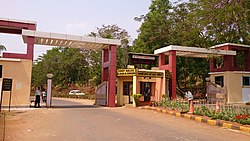
Damanjodi is a town located in the Koraput district of Odisha, India. As of 2001 census, its population was 8,469.[1] The town was founded as a residential area for employees of the National Aluminium Company (NALCO), a company that was established to harness the bauxite-rich deposits of the Panchpatmali Range.[2] Damanjodi contains the NALCO Township, a residential area for NALCO employees, Mathalput, a semi-urban neighborhood with shops, and Bhejaput, a shopping complex. The population is considered cosmopolitan in nature with employees from all over India and locals from the tribal region.

Key Information

Geography

[edit]

Damanjodi is located on the foothills of the Panchapatmali mountain range. The soil is rich with bauxite and has a reddish appearance. The topography is mountainous, and the river Kerandi runs nearby, serving as a source of clean water.

The local agrarian community produces rice, millets, vegetables, and mustard.

NALCO Township

[edit]

The NALCO township is composed of three sectors of housing quarters for the employees of the firm. Facilities include a water supply and treatment plant, NALCO's captive power plant, a hospital, banks with networked ATMs, three large co-operative stores, two market complexes, clubs, community centers, temples, a church, and a mosque. The firm also has some housing in different locations around the township for employees displaced from the main complex. The township also has stadiums, parks, avenues, walking tracks, gardens, plantations, and waterfalls.

Demographics

[edit]

According to the 2001 Indian census,[1] Damanjodi has a population of 8,469. Males constitute 54% of the population and females 46%. The average literacy rate was 83%, higher than the national average of 59.5%. Male literacy was 85% and female literacy was 81%. 14% of the population was under 6 years of age.

Places of worship

[edit]

Damanjodi has a cosmopolitan culture and acknowledges several major religions. Places of religious importance include a number of temples, a church and a mosque.

Shree Jagannath temple

The Shree Jagannath Temple is a major Hindu temple complex. It includes the Mausi Maa Temple, which serves as the center of attention during the annual Ratha-Yatra festival. All major annual festivals and occasions are celebrated in the temple in association with the Shree Jagannath temple at Puri.

Maa Kantabausini temple

Located near one of the main entrance gates of the township, the Maa Kantabausini Temple is a local tourist destination. The presiding deity of Damanjodi Maa Kantabaunsini dwells in the natural sacred grove of bamboo trees.

Shree Shiridi Sai Baba temple

The town's newest temple complex comprises the Dwarka Mayi and Shiridi temples. It hosts all major festivals and rituals in association with the Sai Baba of Shirdi temple.

Shree Hanuman temple

The Shree Hanuman temple complex contains a 108 ft tall statue of Lord Hanuman, which can be seen from any part of the town, as well as a temple with an ashtadhatu idol of Hanuman.

Shree Satya Sai Baba temple

This temple is located in the foothills near Sabari Lake.

Union church

Union church is situated on a small hill near the Ambedkar Stadium and serves the Christian community, .

Damanjodi mosque

The Damanjodi mosque is an example of Muslim style and architecture. It hosts a large gathering during the month of Ramadan for the Muslim Community.

Parks and recreation areas

[edit]

Sabari lake

This artificial lake was originally created by NALCO for water disposal and has become a park including walkways, gardens and sculptures and an artificial waterfall, Sudarshan Jhara. It is popular for picnics in winter.

Biju Patnaik park

One of the oldest parks in the town, Biju Patnaik park is close to Sabari lake. It has a statue of Odisha politician Biju Patnaik near its entrance. The park contains a children's play area and an area dedicated to science.

Nehru Sishu Udyan park

A park mainly dedicated to children.

Saraswati Sishu Udyan park

Located in Saraswati Vihar, this park serves as a central area for children to play.

The NALCO club

This club contains a canteen, swimming pool, badminton court, tennis court, skating ground, indoor games section (table tennis, carom, chess, billiards), gymnasium and library.

NALCO Community Center

A major place of public gathering in the town, the complex hosts all the major trade fairs around the year as well as providing a venue for celebrations, competitions and other events.

Dr. B.R. Ambedkar Stadium

This stadium hosts all the major sporting events as well as the annual Ravan Podi festival, the largest annual gathering in the town.

Pendal amphitheatre

The town's amphitheater is the focus of the annual Panchpatmali Natya Mahotsav theatre festival.

Education

[edit]
Aerial view of DPS Damanjodi

The Saraswati Vidya Mandir school and Delhi Public School are the two main schools within the township. Both institutions were set up with the help of NALCO and provide students with state-of-the-art education amenities.

In addition, the Sri Aurobindo Study Circle, Alumina Girls High School, and Malushanta High School are located outside the township.

Healthcare

[edit]

NALCO supports a hospital complex within the town for company employees, including an occupational health centre and a pharmacy. The Government Health facility is located near Mathalput serves as the main hospital for locals who are not employed by NALCO.

Transportation

[edit]
  • Roads: National Highway 26 (Visakhapatnam-Raipur) is 9 km away from Damanjodi and connected through a service road. The District Headquarters, Koraput, is 36 km away and Jeypore is 52 km. Semilguda and Sunabeda are 9 km and 11 km away respectively. There is a government-run bus service connecting Damanjodi to all major local towns, including Visakhapatnam, Vizianagram, Bhubaneswar, Cuttack, Brahmapur, Jagdalpur, Durg, Raipur, Bhilai, Bolangir, Sambalpur, Baragarh, Bhawanipatna, and Anugul. Private cab and shared taxi services are also available from Damanjodi to all major locations across Odisha and nearby cities like Visakhapatanam, Vizianagram, Jagdalpur and Raipur.
  • Air. Visakhapatnam Airport (200 km away) is the nearest airport used by locals for scheduled domestic flights. There is an airport under development at Jeypore, 54 km away.

References

[edit]
[edit]
Revisions and contributorsEdit on WikipediaRead on Wikipedia
from Grokipedia
Damanjodi is a and industrial hub in the of the Indian state of , primarily established as a residential and operational center for the Limited (NALCO)'s and alumina operations. Located at the foothills of the Panchpatmali plateau in the , the town sits at an elevation of approximately 900 meters above and spans an area of about 12.3 square kilometers. As per the , Damanjodi had a population of 8,862, with a literacy rate of 93.23% and a of 979 females per 1,000 males, reflecting its status as a planned industrial settlement with a diverse . The town's economy revolves around NALCO's Mines & Refinery Complex, which includes a fully mechanized opencast bauxite mine with a capacity of 68.25 tonnes per annum (TPA) on the resource-rich Panchpatmali hills and an adjacent alumina with a normative capacity of 21 TPA, producing metallurgical-grade alumina for domestic aluminum and export markets. Established in the 1980s as part of India's initiatives to harness reserves in the region, Damanjodi's development has transformed the local landscape, with the characteristic of the area owing to high content from deposits. Beyond industry, the town serves as a gateway to Koraput's natural attractions, including the nearby Kolab Reservoir formed by the Upper Kolab , which supports generation and while offering scenic views amid surrounding hills and forests. Damanjodi also features cultural and religious sites such as the Jagannath Temple and Hanuman Temple, which draw local devotees and visitors, contributing to its role as a blend of industrial progress and tribal heritage in one of Odisha's most picturesque districts. The area's , including endemic flora and fauna in the adjacent hills, underscores ongoing efforts in sustainable mining practices by NALCO, though the operations have raised environmental concerns regarding extraction impacts on local ecosystems.

History

Founding and NALCO Establishment

The Limited (NALCO) was incorporated on January 7, 1981, as a public sector undertaking under the , specifically to harness the vast reserves in for alumina and production. This establishment marked a significant step in India's efforts to develop its industry through integrated mining and refining operations, leveraging the state's rich mineral resources to support national industrial growth. The site for NALCO's mining and refining complex was selected in Damanjodi, located in the of , primarily due to its strategic proximity to the extensive deposits in the Panchpatmali hills. These hills, rising to elevations between 1,154 and 1,366 meters above mean , contain substantial reserves that span the plateau, making Damanjodi an ideal location for a pit-head alumina refinery to minimize transportation costs and logistical challenges. Bauxite mining operations at the Panchpatmali mines commenced in November 1985, with a fully mechanized open-cast system designed to supply raw material directly to the adjacent facilities. The alumina in Damanjodi was commissioned in September 1986, enabling the initial production of alumina from the mined bauxite through processes like the Bayer method, which laid the foundation for NALCO's downstream activities. From its inception, Damanjodi was envisioned and planned as a dedicated residential to house NALCO's workforce, comprising engineers, technicians, and laborers recruited from various regions across to support the remote industrial operations. This was integral to attracting and retaining skilled personnel in the tribal-dominated region, fostering a self-contained community around the industrial core.

Township Development

The development of Damanjodi as a township began following the laying of the foundation stone for the Limited (NALCO) project by then-Prime Minister on March 29, 1981, marking the start of to support the emerging industrial complex. Initial efforts from 1981 to 1985 focused on building residential quarters, roads, and basic amenities such as and to accommodate migrant workers arriving for the bauxite mining and alumina refinery projects. These structures were essential to house the influx of skilled and unskilled labor required for site preparation and early operations, transforming the area from a remote forested settlement into a functional . By the late , as NALCO's operations ramped up with the commissioning of the mines in November 1985 and the alumina in September 1986, with initial commercial production beginning in 1987, the township saw further consolidation of housing and connectivity infrastructure. The 's expansion and ongoing operations triggered a significant influx driven by job opportunities in , , and related activities, swelling the resident count and necessitating expanded residential blocks. This period also involved the addition of community facilities like markets and recreational spaces to foster a stable living environment for employees and their families. Early challenges in township development included the displacement of local tribal communities to acquire approximately 2,741 hectares of land for the plant, , and residential areas, affecting around 597 families (including 254 tribal families) and up to 17,678 individuals across 26 villages. Rehabilitation efforts were initiated, with reports highlighting inadequate compensation and relocation support, leading to social tensions; however, NALCO later provided to 599 out of 600 land-displaced persons as of 2022. was integrated from the outset, with provisions for pollution control measures around the to mitigate impacts from industrial activities, though downstream and air quality issues persisted. The 's growth was closely tied to the history at nearby Panchpatmali hills.

Geography and Environment

Location and Topography

Damanjodi is situated in the of southern , , at the coordinates 18°49′N 82°43′E, within the mountain range. The town lies at an elevation of approximately 900 meters (about 3,000 feet) above , positioning it in a region of undulating plateaus and valleys typical of the peninsular highlands. This location places Damanjodi amid the rugged topography of the , where elevations gradually rise from the coastal plains to form a discontinuous chain of hills extending across eastern . The town is positioned at the foothills of Panchpatmali mountain, a prominent plateau in the rising to 1,154–1,366 meters above mean sea level. The surrounding landscape consists of hilly terrain interspersed with dense forests, reflecting the biodiversity-rich ecosystems of the region that include tropical dry and moist vegetation. The Kerandi River flows nearby, providing a vital perennial water source that supports both natural habitats and local needs. Damanjodi's physical setting is underpinned by abundant natural resources, particularly the vast deposits of the Panchpatmali range, estimated at over 310 million tonnes. These reserves, occurring as thick lateritic caps over the plateau, form the geological foundation for aluminum extraction and highlight the area's strategic importance in mineral-rich terrains of the .

Climate

Damanjodi features a , classified under the Köppen system as Aw, with distinct seasonal variations driven by its position in the of . The region experiences three primary seasons: a hot summer from to May, a wet from to , and a mild winter from November to . Average annual temperatures hover around 25°C, with high humidity prevalent during the rainy months, contributing to a lush but challenging environment. In the summer season, daytime highs typically reach 35–40°C, particularly peaking in May at around 36°C, while nighttime lows remain warm at 22–24°C. The brings intense rainfall, with the southwest phase (June–September) accounting for over 80% of the annual total of approximately 1,541 mm, often exceeding 1,500 mm and sometimes approaching 2,000 mm in wetter years. This period sees average highs dropping to 26–30°C and lows around 21–23°C, accompanied by persistently high levels above 80%. The topographical effects of the enhance orographic rainfall in the area but also amplify risks such as landslides in the hilly terrain during these heavy downpours. Winter brings relief with milder conditions, featuring daytime highs of 26–28°C and nighttime lows of 10–15°C, especially dipping to 13°C in December and January. Historical weather events underscore the region's vulnerability, as occasional cyclones originating from the , such as in 2014, deliver excessive rainfall and wind to inland areas like , exacerbating flooding and incidents. For instance, heavy rains in August 2025 triggered landslides that blocked key routes near Damanjodi, highlighting the ongoing hazards posed by the climate.

Economy

NALCO Operations

The Limited (NALCO) operates its primary mining and alumina refining facilities in Damanjodi, , forming the upstream segment of its integrated production chain. The Panchpatmali mines, located in the , employ techniques to extract from the plateau, which spans elevations of 1,154 to 1,366 meters above mean sea level. The current mining capacity stands at 68.25 tonnes per annum (TPA), supporting the downstream processing needs while adhering to sustainable extraction practices. Adjacent to the mines, NALCO's alumina refinery processes the bauxite ore using the , which involves atmospheric pressure digestion in caustic soda to extract alumina hydrate, followed by and to yield smelter-grade alumina. The refinery's normative capacity is 21 TPA, enabling the production of high-purity alumina that is transported by rail to NALCO's integrated smelter in for further . This ensures efficient resource utilization and cost control across the production cycle. As of 2025, NALCO is advancing its operations in Damanjodi with plans for a 10-tonne per year extraction , leveraging indigenous to recover —a critical mineral used in semiconductors and —from the alumina refinery's byproduct streams, with commercial production targeted within the next two years. Additionally, the company's (CSR) initiatives in the region saw expenditure exceeding ₹61 in FY 2024-25, surpassing the mandated obligation of ₹57.93 and focusing on projects such as health, education, and environmental conservation.

Local Employment and Agriculture

The economy of Damanjodi is predominantly driven by employment opportunities at the (NALCO), where a significant portion of the local workforce—particularly from communities—is engaged in , , and ancillary support roles. NALCO's operations at Damanjodi employ around 2,500 people, requiring a mix of skilled technical expertise for roles in extraction and alumina , alongside opportunities for semi-skilled and unskilled labor in maintenance and logistics. In FY 2023-24, NALCO achieved record production, contributing to in the region. As of Q3 FY 2024-25, the company reported a 3-fold surge in net profit, supporting sustained employment. Agriculture remains a supplementary livelihood for many residents outside the industrial sector, characterized by subsistence farming on the limited plains surrounding the hilly terrain. Common crops include , millets, , and mustard, integrated with traditional land and practices that sustain small-scale fields amid the landscape. The rugged topography restricts large-scale cultivation, confining most activities to family-based operations that contribute to rather than commercial output. Beyond NALCO and farming, the local economy features small-scale trade and service-oriented businesses, such as retail shops and maintenance services, primarily serving the needs of township residents and workers. Emerging opportunities in eco-tourism are gaining traction, leveraging the area's natural and proximity to Koraput's eco-tourism sites in the for potential community-led ventures. This heavy dependence on NALCO for primary creates economic vulnerabilities, as fluctuations in global aluminum markets and company-specific challenges, such as raw material shortages, can impact job stability and local incomes.

Demographics

Population Statistics

According to the 2001 Indian census, Damanjodi had a total of 8,475, comprising 4,607 males (54%) and 3,868 females (46%). The 2011 recorded a of 8,862, with 4,633 males and 4,229 females, yielding a of 913 females per 1,000 males. The 2011 is the most recent official data available, as the subsequent census originally planned for 2021 has been delayed and is now set to commence in 2026. This represents a decadal growth rate of approximately 4.55% from 2001 to 2011, part of a steady increase since the driven by industrial migration linked to NALCO's development. In terms of age distribution, the 2001 data indicated that children under 6 years constituted about 14% of the (approximately 1,185 children), while the 2011 figures showed this group at 10.89% (965 children). Damanjodi exhibits an urban-rural mix, with the NALCO township dominating residential patterns and accounting for the majority of the urban .

Literacy and Composition

Damanjodi exhibits a high literacy rate of 93.23% among its population aged seven and above, according to the , surpassing the state average of 72.87% and the national average of 74.04%. Male literacy stands at 96.38%, while female literacy is 90.07%, reflecting a relatively balanced distribution in educational attainment. This elevated rate is largely attributable to the National Aluminium Company's (NALCO) initiatives, including the operation of four schools—two English-medium Delhi Public Schools and two Odia-medium Vidya Mandirs—providing education up to the higher secondary level for children of employees and local residents, alongside support for centers aimed at enhancing among older community members. The demographic composition of Damanjodi is diverse, comprising local Odia-speaking residents, scheduled tribes accounting for 13.47% of the population, and migrants from various Indian states attracted by industrial employment opportunities. Scheduled tribe communities in the area include the Gadaba, a Munda-speaking group prevalent in the Boipariguda block of , with smaller influences from neighboring Particularly Vulnerable Tribal Groups like the Bonda. Scheduled castes represent 14.77% of the populace, contributing to the town's multicultural fabric shaped by NALCO's workforce integration. The population is predominantly Hindu, with minorities including and . The social structure varies spatially: within the NALCO township, nuclear families predominate among professional employees, fostering a modern, urban lifestyle, while traditional extended family systems persist in the surrounding tribal outskirts, where community ties and customary practices remain integral despite industrial influences.

Infrastructure

Education and Healthcare

Damanjodi's system is anchored by institutions supported by the Limited (NALCO), which operates four schools up to the higher secondary level (+2) in the area, including two English-medium and two Oriya-medium facilities catering to both employees' children and local residents. The Delhi Public School (DPS), established in 1984 and affiliated with the (CBSE), is located in the NALCO Township and provides co-educational instruction from grades 1 to 12 with modern amenities. Similarly, Saraswati Vidya Mandir, also founded in 1984 under NALCO's patronage and initially known as Chinmaya Vidyalaya, offers quality in a structured environment for local and tribal students. NALCO's corporate social responsibility (CSR) initiatives extend educational access through programs, including support for centers aimed at improving among locals and tribal communities in peripheral villages. A flagship effort, the Residential School Education program, sponsors 812 underprivileged children from remote and tribal areas around Damanjodi, covering costs for schooling, uniforms, study materials, and hostel fees at institutions such as (KISS) in , Adarsh Vidyalaya in Kakiriguma, and Bikash Vidyalaya in . Additionally, the "NALCO KI LADLI" scheme promotes girl child education by providing scholarships to meritorious students from below-poverty-line families, aligning with national efforts like . Remedial schools operate in five tribal villages near the Mines & Refinery Complex to address learning gaps. For higher education, residents rely on institutions in nearby , approximately 30 km away, including the , Government College Koraput, and Semiliguda College, which offer undergraduate and postgraduate programs in various disciplines. Healthcare in Damanjodi is primarily provided by the NALCO Hospital in Sector 3, which delivers advanced medical care, outpatient services, and emergency treatment to employees, their families, and the broader community. In 2025, NALCO's Director (HR) reviewed the facility to enhance service quality, underscoring ongoing commitments to excellence. Community health centers support rural areas through NALCO's CSR programs, including free health camps for peripheral villages. Challenges persist in accessing services for remote tribal populations due to geographical isolation, prompting expansions like four mobile health units (MHUs) operating in the Damanjodi sector to deliver basic care, medicines, and diagnostics to 163 inaccessible villages. Collaborations, such as with for a paid pediatric outpatient and referral clinic () launched in 2025, further address specialized needs like child healthcare.

Transportation

Damanjodi's road network primarily relies on National Highway 326 (NH 326), which provides connectivity to , approximately 30 km north, and , about 200 km south. The highway facilitates the transport of goods, particularly and alumina from NALCO's operations, though its passage through hilly terrain can lead to occasional disruptions. The NALCO maintains a network of internal roads, including paved streets in residential sectors like Suraksha Vihar, supporting daily commuting and vehicle access within the 8.5 square kilometer area. Rail connectivity is provided by Damanjodi Railway Station (DMNJ), a class B station on the East Coast Railway's Waltair Division, situated along the Koraput-Rayagada line. The station handles around 12-16 trains daily, including express services like the Hirakhand Express and passenger trains to destinations such as (234 km rail distance) and (58 km). It features electronic interlocking signaling and serves as a key stop for passengers and freight related to activities. The nearest airport is Jeypore Airport (PYB), located about 60 km away, which operates domestic flights primarily to via IndiaOne Air's 208B services, with 2-3 weekly flights. For broader international and domestic options, (VTZ), approximately 200 km south, is the primary hub, handling major carriers and connecting to cities like and . Public transportation includes buses operated by the (OSRTC), offering regular services to (1.5 hours), (1.5 hours), and (5-6 hours), with fares starting at ₹50-₹300 depending on the route. NALCO provides carriage bus services for employee commuting to the and within the township.

Community and Culture

NALCO Township

The NALCO Township in Damanjodi is a planned designed to support employees of the Limited (NALCO), featuring zoned sectors that include housing quarters differentiated by employee grades, administrative buildings, and designated green spaces. The comprises approximately 3,000 units organized across well-planned sectors with structured lanes and streets, providing organized residential zones alongside areas for administrative functions and environmental buffers through tree plantations and parks. These green spaces are maintained through ongoing efforts, such as the planting of over 15,000 trees in the and vicinity during 2023-24, contributing to ecological balance within the community. Amenities within the township and a 10-15 km radius cater to daily needs, including clubhouses equipped for recreational activities, shopping complexes for retail and essentials, and sports facilities such as stadiums and gyms. The NALCO Club offers spaces for social gatherings, while market complexes and community centers provide convenient access to banking, postal services, and local commerce, fostering a self-sufficient environment for residents. These facilities support a cosmopolitan population drawn from diverse regions, accommodating multi-ethnic needs through inclusive community infrastructure like fully-aided schools and health units that serve both employees and peripheral areas. The township houses the majority of Damanjodi's residents, primarily comprising NALCO workforce families in a multi-ethnic setting. Sustainability features include a planned system drawing from the Kerandi River to meet residential and operational demands, supplemented by and zero-discharge wastewater management for conservation. In the 2020s, solar initiatives have been integrated, such as a 40 kWp rooftop solar project at the adjacent alumina in 2020 and broader efforts in surrounding areas, promoting use within the township's framework.

Places of Worship and Recreation

Damanjodi's places of worship reflect the town's multicultural fabric, serving Hindu, Christian, and Muslim communities within the NALCO township and nearby areas. The Shree Temple, perched atop the mountains, stands as a prominent Hindu spiritual center, drawing devotees for daily rituals and major festivals. The temple hosts the annual Rath Yatra, a vibrant procession celebrating Lord , which unites residents in traditional Odia festivities. Nearby, the Shree Temple features a 108.9-foot (33.1 m) statue of Lord , the world's second tallest, inaugurated in 2017 and visible from much of the town, serving as a major site for Hindu devotion. Complementing this, the Union Church provides a key venue for , accommodating services and community gatherings for the local Christian . The Damanjodi Mosque offers a dedicated space for Muslim prayers, exemplifying the town's inclusive religious landscape. Recreational facilities in Damanjodi promote leisure and social bonding, particularly through NALCO-maintained green spaces. Sabari Lake, an artificial reservoir transformed into a scenic park, serves as a popular spot for boating, leisurely walks, and picnics amid surrounding hills and greenery. Nearby, Biju Patnaik Park features well-laid gardens, a children's playground, and pathways ideal for family outings, with a statue of the Odisha leader at its entrance enhancing its cultural significance. These sites, all accessible within or adjacent to the township, encourage community interaction. NALCO organizes annual cultural programs and sports meets that blend Odia traditions with influences from migrant workers, fostering . Events such as inter-departmental cricket tournaments and football competitions at local grounds highlight athletic participation, while cultural nights showcase , , and heritage preservation. These initiatives, often held at recreational venues, strengthen communal ties in Damanjodi's diverse setting.

References

Add your contribution
Related Hubs
User Avatar
No comments yet.