


Community hub
Recent from talks
Contribute something
Nothing was collected or created yet.
Dazu Rock Carvings
View on WikipediaThe Dazu Rock Carvings[1] (Chinese: 大足石刻; pinyin: Dàzú Shíkè) are a series of Chinese religious sculptures and carvings and UNESCO World Heritage Site located in Dazu District, Chongqing, China. The carvings date back as far as the 7th century AD, depicting and influenced by Buddhist, Confucian and Taoist beliefs. Some are in rock-cut cave shrines, in the usual Chinese Buddhist style, but many others are rock reliefs carved into the open rock faces. Listed as a World Heritage Site in 1999, the Dazu Rock Carvings are made up of 75 protected sites containing some 50,000 statues, with over 100,000 Chinese characters forming inscriptions and epigraphs.[2] The sites are located in Chongqing Municipality within the steep hillsides throughout Dazu District, located about 165 kilometers west of the urban area of Chongqing. The highlights of the rock grotto are found on Mount Baoding and Mount Beishan.
Key Information


Description
[edit]The Dazu Rock Carvings comprise 5 locations in Dazu District, Chongqing Municipality: Beishan, Baodingshan, Nanshan, Shizhuanshan, and Shimenshan.[2]
- Beishan (North Mountain) contains two groups of rock carvings and sculptures along a cliff face stretching for 300 meters.[2] These date from the 9th to the 12th century and portray Tantric Buddhist and Taoist themes.[3]
- Baodingshan (Baoding Mountain) includes carvings in a U-shaped valley near the Longevity Pavilion, dating from the 12th and 13th centuries. Stretching for 500 meters, the carved figures depict themes from Tantric Buddhism in addition to secular life.[3]
- At Nanshan (South Mountain), the rock art dates from the Song Dynasty during the rule of the Emperor Shao Xing, depicting Taoist themes and symbols.[2] In addition, there is a stele recording the history of Sichuan after a Mongol invasion in the 13th century.[3]
- Shizhuanshan (Shizhuan Mountain) carvings are dated from the early 12th century, uniquely integrating rock-hewn sculptures and carvings depicting Taoism, Confucianism, and Buddhism together. The most prominent of the grotto sculptures are thought to have been sculpted by Wen Wijian, a famous sculptor of the time.[3]
- Shimenshan (Shimen Mountain) contains carvings that date from the 12th century, including statues of the Jade Emperor and several gods.[3]
History
[edit]The technique for rock carvings may have originated in ancient India.[3] The earliest carvings were begun in 650 AD during the early Tang dynasty, but the main period of their creation began in the late 9th century, when Wei Junjing, Prefect of Changzhou, pioneered the carvings on Mount Beishan, and his example was followed after the collapse of the Tang dynasty by local and gentry, monks and nuns, and ordinary people during the Five Dynasties and Ten Kingdoms period (907–65). In the 12th century, during the Song dynasty, a Buddhist monk named Zhao Zhifeng began work on the elaborate sculptures and carvings on Mount Baoding, dedicating 70 years of his life to the project. Unlike most collections of rock carvings, the Dazu rock carvings include statues representing all three major religions: Buddhism, Taoism, and Confucianism.[3]
Off limits to visitors for many years, the carvings were opened to Chinese travelers in 1961 and foreign visitors in 1980. Until 1975, there was only a muddy path between the town of Dazu and the main cluster of carvings.[4]
The carvings were listed as a World Heritage Site in 1999, citing "…their aesthetic quality, their rich diversity of subject matter, both secular and religious, and the light that they shed on everyday life in China during this period. They provide outstanding evidence of the harmonious synthesis of Buddhism, Taoism and Confucianism."[2]
Panorama
[edit]


Gallery
[edit]-
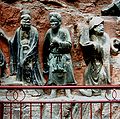 Dazu rock carving at Baodingshan
 -
 Dazu rock carvings at Baodingshan
 -
 Statues of various Buddhas at Baodingshan
 -
 A Bhavacakra depicting the realms of samsara at Baodingshan
 -
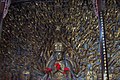 The Thousand-armed manifestation of Guanyin at Baodingshan
 -
 Baodingshan Buddha statues
 -
 Baodingshan panorama of the eighteen layers of hell
 -
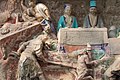 Statues of demons and officials of hell
 -
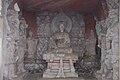 Statue of the bodhisattva Guanyin at Beishan
 -
 The Wisdom King Mahamayuri riding on her peacock mount
 -
 Various Buddhas at Beishan
 -
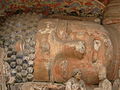 Statue depicting Sakyamuni Buddha entering Nirvana at Beishan


Transport
[edit]- Dazushike railway station on Chengdu-Chongqing Central line high-speed railway is currently under construction[5]
See also
[edit]- Dazu Lotus Manor, a nearby attraction
- Tianlongshan Grottoes
References
[edit]- ^ "Dazu Rock Carvings Baodangshan Site". TripAdvisor. 21 September 2014.
- ^ a b c d e "Dazu Rock Carvings". UNESCO World Heritage Centre. United Nations Educational, Scientific, and Cultural Organization. Retrieved 4 Apr 2021.
- ^ a b c d e f g State Bureau of Cultural Relics, People's Republic of China (1999). Dazu Rock Carvings (PDF) (Report). United Nations Educational, Scientific, and Cultural Organization. Retrieved 4 Apr 2021.
- ^ Terrill, Ross (January 14, 1990). "Serene Haven of Buddhist Art". The New York Times. Retrieved February 11, 2009.
- ^ "走进区域看发展 以后坐高铁去看大足石刻 从这个站下走800米就到了".
External links
[edit]
- UNESCO World Heritage Centre page
- Wisdom embodied: Chinese Buddhist and Daoist sculpture in the Metropolitan Museum of Art, a collection catalog from The Metropolitan Museum of Art Libraries (fully available online as PDF), which contains material on the Dazu Rock Carvings
| Districts | 
 | |
|---|---|---|
| Counties | ||
| Autonomous counties | ||
| Defunct divisions | ||
| Attractions |
| |
| Sports venues | ||
| Higher education | ||
| Culture & demographics | ||
| Transport | ||
| Economy | ||
| East |
|  |
|---|---|---|
| South Central |
| |
| Southwestern | ||
| North | ||
| Northeast | ||
| Northwestern | ||
| Multiple regions |
| |
| International | |
|---|---|
| National | |
| Other | |

Dazu Rock Carvings
View on GrokipediaLocation and Overview
Geographical Setting
The Dazu Rock Carvings are located in Dazu District, Chongqing Municipality, in southwest China, at coordinates 29°42′4″N 105°42′18″E.[3] This rural area lies approximately 105 kilometers northwest of Chongqing's urban center, within the broader Sichuan Basin.[4] The site occupies a mountainous terrain of steep hillsides, abrupt cliffs, and elevated plateaus, with key clusters distributed across five main mountains at altitudes ranging from 374 to 545 meters.[1] These natural rock formations, primarily composed of durable sandstone and limestone, directly influenced site selection, as artisans chose exposed cliff faces—such as those extending up to 500 meters in length—for their stability and suitability for large-scale engraving.[4] The topography features U-shaped gorges and overhanging ledges, providing sheltered niches that protected the carvings from direct weathering while integrating them into the landscape.[1] The region experiences a subtropical warm and humid monsoon climate, characterized by mild temperatures with an annual average of about 17°C (ranging from 5°C in winter to 28°C in summer), high humidity, and seasonal rainfall of 900–1,100 millimeters, which contributes to the site's lush vegetation and occasional erosion challenges for the rock surfaces.[5] As of 2024, digital monitoring technologies have been implemented to protect the carvings from environmental threats.[6] Situated in the upper reaches of the Yangtze River Basin, Dazu is about 100 kilometers from the Yangtze's main course through Chongqing, linking it environmentally to the river's subtropical influences without direct riparian exposure.[7]Scope and Composition
The Dazu Rock Carvings encompass a vast ensemble of ancient Chinese rock art, comprising 75 protected sites scattered across five major clusters in Dazu District, Chongqing Municipality. These sites collectively feature approximately 50,000 statues, ranging from monumental figures to intricate reliefs, alongside over 100,000 inscribed Chinese characters that form epigraphs, steles, and dedicatory texts.[2] This extensive collection highlights the carvings' role as a comprehensive heritage site, preserving a diverse array of sculptural and epigraphic elements that reflect centuries of artistic production.[1] The carvings are primarily executed in sandstone, with some instances involving limestone, hewn directly into open-air rock-cut caves, shrines, and cliff faces on steep hillsides.[8] Dating from the 7th to the 13th centuries, with the earliest examples traced to the Tang Dynasty around AD 650 and the peak activity during the 9th to 13th centuries, the works demonstrate advanced techniques in rock relief and grotto sculpture.[2] The material's durability has allowed many carvings to withstand environmental exposure, though ongoing conservation addresses weathering challenges inherent to these sedimentary rocks.[9] Categorically, the ensemble includes Buddhist, Taoist, and Confucian reliefs, blending statues of deities, narrative scenes, and moral inscriptions in a syncretic manner that marks the Dazu carvings as the last major monumental grotto art tradition in China.[1] This integration underscores their significance as a culminating phase in Chinese cave temple art, where religious iconography coexists with philosophical motifs across the sites.[10]Historical Background
Early Development
The Dazu Rock Carvings originated in the early Tang Dynasty, with the earliest known carvings dating to around 650 AD during the reign of Emperor Gaozong. These initial efforts were spearheaded by local monks and patrons in the Dazu region of present-day Chongqing, reflecting a grassroots initiative to propagate Buddhist teachings amid the broader cultural flourishing of the Tang era.[2] The carvings began modestly at sites such as Jianshanzi, featuring simple relief sculptures and dedicatory inscriptions that served both devotional and commemorative purposes.[11] A key influence on these early works was Esoteric (Tantric) Buddhism, which had spread from India through Central Asia along the Silk Road, reaching China via earlier cave art traditions at sites like Dunhuang. This esoteric strand emphasized ritualistic and symbolic elements, manifesting in the Dazu carvings through basic depictions of deities, mandalas, and sutra scenes that adapted foreign iconography to local Chinese aesthetics.[2][8] The Tang period's relative openness to foreign religious ideas facilitated this synthesis, though the carvings remained rudimentary compared to later developments, prioritizing inscriptional texts alongside shallow reliefs to invoke protective and salvific powers.[2] Carving activity expanded significantly in the late 9th century, particularly from 892 AD under the patronage of Wei Junjing, the Prefect of Changzhou, who initiated major works at Beishan. This period coincided with the transition from the late Tang Dynasty into the Five Dynasties and Ten Kingdoms era (907–960 AD), a time of fragmented central authority that shifted sponsorship from imperial decrees to local officials, gentry, monks, and even ordinary devotees.[2][8] As regional political fragmentation intensified, these local actors funded over 10,000 figures and niches at early sites, marking a pivotal move toward community-driven artistic expression that laid the groundwork for Dazu's enduring legacy.[2]Peak Period
The Dazu Rock Carvings reached their zenith during the Song Dynasty (960–1279), particularly from the 11th to 13th centuries, when carving activity flourished under the patronage of local warlords, officials, monks, lay Buddhists, and villagers in the Sichuan region. After a pause in the early Song Dynasty, work resumed in 1078 AD at sites including Beishan, Nanshan, and Shimenshan, leading to a surge in monumental projects, with sites like Baodingshan emerging as focal points of artistic innovation, supported by merit-making rituals such as shuilu offerings that integrated community contributions. A pivotal figure was the monk Zhao Zhifeng (active ca. 1178–1236), who initiated and oversaw the extensive carvings at Baodingshan, directing work that spanned from 1174 to 1252 and encompassed over 70 years of dedicated effort by teams of artisans.[12][1] Stylistically, the Song-era carvings evolved toward greater realism and secular integration, departing from earlier doctrinal rigidity by incorporating naturalistic depictions of everyday life, such as donors, families, and herdsmen alongside religious icons. This shift reflected broader societal transformations, including rapid urbanization, economic prosperity, and the revival of Neo-Confucianism, which emphasized ethical themes like filial piety and harmonious synthesis of Buddhism, Daoism, and Confucianism in the artwork. Examples include narrative scenes of Jataka tales and parental kindnesses that humanized divine figures, blending Tantric Buddhist elements with local customs to appeal to a diverse audience amid literati migration and cultural flourishing in southern China.[12][13] Carving activity declined sharply after the Mongol invasion in the late 13th century (ca. 1279), which ended the Southern Song and disrupted patronage networks through political upheaval and regional instability. While minor additions occurred during the Yuan (1271–1368) and Ming (1368–1644) dynasties, these were limited in scale compared to the Song peak, marking a transition to sporadic restorations rather than expansive creation.[12][1]Principal Sites
Beishan
The Beishan site, located on the northern cliffs of Mount Beishan in Dazu District, Chongqing, China, represents one of the earliest and most extensive clusters of rock carvings in the Dazu complex, primarily created between the late 9th and mid-12th centuries during the Tang and Song dynasties.[2] This period saw the production of over 10,000 carved figures distributed across approximately 264 niches along a 300-meter stretch of cliff face, rising 7 to 10 meters high, showcasing a blend of esoteric religious motifs that reflect the region's spiritual diversity.[2] The carvings emerged under the patronage of local military and civilian donors, beginning with initiatives by Wei Junjing in 892 AD, and continued through the Five Dynasties and Ten Kingdoms period into the Song era, marking a revival of stone carving traditions in a time of political fragmentation.[11] A defining characteristic of Beishan's artistry is its emphasis on Tantric Buddhist elements, with over half of the niches featuring esoteric mandalas and deities that illustrate complex cosmological diagrams and protective incantations.[2] For instance, Niche 138 depicts the "Wheel of the Universe," a Tantric mandala symbolizing the interconnected realms of existence, while other reliefs portray multi-armed forms like the Sahasrabhuja Sahasranetra Avalokitesvara, emphasizing compassion and esoteric rituals derived from Vajrayana traditions that persisted in southwestern China despite their decline elsewhere.[11] Interwoven with these are Taoist motifs, including depictions of immortals, integrated alongside Buddhist figures to promote harmony between celestial and moral realms, as seen in niches blending Confucian filial piety with Taoist longevity themes.[2] Reliefs of hell scenes further underscore moral teachings, vividly portraying punishments in infernal realms—such as demons tormenting sinners—to exhort ethical conduct and warn against vice, drawing from Buddhist concepts of karma while echoing broader Song-era didactic art.[2] Architecturally, Beishan's carvings are organized into multi-level rock-cut shrines, with niches excavated in rectangular forms often featuring central pillars for structural support and aesthetic depth, as exemplified by Niche 168, a 3.3-meter-high and 7.1-meter-deep chamber from the Song period.[11] These shrines are accompanied by numerous inscriptions, including seven surviving steles from the Tang and Song eras, such as the 895 AD Wei Junjing Stele recording donor intentions for familial prosperity and the 1163–1189 Zhao Yijian Stele inscribed by the renowned calligrapher Cai Jing, which provide historical context on the carvings' creation and the socio-religious motivations behind them.[2] This integration of sculpture, architecture, and epigraphy highlights Beishan's role as a foundational site in Dazu's evolution, influencing later developments in Chinese grotto art.[11]Baodingshan
Baodingshan, located in a U-shaped valley approximately 15 kilometers northeast of Dazu District in Chongqing, China, represents the pinnacle of Song Dynasty rock art innovation within the Dazu ensemble. Primarily carved between 1174 and 1252 CE during the Southern Song period, the site was spearheaded by the monk Zhao Zhifeng, who devoted much of his life to its development as a center for esoteric Buddhist teachings.[14][15] The complex integrates over 10,000 figures across a monumental cliff face, blending spiritual iconography with vivid representations of human experience to convey Buddhist cosmology in an accessible manner.[14][1] The site's distinctive layout centers on the Great Buddha Bend (Dafowan), a 500-meter-long, hairpin-shaped cliff that forms a semi-circular path, allowing visitors to progress through 31 interconnected relief groups that narrate the path to enlightenment. This innovative design, distinct from linear cave arrangements elsewhere, culminates in the circular Tathagata Cave, where carvings of the Buddha's parinirvana and cosmic elements merge with scenes of everyday human activities, symbolizing the interplay between divine order and mortal life.[14][16] Accompanying the Great Buddha Bend is the smaller Little Buddha Bend (Xiaofowan), featuring additional niches that extend the thematic flow.[1] Among the most iconic sculptures is the Thousand-Armed Guanyin (Avalokitesvara), a 7.7-meter-high figure with over 1,000 arms radiating from its body, each holding symbolic objects to represent boundless compassion and the deity's ability to aid all beings simultaneously. Nearby, the Ten Wisdom Kings, including the fierce protector Acala (Fudō Myō-ō), are depicted in dynamic poses wielding ritual implements to subdue ignorance and evil forces, emphasizing Tantric themes of transformation. The carvings also uniquely incorporate depictions of daily life, such as agricultural labor by farmers and the process of childbirth—exemplified in a relief showing a midwife assisting a mother in a vertical delivery position—to illustrate karmic cycles and ethical living within Buddhist doctrine.[14][17][12]Nanshan and Other Sites
The Nanshan site, located approximately 2 kilometers south of Dazu town at an elevation of 514 meters, features rock carvings primarily from the Southern Song Dynasty between 1131 and 1162 CE, emphasizing Taoist themes.[1][4] The carvings span an 86-meter cliff face with 15 niches containing 421 statues, including representations of the Taoist pantheon such as the Jade Emperor and various immortals in the well-preserved Sanqing Ancient Grotto and Jade Emperor Temple.[1][18] A notable 13th-century stele at the site records the historical aftermath of the Mongol invasion in Sichuan, providing insight into regional events during the transition to the Yuan Dynasty.[18] Shizhuanshan, situated 20 to 25 kilometers southwest of Dazu town, dates to the late 11th century during the Northern Song Dynasty (1082–1090 CE) and exemplifies a rare syncretism of Buddhist, Taoist, and Confucian elements across carvings extending 130 meters.[1][4] The site includes 10 grottoes with 14 niches, blending religious figures such as Confucius and his ten disciples in Grotto No. 6 alongside Taoist deities like Lao Tzu and Buddhist icons, highlighting moral philosophy through integrated shrines.[18][4] Shimenshan, 20 kilometers east of Dazu town at 374 meters elevation, preserves carvings from the late Northern to early Southern Song Dynasty (1094–1151 CE), integrating Buddhist and Taoist motifs over a 72-meter span with 16 grottoes, 12 of which contain statues.[1][4] Key features include the prominent Jade Emperor statue in a niche guarded by mythological figures such as Shun Feng Er (Favorable Wind Ears) and Qian Li Yan (Thousand-Mile Eyes), dated to 1147 CE, alongside Confucian emphases on filial piety and moral teachings in inscriptions.[18][19] These peripheral sites collectively underscore a Taoist-leaning orientation with multi-religious influences, contrasting the more singular Buddhist focus elsewhere, and incorporate later Yuan-era elements like the Nanshan stele amid approximately 5,000 figures across minor clusters.[1][18] The emphasis on moral and philosophical themes, such as ethical conduct and religious harmony, reflects the Song-era cultural synthesis in these lesser-visited areas.[18]Religious and Artistic Elements
Syncretism of Beliefs
The Dazu Rock Carvings exemplify the Song Dynasty's (960–1279) religious harmony, known as sanjiao heyi or the unity of the Three Teachings, where Buddhism, Taoism, and Confucianism coexisted and intermingled without rigid hierarchies. This syncretism emerged in a period when Neo-Confucianism absorbed elements from Buddhism and Taoism, supported by imperial patronage and regional stability in Sichuan, allowing carvings to depict Buddhist deities, Taoist immortals, and Confucian sages in shared cliff spaces across sites like Shizhuanshan and Baodingshan.[12][1] The integration reflected broader societal trends, with monks like Zhao Zhifeng (active 1178–1236) at Baodingshan incorporating diverse rituals such as the shuilu ceremony, which invoked figures from all three traditions to honor the deceased and promote communal merit.[12][14] Specific examples of this fusion abound, such as at Miaogaoshan Cave 2 (c. 1144), where Śākyamuni Buddha, Laozi, and Confucius are carved in equal prominence within a single space, symbolizing philosophical dialogue and mutual respect among the teachings. At Baodingshan's Dafowan niches (late 12th to mid-13th century), ethical inscriptions blend Confucian filial piety—depicted in scenes like Prince Sattva's self-sacrifice to feed a starving tigress, illustrating ultimate compassion alongside Confucian filial piety—with Buddhist karma, as seen in carvings of the Seven Buddhas rewarding virtuous behavior while punishing filial neglect alongside Daoist weather gods like thunder and lightning deities. Similarly, Shizhuanshan's niches (1082–1096) feature separate yet proximate dedications, including Niche 6 honoring Confucius with his ten disciples, Niche 8 showing Laozi with attendants, and adjacent Buddhist triads, often tied to inscriptions invoking the shuilu rite for cross-traditional salvation. These arrangements highlight localized adaptations, such as sinicizing Buddhist figures like Hārītī as a noble Chinese woman, merging imported faiths with indigenous ethics.[12][8][14] This syncretism played a pivotal role in fostering religious tolerance during the Song era, reducing sectarian conflicts by presenting the teachings as complementary paths to moral and spiritual enlightenment, as evidenced by donor inscriptions emphasizing shared goals like rebirth and harmony. In Sichuan's cultural landscape, it facilitated local adaptations of Buddhism and Taoism, incorporating Confucian social values to make esoteric concepts accessible to lay audiences and reinforcing community cohesion through public teaching tools like Baodingshan's tableau sequences. The carvings' enduring legacy underscores how this blending promoted a pluralistic worldview, influencing later Chinese religious practices and highlighting the region's role as a hub for ideological synthesis.[12][1][8]Iconography and Themes
The iconography of the Dazu Rock Carvings features a diverse array of dominant themes that blend spiritual, moral, and worldly elements, reflecting the cultural milieu of medieval China. Central to the collection are motifs from Esoteric Buddhism, including intricate mandalas that symbolize the universe and the path to enlightenment, as well as wrathful deities embodying protective forces against ignorance and evil.[1] These esoteric representations underscore the tantric emphasis on ritual visualization and transformation.[14] Complementing the religious imagery are depictions of secular life, capturing the rhythms of daily existence such as farming activities, herding livestock, familial bonds, and scenes of communal labor, which serve to moralize everyday conduct through visual narrative.[1] Punishment in hell realms appears as a stark counterpoint, illustrating consequences for ethical failings like greed and violence, thereby reinforcing didactic messages accessible to lay audiences.[1] Cosmological themes, particularly the Wheel of Life, depict the cyclical nature of existence—encompassing birth, suffering, death, and rebirth—governed by karma, providing a comprehensive visual exegesis of samsara.[1] Symbolic elements enrich these themes, with the lotus flower recurrently employed as a motif for spiritual purity and rebirth, often emerging from muddy waters to signify transcendence over worldly defilements.[1] Dragons, integrated into reliefs and architectural frames, evoke imperial authority, cosmic harmony, and protective guardianship, drawing from longstanding Chinese iconographic traditions.[1] Accompanying inscriptions, etched directly into the stone, incorporate sutra passages that elucidate Buddhist doctrines and poetic compositions that meditate on impermanence and virtue, bridging textual and visual expression.[1] Artistic innovations distinguish the Dazu carvings from predecessors, notably through the use of realistic human proportions that convey natural anatomy and dynamic poses, fostering a sense of immediacy and movement.[14] Emotional expressions on figures—ranging from serene contemplation to intense anguish—add psychological depth, contrasting with the more rigid, stylized aesthetics of earlier Tang-era grottoes and allowing viewers to connect viscerally with the narratives.[14] These stylistic advances, achieved via techniques like relief and openwork carving, elevate the carvings' expressive power while maintaining thematic coherence.[20]Significance and Preservation
Cultural Importance
The Dazu Rock Carvings represent the pinnacle of late Chinese grotto art, spanning the 9th to 13th centuries and marking the culmination of centuries-long traditions from earlier sites like Dunhuang and Yungang. While Yungang's Northern Wei sculptures (5th-6th centuries) featured heavier, more rigid forms influenced by Central Asian styles, Dazu's works transitioned toward Song Dynasty realism with naturalistic drapery, dynamic poses, and intricate reliefs that integrated architectural elements seamlessly into the rock face.[14] This evolution completed the localization of grotto art in China, blending foreign Buddhist imports with indigenous aesthetics to create a distinctly national style.[21] The carvings' unified layouts and stylistic innovations, particularly at Baodingshan under monk Zhao Zhifeng (1174–1252), exerted lasting influence on subsequent Chinese sculpture, attracting restorations as late as the 15th century and serving as a high point in cave temple art before its decline.[8][14] The carvings offer profound insights into 9th- to 13th-century Chinese society, capturing everyday life, social structures, and historical upheavals through over 50,000 statues and 100,000 inscribed characters. Depictions of family dynamics, such as the Baodingshan relief "Parents bestowing kindness on their children," illustrate Confucian values of filial piety and gender roles, with donor inscriptions revealing male dominance in patronage (e.g., 28 male vs. 12 female donors in one Beishan niche) alongside women's active participation in religious funding.[8][22] Scenes of medicine, including the Medicine Buddha in Beishan's Niche 281, reflect societal concerns with health, healing, and the afterlife amid Tang-Song transitions.[22] Historical events like the Song-Jin wars are evoked in war deities such as Mārīcī in Southern Song niches, symbolizing protection against invasions and the era's mass migrations of over 2 million people, providing tangible evidence of military and social stresses.[22] These secular motifs, including farming and domestic activities, humanize the religious narrative and document lay community rituals like family feasts.[1] Comparatively, Dazu stands unique among global rock art sites for its harmonious multi-faith syncretism and emphasis on everyday life, diverging from predominantly Buddhist complexes like those at Dunhuang. Unlike the more esoteric or purely devotional focus of earlier northern grottoes, Dazu integrates Buddhism, Daoism, and Confucianism in tripartite arrangements—such as Tantric Buddhist themes alongside Taoist immortals and Confucian moral scenes—fostering a spiritual pluralism reflective of late imperial folk religion.[1] This eclectic approach, combined with vivid portrayals of secular existence, underscores Dazu's role as a cultural bridge, embodying China's religious dissemination and contributing to its recognition as an outstanding universal value in world heritage.[21][1]Conservation Efforts and UNESCO Status
The Dazu Rock Carvings were inscribed on the UNESCO World Heritage List in 1999 as a cultural property under reference number 912.[1] This recognition affirms their outstanding universal value under criteria (i), (ii), and (iii), acknowledging them as a masterpiece of human creative genius in the realm of rock-cut art, an important interchange of human values exemplified by the syncretism of Buddhist, Taoist, and Confucian beliefs, and a unique testimony to a distinctive cultural tradition in medieval China.[1] Historically, the site faced restricted access, remaining off-limits to visitors for decades before opening to Chinese travelers in 1961 and to foreign visitors in 1980, which limited early conservation and study efforts.[23] Contemporary challenges include natural weathering from subtropical rainfall and accelerating climate change, air pollution via atmospheric particulates and emissions from nearby activities, and increased pressures from tourism that exacerbate environmental stress on the sandstone carvings.[24][25][26] From 2020 to 2025, conservation initiatives have emphasized multidisciplinary water-damage mitigation, incorporating advanced drainage systems, real-time environmental monitoring for moisture and meteorology, and relocation of polluting industries to reduce emissions.[27][28] Digital technologies, including high-precision 3D scanning for damage assessment and virtual projections for restoration planning, have facilitated non-invasive preservation and public engagement through platforms like a trial digital museum launched in 2024.[29][6] That same year, the International Symposium on Dazu Studies gathered over 120 experts from 11 countries to advance strategies in digital preservation, research, and sustainable development of the rock carvings.[30]Visiting the Carvings
Access and Transportation
The Dazu Rock Carvings are most conveniently accessed from Chongqing, located about 100 kilometers northwest, via a 1.5- to 2-hour drive on expressways such as those connecting the city center to Dazu District.[31][32] High-speed trains from Chongqing West Station to Dazu South Station take about 40-50 minutes and cost around 50 CNY, followed by a 50-minute taxi or bus to the sites.[33] Public buses depart from stations like Chenjiaping or Chongqing North Station South Square, taking around 2 hours and costing 43-50 CNY as of 2025, followed by local transfers.[34][35] From Chengdu, the trip spans approximately 3-4 hours, typically combining a high-speed train to Dazu South Station (about 1 hour) with a subsequent 50-minute taxi or bus ride to the sites.[36][34] The nearest major airport is Chongqing Jiangbei International Airport (CKG), from which the carvings are roughly 101 kilometers away, accessible by a 1- to 1.5-hour taxi or shuttle ride costing 140-190 CNY as of 2025.[37][38] Within the Dazu area, buses and taxis provide connections between the main clusters, such as Beishan, Baodingshan, and Nanshan; for instance, a dedicated shuttle links Beishan and Baodingshan in about 10 minutes, often included with entry tickets.[31][39] Entry fees vary by site and season as of 2025: Baodingshan costs 130 CNY (including museum and transport ticket) in peak season (March-November) or 110 CNY off-peak (December-February), Beishan 70 CNY or 50 CNY respectively, and combined tickets 140 CNY peak or 120 CNY off-peak.[40][41][42] Spring (March-May) and autumn (September-November) offer the most favorable conditions for visits, with mild temperatures of 10-25°C and lower rainfall, making navigation easier than in the wet summer or hot mid-year periods.[39] Guided tours are advisable for multi-site itineraries, as they streamline transportation and provide contextual insights across the dispersed locations.[31]Practical Visitor Information
Visitors to the Dazu Rock Carvings can utilize on-site facilities at major clusters such as Baodingshan and Nanshan, including the Dazu Rock Carvings Museum, which features immersive exhibits like 8K panoramic films on the site's history and artistry. Rest areas are available at locations like the Baodingshan Tourist Center, Shengshou Temple, and Sanqing Ancient Grotto, providing spots for breaks during exploration. English-speaking guides or audio guides are offered at Baodingshan for approximately 120-200 CNY per session, though dedicated audio guides are not widely available; visitors are encouraged to hire local guides for detailed explanations. Private full-day tours with English guide start from around 1000 CNY.[43][4][41][44] Accessibility at the sites is limited due to the rugged terrain, with numerous stairs, steep paths, and uneven trails requiring sturdy, comfortable footwear and moderate physical fitness; areas like Shizhuanshan involve significant climbing, and wet weather can make surfaces slippery. These features pose challenges for those with mobility impairments, as ramps or elevators are not extensively provided across the hillside locations. Due to ongoing conservation sensitivities, visitors must adhere to marked paths to avoid stressing the delicate rock surfaces.[41][44][45][31] Strict rules are enforced to protect the carvings, including prohibitions on touching, climbing, or damaging the stone surfaces, as well as bans on using flash photography or tripods without permits in sensitive areas. Smoking and unauthorized religious activities are also restricted, and visitors should maintain low voices in temple zones to respect the site's sanctity. Peak season from April to October brings larger crowds, particularly on weekends and holidays, so arriving early helps mitigate congestion.[46][47][48][49] For an optimal visit, allocate 1-2 days to cover core sites like Baodingshan and Beishan, with 3-6 hours typically needed for Baodingshan alone due to the extent of walking involved. Combining the trip with nearby Chongqing attractions, such as via a short high-speed rail connection, allows for efficient itinerary planning. Recent eco-tourism initiatives emphasize sustainable practices, including staying on designated paths, bringing reusable water bottles to reduce waste, and minimizing single-use plastics to preserve the natural environment surrounding the carvings.[4][44][41]References
- https://en.wikivoyage.org/wiki/Dazu