Hubbry Logo
Debate chamberDebate chamberMain
Open search
Debate chamber
Community hub
Debate chamber
logo
8 pages, 0 posts
0 subscribers
Be the first to start a discussion here.
Debate chamber
Debate chamber
from Wikipedia
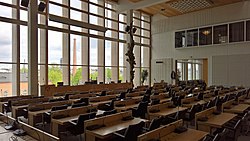
A debate chamber of the City Council of Tampere in the City Central Office Building of Tampere, Finland

A debate chamber is a room for conducting the business of a deliberative assembly or otherwise for debating. When used as the meeting place of a legislature, a debate chamber may also be known as a council chamber, legislative chamber, assembly chamber, or similar term depending on the relevant body. Some countries, such as New Zealand, use the term debating chamber as a name for the room where the legislature meets.[1]

Debating

[edit]

Debating can happen more or less anywhere that is not immediately hazardous. Whether informal or structured, debates often have an audience. The debate does not involve the audience as such; they may even be watching remotely. Therefore, a debate can occur basically anywhere, even in the street, in a hallway, on board a moving vehicle, or any number of other unusual locations.

However, in common parlance, a debating chamber is a room set aside for the purposes of holding debates, usually permanently. It usually contains furniture set up to organize the debate, so as to clearly separate the people participating in the debate and the audience, and usually to clearly separate the sides of the debate. If the format of the debate includes a moderator (such as the speaker of a legislature) they must sit in a clear position of authority.

In general, a debate chamber has seats and tables for the moderator and the debate participants, and a separate seating area for the audience. Other facilities may include one or more podiums for delivering speeches, possibly located on a stage to facilitate presentation of the debate to an audience. Recording and broadcasting equipment may be installed in a debating chamber so that proceedings there can be shown to the public at large. In the case of a legislative chamber or the like, there may be separate galleries for the public, while members of the legislature (and appropriate staff) are the only ones permitted in the chamber proper.

Psychology and geometry

[edit]

The configuration of seating affects interpersonal communication on conscious and subconscious levels. For example, disagreements over the shape of a negotiation table delayed the Vietnam War peace talks for almost a year.[2]

The geometry of seating position can support or determine a sense of opposition/confrontation, hierarchy/dominance, or collaboration/equality. Factors such as angle/rotation, proximity/distance, median/termini, and height/incline are all relevant considerations. The more directly two parties are positioned across from one another, the more likely their relationship will be one of opposition to each other; the less direct, or more "side-by-side" these positions are, the less likely such an opposing relationship becomes, but also the less effective it will be at fostering collaboration.

These effects can be observed in debate chambers, meeting rooms, and at dining or restaurant tables. For instance, with a long rectangular table, those seated at the "head" or "end" of the table are in a position of dominance; they can see everybody, and normally everybody can see them, but the others are restricted to seeing only those across from them. Circular, square, or elliptical tables facilitate more equal status between those seated, as well as less obstructed lines of sight. A circular gathering with three participants provides the only non-oppositional configuration of more than two persons that allows equal line of sight (all 120 degrees apart).

The smaller the group and setting, the greater the equity of participants and sight lines. Conversely, the more participants that are present, the greater is the disparity of sight lines between those sitting immediately adjacent and those more directly across, whose position in turn becomes more oppositional.[3] Winston Churchill recognized this when he insisted the British House of Commons be rebuilt (after wartime bombing) in a similar size and configuration as the prior chamber, to maintain the intimate and adversarial style of debate which he believed was responsible for creating the British form of government.[4]

History

[edit]

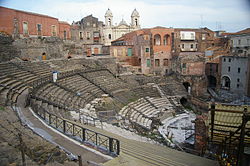
Whether outdoors or in an enclosed space or chamber, such as a cave, it is likely that the earliest designated places for group discourse or debate occurred around a fire, for light, heat, or protection from predators. Throughout recorded history there have been a variety of places and spaces designated for similar purposes. An early gathering for assembly purposes was the Ecclesia of ancient Athens, a popular assembly open to all male citizens with two years of military service. This was held in an Ekklesiasterion, which varied from small amphitheaters to a variety of buildings, including ones that could accommodate over 5,000 people. These assemblies were also held in amphitheater-like, open air theaters. Bouleuterions, also translated as council house, assembly house, and senate house, was a building in ancient Greece which housed the council of citizens of a democratic city state. In Ancient Rome, the earliest recorded debating chamber was for the deliberative body of the Roman Senate.

The first official debating model that emerged (centuries later) after the fall of the Roman Empire was the Magnum Concilium, or Great Council, after the Norman Conquest of England in 1066. These were convened at certain times of the year when church leaders and wealthy landowners were invited to discuss the affairs of the country with the king (of England, Normandy, and France). In the 13th century this developed into the Parliament of England (concilium regis in parliamento). Similar models emerged at roughly the same time with the Parliament of Scotland and Parliament of Ireland. These were later consolidated into the Parliament of Britain and the current Parliament of the United Kingdom (or British Parliament). The system of government that emerged in this model is known as the Westminster system. In Europe, similar models to parliament emerged, termed Diet and Thing, or Ting, thing derived from old Norse for "appointed time" or "assembly". The parliament that claims to have the longest continuous existence is the Tynwald of the Isle of Man. In 19th century Russia, the Duma emerged to perform similar advisory functions to the monarch.

In the 14th century, the king of France established the Estates General, a legislative and consultative assembly of the different classes (or estates) of French subjects. In the 18th Century French Revolution, this was transformed into the National Assembly (1789), the National Constituent Assembly (1789–1791), the Legislative Assembly (1971–1792), the National Convention (1792–1795), the Council of Five Hundred (1795–1799), and eventually the tricameral (three-house) French Consulate during the reign of Napoleon Bonaparte. These bodies met in a variety of palaces, a riding academy, a large theater, and a tennis court.[5]

In the late 18th century the United States of America established the U.S. Congress, a bicameral legislative model that would form the template of many newly emergent republics around the world. The form adopted involved two legislative bodies, each with its own chamber. The lower house, the U.S. House of Representatives, was intended to provide representation based on population. The upper house, the U.S. Senate, was intended to provide more deliberative oversight on legislation and was to represent the States (equally). Each was created and its chambers designed before political parties were well established.

Names

[edit]

The names given to debating places or spaces may refer to an activity, such as assembly or debating; it may refer to the persons performing that activity, such as noblemen (Oireachtas in Ireland), lords, or estates; or it may refer to both, such as Senate (derived from the Latin for elder, and assembly). Some examples of the more common names for debating spaces:

Seating configuration

[edit]

There are several common configurations of seating used in debate chambers: auditorium, rectangular, fan-shaped, circular, and hybrids. The shapes of the room vary and do not necessarily reflect or match the seat configurations. The architectural design of the chamber can shape the style of debating: a semicircular design may promote discussion for the purpose of reaching a consensus, while an arrangement with two opposing sides may promote adversarial debating.[6]

Auditorium

[edit]

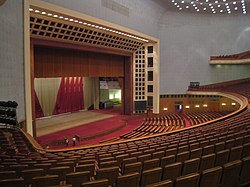
The auditorium form of seating (and chamber) is a large audience facing a stage, often with a proscenium. The model is similar to direct instruction whereby the communication is unidirectional without active interaction or debate. Response is limited to applause or speakers coming onto the stage, from the audience or backstage, to provide a subsequent presentation to the audience. Given the scale and format, there is little opportunity for any direct discourse.

Examples and images: USSR Supreme Soviet

Council and court

[edit]

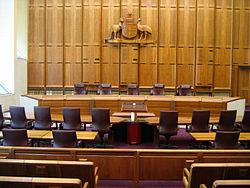
The council and courtroom configuration of seating is one that fosters interaction between the "panel" (court, council, board, or other officials) and the public. The panel members may debate or engage in discourse amongst themselves, particularly in a council of elected officials, but that is not normally the main portion of discourse. The more linear the seating arrangement is, the less supportive of it is for discourse. City Council chamber are less likely to use a linear configuration whereas judges in a court of law (where there is more than one judge in a sitting) frequently sit in a straight or nearly straight line.

Examples and images:

Rectangular

[edit]

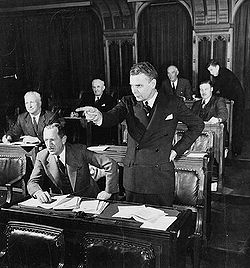
The rectangular (bifurcated) seating configuration comprises two opposing rows of seats or benches facing towards a central aisle which bisects the room. At one end is commonly found a chair, throne, or podium for a Speaker, a monarch or president, or chairperson, respectively. This format is used in the Westminster style of parliamentary debating chambers, such as in the Parliaments of the UK, Canada, Australia, New Zealand, and other former British colonies. In this configuration, on one side of the aisle is the government and the other the opposition. This supports oppositional or divided groupings, from which emerged in the 19th century the two-party political system in the UK, and its dominions and colonies. Each person speaking is nominally directing his or her comments towards the speaker, but they do so facing the opposing members with their own group facing the same way they are. Without having one's own side turn around, it is not possible to face all members of the chamber simultaneously. In the British Parliament, the traditional method of recorded voting is called "division of the assembly" is by members placing themselves in separate rooms called division lobbies, one each for the "Ayes" and "Noes". (This is derived from the Roman Senate which voted by division, by a senator seating himself on one side of the chamber or the other to indicate a vote.

Common folklore speaks of the aisle between the government and the opposition sides as being "two sword lengths", or "two sword lengths plus an inch", apart, although there is no record of this being a criterion.[7]

Examples and images: House of Commons of Canada, House of Commons of the United Kingdom, Cortes of Castilla–La Mancha

Hybrid

[edit]

A hybrid of the bifurcated and semi-circular seating configurations combines a central aisle with a curved end at one end facing the focal point (e.g. Speaker's chair) at the other. Another hybrid form is one that is rectangular, but not bi-furcated; the overall arrangement is rectangular, as is each of the three seat groupings. For example, in both the lower house of the Czech Republic's Chamber of Deputies and in the Palace of Assembly at Chandigarh, India, the seating arrangement is a series of straight rows all facing inward in three groupings, two on either side of a central aisle and one at the end facing the podium.

Examples and images: India's Lok Sabha, Australia's House of Representatives, National Assembly of South Africa, Legislative Assembly of Manitoba, New Zealand's House of Representatives

Fan-shaped

[edit]

The hemicycle or semi-circular seating configuration originated in late 18th century France when the post-revolutionary leaders selected the amphitheater form as one that would symbolize and foster unity, in contrast to the "impression of parliamentary fragmentation" of the British configuration.[8] This configuration was soon emulated in other parts of Europe and in the United States Congress, the Capitol Building being designed by French architect Benjamin Latrobe. This adoption of the ancient Greek theater form coincided with the Greek Revival movements in architecture, including literal use of the symbology of the ancient democracy.[9]

Its form allows for presentation by a single person, or small group, to speak or present to all members of the chamber on a face-to-face basis from a podium (or similar element) at the focal point of the room. The primary hierarchy of position is largely distance from the podium, and is not in a position of support or opposition. This position gives pride of place to the podium, is not inherently partisan, and if each member of the group is given the chance to address the group, everyone has a (theoretically) equal position.

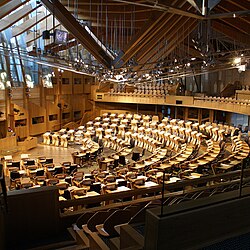
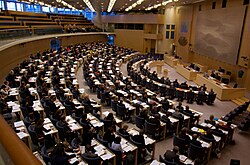
Examples and images: France's National Assembly, U.S. House of Representatives, UN General Assembly, Parliament of Finland, Brazilian Chamber of Deputies, Scottish Parliament, German Bundestag, Riksdag of Sweden

Circular

[edit]

Circular seating configurations for places of discourse have been envisioned as early as the 12th Century story of the Knights of the Round Table. As with many later versions, this was intended to be a collaborative forum. In the late 1940s, facilities for the United Nations Security Council, a body formed during and immediately after World War II, were designed to support collaboration and avoid confrontation.[10][11]

Since the early 1990s, several debating chambers have been constructed that support, or were designed to support, consensus-style or collaboration-style discourse and government. These include legislative assembly facilities for indigenous and non-indigenous peoples in Northern Canada, Great Britain, and Polynesia. Most are for bodies that do not involve formal political parties.[12][13]

Examples and images: United Nations Security Council, Senedd of Wales, Wilp Si A'yuukhl Nisga'a), Legislative Assembly of Nunavut, Legislative Assembly of the Northwest Territories, meeting halls of the Society of Friends, National Parliament of the Solomon Islands.

Virtual

[edit]

The introduction of regular live television broadcasts of legislative chambers, which began with the Canadian House of Commons in 1977,[14][15] has influenced debate and extended the audience well beyond the physical location of the debate chamber. More recently this has developed into direct two-way communication in small and large meeting rooms (virtual events), and even through personal hand-held devices into nearly every corner of the world. This has both changed the nature of the physical nature of the debating environment into a digital and virtual one, and in a non-literal sense into a series of ever-changing and highly varied configuration and collection of spaces determined by where each debate participant happens to be located. This may also have the added effect of drawing others into the debate, whether as passive observers or active participants, unwittingly, uninvited, or by active invitation of a single participant. For those meetings or debates who remain grounded in a structured location, such as a conference room or legislative chamber who connect to one or several remote participants via video-conferencing, the configuration of the room may be re-focused onto the video screen and away from those in the room.

Notes and references

[edit]
[edit]
Revisions and contributorsEdit on WikipediaRead on Wikipedia
from Grokipedia

A debate chamber is a dedicated room where members of a , particularly legislatures, convene to discuss, , and vote on matters and . These spaces are engineered to facilitate structured , often featuring elevated podiums for speakers, clerk desks for recording proceedings, and specialized acoustics to ensure audibility amid potentially heated exchanges.
The architectural configuration of debate chambers profoundly shapes political interaction, with seating layouts ranging from the adversarial, bench-opposed Westminster model—exemplified by the United Kingdom's , where government and opposition face each other to emphasize confrontation—to hemicyclic or fan-shaped arrangements in continental European parliaments and the , which encourage broader participation and a semblance of consensus by allowing members to address a central podium. Empirical studies indicate that such spatial designs influence and interpersonal dynamics among legislators, as proximity in seating can foster alliances or sway decisions through informal interactions. Historically rooted in ancient assemblies like Greek agoras and Roman senates, modern debate chambers reflect national political traditions, with purpose-built structures often symbolizing democratic ideals while adapting to practical needs such as capacity for hundreds of members and secure voting mechanisms.

Purpose and Core Functions

Definition and Primary Roles

A debate chamber is a specialized in a legislative building where elected representatives convene to engage in formal discussions on proposed , policies, and public issues. This space serves as the central venue for deliberative assemblies to exercise their core legislative functions, accommodating the full membership during plenary sessions. The primary roles of a debate chamber include facilitating structured debates that allow members to present arguments, question ministers, and propose amendments to bills. It also hosts voting procedures on motions and legislation, enabling the assembly to make binding decisions on behalf of the . In addition, the chamber supports scrutiny of executive actions through mechanisms like and emergency debates, promoting accountability. Debate chambers often incorporate ceremonial elements, such as the seating of the presiding officer and symbolic dispatch boxes, to underscore the gravity of proceedings. While designs vary—ranging from adversarial layouts in Westminster-style parliaments to arrangements in others—their fundamental purpose remains the orchestration of collective deliberation and decision-making.

Distinction from Other Assembly Spaces

Debate chambers are distinguished from other assembly spaces by layouts that emphasize adversarial interaction among participants, typically featuring opposing benches or rectangular arrangements where government and opposition members face each other directly across a narrow central . This configuration, originating in the Westminster model, positions seats approximately two sword-lengths apart to permit robust verbal exchange without physical escalation, thereby reinforcing a confrontational political dynamic and . In contrast, or fan-shaped seating in many continental legislatures arranges members in a semi-circular arc facing a central speaker's , promoting collective deliberation through set speeches and reducing direct interpersonal antagonism by fostering a unified assembly appearance. Such designs, inspired by ancient theaters like the French National Assembly's modeled after an 18th-century surgical school amphitheater, prioritize public engagement and rhetorical performance over . Conference rooms and committee spaces often employ round or clustered tables to facilitate collaborative discussion and consensus, enabling eye contact among all participants and minimizing hierarchical divides, unlike the polarized orientation of debate chambers that heightens rhetorical combat. Courtrooms diverge further with an elevated judicial bench, separated counsel tables, witness stands, and jury boxes, structuring the environment for evidentiary adjudication under authoritative oversight rather than egalitarian debate among peers. Theaters and auditoriums, characterized by tiered spectator seating and a forward stage, support unidirectional presentations to passive audiences, lacking the central, interactive equality essential to debate chambers where all members contribute dynamically.

Debating Practices

Protocols and Procedures

In formal debate chambers, protocols establish the sequence of proceedings to facilitate structured discourse and decision-making, typically commencing with the presiding officer—such as a speaker or —declaring the session open after confirming a , defined as the minimum number of members required for valid action, often a majority of the total membership. These rules, enshrined in standing orders or procedural manuals like , prioritize while protecting to debate, ensuring one matter is addressed at a time to prevent confusion. Core debate procedures mandate that members seek recognition from the before speaking, with alternation between affirmative and negative sides to balance perspectives, and time limits per speaker—commonly 5 to 20 minutes depending on the assembly—to curb filibustering and maintain efficiency. Motions, which propose actions or resolutions, require a seconder and open floor for before general ; interruptions are restricted to procedural points like order (to enforce rules), privilege (urgent matters affecting rights), or information, all ruled upon immediately by the whose decisions are final unless appealed by majority vote. Voting follows debate closure, achievable via time expiration, , or motions like "" (requiring two-thirds support to end discussion), with methods including voice calls, division (physical count), or electronic recording for precision in larger chambers. enforces , , and relevance to the motion, prohibiting personal attacks or irrelevancies, with sanctions ranging from warnings to suspension for violations, as upheld by the to preserve assembly integrity. concludes sessions, often by motion or fixed hour, with records maintained via minutes or transcripts for accountability.
  • Key procedural safeguards: Quorum verification prevents invalid actions; is generally disallowed to ensure direct participation.
  • Variations by assembly: While Westminster-model chambers emphasize oral advocacy without notes in some cases, U.S. congressional rules permit prepared remarks but enforce germaneness strictly.
These protocols, rooted in 19th-century codifications like those by in 1876, empirically reduce chaos in multi-member deliberations by channeling contention into predictable channels, though enforcement relies on the chair's impartiality to avoid procedural abuse.

Interaction with Physical Environment

In parliamentary debate chambers, participants interact with the physical space primarily through standing to seek recognition from the presiding officer, a convention that ensures visibility, audibility, and orderly progression of discourse. This practice requires members to rise from their seats, often catching the eye of the Speaker or equivalent authority, before delivering remarks while remaining upright to maintain and project authority. For instance, in the , members must occupy their designated seats and stand to be recognized, with the Speaker applying rules on speaking order and duration from this elevated posture. Similarly, in the UK and Australian Parliament House, backbenchers stand at their desks—equipped with microphones—to address the chamber, minimizing disruption while engaging the assembly's attention through bodily posture rather than locomotion. This standing protocol, enforced across many Westminster-derived systems, facilitates rapid transitions between speakers and prevents seated interruptions, though it can strain participants during extended sessions. Frontbench speakers in adversarial chambers often advance to designated positions, such as dispatch boxes or podiums, to intensify interaction with opponents and the record. In the UK , ministers and shadow ministers approach the central dispatch boxes—positioned mere feet apart—to deliver prepared statements or respond in real time, fostering direct confrontation amid the chamber's narrow layout. This movement underscores the environment's role in amplifying rhetorical tension, as proximity enables gestures, , and audible reactions without amplification aids dominating the exchange. In contrast, U.S. congressional chambers permit speaking from desks or the central "well," where members may yield time or engage in colloquies, adapting physical positioning to procedural needs like calls or amendments. Such spatial dynamics influence debate tempo, with closer arrangements in compact chambers like the encouraging brevity and immediacy over prolonged perorations. Debate chambers impose environmental constraints on physical conduct to sustain focus, prohibiting consumables beyond and restricting uncalled movements to avoid chaos. Gestures and props are limited; members rely on vocal projection and minimal locomotion, with exceptions for ceremonial processions or divisions requiring votes by walking through lobbies. These interactions, governed by standing orders, adapt to acoustic and lighting designs that prioritize clarity—such as elevated ceilings for sound dispersion—but empirical data on their causal effects remain sparse, with traditions prioritizing procedural efficiency over ergonomic optimization.

Psychological and Geometric Influences

Impact of Layout on Participant Behavior

Physical layouts in debate chambers influence participant behavior through spatial proximity, which facilitates social interactions and peer effects on . Empirical analysis of the Icelandic Althingi, where seats are randomly assigned independent of party affiliation, demonstrates that legislators seated near those from opposing parties exhibit reduced political distance, with nearby peers influencing up to 30% of voting deviations from party lines and altering speech patterns toward cross-aisle engagement. This causal effect arises from increased informal interactions, which mitigate partisan rigidity and foster behavioral convergence, as random proximity disrupts echo chambers inherent in party-clustered seating. Adversarial rectangular configurations, such as the United Kingdom's with opposing benches separated by a narrow —originally designed post-1834 fire to place speakers within two sword-lengths—promote confrontational dynamics by forcing direct eye contact and verbal sparring between government and opposition. , advocating retention of this layout during 1940s reconstruction, attributed its form to sustaining the two-party system's essence, enabling passionate advocacy and accountability through inherent antagonism rather than consensus. Such designs amplify rhetorical intensity and legislative scrutiny but may exacerbate polarization, as fixed party blocks reinforce intra-group conformity while heightening inter-group conflict. In contrast, consensual hemispherical or circular arrangements, like those in the , diminish direct opposition by distributing participants evenly, potentially moderating aggression and encouraging broader deliberation. Small-group studies analogize this to non-facing orientations, which reduce self-manipulative behaviors and pauses associated with tension, yielding more fluid exchanges compared to face-to-face setups. While lacking legislature-specific longitudinal data, these geometries align with causal mechanisms where diffused sightlines weaken adversarial posturing, though they risk diluting focused critique essential for robust policy challenge. Empirical gaps persist, with most evidence from randomized seating experiments underscoring proximity's outsized role over gross shape in shaping behavioral outcomes.

Empirical Studies on Shape and Dynamics

on the physical shape of debate chambers primarily examines how seating proximity—shaped by overall —influences legislators' voting patterns and interpersonal interactions, rather than direct causal effects of chamber form on broader dynamics. A key study analyzing the European Parliament's layout, where seating is assigned by political groups, found that adjacent seating reduces the likelihood of voting disagreement by approximately 7 percentage points, attributing this to peer effects from informal discussions and during sessions. This proximity-driven convergence occurs even across ideological lines when random or mixed assignments occur, suggesting that chamber designs facilitating closer physical arrangement can subtly moderate partisan divides through repeated exposure. In rectangular adversarial chambers, such as those in Westminster-style parliaments, oppositional seating maximizes distance between government and opposition benches, limiting cross-aisle proximity and thereby minimizing these peer effects; empirical analyses of state legislatures confirm that legislators seated near ideological opposites show increased vote similarity due to localized pressure, but such interactions are rarer in segregated layouts. Conversely, semicircular or hemicyclic designs, common in continental European assemblies, enable more fluid proximity during debates, potentially fostering informal exchanges; however, group-based seating assignments often counteract this by clustering allies, as observed in voting data from the where adjacency primarily reinforces intra-group cohesion rather than bridging divides. Direct comparative studies on chamber shape's impact on legislative outcomes remain limited, with most evidence indirect via proximity metrics. For instance, random seating experiments in smaller assemblies demonstrate heightened responsiveness to neighbors' behaviors in speech and voting, implying that shapes promoting random or mixed proximity—such as circular variants—could enhance cross-partisan learning, though real-world implementations rarely randomize due to institutional norms. These findings underscore causal mechanisms rooted in spatial dynamics, where geometry constrains interaction opportunities, but broader effects on polarization or require further longitudinal data controlling for cultural and procedural variables.

Historical Evolution

Ancient and Classical Origins

![Ancient Greek theater](./assets/Ancient_greek_theater_enen In ancient , the hill functioned as the primary open-air venue for the Ecclesia, the democratic assembly where male citizens debated and voted on state matters. Development occurred in three phases, beginning in the early with a semicircular formed by terracing the natural hillside and including a speaker's platform known as the . By the third phase, around 345–335 BC, the space was expanded to accommodate over 10,000 participants, facilitating large-scale public deliberation on , war, and policy. Complementing the , the in the Athenian served as a roofed for the Boule, a body of 500 citizens responsible for preparing the assembly's agenda and conducting preliminary debates. Erected in the early on the Agora's west side, it provided an enclosed space for more focused discussions among selected representatives, distinct from the broader popular gatherings. This architecture emphasized structured elite input prior to mass decision-making, reflecting the hierarchical yet participatory elements of Athenian governance. In the and early Empire, the emerged as a dedicated senate house, replacing earlier temporary venues and symbolizing formalized elite debate. Commissioned by in 44 BC and completed by in 29 BC within the , the rectangular structure adhered to Vitruvian acoustic principles, with its height proportioned as half the sum of length and width to enhance audibility during senatorial sessions. Designed for approximately 300–600 senators, it hosted deliberations on , finances, and imperial administration, underscoring Rome's shift toward institutionalized advisory assemblies. These classical precedents established purpose-built spaces that integrated oratory, voting, and spatial design to influence rhetorical and collective dynamics.

Medieval and Early Modern Developments

In medieval Europe, assemblies resembling parliaments, such as the English Parliament first summoned regularly by Simon de Montfort in 1265 and formalized under Edward I from 1275, convened in adaptable multi-purpose spaces rather than dedicated debate chambers. These included royal great halls, monastic refectories, and chapter houses, reflecting the itinerant and ad hoc nature of early representative gatherings. For instance, at Westminster, parliamentary openings occurred in the Painted Chamber, while the Commons often debated in the Westminster Abbey refectory or chapter house, accommodating up to 300 members by the 14th century but prioritizing flexibility over specialized design. Lords met in modest spaces like the Queen's Chamber, underscoring the absence of purpose-built venues amid feudal consultations focused on counsel and taxation rather than structured debate. Westminster Hall, completed in 1099 under William II as Europe's largest medieval timber-roofed hall spanning 240 feet in length, primarily hosted judicial proceedings, banquets, and coronations but occasionally served parliamentary functions, such as trials or joint sessions, without adaptation for adversarial seating or acoustic optimization. This multi-use approach prevailed across continental assemblies, like the French Estates-General of 1302 or German diets, which gathered in palace halls or cathedrals, emphasizing communal or hierarchical layouts over oppositional geometries. By the , with 54 English parliaments recorded amid the Wars of the Roses, sessions averaged weeks to months but rarely exceeded capacities of existing venues, limiting innovations in spatial dynamics. The (c. 1500–1800) saw gradual shifts toward semi-permanent adaptations, driven by expanding assemblies and procedural formalization, though purpose-built chambers remained rare. In , the pivotal development occurred in 1547 when Edward VI's government refitted —originally a 14th-century royal oratory—in the Palace of Westminster as the ' dedicated space, featuring benches along walls for about 400 members in a rectangular layout fostering speaker-centered . The Lords, meanwhile, occupied a purpose-adapted chamber in the former White Hall by the , with serial petitioning and rhetorical practices evolving to suit these confined acoustics. exhibited parallel but varied evolutions: Spanish Cortes met in alcázars or convents with estate-separated seating, while Swedish sessions from 1523 onward used guild halls, reflecting fiscal-military demands for more frequent assemblies without uniform architectural specialization. These adaptations influenced emerging parliamentary cultures, as assemblies balanced monarchical oversight with representative input, yet physical constraints—such as St. Stephen's narrow dimensions prompting standing during peaks—highlighted causal links between space and discourse, with overcrowding noted in 54 sessions per century spurring calls for expansion by 1600. Broader European trends, including transplanted quasi-parliaments in colonies, prioritized procedural recording over spatial innovation until absolutist declines post-1688 prompted further entrenchment of dedicated venues.

19th-20th Century Innovations and Reconstructions

The destruction of the Palace of Westminster by fire on October 16, 1834, necessitated a comprehensive reconstruction of the parliamentary debating chambers, with the ' new chamber designed by and completed in 1852. This project incorporated fire-resistant materials such as frameworks, brick vaults, and minimized timber usage to mitigate risks exposed by the blaze, which had originated from burning tally sticks in defective flues. A pioneering feature was the centralized ventilation system engineered by physician David Boswell Reid, which drew through intake towers, filtered and conditioned it via heating or cooling apparatuses, and distributed it through concealed flues in walls and floors before exhausting via stacks—representing an early engineered approach to for large assemblies seating up to 430 members. The adversarial rectangular layout was preserved to maintain traditional debating dynamics, though the chamber's dimensions were adjusted for better sightlines and acoustics compared to the cramped pre-fire space. Similar reconstructions elsewhere emphasized durability and functionality; for instance, after a 1916 fire razed much of Canada's Buildings, the was rebuilt in Gothic Revival style by 1927, incorporating and steel for enhanced fire resistance while retaining ceremonial elements like the expanded debating chamber. Into the , wartime damage prompted further adaptations, as seen in the UK chamber, gutted by incendiary bombs on May 10, 1941, during . Reconstruction from 1945 to 1950, overseen by , reopened the chamber on October 26, 1950, adhering strictly to Churchill's directive to replicate the 1852 layout and scale for intimate confrontation—measuring 62 feet by 45 feet with benches for 430—while integrating modern concrete substructures and electric lighting to replace gas fixtures. Technological integrations accelerated in the mid-20th century, with public address systems and amplification introduced in various chambers to address acoustic challenges in larger or noiser assemblies, though UK Commons initially resisted microphones to preserve unamplified oratory until post-war necessities. These changes prioritized empirical functionality—such as improved audibility and —over radical geometric shifts, contrasting with some European and postcolonial legislatures that adopted hemicyclical designs for expanded memberships, yet underscoring a causal link between historical disruptions and iterative enhancements in chamber resilience and usability.

Seating and Layout Configurations

Adversarial Rectangular Designs

Adversarial rectangular designs in debate chambers feature a narrow, elongated rectangular layout with rows of benches arranged along the longer sides, facing each other directly across a central , while the presiding occupies a raised at one end. This configuration positions the government benches to the presiding officer's right and the opposition to the left, emphasizing binary confrontation between ruling and opposing parties. The design, measuring typically around 21 meters in length and 16 meters in width in examples like the Canadian , accommodates limited seating to maintain intimacy during exchanges. Originating in the Westminster model of parliamentary government, this layout evolved from 19th-century reconstructions of the UK House of Commons, where the post-1834 fire design solidified the opposing benches tradition. After the chamber's destruction in bombing on May 10-11, 1941, Prime Minister insisted on rebuilding in the same adversarial rectangular form rather than adopting a semi-circular alternative, arguing on October 28, 1943, that "we shape our buildings and afterwards our buildings shape us" and that the oblong shape preserved robust, lively debate. The reconstructed chamber, completed in 1950 under architect , retained these dimensions to ensure members remained within two sword-lengths of opponents, a historical precaution against duels. This design promotes direct visual and verbal confrontation, fostering an atmosphere of competition that aligns with majoritarian Westminster systems where government accountability relies on sharp questioning. Proponents claim it encourages concise, passionate oratory by constraining space and visibility, limiting to adversaries rather than a dispersed assembly. Critics, however, note it may exacerbate partisanship by physically dividing participants into fixed camps, potentially hindering cross-party collaboration compared to more inclusive geometries. Prevalent in Commonwealth legislatures, examples include the House of Commons with 430 seats for MPs, the Canadian House of Commons featuring Tyndall limestone paneling, and New South Wales Legislative Assembly's rectangular chamber with facing benches. Australian federal and state parliaments adopt similar arrangements, though some incorporate minor hybrid elements like additional cross-benches. The at Holyrood also employs this pattern, seating parties in direct opposition despite its modern construction opened on October 7, 2004. These implementations underscore the design's adaptability while preserving its core adversarial dynamic.

Consensual Hemispherical and Circular Layouts

Consensual hemispherical and circular layouts arrange participants in a semi-circular, horseshoe, or full circular formation around a central presiding area, positioning members as a unified assembly rather than opposing factions to facilitate and . This contrasts with adversarial rectangular setups by minimizing direct confrontation and enhancing mutual visibility, theoretically encouraging collective decision-making among representatives treated as equals. Such configurations draw from ancient amphitheaters, where audiences gathered in curved tiers for communal , and gained prominence in 19th-century European legislatures as nation-states emphasized rational consensus over partisan combat. The hemicycle, a semi-circular variant, dominates modern examples, seating lawmakers in tiered rows facing a central . 's adopted this layout in its 1791 , accommodating 577 deputies in a chamber renovated in 1830 to promote enlightened among elites. Similarly, the U.S. (seating 435 members) and (100 members) convene in semicircular chambers designed in 1857, fostering deliberation in a federal system prioritizing compromise. European parliaments, including Finland's Eduskunta (200 seats, rebuilt 1931) and the European Parliament's hemicycle (705 seats, constructed 1973-1979), follow this model, with over 70% of European national assemblies using semicircles by the late 20th century. Full circular layouts remain rarer in legislatures but appear in experimental designs, such as West Germany's post-1949 parliamentary attempts and Iceland's Althing-inspired rings, evoking egalitarian tribal councils. Proponents argue these layouts yield psychological benefits, such as improved eye contact and reduced "us-versus-them" dynamics, potentially aiding consensus in multi-party systems. In semicircles, individual desks and microphones enable focused contributions without bench-crushing, as seen in the where group leaders occupy front rows opposite the president. However, empirical outcomes vary; while visibility enhances participation, curved arrangements do not eliminate partisanship, as evidenced by heated debates in France's Assembly despite its hemicycle. Critics note that layout alone cannot override ideological divides, with some studies suggesting semicircles may amplify audience-like spectatorship over interactive exchange. Nonetheless, reforms like Scotland's 2004 hemicycle chamber have been credited with more inclusive proceedings in devolved governance.

Hybrid and Fan-Shaped Variants

Hybrid variants of debate chambers integrate features of adversarial rectangular layouts and consensual semicircular designs, often manifesting as horseshoe configurations where opposing benches curve toward each other on one side, preserving division between and opposition while allowing partial visibility across aisles. This arrangement aims to balance confrontational debate with elements of collaboration, as the curvature reduces the sense of strict opposition compared to pure rectangular benches. Examples include the Australian , which employs a horseshoe seating plan with the speaker at one end, government benches to the right, and opposition to the left, accommodating 150 members since its establishment in 1901. Similar hybrids appear in the U.S. , blending rectangular rows with semicircular extensions for broader interaction among 435 members. Other instances, such as in and , reflect this typology's prevalence in certain and transitional democracies. Fan-shaped variants, closely aligned with designs, feature seating radiating outward in a semicircular or widened fan pattern from a central or speaker's , emphasizing equality and collective over strict partisanship. Originating in late 18th-century , this layout promotes visibility and interaction among all participants, facilitating consensus in multi-party systems. The French National Assembly exemplifies this, with its seating 577 deputies in a fan arrangement centered on the president's rostrum, designed post-1789 to symbolize unity. Germany's employs a wider fan-shaped chamber for 736 members, enhancing inclusivity in systems since its 1949 founding. Such designs are common in European parliaments, including those of and , where the open geometry supports ideological clustering without fixed opposition benches. Empirical observations suggest fan-shaped chambers correlate with higher rates of coalition-building in fragmented legislatures, as physical proximity encourages cross-party , though they may dilute intense adversarial exchanges. Hybrid horseshoe layouts, by contrast, maintain partisan separation while mitigating extremes of isolation, potentially aiding majority-minority dynamics in bicameral systems. Both variants have influenced post-colonial and reconstructed chambers, adapting classical influences to modern governance needs.

Auditorium and Courtroom Influences

Debate chambers have incorporated and theater design principles to enhance visibility, acoustics, and audibility for large assemblies, prioritizing clear projection of speeches to all members. Hemicycle layouts, characterized by semicircular seating facing a central , directly resemble theater arrangements, promoting consensus-oriented debate by directing collective attention toward speakers rather than pairwise opposition. This configuration, evident in the European Parliament's chamber, facilitates better sightlines and sound distribution akin to amphitheaters and modern s. In the United States , chamber reconstructions in the mid-1850s explicitly drew on theater standards, with architects focusing on acoustical qualities and line-of-sight visibility to ensure effective communication in expanded halls accommodating over 400 members in the . The resulting tiered, curved seating in the chamber, where members face a rostrum rather than each other, shifts dynamics toward performative addresses, similar to lectures in settings, reducing direct interpersonal confrontation. Courtroom influences manifest in hierarchical and adversarial elements, particularly in Westminster-model chambers with opposing benches separated by a narrow —traditionally two lengths wide to prevent duels—evoking the divided setup of prosecution and defense before a presiding . The elevated Speaker's in the UK parallels a judicial bench, structuring proceedings as contention before a neutral arbiter, a dynamic rooted in the chamber's evolution from St. Stephen's Chapel choir stalls but reinforced by typologies of facing parties. This layout, retained post-1834 fire in Charles Barry's 1852 design, underscores combative debate over deliberation.

Terminology and Adaptations

Naming Conventions

Debate chambers in legislative contexts are most frequently designated simply as "the chamber," a term derived from the Latin camera meaning vaulted room, reflecting their historical role as enclosed spaces for . This prevails in bicameral systems, where distinctions are made between the lower or people's chamber and the upper or chamber, as seen in the United States Congress, where the convenes in "the House Chamber" and the in "the Senate Chamber." In unicameral parliaments modeled on Westminster traditions, such as New Zealand's, the space is often termed the "debating chamber" to emphasize its function for oral argumentation and voting. Variations emerge in non-English-speaking or continental European legislatures, where terms like "plenary chamber" or "Plenarsaal" underscore the full assembly's collective decision-making authority. The German , for instance, officially uses "Plenarsaal" for its main debating space, accommodating up to 709 members during sessions. Similarly, the refers to its Strasbourg as the "Plenary Chamber" or "Hemicycle," a term evoking the semicircular seating arrangement while denoting the site of plenary debates. In international bodies, "assembly hall" is common, as with the Hall in New York, designed to seat 1,933 delegates and symbolizing multilateral discourse. Local and subnational legislatures often adopt "council chamber" for municipal or regional bodies, distinguishing them from national "debate chambers," though overlap occurs; for example, many city councils worldwide use "council chamber" for their primary meeting rooms. These conventions are not rigidly codified but evolve from architectural function, linguistic heritage, and institutional identity, with modern hybrids like virtual chambers retaining physical naming analogs for continuity.

Virtual and Hybrid Modern Forms

Virtual and hybrid forms of debate chambers integrate digital technologies to enable remote participation alongside or in lieu of , adapting traditional spatial arrangements to online environments. These configurations typically employ video conferencing platforms to simulate chamber layouts, with participants positioned virtually according to party affiliations or roles—such as government benches on one side and opposition on the other—via screen grids or dedicated interfaces that maintain adversarial or consensual dynamics. The widespread adoption of these forms accelerated during the to sustain legislative functions amid lockdowns and health risks. In the , the conducted its inaugural virtual debates on 23 April 2020, shifting to hybrid sittings on 8 June 2020, where peers could intervene remotely while in-person members occupied the chamber. The followed with virtual proceedings from April 2020, incorporating hybrid elements like and queued remote speeches to replicate physical debate flows. Canada's House of Commons implemented hybrid proceedings in spring 2020, featuring and remote voting, with authority for such formats extended through 23 June 2023 to support ongoing flexibility. Technologies central to these setups included Zoom and for plenary and committee sessions, often augmented by parliamentary-specific systems for agenda management, time controls, and secure voting to enforce procedural norms akin to physical chambers. By late June 2020, the reported that 17 percent of parliaments worldwide utilized virtual or hybrid modes, with 36 percent conducting reduced or fully remote sittings overall. Post-pandemic persistence has been uneven, reflecting evaluations of efficacy in preserving debate quality. The UK House of Commons terminated hybrid chamber participation on 22 July 2021, reverting to in-person requirements due to concerns over diminished spontaneity and interaction. In contrast, some assemblies, including Canada's, retained hybrid provisions for committees and select debates to accommodate regional representatives or accessibility needs, though full virtual plenaries largely reverted to temporary measures. These adaptations have facilitated broader participation—such as for legislators with caregiving responsibilities—but empirical analyses indicate mixed outcomes in replicating the causal cues and real-time cues of physical layouts.

Criticisms, Controversies, and Reforms

Debates on Adversarial vs. Consensual Efficacy

The debate over adversarial versus consensual debate chamber layouts centers on their influence on legislative deliberation, accountability, and policy outcomes, with adversarial designs—characterized by opposing benches as in the Westminster model—prioritizing confrontational exchange to test arguments rigorously, while consensual arrangements like semicircular or circular seating aim to foster collaboration and reduce partisanship. Proponents of adversarial layouts argue that direct opposition seating heightens tension and urgency, compelling participants to refine positions under scrutiny, as emphasized in his 1943 advocacy for compact chambers seating only about two-thirds of members to maintain intimacy and conflict essential for democratic vitality. This configuration, seen in the UK and replicated in and , institutionalizes conflict to expose policy flaws, drawing on historical precedents where oppositional dynamics refined legislation through dialectical opposition akin to Milton's . Empirical patterns in adversarial systems, such as heightened conflictual questioning in the UK and , suggest enhanced accountability, though critics contend this can devolve into performative hostility rather than substantive discourse. In contrast, advocates for consensual layouts, prevalent in many European parliaments with semicircular designs, assert that such arrangements promote inclusivity and dialogue by blurring rigid government-opposition divides, potentially yielding more stable, compromise-driven outcomes in multiparty systems. These setups, as in the 's Strasbourg hemicycle, encourage unity and reduce the "yah-boo" culture associated with facing benches, which some political scientists link to more harmonious deliberations suited to consensus-oriented cultures. However, detractors, including architectural analysts of parliamentary design, warn that semicircular formats may dilute accountability by obscuring clear factional lines, fostering group conformity over rigorous challenge, and empirical observations indicate higher incidences of physical altercations in larger consensual chambers despite lower verbal antagonism. Studies on seating proximity reveal peer influence on voting behavior—such as a 7% alignment increase from adjacent seats in the —but provide limited causal evidence tying layout directly to overall debate quality or legislative efficacy, highlighting a gap in rigorous, comparative data beyond anecdotal or stylistic assessments. Reform proposals, such as adapting chambers to semicircular formats to mitigate perceived toxicity, have faced resistance from those arguing that adversarial efficacy underpins Westminster's historical legislative successes, including robust opposition scrutiny that has constrained executive overreach. Conversely, in consensual systems, outcomes like continuity in Scandinavian assemblies are attributed to collaborative dynamics, yet causal realism suggests these may stem more from cultural norms than layout alone, with adversarial models demonstrably sustaining high-stakes in polarized environments without empirical proof of inferior long-term . The absence of large-scale, controlled studies—despite peer effects —underscores reliance on theoretical and historical , where adversarial designs align with first-principles needs for truth-testing through opposition, potentially outperforming consensus in revealing causal weaknesses.

Specific Design Critiques and Failures

The rectangular layout of the United Kingdom's chamber, with benches accommodating only approximately 427 members despite a total of 650 MPs, has been criticized for inducing chronic overcrowding and physical discomfort, as members often stand or share limited space during sessions. This design, intentionally preserved after the 1941 bombing and reconstruction completed in 1950, prioritizes intimacy over capacity to avoid an "echoing" atmosphere conducive to , yet it results in inadequate room for documents, laptops, or ergonomic seating, exacerbating fatigue during extended debates. Critics argue this fosters inefficiency and distraction, with MPs resorting to makeshift accommodations that undermine procedural focus. In semi-circular or hemispherical chambers, such as Australia's , the diffused seating arrangement intended to promote collegiality has failed to mitigate partisan antagonism empirically, as evidenced by persistent adversarial rhetoric and procedural despite the layout's emphasis on consensus over direct opposition. This configuration can obscure clear delineations between and opposition, complicating visual cues for and allowing speakers to address a fragmented audience rather than engage in pointed , which some analyses link to reduced deliberative intensity. For instance, post-1988 implementation in Australia's Parliament House revealed no measurable decline in confrontational behavior, challenging assumptions that spatial geometry causally moderates political culture. Temporary debating chambers have exposed additional vulnerabilities, as seen in the 2018-2020 relocation to , where the prefabricated design by Allford Burle Atkinson drew rebuke for insufficient acoustic isolation, suboptimal lighting, and cramped sightlines that hindered and hybrid participation during the period. These flaws amplified procedural disruptions, with members reporting echoed speech and visual obstructions, underscoring how adaptations to historic constraints can compound rather than resolve underlying ergonomic deficits in legacy designs.

Proposed Reforms and Empirical Outcomes

Proponents of reform argue that adversarial rectangular layouts, such as in the UK , exacerbate partisanship by positioning government and opposition in direct opposition, potentially hindering collaborative deliberation; they propose semicircular or horseshoe arrangements to foster a sense of unified assembly and reduce confrontational dynamics. This shift draws from historical precedents like assemblies and modern consensual democracies, where semicircular designs symbolically integrate members toward common goals rather than binary divides. In the UK, occasional calls for redesigning the chamber during restorations have surfaced, though traditionalists, including post-World War II, defended the rectangular form as essential for vigorous, accountability-driven debate suited to Westminster's majoritarian system. Devolved legislatures provide tested examples of such reforms. The Scottish Parliament's debating chamber, opened in 2004, adopted a semicircular layout explicitly to symbolize collaboration and openness, diverging from Westminster's model to align with devolution's emphasis on consensus-building in a system. Similarly, the Welsh employs a horseshoe design to encourage cross-party dialogue, reflecting post-devolution aspirations for inclusive governance. These intentional departures aimed to mitigate the "bear-pit" antagonism of rectangular chambers, promoting over rhetorical combat. Empirical assessments of these reforms reveal mixed outcomes, with physical layout exerting influence primarily through micro-level interactions rather than transforming overall legislative behavior. Studies on the indicate that adjacent seating increases voting similarity by approximately 7%, suggesting proximity in semicircular setups could enhance intra-party cohesion or cross-aisle influence, but this effect is modulated by and electoral incentives rather than design alone. In , despite the collaborative intent, debates have featured persistent partisanship, including walkouts and heated exchanges, with legislative productivity—measured by bills passed and policy innovation—attributable more to and coalition necessities than chamber shape. No large-scale comparative analyses demonstrate causal improvements in civility or output from semicircular reforms; correlational evidence links rectangular chambers to majoritarian systems' emphasis on executive accountability, while semicircular ones correlate with consensual multiparty arrangements, implying design reinforces rather than drives . Restoration projects, such as the UK's renewal, have opted to replicate existing rectangular designs in temporary chambers, prioritizing continuity over unproven spatial interventions. Overall, while reforms address perceived flaws in fostering deliberation, causal evidence remains limited, underscoring that institutional rules and electoral systems exert stronger effects on quality and outcomes than architectural changes.

References

Add your contribution
Related Hubs
User Avatar
No comments yet.