Hubbry Logo
logo
Deccan Traps
Community hub

Deccan Traps

logo
0 subscribers
Read side by side
from Wikipedia

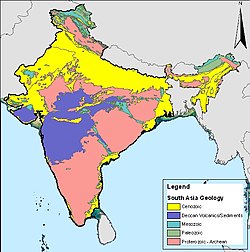
Geologic map of India, showing the Deccan Traps in blue-purple
The Western Ghats at Matheran in Maharashtra
Oblique satellite view of the Deccan Traps
Map of the Deccan Traps[1]

The Deccan Traps are a large igneous province of west-central India (17–24°N, 73–74°E). They are one of the largest volcanic features on Earth, taking the form of a large shield volcano.[2] They consist of many layers of solidified flood basalt that together are more than about 2 kilometres (1.2 mi) thick, cover an area of about 500,000 square kilometres (200,000 sq mi),[3] and have a volume of about 1,000,000 cubic kilometres (200,000 cu mi).[4] Originally, the Deccan Traps may have covered about 1,500,000 square kilometres (600,000 sq mi),[5] with a correspondingly larger original volume. This volume overlies the Archean age Indian Shield, which is likely the lithology the province passed through during eruption. The province is commonly divided into four subprovinces: the main Deccan, the Malwa Plateau, the Mandla Lobe, and the Saurashtran Plateau.[6]

The eruptions occurred over a 600–800,000 year time period between around 66.3 to 65.6 million years ago, spanning the Cretaceous–Paleogene boundary. While some authors have suggested that the eruptions were the primary cause of the Cretaceous–Paleogene mass extinction event, which dates to around 66.05 million years ago,[7] this has been strongly disputed, with many authors suggesting that the Chicxulub impact was the primary cause of the extinction.[8][9][10][11] While some scholars suggest that the eruptions may have been a contributing factor in the extinctions, others suggest that the role of the Deccan Traps in the extinction were negligible or even partially negated the effects of the impact.[9][10]

The Deccan Traps are thought to have been produced in major part by the still active Réunion hotspot, responsible for the creation of the modern Mascarene Islands in the Indian Ocean.[12]

Etymology

[edit]

The term trap has been used in geology since 1785–1795 for such rock formations. It is derived from the Swedish word for stairs (trapp) and refers to the step-like hills forming the landscape of the region.[13] The name Deccan has Sanskrit origins meaning "southern".[6]

History

[edit]
Deccan Traps at Ajanta Caves

The Deccan Traps began forming 66.25 million years ago,[5] at the end of the Cretaceous period, although it is possible that some of the oldest material may underlie younger material.[2][6] The bulk of the volcanic eruption occurred at the Western Ghats between 66 and 65 million years ago when lava began to extrude in fissure eruptions.[14] Determining the exact age for Deccan rock is difficult due to a number of limitations, one being that the transition between eruption events may have lasted only a few thousand years and the resolution of dating methods is not sufficient to pinpoint these events. In this way, determining the rate of magma emplacement is also difficult to constrain.[2] This series of eruptions may have lasted for less than 30,000 years.[15]

The original area covered by the lava flows is estimated to have been as large as 1.5 million km2 (0.58 million sq mi), approximately half the size of modern India. The Deccan Traps region was reduced to its current size by erosion and plate tectonics; the present area of directly observable lava flows is around 500,000 km2 (200,000 sq mi).

The Deccan Traps are segmented into three stratigraphic units: the Upper, Middle, and Lower traps. While it was previously interpreted that these groups represented their own key points in the sequence of events in Deccan extrusion, it is now more widely accepted that these horizons relate more closely to paleotopography and distance from the eruption site.[6]

Effect on mass extinctions and climate

[edit]

The release of volcanic gases, particularly sulfur dioxide, during the formation of the traps may have contributed to climate change. An average drop in temperature of about 2 °C (3.6 °F) was recorded during this period.[16]

Because of its magnitude, some scientists (notably Gerta Keller) have speculated that the gases released during the formation of the Deccan Traps played a major role in the Cretaceous–Paleogene (K–Pg) extinction event (also known as the Cretaceous–Tertiary or K–T extinction).[17] It has been theorized that sudden cooling due to sulfurous volcanic gases released by the formation of the traps and toxic gas emissions may have contributed significantly to the K–Pg mass extinction.[18] However, the current consensus among the scientific community is that the extinction was primarily triggered by the Chicxulub impact event in North America, which would have produced a sunlight-blocking dust cloud that killed much of the plant life and reduced global temperature (this cooling is called an impact winter).[19]

A 2014 study suggested the extinction may have been caused by both the volcanism and the impact event.[20][21] This was followed by a similar study in 2015, both of which consider the hypothesis that the impact exacerbated or induced the Deccan volcanism, since the events occurred approximately at antipodes.[22][23] A 2020 study questioned the idea that the Deccan Traps were a contributory factor at all, suggesting that the Deccan Traps eruptions may have even partially negated the climatic change induced by the impact.[10]

A major criticism of the Deccan Traps as the primary cause of the extinctions is that the extinction event appears to be globally geologically instantaneous and simultaneous in both marine and terrestrial environments, as would be expected from an impact cause, rather than staggered as would be expected from an LIP cause.[10]

A more recent discovery appears to demonstrate the scope of the destruction from the impact alone, however. In a March 2019 article in the Proceedings of the National Academy of Sciences, an international team of twelve scientists revealed the contents of the Tanis fossil site discovered near Bowman, North Dakota, that appeared to show a devastating mass destruction of an ancient lake and its inhabitants at the time of the Chicxulub impact. In the paper, the group reports that the geology of the site is strewn with fossilized trees and remains of fish and other animals. The lead researcher, Robert A. DePalma of the University of Kansas, was quoted in the New York Times as stating that "You would be blind to miss the carcasses sticking out... It is impossible to miss when you see the outcrop". Evidence correlating this find to the Chicxulub impact included tektites bearing "the unique chemical signature of other tektites associated with the Chicxulub event" found in the gills of fish fossils and embedded in amber, an iridium-rich top layer that is considered another signature of the event, and an atypical lack of evidence for scavenging, perhaps suggesting that there were few survivors. The exact mechanism of the site's destruction has been debated as either an impact-caused tsunami or lake and river seiche activity triggered by post-impact earthquakes, though there has yet been no firm conclusion upon which researchers have settled.[24][25]

A 2024 study of glycerol dialkyl glycerol tetraether levels in fossilized peat found that the Deccan Traps caused long-term warming of around 3°C over the course of the final 100,000 years of the Maastrichtian, as well as about 5°C drop in temperature for less than 10,000 years around 30,000 years prior to the K-Pg boundary (coinciding with the peak of the Poladpur eruptive phase), but by the time of the K-Pg boundary, global temperatures had returned to previous levels. This suggests that the Deccan Traps were not the primary cause of extinction.[11]

Petrology

[edit]
The Deccan Traps shown as a dark purple spot on the geologic map of India
Crystals of epistilbite and calcite in a vug in Deccan Traps basalt lava from Jalgaon District, Maharashtra

Within the Deccan Traps, at least 95% of the lavas are tholeiitic basalts.[26] Major mineral constituents are olivine, pyroxenes, and plagioclase, as well as certain Fe-Ti-rich oxides. These magmas are <7% MgO. However, many of these minerals are observed as highly altered forms.[2] Other rock types present include alkali basalt, nephelinite, lamprophyre, and carbonatite.

Mantle xenoliths have been described from Kachchh (northwestern India) and elsewhere in the western Deccan and contain spinel lherzolite and pyroxenite constituents.[2][27]

While the Deccan traps have been categorized in many different ways including the three different stratigraphic groups, geochemically the province can be split into as many as eleven different formations. Many of the petrologic differences in these units are a product of varying degrees of crustal contamination.[2]

Fossils

[edit]
Paleoart of the Deccan trap during the Late Cretaceous

The Deccan Traps are famous for the beds of fossils that have been found between layers of lava. Particularly well-known species include the frog Oxyglossus pusillus (Owen) of the Eocene of India and the toothed frog Indobatrachus, an early lineage of modern frogs, which is now placed in the Australian family Myobatrachidae.[28][29] The Infratrappean Beds (Lameta Formation) and Intertrappean Beds also contain fossil freshwater molluscs.[30]

Theories of formation

[edit]

It is postulated that the Deccan Traps eruption was associated with a deep mantle plume. High 3He/4He ratios of the main pulse of the eruption are often seen in magmas with mantle plume origin.[31] The area of long-term eruption (the hotspot), known as the Réunion hotspot, is suspected of both causing the Deccan Traps eruption and opening the rift that separated the Mascarene Plateau from India. Regional crustal thinning supports the theory of this rifting event and likely encouraged the rise of the plume in this area.[6] Seafloor spreading at the boundary between the Indian and African Plates subsequently pushed India north over the plume, which now lies under Réunion island in the Indian Ocean, southwest of India. The mantle plume model has, however, been challenged.[32]

Data continues to emerge that supports the plume model. The motion of the Indian tectonic plate and the eruptive history of the Deccan traps show strong correlations. Based on data from marine magnetic profiles, a pulse of unusually rapid plate motion began at the same time as the first pulse of Deccan flood basalts, which is dated at 67 million years ago. The spreading rate rapidly increased and reached a maximum at the same time as the peak basaltic eruptions. The spreading rate then dropped off, with the decrease occurring around 63 million years ago, by which time the main phase of Deccan volcanism ended. This correlation is seen as driven by plume dynamics.[33]

The motions of the Indian and African plates have also been shown to be coupled, the common element being the position of these plates relative to the location of the Réunion plume head. The onset of accelerated motion of India coincides with a large slowing of the rate of counterclockwise rotation of Africa. The close correlations between the plate motions suggest that they were both driven by the force of the Réunion plume.[33]

When comparing the Na8, Fe8, and Si8 contents of the Deccan to other major igneous provinces, the Deccan appears to have undergone the greatest degree of melting suggesting a deep plume origin. Olivine appears to have fractionated at near-Moho depths with additional fractionation of gabbro ~6 km below the surface.[2] Features such as widespread faulting, frequent diking events, high heat flux, and positive gravity anomalies suggest that the extrusive phase of the Deccan Traps is associated with the existence of a triple junction which may have existed during the Late Cretaceous, having been caused by a deep mantle plume. Not all of these diking events are attributed to large-scale contributions to the overall flow volume. It can be difficult, however, to locate the largest dikes as they are often located towards the west coast and are therefore believed to currently reside under water.[6]

[edit]
The illustration of the Deccan Trap eruption that may have caused the extinction of the dinosaurs

Chicxulub crater

[edit]

Although the Deccan Traps began erupting well before the impact, in a 2015 study it was proposed based on argon–argon dating that the impact may have caused an increase in permeability that allowed magma to reach the surface and produced the most voluminous flows, accounting for around 70% of the volume.[34] The combination of the asteroid impact and the resulting increase in eruptive volume may have been responsible for the mass extinctions that occurred at the time that separates the Cretaceous and Paleogene periods, known as the K–Pg boundary.[35][36] However this proposal has been questioned by other authors, who describe the suggestion as being "convenient interpretations based on superficial and cursory observations."[37]

Shiva crater

[edit]

A geological structure that exists in the sea floor off the west coast of India has been suggested as a possible impact crater, in this context called the Shiva crater. It was also dated approximately 66 million years ago, potentially matching the Deccan traps. The researchers claiming that this feature is an impact crater suggest that the impact may have been the triggering event for the Deccan Traps as well as contributing to the acceleration of the Indian plate in the early Paleogene.[38] However, the current consensus in the Earth science community is that this feature is unlikely to be an actual impact crater.[39][40]

See also

[edit]

References

[edit]
[edit]
Revisions and contributorsEdit on WikipediaRead on Wikipedia
from Grokipedia
The Deccan Traps constitute a large igneous province comprising extensive layers of flood basalt in west-central India, primarily across the states of Maharashtra, Gujarat, Madhya Pradesh, Andhra Pradesh, and Karnataka.[1] This volcanic formation, one of the largest on Earth, covers more than 500,000 square kilometers in its current extent, with pre-erosion estimates ranging from 1 to 2.6 million square kilometers, and features basalt thicknesses exceeding 2,000 meters in places.[1] Formed mainly through pulsed eruptions of basaltic lava between approximately 68 and 60 million years ago, with peak activity around 66 million years ago at the Cretaceous–Paleogene boundary, the Deccan Traps represent a classic example of continental flood volcanism likely associated with a mantle plume and tectonic rifting.[2][1][3] The eruptions produced an estimated volume of over 1 million cubic kilometers of magma, releasing vast quantities of carbon dioxide, sulfur, chlorine, and mercury into the atmosphere over a main phase lasting about 750,000 years.[4] These emissions triggered significant environmental disruptions, including hyperthermal global warming of 3–4°C, ocean acidification, acid rain, and widespread mercury toxicity, which contributed to ecological stress and the Cretaceous–Paleogene mass extinction event that eliminated non-avian dinosaurs and many other species.[3][4] Geologically, the Deccan Traps played a key role in the breakup of the Indian subcontinent from the Seychelles microcontinent, influencing regional tectonics and the formation of volcanic margins.[1] Today, the stepped, trap-like topography—resulting from differential erosion of the horizontal lava flows—remains a prominent landscape feature, supporting diverse ecosystems and serving as a critical site for studying large igneous provinces, mantle dynamics, and links between volcanism and biotic crises.[2]

Introduction and Location

Geographical Description

The Deccan Traps form a vast volcanic province covering approximately 500,000 square kilometers in west-central India, primarily spanning the states of Maharashtra, Madhya Pradesh, and Gujarat, with extensions into parts of Telangana, Andhra Pradesh, and Karnataka.[2][5] Originally, prior to extensive erosion, the province is estimated to have extended over about 1,500,000 square kilometers.[6] The thickness of the basalt flows varies significantly across the region, exceeding 2,000 meters in the west near the Western Ghats while thinning to around 200–500 meters or less in eastern areas due to prolonged erosion.[1][7] Elevations range from near sea level along coastal margins to over 1,500 meters on the interior plateaus, creating a rugged topography that rises sharply from the surrounding plains.[8] Prominent landforms include broad basaltic plateaus, steep cliffs along the Western Ghats escarpment—which forms a dramatic 1,500-kilometer-long barrier—and incised valleys resulting from differential erosion of the layered flows.[8] These features are vividly illustrated by cultural sites such as the Ajanta and Ellora caves, excavated directly into the exposed basalt cliffs.[9] Monsoon-driven erosion has profoundly influenced the current exposure and visibility of the Deccan Traps, carving out steep scarps, gorges, and soil-mantled slopes that reveal the stepped basalt layers while contributing to ongoing landscape evolution.[10][7]

Geological Setting

The Deccan Traps erupted primarily between 66.1 and 65.5 million years ago, during the Maastrichtian stage of the Late Cretaceous, with the main phase of activity spanning the Cretaceous-Paleogene boundary.[11] This timing is constrained by high-precision U-Pb dating of zircon crystals from ash beds interbedded within the lava flows, revealing pulsed eruptions over approximately 800,000 years.[11] Stratigraphically, the basalts overlie Late Cretaceous sedimentary rocks, such as the Lameta Formation, which consists of limestones, sandstones, and clays deposited in fluvial and lacustrine environments prior to the onset of volcanism.[12] Paleogene sediments, including intertrappean beds with Early Danian fossils, unconformably overlie the traps in places, marking the transition to post-eruptive deposition.[12] The formation of the Deccan Traps is closely associated with the tectonic evolution of the Indian plate following the breakup of the supercontinent Gondwana. India began separating from Madagascar around 88 million years ago as part of the progressive fragmentation of Gondwana, which initiated in the Jurassic.[13] This separation facilitated the northward drift of the Indian plate at rates exceeding 15 cm per year during the Late Cretaceous, positioning it over the Réunion hotspot in the mantle.[8] The interaction between the overriding plate and the hotspot is inferred from the alignment of the Deccan Traps with the subsequent volcanic track of the Réunion hotspot, extending through the Mascarene Islands to present-day Réunion.[8] Estimates of the total volume of extruded basalt for the Deccan Traps range from 1 to 2 million cubic kilometers, accounting for pre-erosional extent and making it one of the largest known large igneous provinces (LIPs) on Earth.[14] This vast outpouring of magma, primarily tholeiitic basalt, covered an original area of up to 1.5 million square kilometers before significant erosion reduced the preserved thickness to 2 kilometers in places.[14] As a continental flood basalt province, the Deccan exemplifies LIPs formed by mantle plume activity, contributing to global tectonic and climatic perturbations during the end-Cretaceous.[8]

Etymology and Historical Study

Origin of the Name

The term "Deccan" originates from the Sanskrit word dakṣiṇa, meaning "south," reflecting its position on the Deccan Plateau in southern India.[15] This etymological root underscores the region's historical identification as the southern heartland of the Indian subcontinent, distinct from the northern Indo-Gangetic plains.[16] The descriptor "Traps" derives from the Swedish word trappa, translating to "stair" or "stairway," a term adopted in geology to describe the stepped, terraced topography resulting from the erosion of stacked horizontal basalt flows.[17] This nomenclature entered European geological discourse in the late 18th century, with Abraham Gottlob Werner applying it to similar basaltic formations in his influential rock classification system, emphasizing their stratified, stair-like exposures.[18] The full name "Deccan Traps" was formalized in English-language geological literature by William Thomas Blanford in 1867, during his surveys for the Geological Survey of India, where he documented the extensive basaltic sequences of western and central India in his memoir On the Traps and Intertrappean Beds. Blanford's work integrated the regional "Deccan" with the established European term "traps," establishing a standardized reference for the province. Locally, exposures of the Deccan Traps along the Western Ghats are known by the Marathi name "Sahyadri," evoking the mountain range's ancient forested ridges, though this term more broadly denotes the ghats themselves rather than the volcanic rocks exclusively.[19]

Discovery and Key Expeditions

The initial scientific recognition of the Deccan Traps emerged in the early 19th century through observations of fossils in the underlying Lameta Formation in central India. In 1828, British officer Captain W.H. Sleeman discovered the first dinosaur bones near the Narmada River, marking the earliest documented paleontological finds associated with the volcanic province; these were subsequently reported and illustrated by antiquarian James Prinsep in 1832, who noted their stratigraphic position beneath the black basalt layers.[20] Such discoveries by British surveyors and travelers in the 1820s and 1830s highlighted the unusual step-like basalt exposures across the Deccan Plateau, though systematic geological interpretation lagged behind.[21] Systematic mapping and study commenced with the establishment of the Geological Survey of India (GSI) in 1851, which initiated detailed surveys of the volcanic terrain in the 1850s. Henry Haversham Godwin-Austen, a prominent GSI officer and later superintendent, contributed early stratigraphic observations of the traps during surveys in western India in the 1860s, documenting their thickness and association with sedimentary beds. Complementing this, William Thomas Blanford led extensive fieldwork in the 1860s, producing the seminal 1869 GSI memoir "On the Traps and Intertrappean Beds of Western and Central India," which delineated the lateral extent of the lava flows over 500,000 km² and described interbedded fossiliferous sediments. These efforts by GSI pioneers established the Deccan Traps as a vast volcanic sequence, with the term "traps" originating from 19th-century British descriptions of their stair-step morphology resembling the Swedish word for "stairs."[22] Twentieth-century expeditions shifted focus toward paleontological and geochronological investigations. In the 1930s, GSI geologist Charles A. Matley conducted pivotal fieldwork across central India, excavating numerous vertebrate fossils—including titanosaurs and other dinosaurs—from intertrappean beds exposed in quarries and ravines, amassing collections that illuminated the Late Cretaceous biota prior to the main eruptions.[23] By the 1960s, the Deccan Traps gained recognition as a continental flood basalt province following initial potassium-argon (K-Ar) radiometric dating, which placed the eruptions in the Late Cretaceous around 65-68 million years ago.[24] Post-1980s advancements in argon-argon (⁴⁰Ar/³⁹Ar) dating refined this timeline, confirming the primary eruptive phase spanned approximately 66.04 to 65.45 million years ago, aligning closely with the Cretaceous-Paleogene boundary.[25] In the 1990s, integrated studies of paleomagnetic, stratigraphic, and isotopic data solidified links between the Traps' massive outpourings—estimated at over 1 million km³ of basalt—and the global mass extinction event, emphasizing their role in environmental perturbations.[14]

Petrology and Composition

Rock Types and Stratigraphy

The Deccan Traps are composed primarily of tholeiitic basalt flows, forming a vast sequence of layered volcanic rocks that dominate the province's lithology.[26] These flows represent the bulk of the erupted material, with individual units typically exhibiting massive interiors overlain by vesicular or amygdaloidal tops, and separated by thin red bole horizons formed from weathered flow tops. The entire sequence comprises numerous individual flows, estimated at over 2,000 across the province, each averaging 20-30 meters in thickness, though variations occur with some reaching up to 50 meters or more.[27] This repetitive layering reflects pulsed effusive eruptions over a geologically short period. Stratigraphically, the Deccan Traps in the Western Ghats are divided into three major subgroups: the lower Kalsubai Subgroup, the middle Lonavala Subgroup, and the upper Wai Subgroup. The Kalsubai Subgroup forms the basal unit, consisting of the oldest lava flows organized into formations such as Jawhar, Igatpuri, Neral, Thakurvadi, and Bhimashankar, and it is characterized by a heterogeneous assemblage of tholeiitic basalts.[28] The Lonavala Subgroup overlies it and includes the Khandala and Bushe Formations, representing a thinner intermediate package of flows.[26] The Wai Subgroup caps the sequence, encompassing formations like Poladpur, Ambenali, and Mahabaleshwar, with the Poladpur Formation marking its lower boundary and featuring compact, phyric basalt flows.[12] These divisions are based on field mapping, flow characteristics, and regional correlations, providing a framework for understanding the vertical architecture. Intertrappean sedimentary layers, including shales, limestones, and sandstones, are interspersed between many basalt flows, particularly in the lower and middle subgroups, signifying episodic pauses in volcanism that allowed for sediment deposition in subaerial or shallow lacustrine environments.[29] Rare non-basalt rock types occur as minor components, such as picritic basalts concentrated in the lower Kalsubai Subgroup and scattered rhyolitic flows or intrusions in the upper parts and peripheral regions like Pavagadh.[30][31] These exceptions highlight localized variations in magma composition but do not alter the overwhelmingly basaltic nature of the stratigraphy. The total thickness of the Deccan Traps exhibits significant lateral variation, reaching up to 3,500 meters in the western sections near the eruptive center, such as around Kalsubai Peak, where the full sequence of subgroups is preserved.[32] In contrast, the eastern and peripheral areas are thinner, often less than 500 meters, due to a combination of original thinner deposition away from the main vents and extensive post-emplacement erosion that has dissected the plateau.[33] This tapering underscores the province's original dome-like geometry prior to uplift and denudation.

Mineral and Chemical Composition

The Deccan Traps basalts predominantly consist of plagioclase feldspar as the most abundant mineral phase, typically comprising 50-60% of the rock volume, followed by pyroxene at 20-30%, and olivine up to 10%. Accessory minerals such as magnetite and apatite occur in minor amounts, often less than 5%, contributing to the overall mafic to intermediate composition of these tholeiitic rocks. These modal proportions reflect the fine- to medium-grained texture of the flows, with plagioclase often forming lath-shaped crystals in the groundmass and phenocrysts of pyroxene and olivine in more porphyritic varieties.[8][34] Geochemically, the Deccan Traps exhibit low silica contents ranging from 45-52 wt%, characteristic of tholeiitic basalts, alongside elevated levels of titanium and incompatible trace elements such as zirconium (Zr) and niobium (Nb). This composition indicates a tholeiitic affinity, with the basalts divisible into low-Ti (TiO₂ < 2.5 wt%) and high-Ti (TiO₂ > 2.5 wt%) subtypes, both enriched in light rare earth elements relative to heavy ones. The high incompatible element abundances, including Zr/Nb ratios similar to those in ocean island basalts, suggest derivation from a mantle source with minimal prior depletion.[35][36] Isotopic analyses reveal initial strontium ratios (⁸⁷Sr/⁸⁶Sr) of approximately 0.704-0.706 and neodymium ratios (¹⁴³Nd/¹⁴⁴Nd) greater than 0.5126, pointing to a predominantly depleted mantle source for the parental magmas. These values, observed across multiple flows in the Western Ghats, indicate limited influence from enriched reservoirs in the primary melts. However, systematic variations occur across the stratigraphic sequence, with upper flows showing elevated ⁸⁷Sr/⁸⁶Sr ratios up to 0.707 due to crustal assimilation, evidenced by correlations between isotopic shifts and increased silica and incompatible element contents from contaminant incorporation during magma ascent. Lower flows, in contrast, preserve more primitive signatures closer to the depleted mantle end-member.[37][38]

Formation Mechanisms

Mantle Plume Model

The mantle plume model proposes that the Deccan Traps originated from the arrival of a massive plume head ascending from the core-mantle boundary beneath the Indian continent, initiating widespread decompression melting and flood basalt volcanism. This framework builds on early conceptualizations of deep-sourced mantle upwellings driving intraplate magmatism, as articulated by J. Tuzo Wilson in 1973, who described plumes as buoyant columns influencing plate motions and volcanic hotspots.[39] The plume head, envisioned as a bulbous structure roughly 1000 km in diameter with excess temperatures of 200–300°C, spreads laterally upon impinging the lithosphere, generating voluminous melts that erupted over a short interval around 66 million years ago. Seminal numerical and experimental simulations demonstrate how such a head could produce the observed volume of Deccan lavas through high-degree partial melting.[40] Seismic tomography corroborates the persistence of the plume's conduit, revealing a prominent low-velocity anomaly—indicative of hot, low-density mantle—extending vertically from near the core-mantle boundary to shallow depths beneath the active Réunion hotspot in the Indian Ocean. This cylindrical structure, with velocities 1–3% slower than surrounding mantle, aligns with the expected thermal signature of a plume tail and traces northward along the reconstructed path of the Indian plate, which moved over the plume at rates of 15–20 cm per year, positioning the Deccan site directly above it at ~66 Ma.[41] Geochemical evidence further supports plume involvement, with Deccan basalts exhibiting high-temperature melting indicators such as elevated MgO contents (up to 10–12 wt%) and pyroxene-hosted melt inclusions suggesting initial temperatures exceeding 1400–1500°C, far above mid-ocean ridge basalt sources. Trace element patterns, including enrichments in Nb, Ta, and light rare earth elements relative to high field strength elements, alongside Sr-Nd-Pb isotope ratios (e.g., εNd ~ +5 to +8), match those of primitive, deep-mantle derived magmas and closely resemble compositions from modern Réunion lavas, establishing a direct geochemical continuity between the ancient plume head and its ongoing tail.[42] The model predicts an incubation period for the plume of 10–20 million years prior to peak eruptions, during which dynamic support from the approaching plume head causes regional uplift of 1–2 km, eroding sediments and preparing the lithosphere for rifting and volcanism; the main phase commenced as India overrode the plume around 66 Ma, triggering rapid ascent and melting of the plume material.[40] This timing aligns with plate reconstructions and distinguishes the plume mechanism from alternatives like lithospheric extension, which lack comparable deep-mantle signatures.

Alternative Hypotheses

Alternative hypotheses for the formation of the Deccan Traps challenge the dominant mantle plume model by emphasizing tectonic processes related to plate boundaries, continental rifting, and lithospheric instabilities during the breakup of Gondwana. These models propose that magmatism resulted from upper mantle convection triggered by edge effects, slab dynamics, and stress-induced delamination rather than deep-seated thermal anomalies. Such explanations better account for the temporal and spatial associations between Deccan volcanism and India's rifting from the Seychelles around 65-66 million years ago.[43] One prominent alternative is the edge-driven convection (EDC) model, which posits that convective instabilities arise at the lateral boundaries between thick, cold continental lithosphere and thinner, warmer oceanic lithosphere during rifting. In this framework, applied to the Deccan Traps, the ongoing separation of India from Gondwana created shear-driven upwellings in the upper mantle, leading to decompression melting without requiring a deep plume. This mechanism, originally proposed by King and Anderson in 1995 and elaborated in their 1998 work, explains the flood basalt eruptions as a passive response to plate tectonics, with localized heating from frictional stresses at the rift margin. For the Deccan, Hetu Sheth (2007) argued that EDC at the western Indian rifted margin produced the voluminous basalts, supported by the absence of pre-eruption doming and the linear, rather than radial, orientation of dyke swarms.[44][45] The "plate model," advanced by Gillian Foulger in 2007, further integrates lithospheric delamination into this tectonic paradigm, suggesting that the Deccan Traps formed through the foundering of dense lower lithospheric material during the Gondwana breakup. As India rifted away, gravitational instability caused delamination of the thickened lithospheric root, inducing convective upwelling and partial melting in the asthenosphere. This process recycled continental mantle material, contributing to the geochemical signatures observed in Deccan basalts, and aligns with seismic evidence of delaminated fragments stagnating at 600-800 km depths beneath ancient Gondwanan margins. Unlike plume models, this approach attributes the volcanism to shallow, plate-driven dynamics, with delamination enhancing melting rates through adiabatic decompression. Recent seismic studies link such delamination events to multiple Gondwanan flood basalts, including the Deccan.[46] Another non-plume hypothesis involves slab-related processes, particularly the slab window model tied to the subduction of Tethyan oceanic crust beneath India. As the Neo-Tethys Ocean closed, oblique subduction created tears or gaps in the descending slab, allowing hot asthenosphere to upwell through these windows and trigger melting. This mechanism, explored in regional tectonic reconstructions, links Deccan magmatism to enhanced mantle flow following slab detachment around 70-65 million years ago, providing a source for the rapid eruption volumes without radial symmetry expected from plumes.[47] Critiques of the plume model underscore these alternatives, highlighting the lack of a coherent radial dyke swarm converging on a central plume head, with Deccan dykes instead forming multiple, sub-parallel or curved sets aligned with rift-related stresses. Additionally, the purported hotspot track from Deccan to Réunion shows inconsistencies, including mismatched ages, variable eruption rates, and no fixed reference frame for plume motion. Post-2020 analyses of dyke patterns confirm that Deccan swarms are not radially distributed but reflect segmented, tectonically controlled intrusions. Recent models (post-2020) incorporate plate flexure and stress changes preceding India's collision with Eurasia, where flexural loading along the northern Indian margin induced tensile stresses that facilitated dyke propagation and magma ascent during the late stages of rifting. These stresses, modeled through finite element simulations, explain the westward migration of vents without deep thermal drivers.[45][48][33]

Paleoenvironmental and Biological Effects

Climate and Atmospheric Changes

The massive eruptions of the Deccan Traps released substantial volumes of volcanic gases, including CO₂ and SO₂, over the late Maastrichtian period. These emissions initially drove significant greenhouse warming through CO₂ accumulation in the atmosphere, with global surface temperatures rising by up to 7.8 ± 3.3 °C synchronous with the onset of major Deccan activity approximately 150,000 years before the CretaceousPaleogene (K–Pg) boundary.[49] This warming phase was subsequently interrupted by short-term global cooling events, as SO₂ oxidized to form sulfate aerosols that reflected sunlight and reduced surface temperatures by several degrees for periods of months to years following individual large eruptions.[50] Paleotemperature proxies, including carbonate clumped isotope records from bivalve shells, provide evidence of these pre-extinction warming pulses linked to Deccan volcanism. For instance, decreases in δ¹⁸O values from benthic foraminifera in deep-sea sediments from sites in the South Atlantic and Indian Ocean indicate transient warm intervals of 2–4 °C during the late Maastrichtian, coinciding with accelerated Deccan eruptive phases and elevated mercury anomalies as tracers of volcanic activity.[49][11][51] These isotopic shifts reflect both atmospheric CO₂ forcing and potential changes in ocean circulation influenced by the volcanic climate perturbations.[49] The dissolution of excess CO₂ into seawater during these eruptions triggered ocean acidification, lowering the carbonate ion saturation state (Ω) and promoting widespread deep-sea carbonate dissolution. This effect is evident in hiatuses and reduced carbonate preservation in late Maastrichtian sediments from tropical Pacific and Atlantic cores, where increased lysocline depth indicates acidification prior to the K–Pg boundary.[11] Such acidification disrupted marine carbonate systems, exacerbating environmental stress through enhanced sediment dissolution without direct biotic details. In the aftermath of the main eruptive phase, intensified chemical weathering of the freshly exposed Deccan basalts acted as a long-term carbon sink, drawing down atmospheric CO₂ through silicate mineral reactions and contributing to Paleocene cooling trends. Model estimates suggest this weathering process sequestered CO₂ at rates exceeding residual volcanic inputs, leading to a net decline in greenhouse gases and gradual cooling, as inferred from benthic foraminiferal δ¹⁸O records.[52] This feedback mechanism helped stabilize the post-eruption climate, with the equatorial position of the Deccan Traps enhancing weathering efficiency under humid conditions.

Influence on Mass Extinctions

The Deccan Traps eruptions have been implicated in the end-Cretaceous (K–Pg) mass extinction event approximately 66 million years ago, which resulted in the loss of about 75% of Earth's species, including non-avian dinosaurs, through prolonged environmental stress exerted by massive volcanic outgassing and associated perturbations. The volcanism is argued to have contributed to this biodiversity collapse by releasing vast quantities of sulfur dioxide, carbon dioxide, and other volatiles over a geologically short interval, leading to global warming, acid rain, and disruption of terrestrial and marine ecosystems.[11] This environmental forcing is particularly linked to the main eruptive phase spanning from 66.04 ± 0.05 Ma to 65.52 ± 0.06 Ma, immediately preceding and overlapping the K–Pg boundary dated at 66.016 ± 0.016 Ma. High-precision U–Pb dating of zircon crystals from interbedded tuffs within the Deccan sequence reveals that the primary eruptive pulse occurred just prior to the K–Pg boundary, with approximately 75% of the total erupted volume—estimated at 1.1–1.5 million km³—occurring in less than 100,000 years.[11] This rapid emplacement rate intensified the climatic and chemical stresses, as the short duration amplified the rate of volatile emissions relative to natural carbon cycle buffering. Recent analyses further refine this timeline, identifying four discrete high-volume pulses, with the largest centered about 30,000 years before the boundary, underscoring the volcanism's temporal proximity to the extinction horizon. These findings support models where the Deccan Traps' intensity provided a sustained precursor to the abrupt extinction, distinct from instantaneous events. Syn-eruptive effects included widespread marine anoxia and hypercapnia, which acted as key kill mechanisms by depleting oxygen and elevating dissolved CO₂ levels in oceans, suffocating marine life and disrupting calcification in shelled organisms. Evidence for these conditions is corroborated by geochemical signatures in intertrappean beds, such as elevated mercury and sulfur isotopes indicative of volcanic influence on ocean chemistry, alongside iridium anomalies in these sediments that align with eruptive phases rather than solely extraterrestrial sources.[53][54] For instance, iridium concentrations in Cretaceous-age intertrappean deposits from central India reflect localized atmospheric fallout from Deccan plumes, linking volcanism directly to pre-boundary environmental degradation.[53] Debates persist regarding the relative dominance of Deccan volcanism versus other factors in driving the K–Pg extinction, with quantitative models suggesting volcanism's contributions were secondary to the Chicxulub impact, potentially even ameliorating short-term cooling in some scenarios.[55] Proponents of a primary volcanic role emphasize the prolonged stress from emissions, which weakened ecosystems prior to any acute triggers. Recent studies, including 2023 modeling indicating Deccan emissions alone could induce the extinction and 2025 analyses of volatile budgets, continue to refine these models, highlighting Deccan-induced climate changes, such as a 2–4°C global temperature rise from greenhouse gases, set the stage for heightened vulnerability across biomes.[56][57]

Associated Fossils and Biostratigraphy

Fossil Assemblages

The intertrappean freshwater deposits embedded between the basaltic flows of the Deccan Traps preserve a diverse array of vertebrate fossils, reflecting lacustrine and fluvial environments during the Maastrichtian. These sediments have yielded numerous dinosaur eggshells attributed to titanosaurs, often found in clutches within calcareous sandstones and limestones of the underlying Lameta Formation and equivalent intertrappean beds, indicating nesting behaviors in semi-arid floodplains.[58] Turtle remains are common, including species of the trionychid Shweboemys, such as S. pilgrimi and S. narmadensis, preserved as partial carapaces and plastrons in fine-grained clays, suggesting adaptation to shallow aquatic habitats amid volcanic activity.[59] Early mammals are represented by Deccanolestes hislopi, a basal euarchontan known from isolated teeth and postcranial elements recovered from sites like Naskal and Rangapur in Andhra Pradesh, highlighting an arboreal lifestyle in forested riparian zones.[60] Plant fossils occur abundantly in the intertrappean sedimentary layers, dominated by angiosperm leaves, fruits, and pollen alongside fern fronds, which collectively point to a tropical, humid ecosystem punctuated by episodic volcanism. Angiosperms, including dicotyledonous forms like Sahnipushpam and palm-like monocots, comprise over 50% of palynological assemblages in beds from central India, with fern spores (e.g., from Gleicheniaceae) indicating recovery in disturbed wetlands following eruptions.[61] These floral remains, preserved in cherts and shales, show morphological adaptations such as thick cuticles on leaves, consistent with a warm, seasonal climate before widespread disruption by ash falls and lava flows.[62]

Stratigraphic and Dating Evidence

The stratigraphic and dating evidence for the Deccan Traps integrates radiometric geochronology with biostratigraphic and magnetostratigraphic markers to establish a high-resolution timeline for volcanic flows and associated sedimentary layers, particularly during the Maastrichtian-Danian transition. High-precision 40Ar/39Ar dating of plagioclase and whole-rock samples from lava flows has provided ages spanning approximately 67.5 to 65.5 Ma, with the main eruptive phase concentrated within magnetic chron C29r (66.4–66.0 Ma), indicating pulsed volcanism over about 800 kyr.[63] Complementary U-Pb dating of zircon crystals from interbedded ash layers and flows has refined this timeline, yielding eruption ages such as 66.34 ± 0.06 Ma for early main-phase flows and 66.05 ± 0.04 Ma near the Cretaceous-Paleogene (K-Pg) boundary, confirming the bulk of Deccan volcanism (∼80% of volume) occurred in less than 1 million years.[11] Biostratigraphic correlations rely on fossil markers in intertrappean sedimentary beds, which intercalate between lava flows and preserve evidence of the Maastrichtian-Danian transition. Planktic foraminifera, such as species of Globotruncana (e.g., Globotruncana aegyptiaca), serve as key index fossils for the late Maastrichtian, appearing in marine-influenced intertrappean deposits and correlating with global zones CF7–CF8.[64] These assemblages, combined with dinoflagellate cysts and pollen, link local sections to the international timescale, with the abrupt shift to early Danian taxa (e.g., Globigerina extensa) marking the K-Pg boundary in beds overlying the final major flows.[65] Magnetostratigraphy further anchors this framework, with the C29r reversal identified in multiple Western Ghats sections, placing ∼80% of the trap volume within this reversed polarity interval (∼66.43–66.04 Ma).[66] Intertrappean beds, such as those at Jhilmili and Deccan Intertrappean in central India, correlate directly to the global Maastrichtian-Danian stages through these multiproxy data, revealing a terrestrial-to-marine transition influenced by volcanism. For instance, the uppermost Maastrichtian intertrappeans yield diverse palynomorphs and foraminifera consistent with the Abathomulus mayaroensis zone, transitioning to Danian equivalents above the K-Pg iridium layer in some sections.[67] Fossil types, including ostracods and charophytes, provide additional biostratigraphic tie-points for correlating these beds across the province.[68] Dating the Deccan Traps faces challenges from hydrothermal alteration, which can cause excess 40Ar incorporation or Pb loss in zircons, leading to imprecise or biased ages in altered samples.[69] Since the 2010s, CA-ID-TIMS (chemical abrasion-isotope dilution-thermal ionization mass spectrometry) methods have addressed these issues by selectively dissolving altered zircon domains prior to analysis, achieving uncertainties as low as ±0.02 Ma and enabling robust correlations despite alteration.[11]

Connections to Impact Events

Relation to Chicxulub Crater

The Chicxulub crater, located on the Yucatán Peninsula in Mexico, is an impact structure approximately 150 km in diameter formed by the collision of a ~10-15 km asteroid. Radiometric dating places the impact event at 66.04 ± 0.05 Ma, based on high-precision ⁴⁰Ar/³⁹Ar analyses of impact melt rock and tektites, with corroborating U-Pb dates from shocked zircons yielding ages consistent within error. This timing closely coincides with the onset of the main eruptive pulse of the Deccan Traps, which produced approximately 75% of the province's total volume post-K-Pg boundary within less than 1 million years, with a significant portion emplaced in ~650,000 years following the boundary.[70] One prominent hypothesis posits that the Chicxulub impact dynamically triggered the intensification of Deccan Traps volcanism through the propagation of seismic waves that interacted with the underlying Reunion mantle plume. Numerical modeling of these seismic waves indicates that, despite the impact site not being antipodal to the Deccan region at the time, focusing effects could have temporarily increased magmatic permeability and ascent rates in the pre-existing plume, leading to enhanced decompression melting and eruption. This mechanism is supported by the observation of a sharp increase in eruption rates immediately following the impact, as evidenced by paleomagnetic and geochronologic data from Deccan sections.[70] The global iridium enrichment layer at the K-Pg boundary, with concentrations up to 100 times background levels, serves as a key stratigraphic marker primarily attributed to the vaporized Chicxulub impactor.[71] However, platinum-group element (PGE) anomalies, including iridium, in some K-Pg sections also reflect contributions from Deccan Traps volcanism, likely dispersed globally via atmospheric transport of volcanic aerosols and particulates during the eruptive pulses.[72]

Shiva Crater Proposal

The Shiva crater hypothesis posits a massive impact event as a potential trigger for the Deccan Traps volcanism and contributor to the Cretaceous-Paleogene (K-Pg) boundary mass extinction. Proposed by paleontologist Sankar Chatterjee and colleagues, the structure is identified in the Mumbai Offshore Basin on India's western continental shelf, encompassing the Bombay High oil field and surrounding depressions. It is described as an approximately 500 km diameter, multi-ringed basin formed by the oblique impact of a roughly 40 km asteroid around 65 million years ago, contemporaneous with the K-Pg boundary.[73][74] Chatterjee suggested that the low-angle impact excavated deep into the continental crust, causing a rebound in the underlying mantle that activated a dormant plume, thereby initiating the massive outpouring of Deccan basalts. Additionally, the impact is proposed to have generated widespread ejecta, including shocked quartz and iridium-enriched material, which contributed to the global K-Pg boundary clay layer. Supporting observations drawn from bathymetric data, seismic reflection profiles, and gravity anomalies highlight a central peak ring (including the Bombay High uplift) and an irregular, teardrop-shaped rim, interpreted as evidence of oblique trajectory and subsequent erosion under 7 km of post-impact sediments.[75][74] Despite these claims, the proposal faced immediate and sustained criticism from the geological community. Prominent impact geologist Christian Koeberl emphasized that the structure lacks essential diagnostic features of an impact crater, such as circular morphology, high-pressure minerals like shocked quartz, or impact melt rocks, attributing the anomalies instead to tectonic fracturing of the basement. Similarly, paleontologist Gerta Keller critiqued the absence of direct iridium anomalies or shocked minerals within the structure itself and highlighted imprecise dating, noting that seismic data indicate the features predate the K-Pg boundary. No drill cores from the basin have yielded conclusive impact signatures, undermining the ejecta contribution to K-Pg markers.[76] By the 2010s, the hypothesis achieved broad consensus rejection in peer-reviewed literature, with the structure reinterpreted as a product of salt diapirism and regional tectonics in the Mumbai Basin, where mobile salt layers from underlying formations created apparent highs and rims unrelated to bolide impact. The proposed size exceeds plausible late Cretaceous impactors, and no temporal correlation links it definitively to Deccan onset, which high-precision dating places slightly predating 66 Ma. Unlike the well-verified Chicxulub crater with its abundant impact proxies, Shiva remains unconfirmed and is excluded from recognized Earth impact databases.[77][78]

References

User Avatar
No comments yet.