Hubbry Logo
DevprayagDevprayagMain
Open search
Devprayag
Community hub
Devprayag
logo
8 pages, 0 posts
0 subscribers
Be the first to start a discussion here.
Devprayag
Devprayag
from Wikipedia

Devprayag (Deva prayāga) is a town and a nagar palika, near New Tehri city in Tehri Garhwal District[1] in the state of Uttarakhand, India, and is the final one of the Panch Prayag (five confluences) of Alaknanda River where Alaknanda meets the Bhagirathi river and both rivers thereafter flow on as the Ganges river or Ganga.

Key Information

Overview

[edit]

"Devprayag" means "Godly Confluence" in Sanskrit. According to Hindu scriptures, Devprayag is the sacred place of merging of two visible heavenly rivers, Alaknanda and Bhagirathi, to form the holy Ganges.

On a terrace in the upper part of the village is the temple of Raghunathji, built of huge stones, pyramidal in form, and capped by a white cupola.[2] There are major four temples located on this Godly Confluence. These temples increase the spiritual importance of Devprayag.[3]

Geography

[edit]

The Alaknanda rises at the confluence and feet of the Satopanth and Bhagirath Kharak glacier in Uttarakhand near the border with Tibet. The headwaters of the Bhagirathi are formed at Gaumukh, at the foot of the Gangotri glacier and Khatling glaciers in the Garhwal Himalaya. These two sacred rivers join to form the Ganges (Ganga) in Devprayag.

Devprayag is 70 km from Rishikesh. Devprayag has an average elevation of 830 metres (2,723 feet).

Demographics

[edit]
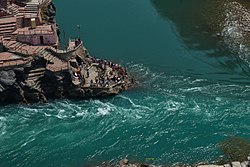
Confluence of the Alaknanda (left) and Bhagirathi (right) Rivers to form the Ganga at Devprayag

As of 2001 India census,[4] Devprayag had a population of 2144. Males constitute 52% of the population and females 48%. Devprayag has an average literacy rate of 77%, higher than the national average of 74.5%; male literacy is 82% and, female literacy is 72%. In Devprayag, 13% of the population is under 6 years of age. The town is the seat of the pandas of the Badrinath Dham.

[edit]

Devprayag has been featured prominently in the films Kisna: The Warrior Poet and Ponga Pandit.

Transport

[edit]

Air

[edit]

The nearest airport is the Jolly Grant Airport near Dehradun 116 km (72 mi) away.

Railway

[edit]

The nearest railway stations is at Rishikesh. However, Rishikesh is a small railway station not connected by fast trains. Haridwar railway junction, 24 km farther from Rishikesh, has train connections to most of the major cities in India and is, therefore, the railhead for Devprayag.

Road

[edit]

Devprayag lies on national highway NH58 that connects Delhi with Badrinath and Mana Pass in Uttarakhand near Indo-Tibet border. Therefore, all the buses and vehicles that carry pilgrims from New Delhi to Badrinath via Haridwar and Rishikesh in pilgrim season of summer months pass through Devprayag on the way to Joshimath and further north. Rishikesh is the major starting point for road journey to Devprayag and regular buses operate from Rishikesh bus station to Devprayag. The road distance from Rishikesh to Devprayag is 74 km (46 mi).

  • Haridwar to Rishikesh 24 km
  • Rishikesh to Devprayag 74 km
  • Devprayag to Srinagar 34 km
  • Srinagar to Rudraprayag 33 km
[edit]
A Panoramic View of Devprayag

See also

[edit]

References

[edit]
[edit]
Revisions and contributorsEdit on WikipediaRead on Wikipedia
from Grokipedia
Devprayag is a town and spanning the Tehri Garhwal and Pauri Garhwal districts of , , situated at an altitude of 830 meters where the Alaknanda and Bhagirathi rivers converge to form the River, marking it as the southernmost of the five sacred confluences known as the . This confluence holds profound religious significance in , symbolizing the birth of the holy Ganga and serving as a key pilgrimage site along the Char Dham route. The town is renowned for its ancient temples, particularly the , dedicated to Lord Rama and believed to be over 1,000 years old, constructed from massive stone slabs and attracting devotees for its historical and spiritual importance. Other notable sites include the Sangam viewpoint, where rituals such as holy dips and aarti ceremonies are performed daily. Devprayag's location in the provides stunning natural scenery, with the rivers' turbulent waters creating a dramatic that draws both pilgrims and nature enthusiasts. Administratively, Devprayag serves as the headquarters of its in , with the tehsil covering an area of approximately 477 square kilometers and encompassing 378 villages; the town's combined urban population was recorded at 2,868 in the 2011 , reflecting a rate of 91.86% and a of 963 females per 1,000 males. Historically, the site has been referenced in ancient texts for its sanctity, and it lies on the metalled road from to , facilitating access for travelers.

Geography

Location and Topography

Devprayag is situated at coordinates 30°08′N 78°36′E in the of , , approximately 70 km northeast of and 94 km from . The town occupies an elevation of about 830 meters above on a rocky ridge wedged between the Alaknanda and Bhagirathi rivers, while the river confluence (Sangam) lies at approximately 475 meters. Its topography is characterized by a dramatic V-shaped valley created by the confluence of these rivers, which merge here to form the ; the surrounding area features terraced hills and densely forested slopes within the . As the southernmost of the —the five sacred confluences along the in —Devprayag holds a pivotal geographical position in the region's riverine landscape.

Climate and Environment

Devprayag features a subtropical highland climate characterized by moderate temperatures and significant seasonal variations, influenced by its position in the Himalayan foothills at approximately 830 meters elevation. Summers, spanning March to June, bring warm to hot conditions with daytime highs typically ranging from 25°C to 38°C and nighttime lows between 11°C and 21°C, accompanied by clear skies and low humidity. Winters from December to February are cooler, with highs of 19°C to 23°C and lows dipping to 7°C to 9°C, often featuring dry and pleasant weather suitable for outdoor activities. The monsoon season, from July to September, delivers heavy rainfall, with up to 21 rainy days per month in peak periods and annual precipitation averaging around 1,633 mm, contributing to lush vegetation but also increasing risks of water-related hazards. The surrounding environment is marked by rich in the forested hills, where subtropical and temperate dominate, including (Quercus spp.), (Pinus roxburghii), and deodar (Cedrus deodara) trees that form dense canopies supporting diverse and . The of the Alaknanda and Bhagirathi rivers creates a vibrant riverine ecosystem, sustaining aquatic life such as fish including Tor putitora (golden ) and various cyprinids, with at least 12 fish documented in the upper reaches near Devprayag. However, the town's Himalayan location exposes it to environmental vulnerabilities, including frequent landslides triggered by steep slopes and heavy monsoons, as well as flash floods that can disrupt the riverine and local . Conservation initiatives in the region focus on preserving this through efforts under the National Mission for Clean Ganga, which includes river surface cleaning, improvements, and monitoring to reduce pollution in the upper . Local programs promote native tree planting to combat and enhance , while community-driven activities aim to maintain river cleanliness and protect aquatic habitats from anthropogenic threats. These measures align with broader Ganga rejuvenation strategies, emphasizing sustainable management of the watershed to support ecological balance.

History and Mythology

Mythological Significance

In , Devprayag is revered as the sacred site where the Ganga River attains its complete form through the of the and Alaknanda rivers, symbolizing the culmination of the divine descent of the sacred waters to earth. The , named after King , represents the celestial Ganga brought down from heaven through his rigorous penance to liberate the souls of his 60,000 ancestors, a legend detailed in ancient texts such as the . The further elevates Devprayag's status by narrating the austerities of the sage Dev Sharma in the , who received a boon from Lord that the site would be eternally known as Devprayag, or the "confluence of the gods," underscoring its primordial spiritual potency. According to local tradition, Lord Rama is believed to have performed penance at this location to atone for the sin of incurred during the slaying of ; some accounts mention it occurring with his father King . Additionally, tradition attributes the establishment of key temples, such as the , to Adi in the 8th century, who installed the idol of Lord Rama to propagate and reinforce the site's devotional heritage. Among the —the five sacred confluences of the Alaknanda with its tributaries (Vishnu Prayag, Nand Prayag, Karn Prayag, Rudra Prayag, and Dev Prayag)—Devprayag holds the highest sanctity as the final and "godly" merger point, where the nascent Ganga emerges in its unified, life-giving essence, embodying the pinnacle of Himalayan pilgrimage symbolism.

Historical Timeline

Devprayag's documented history begins in the medieval period, when the region fell under the influence of the Katyuri dynasty, which ruled parts of Garhwal from approximately the 8th to 11th centuries, promoting and leaving inscriptions that highlight administrative and religious developments. The subsequent Chand dynasty, which ruled the neighboring Kumaon region from the 10th to 18th centuries, exerted indirect influence on Garhwal through trade and cultural exchanges, though local chieftains maintained semi-autonomous control in areas like Devprayag. Following the Katyuri and amid Chand influences from Kumaon, the Panwar dynasty established control over Garhwal around the 13th century, ruling until the early 19th century and promoting local development, including temple patronage in areas like Devprayag. During this era, the , a key landmark, was constructed between the 12th and 13th centuries, serving as a center for Vaishnavite worship amid the shifting dynastic landscape. In the colonial era, British expeditions focused on mapping the upper , with early 19th-century surveys, such as the 1810 effort led by Frederick William Raper, documenting the river's sources and confluences, including the site at Devprayag where the Bhagirathi and Alaknanda rivers meet to form the . These efforts, part of the broader initiatives, facilitated hydrological and topographical records that integrated the Garhwal region into British administrative frameworks. By the early , following the formation of the United Provinces of and Oudh in 1902, surrounding areas were incorporated into colonial governance, though Devprayag remained linked to the semi-independent Tehri Garhwal . Post-independence, Devprayag was part of the until its accession to in 1949, after which it was integrated into as a in the . Administrative boundaries shifted again with the Uttar Pradesh Reorganisation Act of 2000, carving out as a separate state on November 9, 2000, placing Devprayag within the newly formed . Recent infrastructure enhancements include upgrades to National Highway 58, such as ongoing works from Kodiyala to Devprayag, with a Rs 125 project approved in August 2025 to address vulnerabilities along the Rishikesh-Badrinath corridor. A significant setback occurred during the 2013 Uttarakhand floods, triggered by extreme cloudbursts from June 16-17, which caused severe at the Devprayag , damaged roads and bridges, and led to widespread infrastructure disruption in the town, contributing to over 5,000 deaths across the state. Recovery efforts focused on rebuilding transport links and stabilizing slopes, underscoring the area's vulnerability to Himalayan disasters.

Religious Importance

Sacred Confluence

The sacred confluence at Devprayag, referred to as Sangam, marks the point where the Bhagirathi and Alaknanda rivers merge to form the Ganga, embodying deep spiritual symbolism in . The Bhagirathi, named after King who invoked the descent of the Ganga and closely associated with Lord —who is said to have contained the river's force in his matted locks—represents transformative and ascetic energies. In contrast, the Alaknanda, originating from the Vishnu Prayag where the Vishnu Ganga joins the Dhauliganga, symbolizes preservative and linked to Lord . This union at Devprayag is revered as the harmonious blending of Shiva's destructive-renewal power with Vishnu's sustaining essence, creating a balanced flow essential for spiritual purification. For ritual purposes, this site is regarded as the authentic birthplace of the Ganga, where its 12 mythical channels are believed to reunite, tempering the river's primordial ferocity into a benevolent force. Positioned as a critical juncture on the pilgrimage path leading to , Devprayag draws innumerable devotees seeking communion with the divine through the confluence's waters. Pilgrims undertake holy dips, known as snan, at the Sangam to wash away karmic impurities and foster , a practice rooted in the belief that the merged rivers amplify the Ganga's redemptive qualities. Complementing these immersions, evening aarti rituals—offering lamps and chants to the river—illuminate the site's sanctity, fostering a collective devotional experience that reinforces Hindu traditions of reverence for . The broader significance of Devprayag's confluence lies in its foundational role in enhancing the Ganga's holiness, which cascades downstream to sites like , sustaining a network of pilgrimage centers across the river basin. This spiritual amplification underscores the site's cosmological importance, where the river's journey from Devprayag onward embodies the eternal cycle of purification and devotion in Hindu lore, influencing rituals and beliefs far beyond the .

Major Temples and Sites

The , dedicated to Lord as Raghunathji, stands as the principal religious edifice in Devprayag, perched atop a rocky outcrop overlooking the confluence of the Alaknanda and Bhagirathi rivers. Believed to have been originally established in the 8th century by Adi , the structure was damaged in an earthquake around 1893 and subsequently rebuilt by a local king of the Garhwal Kingdom. The temple features ornate carvings on its stone facade, and a central idol of Lord measuring approximately 15 feet in height, flanked by smaller figures of , , and . Local legends associate the site with Lord 's penance for absolution after the slaying of , enhancing its spiritual allure. Adjacent to the sacred Sangam, the Laxmi Temple serves as an ancient Vaishnava shrine housing black stone idols of Lord Vishnu in his form alongside Goddess Lakshmi, positioned to offer panoramic views of the river merger. Though precise construction dates remain undocumented in available records, the temple's simple yet enduring stone architecture reflects early medieval influences, with the idols believed to date back several centuries and symbolizing prosperity and divine protection over the pilgrimage site. Approximately 7 kilometers from Devprayag, the Chandrabadani Temple emerges as a prominent nearby shrine, recognized as one of the 51 Shakti Peeths where the torso of Goddess Sati is said to have fallen during Lord Shiva's cosmic procession. Situated at an elevation of 2,277 meters on Chandrabadni Mountain, the temple complex includes a silver-faced idol of the goddess without a traditional form, surrounded by ancient iron trishuls and weapons attributed to her divine arsenal. The site, accessible via a short trek, underscores the region's worship traditions. The Gita Mandir, located nearby, is another significant temple dedicated to Lord Krishna, featuring teachings from the inscribed on its walls and serving as a center for spiritual discourse and devotion. Devprayag also preserves ancient bathing ghats along the Sangam, such as the multi-tiered stone steps at the river , constructed to facilitate immersions amid varying water levels, particularly during monsoons. These ghats, hewn from local rock, date to historical eras and remain integral to daily ablutions. Scattered ashrams dot the town's periphery, serving as hermitages for ascetics; notable examples include modest stone-built retreats near the ghats, fostering and scriptural study in the Himalayan setting. The temples of Devprayag predominantly exhibit Nagara-style architecture, characterized by curvilinear shikharas rising from square sanctums, but adapted to the rugged Himalayan terrain through reinforced stone bases and gently sloping roofs on mandapas to withstand seismic activity and heavy snowfall. This regional variation in the North Indian Nagara tradition emphasizes durability, with projections (rathas) on walls providing stability against mountain winds, as seen in the robust rock-integrated construction of the .

Demographics and Society

Population and Growth

According to the , the population of Devprayag town, administered as a , stood at 2,868 residents. The broader Devprayag encompassed a total population of 94,441 individuals. The in the tehsil was 1,109 females per 1,000 males, reflecting a relatively balanced distribution compared to the state average. The literacy rate across the tehsil was recorded at 75.72%, indicating moderate in the region. Between the and 2011 censuses, the town's exhibited modest growth, rising from 2,769 to 2,868—a decadal increase of approximately 3.6%. This expansion was lower than the state's overall decadal growth rate of 18.81% during the same period, likely influenced by the town's strategic location and significance. Projections based on historical trends suggest that the town's population reached around 4,100 by 2025. Within the tehsil, the demographic composition showed a rural-urban split with about 96% of the residing in rural areas, highlighting the predominance of village-based livelihoods.

Cultural Composition

Devprayag's is overwhelmingly Hindu, comprising over 99% of the tehsil's residents according to the 2011 census, with small minorities of (0.83%), (0.05%), and (0.02%). This religious homogeneity reflects the town's status as a key Hindu pilgrimage center, where non-Hindu communities maintain low profiles amid the dominant Hindu ethos. The linguistic landscape is dominated by Hindi and Garhwali, the primary languages spoken by the local Garhwali population, with serving as the official medium and Garhwali used in daily and cultural interactions. holds significant influence in religious rituals and temple discourses, underscoring the town's scriptural heritage tied to . Socially, Devprayag exhibits a caste-based structure typical of Garhwali society, with Brahmins and Rajputs forming the upper strata, while Scheduled Castes account for 18.4% of the and Scheduled Tribes a minimal 0.2%, indicating limited but present tribal elements in the broader Garhwal region. roles are shaped by the pilgrimage economy, where male outmigration for work leaves women managing household duties, agriculture, and increasingly, tourism-related activities like guiding visitors and operating small enterprises. Education indicators show a tehsil rate of 75.72% (male: 89.21%, female: 63.93%), supported by government primary and secondary schools, while health access includes a Community Health Centre providing basic medical services to the approximately 94,000 residents. Community life in Devprayag revolves around joint family systems, prevalent in rural Garhwal settings, where extended households foster intergenerational support and resource sharing amid the small-town environment. dynamics persist, influencing social interactions and marriage alliances, with upper castes like Brahmins holding cultural prominence due to their roles in religious institutions, though modernization is gradually softening rigid hierarchies.

Culture and Festivals

Local Traditions

Local traditions in Devprayag reflect the Garhwali heritage of the region, emphasizing simplicity, community, and harmony with the natural environment shaped by the Himalayan foothills and sacred rivers. Everyday customs are deeply intertwined with daily life, where residents maintain practices passed down through generations, often centered around family, agriculture, and spiritual observance. Garhwali customs include distinctive traditional attire that highlights the region's . Women commonly wear the ghagra-choli, consisting of a long pleated skirt (ghagra or ghagri) paired with a fitted blouse (), often complemented by an orni or for modesty and adornment during daily activities or special occasions. This ensemble, typically made from cotton or wool, is embroidered with local motifs and worn by both Garhwali and Kumaoni women in , symbolizing regional pride and practicality for mountainous terrain. and form a vital part of social interactions, particularly during weddings, where group performances like the Jhora or Thali Jad are enacted in circles to the rhythm of dholak drums and traditional songs, fostering communal joy and preserving oral histories through rhythmic . Culinary traditions in Devprayag draw from locally available ingredients, emphasizing nutritious, hearty dishes suited to the cold climate and agrarian lifestyle. Chainsoo, a protein-rich made from roasted black gram (urad dal), is a staple, prepared by grinding the dal into a paste and tempering it with spices like and , then served with or for its warming qualities. Similarly, bhatt ki churkani features fermented black soybeans (bhatt), soaked and cooked into a tangy with ginger and green chilies, providing essential nutrients in the Garhwali diet and reflecting sustainable use of high-altitude crops. While the rivers influence local sustenance, the sacred nature of the waters limits widespread consumption of river fish, though it occasionally supplements meals in non-ritual contexts. Arts and crafts in Devprayag showcase skilled craftsmanship rooted in religious and domestic needs. , known locally as likhai, adorns temple structures and household items with intricate motifs of , , and deities, using tools like the burin to etch deodar wood for durability in the humid climate. This art form enhances the aesthetic and spiritual ambiance of sites like the ancient temples along the . Seasonal flower offerings, influenced by longstanding practices akin to spring rituals, involve gathering wild blooms such as (buransh) and pyoli to decorate homes and shrines, symbolizing gratitude for nature's renewal and integrating into daily worship. Social norms in Devprayag underscore the centrality of river-based rituals in daily life, where the majority Hindu population engages in practices that reinforce spiritual discipline and bonds. Morning aarti ceremonies at the of the Alaknanda and Bhagirathi rivers begin at dawn, involving the of lamps, chanting of hymns, and offerings to the emerging Ganga, performed by locals as a routine act of devotion to purify the soul and seek blessings for the day. These rituals, conducted on the ghats, promote values of and environmental reverence, with families participating collectively to maintain social cohesion.

Annual Events

Devprayag, as a sacred pilgrimage site at the of the Alaknanda and Bhagirathi rivers, hosts several annual events that blend religious rituals with community participation, drawing devotees and visitors to its ghats and temples. These festivals emphasize the town's spiritual heritage, particularly its association with the Ganga, and involve collective bathing, processions, and cultural performances that foster communal bonds. Ganga Dussehra, observed in May or June on the tenth day of the Jyeshtha month, commemorates the descent of the Ganga from heaven to earth as per Hindu mythology. In Devprayag, the festival features mass ritual bathing at the Sangam ghat, where thousands of pilgrims immerse themselves in the holy waters believed to cleanse sins. Boat processions along the river, adorned with flowers and lamps, accompany temple decorations and evening aartis, with locals and visitors offering prayers for prosperity and purification. Community involvement is prominent, as residents prepare special sweets and organize bhajans to honor the river goddess. Ram Navami, celebrated in March or April to mark the birth of Lord , centers on special pujas at the historic overlooking the Sangam. Devotees perform elaborate rituals, including recitations from the and symbolic reenactments of Rama's penance at the site, which is mythologically linked to his exile. The day culminates in processions carrying the deity's idol through the town, with prasad distribution involving the entire community in fasting and feasting. These events highlight the temple's role as a focal point for Vaishnava devotion. Makar Sankranti in January signifies the sun's transition to the and is marked by holy dips at the Sangam, kite-flying competitions along the riverbanks, and the distribution of sesame-based sweets like til laddoos among families and pilgrims. Residents offer gratitude to the sun god through tilak ceremonies and bonfires, while the theme encourages communal gatherings for folk songs and dances. This underscores Devprayag's agrarian roots, with locals sharing produce in a spirit of renewal. Navratri fairs in September-October feature nine nights of worship to Goddess , with vibrant Garhwali folk dances like Jhora and performed at the Sangam and nearby temples, involving women in traditional attire leading processions.

Transport and Connectivity

Road Access

Devprayag is situated along National Highway 7 (NH7), which follows the historic Rishikesh-Badrinath route through the , connecting it to key junctions such as to the north and further ahead. The town serves as a vital transit point for travelers heading to higher Himalayan destinations, with the highway providing a primary artery for vehicular access from the plains. Public bus services are a common mode of ground transport to Devprayag, operated by the Garhwal Motor Owners' Union (GMOU) and (UTC), offering regular departures from nearby hubs. GMOU and UTC buses run from (approximately 110 km away), (95 km), and (72 km), with journeys typically taking 3-5 hours depending on traffic and road conditions. Local taxis and shared jeeps are also widely available from these points, providing flexible options for smaller groups or direct drops to the town center. Within Devprayag, internal connectivity relies on a network of narrow, winding local roads that link the main highway to temples, ghats, and residential areas along the river confluences. These roads are often steep and prone to congestion, with seasonal blockages common during monsoons due to landslides and heavy rainfall, which can disrupt access for several days.
City/TownApproximate Distance (km)Travel Time (hours)Source
3058-10eUttaranchal
1103-4Yatra.com
953-4Himalayan Moments
722-3Travanya

Air and Rail Options

The nearest airport to Devprayag is Jolly Grant Airport (DED) in , located approximately 91 km away, with a typical drive time of 2-3 hours via National Highway 7. This airport offers regular flights from major Indian cities such as and , operated by airlines including and . From the airport, travelers can arrange prepaid , which cost around ₹1,200-₹1,650 for a sedan or to Devprayag, or opt for shared shuttle services. For those arriving from farther destinations, () in serves as an alternative, situated about 320 km from Devprayag, though its connectivity is more limited for direct access to the region due to the greater distance. Transfers from airport typically involve a combination of flight to Jolly Grant followed by road, or a direct long-haul drive. Devprayag lacks a railway station, with the closest being (RKSH), roughly 72 km away and reachable in about 2 hours by road. Rishikesh connects to via several trains, including the and , offering frequent daily services. Junction (HW), another key station with broader options like the from , is approximately 95 km from Devprayag. From either station, prepaid taxis (₹1,000-₹2,000) or local buses (₹100-₹500) provide onward , with buses departing regularly from Rishikesh ISBT. The –Karnaprayag railway line, a 125 km under-construction broad-gauge project, will provide direct rail connectivity to Devprayag and surrounding areas upon completion, expected in phases by 2026 or later. As of November 2025, trial train services have commenced between and Byasi, marking progress on this line that includes 12 stations, 17 tunnels, and 35 bridges.

Economy and Tourism

Local Economy

The local economy of Devprayag is predominantly agrarian, with forming the backbone of livelihoods for a majority of residents in this hilly terrain of , . Terraced farming is widely practiced due to the steep slopes, supporting the cultivation of staple crops such as and , alongside millets like mandua and jhangora. also plays a supplementary role, with crops including apples, potatoes, and limited contributing to household income, though these are grown on small plots owing to fragmented landholdings and challenging . Complementing agriculture is the pilgrimage-driven economy, as Devprayag's status as the sacred of the Bhagirathi and Alaknanda rivers—marking the origin of the Ganga—attracts numerous yatris (pilgrims) annually. This generates through temple donations, sales of religious artifacts like holy Ganga water (Gangajal) in bottles, and small-scale trade in devotional items, while providing seasonal employment in guiding services, basic lodging, and hospitality for visitors en route to higher sites. Recent growth in , with over 23 crore visitors in the last three years up to 2025, has further boosted this sector in pilgrimage sites like Devprayag. Such activities bolster local markets but remain informal and fluctuating with pilgrimage seasons. Development challenges persist, including limited industrial growth constrained by the rugged terrain and vulnerability to , leading to significant out-migration of to urban areas in search of better opportunities. Subsistence farming's low exacerbates agro-economic distress, with many households relying on remittances. Government initiatives, such as the for river rejuvenation, aim to mitigate these issues by improving water quality and supporting eco-friendly livelihoods along the Ganga basin, though implementation in remote areas like Devprayag faces logistical hurdles. Infrastructure supports rudimentary economic activities through basic weekly markets for local produce and religious goods, alongside a few bank branches offering essential to farmers and traders. However, per capita income in Devprayag block remains below the state average of ₹2.74 (2024-25).

Visitor Attractions

Devprayag serves as a prime destination for pilgrims and adventure seekers, drawn primarily to the scenic Sangam, the confluence of the Alaknanda and Bhagirathi rivers forming the , where visitors can enjoy panoramic viewpoints ideal for observing the river's dramatic meeting point. The viewpoint offers opportunities for , capturing the crystal-clear waters and surrounding Himalayan , especially during clear from October to April when visibility is optimal. Nearby, the historic and other sacred sites add a spiritual dimension to visits, often coinciding with local festivals that enhance the cultural experience. Adventure activities abound, including river on the starting from Devprayag, featuring Grade III-IV suitable for intermediate rafters, with trips typically spanning 70 km downstream to over 2-3 days. These expeditions, available from October to March, combine thrilling navigations through like "Flash Pans" with serene stretches for swimming and wildlife spotting, emphasizing safety with professional guides. For those seeking milder exertion, short treks such as the 1 km uphill path to Chandrabadani Temple—after a 33 km drive from Devprayag—provide rewarding hikes through pine forests to a hilltop Shaktipeeth with stunning valley views. Additional pursuits include retreats at local ashrams like Yog Niketan Dham, offering sessions amid the riverside tranquility, and guided eco-tourism walks exploring nearby trails and biodiversity hotspots. Accommodations in Devprayag cater to budget-conscious travelers, with the Garhwal Mandal Vikas Nigam (GMVN) Tourist Rest House providing 14 economy rooms featuring basic amenities and common baths, starting at affordable rates for a comfortable stay overlooking the Sangam. Several budget hotels and guesthouses, such as those near the main market, offer simple lodging with options for meals, though advance booking is recommended during peak pilgrimage seasons. The optimal visiting period is to , avoiding the July-September monsoon when heavy rains can lead to and landslides, posing significant risks to river-based activities and access roads. Visitors should heed warnings from local authorities, stay informed via weather apps, and refrain from alcohol consumption near sacred sites, in line with regional policies prohibiting public drinking to maintain the area's spiritual sanctity.

References

Add your contribution
Related Hubs
User Avatar
No comments yet.