Hubbry Logo
Diffa RegionDiffa RegionMain
Open search
Diffa Region
Community hub
Diffa Region
logo
8 pages, 0 posts
0 subscribers
Be the first to start a discussion here.
Contribute something
Diffa Region
Diffa Region
from Wikipedia

Diffa is one of the seven regions of Niger, and is located in the southeast of the country. The capital of the region is Diffa.

Key Information

Geography

[edit]

Diffa Region is situated in the extreme southeast of Niger between 10° 30’ and 15° 35’ longitude East and 13° 04’ and 18° 00’ latitude North. It covers 156 906 km², and it borders Agadez Region to the north, Chad to the east, Nigeria to the south, and Zinder Region to the west. The landscape is primarily Sahelian in the south, merging into the Sahara desert in the north of the region. In the far southeast can be found Niger's portion of Lake Chad; formerly extending as far west as N'guigmi, the lake has shrunk drastically in recent decades.[3] In the southeast, the Komadougou Yobe river forms part of the border with Nigeria.[3]

Settlements

[edit]

Diffa is the regional capital. Other major settlements include Bosso, Chetimari, Dungass, Gueskerou, Goudoumaria, Kablewa, Mainé-Soroa, N'Gourti, N'Guelbély, N'guigmi and Toumour.[4]

Administrative subdivisions

[edit]
Departments of Diffa (Old borders)

Diffa Region is divided into six Departments:

The Region also includes three Urban Communes, a number of Rural Communes, four Cantons, and over twenty Groupments (administrative councils of nomadic communities). The Urban Communes are Diffa, Maïné-Soroa, N'guigmi; while the Rural Communes include Bosso, Chétimari, Goudoumaria, N'Gourti, Kabléwa, Nguel beyli, and Gueskérou.

Demographics

[edit]

The main ethnolinguistic groups in the region are Arabs, Fula, Hausa, Kanuri, Buduma, and Toubou.[5][6]

Historical population
YearPop.±%
1977167,382—    
1985189,091+13.0%
2001346,595+83.3%
2012593,821+71.3%
source:[7]

Refugees

[edit]

Refugees from Nigeria fleeing violence from Boko Haram are living with local populations in the Diffa Region. As of June 11, 2014, the International Rescue Committee (IRC) estimated that as many as 1,000 refugees a week were crossing the border into Diffa region; four out of five were women and girls.[8] By October 2015 the number of Nigerian refugees in the region had risen to at least 150,000.[9] After a lull in the fighting in 2017-18, violence increased in 2019, further worsening an already fragile security situation.[10]

Economy

[edit]
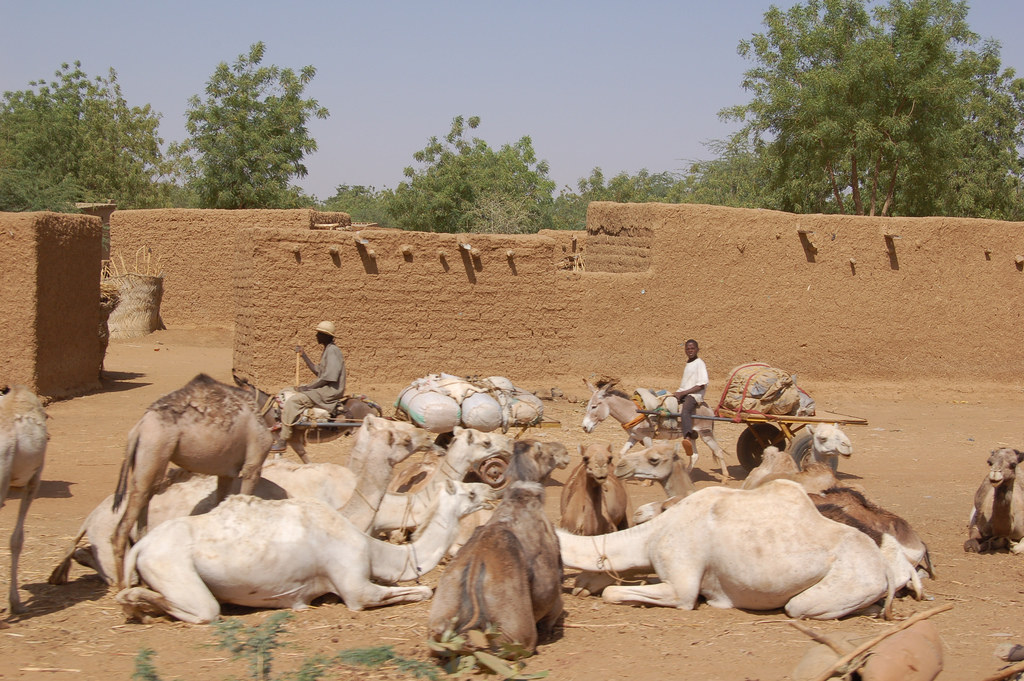
Landscape of rural Diffa Region, Niger, traveling on the main highway from Diffa to Niamey. (2006)

The economy of Diffa Region is primarily agricultural, based upon pastoralism and farming. The major crop, grown both for subsistence and sale, is millet, especially the drought-tolerant varieties. One third of arable land is devoted to farming: almost 105,000 hectares farmed of the 299,500 hectares of arable land. Areas of the east and south also grow rice and maize. Irrigation in the valleys around Maïné-Soroa make this possible, as does the edge of Lake Chad (3,000 km² in the far east) and the seasonal Komadougou Yobe river valley in the south. This river valley forms around 150 km of the border with Nigeria. Despite this, the Diffa Region is among the most unproductive agricultural areas in Niger, and all of West Africa, making it especially vulnerable to drought and famine.

See also

[edit]

References

[edit]
[edit]
Revisions and contributorsEdit on WikipediaRead on Wikipedia
from Grokipedia
Diffa Region is the southeasternmost administrative division of Niger, with its capital at the city of Diffa and an area of 156,906 square kilometers. The region borders Agadez Region to the north, Zinder Region to the west, Nigeria to the south, and Chad to the east, encompassing parts of the Sahel and the shrinking Lake Chad basin. As of 2016 estimates, Diffa Region had a of 669,307, characterized by low density of about 4.3 inhabitants per square kilometer, primarily comprising Hausa, Kanuri, and ethnic groups engaged in subsistence activities. The local economy relies heavily on rain-fed , pastoral nomadism, and seasonal along the Komadugu Yobe and remnants of , which have diminished significantly due to climate variability and upstream water diversions, exacerbating food insecurity and livelihood pressures. Since the mid-2010s, the region has endured recurrent violence from militants operating across the border, including attacks on villages, abductions, and bombings that have displaced over 300,000 people internally and hosted tens of thousands of Nigerian refugees, straining humanitarian resources. Nigerian and regional forces have conducted operations, but cross-border raids persist, as evidenced by ongoing bilateral security discussions between and in 2025 to address the threat. These insecurities have disrupted trade, agriculture, and pastoral mobility, contributing to cycles of poverty and conflict in the Basin.

Geography and Environment

Physical Geography and Borders

The Diffa Region constitutes the southeasternmost administrative division of , encompassing an area of 156,906 square kilometers. It shares land borders with to the north, to the west, to the south, and to the east. These boundaries position Diffa as a strategic zone, with the southern and eastern frontiers approximating 1,196 kilometers of Niger's total international border length shared with Chad and portions of 's . The region's physical landscape consists primarily of flat, expansive plains typical of the transitional zone between the Desert and savanna grasslands, with average elevations of approximately 364 meters above . The features sandy soils, scattered dunes, and minimal topographic relief, lacking significant mountain ranges or escarpments, which contributes to its vulnerability to and processes. Hydrologically, the Komadugu Yobe River—also referred to as the Yobe River—dominates the southern geography, delineating about 150 kilometers of the border with as it flows eastward for a total length of 320 kilometers toward . This seasonal river supports intermittent floodplains and riparian zones south and east of the regional capital Diffa, serving as the principal source amid pervasive aridity, though flow variability is pronounced due to upstream damming and climatic fluctuations.

Climate, Desertification, and Resource Strain

The Diffa Region experiences a hot typical of the zone, characterized by high temperatures year-round and a short rainy season from to September. Average annual rainfall is approximately 200-300 mm, with the peak in reaching about 100 mm, while the remainder of the year remains extremely dry. Daytime temperatures frequently exceed 40°C during the hot season from March to May, with average highs around 42°C, and minimum temperatures rarely drop below 20°C even in the cooler months of to February. Desertification in the Diffa Region is driven by a combination of climatic variability, including prolonged droughts, and anthropogenic factors such as , for fuelwood, and expanding into marginal lands. Soil erosion has intensified due to wind and water runoff on degraded soils, reducing vegetative cover and fertility across vast areas; as a whole loses an estimated 100,000 hectares of annually to processes. In the context encompassing Diffa, these dynamics have led to the southward advance of the at rates of up to 10 km per decade in some periods, exacerbating that affects over one-third of the region's . communities, reliant on mobile , face perpetual disequilibrium from shortages, contributing to further environmental stress through concentrated grazing pressure. Resource strain in Diffa is acute, particularly around water sources tied to the shrinking Basin, where the lake has diminished by over 90% since the due to reduced inflows, evaporation, and upstream diversions. This scarcity heightens competition between sedentary farmers and transhumant pastoralists for access to rivers like the Komadugu Yobe and diminishing wetlands, fueling low-intensity conflicts over and rights; soil deficits correlate directly with escalated water-related disputes in the region. and , which support 95% of the local population through rearing of , sheep, and goats numbering in the millions regionally, suffer from declining yields amid land pressure, with pastoral areas contracting due to cropland encroachment and refugee-driven demand surges. These pressures compound food insecurity and displacement, as herders adapt by reducing mobility, leading to localized of remaining resources.

Historical Background

Pre-Colonial and Colonial Periods

The territory comprising the modern Diffa Region was historically part of the eastern frontier of the Kanem-Bornu Empire, which exerted influence over areas around from the onward, encompassing parts of present-day eastern through trade networks and military expansion. The empire's core, ruled by the Sef dynasty, facilitated trans-Saharan commerce in slaves, salt, and ivory, with the region's nomadic pastoralists and sedentary communities along seasonal riverbeds contributing to these exchanges. Primary inhabitants included the , whose language and cultural practices trace back to Bornu's administrative and Islamic-influenced systems, alongside Toubou nomads and Arab traders who navigated the arid landscapes for grazing and commerce. Pre-colonial societies in the area relied on agro-pastoralism, with millet cultivation near Komadugu Yobe riverbeds and livestock herding by Kanuri and Fulani groups, supplemented by in Lake Chad's fringes; hierarchical structures featured mai (kings) delegating authority to district chiefs, though power was often contested by jihadist movements in the that weakened central Bornu control. was integral, with captives from raids integrated into households or traded southward, reflecting broader Sahelian patterns where servile labor supported households amid environmental volatility. By the late 1800s, the decline of Kanem-Bornu due to internal strife and external pressures left the region fragmented into local chiefdoms, vulnerable to European incursions. French colonial expansion into commenced in the late , with systematic conquest accelerating after following the capture of , extending eastward to subdue remnants of Bornu and Damagaram sultanates that overlapped Diffa's territories. The Diffa area, remote and sparsely administered, fell under French military control by the early 1900s as part of the Niger Military Territory established in 1900, formalized as a colony in 1922 within . Administration emphasized resource extraction and pacification, imposing labor for infrastructure like wells and roads while co-opting Kanuri chiefs as intermediaries, though resistance persisted through sporadic revolts against taxation and forced recruitment. Border delineations with British and , fixed by agreements like the 1898 Anglo-French Convention, isolated Diffa as a peripheral zone focused on border patrols rather than development, perpetuating nomadic patterns amid minimal investment until independence in 1960.

Post-Independence to Pre-Insurgency Era

Following Niger's independence from on August 3, 1960, the southeastern territory that would later form the Diffa Region remained a marginal administrative outpost, primarily integrated into the larger Department, with limited investment in infrastructure or services. The area's economy centered on subsistence , small-scale along the Komadugu Yobe River, and cross-border trade with , sustaining ethnic groups including Kanuri, (nomadic herders of Sudanese and Chadian origin), Toubou, Fulani, and Hausa communities. These populations practiced mobile herding of camels, cattle, and goats, adapted to semi-arid conditions, but faced chronic underdevelopment, with low rates and minimal urbanization beyond the town of Diffa itself. The post-independence era brought recurrent environmental shocks, notably the Sahel-wide droughts of 1968–1974 and 1983–1985, which devastated grazing lands and crop yields in Diffa, exacerbating food insecurity and prompting migration to urban centers or across borders. These crises, compounded by national political instability—including the 1974 military coup against President and subsequent regimes under (1974–1987)—further strained resources, as aid and development efforts prioritized northern uranium-rich areas over eastern peripheries. Pastoralist groups like the maintained resilience through traditional mobility and mechanisms, avoiding the Tuareg rebellions that plagued northern in the 1990s. By the late 1990s, decentralization reforms under the democratic transition elevated Diffa to departmental status in and regional status amid the 1999–2005 devolution process, enabling localized but yielding scant economic gains amid persistent and vulnerability to floods and infestations. Socioeconomic conditions improved marginally in the 2000s under President , with some and borehole projects supported by international donors, yet Diffa remained among 's least developed zones, with agriculture yields hampered by soil degradation and overgrazing. Cross-border dynamics fostered informal markets for livestock and grains with Nigeria's , but weak state presence allowed petty and to persist without escalating to organized prior to 2013. pressures from high rates—averaging over 7 children per woman nationally—intensified resource competition, setting the stage for later vulnerabilities, though the era was marked by relative communal stability rooted in ethnic pluralism and Islamic networks.

Insurgency Onset and Evolution (2013–Present)

The insurgency in 's Diffa Region emerged as a spillover from 's expanding operations in northeastern , with initial cross-border incursions reported in late 2014 as militants sought safe havens amid Nigerian military pressure. By early 2015, conducted its first documented attacks inside , targeting military positions in Bosso and Diffa town on February 6–8, killing several soldiers and prompting to declare a in the region on February 11. These raids involved hundreds of fighters exploiting the porous border, marking the onset of sustained jihadist activity in Diffa, where militants aimed to disrupt Nigerien forces participating in the (MNJTF) against them. Throughout 2015, escalated incursions, launching approximately 30 security incidents in Diffa, including suicide bombings and ambushes that killed dozens of Nigerien troops and civilians. The group's tactics focused on border towns like Bosso, leveraging local grievances over resource access and recruitment from marginalized pastoralist communities to sustain operations. Niger's military response intensified with joint operations alongside MNJTF partners, but early efforts were hampered by under-resourced forces and intelligence gaps, allowing to retreat into remote islands and forests around shrinking . By mid-2016, the deadliest phase unfolded with coordinated assaults on Bosso starting June 3, involving hundreds of militants who overran military posts, killing at least 26 soldiers (including two Nigerians) and displacing over 50,000 residents in subsequent waves of attacks on June 5–6. The 2016 Bosso offensive highlighted Boko Haram's tactical adaptation, using suicide bombers, heavy weapons looted from Nigerian stocks, and cross-border mobility to challenge Nigerien defenses, though it also spurred local vigilante mobilization and fortified military outposts. In response, Niger deployed additional battalions and conducted clearance operations, reclaiming territory but at the cost of exacerbating civilian displacement; by late 2016, Diffa hosted over 400,000 internally displaced persons (IDPs) and Nigerian refugees amid repeated clashes. The factional split within in 2016—leading to the emergence of the Islamic State West Africa Province (ISWAP)—further evolved the threat, as ISWAP's more disciplined cells began probing Diffa for supply routes, though Jama'at Ahl as-Sunnah li-Da'wa wa-l-Jihad (JAS, the remnant faction) remained dominant in cross-border raids. From 2017 to 2019, insurgency patterns shifted toward , with ambushes on patrols and attacks on refugee camps yielding lower but persistent casualties—such as the May 2020 assault on a Diffa outpost killing 12 soldiers—while Niger's emphasized aerial surveillance and community-based intelligence. ISWAP's influence grew in the Basin, incorporating Diffa into broader logistics networks, but operations remained fragmented due to inter-factional rivalries and MNJTF pressure, which neutralized several high-value targets. Cumulative impacts included over 250,000 IDPs and straining local resources by 2017, with jihadist and forced deepening socioeconomic divides. Into the 2020s, the persisted at a simmer, with dozens of annual attacks by JAS and ISWAP affiliates targeting isolated garrisons and convoys in Diffa, as seen in U.S. assessments of ongoing threats. 's responses evolved to include drone strikes and fortified buffer zones, reducing large-scale offensives but failing to eradicate hidden cells amid environmental stressors like aiding militant concealment. By 2025, jihadist resurgence in the Basin signaled renewed adaptability, with coordinated strikes underscoring unresolved vulnerabilities despite regional cooperation. Overall, the conflict has claimed hundreds of and civilian lives in Diffa since 2013, driven primarily by Boko Haram's quest for territorial buffers rather than ideological conquest of proper.

Governance and Administration

Regional Divisions and Local Authorities

The Diffa Region is administratively subdivided into six departments: Bosso, Diffa, Goudoumaria, Mainé-Soroa, N'Gourti, and N'guigmi. These departments serve as intermediate administrative units between the region and the communes, handling coordination of state services, security implementation, and development planning under national oversight. Each department is further divided into communes, with the Diffa Region comprising 12 communes in total—three urban (Diffa, Mainé-Soroa, and N'guigmi) and nine rural (including Bosso, Chétimari, Goudoumaria, Kabléwa, N'gourti, N'guélbeyli, Foulatari, Garin Koudou, and Guidiguir). Communes represent the primary tier of local governance, responsible for basic services such as waste management, local roads, and , though their fiscal autonomy remains constrained by central funding allocations. The regional , appointed by the President of , holds executive authority over the Diffa Region, coordinating departmental activities, humanitarian responses, and security operations amid ongoing insurgencies. Departmental prefects, likewise appointed by the , enforce state policies at the departmental level and report directly to the governor, often managing influxes and inter-communal in Diffa. Commune-level authorities consist of elected municipal councils presided over by mayors, who oversee local budgets and community initiatives; elections occur periodically under Niger's 2010 electoral code, though insecurity in Diffa has periodically disrupted voting and council functionality. Niger's framework, formalized through laws since the , aims to devolve powers to these local bodies, but implementation in Diffa remains limited by centralized control over resources and security, with governors retaining veto authority over local decisions.

Security Governance and Policy Responses

The security apparatus in Diffa Region is primarily overseen by Niger's national defence and (Forces de Défense et de Sécurité, FDS), including the army, , and , operating under the authority of the regional and coordinated through the Ministry of Interior and the Ministry of National Defence. Local vigilance committees and community-based early warning systems supplement formal structures, though their effectiveness is limited by resource constraints and insurgent infiltration risks. Since the escalation of activities around 2013, governance has emphasized centralized military command with decentralized rapid-response units stationed along the border, particularly in departments like Diffa and N'Gourmadji. Key policy responses have centered on repeated declarations of states of , first imposed in 2015 for 15 days following Boko Haram attacks that killed dozens and displaced thousands, and extended multiple times thereafter, including a three-month renewal on August 19, 2025, amid ongoing threats. These measures grant expanded powers for searches, arrests without warrants, curfews, and restrictions on assemblies and media reporting on security incidents without prior authorization, aimed at disrupting insurgent logistics and safe havens in remote border areas. The Nigerien government has also integrated Diffa into broader counter-insurgency frameworks, such as the (MNJTF), operational since 2015 with Niger contributing battalions alongside , , and ; MNJTF operations have included cross-border pursuits and neutralization of Boko Haram cells, with reported gains like the rescue of eight civilians in Kaji Jiwa on July 2025. Military-focused policies have yielded tactical successes, such as FDS-led offensives reclaiming territory and reducing large-scale incursions, but analysts note that insurgency persistence stems from underlying local disputes over resources like and grazing lands, exacerbated rather than resolved by heavy-handed responses. Efforts to bolster include international partnerships for security sector reform, such as DCAF programs since 2019 enhancing accountability and training, though systemic issues like and uneven command structures undermine efficacy. Human rights monitors have documented excesses under emergency powers, including arbitrary detentions and extrajudicial actions by security forces, prompting calls for oversight mechanisms to align policies with civilian protection.

Population and Society

Demographic Profile and Ethnic Groups

The Diffa Region of spans approximately 156,906 square kilometers, resulting in one of the lowest population densities in the at about 3.8 inhabitants per square kilometer as of the national . That recorded a regional of 591,715, reflecting a young demographic typical of , with over 70% under age 30 and a high driven by rates exceeding national averages in rural eastern areas. Projections indicate growth to around 669,307 by 2016, though subsequent estimates vary due to underreporting from insecurity and migration; remains minimal, with the capital Diffa hosting about 39,960 residents in , or roughly 7% of the regional total. Ethnically, the Kanuri constitute the predominant group, comprising the majority of the sedentary population in Diffa and neighboring Basin areas, where they engage in agriculture and fishing. Kanuri subgroups, including the Manga, number tens of thousands regionally and maintain cultural ties to historical Bornu Empire legacies, speaking dialects of the within the Nilo-Saharan family. Nomadic and semi-nomadic minorities include the Toubou (Tubu), concentrated in northern districts near , known for camel herding and adaptation to arid environments; (Mahamid), Arabicized pastoralists involved in ; and Fulani (Peuhl) herders traversing borders for livestock. Smaller Hausa communities exist along southern trade routes, while Gurma and other Sahelian groups appear sporadically; inter-ethnic relations have historically involved resource competition over water and grazing, exacerbated by environmental pressures. Linguistic diversity mirrors ethnic lines, with Kanuri dominant alongside French as the , Hausa as a trade , and Toubou and variants in nomadic subgroups; literacy rates lag national figures at under 20% for adults, reflecting limited schooling access in remote zones. Religious composition is overwhelmingly Muslim (Sunni Maliki rite), with Sufi brotherhoods like Tijaniyya influencing Kanuri and Fulani social structures, though animist practices persist marginally among Toubou. These demographics underpin a society oriented toward subsistence and agro-pastoralism, vulnerable to shocks from and conflict displacement.

Refugee Influx, IDPs, and Socioeconomic Pressures

The Diffa region, bordering northeastern , has absorbed a substantial influx of refugees primarily fleeing and associated violence since early 2013, with peak arrivals occurring between 2014 and 2016 when attacks spilled across the border, displacing tens of thousands in events such as the 2015 Bosso and Diffa town assaults. By September 2025, the region hosted approximately 120,149 persons of concern under UNHCR monitoring, predominantly Nigerian refugees and returnees alongside local displaced groups, reflecting ongoing though reduced cross-border movements—such as the 1,365 Nigerian refugees arriving since January 2024 amid persistent insecurity. nationally registers around 431,072 refugees and asylum-seekers as of March 2025, with Nigerian nationals comprising the largest cohort (over 187,000), the bulk concentrated in Diffa due to its proximity to . Internally displaced persons (IDPs) within Diffa stem from direct incursions into Nigerien territory, including suicide bombings, abductions, and village razings that prompted mass evacuations, such as the 50,000–75,000 displaced from Yebi and Bosso in 2015–2016. As of March 2025, recorded 507,438 IDPs nationwide—a 25% rise from the prior year— with Diffa and Tillabéri regions accounting for nearly 78% of the total, driven by jihadist activities and operations disrupting pastoral and sedentary communities. Sites like Gueskerou camp near Diffa city shelter over 15,000 IDPs and refugees combined, where vulnerability to floods and conflict compounds relocation challenges. This displacement has intensified socioeconomic pressures in Diffa, an arid zone with pre-existing , limited , and reliance on and , as influxes strain water sources, grazing lands, and food supplies, fostering competition between hosts and newcomers that risks intercommunal tensions. disruptions from conflict curtail income opportunities for both IDPs/refugees and locals, exacerbating food insecurity—primarily conflict-induced—and overburdening scant services like and education, where displaced populations face differential access and heightened vulnerabilities. Without sustained , such dynamics perpetuate dependency on aid while diminishing host community resilience to environmental shocks like .

Economic Foundations

Agriculture, Pastoralism, and Trade

in Diffa Region primarily involves rainfed cultivation of staple cereals including , , and , which dominate national acreage at 46%, 18%, and 32% respectively, reflecting patterns in this semi-arid zone. Irrigated farming along the Komadugu Yobe supports additional crops such as onions, , and cowpeas, contributing to household amid variable rainfall. area totals approximately 122,461 hectares, representing 1.5% of 's national cultivated . Pastoralism forms the cornerstone of the local economy, engaging 95% of communities through herding of , sheep, goats, , and donkeys, with Diffa noted for specialized camel rearing among transhumant pastoralists. Sedentary and mobile systems coexist, as evidenced by surveys of 300 households split evenly between the two, highlighting vulnerability to environmental fluctuations and resource competition. such as the indigenous Kuri are prevalent, supporting both subsistence and market-oriented activities. Trade revolves around Diffa town's markets for staple foods and livestock, serving internal distribution and cross-border flows with and in the Lake Chad Basin, encompassing agricultural produce, animals, and fisheries despite logistical barriers. Livestock exports, including cattle and small ruminants, drive regional commerce, with routes facilitating seasonal movements into during the dry season.

Disruptions from Conflict and Environmental Factors

The , escalating from 2013 onward, has profoundly disrupted agriculture and pastoralism in Diffa through targeted attacks, , and restricted mobility, resulting in widespread abandonment of farmlands and grazing areas. By April 2024, Diffa hosted approximately 38% of 's 870,828 internally displaced persons, exacerbating labor shortages for planting and harvesting seasons. Insecurity has altered traditional routes, heightening competition for water points and pastures between sedentary farmers and mobile herders, while cross-border markets have contracted due to blocked pathways. Trade in key exports like peppers and rice from the Komadougou Valley, previously directed to , faced interruptions that persisted beyond the 2015 declaration, though partial resumption occurred after mid-2023 amid ongoing volatility. Environmental degradation compounds these conflict-induced setbacks, with the recession of —shrinking over 90% since the 1960s due to reduced inflow, high evaporation, and upstream damming—severely curtailing fishing yields and irrigation for rain-fed crops in Diffa's lacustrine zones. Erratic rainfall patterns, including deficits and floods along the Komadougou Yobé River, have threatened availability for and crop production, with 2024 floods risking further losses in millet and harvests essential to local pastoral-agricultural systems. Pastoralists face intensified vulnerability from and resource scarcity, which, intertwined with insurgency-driven displacement, has eroded traditional livelihoods and amplified farmer-herder tensions over diminishing rangelands. These dual pressures have fostered chronic food insecurity, with 31% of Diffa's population reliant on aid distributions until security constraints limited access in mid-2024, underscoring the interplay between violent disruptions and climatic stressors in undermining economic resilience.

Security Dynamics

Jihadist Threats and Boko Haram Activities

The Diffa Region in southeastern Niger has endured persistent jihadist threats from Boko Haram and its splinter faction, the Islamic State West Africa Province (ISWAP), owing to its proximity to Nigeria's Borno State and the porous borders around Lake Chad. These groups exploit the region's remote terrain, including islands and swamps, for cross-border operations, launching incursions that target military outposts, villages, and supply routes. Attacks typically involve ambushes, suicide bombings, and raids, driven by efforts to establish territorial control, disrupt governance, and recruit from local grievances exacerbated by poverty and resource competition. Boko Haram's activities intensified in Diffa from 2014 onward, with fighters using the area as a staging ground after Nigerian offensives pushed them westward. Notable early incursions included coordinated assaults on towns like Bosso and Diffa in February 2015, where militants overran military positions, killing dozens of soldiers and prompting multinational counteroffensives. By 2020-2021, attacks escalated against Nigerien forces; on May 20, 2020, militants assaulted a in the region, killing 12 soldiers and wounding others in a raid involving heavy weapons. Similarly, on August 25, 2021, hundreds of fighters attacked a southern post near Diffa, resulting in 16 soldiers killed and nine wounded, highlighting the group's capacity for large-scale operations despite internal fractures. ISWAP, which split from in 2016 emphasizing more structured governance over indiscriminate violence, has conducted targeted strikes in Diffa, often blending with remnants. In August 2023, Nigerien forces killed 39 /ISWAP fighters near Barwa in Diffa during a clash, underscoring ongoing militant presence. More recently, on August 18 (year unspecified in report but contextualized as part of continuous conflict), government operations neutralized additional jihadists in the region. 's resurgence in late 2024 spilled over, with the capture of Dammasak in on November 24 forcing thousands of civilians to flee into Diffa, straining local resources and enabling further incursions. As of 2025, the threat persists amid intra-jihadist rivalries and regional instability, with Nigerien forces reporting the killing of a senior leader in the Basin near Diffa on August 22, 2025, during an operation targeting cross-border networks. These activities have caused hundreds of civilian casualties over the years, including village raids like the February 1 killing of six in Bagué Djaradi by suspected militants, and contributed to over 300,000 displacements in Diffa since 2014. Jihadist tactics prioritize hit-and-run assaults to erode state authority, with limited but disruptive suicide bombings and abductions, particularly of women and children, reflecting ideological goals of imposing strict rule.

State Military Operations and Regional Alliances

Nigerien defence and security forces have conducted ongoing operations in the Diffa region to counter incursions originating from , with intensified efforts since the group's cross-border attacks escalated around 2014-2015. These operations focus on border areas near , including patrols, ambushes, and targeted strikes against insurgent camps and supply lines. In August 2025, Nigerien troops executed a surgical operation in the basin, resulting in the elimination of Bakura and the seizure of weapons and logistics materials. Similarly, in July 2025, forces rescued eight civilians abducted in Kaji Jiwa district, Diffa, as part of broader gains reported against jihadist elements. Despite these actions, has persisted with sporadic attacks on military positions and civilian targets, underscoring the challenges of securing porous desert and lacustrine terrains. Niger collaborates through the Multinational Joint Task Force (MNJTF), a coalition established under the Lake Chad Basin Commission in 2015 and authorized by the African Union, involving contingents from Nigeria, Chad, Cameroon, and Niger to conduct coordinated counter-insurgency campaigns across the basin, including Diffa. The MNJTF has undertaken joint offensives that have reclaimed territories and disrupted Boko Haram logistics, though operational effectiveness has been hampered by funding shortfalls, logistical constraints, and national divergences in priorities. In parallel, bilateral engagements, such as April 2025 military talks between Niger and Chad, have aimed to bolster cross-border patrols and intelligence sharing specifically against Boko Haram threats along their shared frontier with Diffa. These alliances reflect a pragmatic regional response to transnational jihadism, prioritizing kinetic operations over broader stabilization, amid Niger's post-2023 pivot away from Western partnerships toward African-led initiatives.

Local Impacts and Counter-Insurgency Controversies

The has caused extensive civilian harm in the Diffa Region, with attacks frequently targeting local communities and infrastructure. In June 2016, militants overran Bosso town, killing soldiers and prompting thousands of residents to flee across the . By early 2017, the violence had displaced over 300,000 people—roughly a quarter of the region's population—leading to acute food insecurity, strained health services, and disrupted pastoral livelihoods dependent on access. These incursions have also heightened intercommunal tensions, as jihadist raids on and farming sites exacerbate for scarce resources among ethnic groups like the Buduma and Kouri. Economic spillover from Nigeria's northeast conflict has further depressed cross- trade, with border closures reducing market activity and inflating in Diffa towns. Niger's military response, bolstered by the since 2015, has reclaimed key areas like the Diffa-Lake Chad corridor through offensives that degraded Boko Haram's operational capacity. However, these operations have generated controversies over excessive force and civilian collateral damage. U.S. State Department reports cite credible accounts of committing arbitrary killings during sweeps targeting suspected collaborators, including summary executions of young men profiled as potential recruits. In Diffa, military relocations of lakeside villages—intended to deny insurgents hideouts—displaced additional thousands between 2015 and 2016, with allegations of property destruction and inadequate compensation fueling resentment. Human rights organizations have documented patterns of abuse, such as forced screenings and beatings during counter-insurgency patrols, which blur distinctions between combatants and non-combatants in sparse border zones. While Niger's government established a human rights unit in response to such claims, investigations have yielded few prosecutions, and jihadist propaganda exploits these incidents to portray the state as oppressive, aiding recruitment among alienated youth. Critics argue that heavy-handed tactics, though tactically effective against mobile jihadist cells, risk perpetuating a cycle of grievance and retaliation in communities already scarred by Boko Haram's predations, which include mass abductions and village burnings.

Challenges and Future Prospects

Humanitarian Aid Effectiveness and Dependency Risks

Humanitarian aid in the Diffa Region has primarily focused on emergency responses to displacement from violence, delivering food, water, shelter, health services, and cash assistance to over 250,000 internally displaced persons (IDPs), , and host communities as of 2016, with ongoing efforts reaching tens of thousands through life-saving interventions. By 2017, 51 organizations operated in the region, achieving 84% funding for the national humanitarian plan, though Diffa-specific funding lagged at 36%, enabling expanded geographical coverage but revealing persistent gaps in coordination and preparedness. Cash and voucher assistance (CVA) programs, such as those by the since 2015, supported 71,770 households, with 75% of surveyed recipients reporting receipt and 89% via CVA modalities, fostering some social cohesion through aid sharing across refugee and host groups. Health and nutrition outcomes show mixed effectiveness, with simplified protocols for severe acute (SAM) treatment exceeding humanitarian benchmarks and improving recovery rates compared to standard approaches in Diffa facilities. Mobile outreach clinics have enhanced access for vulnerable populations, addressing barriers in remote or insecure areas. However, outbreaks like in 2016–2017, with 2,078 cases and 39 deaths concentrated in displaced communities, highlighted delays of 3–4 months in response due to inadequate stockpiles and coordination failures between national and field levels. Funding shortfalls and actor competition have perpetuated unmet basic needs, including healthcare affordability, with informal camps remaining underserved despite aid inflows. Dependency risks are acute, as the majority of the over 247,000 displaced in 2017 relied almost entirely on for , , and , with limited local coping mechanisms undermined by insecurity, fishing restrictions, and climate shocks like floods. Approximately three-quarters of the , including 100,000 in extreme vulnerability, depended on humanitarian support, straining public services that have become overly reliant on external actors, risking rapid deterioration if funding wanes. The 2023 military coup in triggered drastic reductions, directly impacting aid-dependent communities in Diffa and exacerbating insecurity amid persistent conflict disruptions to markets and livelihoods. While CVA has provided flexibility, preferences for in-kind among 50% of recipients and challenges like low signal barriers to building , potentially entrenching long-term vulnerability without integrated economic recovery efforts.

Pathways to Stability, Self-Reliance, and Development

Efforts to foster stability in the Diffa Region emphasize community-based resilience programs alongside military operations, recognizing that countering jihadist threats like requires addressing local resource conflicts and vulnerabilities. The Community Counter-radicalization Initiative (NCCI), supported by U.S. State Department funding, strengthens social ties among communities to resist , focusing on activities that build trust and reduce 's appeal in Diffa. Regional frameworks, such as the Lake Chad Basin Commission's Regional Strategy for Stabilization, Recovery, and Resilience (RS SRR) adopted in 2018, promote coordinated non-military approaches, including and recovery efforts to mitigate instability drivers like displacement and economic marginalization. Beyond kinetic operations, initiatives target underlying grievances, such as competition over fertile lands near , which exacerbate jihadist incursions and local tensions. Economic self-reliance programs prioritize and to reduce dependency amid recurrent insecurity and displacement. The Family Farming Development Programme (ProDAF) in Diffa and , financed by the (IFAD) with US$52.5 million out of a total US$116.73 million project cost, supports sustainable farming to guarantee and nutrition security for vulnerable households. By mid-2025, ProDAF had rehabilitated nearly 50,000 hectares of land, established over 640 Farmer Field Schools, and exceeded outreach targets for enhancing resilience in fragile contexts. UNHCR complements these with initiatives for refugees and host communities in Diffa, including access for entrepreneurs and programs promoting economic inclusion and peaceful coexistence, as part of broader goals to transition from to durable solutions by 2025. Organizations like RET International implement projects tailored to refugees and internally displaced persons (IDPs) in Diffa, focusing on skills training and market integration to improve economic participation despite insecurity. Development pathways integrate humanitarian responses with capacity-building to support governance and migration management, aiming to mitigate socioeconomic pressures from over 300,000 refugees and IDPs in Diffa as of late 2024. The for Migration's (IOM) Niger Crisis Response Plan for 2025 allocates resources for rights-based migration governance, durable solutions, and assistance to stabilize affected populations, including in Diffa where cross-border movements intensify vulnerabilities. World Bank-supported projects, such as the Refugees and Host Communities Support Project, provide transitional aid in 's eastern regions like Diffa, enhancing access to basic services and restoring livelihoods to build among displaced groups. These efforts underscore causal links between stabilized security environments—enabled by reduced activity—and viable development, though challenges persist from and funding gaps, with 's 2025 humanitarian plan requiring calibrated investments to avoid perpetuating dependency.

References

Add your contribution
Related Hubs
Contribute something
User Avatar
No comments yet.