Hubbry Logo
Diffraction from slitsDiffraction from slitsMain
Open search
Diffraction from slits
Community hub
Diffraction from slits
logo
8 pages, 0 posts
0 subscribers
Be the first to start a discussion here.
Diffraction from slits
from Wikipedia

Diffraction processes affecting waves are amenable to quantitative description and analysis. Such treatments are applied to a wave passing through one or more slits whose width is specified as a proportion of the wavelength. Numerical approximations may be used, including the Fresnel and Fraunhofer approximations.

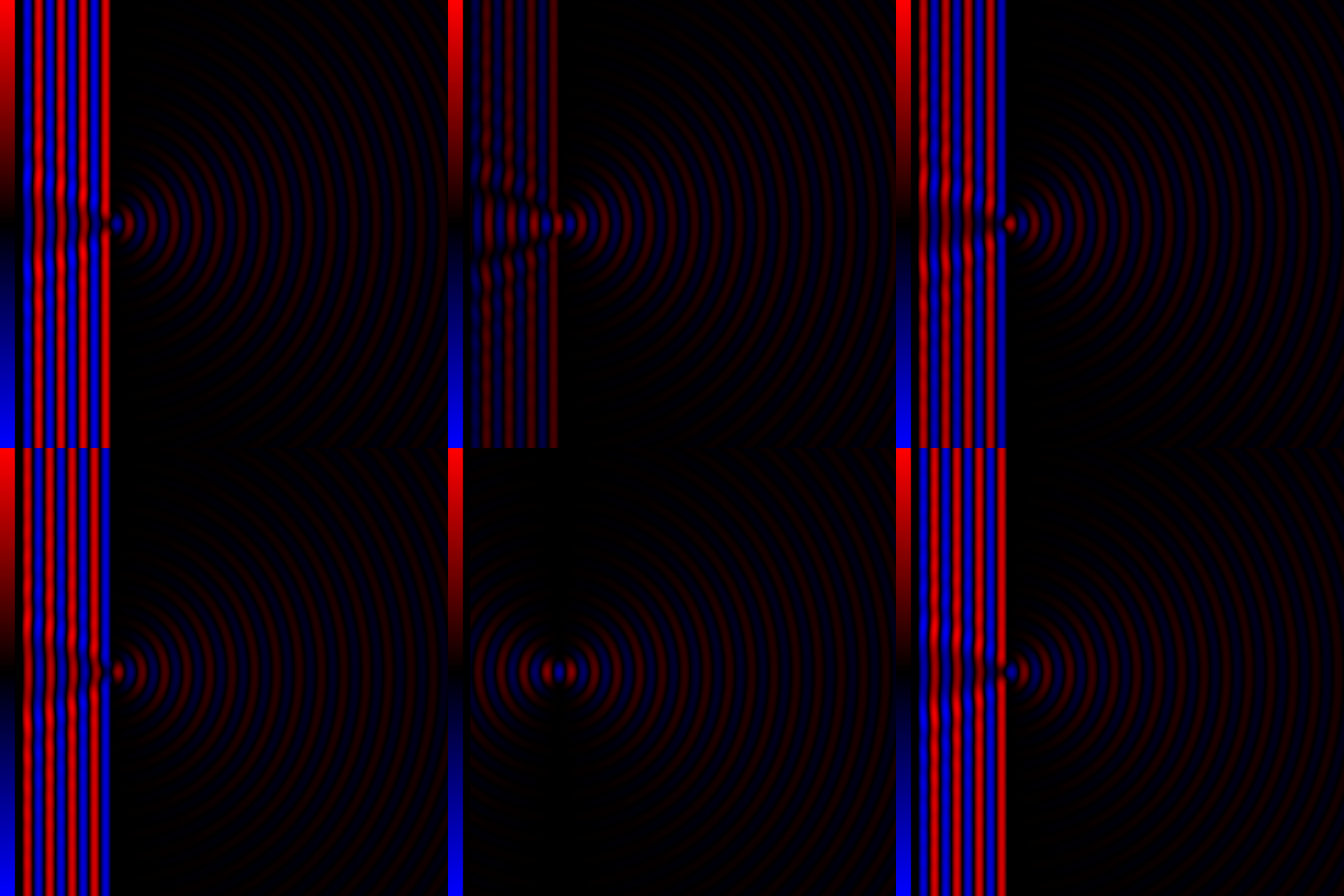
Diffraction of a scalar wave passing through a 1-wavelength-wide slit
Diffraction of a scalar wave passing through a 4-wavelength-wide slit

General diffraction

[edit]

Because diffraction is the result of addition of all waves (of given wavelength) along all unobstructed paths, the usual procedure is to consider the contribution of an infinitesimally small neighborhood around a certain path (this contribution is usually called a wavelet) and then integrate over all paths (= add all wavelets) from the source to the detector (or given point on a screen).

Thus in order to determine the pattern produced by diffraction, the phase and the amplitude of each of the wavelets is calculated. That is, at each point in space we must determine the distance to each of the simple sources on the incoming wavefront. If the distance to each of the simple sources differs by an integer number of wavelengths, all the wavelets will be in phase, resulting in constructive interference. If the distance to each source is an integer plus one half of a wavelength, there will be complete destructive interference. Usually, it is sufficient to determine these minima and maxima to explain the observed diffraction effects.

The simplest descriptions of diffraction are those in which the situation can be reduced to a two-dimensional problem. For water waves, this is already the case, as water waves propagate only on the surface of the water. For light, we can often neglect one dimension if the diffracting object extends in that direction over a distance far greater than the wavelength. In the case of light shining through small circular holes we will have to take into account the full three-dimensional nature of the problem.

Several qualitative observations can be made of diffraction in general:

  • The angular spacing of the features in the diffraction pattern is inversely proportional to the dimensions of the object causing the diffraction. In other words: the smaller the diffracting object, the wider the resulting diffraction pattern, and vice versa. (More precisely, this is true of the sines of the angles.)
  • The diffraction angles are invariant under scaling; that is, they depend only on the ratio of the wavelength to the size of the diffracting object.
  • When the diffracting object has a periodic structure, for example in a diffraction grating, the features generally become sharper. The fourth figure, for example, shows a comparison of a double-slit pattern with a pattern formed by five slits, both sets of slits having the same spacing between the center of one slit and the next.

Approximations

[edit]

The problem of calculating what a diffracted wave looks like, is the problem of determining the phase of each of the simple sources on the incoming wave front. It is mathematically easier to consider the case of far-field or Fraunhofer diffraction, where the point of observation is far from that of the diffracting obstruction, and as a result, involves less complex mathematics than the more general case of near-field or Fresnel diffraction. To make this statement more quantitative, consider a diffracting object at the origin that has a size . For definiteness let us say we are diffracting light and we are interested in what the intensity looks like on a screen a distance away from the object. At some point on the screen the path length to one side of the object is given by the Pythagorean theorem

[further explanation needed]

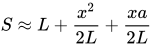
If we now consider the situation where , the path length becomes This is the Fresnel approximation. To further simplify things: If the diffracting object is much smaller than the distance , the last term will contribute much less than a wavelength to the path length, and will then not change the phase appreciably. That is . The result is the Fraunhofer approximation, which is only valid very far away from the object Depending on the size of the diffraction object, the distance to the object and the wavelength of the wave, the Fresnel approximation, the Fraunhofer approximation or neither approximation may be valid. As the distance between the measured point of diffraction and the obstruction point increases, the diffraction patterns or results predicted converge towards those of Fraunhofer diffraction, which is more often observed in nature due to the extremely small wavelength of visible light.


Multiple narrow slits

[edit]

A simple quantitative description

[edit]
Diagram of a two slit diffraction problem, showing the angle to the first minimum, where a path length difference of a half wavelength causes destructive interference.

Multiple-slit arrangements can be mathematically considered as multiple simple wave sources, if the slits are narrow enough. For light, a slit is an opening that is infinitely extended in one dimension, and this has the effect of reducing a wave problem in 3D-space to a simpler problem in 2D-space. The simplest case is that of two narrow slits, spaced a distance apart. To determine the maxima and minima in the amplitude we must determine the path difference to the first slit and to the second one. In the Fraunhofer approximation, with the observer far away from the slits, the difference in path length to the two slits can be seen from the image to be Maxima in the intensity occur if this path length difference is an integer number of wavelengths.


where

  • is an integer that labels the order of each maximum,
  • is the wavelength,
  • is the distance between the slits, and
  • is the angle at which constructive interference occurs.

The corresponding minima are at path differences of an integer number plus one half of the wavelength:

For an array of slits, positions of the minima and maxima are not changed, the fringes visible on a screen however do become sharper, as can be seen in the image.

2-slit and 5-slit diffraction of red laser light

Mathematical description

[edit]

To calculate this intensity pattern, one needs to introduce some more sophisticated methods. The mathematical representation of a radial wave is given by where , is the wavelength, is frequency of the wave and is the phase of the wave at the slits at time t = 0. The wave at a screen some distance away from the plane of the slits is given by the sum of the waves emanating from each of the slits. To make this problem a little easier, we introduce the complex wave , the real part of which is equal to The absolute value of this function gives the wave amplitude, and the complex phase of the function corresponds to the phase of the wave. is referred to as the complex amplitude. With slits, the total wave at point on the screen is

Since we are for the moment only interested in the amplitude and relative phase, we can ignore any overall phase factors that are not dependent on or . We approximate . In the Fraunhofer limit we can neglect terms of order in the exponential, and any terms involving or in the denominator. The sum becomes

The sum has the form of a geometric sum and can be evaluated to give

The intensity is given by the absolute value of the complex amplitude squared where denotes the complex conjugate of .

Single slit

[edit]
Numerical approximation of diffraction pattern from a slit of width equal to wavelength of an incident plane wave in 3D blue visualization
Numerical approximation of diffraction pattern from a slit of width four wavelengths with an incident plane wave. The main central beam, nulls, and phase reversals are apparent.
Graph and image of single-slit diffraction

As an example, an exact equation can now be derived for the intensity of the diffraction pattern as a function of angle in the case of single-slit diffraction.

A mathematical representation of Huygens' principle can be used to start an equation.

Consider a monochromatic complex plane wave of wavelength λ incident on a slit of width a.

If the slit lies in the x′-y′ plane, with its center at the origin, then it can be assumed that diffraction generates a complex wave ψ, traveling radially in the r direction away from the slit, and this is given by:

Let (x′, y′, 0) be a point inside the slit over which it is being integrated. If (x, 0, z) is the location at which the intensity of the diffraction pattern is being computed, the slit extends from to , and from to .

The distance r from the slit is:

Assuming Fraunhofer diffraction will result in the conclusion . In other words, the distance to the target is much larger than the diffraction width on the target. By the binomial expansion rule, ignoring terms quadratic and higher, the quantity on the right can be estimated to be:

It can be seen that 1/r in front of the equation is non-oscillatory, i.e. its contribution to the magnitude of the intensity is small compared to our exponential factors. Therefore, we will lose little accuracy by approximating it as 1/z.

To make things cleaner, a placeholder C is used to denote constants in the equation. It is important to keep in mind that C can contain imaginary numbers, thus the wave function will be complex. However, at the end, the ψ will be bracketed, which will eliminate any imaginary components.

Now, in Fraunhofer diffraction, is small, so (note that participates in this exponential and it is being integrated).

In contrast the term can be eliminated from the equation, since when bracketed it gives 1.

(For the same reason we have also eliminated the term )

Taking results in:

It can be noted through Euler's formula and its derivatives that

and from the geometry that

.

Therefore, we have

where the (unnormalized) sinc function is defined by .

Now, substituting in , the intensity (squared amplitude) of the diffracted waves at an angle θ is given by:

Multiple slits

[edit]
Double-slit diffraction of red laser light
2-slit and 5-slit diffraction

Let us again start with the mathematical representation of Huygens' principle.

Consider slits in the prime plane of equal size and spacing spread along the axis. As above, the distance from slit 1 is:

To generalize this to slits, we make the observation that while and remain constant, shifts by

Thus and the sum of all contributions to the wave function is:

Again noting that is small, so , we have:

Now, we can use the following identity

Substituting into our equation, we find:

We now make our substitution as before and represent all non-oscillating constants by the variable as in the 1-slit diffraction and bracket the result. Remember that

This allows us to discard the tailing exponent and we have our answer:

General case for far field

[edit]

In the far field, where r is essentially constant, then the equation: is equivalent to doing a Fourier transform on the gaps in the barrier.[1]

See also

[edit]

References

[edit]
Revisions and contributorsEdit on WikipediaRead on Wikipedia
from Grokipedia
Diffraction from slits is a fundamental wave phenomenon in which coherent waves, such as , passing through one or more narrow apertures produce characteristic interference patterns on a distant screen due to the constructive and destructive superposition of secondary wavelets emanating from different points along the slit edges, as described by Huygens' principle. This effect reveals the wave nature of and other propagating waves, with patterns determined by factors like slit width, separation, , and distance to the observation screen. The classic demonstration of diffraction from slits is Thomas Young's double-slit experiment, conducted in , where monochromatic passing through two closely spaced slits separated by distance dd creates alternating bright and dark fringes on a screen at distance LL, with bright fringes (maxima) occurring at angles θ\theta satisfying dsinθ=mλd \sin \theta = m \lambda for integer mm, where λ\lambda is the . In this setup, the overall pattern is modulated by a broader single-slit envelope, as each slit individually diffracts to form a central maximum flanked by secondary maxima and minima. For a single slit of width aa, destructive interference produces minima at angles given by asinθ=mλa \sin \theta = m \lambda for m=±1,±2,m = \pm 1, \pm 2, \dots , resulting in a bright central band twice as wide as the adjacent side bands, which diminish in intensity outward. For multiple slits or diffraction gratings—arrays of NN evenly spaced slits with grating constant dd—the interference pattern sharpens dramatically, producing principal maxima at the same angles as the double-slit case but with much narrower peaks and enhanced resolution for spectral dispersion, as the intensity scales with N2N^2 at maxima. These patterns arise from the phase differences between waves from adjacent slits, leading to applications in spectroscopy, where gratings separate light into its constituent wavelengths via the grating equation dsinθ=mλd \sin \theta = m \lambda. Diffraction from slits not only confirmed the wave theory of light over the particle theory but also extends to other waves like sound and electrons, underscoring universal wave behaviors.

General Principles of Diffraction

Huygens-Fresnel Principle

In 1678, proposed that every point on a serves as a source of secondary spherical wavelets, which propagate outward and combine to form the subsequent , thereby explaining the propagation of light as a wave phenomenon. This principle, detailed in his Traité de la Lumière (composed around 1678 and published in 1690), accounted for , reflection, and by treating the envelope of these wavelets as the new . Augustin-Jean Fresnel modified Huygens' idea in the early 19th century by incorporating the interference of these secondary wavelets and introducing an obliquity factor to account for the realistic decay in amplitude of wavelets propagating at angles away from the forward direction. The obliquity factor, expressed as 1+cosθ2\frac{1 + \cos \theta}{2} where θ\theta is the angle between the wavelet's propagation direction and the normal to the , ensures that contributions from oblique wavelets are reduced, aligning the model more closely with observed diffraction patterns. In the context of diffraction from slits, the Huygens-Fresnel principle models the of the slit as a portion of the incident , where each point within the generates secondary wavelets that superpose beyond the slit to form a new, curved responsible for the diffracted distribution. The resulting wave field at an observation point PP is given by the integral U(P)=1iλSU(Q)rexp(ikr)1+cosθ2dS,U(P) = \frac{1}{i\lambda} \int_S \frac{U(Q)}{r} \exp(i k r) \frac{1 + \cos\theta}{2} \, dS, where U(P)U(P) is the complex amplitude at PP, the integral is over the aperture surface SS, U(Q)U(Q) is the amplitude at source point QQ on the aperture, rr is the distance from QQ to PP, k=2π/λk = 2\pi / \lambda is the wave number, λ\lambda is the wavelength, and θ\theta is the obliquity angle. Fresnel's 1818 memoir on diffraction applied this principle to resolve contemporary disputes favoring the particle of , notably predicting the existence of a bright spot (now known as Poisson's spot) at the center of the shadow cast by a circular obstacle, a counterintuitive result later experimentally verified in 1819 that bolstered the wave .

Distinction Between Interference and

Interference refers to the superposition of waves originating from a limited number of discrete, coherent sources, resulting in a of constructive and destructive interference characterized by maxima and minima determined by phase differences between the waves. This phenomenon was first experimentally demonstrated by Thomas Young in 1801 through his , where coherent passing through two closely spaced slits produced an intensity of equally spaced bright and dark fringes on a distant screen, providing early for the wave nature of . Diffraction, in contrast, describes the bending and spreading of as they encounter obstacles or pass through apertures comparable in size to the , arising from the continuous variation in path lengths across the and leading to a redistributed intensity pattern. Observationally, patterns typically feature a prominent central maximum surrounded by weaker secondary maxima, or side lobes, that decrease in intensity with increasing angle from the center, reflecting the wave's tendency to propagate in all forward directions rather than strictly geometrically. The primary distinction between interference and is terminological rather than fundamental, as both stem from the same principle of wave superposition; conventionally, interference is reserved for cases involving few sources (e.g., two point-like slits), yielding sharp, periodic fringes, whereas applies to scenarios with many effectively continuous sources across an extended , producing broader modulation and angular spreading. emphasized this usage in his lectures, noting that a two-source setup is dubbed interference, while a continuous distribution like a slit is termed , though the underlying physics—coherent addition of wavelets—is identical. In the context of slit apertures, these concepts intersect because the extended nature of the opening gives rise to at the edges, which envelopes an underlying interference pattern from the many wavelets within the slit, creating a composite that highlights their interplay without altering the core theoretical separation. This distinction, unified under the Huygens-Fresnel principle of secondary wavelets, is essential for interpreting wave propagation through finite openings.

Single-Slit Diffraction

Experimental Setup and Observations

The phenomenon of single-slit diffraction was first observed in the 17th century by Italian physicist , who noted the spreading of light beyond the geometric shadow when passing near edges or through small apertures in his treatise Physico-mathesis de lumine. Quantitative experiments and theoretical explanations emerged in the early 19th century through the work of , who in 1819 presented detailed observations and a wave-based model for diffraction patterns produced by slits, earning a prize from the . In a standard experimental setup for single-slit diffraction, a monochromatic from a coherent source, such as a helium-neon emitting at 632.8 nm, is directed perpendicularly onto an opaque screen containing a narrow slit of width a (typically on the order of micrometers). The diffracted light is then observed on a distant screen placed several meters away or focused onto a detector plane using a converging lens to achieve far-field conditions. This arrangement ensures that the incident wavefront can be treated as planar across the slit, allowing the Huygens-Fresnel principle to describe the secondary wavelets emanating from points along the aperture edges./University_Physics_III_-Optics_and_Modern_Physics(OpenStax)/04%3A_Diffraction/4.02%3A_Single-Slit_Diffraction) Qualitatively, the resulting diffraction pattern on the observation screen consists of a bright central maximum surrounded by symmetric alternating bright and dark fringes, with the minima appearing as sharp dark bands due to destructive interference among waves from different parts of the slit. The overall width of the central maximum decreases as the slit width a increases, demonstrating an inverse proportionality between pattern spread and a, while the pattern broadens with longer wavelengths λ, such as comparing (λ ≈ 650 nm) versus (λ ≈ 450 nm) ./University_Physics_III_-Optics_and_Modern_Physics(OpenStax)/04%3A_Diffraction/4.02%3A_Single-Slit_Diffraction) The first minimum occurs at an angular position θ ≈ λ/a from the central axis, marking the boundary where path differences from slit edges lead to complete destructive interference. Several factors influence the visibility and characteristics of the diffraction pattern. The source must have sufficient spatial and temporal coherence, as provided by with long coherence lengths (often >1 m), to maintain phase relationships across the slit; incoherent sources like produce blurred or absent patterns./University_Physics_III_-Optics_and_Modern_Physics(OpenStax)/04%3A_Diffraction/4.02%3A_Single-Slit_Diffraction) Diffraction effects are most prominent when the slit width a is comparable to the λ (e.g., a ≈ λ to 10λ), whereas wider slits (a >> λ) yield negligible spreading and sharper geometric images. Additionally, the polarization state of the incident light affects the pattern subtly; for slits oriented parallel to the vector, transmission and fringe contrast may differ slightly from perpendicular orientations due to boundary interactions at the slit edges, a dependence more evident in modern demonstrations than in historical sunlight-based experiments.

Intensity Distribution Formula

The intensity distribution in single-slit diffraction is derived from the Huygens-Fresnel principle, which posits that every point on a acts as a source of secondary spherical wavelets, and the resultant field at a distant point is the superposition of these wavelets with appropriate phase differences. For a slit of width aa uniformly illuminated by a of λ\lambda, the derivation involves integrating the contributions from infinitesimal elements across the slit, accounting for path length differences that introduce phase variations proportional to sinθ\sin\theta, where θ\theta is the diffraction angle from the normal. The resulting at the observation point is the of these phasors, leading to the intensity I(θ)I(\theta) given by I(θ)=I0[sinββ]2,I(\theta) = I_0 \left[ \frac{\sin \beta}{\beta} \right]^2, where I0I_0 is the intensity at the central maximum (θ=0\theta = 0), and β=πasinθλ\beta = \frac{\pi a \sin\theta}{\lambda}. This sinc-squared function emerges mathematically as the squared modulus of the of the rectangular function representing the slit, highlighting the diffraction pattern as the of the . Minima in the intensity occur where sinβ=0\sin\beta = 0 but β0\beta \neq 0, specifically at β=mπ\beta = m\pi for integers m=±1,±2,m = \pm1, \pm2, \dots, corresponding to positions sinθm=mλa\sin\theta_m = \frac{m\lambda}{a}. These zeros arise from complete destructive interference between slit elements symmetrically placed around the midpoint. Secondary maxima appear approximately at β=(m+1/2)π\beta = (m + 1/2)\pi, though their intensities decrease rapidly with increasing m|m|. The central maximum has a half-width angular spread of approximately θλ/a\theta \approx \lambda / a, scaling inversely with slit width. Normalization ensures I(0)=I0I(0) = I_0, with I0I_0 proportional to (a/λ)2(a / \lambda)^2 times the incident intensity, reflecting the total power collected from the . While this scalar formulation assumes unpolarized or linearly polarized light with parallel to the slit, recent studies on vectorial extend the model to account for polarization-dependent effects in non-scalar waves, revealing far-field polarization variations induced by the .

Multi-Slit Diffraction

Double-Slit Case

The serves as the foundational multi-slit scenario in diffraction studies, featuring two narrow slits separated by a center-to-center distance dd, each with width aa where ada \ll d, and illuminated by a coherent of λ\lambda. This configuration, first performed by Thomas Young in 1801, produced an interference pattern on a distant screen that provided compelling evidence for the wave nature of light, challenging the prevailing particle theory at the time. The pattern arises from the superposition of waves emanating from each slit, treated as secondary sources under the Huygens-Fresnel principle. The interference fringes form due to the path length difference δ=dsinθ\delta = d \sin \theta between waves reaching a point on the screen at θ\theta from the normal, where constructive interference (maxima) occurs when δ=mλ\delta = m \lambda for m=0,±1,±2,m = 0, \pm 1, \pm 2, \dots. Destructive interference (minima) happens midway between maxima, at δ=(m+1/2)λ\delta = (m + 1/2) \lambda. These fringes create a series of bright and dark bands, with the central maximum at θ=0\theta = 0 being the brightest. The overall intensity distribution on the screen is described by I(θ)=I0cos2(ϕ2)(sinββ)2,I(\theta) = I_0 \cos^2 \left( \frac{\phi}{2} \right) \left( \frac{\sin \beta}{\beta} \right)^2, where I0I_0 is the maximum intensity, ϕ=2πdsinθλ\phi = \frac{2\pi d \sin \theta}{\lambda} is the phase difference between waves from the two slits, and β=πasinθλ\beta = \frac{\pi a \sin \theta}{\lambda} characterizes the single-slit diffraction contribution. The cos2(ϕ/2)\cos^2 (\phi / 2) term produces the rapid variation of interference fringes, while the (sinβ/β)2(\sin \beta / \beta)^2 factor acts as a slowly varying from single-slit diffraction, suppressing fringe visibility at larger angles where the envelope diminishes, thus explaining the absence of expected fringes near the pattern's edges. Beyond , the wave interference principles demonstrated in the have informed , with properties confirmed by experiments such as that of Davisson and Germer in 1927.

N-Slit Generalization

The N-slit experiment generalizes the double-slit setup to an array of NN equally spaced parallel slits, each of narrow width aa such that ada \ll d, where dd is the center-to-center spacing between adjacent slits. Monochromatic light of λ\lambda illuminates the array normally, producing a far-field intensity pattern on a screen that combines the broad single-slit diffraction envelope with sharp interference fringes from the multi-slit array. This configuration enhances compared to fewer slits, as the constructive interference conditions become more selective with increasing NN. The intensity distribution I(θ)I(\theta) for the N-slit pattern, under the Fraunhofer approximation, is given by the product of the single-slit diffraction factor and the N-slit array factor: I(θ)=I0(sinββ)2(sin(Nγ)sinγ)2,I(\theta) = I_0 \left( \frac{\sin \beta}{\beta} \right)^2 \left( \frac{\sin (N \gamma)}{\sin \gamma} \right)^2, where β=πasinθλ\beta = \frac{\pi a \sin \theta}{\lambda} accounts for the finite slit width, γ=πdsinθλ\gamma = \frac{\pi d \sin \theta}{\lambda} is the phase difference between adjacent slits, θ\theta is the diffraction angle from the normal, and I0I_0 is the central intensity. For infinitely narrow slits (a0a \to 0), the single-slit term (sinββ)21\left( \frac{\sin \beta}{\beta} \right)^2 \to 1, simplifying the pattern to pure N-slit interference. The principal maxima occur at γ=mπ\gamma = m \pi (where m=0,1,2,m = 0, 1, 2, \dots), corresponding to the grating equation dsinθm=mλd \sin \theta_m = m \lambda, with peak intensity scaling as N2I0N^2 I_0 due to constructive superposition from all slits. Between consecutive principal maxima, the pattern exhibits N2N-2 secondary maxima (minima occur at γ=lπN\gamma = \frac{l \pi}{N} where ll is an not divisible by NN), forming a series of weaker side lobes whose intensities decrease rapidly away from the principal peaks, approximately as 1/j21/j^2 for the jj-th secondary maximum relative to the principal. For large NN, these secondary features appear as fine ripples superimposed on the slowly varying single-slit , a finite-size effect that broadens slightly with decreasing NN but sharpens overall, with the full width at half-maximum of each principal peak scaling as Δθλ/(Ndcosθ)\Delta \theta \approx \lambda / (N d \cos \theta). This sharpening enables higher in applications like diffraction gratings, where large NN (often thousands) separates closely spaced wavelengths in , achieving resolving powers up to R=NmR = N m for order mm. Recent computational studies have validated these analytical expressions for finite NN using numerical methods, including simulations of multiple-slit arrays in negative-index materials that highlight evanescent wave contributions aligning with classical predictions.

Theoretical Approximations

Fraunhofer Approximation

The Fraunhofer approximation, also known as far-field diffraction, applies to scenarios where the observation point is sufficiently distant from the diffracting aperture, specifically when the propagation distance zz satisfies za2λz \gg \frac{a^2}{\lambda}, with aa denoting the aperture width and λ\lambda the wavelength. This condition ensures the far-field regime, where the incident wave can be treated as a plane wave and the diffracted wavefronts appear as plane waves at the observation plane, resulting in diffraction patterns that depend only on the angle θ\theta rather than the absolute distance zz. Under these conditions, the approximation simplifies the computation of diffraction patterns, making it particularly useful for optical instruments like telescopes and spectrometers where far-field observations are common. Mathematically, the Fraunhofer approximation derives from the Fresnel diffraction integral by neglecting higher-order terms in the phase expansion. The distance rr from an aperture point ξ\xi to the observation point is approximated such that exp(ikr)exp(ikz)exp(ikξsinθ)\exp(i k r) \approx \exp(i k z) \exp(-i k \xi \sin\theta), where k=2π/λk = 2\pi / \lambda is the wavenumber and θ\theta is the diffraction angle. This leads to the diffracted field U(ξ,η)U(\xi, \eta) being proportional to the Fourier transform of the aperture function U(x,y)U(x, y): U(ξ,η)1iλzexp(ikz)U(x,y)exp(i2πλz(xξ+yη))dxdyU(\xi, \eta) \propto \frac{1}{i \lambda z} \exp(i k z) \int_{-\infty}^{\infty} \int_{-\infty}^{\infty} U(x, y) \exp\left( -i \frac{2\pi}{\lambda z} (x \xi + y \eta) \right) \, dx \, dy where ξ=ztanθx\xi = z \tan\theta_x and η=ztanθy\eta = z \tan\theta_y are coordinates in the observation plane. For slit diffraction, which typically involves a one-dimensional rectangular aperture of width aa, the aperture function is a rect function, and its Fourier transform yields a sinc pattern for the field amplitude: U(θ)sinc(asinθλ),U(\theta) \propto \operatorname{sinc}\left( \frac{a \sin\theta}{\lambda} \right), with sinc(x)=sin(πx)/(πx)\operatorname{sinc}(x) = \sin(\pi x)/(\pi x), and the intensity following I(θ)sinc2I(\theta) \propto |\operatorname{sinc}|^2. This sinc distribution justifies the intensity formulas used in analyses of single- and multi-slit diffraction. The approximation breaks down in the near field, or Fresnel regime, where za2λz \sim \frac{a^2}{\lambda}, as quadratic phase terms become significant and the pattern varies with distance. Additionally, in modern optics involving sources post-2000, illumination introduces deviations from the ideal plane-wave assumption, requiring mode decomposition methods to accurately model by apertures. Compared to the full Fresnel treatment, Fraunhofer patterns are computationally simpler due to their direct nature, facilitating easier analysis in far-field applications.

Narrow Slit Assumptions

In the narrow slit approximation for diffraction from multiple slits, the width aa of each slit is taken to approach zero relative to the inter-slit spacing dd and the λ\lambda, effectively modeling each slit as an idealized or delta function that emits secondary wavelets without internal structure. This assumption, rooted in the Huygens-Fresnel principle, neglects the finite size of the slits and focuses exclusively on phase differences arising from their positions, simplifying the analysis of interference patterns in arrays such as diffraction gratings. Under this , the resulting intensity distribution for an NN-slit system is purely interferential, given by I(θ)[sin(Nγ)sinγ]2,I(\theta) \propto \left[ \frac{\sin(N \gamma)}{\sin \gamma} \right]^2, where γ=πdsinθλ\gamma = \frac{\pi d \sin \theta}{\lambda} represents half the phase difference between adjacent slits. This expression, derived from the coherent of phasors from the NN point sources, produces sharp principal maxima separated by secondary peaks, with no overarching single-slit envelope to modulate the . The approximation holds well for ruled or holographic gratings where a/d1a/d \ll 1, enabling high-resolution spectral dispersion by concentrating energy in discrete orders while treating the array as a uniform periodic structure. The narrow slit assumption breaks down when aa becomes comparable to λ\lambda, as the finite slit width then generates a significant sinc-squared from each slit, which convolves with the interference pattern and broadens or suppresses peaks. Fabrication imperfections, such as irregular edges or groove profiles, further deviate from the ideal point-source model by introducing unwanted phase variations. A key quantitative criterion for validity is that the angular half-width of the single-slit central lobe, approximately λ/a\lambda / a, must greatly exceed the angular spacing between interference maxima, λ/d\lambda / d; this ensures the remains nearly uniform across multiple fringes, a condition met when ada \ll d. Modern advancements in grating design address sidelobe issues arising from finite slit effects through techniques like blazing and , which shape the response to suppress off-order . Blazed , featuring slanted facets that redirect toward a target diffraction order via the condition mλ=d(sinθi+sinθm)m\lambda = d (\sin \theta_i + \sin \theta_m), achieve efficiencies up to 90% while minimizing compared to rectangular profiles. In the 2010s, nanofabrication progress, including and , enabled sub-wavelength blazed structures with reduced stray light, enhancing performance in spectrometers and systems.

Far-Field Diffraction Analysis

General Mathematical Framework

The general mathematical framework for far-field diffraction from slits is provided by the integral, which describes the diffracted field as the of the function under plane-wave illumination. For a one-dimensional slit along the ξ-direction, the complex amplitude U(θ) in the far field at angle θ from the is given by U(θ)U0(ξ)exp[i2πξsinθλ]dξ,U(\theta) \propto \int_{-\infty}^{\infty} U_0(\xi) \exp\left[-i \frac{2\pi \xi \sin\theta}{\lambda}\right] d\xi, where U_0(ξ) is the complex field transmittance of the (equal to 1 inside the slit and 0 outside for an ideal amplitude slit), λ is the , and the is over the aperture extent. This formulation arises from the Huygens-Fresnel principle in the far-field limit, where phase variations across the are linear in ξ, enabling efficient computation via Fourier methods. For periodic slit configurations, such as diffraction gratings with N equally spaced slits of width a and period d, the reduces to a discrete sum due to the repetitive structure. The aperture function U_0(ξ) can be expressed as a product of a single-slit and a function, leading to U(θ) as the product of the single-slit pattern and an array factor: a finite summing phases from each slit center. This results in a representation, with principal maxima at angles θ_m satisfying sin θ_m = m λ / d (m ) modulated by the , sharpening peaks as N increases. Extensions to arbitrary slit shapes maintain the form but incorporate non-rectangular U_0(ξ), such as irregular widths or positions, while focusing on slits where |U_0(ξ)| = 0 or 1. For non-uniform slits, the pattern remains the of the binary transmittance, enabling analysis of complex geometries like zoned apertures. Although phase gratings introduce U_0(ξ) = exp(iφ(ξ)) with varying phase φ, the framework prioritizes for standard slit diffraction, where phase is uniform across open regions. Numerical evaluation of these patterns for intricate slit arrays often employs the (FFT) algorithm, exploiting the integral's Fourier nature to compute U(θ) efficiently on discrete grids. This approach handles complex apertures by sampling U_0(ξ) and yields intensity |U(θ)|^2 with O(N log N) complexity, where N is the grid size, facilitating simulations beyond analytical solutions. Recent advancements in the 2020s incorporate for inverse design, optimizing slit parameters to target desired patterns via neural networks trained on forward FFT simulations, though briefly noted here for computational enhancement. This framework unifies slit diffraction cases: the single-slit pattern emerges as the N=1 limit of the periodic sum, while multi-slit arrays represent sampled versions of a continuous rectangular , with the factor capturing interference and the the envelope .

Phase and Amplitude Considerations

In the far-field pattern from slits, phase variations across the play a critical role in determining the position and structure of interference maxima. Tilted illumination introduces a gradient, which effectively shifts the entire pattern laterally without altering its overall shape, analogous to a change in the effective incidence angle in grating . This factor, often expressed as exp(ikξsinθi)\exp(i k \xi \sin\theta_i), where ξ\xi is the position along the slit , θi\theta_i is the tilt angle, kk is the , and ii is the , modifies the phase difference γ\gamma in the interference term, leading to a displacement proportional to the tilt. Similarly, a quadratic phase factor, such as exp(iπξ2/(λf))\exp(i \pi \xi^2 / (\lambda f)), arises in scenarios involving focusing elements or curved wavefronts, enabling the formation of a diffraction-limited spot at the focal distance ff, where λ\lambda is the . Amplitude distributions across the slits also significantly influence the far-field intensity profile, particularly the sidelobe structure. For non-uniform illumination, such as a Gaussian profile exp(ξ2/w2)\exp(-\xi^2 / w^2) where ww is the beam waist, the diffraction pattern deviates from the uniform case, resulting in suppressed and a broader compared to the standard [sin(Nγ)sinγ]2\left[ \frac{\sin(N\gamma)}{\sin\gamma} \right]^2 for NN slits. This tapering reduces the peak intensity of secondary maxima by up to 13 dB in analogous array systems, smoothing the pattern and minimizing unwanted interference artifacts. Polarization effects require a vectorial treatment beyond scalar approximations, especially when slits are oriented perpendicular to the vector. In such configurations, vector theory accounts for the and altered boundary conditions, where the components parallel and perpendicular to the slit plane experience different transmission efficiencies. Rigorous application of Kirchhoff boundary conditions in the plane assumes the tangential is continuous, but for subwavelength slits, this leads to evanescent modes that modify the far-field polarization state, potentially rotating the output ellipticity. Partial coherence further complicates the pattern by broadening the interference fringes, as the degree of spatial coherence μ\mu between slit emissions decreases with source size. According to the van Cittert-Zernike theorem, the mutual coherence function is the of the source intensity distribution, implying that larger extended sources reduce μ\mu, effectively convolving the coherent pattern with a sinc-like broadening kernel and diminishing contrast for slit separations exceeding the . This effect is pronounced in experiments with finite-source illumination, where fringe visibility drops as source angular size increases beyond λ/D\lambda / D, with DD the source . Recent advancements in structured light have extended these considerations to slit arrays carrying orbital (OAM), where helical phase profiles exp(iϕ)\exp(i \ell \phi) with topological charge \ell propagate through the slits, preserving OAM in the diffracted beams under far-field conditions. Post-2015 research demonstrates that such arrays generate vortex-laden patterns with enhanced mode purity, enabling applications in and optical communications by tailoring the phase-amplitude interplay without deep computational overhead. For instance, triangular apertures in OAM beams reveal structured transverse , broadening the utility of slit for probing spectra.

References

Add your contribution
Related Hubs
User Avatar
No comments yet.