Hubbry Logo
Chrysler Viper GTS-RChrysler Viper GTS-RMain
Open search
Chrysler Viper GTS-R
Community hub
Chrysler Viper GTS-R
logo
8 pages, 0 posts
0 subscribers
Be the first to start a discussion here.
Chrysler Viper GTS-R
from Wikipedia

Chrysler Viper GTS-R[1]
CategoryGT2
DesignerBob Lutz
Production1996-2005
SuccessorDodge Viper Competition Coupe GT3
Technical specifications
ChassisUnitary steel spaceframe
Suspension (front)Double wishbones, coil springs, and adjustable dampers, with carbon-fiber anti-roll bars
Suspension (rear)Double wishbones, coil springs, and adjustable dampers, with steel anti-roll bars
Length4,548 mm (179.1 in)
Width1,924 mm (75.7 in)
Height1,146 mm (45.1 in)
Axle track1,658 mm (65.3 in) (front)
1,688 mm (66.5 in) (rear)
Wheelbase2,243 mm (88.3 in)
EngineChrysler EWB 8.0 L (490 cu in) (7,998 cc) OHV V10 naturally-aspirated, front-engined, rear-wheel drive
Viper-derived Chrysler LA 6.2 L (380 cu in) OHV V8 naturally-aspirated, front-engined, rear-wheel drive (1998-2002 #1 Zakspeed Racing Viper GTS-R only)[2][3][4][5]
TransmissionBorgWarner T56 or TREMEC[6] 6-speed manual
Power600–770 hp (450–570 kW)[7]
535–729 lb⋅ft (725–988 N⋅m) torque[8]
Weight1,150 kg (2,540 lb)[9]
TiresMichelin
Pirelli (privateer teams)
Yokohama (Team Taisan)
Competition history
Notable entrantsFrance Larbre Compétition
France Paul Belmondo Racing
France Viper Team Oreca
United Kingdom Hayles Racing
United Kingdom Orion Motorsport
United States Canaska-Southwind
United States Viperacing
Japan Team Taisan
Germany Zakspeed Racing
Notable driversFrance Alain Prost
France Paul Belmondo
United Kingdom Kurt Luby
United Kingdom Richard Dean
Monaco Olivier Beretta
Debut1996 24 Hours of Daytona
First win1998 British GT Championship Silverstone
Last win2006 FFSA GT Magny-Cours
Last event2008 Monza 2 Hours
RacesWinsPodiumsPolesF/Laps
445162213117N/A
Constructors' Championships23
Drivers' Championships24
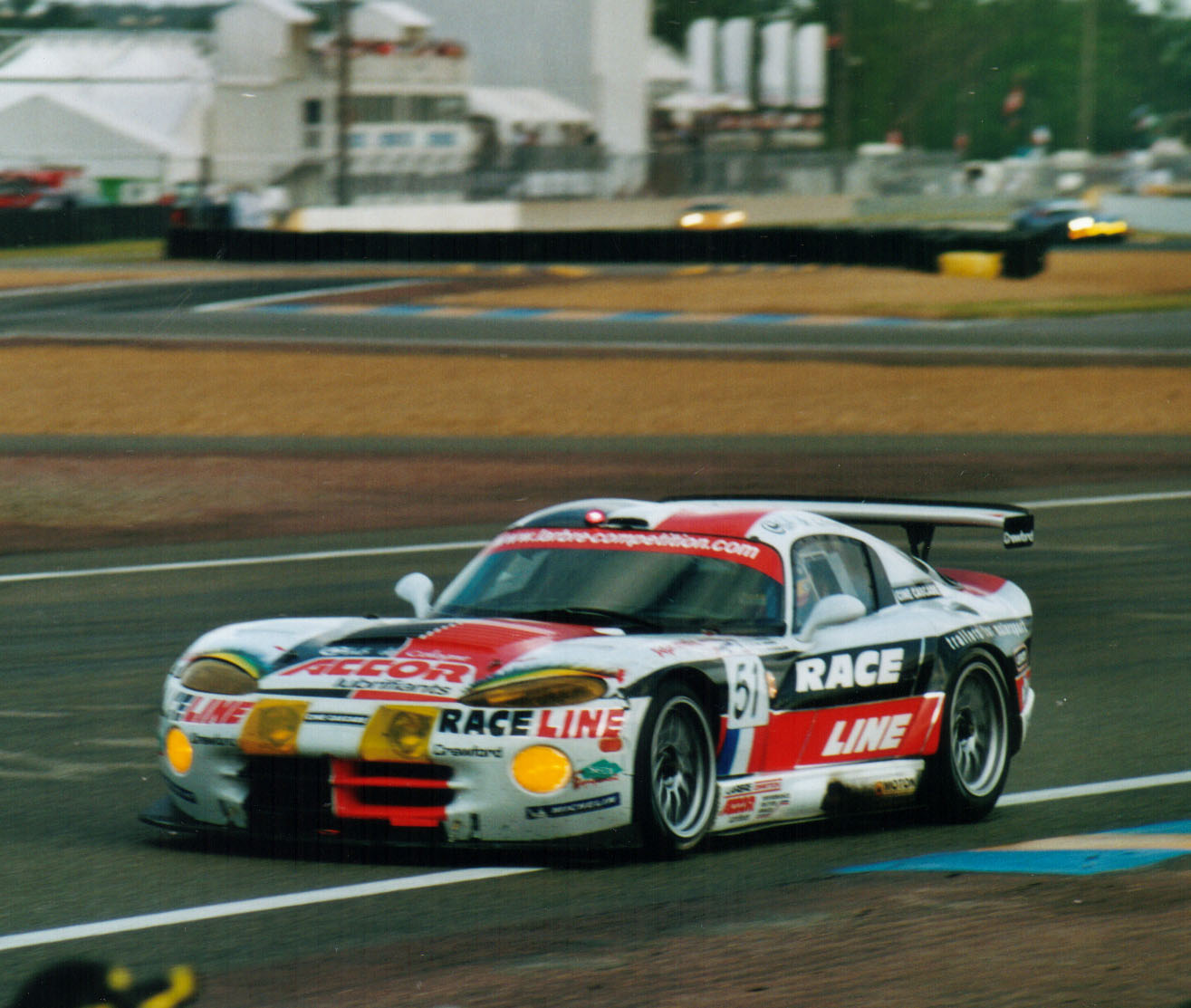
2000 Team Oreca #92 Chrysler Viper GTS-R at Goodwood in 2010

The Chrysler Viper GTS-R (also known as the Dodge Viper GTS-R when raced in North America) was a successful racing variant of the Dodge Viper developed in conjunction with Chrysler of North America, Oreca of France and Reynard Motorsport of the United Kingdom. Officially unveiled at the 1995 Pebble Beach Concours, it has won numerous championships and famous events in its history.

Development

[edit]

In the early 1990s, first-generation Dodge Viper RT/10s had been modified by racing teams for use in GT racing in North America and Europe without much success. Although its V10 engine was powerful, the car was not adapted to racing and teams lacked the funding to build a car that could compete with factory efforts. One key issue was that the Viper was a roadster, therefore lacking the rigidity that a coupe bodystyle would have. However, following the sales success of the first generation Viper, Dodge began redesigning the car in 1995, upgrading the roadster while at the same time adding a new coupe, known as the Viper GTS.

Although the first generation Vipers had sold well, Dodge wished to showcase the potential capabilities of the new car, mostly in the realm of handling. At the same time, Dodge also hoped to increase sales in Europe where importation of the Viper had struggled. Dodge's parent, Chrysler, therefore approved the development of a racing program centering on the Viper GTS which was still in development at the time. This co-development would allow for elements of the racing car to be adapted to the road car, and vice versa, for each car's mutual improvement.

Chrysler believed that in order to adapt their car not only for North American but also European circuits, they would require outside assistance. An agreement was made with the French racing and engineering firm Oreca, who had many years of experience in sports car racing as well as assistance in the Mazda 787B's win in the 1991 24 Hours of Le Mans. Oreca would construct and maintain the racing cars in their shops, as well as run Chrysler's official factory teams in Europe. For North America, Chrysler would recruit the Canaska / Southwind Team to operate the factory effort.

Although Oreca would construct the cars, key elements would come from British engineering firm Reynard Motorsport. This would mainly consist of the construction of the car's basic chassis and other integral parts before they were shipped to Oreca for assembly. As for the Viper's engine, it was ideally suited for competition at the time due to limits of 8000 cc being just beyond the Viper's 7998.5 cc. Modifications were therefore light for the 356-T6 V10, with concentration on redesigned intakes for horsepower and reinforcements for endurance.

In terms of design much of the bodywork of the Viper GTS was retained on the race car. Mandatory elements such as a rear wing, rear diffuser and front splitter were added for aerodynamics, while initial cars had their fog lights covered over before being put back for increased visibility at night. To aid in lighting, optional lights were able to be placed in square notches above the grill. The exhaust would also be routed out the side of the car, just under the doors, about halfway between the front and rear wheel wells. Side exhausts had been a feature of the first generation American-market RT/10s, but were no longer used on the GTS. Vents were also added to the hood for cooling the engine, while intakes were placed on the roof and rear fenders.

In total, 57 Viper GTS-Rs would be built. After the production of an initial five prototypes for testing and early usage by Oreca and Canaska / Southwind, 52 more cars would be built. Oreca built a total of 18 chassis. Although some would be used by the factory teams, most would be sold directly to customers for use in whatever series would allow them. Viper GTS-Rs continued to be built into 2005, after which Oreca concentrated on maintaining and supporting the existing Viper GTS-R fleet.

Naming

[edit]

Although the production cars have mostly been known as Dodge Vipers, the Dodge brand did not sell the Viper in Europe. Because the new cars, named GTS-R, were built in Europe, they were mostly known as Chrysler Viper GTS-R. However, cars racing in North America usually ran under the Dodge banner, making them Dodge Viper GTS-Rs. This naming difference therefore depends on location and region. The cars themselves actually carried no badging for either Chrysler or Dodge, with only the Viper GTS-R name appearing on the side of the bonnet.

GT2 Champion Edition

[edit]

With the FIA GT2 Team and Driver championship wins in October 1997, Team Viper set forth with the creation of a unique Viper called the GT2 Champion Edition. There would be 100 cars offered through the top Dodge Viper dealers, featuring the same white with blue stripes paint scheme as the race cars, as well as a large rear wing, front dive planes and splitter, side sills, BBS rims and GTS-R badging. The GT2 also features an Oreca 5-point racing harness, and the center dash plaque with the vehicle's unique production number.

Racing history

[edit]

Debuting in 1996, two racing teams separately developed the Chrysler Viper GTS-R coupe for competition. Canaska Southwind started in the North American IMSA GT Championship GTS-1 class at the 1996 24 Hours of Daytona, managing to finish in 29th place. However, the team would improve with a twelfth-place finish at the 12 Hours of Sebring. Viper Team Oreca would also run a limited schedule beginning with the 24 Hours of Le Mans.

Both teams appeared at the Le Mans with two entries each. Three of those four cars managed to finish with Canaska Southwind earning the best result in tenth place. The two teams returned to their respective series afterwards. Viper Team Oreca concluded the year with three races in the BPR Global GT Series earning eighth place at Brands Hatch, ninth at Spa, and sixth at Nogaro. Canaska Southwind concluded the season by finishing second in class at Mosport and sixth overall.

The Canaska Southwind team would end their involvement in the Viper program in 1997. This meant Oreca would make the only appearance for a Viper in IMSA GT by submitting a lone entry at the Rolex 24 at Daytona, finishing in 12th place. After Daytona, the team returned to Europe to concentrate on the new FIA GT Championship which had replaced the BPR series. The team would switch to the less powerful GT2 class due to the strength of the Porsche and Mercedes-Benz teams which were entering GT1, while at the same time being joined by the customer Chamberlain Engineering team. Oreca began the season strong with a 1-2 finish in their class ahead of the Roock Racing Porsches, and would go on to take six more victories in the eleven race season and winning the GT2 championship. The team also returned to Le Mans with three cars, although they would only finish in 14th place, fifth in their class. Another customer Viper would also appear in the All Japan Grand Touring Car Championship for Team Taisan, making two appearances with a best finish of eighth.

The Oreca team would strengthen their dominance in FIA GT in 1998, as the team managed to win all but one event in the ten race schedule. Oreca would also take their first class victory at Le Mans with an eleventh place overall finish. Chamberlain continued as a privateer in FIA GT earning several points, as well as earning a 14th-place finish at Daytona. Meanwhile, the Orion Motorsport would purchase a Viper GTS-R and go on to score six class wins in the British GT Championship, including an overall race win at Silverstone and earning Kurt Luby and Richard Dean the drivers' championship.

For 1999, Oreca's efforts were expanded further, as the team now operated in two championships: A two-car team in the new American Le Mans Series and the existing two car team already competing in FIA GT. FIA GT saw the Vipers once again sweep the series with nine wins for Oreca, and a lone win for the Paul Belmondo Viper. Chamberlain improved their team to finish second in the championship, while GLPK Carsport would be the fourth Viper squad to compete. A similar story occurred in the ALMS, with Oreca winning six races and taking that championship as well. Oreca would also earn their second straight win at Le Mans, with various Vipers finishing in the top six positions in their class. The FFSA GT Championship would see the appearance of Belmondo's Vipers, earning two victories over the season, and the 24 Hours Nürburgring would see Zakspeed claiming overall victory.

2000 Team Carsport Holland's #3 Viper GTS-R

For 2000, Oreca chose to concentrate on North America, leaving the FIA GT Championship to privateers. The team opened the season with one of their most notable victories, winning the 24 Hours of Daytona by a small margin over the new Chevrolet Corvette factory team. Oreca went on to win ten races in the American Le Mans Series, eventually falling to Corvette in two rounds late in the season but once again securing the championship. Oreca would also outperform Corvette at Le Mans, winning their third straight class victory with a seventh-place finish. In FIA GT, the Paul Belmondo and new Carsport Holland teams would run strong and win a collective four races, but would not be able to overcome the five victories by the Lister Storm, forcing the two teams to settle for second and third in the championship. In French GT, the DDO, ART, and MMI squads would combine for a total of eight Viper victories.

The backing by Chrysler officially ended in 2001, as Chrysler and Oreca had begun work the previous year on developing a Le Mans Prototype, forcing Oreca to abandon their Viper teams. The American Viperacing squad would be the sole contender in the American Le Mans Series, scoring no victories and finishing the season in third for the championship. FIA GT would however see a blossoming of teams, as eight different Viper squads competed over the season. Larbre Compétition would win three events (including the Spa 24 Hours) and win the championship, while Carsport Holland won two races and finished second. Hayles Racing would win four races in British GT to win that championship by two points over Lister, while the DDO team would win five French GT events, and Zakspeed would manage to win the 24 Hours Nürburgring for the second time. Le Mans however would not see the Vipers repeat their past success, as the factory Corvette squad won the class and only a lone Viper finished.

One of Zakspeed's Viper GTS-Rs from the 24 Hours of Nürburgring, advertising the new presence of Dodge in Europe

Larbre was able to defend their FIA GT championship in 2002, but were only able to win one race in the process. Carsport Holland and Paul Belmondo also managed single victories, while the new Ferrari 550s showed their potential with four wins. The only other victories for Vipers that season came in French GT, with four earned by DDO, and a third victory at the Nürburgring for Zakspeed. An Oreca-backed entry at Le Mans would manage to finish on the class podium, although several laps behind the two factory Corvettes.

In 2003, the dominance of the Prodrive-built Ferraris began. Vipers were unable to win any races in FIA GT, leaving Larbre as the best finishing Viper in the championship, a distant seventh. Some victories were still scored by Vipers however, as Larbre took six wins in French GT and Force One Racing a further two. The Team Taisan Viper in JGTC would also manage its first class victory in an event at Fuji Speedway. Vipers would compete for the first time in Italian GT, winning all but three races during the season. However at the same time, Vipers would make their final appearance at Le Mans, with Larbre finishing fourth in their class.

2004 would see the Viper GTS-Rs begin to be phased out. Only Zwaan's Racing would be entered in the full FIA GT season, earning ninth in the championship. Vipers would remain dominant in FFSA GT and Italian GT, winning eleven and five races respectively. For 2005, the only Viper entry in FIA GT would be a single entry at the Spa 24 Hours, finishing 12th, while Italian GT would see only three teams competing and unable to score any victories. French GT became the only series in which Vipers were competitive, which lured former Formula One champion Alain Prost to run Viper GTS-R chassis #C50 in the series as part of his 50th birthday, eventually winning one race as part of the Vipers nine victories that season.

In 2006, Viper GTS-Rs continue in French GT and Italian GT, although their victories continued to diminish. By 2007, the homologation of the Viper GTS-Rs would come to an end as the Viper GTS bodystyle had been replaced nearly seven years prior. Few privateers entered Vipers in French and Italian GT, while Red Racing would enter a lone car in select rounds of the FIA GT Championship as part of the amateur Citation Cup but would be unable to even finish any of its events. In 2008 Italian team Lanza Motorsport entered a GTS-R in the Italian round of the FIA GT Championship, but the car did not finish the race.

In 2007, a Viper GTS-R was first raced during a historic event at Magny-Cours by Florent Moulin. The then-new GT90s Revival series accepts former FIA GT racers from 1990 to 2000. The car was chassis C23, the FIA GT Championship-winning car from 1999, as driven by Karl Wendlinger and Olivier Beretta, completely restored into original 1999 Oreca specifications. The same car was invited to the Goodwood Festival of Speed in 2008 and driven by its period driver Justin Bell, in its Le Mans 1999 livery, when Justin drove this very car to second place in GTS. In November 2008 Florent Moulin entered it again in the GT90s Revival race at Paul Ricard, co-driven by another of its period drivers from Le Mans 1999, Marc Duez. In 2010, chassis 27 participated in the Goodwood Festival of Speed to celebrate the tenth anniversary 24 Hours of Daytona victory. One of the Viper GTS-Rs run by Oreca in the 1997 24 Hours of Le Mans was purchased by Ken Finneran and entered in the 2007 24 Hours of Silverstone race organised by Britcar. It was entered by KTF Group and completed 142 laps before retiring. The drivers were Phil Bennett, Mark Dwyer, Finneran, Robert Huff and Adam Sharpe.

Achievements

[edit]

Since its racing debut in 1996, the Viper GTS-R has achieved many victories or class wins in competition, as well as many series championships. This is a list of some of the more notable victories by the Viper GTS-Rs.

Overall victory
Type Event Years
Overall 24 Hours Nürburgring 1999, 2001, 2002
Rolex 24 at Daytona 2000
Spa 24 Hours 2001, 2002
Class victory 24 Hours of Le Mans 1998, 1999, 2000
12 Hours of Sebring 2000
Petit Le Mans 1999
Fuji 1000 km 1999
Mil Milhas Brasileiras 2004
24 Hours Nürburgring 2005, 2006, 2007
Series Championships FIA GT Championship 1997, 1998, 1999, 2001, 2002
American Le Mans Series 1999, 2000
FFSA GT Championship 2001, 2003, 2004, 2005
Belgian GT Championship 2001, 2002, 2003, 2004, 2009
British GT Championship 1998
Italian GT Championship 2003, 2004
Swedish GTR Championship 2001, 2002, 2003
VLN Championship 1999
Euro GT Series 2003

Replacement

[edit]

Following Dodge's official end of their factory-backed racing program in 2001, as well as the redesigning of the Viper in 2003, the first generation GTS-Rs were retired. Nonetheless, Dodge persevered in motorsports competition by backing a different type of racing endeavor. Unlike before, there would be no factory team. These racing vehicles, known as Dodge Viper Competition Coupes, would be sold to those customers who wanted a ready-made track car. Because they complied with the FIA GT3 regulations, these vehicles were prevented from exhibiting the same level of extreme performance characteristic of the earlier Viper GTS-Rs which ran in GT1. In this instance, Oreca ran the Viper Competition Coupe program, building the cars for Dodge.

Attempts were made by Oreca as well as privateers Racing Box and Woodhouse Performance to modify Viper Competition Coupes to run in the faster GT2 class. Although this did not receive official support from Dodge, they did express interest in exploring the idea. [citation needed]

Coinciding with the release of the fifth generation Viper road car in 2012, Chrysler returned to motorsports competition under the SRT Motorsports banner in the American Le Mans Series with the SRT Viper GTS-R race car.[10] After winning the GTLM Class of the Tudor United Sportscar Championship in 2014, factory support was again terminated. Nevertheless, private racing teams were still able to compete with the 2013 release of the Dodge Viper SRT GT3-R which was FIA GT3 homologated as GT3-036.[11][12]

[edit]

References

[edit]
Revisions and contributorsEdit on WikipediaRead on Wikipedia
from Grokipedia
The Viper GTS-R is a purpose-built GT2-class racing car developed by Corporation in collaboration with the French racing team, derived from the production GTS coupe, and powered by a naturally aspirated 8.0-liter all-aluminum delivering 620 horsepower and 590 pound-feet of torque at a of 6,500 rpm. Featuring a lightweight tubular steel spaceframe with carbon-fiber body panels that reduced curb weight to approximately 2,535 pounds, the GTS-R was designed for high-speed endurance racing with a top speed exceeding 205 mph and a 0-60 mph acceleration time of around 3.5 seconds. Debuting in 1996, the Viper GTS-R was created to homologate the model for international GT under FIA regulations, with producing 56 factory-built units—five prototypes and 51 series cars—to meet production requirements, marking a significant factory-backed effort for the Viper platform in global motorsport. The car's development emphasized enhanced torsional rigidity (up to 200% stiffer than early modified Vipers), improved with a low-slung body, and a rear-wheel-drive layout paired with a six-speed sequential gearbox, allowing it to compete effectively against European rivals like the and GTE. The GTS-R quickly established a dominant presence in GT racing, securing the GT2 drivers' and teams' titles with , along with nine wins in ten races during the 1998 season, and achieving class victories at the in both 1998 and 2000. In 2000, chassis C31 led Viper Team to an overall victory at the —the first for an American car in the event since —and a 1-2-3 class finish at the , contributing to over 120 total race wins across series like the FIA GT, , and . Its racing career spanned until around 2002, after which it influenced subsequent Viper generations in GT and categories, cementing the model's reputation as a formidable American contender in endurance racing.

Background and Development

Historical Context

The originated as a unveiled at the 1989 Detroit Auto Show, spearheaded by president Bob Lutz, who drew inspiration from the classic Shelby Cobra to create a bold, American sports car with a minimalist and aggressive styling. Designed by Tom Gale's team with input from , the Viper concept featured a long-nose layout emphasizing raw performance, and it transitioned to production with minimal changes by 1992, initially hand-built at Chrysler's Conner Avenue Assembly Plant in . This evolution marked Chrysler's push to revitalize the brand through a high-performance halo vehicle, distinct from the company's more conventional sedans and trucks of the era. In the early , Chrysler pursued a strategic entry into international motorsport to elevate brand prestige and counter the dominance of European sports cars in global markets, particularly aiming to boost sales in where Dodge lacked a strong foothold. The Viper's road-going success provided a platform for racing ambitions, as sought to leverage its image as a powerful, no-compromise American icon to compete against established rivals like and Ferrari, whose grand tourers commanded admiration and market share. This move aligned with broader industry trends where manufacturers used racing to demonstrate engineering prowess and enhance consumer appeal amid intensifying competition from imported exotics. The early 1990s motorsport landscape featured a burgeoning GT racing scene, with the BPR Global GT Series launching in 1994 as a precursor to the , attracting high-powered production-based cars from European manufacturers. Porsche's 911 variants and Ferrari's F40 evolutions dominated early events, showcasing the need for a competitive GT-class entrant that could challenge their technical and brand superiority in endurance formats. Chrysler identified an opportunity to homologate a Viper racing variant for these series, capitalizing on the production model's 8.0L —which delivered exceptional torque—while the existing production of the Viper GTS satisfied requirements, allowing the build of 51 race cars to position the Viper as a formidable contender.

Design Collaboration

The development of the Chrysler Viper GTS-R was a collaborative effort spearheaded by in , partnering with in for chassis engineering and overall race car construction, and in the for prototyping and fabrication of carbon fiber and components. These alliances leveraged 's endurance racing expertise and Reynard's composite materials know-how to transform the street-legal Viper GTS into a competitive GT2 racer. Initiated in 1995, the project progressed rapidly with the construction of initial prototypes for validation, culminating in adaptations compliant with GT2 regulations by late 1996. assembled the first units in , , sourcing chassis from Reynard before integrating full in-house production elements. Engineering priorities centered on refining the Viper's raw performance for circuit demands, including aerodynamic enhancements via a full-width front splitter, rear wing, and underbody diffuser to improve and stability. Weight was reduced to around 1,150 kg through materials and structural optimizations, while handling was bolstered with double-wishbone suspension at both ends, all without major modifications to the fundamental 8.0-liter V10 powerplant, which was tuned for reliability under restrictor rules. Oreca founder Hugues de Chaunac directed the adaptation process, coordinating extensive prototype testing to fine-tune the and for European GT competition.

Initial Unveiling

The Viper GTS-R made its public debut as a concept racer at the 1995 Pebble Beach , where unveiled the full racing program for the high-performance variant of the Viper . This event marked the first official presentation of the GTS-R, showcasing its evolution from the street-legal Viper GTS into a competition-ready machine developed in collaboration with European partners like and . Initial industry reactions highlighted the GTS-R's aggressive styling, featuring aerodynamic enhancements such as a prominent rear wing and flared bodywork that evoked a menacing, NASCAR-inspired presence, positioning it as a bold American entrant in European-dominated GT racing. Media coverage emphasized its potential to challenge established GT cars like the , praising the infusion of raw American muscle—powered by a tuned 8.0-liter —into international endurance series, though some skeptics questioned its viability against prototypes. The unveiling generated buzz for representing Chrysler's ambition to compete globally, drawing attention to the Viper's heritage of privateer successes at events like . Pre-production testing in 1995 included shakedown runs that validated the GTS-R's core reliability and performance, confirming its readiness for a full debut in 1996. These tests, conducted by Chrysler's engineering team using CAD simulations and evaluations, focused on durability and integration to ensure the car could withstand the demands of GT-class competition. As a homologation special, the GTS-R was marketed to support Chrysler's racing efforts by producing a limited number of units—initially planned at 5 to 30 race cars priced around $200,000 each—to meet FIA GT regulations, while enabling limited street-legal sales through a subsequent commemorative edition. This strategy aimed to supply privateer teams with 525- to 750-horsepower variants for national and international events, bolstering the Viper's presence in series like the FIA GT Championship without diluting its production focus.

Technical Specifications

Engine and Powertrain

The Chrysler Viper GTS-R utilized an 8.0-liter all-aluminum derived from the production , featuring a 90-degree bank angle, overhead valves (OHV), and electronic for reliable high-revving performance in endurance racing. Key modifications included a dry-sump to maintain oil pressure during high-G cornering and extended sessions, along with a revised tuned for optimal power delivery under racing conditions. The engine's displacement of 7,986 cc allowed it to operate near the 8.0-liter regulatory limit, with outputs typically reaching 620 horsepower at 6,500 rpm and 590 lb-ft of torque at 5,300 rpm in unrestricted configurations, though FIA GT2 balance-of-performance rules often imposed air restrictors limiting power to approximately 450-500 horsepower for competitive equity. The powertrain incorporated a rear-wheel-drive layout with a robust 6-speed sequential gearbox, co-developed by for quick, precise shifts suited to GT racing demands, paired with a to optimize traction out of corners. A reinforced multi-plate enhanced durability for prolonged races, minimizing downtime from component failure. Supporting endurance capability, the fuel system included a 110-liter FIA-approved tank with integrated foam baffles and safety bladders to prevent sloshing and fuel starvation during aggressive driving, ensuring consistent supply over 24-hour events like . These elements contributed to performance figures such as 0-60 mph acceleration in under 4 seconds and a top speed over 200 mph, calibrated to meet GT2 while prioritizing reliability over raw sprint capability.

Chassis and Aerodynamics

The of the Chrysler Viper GTS-R utilized a reinforced tubular spaceframe derived from the production Viper, with extensive modifications including stress-relieved to withstand the rigors of GT racing, paired with lightweight carbon-fiber body panels that significantly reduced overall vehicle mass to approximately 2,535 pounds (1,150 kg). This construction provided a robust foundation for high-speed stability while minimizing weight to improve power-to-weight ratios essential for competitions. The emphasized durability under extreme loads, with the spaceframe serving as the core structure onto which composite panels were mounted for both efficiency and reduced . The suspension system featured an independent double-wishbone configuration at all four corners, incorporating coil springs and fully adjustable dampers to allow precise tuning for varying track conditions and compounds. This setup enabled superior cornering grip and compliance, critical for maintaining control during prolonged races, with anti-roll bars constructed from carbon fiber to further shave weight without compromising rigidity. Component relocation, including the positioning of the slightly rearward, helped achieve a near 50/50 of approximately 47/53 front-to-rear, optimizing traction and handling balance across diverse circuits. Aerodynamic modifications distinguished the GTS-R from its street counterpart, incorporating a prominent fixed rear , aggressive front splitter, rear diffuser, and side vents to channel airflow and generate substantial for enhanced high-speed stability. These elements were refined through extensive testing at facilities in collaboration with , ensuring balanced aerodynamic loads that supported the car's competitive edge in GT-class events without excessive drag penalties. The louvered intakes on the hood, roof, and quarter panels also aided cooling while contributing to overall airflow management. The braking system employed ventilated carbon rotors—used in FIA-sanctioned races for their heat resistance during sustained high-speed braking—with 6-piston calipers at the front and 4-piston units at the rear, delivering progressive feel and fade-resistant performance tailored to endurance racing demands. This configuration allowed the GTS-R to handle repeated heavy braking zones effectively, maintaining consistent lap times over 24-hour events like .

Requirements

The requirements for the Chrysler Viper GTS-R were dictated by the FIA's GT2 class regulations under Appendix J of the , which emphasized production-derived grand touring cars to promote competitive balance in the 1990s and related series. These rules mandated that variants derive from series-production models with sufficient to verify authenticity, requiring derivation from a series-produced grand touring model with sufficient production to verify authenticity, met by the Viper GTS with over 1,000 units produced in , though special bodywork or component updates could necessitate additional limited-run road versions for approval. The Viper GTS road car, serving as the base, met this threshold with annual production exceeding 300 units during the mid-1990s, maintaining close ties to the consumer vehicle through shared core mechanical elements like the and . Specific technical mandates under GT2 rules capped engine displacement at 8.0 liters for configurations like the Viper's V10 to align with naturally aspirated limits for larger cylinder counts, preventing excessive power advantages while allowing tuning within homologated parameters. Minimum was set around 1,150-1,200 kg (including fluids but excluding ) to standardize performance, with aerodynamic modifications restricted to subtle enhancements such as fender flares and spoilers that preserved the original silhouette and did not exceed defined protrusion limits (e.g., no more than 100 mm beyond wheel arches). measures, including adjustable ballast, air restrictors, or blocks (minimum 2.5 inches), were applied by the FIA to equalize competition across diverse entrants, curbing potential dominance by high-displacement American muscle like the Viper. The process involved submitting detailed blueprints, technical specifications, and a representative to the FIA via the national sporting authority (ASN) for and certification, a step completed for the Viper GTS in late 1995 leading to official GT2 approval on April 2, 1996 (homologation number 5). Compliance inspections verified adherence to safety standards, such as capacity and chassis integrity, with ongoing bulletins allowing minor updates. For series like the (ALMS), additional adjustments were required, such as refined weight distribution or tire approvals, but the core FIA framework dictated the GTS-R's eligibility. This process significantly influenced the design, forcing retention of the 8.0-liter and body style from the road-going GTS to satisfy commonality rules, while limiting modifications to suspension and for racing optimization.

Production and Variants

Production Numbers

A total of 57 Chrysler Viper GTS-R units were produced, comprising five prototypes constructed in 1995 for initial testing and development, followed by 52 production cars assembled between 1996 and 2002. These production figures exceeded the need to meet FIA GT2 minimums for the 1996 racing season, which were satisfied by the standard Viper GTS production model. The vehicles were primarily assembled by in , , utilizing chassis and components sourced from Roush in the United States and bodywork from in the . All production GTS-R cars were built as race-ready units primarily allocated to professional teams such as in and Canaska/Southwind in . The initial production batch focused on satisfying team demands for the season, with subsequent runs supporting ongoing participation in European and North American series; while main production ceased in 2002, teams continued campaigning the cars through 2005.

Naming Conventions

The Chrysler Viper GTS-R adopted distinct regional branding to reflect Chrysler's corporate structure and market strategies. In European markets, it was officially designated as the Chrysler Viper GTS-R, aligning with Chrysler's ownership of the division and aimed at appealing to international audiences where Dodge had limited presence. In contrast, North American versions were branded as the GTS-R, emphasizing the Dodge marque's identity for U.S. consumers familiar with the street Viper lineup. This location-based nomenclature extended to racing entries, with European campaigns featuring the Chrysler badge and North American ones using . The naming evolution traces back to the initial concept unveiled by at the 1995 Pebble Beach , where it was introduced simply as the Viper GTS-R race program. This designation remained consistent through development and production, starting with prototypes in 1995 and culminating in 52 specials built for GT racing compliance. Throughout its run, the "Chrysler" prefix gained particular emphasis in FIA GT Championship contexts to underscore the parent company's involvement in European series. The dual naming approach served a clear rationale: to leverage the Viper's racing success for global brand elevation while avoiding confusion with the Dodge-badged production Vipers sold primarily in the U.S. By badging it as in , where Viper imports had previously struggled, the program sought to boost recognition and prestige across continents without diluting the domestic Dodge identity. This strategy effectively positioned the GTS-R as a unified icon of American engineering in international .

GT2 Champion Edition

The GT2 Champion Edition was a limited-production variant of the GTS coupe, introduced for the 1998 model year to commemorate the Viper GTS-R's FIA GT2 team and drivers' championship victories in 1997. Only 100 units were built, each featuring race-inspired styling elements drawn from the victorious GTS-R. These cars served primarily as a celebratory edition for enthusiasts, highlighting the Viper's racing prowess without serving direct purposes for further competition. Priced at $85,200 including destination charges, the edition was equipped with the familiar 8.0-liter , tuned to produce 460 horsepower and 500 lb-ft of torque—a slight increase over the standard GTS's 450 horsepower output. Visually, it featured a white exterior with distinctive double blue stripes mirroring the race cars, along with a comprehensive GTS-R-inspired package that included front dive planes, a black sill ground effects kit, a front splitter, and a prominent rear wing. Additional cosmetic touches comprised "Viper GTS-R" banners on the header and hood sides, an American flag decal with "FIA GT2 Champion" scripting on the quarter panels, 18-inch one-piece BBS wheels with chrome Viper snake logos, and MXX3 tires. Inside, the cars offered a black interior accented in blue, a five-point restraint system for enhanced safety, and a unique dash plaque denoting the production number and VIN. Beyond these aesthetic and minor performance enhancements, the GT2 Champion Edition retained the core mechanical layout of the standard GTS, with no significant alterations to the , suspension, or architecture.

Racing History

Debut and Early Seasons

The Chrysler Viper GTS-R marked its entry into competitive racing through the Oreca factory effort, beginning with limited outings in the 1996 BPR Global GT Series. The team's initial appearance came at the 4 Hours of Silverstone on May 12, where the #51 entry, driven by Philippe Gache and Olivier Beretta, finished 16th overall in the GT1 class. Later that season, at the 1000 km of Suzuka on August 25, the same duo piloted the car to 11th overall, again in GT1, demonstrating promising pace despite the car's developmental stage. These early entries were hampered by reliability challenges, including overheating problems with the 8.0-liter V10 engine, which were addressed through mid-season modifications to the cooling system and aerodynamics, allowing improved consistency in subsequent rounds like the 4 Hours of Nogaro, where the team finished 6th overall on October 6. The 1997 season represented a breakthrough for the Viper GTS-R, as shifted focus to the inaugural in the GT2 class, where the car's homologated specifications—such as its lightweight chassis and high-torque —proved more competitive. The team's North American debut came at the on February 1-2, with the #93 entry driven by Olivier Beretta, Tommy Archer, and Dominique Dupuy finishing 15th overall and 3rd in the GTS class, highlighting the Viper's endurance potential. In Europe, the season opened with class victories at on May 11, where #52 ( and Tommy Archer) took 1st in GT2 after completing 82 laps, and at the 4 Hours of on September 28, where #52 secured another GT2 win. These successes were driven by key pilots including Olivier Beretta and, later in the year, , who joined for select rounds, contributing to Oreca's GT2 drivers' and teams' championships. Privateer teams, such as , supplemented the factory program by fielding Viper GTS-Rs in select and BPR events, providing valuable development data and expanding the model's presence beyond official entries. This collaborative approach laid the foundation for the Viper's rapid evolution into a dominant GT contender.

FIA GT Championship

The Chrysler Viper GTS-R made its mark in the starting in 1997, competing in the GT2 class under the management of Viper Team . In its debut season, the team secured both the drivers' and teams' titles, achieving six victories across the 11-round calendar, including class wins that established the car's reliability and speed against rivals like the Porsche 911 GT2. Oreca's dominance intensified in 1998, with the Vipers claiming nine wins in the 10-race series to defend the GT2 titles convincingly. A highlight was the GT2 class victory at the 24 Hours of Le Mans, marking the first such success for the Viper and demonstrating its endurance prowess in a 1-2 finish over the field. The team also took the class honors at the 24 Hours of Spa-Francorchamps, further solidifying the car's reputation in long-distance events. The 1999 campaign extended this streak to three consecutive GT2 championships for , with the Vipers amassing additional key wins, including a dominant 1-2-3-4 sweep in the GT2 class at . High-profile drivers such as Olivier Beretta and Dominique Dupuy were instrumental in these results, contributing to an overall tally of 15 victories from 24 races across the three seasons. Privateer efforts, including entries from teams like Larbre Compétition, began supplementing Oreca's points haul, broadening the Viper's presence in the series. In 2000, the Viper GTS-R maintained competitive form in GT2 amid intensifying rivalry with the , securing several podiums and strong finishes before regulatory changes to the GT classes altered the competitive landscape. Oreca and private teams like Larbre Compétition continued to score points, though the titles eluded the Vipers that year, capping a remarkable four-year European campaign.

American Le Mans Series

The Chrysler Viper GTS-R entered the (ALMS) in 1999 under Team Viper, focusing on the GTS class with managing operations. The program marked a strong U.S. debut for the car, with the team securing the inaugural ALMS GTS manufacturers' and drivers' titles after winning six consecutive class victories starting from their first outing at Mosport. Olivier Beretta earned the drivers' championship, supported by teammates including David Donohue and , establishing the Viper as a formidable contender in American endurance racing. In 2000, Team Viper defended both titles with overwhelming dominance, clinching the GTS manufacturers' and drivers' championships while amassing ten class wins across the season. Key successes included victories at Road Atlanta's and , where the Vipers outperformed rivals like the , finishing the year with 266 points—a 130-point margin over the second-place team. Drivers Tommy Archer and David Donohue joined and Wendlinger to lead the U.S. campaigns, leveraging tactics refined from European to maintain an 88% win rate in starts. With factory backing ending after 2000, privateer outfits such as American Viperacing sustained the Viper GTS-R's presence in through 2005, achieving consistent GTS class podiums amid fierce competition from the C5-R. These efforts yielded several strong results, including third-place finishes in races like Portland 2001, though outright dominance shifted to in the category. Tommy Archer continued as a leading figure in these independent U.S. programs, helping to keep the Viper competitive in endurance events.

Achievements

Major Victories

The Chrysler Viper GTS-R achieved a remarkable hat-trick of GT2 class victories at the from to 2000, establishing its dominance in endurance racing during that period. In , the #53 Viper Team entry, driven by , David Donohue, and Luca Drudi, secured the GT2 class win with an 11th-place overall finish, marking the first class victory for an American production-based GT car. The following year, in 1999, the #51 Viper GTS-R, piloted by Olivier Beretta, , and Dominique Dupuy, claimed the GT2 class triumph, finishing 10th overall after a strong performance that highlighted the car's reliability over the 24-hour distance. This success continued in 2000, when the #51 Viper GTS-R, driven by Olivier Beretta, , and Dominique Dupuy, took the LMGTS class victory with a 7th-place overall result, completing 's three consecutive GT2 wins and underscoring the Viper's engineering prowess in high-stakes endurance events. One of the Viper GTS-R's most iconic achievements came at the 2000 24 Hours of Daytona, where the #91 entry, driven by , Wendlinger, and Dupuy, not only won the GTS class but also claimed outright victory, defeating faster prototype competitors in a historic upset—the first overall win for a GT car at Daytona and the Viper's debut class success in the / framework. This triumph demonstrated the Viper's raw power and strategic pit management, finishing just under 31 seconds ahead of the second-place prototype after 24 hours of intense racing. In 2001, the Viper GTS-R secured an overall GT victory at the , with the Larbre Compétition entry driven by Jean-Philippe Belloc, Christophe Bouchut, and Marc Duez leading the field to a dominant win in the GT category, showcasing the car's adaptability on the demanding Spa-Francorchamps circuit. The 2001 provided another class highlight, as the American Viperacing team clinched the GTS class victory at with Mike Hezemans and . These results culminated in a defining " in 2000, encompassing the outright win at the Rolex 24 at Daytona, the class win at the , and the class win at the with , which symbolized the Viper GTS-R's unparalleled dominance and technical superiority during its factory-supported era.

Championships Won

The Chrysler Viper GTS-R, primarily campaigned by Team , achieved sweeping success in GT racing championships from 1997 to 1999 in the FIA GT Championship's GT2 class. In 1997, Viper Team secured both the GT2 constructors' and drivers' titles, marking the model's debut season dominance with consistent podium finishes across the 11-round calendar. This momentum carried into 1998, where 's Vipers won nine of ten races to claim the GT2 constructors' title and the drivers' crown for Olivier Beretta and . The trio repeated in 1999, with again sweeping the GT2 constructors' and drivers' titles through Beretta and Wendlinger's efforts, including victories at key events like and the 500 km of that clinched the championships early. Shifting focus to , the Viper GTS-R captured the (ALMS) GTS manufacturers' title in , powered by Oreca's factory effort that amassed 10 class wins across the season despite late challenges from Chevrolet Corvettes. The drivers' championship went to Olivier Beretta with 268 points, edging out teammate , while Tommy Archer and David Donohue contributed key results in the #92 entry. Across all variants and series, the Viper racing program overall accumulated 23 constructors' championships and 24 drivers' titles, underscoring its enduring competitiveness in GT racing. These victories solidified the Viper GTS-R's reputation as a GT powerhouse, leading to adjustments in regulations by sanctioning bodies to address its performance advantages.

Statistical Records

The Chrysler Viper GTS-R amassed an impressive record during its factory-supported era from to 2005, with 445 total starts resulting in 162 victories—a win percentage exceeding 36% across GT classes. This dominance was evident in international and GT championships, where the car consistently outperformed European rivals like and Ferrari. In the FIA GT2 category, the Viper GTS-R achieved an even higher success rate, surpassing 60% wins in championship events during its peak years, including an 80% victory rate across the races entered from 1997 to 1999. The car also recorded 213 finishes and 117 pole positions overall, highlighting its qualifying prowess and race-day reliability. Key drivers played pivotal roles in these achievements. Olivier Beretta, a core member of Viper Team , secured 32 wins in 53 starts with the GTS-R from 1996 to 2005, encompassing multiple endurance class triumphs such as three at the . made select guest appearances in a Viper GTS-R for Exagon Engineering, contributing in 2005 Le Mans Series events. Notable series benchmarks included a near-unbeaten run in 1998, where the Viper GTS-R won 9 of 10 FIA GT races, establishing a benchmark for GT2 consistency. These quantitative milestones underpinned the car's three FIA GT2 championships and reinforced its legacy as one of the most successful American GT racers of the era.

Legacy and Replacement

Post-Production Racing

Following Chrysler's withdrawal from factory support in 2001, teams continued to campaign the Viper GTS-R in major endurance events, leveraging the car's robust 8.0-liter and proven chassis derived from earlier factory specifications. In the (), teams such as American Viperacing fielded multiple entries in the GTS class through 2002, achieving top-six finishes, including fifth at Sebring (#45, Lewis) and (with Franchitti and Bunting). Carsport America also entered Vipers in 2003 races, such as the , where they competed competitively despite the shift to private funding. By 2004 and 2005, private efforts like those with chassis 029R persisted in , challenging factory Corvettes with strong reliability, though results tapered as the class evolved. In , French squad Larbre Compétition became a prominent , entering Viper GTS-Rs at the . Oreca's chassis C41 secured third place in the GTS class in , driven by Jean-Philippe Belloc, Benoit Tréluyer, and Jonathan Cochet. The team returned in with chassis C46, finishing fourth in GTS after 317 laps, a notable performance amid stronger factory opposition. Larbre's efforts extended to the , where Vipers claimed titles in , , and 2005 under private operation. Beyond 2005, Viper GTS-R appearances grew sporadic in national series, with entries in the French GT Championship continuing through 2006 via teams like Dominique Dupuy Organisation, but fading by 2010 due to regulatory shifts. Restorations have since sustained the car's presence in historic racing, such as at in 2022, where restored examples like those from Gipimotor competed in period-correct configurations. These efforts highlight the Viper's longevity, though privateers faced mounting challenges from newer GT3 regulations, including handicaps that restricted power and added weight to the aging GT1-derived design, accelerating its phase-out in modern competition.

Successor Models

The immediate successor to the Chrysler Viper GTS-R was the 2003 Competition Coupe, a track-only racing variant developed to continue Viper's presence in professional and club racing series following the end of factory support for the original GTS-R in 2002. This model was homologated for GT3 specifications under FIA regulations and adapted for the (ALMS), featuring a steel spaceframe chassis with integrated FIA-approved safety cage and engine bracing, distinct from the GTS-R's earlier tubular frame design. Powered by an enlarged 8.3-liter producing approximately 520 horsepower, it incorporated revised with a composite body for improved and weight reduction, enabling competitive performance in GT3 and GT2 classes during the mid-2000s. As racing regulations evolved, particularly with the broader adoption of GT3 standards by the FIA and the transition of toward more balanced GT categories, Viper teams adapted the Competition Coupe platform into GT3-compliant versions, marking a shift from the GT2 era dominated by the original GTS-R. This period saw a hiatus in factory involvement after 2002, with efforts sustaining the model until SRT's return to factory-backed racing in the early , aligning with the Viper's fifth-generation street car redesign. A significant later evolution arrived with the 2013 SRT Viper GTS-R, built on the Gen5 Viper platform for the GTLM class (later IMSA's equivalent under the TUDOR United SportsCar Championship). This model featured a stiffer aluminum-intensive derived from the production Viper, an 8.4-liter naturally aspirated restricted to around 485 horsepower per GTLM Balance of Performance rules, and advanced carbon-fiber optimized for high-speed stability and efficiency in endurance racing. The SRT factory team fielded two cars starting in , securing multiple podiums in before clinching the 2014 GTLM drivers' and teams' championships with victories at events like the Brickyard Grand Prix and . The program concluded after that title-winning season, with SRT discontinuing factory support at the 2014 . These successor models built upon the GTS-R's legacy by emphasizing Viper's signature V10 power and raw handling in adapting to stricter regulatory environments and modern demands.

Cultural Impact

The Chrysler Viper GTS-R emerged as a potent of American ingenuity triumphing in European-dominated motorsport circuits during the late and early . Its victories, including three consecutive s from 1997 to 1999 and GT2 class wins at the in 1998, 1999, and 2000, showcased a raw, V10-powered American challenger outpacing established European rivals like Ferrari and . This success not only elevated Chrysler's profile in international endurance but also inspired a wave of private teams to adopt Viper platforms, leading to continued competitiveness even after official factory support waned in 2001; for instance, private entries secured an win in 2002. The GTS-R's enduring appeal in grassroots and historic underscores its role in fostering a dedicated community of Viper enthusiasts worldwide. Preservation efforts have ensured the GTS-R's legacy endures beyond the track, with surviving examples prominently displayed in key automotive collections. The in , featured a 1997 Viper GTS-R and a 2000 model in its 2010 "Born to Race: Dodge Viper Racing Heritage" exhibition, highlighting the car's evolution from prototype to global competitor. Similarly, the Swiss Viper Museum houses the world's largest collection of GTS-R variants, safeguarding these rare machines for public appreciation. In 2025, commemorative events marked nearly three decades since the model's 1996 debut, including the return of an ORECA-prepared GTS-R chassis to for the Daytona Classic and celebrations at the Viper Dream Festival, where over 50 Vipers gathered to honor the marque's racing heritage. The GTS-R's cultural footprint extends into popular media, amplifying the Viper's allure and contributing to a surge in public interest during the late 1990s. It appeared in films such as the 2003 racing drama Michel Vaillant, where a GTS-R represented high-stakes competition, and in television series like Top Gear (1978–2002) and Bugs (1995–1999), often symbolizing unbridled American power. In video games, the model became a staple, debuting in the original Gran Turismo (1997) and featuring prominently in titles like Midnight Club 3: DUB Edition (2005) and the Forza Horizon series, allowing players to experience its aggressive handling and iconic design. This visibility, coupled with the GTS-R's on-track triumphs, generated significant halo effect for the Viper lineup, with production peaking at around 1,887 units in 1996.

References

Add your contribution
Related Hubs
User Avatar
No comments yet.