Hubbry Logo
DolsotDolsotMain
Open search
Dolsot
Community hub
Dolsot
logo
8 pages, 0 posts
0 subscribers
Be the first to start a discussion here.
Dolsot
Dolsot
from Wikipedia

Dolsot
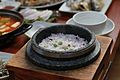
Dolsot-bibimbap, bibimbap served in a dolsot
Korean name
Hangul
돌솥
RRdolsot
MRtolsot
IPAtol.sot̚
Alternate name
Hangul
곱돌솥
RRgopdolsot
MRkoptolsot
IPAkop̚.t͈ol.sot̚

A dolsot (Korean돌솥; lit. stone pot) or gopdolsot (곱돌솥; lit. agalmatolite pot) is a small-sized piece of cookware or serveware made of agalmatolite, suitable for one to two servings of bap (cooked rice).[1][2][3] In Korean cuisine, various hot rice dishes such as bibimbap or gulbap (oyster rice) as well as plain white rice can be prepared and served in dolsot. As a dolsot does not cool off as soon as removed from the stove, rice continues to cook and arrives at the table still sizzling.[4]

On the bottom of a dolsot, there is a thin crust of scorched rice, to be scraped off and eaten in the case of bibimbap or made into sungnyung (숭늉, infusion) in the case of unseasoned rice dishes. In the former case, dolsot can be brushed with sesame oil beforehand to facilitate scraping.[4] To make sungnyung, the unscorched part of rice is scooped and transferred into another serving bowl right after being served, and hot water or tea (usually mild-grain teas such as barley tea or corn tea)[5] is poured into the dolsot while it is still blistering hot. The infusion with loosened chunks of scorched rice remains warm until the end of the meal, when it is typically savored.

[edit]

See also

[edit]

References

[edit]
Revisions and contributorsEdit on WikipediaRead on Wikipedia
from Grokipedia
A dolsot (돌솥), also known as a stone pot, is a traditional Korean cookware vessel carved from stone, typically granite, designed for both cooking and serving individual portions of hot dishes on the stovetop or open flame. It features a thick-walled bowl often paired with a stone lid, allowing it to retain intense heat even after removal from the heat source, which enhances cooking processes and keeps food sizzling at the table. The dolsot is most famously associated with dolsot , a mixed dish where pre-cooked , seasoned vegetables, meat, and a raw are added to the preheated pot, resulting in a crispy, nutty crust (nurungji) on the bottom while the fries gently from the residual heat. Beyond , it is versatile for preparing and serving other Korean staples, including multi-grain (such as five-grain mixes with beans for added nutrition), hearty stews like (fermented soybean paste stew with vegetables), and nourishing soups such as ssamgyetang ( chicken soup). Its heat retention properties make it ideal for single or double servings, promoting even cooking and prolonged warmth during meals.

History

Origins

The dolsot, a traditional Korean stone pot, emerged as a preferred cooking vessel during the Joseon Dynasty (1392–1910), particularly for preparing rice dishes valued for their enhanced flavor and texture. Traditionally crafted from agalmatolite, a soft talc-based stone valued for its heat retention, the dolsot allowed for superior heat distribution compared to metal alternatives like or , which were more common among the general populace. This material's properties made it a luxury item, often reserved for elites, as documented in Joseon-era texts that praised stone pots for producing the most delicious steamed and through even heating. Early references to dolsotbap, or stone pot rice, highlight its role in elevating the culinary experience by leveraging the pot's ability to maintain high temperatures post-cooking, resulting in a crispy rice crust known as nurungji at the bottom while keeping the upper layers warm and moist. The Gyuhap Chongseo (1809), a comprehensive encyclopedia on household arts including cooking, explicitly recommends stone pots for preparation, noting that they yield superior taste due to prolonged heat distribution that prevents uneven cooking. This method contrasted with conventional boiling in metal pots, offering a nuanced texture that became synonymous with refined Korean rice dishes. In , stone pots like the dolsot were instrumental for achieving precise in mixed preparations, such as those incorporating medicinal or nuts for nourishing effects. Court cooks employed small stone pots over in braziers to simmer slowly, stirring to ensure consistency and using heavy lids to minimize , thereby stabilizing heat for dishes served to the king and queen. This practice influenced broader adoption among , positioning the dolsot as a symbol of sophisticated during the dynasty.

Development

In the , the dolsot evolved from traditional handcrafted versions primarily made of agalmatolite to more robust constructions suitable for . This shift addressed growing domestic and international demand following Korea's industrialization, with pots often featuring stainless steel bands around the rim for added structural integrity and resistance to cracking during repeated high-heat use. By the mid-1900s, adaptations emerged to accommodate modern kitchen appliances, including bases designed for compatibility with gas and electric stovetops, enabling direct heating without traditional open flames. These modifications facilitated everyday home use amid Korea's rapid and the adoption of Western-style cooking infrastructures in the and . Post-Korean War immigration contributed to the global spread of Korean culinary traditions, including , through diaspora communities , , and beyond. This led to the popularity of dolsot-integrated dishes like hot stone in diaspora restaurants. Additionally, was introduced as an in-flight meal by in 1997, helping to embed the dish in international .

Design and Materials

Construction

The dolsot is constructed as a thick-walled, bowl-shaped vessel carved from solid stone, featuring a flat bottom that ensures stability on stovetops and promotes even heat distribution during cooking. Its design includes a heavy stone lid that seals in heat and moisture, enabling the pot to function both as a cooking tool and a serving dish. Typical single-serving dolsots measure approximately 18 cm in diameter and hold about 32 ounces, allowing for individual portions while maximizing heat retention for crisping effects in dishes. The interior surface is unglazed and naturally porous, which is treated with a seasoning layer—typically formed by applying oil after initial curing—to prevent food from sticking and to enhance the vessel's ability to withstand and hold high temperatures without cracking. To manage the intense residual heat after cooking, dolsots are commonly paired with a protective made of wood or heat-resistant , which safeguards surfaces and allows safe handling of the scorching pot. Many models incorporate a reinforcing band around the exterior for added durability against .

Materials

The primary traditional material used in dolsot production is agalmatolite, a soft metamorphic rock composed mainly of pyrophyllite and talc-like minerals, which resembles soapstone in texture and properties. This material is prized for its even heat distribution, achieved through its moderate thermal conductivity that allows gradual and uniform warming without hot spots, making it suitable for simmering and retaining warmth in cooked rice. Agalmatolite's non-reactivity with acidic or alkaline foods stems from its chemically inert composition, preventing leaching of metals or alteration of flavors during cooking. Additionally, its natural porosity is managed through initial seasoning processes that seal the surface, reducing absorption while preserving the stone's ability to release absorbed moisture for enhanced food tenderness. In modern dolsot production, solid granite serves as a common alternative, offering superior durability and heat resistance. Granite's high thermal mass enables sustained heat retention, supporting the characteristic sizzling effect observed in dishes like dolsot bibimbap. To mitigate cracking from thermal expansion, granite dolsots are often reinforced with stainless steel bands around the rim and base, enhancing structural integrity while maintaining the stone's non-porous, non-reactive surface. The porosity of granite is inherently low but can be further controlled through quarrying from high-quality sources and polishing, ensuring safe contact with food.

Culinary Uses

Preparation

To prepare a dolsot for cooking, it must first be preheated gradually to ensure even distribution and prevent damage to the . On a stovetop, place the empty dolsot over low to medium for 5-10 minutes, then increase to medium-high for an additional 10-15 minutes until the interior is smoking hot and water droplets sizzle upon contact; for electric stoves, use a heat diffuser to promote uniform heating. Alternatively, preheat the dolsot in an at 200-220°C (400-428°F) for 10-20 minutes with the placed inside as the warms, allowing the stone to absorb slowly. Once preheated, apply a thin layer of or neutral to the interior surface using a or to create a non-stick barrier and promote crisping during cooking. Swirl the oil to coat evenly, wiping away any excess to avoid pooling, which helps achieve the desired texture in dishes like dolsot . is paramount when handling a dolsot, as it can reach temperatures up to 260°C (500°F) and retain heat for extended periods. Always use thick oven mitts or heat-resistant gloves when moving the pot, and position it on a stable, heatproof surface such as a wooden or metal to avoid burns or scorching tabletops. To prevent thermal cracking, avoid sudden temperature changes by heating gradually and never adding cold liquids or ingredients directly to the hot dolsot; allow it to cool naturally after use.

Common Dishes

One of the most iconic dishes prepared in a dolsot is dolsot , a mixed where steamed is layered with seasoned vegetables such as , bean sprouts, carrots, and , along with marinated beef or other proteins, a fried or raw egg, and sauce. The hot, preheated dolsot allows the to sizzle upon assembly, creating a crispy, golden nurungji crust at the bottom through direct contact with the heated stone surface. This technique leverages the dolsot's superior heat retention to develop the nutty, textured crust without overcooking the toppings, typically achieved by cooking on low heat for 5-10 minutes after layering. Dolsotbap refers to steamed rice cooked directly in the dolsot, often as a plain short-grain or mixed-grain variety (such as yeongyang dolsotbap with beans, chestnuts, and jujubes for added ), where the rice is soaked, added with to the oiled pot, and cooked on the stove until fluffy; the bottom layer can be crisped by additional low-heat cooking to form a golden nurungji crust, enhancing the rice's flavor with subtle smokiness. This simple preparation highlights the pot's ability to evenly distribute heat during , resulting in fluffy rice atop the crunchy nurungji layer. It is commonly served with an array of side dishes, such as , seasoned seaweed, and pickled vegetables, allowing diners to customize their meal. Beyond rice-based dishes, the dolsot is utilized for stews and soups, where its thick construction maintains a gentle simmer even after removal from the heat source, keeping the broth hot at the table. Examples include (fermented soybean paste stew with vegetables), benefiting from the pot's prolonged heat retention to preserve flavors and temperatures during communal serving.

Cultural Significance

In Korean Cuisine

The dolsot plays a central role in through its association with , a dish that embodies the harmony of flavors, colors, and textures, reflecting traditional Korean principles of balance and order such as Pungnyudo. served in a heated dolsot, known as dolsot bibimbap, features rice topped with seasoned vegetables, protein, and a , arranged in the five cardinal colors—green, red, yellow, white, and black—symbolizing the Korean philosophical principles of yin-yang and the five elements. This visual and gustatory equilibrium promotes a unified meal where diverse ingredients blend upon mixing, aligning with emphasis on moderation, community, and natural harmony, as seen in concepts like Jeong. The sizzling heat of the dolsot not only crisps the rice base, known as nurungji, but also maintains warmth throughout the meal, enhancing the sensory experience of this balanced dish. Regional variations highlight the dolsot's prevalence in southern Korea, particularly in areas like and , where rice-focused dishes thrive due to the region's fertile plains and agricultural abundance. In these locales, dolsot incorporates local ingredients such as fernbrake or regional herbs, emphasizing the pot's role in everyday southern meals that prioritize steamed rice and vegetable harmony over northern meat-heavy fare. This southern emphasis integrates the dolsot into routine family dining, reinforcing its status as a staple for nutritious, seasonal cooking in traditional Korean households.

Modern Adaptations

In contemporary Korean-American cuisine, the dolsot has been adapted for fusion dishes that blend traditional elements with Western influences, such as poke-style featuring raw or plant-based proteins layered over in the hot stone pot to create a customizable, sizzling bowl reminiscent of Hawaiian poke. These adaptations often incorporate local ingredients like avocado or alongside classic vegetables, appealing to diverse palates in urban restaurants. Vegan versions further modernize the dish by substituting beef or egg with marinated , , or mushroom "bulgogi," preserving the signature crispy rice crust while aligning with plant-based dietary trends. Commercial innovations have made dolsot pots more user-friendly for home cooks, with pre-seasoned and models featuring non-stick coatings to simplify preparation and reduce maintenance compared to traditional unglazed versions. These products, often including lids and trivets for , are available through platforms, enabling widespread access beyond specialty stores. Manufacturers emphasize their compatibility with induction stoves and microwaves, broadening appeal for everyday use in global households. The international popularity of dolsot pots has surged, with significant exports to the United States, Japan, and Europe since the 2010s, driven by the global rise of Korean cuisine through media like K-dramas and food tourism. In these markets, dolsot is frequently marketed for its health benefits, including superior heat retention that promotes even cooking and minimizes nutrient loss in vegetables and grains by reducing overcooking time. Retailers highlight how the stone material's thermal properties help preserve vitamins and minerals, positioning it as a tool for nutritious home cooking.

Care and Maintenance

Seasoning

The seasoning process for a new dolsot begins with thorough to remove any residues, followed by the pot in salted water or to condition the porous stone surface and open its pores. After rinsing and drying, a thin layer of neutral or is rubbed onto the interior, and the pot is heated gradually on low to medium heat—often by simmering the oil for 20-30 minutes—to allow the oil to seep in and form a protective . This gradual heating step is crucial to avoid to the stone. Seasoning is recommended before the first use to establish the initial non-stick layer, with re-seasoning advised every few months or whenever food begins to stick, to preserve the pot's performance during regular cooking. The benefits of proper seasoning include creating a non-stick surface to prevent food from sticking, providing a protective layer for the stone, and allowing a patina to form that enables gradual flavor infusion with use, enhancing the taste of dishes like bibimbap.

Cleaning

After using a dolsot, it is essential to allow the pot to cool completely to before attempting any cleaning to prevent that could lead to cracking or damage to the . This cooling process typically takes 1-2 hours, during which the dolsot should be placed on a heatproof surface away from cold drafts or wet areas. For routine cleaning, hand washing is recommended using warm water and a mild applied with a soft or cloth to gently remove food residues without scratching the porous surface; while mild is commonly used, some sources advise avoiding it to prevent absorption that could affect flavors in future dishes, in which case rinse thoroughly if is applied. Dishwashers must be avoided, as the harsh detergents, high temperatures, and mechanical agitation can degrade the stone's integrity and layer. After washing, rinse thoroughly to eliminate any traces, then dry the dolsot immediately with a clean or allow it to air dry completely in a shaded area to prevent absorption that could foster mold growth or bacterial buildup. To address stubborn residues, such as burnt bits or stuck-on , apply a paste of baking soda and water to the residues, allow it to sit for 10-15 minutes, then gently scrub with a soft brush or , avoiding abrasive materials like that could harm the surface. This method leverages baking soda's mild abrasive and deodorizing properties to loosen debris without compromising the pot's , which should be reapplied lightly if needed after drying.

References

Add your contribution
Related Hubs
User Avatar
No comments yet.