



Community hub
Recent from talks
Contribute something
Nothing was collected or created yet.
Dominical letter
View on WikipediaDominical letters or Sunday letters are a method used to determine the day of the week for particular dates. When using this method, each year is assigned a letter (or pair of letters for leap years) depending on which day of the week the year starts with. The Dominical letter for the current year 2025 is E.
Dominical letters are derived from the Roman practice of marking the repeating sequence of eight letters A–H (commencing with A on January 1) on stone calendars to indicate each day's position in the eight-day market week (nundinae). The word is derived from the number nine due to their practice of inclusive counting. After the introduction of Christianity a similar sequence of seven letters A–G was added alongside, again commencing with January 1. The dominical letter marks the Sundays. Nowadays they are used primarily as part of the computus, which is the method of calculating the date of Easter.
A common year is assigned a single dominical letter, indicating which lettered days are Sundays in that particular year (hence the name, from Latin dominica for Sunday). Thus, 2025 will be E, indicating that all E days will be Sunday, and by inference, January 5, 2025, will be a Sunday. Leap years are given two letters, the first valid for January 1 – February 28 (or February 24, see below), the second for the remainder of the year.
In leap years, the leap day may or may not have a letter. In the Catholic version it does, but in the 1662 and subsequent Anglican versions it does not. The Catholic version causes February to have 29 days by doubling the sixth day before March 1, inclusive, thus both halves of the doubled day have a dominical letter of F.[1][2][3] The Anglican version adds a day to February that did not exist in common years, February 29, thus it does not have a dominical letter of its own.[4][5] After the 1662 reform there was correspondence between the Archbishop of Canterbury and the printer of the Book of Common Prayer, in which it was explained that the feast day of St Matthias now fell on February 24 every year.
In either case, all other dates have the same dominical letter every year, but the days of the dominical letters change within a leap year before and after the intercalary day, February 24 or February 29.
History and arrangement
[edit]According to Thurston 1909, p. 109 dominical letters are:
a device adopted from the Romans by the old chronologers to aid them in finding the day of the week corresponding to any given date, and indirectly to facilitate the adjustment of the 'Proprium de Tempore' to the 'Proprium Sanctorum' when constructing the ecclesiastical calendar for any year. The Church, on account of her complicated system of movable and immovable feasts... has from an early period taken upon herself as a special charge to regulate the measurement of time. To secure uniformity in the observance of feasts and fasts, she began, even in the patristic age, to supply a computus, or system of reckoning, by which the relation of the solar and lunar years might be accommodated and the celebration of Easter determined. Naturally she adopted the astronomical methods then available, and these methods and the terminology belonging to them having become traditional, are perpetuated in a measure to this day, even after the reform of the calendar, in the prolegomena to the Breviary and Missal.
The Romans were accustomed to divide the year into nundinæ, periods of eight days; and in their marble fasti, or calendars, of which numerous specimens remain, they used the first eight letters of the alphabet [A to H] to mark the days of which each period was composed. When the Oriental seven-day period, or week, was introduced in the time of Augustus, the first seven letters of the alphabet were employed in the same way to indicate the days of the new division of time. In fact, fragmentary calendars on marble still survive in which both a cycle of eight letters – A to H – indicating nundinae, and a cycle of seven letters – A to G – indicating weeks, are used side by side (see "Corpus Inscriptionum Latinarum", 2nd ed., I, 220. -The same peculiarity occurs in the Philocalian Calendar of A.D. 356, ibid., p. 256). This device was imitated by the Christians, and in their calendars the days of the year from 1 January to 31 December were marked with a continuous recurring cycle of seven letters: A, B, C, D, E, F, G. A was always set against 1 January, B against 2 January, C against 3 January, and so on. Thus F fell to 6 January, G to 7 January; A again recurred on 8 January, and also, consequently, on 15 January, 22 January, and 29 January. Continuing in this way, 30 January was marked with a B, 31 January with a C, and 1 February with a D. Supposing this to be carried on through all the days of an ordinary year (i.e. not a leap year), it will be found that a D corresponds to 1 March, G to 1 April, B to 1 May, E to 1 June, G to 1 July, C to 1 August, F to 1 September, A to 1 October, D to 1 November, and F to 1 December – a result which Durandus recalled by the following distich:
Alta Domat Dominus, Gratis Beat Equa Gerentes
Contemnit Fictos, Augebit Dona Fideli.
Another one is "Add G, beg C, fad F," and yet another is "At Dover dwell George Brown, Esquire; Good Christopher Finch; and David Fryer."
Dominical letter cycle
[edit]Thurston 1909 continues:
Now, as a moment's reflection shows, if 1 January is a Sunday, all the days marked by A will also be Sundays; if 1 January is a Saturday, Sunday will fall on 2 January, which is a B, and all the other days marked B will be Sundays; if 1 January is a Monday, then Sunday will not come until 7 January, a G, and all the days marked G will be Sundays ...
It is plain, however, that when leap year occurs, a complication is introduced. February has then twenty-nine days. According to the Anglican and civil calendars this extra day is added at the end of the month; according to the Catholic ecclesiastical calendar 24 February is counted twice. But in either case 1 March is then one day later in the week than 1 February, or, in other words, for the rest of the year the Sundays come a day earlier than they would in a common year. This is expressed by saying that a leap year has two Dominical Letters, the second being the letter which precedes that with which the year started.
Of course, "24 February" is not "counted twice". The 23rd is ante diem vii kalendas Martias, the next day in a leap year is a.d. bis sextum kal. Mart., the next day is the regular a.d.vi kal. Mart., and so to the end of the month. For example, in 2024 (=GF), all days preceding the leap day corresponded to a common-year G calendar, and all days afterward corresponded to a common-year F calendar. The same thing will happen in 2028 (=BA), for example all days preceding the leap day will correspond to a common-year B calendar, and all days afterward will correspond to a common-year A calendar. The relevant line of the Februarius page in the Kalendarium of a 1913 Breviarium Romanum reads:
- 5 |f|vj|24|S. MATHIAE APOSTOLI, dupl. 2. class.
The first column is the epact, a replacement for the golden number, from which the age of the moon was computed and announced in some English cathedrals prior to the Reformation. The second column is the letter, the third the Roman date and the fourth the modern date. A note at the foot of the page reads:
In anno bissextili mensis Februarius est dierum 29. et Festum S. Mathiae celebratur die 25. Februarii et bis dicitur sexto Kalendas, id est die 24. et die 25. et littera Dominicalis, quae assumpta fuit in mense Januario, mutatur in praecedentem; ut si in Januario littera Dominicalis fuerit A, mutatur in praecedentem, quae est g. etc.; et littera f bis servit, 24. et 25.
(In a bissextile year the month February is of 29 days and the Feast of St. Matthias is celebrated on 25 February, and twice is said on the sixth Kalends, that is on the 24th and 25th, and the Sunday letter, which was assumed in the month of January, is changed to the preceding; so if in January the Sunday letter may have been A, it is changed to the preceding, which is G. etc.; and letter F twice serves, 24th and 25th.)
Dominical letters of the years
[edit]The dominical letter of a year provides the link between the date and the day of the week on which it falls. The following are the correspondences between dominical letters and the day of the week on which their corresponding years is day and date:
The Gregorian calendar repeats every 400 years (i. e., every four centuries). Of the 400 years in one Gregorian cycle, there are:
- 44 common years for each single Dominical letter D and F;
- 43 common years for each single Dominical letter A, B, C, E, and G;
- 15 leap years for each double Dominical letter AG and CB;
- 14 leap years for each double Dominical letter ED and FE;
- 13 leap years for each double Dominical letter BA, DC, and GF.
Thus 58 out of 400 years begin as A, C, or F, while 57 begin as D or E and 56 begin as B or G. The end of a year preceding a given year has the next letter (meaning A years are preceded by years ending as B), so 58 of 400 years end as B, D or G, whereas 57 end as E or F and 56 end as C or A. This means, for example, that Christmas falls on a Saturday or Monday (C and A years, resp.) 56 times and Wednesday or Thursday (F and E years, resp.) 57 times, whereas they fall on Friday, Sunday or Tuesday (D, B and G years, resp.) 58 times in the span of four centuries.
The Julian calendar repeats every 28 years. Of the 28 years in one Julian cycle, there are:
- 3 common years for each single Dominical letter A, B, C, D, E, F, and G;
- 1 leap year for each double Dominical letter BA, CB, DC, ED, FE, GF, and AG.
Calculation
[edit] | This article may contain an excessive amount of intricate detail that may only interest a particular audience. (January 2015) |
The dominical letter of a year can be calculated based on any method for calculating the day of the week, with letters in reverse order compared to numbers indicating the day of the week.

For example:
- ignore periods of 400 years
- considering the second letter in the case of a leap year:
- for one century within two multiples of 400, go forward two letters from BA for 2000, hence C, E, G.
- for remaining years, go back one letter every year, two for leap years (this corresponds to writing two letters, no letter is skipped).
- to avoid up to 99 steps within a century, the table below can be used.
| Year mod 28 | # |
|---|---|
| 00 06 12 17 23 | 0 |
| 01 07 12 18 24 | 6 |
| 02 08 13 19 24 | 5 |
| 03 08 14 20 25 | 4 |
| 04 09 15 20 26 | 3 |
| 04 10 16 21 27 | 2 |
| 05 11 16 22 00 | 1 |
Red for the first two months of leap years.
For example, to find the Dominical Letter of the year 1913:
- 1900 is G and 13 corresponds to 5
- G + 5 = G − 2 = E, 1913 is E
Similarly, for 2007:
- 2000 is BA and 7 corresponds to 6
- A + 6 = A − 1 = G, 2007 is G
For 2065:
- 2000 is BA and 65 mod 28 = 9 corresponds to 3
- A + 3 = A − 4 = D, 2065 is D
The odd plus 11 method
[edit]A simpler method suitable for finding the year's dominical letter was discovered in 2010. It is called the "odd plus 11" method.[6]
The procedure accumulates a running total T as follows:
- Let T be the year's last two digits.
- If T is odd, add 11.
- Let T = T/2.
- If T is odd, add 11.
- Let T = T mod 7.
- Count forward T letters from the century's dominical letter (A, C, E or G see above) to get the year's dominical letter.
The formula is

De Morgan's rule
[edit]This rule was stated by Augustus De Morgan:
- Add 1 to the given year.
- Take the quotient found by dividing the given year by 4 (neglecting the remainder).
- Take 16 from the centurial figures of the given year if that can be done.
- Take the quotient of III divided by 4 (neglecting the remainder).
- From the sum of I, II and IV, subtract III.
- Find the remainder of V divided by 7: this is the number of the Dominical Letter, supposing A, B, C, D, E, F, G to be equivalent respectively to 6, 5, 4, 3, 2, 1, 0.[7]
So the formulae (using the floor function) for the Gregorian calendar is

It is equivalent to

and
- (where = last two digits of the year, = century part of the year).



For example, to find the Dominical Letter of the year 1913:
- 1. (1 + 1913 + 478 + 0 − 3) mod 7 = 2
- 2. (1913 + 478 + 4 − 19 − 1) mod 7 = 2
- 3. (13 + 3 + 15 -1) mod 7 = 2
- Hence, the Dominical Letter is E in the Gregorian calendar.
De Morgan's rules no. 1 and 2 for the Julian calendar:
- and


To find the Dominical Letter of the year 1913 in the Julian calendar:
- (1913 + 478 − 3) mod 7 = 1
- Hence, the Dominical Letter is F in the Julian calendar.
In leap years the formulae above give the Dominical Letter for the last ten months of the year. To find the Dominical Letter for the first two months of the year to the leap day (inclusive) subtract 1 from the calculated number representing the original Dominical Letter; if the new number is less than 0, it must be changed to 6.
Dominical letter in relation to the Doomsday Rule
[edit]The "doomsday" concept in the doomsday algorithm is mathematically related to the Dominical letter. Because the letter of a date equals the dominical letter of a year (DL) plus the day of the week (DW), and the letter for the doomsday is C except for the portion of leap years before February 29 in which it is D, we have:
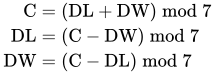
Note: G = 0 = Sunday, A = 1 = Monday, B = 2 = Tuesday, C = 3 = Wednesday, D = 4 = Thursday, E = 5 = Friday, and F = 6 = Saturday, i.e. in our context, C is mathematically identical to 3.
Hence, for instance, the doomsday of the year 2013 is Thursday, so DL = (3–4) mod 7 = 6 = F. The dominical letter of the year 1913 is E, so DW = (3–5) mod 7 = 5 = Friday.
| Doomsday | Dominical letter | |
|---|---|---|
| Common year | Leap year | |
| Sunday | C | DC |
| Monday | B | CB |
| Tuesday | A | BA |
| Wednesday | G | AG |
| Thursday | F | GF |
| Friday | E | FE |
| Saturday | D | ED |
All in one table
[edit]If the year of interest is not within the table, use a tabular year which gives the same remainder when divided by 400 (Gregorian calendar) or 700 (Julian calendar). In the case of the Revised Julian calendar, find the date of Easter Sunday (see the section "Calculating Easter Sunday", subsection "Revised Julian calendar" below) and enter it into the "Table of letters for the days of the year" below. If the year is a leap year, the dominical letter for January and February is found by inputting the date of Easter Monday. Note the different rules for leap years:
- Gregorian calendar: every year which divides exactly by 4, but of century years only those which divide exactly by 400; therefore ignore the left-hand letter given for a century year which is not a leap year.
- Julian calendar: every year which divides exactly by 4.
- Revised Julian calendar: every year which divides exactly by 4, but of century years only those which give the remainder 200 or 600 when divided by 900.[8]
|
| ||||||||||||||||||||||||||||||||||||||||||||||||||||||||||||||||||||||||||||||||||||||||||||||||||||||||||||||||||||||||||||||||||||||||||||||||||||||||||||||||||||||||||||||||||||||||||||||||||||||||||||||||||||||||||||||||||||||||||||||||||||||||||||||||||||||||||||||||||||||||||||||||||||||||||||||||||||||||||||||||||||||||||||||||||||||||||||||||||||||||||||||||||||||||||||||||||
Years with special dominical letters
[edit]When a country switched to the Gregorian calendar, there could be some unusual combinations of dominical letters.
Some examples
[edit]- 1582: Many Catholic countries switched to the Gregorian calendar Friday October 15. The table above indicates that year 1582 had the dominical letter G in the Julian calendar and C in the Gregorian one. So the dominical letters for 1582 in these Catholic countries became GC for mixing the two calendars used in this legal year, a special combination not seen before and after with a single calendar used in the same legal year.
- 1712: Sweden had a February 30 in 1712, and the Julian calendar dominical letters FE and in the Gregorian one dominical letters CB, but in Sweden started as GF, so the dominical letters for 1712 in Sweden were GE, a very special combination which also only applies to this legal year.
- 1752: The British Empire and its colonies switched to the Gregorian calendar Thursday September 14. 1752, a leap year, had in the Julian calendar dominical letters ED and in the Gregorian one dominical letters BA, so the dominical letters for 1752 in Britain were EDA, a very special combination which also only applies to this legal year.
Calculating Easter Sunday
[edit]Enter the "all in one table" to find the date of the paschal full moon, then use the "week table" below to find the day of the week on which it falls. Easter is the following Sunday.
Week table: Julian and Gregorian calendars for AD years since March 1 AD 4
[edit]Note that this table does not work for AD years at the early stage of the real Julian calendar before March 1 AD 4[9] or for any BC year, except when using the Julian calendar rules for proleptic dates (which are different from effective historic dates, whose effective calendar in use depended on the location of dated events or the location of the person using the calendar, sometimes differently between political/civil or religious purposes in places where both calendars still coexisted). The duration of months, and the number and placement of intercalated days also changed inconsistently before AD 42 in the early local Julian calendars which used native names for the months, depending on places and years, causing finally a lot of confusion in the population (so dating events precisely in that period is often difficult, unless they are correlated with observed lunar cycles, or with days of the week, or with another calendar).
In these early AD years and in all BC years, with the effective Julian calendars used locally to align the counting of years (but still with the tradition inherited from the earlier Roman calendar for noting days in each year), a variable number of days at end of the months (after the last day of its ides but before the last day of calends which started the next month) were also still counted relatively from the start of the next named month (on the last day of its calends), and years were theoretically starting on March 1 (but with the last days of the year in February also counted from the New Year's Day in March). As well, all these early years were effectively counted inclusively and positively from a different, much earlier epoch in other eras, such as the supposed foundation of Rome, or the accession to power of a local ruler (and still not relatively to the supposed date of birth of Christ, which was fixed later arbitrarily by a Christian reform for the modern Julian calendar so that this epoch for the Christian era starts now on January 1 in proleptic year AD 1 of the modern Julian calendar, but the real date of birth of Christ is still not known precisely but certainly falls before, somewhere in the last few BC years).
Instructions
For Julian dates before 1300 and after 1999 the year in the table which differs by an exact multiple of 700 years should be used. For Gregorian dates after 2299, the year in the table which differs by an exact multiple of 400 years should be used. The values "r0" through "r6" indicate the remainder when the Hundreds value is divided by 7 (Julian) or 4 (Gregorian), indicating how the series extend in either direction. Both Julian and Gregorian values are shown for years 1500–1999 / 1500–2200 for convenience.
The corresponding numbers in the far right hand column on the same line as each component of the date (the hundreds, remaining digits and month) are added, then the day of the month. This total is divided by 7 and the remainder from this division located in the far right hand column. The day of the week is beside it. Bold figures (e.g., 04) denote leap year. If a year ends in 00 and its hundreds are in bold, it is a leap year. Thus 19 indicates that 1900 is not a Gregorian leap year, (but bold 19 in the Julian column indicates that it is a Julian leap year, as are all Julian x00 years). 20 indicates that 2000 is a leap year. Use bold Jan and Feb only in leap years.
| Century digits | Remaining year digits | Month | Day of week |
Number | ||||||||||||||||||||||
|---|---|---|---|---|---|---|---|---|---|---|---|---|---|---|---|---|---|---|---|---|---|---|---|---|---|---|
| Julian (r ÷ 7) |
Gregorian (r ÷ 4) | |||||||||||||||||||||||||
| r5 19 | 16 20 r0 | (00) | 06 | — | 17 | 23 | 28 | 34 | — | 45 | 51 | 56 | 62 | — | 73 | 79 | 84 | 90 | — | Jan | Oct | Sat | 0 | |||
| r4 18 | 15 19 r3 | 01 | 07 | 12 | 18 | — | 29 | 35 | 40 | 46 | — | 57 | 63 | 68 | 74 | — | 85 | 91 | 96 | May | Sun | 1 | ||||
| r3 17 | — | 02 | — | 13 | 19 | 24 | 30 | — | 41 | 47 | 52 | 58 | — | 69 | 75 | 80 | 86 | — | 97 | Feb | Aug | Mon | 2 | |||
| r2 16 | 18 22 r2 | 03 | 08 | 14 | — | 25 | 31 | 36 | 42 | — | 53 | 59 | 64 | 70 | — | 81 | 87 | 92 | 98 | Feb | Mar | Nov | Tue | 3 | ||
| r1 15 | — | — | 09 | 15 | 20 | 26 | — | 37 | 43 | 48 | 54 | — | 65 | 71 | 76 | 82 | — | 93 | 99 | Jun | Wed | 4 | ||||
| r0 14 | 17 21 r1 | 04 | 10 | — | 21 | 27 | 32 | 38 | — | 49 | 55 | 60 | 66 | — | 77 | 83 | 88 | 94 | — | Sep | Dec | Thu | 5 | |||
| r6 13 | — | 05 | 11 | 16 | 22 | — | 33 | 39 | 44 | 50 | — | 61 | 67 | 72 | 78 | — | 89 | 95 | — | Jan | Apr | Jul | Fri | 6 | ||
For determination of the day of the week (January 1, 2000, Saturday)
- the day of the month: 1
- the month: 6
- the year: 0
- the century mod 4 for the Gregorian calendar and mod 7 for the Julian calendar 0
- adding 1 + 6 + 0 + 0 = 7. Dividing by 7 leaves a remainder of 0, so the day of the week is Saturday.
Revised Julian calendar
[edit]- Use the Julian portion of the table of paschal full moons. Use the "week table" (remembering to use the "Julian" side) to find the day of the week on which the paschal full moon falls. Easter is the following Sunday and it is a Julian date. Call this date JD.
- Subtract 100 from the year.
- Divide the result by 100. Call the number obtained (omitting fractions) N.
- Evaluate 7N/9. Call the result (omitting fractions) S.
- The Revised Julian calendar date of Easter is JD + S − 1.
Example. What is the date of Easter in 2017?
2017 + 1 = 2018. 2018 ÷ 19 = 106 remainder 4. Golden number is 4. Date of paschal full moon is April 2 (Julian). From "week table" April 2, 2017 (Julian) is Saturday. JD = April 3. 2017 − 100 = 1917. 1917 ÷ 100 = 19 remainder 17. N = 19. 19 × 7 = 133. 133 ÷ 9 = 14 remainder 7. S = 14. Easter Sunday in the Revised Julian calendar is April 3 + 14 − 1 = April 16.
Calculate the day of the week in the Revised Julian calendar
[edit]Note that the date (and hence the day of the week) in the Revised Julian and Gregorian calendars is the same up until February 28, 2800, and that for large years it may be possible to subtract 6300 or a multiple thereof before starting so as to reach a year within or closer to the table.
To look up the weekday of any date for any year using the table, subtract 100 from the year, divide the number obtained by 100, multiply the resulting quotient (omitting fractions) by seven and divide the product by nine. Note the quotient (omitting fractions). Enter the table with the Julian year, and just before the final division add 50 and subtract the quotient noted above.
Example: What is the day of the week of 27 January 8315?
8315 − 6300 = 2015, 2015 − 100 = 1915, 1915 ÷ 100 = 19 remainder 15, 19 × 7 = 133, 133 ÷ 9 = 14 remainder 7. 2015 is 700 years ahead of 1315, so 1315 is used. From the table: for hundreds (13): 6. For remaining digits (15): 4. For month (January): 0. For date (27): 27. 6 + 4 + 0 + 27 + 50 − 14 = 73. 73 ÷ 7 = 10 remainder 3. Day of week = Tuesday.
Dominical letter
[edit]To find the dominical letter, calculate the day of the week for either January 1 or October 1. If it is Sunday, the Sunday Letter is A, if Saturday B, and similarly backward through the week and forward through the alphabet to Monday, which is G.
Leap years have two letters, so for January and February calculate the day of the week for January 1 and for March to December calculate the day of the week for October 1.
Leap years are all years that divide exactly by four, with the following exceptions:
Gregorian calendar – all years divisible by 100, except those that divide exactly by 400.
Revised Julian calendar – all years divisible by 100, except those with a remainder of 200 or 600 when divided by 900.
Clerical utility
[edit] |
The dominical letter had another practical utility in the period prior to the annual printing of the Ordo divini officii recitandi, in which period, therefore, Christian clergy were often required to determine the Ordo independently. Easter Sunday may be as early as March 22 or as late as April 25, and consequently there are 35 possible days on which it may occur; each dominical letter includes 5 potential dates of these 35, and thus there are 5 possible ecclesiastical calendars for each letter. The Pye or Directorium which preceded the present Ordo took advantage of this principle by delineating all 35 possible calendars and denoting them by the formula "primum A", "secundum A", "tertium A", et cetera. Hence, based on the dominical letter of the year and the epact, the Pye identified the correct calendar to use. A similar table, adapted to the reformed calendar and in more convenient form, is included in the beginning of every breviary and missal under the heading "Tabula Paschalis nova reformata".
Saint Bede does not seem to have been familiar with dominical letters, given his "De temporum ratione"; in its place he adopted a similar device of Greek origin consisting of seven numbers, which he denominated "concurrentes" (De Temp. Rat., Chapter LIII). The "concurrents" are numbers that denote the days of the week on which March 24 occurs in the successive years of the solar cycle, 1 denoting Sunday, 2 (feria secunda) for Monday, 3 for Tuesday, et cetera; these correspond to dominical letters F, E, D, C, B, A, and G, respectively.
Use for computer calculation
[edit]Computers are able to calculate the Dominical letter for the first day of a given month in this way (function in C), where:
- m = month
- y = year
- s = "style"; 0 for Julian, otherwise Gregorian.
char dominical(int m, int y, int s) {
  int leap = y % 4 == 0 && (s == 0 || y % 100 != 0 || y % 400 == 0),
      a = (y % 100) % 28,
      b = (s == 0) * (  (y%700)/100 + a/4 * 2  + 4 + ((a%4+1)*!leap + (m+9)/12*leap) * 6 ) % 7
        + (s != 0) * ( ((y%400)/100 + a/4 + 1) * 2 + ((a%4+1)*!leap + (m+9)/12*leap) * 6 ) % 7;
  b += (b == 0) * 7;
  return (char)(b + 64);
}
Years are also given a dominical letter or pair of dominical letters according to the first day in January and last day in December: when they are equal, only the first letter is given. The dominical letter of the last day of December just precedes in the ordered cycle (G,F,E,D,C,B,A), the dominical letter of the first day in January for the next year.
See also
[edit]References
[edit]Citations
[edit]- ^ Archer 1941, p. 5.
- ^ Blackburn & Holford-Strevens 1999, p. 829.
- ^ Calendarium Archived February 15, 2005, at the Wayback Machine (Calendar attached to the papal bull "Inter gravissimas").
- ^ "Anno vicesimo quarto Georgii II. c. 23" (1751), The Statutes at Large, from Magna Charta to the end of the Eleventh Parliament of Great Britain, Anno 1761, ed. Danby Pickering, p. 194.
- ^ Fotheringham 1929, pp. 735–747.
- ^ Fong & Walters 2011.
- ^ Thurston 1909.
- ^ Shields, Miriam Nancy (1924). "The new calendar of the Eastern churches". Practical Astronomy. 32: 407–411. Bibcode:1924PA.....32..407S.
- ^ Bennett, Christopher J (2004). "The early Augustan calendars in Rome and Egypt". Zeitschrift für Papyrologie und Epigraphik. 147: 165–168. JSTOR 20191595.
The later literary sources describe a period of 12 years without an intercalary day after the reform. This number has always been slightly problematic. Since the reform occurred in 8 B.C., it implies that intercalation resumed in A.D. 5. But A.D. 5 was not a Julian leap year, so the next actual intercalation was in A.D. 8, not 12 but 15 years after the reform. This discrepancy has traditionally been reconciled by interpreting "resumption of intercalation" to mean that accumulation of quarter days started in A.D. 5.
Sources
[edit]- Archer, Peter (1941). The Christian Calendar and the Gregorian Reform. New York: Fordham University Press. ASIN B01K942KH2.
- Blackburn, Bonnie J.; Holford-Strevens, Leofranc (1999). The Oxford Companion to the Year. Oxford University Press. ISBN 978-0-19-214231-3.
- Fong, Chamberlain; Walters, Michael K. (2011). "Methods for Accelerating Conway's Doomsday Algorithm (part 2)". 7th International Congress of Industrial and Applied Mathematics. arXiv:1010.0765.
- Fotheringham, J. K. (1929). "Explanation: The Calendar". The Nautical Almanac and Astronomical Ephemeris for the year 1931. London: HMSO.
- Thurston, Herbert (1909). . In Herbermann, Charles (ed.). Catholic Encyclopedia. Vol. 5. New York: Robert Appleton Company.
Further reading
[edit]- Chisholm, Hugh, ed. (1911). . Encyclopædia Britannica. Vol. 4 (11th ed.). Cambridge University Press. p. 992.

.png)
Dominical letter
View on GrokipediaHistorical Development
Origins and Early Use
The Dominical letter system originated in the early Christian era as a key component of the computus, the computational method for determining the date of Easter. The system, formalized in its Christian application by the Scythian monk Dionysius Exiguus around 525 AD, originated from earlier Roman calendrical practices. It was developed to standardize Easter calculations in the Julian calendar following the Council of Nicaea's guidelines from 325 AD. Dionysius, tasked with extending earlier Alexandrian Paschal tables, integrated the Dominical letters into his 95-year extension (later part of a 532-year cycle) to align solar and lunar calendars for ecclesiastical purposes. This innovation replaced the Diocletian era with the Anno Domini system, starting his tables from AD 532 to avoid pagan associations.[5][6] In its original form within the Julian calendar, the Dominical letter denoted the weekday alignment for Sundays throughout the year by assigning the letters A through G sequentially to the dates of the year, starting with A for January 1 and repeating every seven days; the Dominical letter is the one that falls on Sundays for that year. The letter for a given year was determined by the weekday of January 1, effectively indicating which letter corresponded to all Sundays; for instance, if January 1 fell on a Sunday, the Dominical letter was A, marking all A-days as Sundays. This system facilitated quick identification of the first Sunday after the Paschal full moon, essential for Easter, without needing full astronomical observations. Early chronologers adapted it from Roman calendrical practices of labeling days with letters on stone calendars, but Dionysius formalized its Christian application in computus tables.[7][5] The Dominical letters were integrated with the golden number, a marker for the 19-year Metonic lunar cycle (calculated as the year modulo 19 plus 1), to create comprehensive Paschal tables for perpetual calendar alignment. In these tables, golden numbers indexed rows for lunar phases, while Dominical letters indexed columns for solar weekdays, with intersections revealing potential Easter dates between March 22 and April 25. Dionysius's tables, commencing in AD 532, provided an example: for that year, the golden number was 10 and the Dominical letter was C, yielding Easter on April 11 by locating the Sunday after the ecclesiastical full moon. This method ensured uniformity in Easter observance across Christian communities, relying on the 532-year cycle (19 lunar × 28 solar) to repeat patterns. Subsequent tables, like those extended to AD 626, perpetuated this reliance on Dominical letters for liturgical harmony.[6][5]Evolution Across Calendars
The Gregorian calendar was introduced in 1582 by Pope Gregory XIII through the papal bull Inter gravissimas, which omitted ten days—October 5 through 14—to correct the Julian calendar's accumulated drift of approximately ten days since the Council of Nicaea in 325. This adjustment directly impacted dominical letter assignments, as the skipped days shifted the weekday cycle by ten days, equivalent to three days modulo seven; in 1582, the dominical letter transitioned from G (applicable before the correction) to C starting October 17, altering the lettering for Sundays in the latter part of the year.[8] In comparison, the Julian calendar maintained a strict 28-year solar cycle for dominical letters, repeating every 28 years due to its uniform leap year rule every four years, which aligned the seven-day week with the calendar without century adjustments.[9] The Gregorian reform, however, extended this to a 400-year cycle by omitting leap years in most century years (those not divisible by 400), preventing further drift and ensuring long-term synchronization between the solar year and dominical letters; the initial ten-day omission in 1582, combined with subsequent skips of the leap day in 1700, 1800, and 1900 (one day each), but none in 1600 and 2000, recalibrated the letter progression to match astronomical reality more accurately.[10] Britain's adoption of the Gregorian calendar occurred later, under the Calendar (New Style) Act of 1750 (effective 1752), which skipped eleven days in September—from September 2 directly to September 14—to account for the additional drift since 1582. This shift disrupted the dominical letter sequence for 1752, a leap year that had dominical letters ED under the Julian system before the change, requiring ecclesiastical adjustments to maintain consistency for movable feasts thereafter.[9] Meanwhile, Eastern Orthodox churches retained the Julian calendar for liturgical purposes, leading to ongoing variations in dominical letter applications; their letters follow the Julian cycle, resulting in a thirteen-day divergence from Gregorian dates by the 20th century and differing Sunday alignments for Pascha calculations.[11] During the 19th and 20th centuries, dominical letters played a key role in standardizing Anglican liturgical calendars, particularly through revisions to the Book of Common Prayer, which incorporated updated tables for finding dominical and golden numbers aligned with the Gregorian system post-1752.[12] For instance, the 1662 edition's tables were adapted in subsequent printings and the 1928 American revision to reflect Gregorian progressions, ensuring uniform computation of Sundays and feasts across the Anglican Communion without reverting to Julian inconsistencies.Core Concepts and Cycle
Definition and Purpose
The Dominical letter is one of seven letters, A through G, used in ecclesiastical and perpetual calendars to designate the Sundays throughout a given year. It represents the letter assigned to the first Sunday of the year, determined by the weekday on which January 1 falls, and serves as a fixed identifier for all subsequent Sundays via a repeating seven-day cycle.[2][13] The primary purpose of the Dominical letter is to simplify the tracking of Sundays and related movable religious observances in a calendar year without requiring complete weekday calculations for each date. By leveraging modular arithmetic inherent in the seven-letter cycle, it enables users to identify Sundays directly from pre-labeled date tables, facilitating the construction of perpetual calendars that remain valid across centuries.[14] This tool emerged as part of the medieval computus tradition for aligning liturgical dates with astronomical cycles.[2] Conceptually, the letters act as offsets corresponding to the starting weekday of the year: A indicates January 1 falls on Sunday (with Sundays on all A-labeled dates), B for January 1 on Saturday (Sundays on B dates), C for Friday start, D for Thursday, E for Wednesday, F for Tuesday, and G for Monday. This assignment ensures that, in a non-leap year, a single letter consistently marks all 52 Sundays, reflecting the 365-day year's remainder of one day modulo seven, which shifts the cycle annually.[13][2] In a typical Dominical letter table for a perpetual calendar, dates are grouped by their fixed letter assignments, independent of the year. For example, in a year with Dominical letter A (January 1 on Sunday), the table might appear as follows for January:| Date Range | Letter | Weekday (in A Year) |
|---|---|---|
| 1, 8, 15, 22, 29 | A | Sunday |
| 2, 9, 16, 23, 30 | B | Monday |
| 3, 10, 17, 24, 31 | C | Tuesday |
| 4, 11, 18, 25 | D | Wednesday |
| 5, 12, 19, 26 | E | Thursday |
| 6, 13, 20, 27 | F | Friday |
| 7, 14, 21, 28 | G | Saturday |
The Seven-Letter Cycle
The seven-letter cycle of Dominical letters, denoted by A through G, corresponds to the seven days of the week and repeats weekly throughout the year, enabling the identification of Sundays for any given date by aligning the appropriate letter with Sunday.[2] In the Julian calendar, this cycle advances annually based on the number of days in the year, creating a repeating pattern that returns to its starting point every 28 years, known as the solar cycle. This 28-year period arises from the combination of the seven letters and the four-year leap year rhythm (7 letters × 4 years = 28 years), during which exactly seven leap years occur, ensuring the total number of days—10,227—is divisible by 7 and thus resets the weekday alignment.[15][16] The advancement of the Dominical letter from one year to the next depends on whether the current year is common (365 days) or leap (366 days). In a common year, the letter advances by one position (for example, from A to B), reflecting the extra day beyond 52 full weeks. In a leap year, it advances by two positions (for example, from A to C), due to the additional leap day. This mechanism ensures consistent tracking of the weekday progression across years, with the cycle completing its repetition after 28 years in the Julian calendar, where every fourth year is a leap year without exception for centuries.[17][16] The mathematical foundation of this cycle lies in modular arithmetic modulo 7, as the week has seven days. A common year contributes an advance of 1 day in the weekday cycle, since , while a leap year contributes 2 days, since . Over the 28-year solar cycle, the cumulative effect—21 common years advancing 1 each (total 21) plus 7 leap years advancing 2 each (total 14)—yields 35 days, or exactly 5 weeks (), confirming the pattern's repetition and alignment with Sunday positions.[17]Year Assignment and Patterns
Assigning Letters to Gregorian Years
In the Gregorian calendar, assigning a Dominical letter to a year involves identifying the day of the week for January 1 and determining the corresponding letter that marks the Sundays throughout the year, based on the fixed labeling of dates in the seven-day cycle where A aligns with January 1, B with January 2, and so on through G for January 7. This letter is specifically the one falling on the date of the first Sunday in January, ensuring all Sundays share that label in the perpetual calendar framework. The process accounts for the Gregorian structure, which repeats every 400 years—equivalent to 20,871 weeks—to maintain alignment with the seven-day week.[18][15] The step-by-step assignment typically begins with computing the position of the year relative to a reference point in the calendar's epoch, often by dividing the year number by 7 to obtain a remainder, which is then adjusted for the Gregorian corrections (omitting leap years in century years not divisible by 400) to shift the cycle appropriately from the Julian baseline. The remainders map to letters as follows: remainder 0 corresponds to G, 1 to F, 2 to E, 3 to D, 4 to C, 5 to B, and 6 to A, reflecting the reverse ordering relative to standard weekday numbering where Sunday is 0. This adjustment ensures the letter aligns with the actual weekday progression from the calendar's adoption in 1582 onward.[19] For the year 2025, a common year, the calculation yields the letter E: January 1, 2025, falls on a Wednesday, placing the first Sunday on January 5, which corresponds to E in the cycle (A for position 1, B for 2, C for 3, D for 4, E for 5). This result is verified against established perpetual calendar tables, which consistently list E for 2025 based on the Gregorian 400-year cycle.[15][20] Perpetual calendar tables offer a practical reference for assignment, listing Dominical letters for every year from AD 1 to the present, typically organized by century (with columns for century mod 4) and rows for the last two digits of the year to incorporate the Gregorian adjustments efficiently. These tables derive from the full 400-year sequence, allowing direct lookup without recomputation.[19][20] For pre-1582 years, the proleptic Gregorian calendar extends the same assignment rules backward by applying the arithmetic adjustments and table extrapolations as if the Gregorian system had always been in use, enabling consistent lettering despite the historical prevalence of the Julian calendar.Patterns in Julian and Proleptic Calendars
In the Julian calendar, the assignment of Dominical letters exhibits a pure 28-year cycle, repeating precisely without interruptions from century-based adjustments. This regularity arises because 28 Julian years encompass exactly 10,227 days, equivalent to 1,461 weeks, ensuring that the day of the week for any given date recurs identically after each cycle. Unlike later reforms, the Julian system treats every fourth year as a leap year without exception, preserving the unbroken repetition of the seven-letter sequence across centuries.[15][18] The proleptic extension of the Julian calendar backward into BC years maintains this cyclic purity, applying the same leap year rule where a year is leap if its number (with 1 BC as year 0) is divisible by 4. For example, 1 BC (year 0) is a leap year with Dominical letters D (for January 1 to February 29) and C (for March 1 to December 31), as January 1 falls on a Thursday. This assignment demonstrates symmetry around year 0: the preceding year aligns with the cycle's continuity, while year 1 AD has letter B, reflecting the extra day shift from the leap year. Such proleptic applications allow consistent letter determination for ancient dates, underscoring the calendar's mathematical coherence before its historical introduction in 45 BC.[21] Within each 28-year block, the Dominical letters distribute evenly, with each of A through G appearing exactly four times to cover all weekly alignments uniformly. This balance includes three common years per single letter and one occurrence per letter in the paired letters of the seven leap years. The following table summarizes the frequencies:| Letter | Frequency |
|---|---|
| A | 4 |
| B | 4 |
| C | 4 |
| D | 4 |
| E | 4 |
| F | 4 |
| G | 4 |
Calculation Techniques
Simple Arithmetic Methods
Simple arithmetic methods for determining the Dominical letter of a Gregorian year use step-by-step calculations accounting for the 7-day cycle and leap year rules. These map to letters A through G, with remainders corresponding as follows (per De Morgan): 0=G, 1=F, 2=E, 3=D, 4=C, 5=B, 6=A. De Morgan's rule, from the 19th century, provides a method for the Gregorian calendar. The steps are:- Add 1 to the given year.
- Take the quotient of the (original) year divided by 4 (ignore remainder).
- Subtract 16 from the century figures (e.g., 20 for 2000 becomes 4).
- Take the quotient of step 3 divided by 4 (ignore remainder).
- Sum steps 1, 2, and 4; subtract step 3.
- Find the remainder when step 5 is divided by 7.
- The remainder maps to the letter: 0=G, 1=F, 2=E, 3=D, 4=C, 5=B, 6=A.
- 2001
- 2000 ÷ 4 = 500
- 20 - 16 = 4
- 4 ÷ 4 = 1
- 2001 + 500 + 1 - 4 = 2498
- 2498 ÷ 7 = 356 remainder 6 (2498 - 2492 = 6)
- 6 = A (for March–December); January–February = B, so BA.
- 2025
- 2024 ÷ 4 = 506
- 20 - 16 = 4
- 4 ÷ 4 = 1
- 2025 + 506 + 1 - 4 = 2528
- 2528 ÷ 7 = 361 remainder 1 (2528 - 2527 = 1)
- 1 = F (March–December); January–February = G, so GF.[17]
Mnemonic and Rule-Based Approaches
One notable mnemonic approach for determining the Dominical letter is the Doomsday Rule, developed by mathematician John Horton Conway in 1973. This method facilitates mental computation of the day of the week for any date by identifying "doomsdays"—memorable anchor dates within each month that fall on the same weekday as the year's doomsday, such as 4/4 (April 4), 6/6 (June 6), 8/8 (August 8), 10/10 (October 10), 12/12 (December 12), and others like 5/9, 9/5, 11/7, or 2/29 in leap years. The core calculation yields the doomsday weekday using the formula for a Gregorian year : where the result maps to weekdays (0 = Sunday, 1 = Monday, ..., 6 = Saturday).[23] To integrate this with the Dominical letter, compute the weekday for January 1 by adjusting from the January anchor date: for common years, use January 3 as the doomsday; for leap years, use January 4. The Dominical letter is then the one assigned to Sunday in the A–G cycle starting with A on January 1. For example, in 1900 (a common year), the formula gives 3 (Wednesday) as the doomsday; January 3 falls on Wednesday, so January 1 is Monday, assigning G to Sunday (January 7) and yielding Dominical letter G. In 2000 (a leap year), the formula gives 2 (Tuesday); January 4 falls on Tuesday, so January 1 is Saturday, assigning B to Sunday in January–February (January 2) but shifting to A for March–December after the leap day, yielding dual letters BA.[23][24] This rule-based system offers advantages for mental calculation in liturgical contexts, where clergy historically needed quick identification of Sundays and movable feasts without tables or arithmetic aids, building on earlier Dominical letter research by figures like C. Willmann and E. Rogent. Arithmetic methods can verify results but are less mnemonic.[24]Tabular and Formulaic Summaries
Tabular and formulaic summaries provide efficient lookup tools and mathematical expressions for determining the Dominical letter of any given year in the Gregorian or Julian calendars, facilitating rapid computation without iterative methods.[19] A unified formula adapts Zeller's congruence to compute the day of the week for January 1, from which the Dominical letter is derived. The formula for the Gregorian calendar, treating January as the 13th month of the previous year, is: where (day of January 1), , year adjusted to previous year, is the year-of-century (00–99 of adjusted year), and is the century (e.g., 19 for 1900s); for Saturday, 1 for Sunday, up to 6 for Friday. To adapt for the Dominical letter, map the day of January 1 to the corresponding letter: if (Sunday), letter A; , letter G; , letter F; , letter E; , letter D; , letter C; , letter B. For leap years, the letters shift after February 29 (add 1 to the letter position for post-leap dates, e.g., B becomes A).[25] Week tables for Dominical letters from AD 4 onward exist for both Julian and proleptic Gregorian calendars, listing the letter for each year based on the 28-year solar cycle in Julian (repeating every 28 years) and the 400-year Gregorian cycle. For instance, in the Julian calendar starting AD 4 (letter A), the sequence progresses as A, G, F, E, D, C, B, then repeats with adjustments for leap years every fourth year. Gregorian tables align similarly but account for skipped leap years in century years not divisible by 400, with AD 4 as reference point G in proleptic usage. These tables enable direct lookup for historical dates post-AD 4.[26] Usage notes for interpolation allow determination of any year's letter without full recomputation by anchoring to a known base year (e.g., 2000 = BA) and adjusting forward or backward: advance one letter per common year (A to G cycle, then to A), two for leap years, with century corrections of -2 letters for centuries 100 or 300 mod 400 and +2 for 200 or 0 mod 400. This method leverages cycle patterns for efficient extension across eras.[19]Special Considerations
Handling Leap Years and Transitions
In leap years of the Gregorian calendar, the insertion of February 29 causes a shift in the alignment of days of the week relative to the fixed lettering cycle, resulting in two distinct Dominical letters for the year. The first letter applies from January 1 through February 29, determining Sundays for those months based on the initial weekly position at the year's start. After the leap day, the extra day advances the calendar by one additional day, effectively shifting the Dominical letter backward by one position in the A–G cycle (modulo 7) for March 1 through December 31. This adjustment ensures that the lettering correctly identifies Sundays for the remainder of the year, as the days of the week "slip" relative to the date labels post-February.[15] For example, the leap year 2012 had Dominical letters AG: A governed January and February, while G applied from March onward. The following table illustrates the periods affected in a typical leap year like 2012:| Period | Dominical Letter | Sundays Fall On |
|---|---|---|
| January 1 – February 29 | A | Dates labeled A |
| March 1 – December 31 | G | Dates labeled G |
Irregular Years and Exceptions
In the Gregorian calendar, the assignment of Dominical letters encounters irregularities at century years not divisible by 400, which are treated as common years rather than leap years. This suppression of the leap day results in the dominical letter advancing by only one position (modulo 7) from the preceding year, instead of the two positions typical of leap years, thereby skipping a letter in the sequence and interrupting the 28-year solar cycle. Such disruptions ensure the calendar remains synchronized with the solar year over 400 years but require special tables or adjustments for accurate computation across centuries.[30] The following table provides representative Dominical letters for selected century years, highlighting the impact of the leap year rule:| Year | Leap Status | Dominical Letter |
|---|---|---|
| 1700 | Non-leap | C |
| 1800 | Non-leap | E |
| 1900 | Non-leap | G |
| 2000 | Leap | BA |
| 2100 | Non-leap | C |
Practical Applications
Role in Easter Computation
In the computus, the traditional method for calculating Easter, the Dominical letter is integrated with the golden number, which tracks the 19-year Metonic lunar cycle, to determine the date of the Paschal full moon—the ecclesiastical full moon on or after March 21. For the Julian calendar, the golden number is computed as (year mod 19) + 1, and combined with the Dominical letter via lookup tables to identify the Paschal full moon date; the Easter Sunday is then the following Sunday, offset by the Dominical letter's indication of the weekly cycle. In the Gregorian calendar, the Dominical letter pairs with the epact (the age of the moon on January 1, adjusted for solar corrections) to similarly locate the Paschal full moon, after which the letter provides the Sunday adjustment, ensuring Easter falls between March 22 and April 25.[18][32] A variant of the Meeus/Jones/Butcher algorithm, a simplified arithmetic approach for Gregorian Easter valid from 1583 onward, incorporates the Dominical letter to refine the weekday alignment after computing the Paschal full moon through modular arithmetic on the year. The algorithm first derives the epact using factors like the century and golden number, then uses the Dominical letter (or its numerical equivalent, often derived as (year + floor(year/4) - floor(year/100) + floor(year/400)) mod 7) to adjust for the weekday of an equivalent March 21, yielding the final Easter date by adding the necessary days to reach the subsequent Sunday. This method avoids full tables while preserving the letter's role in weekday correction, as detailed in Meeus's adaptations of earlier anonymous formulas.[33][6] Week tables for both Julian and Gregorian calendars, dating back to mappings from AD 4, illustrate Easter dates by combining the Dominical letter with the Paschal full moon; for instance, under letter A (where Sundays align such that March 22 is a Sunday), possible Easter dates include March 22 if the full moon is March 21, or April 18 for a later full moon around April 17. These tables, structured by golden number or epact rows and Dominical letter columns, show the full range of 35 possible dates, with Julian examples often shifted earlier due to uncorrected lunar drift.[18][32] In the Revised Julian calendar, adopted by some Orthodox churches since 1923, the Dominical letter is calculated using the Gregorian formula ((year + floor(year/4) - floor(year/100) + floor(year/400)) mod 7), applied within a solar year structure that includes Gregorian-style century rules for leap years, resulting in Easter dates differing from the pure Julian by 0 to 13 days and aligning more closely with the Gregorian in most years. Note that while some Orthodox churches (e.g., Greek) use Revised Julian for fixed feasts, they retain Julian computation for Easter, resulting in dates like April 12 in 2026; others (e.g., Finnish) align Easter with the Gregorian date. For example, in 2026 (Dominical letter D), the Revised Julian Easter falls on April 5, while the Julian computation gives March 30 (observed as April 12 in the Gregorian calendar).[34][18]Liturgical and Clerical Functions
In liturgical practice, the Dominical letter serves as a key reference for priests consulting missals and breviaries to identify Sundays and align readings from the Proprium de Tempore with fixed saints' days in the Proprium Sanctorum. By indicating the letter corresponding to the first Sunday of the year, it enables the selection of appropriate scriptural passages and prayers for each Sunday Mass, ensuring consistency in the observance of the liturgical cycle. This system, embedded in tools like the Tabula Paschalis nova reformata, facilitates the integration of movable elements into the annual calendar without requiring complex computations during services.[17] Historically, from the 17th to 19th centuries, clerical almanacs and directoriums printed annual Dominical letters alongside feast dates to aid in homily preparation, allowing priests to anticipate themes tied to specific Sundays and prepare sermons in advance. These publications, often including perpetual calendars with letter cycles, were essential for rural clergy managing diverse parish schedules, as they provided quick lookups for aligning homilies with the ecclesiastical year. For instance, English almanacs from this period routinely featured Dominical letters to support pastoral planning beyond mere date-finding.[35] The Dominical letter also informs the assignment of seasonal observances such as Ember days, which occur on the Wednesday, Friday, and Saturday following the first Sunday in Lent, Whitsunday, Holy Cross Day (September 14), and Saint Lucy's Day (December 13); letter shifts determine the exact Sundays anchoring these periods of fasting and ordination prayers. Similarly, Rogation Sunday, the fifth Sunday after Easter, relies on the letter to fix its date relative to Ascension, marking the start of processional litanies for agricultural blessings. These applications underscore the letter's role in synchronizing penitential and communal rites with the weekly cycle.[17] Denominational variations emerged post-Trent, particularly in leap year handling: Catholic calendars, standardized by the 1582 Gregorian reform, repeat February 24 to accommodate the extra day, causing the Dominical letter to shift midway through the year (e.g., from E to D in 1908), while Anglican implementations in the Book of Common Prayer append the day to February's end, maintaining a single letter for the year but altering Sunday alignments thereafter. This divergence affected feast scheduling in prayer books, with Catholic missals emphasizing the mid-year shift for precise breviary recitations and Anglican tables providing simplified annual letters for common prayer services.[17]Modern Computational Uses
In modern software for calendar generation, Dominical letters are computed algorithmically to support liturgical, astronomical, and historical date calculations, particularly for determining Sundays and Easter dates in Gregorian calendars. These computations leverage standard date libraries to find the day of the week for January 1, then map it to the corresponding letter (A for Sunday, G for Monday, F for Tuesday, E for Wednesday, D for Thursday, C for Friday, B for Saturday). For leap years, a second letter is assigned after February 29 to account for the shift. This approach ensures accurate replication of traditional perpetual calendars in digital formats.[11] Programming implementations often use built-in datetime functions rather than dedicated Dominical letter methods, allowing straightforward integration. For example, in Python, thedatetime module can compute the weekday for January 1 and derive the letter via a simple mapping. The following pseudocode illustrates this for a Gregorian year:
from datetime import date

def dominical_letter(year):
    jan1 = date(year, 1, 1)
    weekday = jan1.weekday()  # 0=Monday, 6=Sunday
    letters = ['G', 'F', 'E', 'D', 'C', 'B', 'A']  # Maps Monday to Sunday
    dl = letters[weekday]
    if is_leap_year(year):
        # Second letter for post-leap day: shift by 1 day (leap day effect)
        second_dl = letters[(weekday + 1) % 7]
        return f"{dl}{second_dl}"
    return dl

def is_leap_year(year):
    return year % 4 == 0 and (year % 100 != 0 or year % 400 == 0)
from datetime import date

def dominical_letter(year):
    jan1 = date(year, 1, 1)
    weekday = jan1.weekday()  # 0=Monday, 6=Sunday
    letters = ['G', 'F', 'E', 'D', 'C', 'B', 'A']  # Maps Monday to Sunday
    dl = letters[weekday]
    if is_leap_year(year):
        # Second letter for post-leap day: shift by 1 day (leap day effect)
        second_dl = letters[(weekday + 1) % 7]
        return f"{dl}{second_dl}"
    return dl

def is_leap_year(year):
    return year % 4 == 0 and (year % 100 != 0 or year % 400 == 0)
getDominicalLetter(). Instead, ICU's Calendar class supports Gregorian computations that can derive letters via day-of-week queries, as seen in its handling of fields like DAY_OF_WEEK. In Java's java.util.Calendar (now legacy, superseded by java.time), equivalent derivations use get(DAY_OF_WEEK) on January 1, ensuring compatibility with Unicode standards for global date formatting. These tools enable seamless integration in cross-platform applications.[37][38]
Contemporary applications persist in digital almanacs and astronomy software, where Dominical letters aid in generating perpetual calendars and verifying solar alignments. The U.S. Naval Observatory's annual almanac PDFs, for instance, include Dominical letters alongside ephemerides for navigational and astronomical planning, computed programmatically to align with observed celestial events. While mainstream AI calendar planners like Reclaim.ai or Clockwise prioritize task scheduling over liturgical details, niche tools for religious observances—such as Python's liturgical-calendar package—embed similar computations for feast day predictions, extending traditional uses into automated workflows.[39][40]
Post-2000 updates in computational calendars emphasized robust handling of the Y2K transition and the 2000 leap year, which affected Dominical letter assignments due to the century rule (years divisible by 400 are leaps). Pre-Y2K code often mishandled this, leading to incorrect day-of-week shifts and erroneous letters (e.g., treating 2000 as non-leap would yield letter B instead of the correct BA). Modern libraries, updated during the Y2K remediation, incorporate the full Gregorian algorithm—(year % 4 == 0 && (year % 100 != 0 || year % 400 == 0))—to prevent such errors, as verified in post-millennium validations by organizations like the British Standards Institution. This ensures accurate letters for years like 2000 (BA) and beyond, supporting long-term simulations up to 9999.[41][42]References
- https://en.wikisource.org/wiki/1911_Encyclop%C3%A6dia_Britannica/Calendar/Ecclesiastical_Calendar