Hubbry Logo
DonaldaDonaldaMain
Open search
Donalda
Community hub
Donalda
logo
8 pages, 0 posts
0 subscribers
Be the first to start a discussion here.
Donalda
Donalda
from Wikipedia

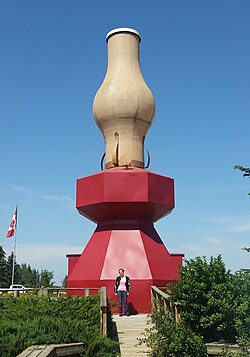
Donalda is a village in central Alberta, Canada that is east of Ponoka. It was founded in 1911 and takes its name from Donalda Crossway, a niece of Sir Donald Mann, a Canadian Northern Railway official.[4] It is home to the "World's Largest Oil Lamp", standing at 12.8 metres (42 ft) high, the structure is one of the Giants of the Prairies. The village was first named Eidswold by the Norwegian settlers who first founded the community.[5] It was renamed Donalda in 1910, when the railroad came through.[6]

Key Information

Demographics

[edit]

In the 2021 census conducted by Statistics Canada, the village of Donalda had a population of 226 living in 109 of its 123 total private dwellings, a change of 3.2% from its 2016 population of 219. With a land area of 0.97 km2 (0.37 sq mi), it had a population density of 233.0/km2 (603.4/sq mi) in 2021.[3]

In the 2016 census conducted by Statistics Canada, the village of Donalda recorded a population of 219 living in 115 of its 131 total private dwellings, a -15.4% change from its 2011 population of 259. With a land area of 0.99 km2 (0.38 sq mi), it had a population density of 221.2/km2 (572.9/sq mi) in 2016.[7]

Education

[edit]

Donalda School has about 80 students from pre-kindergarten to grade 9.[8]

Notable people

[edit]

See also

[edit]

References

[edit]
[edit]
Revisions and contributorsEdit on WikipediaRead on Wikipedia
from Grokipedia
Donalda is a small village in , , situated within the County of Stettler No. 6 and on the edge of the Canadian Badlands, approximately 40 km northeast of Stettler and 72 km southeast of Camrose. With a of 226 according to the 2021 Census of Population, it serves as a close-knit rural community centered on , , and local heritage preservation. The village is renowned for its historical ties to the railway era and unique attractions, including the Donalda and District Museum, which houses Canada's largest public collection of over 1,500 antique oil lamps dating from the 1600s to the 1960s. Established in the early amid Alberta's railway expansion, Donalda was incorporated as a village in 1912 following the arrival of the Canadian Northern Railway, which facilitated settlement and economic growth in the region. Originally proposed to be named Eideswold after a Norwegian locale due to early Scandinavian settlers, the community adopted its current name after Donalda Crossway, the niece of Sir Donald A. Mann, a co-founder of the Canadian Northern Railway. The village's economy historically revolved around farming and cream production, with the Donalda Co-operative Creamery Association formed in 1937 to support local dairy producers, though today it emphasizes sustainable agriculture, small businesses, and eco-tourism leveraging its proximity to the for , , and . Donalda's cultural landmarks further highlight its quirky heritage, such as the world's largest —a 12-meter-tall structure built by locals over four years and unveiled in the late —as well as annual events like the Parade and Car Show and Shine that foster community spirit. Positioned within territory, the village offers year-round amenities including a fully serviced campground and access to nearby golf courses like Double Dam and Pheasantback, making it a gateway for visitors exploring central Alberta's natural and historical landscapes.

History

Founding

The settlement that would become Donalda was originally established in the , with first settlers arriving including before 1906, followed by Norwegian immigrants in the early 1900s who proposed naming it Eideswold, reflecting their as they sought new opportunities in the Canadian prairies. These early pioneers arrived amid a wave of Scandinavian migration to , drawn by the promise of fertile land for . The post office opened on August 8, 1911. In 1912, the community was renamed Donalda in honor of Donalda Crosthwait, the niece of Sir Donald A. Mann, a prominent executive and vice-president of the Canadian Northern Railway. This change coincided with the railway's expansion through the area, as the line reached Donalda in , facilitating the construction of a station and transforming the nascent settlement into a vital service center for surrounding farms. Early settlers in Eideswold focused on , clearing land for basic such as cultivation and rearing, which laid the foundation for the region's agrarian economy despite challenges like isolation and harsh weather.

Development and incorporation

Following the arrival of Northern Railway in , Donalda experienced rapid growth as a classic , with the railway company surveying the townsite and selling lots to attract settlers and businesses. The village was formally incorporated on December 30, 1912, amid Alberta's widespread railway expansion that spurred the development of numerous small communities across the province. This incorporation provided a structured municipal framework to manage the influx of residents and infrastructure needs during the peak of homesteading fervor. Initial construction boomed in tandem with the railway, including the erection of the Canadian Northern Railway station in 1911 and the Gillespie Grain Company elevator shortly thereafter, which facilitated grain storage and transport. By 1912, a large 20-room hotel had been built on to accommodate travelers and workers, while a , , and pool hall were already operating by 1908 to support early settlers. The first was established soon after incorporation to serve the growing of families, though it was later destroyed by in 1937 and rebuilt in an style the following year; additionally, the Merchants Bank of Canada opened in 1913, underscoring the village's emerging commercial core tied directly to rail connectivity. In the and , Donalda's economy transitioned from initial to more established and farming, bolstered by the construction of four grain elevators by 1931 that handled and other crops for export . Businesses like the Viske Brothers thrived during this period of architecture, while a local power plant installed in 1931 by resident Henry Paege provided electricity until 1942, supporting farm operations and households amid the challenges of the . The Donalda Creamery, opening in 1924 as Woodland Dairy, marked a key development in processing for producers, evolving into a farmer-owned co-operative in 1937 to better serve local agriculture. The creamery's operations proved resilient, powering the village's electricity supply until 1942 and continuing butter production—such as the award-winning Donalda Maid Butter from 1941 onward—despite consolidation pressures, including an unsuccessful 1946 absorption attempt by the Central Alberta Dairy Pool that highlighted the era's shifts in rural cooperatives. By the mid-1940s, new facilities like the Clement Brothers hardware store (opened 1939) and the Donalda Locker Plant (built 1948) further supported farming infrastructure, reflecting recovery and mechanization in livestock handling.

Geography and climate

Location and physical features

Donalda is a village located in , , within the traditional territory of , encompassing lands historically traveled by , , Blackfeet, , , and peoples. Geographically positioned at approximately 52°35′N 112°34′W and at an elevation of 780 meters (2,560 feet), it lies east of Ponoka amid the expansive prairies of the province's central region. The village occupies a compact land area of 0.97 square kilometres. Nestled on the northern edge of the Canadian Badlands, Donalda's terrain features rolling hills, mixed grasslands, and unique geological formations including rugged canyons and intricate rock outcrops, providing opportunities for and . These physical characteristics reflect the broader landscape, with its open vistas and subtle elevations contributing to the area's scenic appeal. To the north, Buffalo Lake offers access to beaches and campgrounds for water-based recreation, reachable in about 15 minutes by car from the village. Donalda is accessible primarily via Alberta Highway 53, a key east-west route that links it to nearby communities, including Stettler approximately 40 kilometers to the southwest and Bashaw 29 kilometers to the west. This connectivity facilitates travel across the prairies while highlighting the village's position as a gateway to both urban centers and natural features in .

Climate

Donalda experiences a (Köppen Dfb), typical of the central Alberta prairies, with distinct seasonal variations marked by cold, dry winters and warm, relatively short summers. Winters are severe, with average temperatures featuring highs around -5°C and lows near -15°C, accompanied by frequent snowfall and wind chills that can drop well below -30°C. Summers are mild to warm, with July averages reaching highs of 23°C and lows of 12°C, though daytime temperatures occasionally exceed 30°C during heat waves. Annual precipitation averages approximately 400 mm, predominantly as convective summer thunderstorms between May and , which account for over 60% of the total; winter snowfall contributes about 120 cm on average. The flat terrain exposes the area to strong winds, including occasional chinook events—warm, dry downslope winds from the Rockies—that can cause rapid winter thaws, raising temperatures by 10–20°C in hours and leading to alternate freezing and melting cycles. This pattern significantly impacts local , where frosts (with a 50% risk of temperatures below 0°C into early May) threaten seedling crops like grains and canola, potentially reducing yields by up to 20–50% in affected years. Additionally, the region's semi-arid tendencies contribute to potential, particularly in El Niño-influenced summers, when below-average rainfall can stress and exacerbate water shortages for irrigation-dependent farming. Notable historical weather events include severe blizzards in the early , such as the intense May 1903 snowstorm that dumped over 30 cm across prairies, stranding early settlers, burying homesteads, and delaying agricultural activities during the critical planting season.

Demographics

The population of Donalda has fluctuated over the , reflecting broader patterns in rural settlement and economic shifts. Incorporated as a village in 1912 with approximately 200 residents, the community grew rapidly with the arrival of the Canadian Northern Railway, reaching a peak of 250 in 1914. led to a decline to 150 residents, followed by a rebound to 275 by 1921. By 1931, the population had fallen to 180 amid the , remaining at 180 in 1940. A post- boom pushed numbers to 318, but subsequent drew residents to larger cities, contributing to a decline and stabilization between 230 and 278 from the onward. Census data illustrate this stabilization in recent decades. In 2006, Donalda recorded 224 residents, increasing 15.6% to 259 by 2011 before declining 15.4% to 219 in 2016. The 2021 Census reported 226 residents, a 3.2% increase from 2016, with a population density of 233.6 per square kilometer over 0.97 km² of land area. That year, there were 123 total private dwellings, of which 109 were occupied, reflecting a -5.2% change in occupied dwellings from 2016. These trends align with rural depopulation pressures across Alberta's small municipalities, where has led to stagnation or decline in many villages since the mid-20th century. In Donalda, stability has been supported by consistent agricultural activity and growing , which help counter broader out-migration.

Composition

The residents of Donalda are predominantly Canadian-born individuals of European descent, shaped by the influences of early Norwegian and British settlers who arrived in the late and early to establish communities. According to the 2021 Census of Population, 93% of the population consists of non-immigrants, with no reported groups. Donalda lies within territory, recognizing the traditional homelands of , , , and other Indigenous nations. In the 2021 census, approximately 21% of residents identified as Indigenous. Nearby reserves such as those in the area support additional Indigenous communities. The age distribution reflects a mature, family-centered influenced by the agricultural lifestyle, with an average age of 46.2 years and approximately 15.2% of residents under 15 years old, alongside 28.3% over 65. Socioeconomic indicators are closely linked to farming, with a family income of $89,060 in 2022 and an rate of 12.5% as of 2021, characterized by seasonal fluctuations due to agricultural cycles.

Economy

Agriculture and industry

The economy of Donalda is anchored in , serving as a hub for surrounding and operations in the County of Stettler No. 6. Local farms primarily cultivate and on the fertile lands, benefiting from the region's suitable and for dryland production. farming, particularly ranching through cow-calf operations, complements these activities, with examples like family-run enterprises managing seasonal herds of around 50 cows. Historically, dairy processing played a vital role, exemplified by the Donalda Creamery, which began operations in 1924 as Woodland Dairy under private ownership and transitioned to a in 1937. This facility processed local milk into and until its closure in 1987, supporting farmers by providing an essential market outlet and boosting the rural economy during its peak. The creamery building, relocated in 1954, stands as a preserved example of early 20th-century agricultural infrastructure. In 2023, restoration work began on the creamery building, recognized as an award-winning . As of 2021, employed about 20 residents in resources and production roles, forming the core of local livelihoods, while nearby and gas extraction provided around 10 jobs but remained secondary. The sector faces ongoing challenges, including variability that disrupts seeding, harvesting, and water management through erratic precipitation and frost patterns. Additionally, increased and farm consolidation have reduced labor demands, contributing to fewer on-farm jobs despite overall agricultural output growth.

Businesses and tourism

Donalda's local economy features a variety of small-scale commercial enterprises that cater to both residents and visitors, reflecting the village's rural character. Along Main Street and nearby areas, businesses include general stores such as Country Convenience, which provides everyday essentials and locally sourced goods, and diners like the Coulee Tea House offering home-cooked lunches. Antique and specialty shops, exemplified by the Coulee Trading Company with its collection of unique historical items tied to local heritage, contribute to the commercial landscape, alongside services like repair shops (e.g., Todds Welding) and garden centers such as Echoglen Gardens, operated on a family farm. These establishments, typical of early 20th-century prairie communities, support daily needs and attract passersby along Highway 13. Tourism in Donalda draws on its natural surroundings and cultural sites, promoting eco-tourism through proximity to the Canadian Badlands and Buffalo Lake, located just a 15-minute drive away for beaches and . Key attractions include the World's Largest , a 42-foot that illuminates at night and symbolizes the area's heritage, and the Donalda & District Museum, housing over 1,500 antique lamps and regional artifacts in restored historic buildings like the railway station. Eco-tourism operators such as LaPrairieaire EcoTours offer guided explorations of the Battle River Badlands, including dinosaur fossil sites and native grasslands on a six-generation , with options for , , and accommodations in cabins or bunkhouses. Annual events like the Donalda Ranch Rodeo, Coulee Show & Shine car exhibition, and festivities further enhance visitor appeal, fostering community engagement. The sector supplements Donalda's economy by supporting local businesses through seasonal visitors interested in outdoor and heritage experiences, with nearby courses at Double Dam and Pheasantback providing additional recreational draws. Recent developments highlight growth in , such as farm-based eco-tours and stays at operations like LaPrairieaire, aligning with broader trends toward rural experiential travel following increased interest in outdoor activities post-2020. This integration of commerce and helps sustain the village's vitality amid its agricultural base.

Government and services

Local government

Donalda is governed by a village consisting of a and four councillors, who are elected by residents for four-year terms in accordance with Alberta's Municipal Government Act. The holds regular meetings on the third of each month at 7:00 p.m. in the village office at 5001 . As of November 2025, the is Shaleah Fox, who assumed the role following the of previous mayor Doug Booker in 2024 and continued after the October 20, 2025, municipal where the mayoral position was acclaimed. In the 2025 , three council seats were contested among five candidates, with Phil Menecola, Shaleah Fox (also serving as ), and Tanya Metcalfe securing the positions based on vote totals of 53, 58, and 53 respectively; the remaining council seat was filled by to Dan Knudtson. Following the organizational meeting on November 3, 2025, Phil Menecola serves as deputy mayor. Previous councillors such as Heather Briscoe served in recent terms prior to the . The council's primary responsibilities include managing and , overseeing utilities such as and services, and guiding community initiatives, all within the regulatory framework established by the Province of . These functions ensure local services align with provincial standards while addressing the needs of Donalda's approximately 220 residents. However, the Village of Donalda is currently under a provincial viability review initiated by the Minister of Municipal Affairs in July 2025 to assess its long-term , including financial and service delivery capacity. Public engagement sessions were paused pending the 2025 municipal election, and as of November 2025, the review remains ongoing with no final recommendations issued. This process could result in recommendations for dissolution, amalgamation with the County of Stettler No. 6, or other restructuring measures to ensure viability. The village's annual operating was approximately $700,000 as of 2023, primarily funded through property taxes, user fees, and provincial . A 2025 operating was approved by in April 2025, though specific figures reflect ongoing adjustments amid the viability review. Capital expenditures, such as improvements, are handled separately through multi-year plans approved by . In line with broader reconciliation efforts, Donalda's official policies and meeting agendas include a Treaty 6 land acknowledgment, recognizing the village's location on the traditional territories of the Cree, Blackfoot, and other Indigenous nations, and committing to ongoing dialogue and support for Indigenous communities.

Education

Donalda School serves as the primary educational institution in the village, operating as a public school for through grade 9 under the Clearview School Division. It accommodates approximately 80 students in a facility located at 2101 Haviland Street, equipped to support core academic programs and physical activities, including . As there is no high school in Donalda, students in grades 10-12 attend William E. Hay Composite High School in nearby Stettler. The school's origins trace back to 1911, when it was established to meet the needs of the growing rural community, with the first building constructed in 1913. This original structure burned down in 1937 and was promptly rebuilt in 1938, reflecting the community's commitment to amid agricultural development. The institution marked its centennial in 2013, highlighting a century of adapting to rural educational demands. The curriculum at Donalda School emphasizes foundational skills in , , , , and , with tailored support through individualized education plans for students requiring special accommodations. Extracurricular offerings include sports teams, arts programs, and clubs that foster , , , and community involvement, enhancing the rural learning environment.

Infrastructure and transportation

Donalda's primary transportation access is provided by Alberta Highway 53, which runs east-west through and connects the village to nearby communities such as Stettler, approximately 35 kilometers to the southwest. This highway facilitates regional travel and commerce, with ongoing maintenance including bridge repairs over Meeting Creek east of the village conducted by Transportation in 2024. Local connectivity relies on a network of county-maintained gravel roads that extend to surrounding farms and rural properties, supporting agricultural operations in the area. The village manages essential utilities including municipal water and sewage systems, with water supplied based on metered usage and ongoing infrastructure upgrades such as a new and pumphouse funded by a $2.975 million grant from Transportation, set for completion by late 2025. and services are not directly provided by the village but are available through regional providers like , drawing from nearby natural gas fields in to serve residential and commercial needs. Healthcare in Donalda includes a local Wellness Navigator program to assist residents in accessing services, while more comprehensive care is available at the Stettler Hospital and Care Centre, which offers a 24/7 and is located about 35 kilometers away. Additional options include the Bashaw Regional Wellness Centre with part-time physicians, approximately 29 kilometers to the west. Broadband internet access in Donalda is supported by the , a provincial fiber-optic network that connects rural communities for high-speed services, though full fiber-to-the-premise expansion remains limited as of 2025 with ongoing provincial initiatives to enhance rural connectivity. These efforts align with 's broadband strategy, including the Alberta Broadband Fund, aimed at improving access for and digital inclusion in areas like Donalda during the .

Culture and attractions

Landmarks

Donalda's landmarks reflect its agricultural roots, railway heritage, and community pride in preserving symbols of its past. The village features several notable sites that highlight its early 20th-century development and cultural influences, particularly from Norwegian settlers who founded the community under the original name Eidswold. One of the most iconic landmarks is the World's Largest Oil Lamp, a 12.8-meter-tall and structure erected in 2000 as part of Alberta's initiative. This working lamp, which illuminates at dusk overlooking the Meeting Creek Coulee, symbolizes Donalda's connection to the province's oil industry and rural ingenuity, drawing visitors to the adjacent Donalda and District Museum. The Donalda stands as a key historic building tied to the area's early dairy industry. Established in 1937 by local farmers through the Donalda Co-operative Association, the current wood-framed structure with and vented cupolas, originally a commercial garage near Edberg, was relocated to the site in 1955 to replace an earlier facility, emphasizing ventilation for butter production. Recognized on the Alberta Register of Historic Places, it was later repurposed as a before restoration efforts began in the to preserve its industrial heritage; restoration efforts, which began in the , continue as of 2025 with recent funding and fundraising, and it is part of the Donalda Museum complex but temporarily closed, showcasing artifacts from the cooperative's operations. Donalda's Main Street preserves early 1900s boomtown architecture from the Canadian Northern Railway era, offering a self-guided heritage that traces the village's growth since its 1912 incorporation. Key preserved structures include the 1928 building, later the Imperial Bank of Canada and now the Donalda Gallery for the Arts, featuring neo-classical elements and registered as an Heritage Resource; the circa-1916 Antique Market, originally a store and garage that later became a and farm equipment dealership in 1939; and the 1912 Nutcracker Sweet shop, a with characteristic false-front facade and pressed-tin details operated by early merchants. These buildings exemplify the rapid commercial expansion spurred by the railway's arrival in 1911, maintaining Donalda's small-town character. The Donalda Cemetery serves as a poignant pioneer , with grave markers commemorating early settlers, including those from the Norwegian community that initially named the area Eidswold before its renaming in 1912. Located on the village outskirts, this site holds numerous memorials dating back to the settlement's founding, reflecting the hardships and legacies of mixed-farming pioneers in .

Events and recreation

Donalda hosts several annual community events that foster local engagement and celebration. The festivities on July 1 feature a starting at 4 p.m., family entertainment, a , and pie and coffee gatherings at the drop-in centre, drawing residents and visitors to mark the occasion with parades and communal meals. In August, the Donalda Show & Shine showcases classic vehicles, complementing the summer calendar of community fairs organized by the Donalda and District Agricultural Society, including the Ranch and Open Light . The 2025 Donalda Show & Shine took place on August 9, featuring classic vehicles and community activities. Recreational opportunities in and around Donalda emphasize outdoor pursuits suited to the . Golf enthusiasts can access nearby courses such as Double Dam Golf Course & Campground, an 18-hole layout in the Battle River Valley about 25 minutes east, and in Stettler, known for its challenging design and scenic views. is popular in the surrounding Battle River Valley and , where observers can spot species like bald eagles and rock wrens during seasonal migrations. Local sports programs, often connected to Donalda Composite School, include participation in hockey and leagues that promote youth involvement and community spirit. The village's NHL-sized outdoor skating rink supports winter hockey activities for all ages. Seasonal activities highlight Donalda's natural setting, with winter skating on the community rink providing family-friendly exercise amid winters. In summer, camping at Buffalo Lake Provincial Recreation Area, located nearby, offers opportunities for , , and beach relaxation in a protected lakeside environment.

Notable residents

Tricia Helfer (born April 11, 1974) is a Canadian actress and former model born in rural , . She is best known for her role as the humanoid Cylon Number Six in the re-imagined television series (2004–2009).

References

Add your contribution
Related Hubs
User Avatar
No comments yet.