Hubbry Logo
Doug HenningDoug HenningMain
Open search
Doug Henning
Community hub
Doug Henning
logo
8 pages, 0 posts
0 subscribers
Be the first to start a discussion here.
Doug Henning
Doug Henning
from Wikipedia

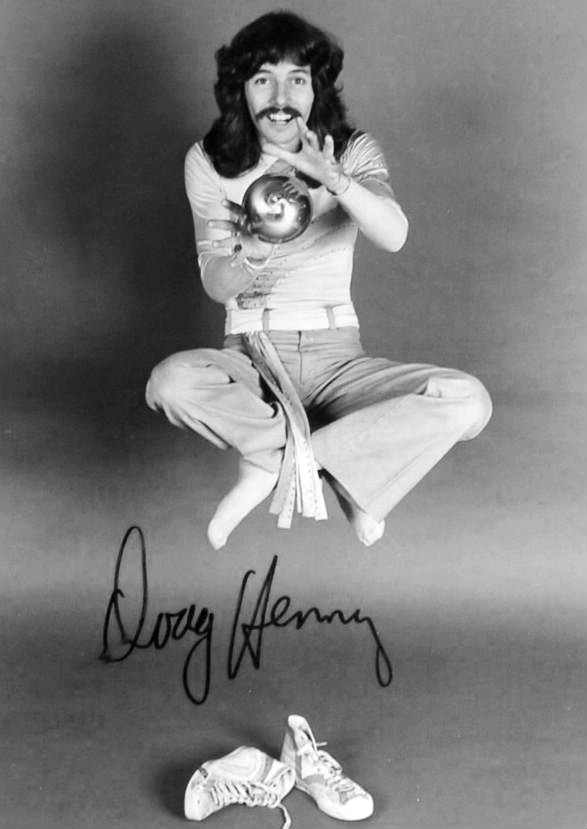
Douglas James Henning (May 3, 1947 – February 7, 2000) was a Canadian magician, illusionist, escape artist and politician.

Key Information

Early life

[edit]

Henning was born in the Fort Garry district of Winnipeg, Manitoba.

Henning became interested in magic after seeing the Peruvian magician Richiardi Jr. perform on The Ed Sullivan Show.[1] He subsequently learned a variety of tricks and performed for his relatives.[1] He began practising magic at Oakenwald School in Fort Garry. Later, his family relocated to Oakville, Ontario. Eventually he named himself "The Astounding Hendoo" and started advertising in local newspapers.[1]

After Henning graduated from Oakville Trafalgar High School, he stopped doing magic, not wanting to do it for a living. He felt that there were only two kinds of magicians, "...magicians for kids, and magicians for nightclub acts. I didn't want to be either kind." So, instead, he enrolled and became a student at McMaster University in Hamilton, Ontario, and studied psychology,[2] in preparation for a medical degree. There, Henning met Ivan Reitman, when he appeared in the 1968 Reitman-directed production of Li'l Abner in the role of Lonesome Polecat.[citation needed]

To support himself during this time, Henning worked at the Toronto International Airport, loading and unloading crates. He found the work to be too heavy and tiring; so, with the help of his partner Mars Barrick, he formed the partnership of Henning and Mars, and they performed at local bars and nightclubs.[3]

On May 19, 1967, Doug's father, an Air Canada pilot, was killed during a training flight when his DC-8-54 crashed near the Ottawa airport (CYOW).[4]

Henning graduated with honours, earning a degree in science and psychology. He subsequently decided to take a couple of years to concentrate on his magic before entering medical school.

Career

[edit]

Henning and Mars successfully performed with the top entertainers in Canada and travelled from one end of the country to the other.

Henning realized that he needed more theatrical training as well as in the principles of magic. He applied for a grant from the Canada Council for the Arts in the theatre division with a proposal that used the equation that magic plus theatre equals art. Henning was awarded a Canada Council for the Arts grant for $4,000.[5] After being awarded the grant to study the art of magic for a year, he studied mime under Adrian Pecknold as well as dance with a Canadian choreographer. He sifted through magic literature in the hopes of developing an all-around magic education in manipulation and illusionism.

He visited the Magic Castle in Hollywood, California, a private club for magicians. After an impromptu performance in the Wine Cellar, he met resident magician, guru, and fellow Canadian Dai Vernon, known as the Professor. Since the terms of the grant required Henning to study magic, he got up the nerve later in the year to write the Professor and asked him if he could take lessons with him. Thereafter, Henning travelled to Hollywood to study with Vernon and then with another magic great, Slydini, whom he came to consider his primary teacher of magic.[6]

Intending to return magic to its "glory days", Henning worked to perfect his craft. Garnering financial support, he developed a live theatrical show, Spellbound, written by David Cronenberg and directed by Henning's college friend Ivan Reitman.[1] Along with music by Howard Shore and co-starring actress Jennifer Dale, Henning created a musical that combined his magic with a dramatic storyline.

Henning borrowed money for the project and spent $5,000 to build and design illusions. They set up a backer's audition in Toronto. One man found potential in the project and invested $70,000. It took so long to work out a plot around his illusions that there was time only for two dress rehearsals, neither of which was in the theatre.

The show opened at the Royal Alexandra Theatre in Toronto, where it broke box-office records.[7]: 278  Henning reworked the show after catching the attention of New York producers and took it to Broadway as The Magic Show, with songs composed by Stephen Schwartz. Debuting in 1974, the show ran for four and a half years and earned Henning a Tony Award nomination.[8]

Following his Broadway success, Henning approached NBC with the idea of producing a television special. It was not until Henning suggested that he would reproduce live Harry Houdini's famous and dangerous water-torture escape—for the first time since Houdini performed it himself—that the NBC executives signed him.

Henning spent the next eight months reworking his stage act for TV and practising the water-torture escape act. More than 50 million viewers tuned in for the December 1975 broadcast of Doug Henning's World of Magic, hosted by Bill Cosby.

In 1977, Henning co-wrote a biography of Houdini, Houdini: His Legend and His Magic.[9] He created illusions for an Earth, Wind and Fire tour in 1979,[10] and for two of singer Michael Jackson's concerts, including his 1984 Victory Tour.[11][12]

In 1983, Henning was the producer and star of the Broadway musical Merlin.[2] In 1984, he began a solo Broadway show, Doug Henning and His World of Magic.[2]

In 1985, Doug & Debby Henning's Wonder Whims, a set of plush toys, were made by Panosh Place and copyrighted by Marvin Glass and Associates.[citation needed] There were a total of six Wonder Whim characters. Each came with an animal friend, a personalized story, and a magic kaleidoscope wand of colors and patterns.[13]

The World of Magic specials

[edit]

Henning's first World of Magic special aired on NBC on December 26, 1975. Henning successfully performed the water torture illusion, although he did not break Houdini's time record. Produced by famed talk show host David Susskind and sponsored by Mobil, the show ran live in the eastern United States without commercials. The event was the first of seven annual broadcasts,[14] which eventually brought Henning seven[15] Emmy Award nominations, including two back-to-back in 1976 and 1977 for World of Magic.

In December 1976, Doug Henning's World of Magic II aired, again live and with only two commercial breaks, on NBC. The theme for this show was "Fire, Water and Air" and it was hosted by actor Michael Landon, with guest star Joey Heatherton. The show included Henning vanishing an elephant. A segment of the show featured special guest magician Ricky Jay.

On December 15, 1977, Doug Henning's World of Magic III aired live with guests Glen Campbell and Sandy Duncan; the hyped illusion was "Walking Through a Brick Wall".

On December 14, 1978, Doug Henning's World of Magic IV aired with the theme "A Magical Journey Through Time"; however, due to numerous problems that occurred during the telecast, this was the last special broadcast live.

On February 15, 1979, there was a broadcast of the fifth World of Magic special, which was taped at the Las Vegas Hilton.

Doug Henning's World of Magic VI, taped at Osmond Studios in Orem, Utah, was broadcast February 22, 1980, on NBC. Bill Cosby made his second appearance as special guest. Marie Osmond also appeared on the program. Several revamped versions of illusions from earlier specials appeared. The finale was an escape and reappearance featuring a huge Rube Goldberg machine.

Henning's last TV special was World of Magic VII in 1982, which featured guest Bruce Jenner and several revamped versions of illusions from earlier specials. The theme was Henning's magical house, with rooms featuring magic from the past, present and future. In the show's finale, Henning created the illusion of turning a black horse and a white horse into a zebra.[16]

At the end of each World of Magic performance, Henning addressed the audience with the same monologue: "Anything the mind can conceive is possible. Nothing is impossible. All you have to do is look within, and you can realize your fondest dreams. I would like to wish each one of you all of life's wonders and a joyful age of enlightenment."[17]

Other television appearances

[edit]

On May 20, 1974, Henning appeared as a guest on the game show To Tell the Truth. He received two of the four votes and then performed The Metamorphosis trick.[18]

On December 13, 1977, Henning appeared as a guest on The Tonight Show Starring Johnny Carson. While Henning performed illusions and chatted with host Johnny Carson and his other guests, he also plugged his new book on Houdini and announced his impending marriage to Barbara De Angelis.

In 1979, Henning appeared on The Crystal Gayle Special, a variety program starring singer Crystal Gayle and featuring, along with Henning, B.B. King and the Statler Brothers. In 1980, Henning appeared on The Muppet Show, where he performed several tricks. He demonstrated chink-a-chink for Scooter, did a flying handkerchief trick for Kermit the Frog's nephew Robin, segmented a Muppet monster into four pieces (and put him together wrong), and performed The Metamorphosis. In December, Henning appeared on The Osmond Family Christmas Special, starring the popular brother/sister act Donny and Marie Osmond, as a guest with such entertainers as Peggy Fleming and Greg Evigan, at the time star of NBC's B. J. and the Bear.

On February 13, 1981, Henning made his seventh appearance on The Tonight Show Starring Johnny Carson. This show marked the first time that Henning was Carson's first guest.

A version of The Magic Show was mounted in Toronto at the Queen Elizabeth Theatre. The purpose of this show was to film in front of a live audience of several thousand people for broadcast on CBC Television. Henning came back to the show that had made him a star, and many changes were made for this new production. Most of the cast was changed, including the role of Cal, now performed by Didi Conn. Some script changes were made (the night club was now known as "Chez Manny" and the older, drunk magician was now named "Van Zyskin"). Some of the songs in the Broadway version were also changed (such as the risqué lyrics of Charmin's lament), or replaced totally, such as the song "Solid Silver Platform Shoes" (the once popular shoe style, by then out of fashion), which was replaced with "It's Gonna Take a Magician". The film version of the production was only aired once on Canadian television, but released on DVD decades later.

Henning was featured in television commercials during 1984 to promote the Plymouth Voyager minivan.[19][20]

Retirement

[edit]

In the mid-1980s, Henning quit his profession, sold his props, and moved to India in order to devote his time to Transcendental Meditation.[7]: 279 [21]

In 1993, he released a video for the Natural Law Party of Canada, made up of excerpts from his World of Magic specials along with newly recorded linking dialogue detailing his philosophy of how the world's problems could be solved by meditation and yogic flying.

Transcendental Meditation

[edit]

Henning had an increasing interest in Transcendental Meditation.[2] He received a Ph.D. in the Science of Creative Intelligence from the Maharishi University in Switzerland.[22]

In 1992, Henning and Transcendental Meditation founder Maharishi Mahesh Yogi drafted plans for a $1.5 billion project, Maharishi Veda Land, near Niagara Falls, Ontario,[2] that would "combine astonishing, unique visual and sensory effects, state-of-the-art 3D imagery, and ultra high-tech entertainment technology with his best original magic illusion secrets".[23] Attractions were to include a building suspended above water and a journey into the heart of a rose, but at the time of Henning's death the project's status was uncertain.[2]

Political career

[edit]

In 1992, Henning was a Natural Law Party candidate in the United Kingdom's general election, contesting the Parliamentary constituency of Blackpool South in Lancashire.[24] As a Canadian citizen, Henning qualified as a candidate under British electoral law, which allows candidates from Commonwealth nations. He finished fourth of four candidates, polling 173 votes. He was senior vice president of the Natural Law Party of Canada ("NLPC"), and ran as the party's candidate for the former Toronto riding of Rosedale in the 1993 federal election, finishing sixth out of ten candidates.[25][26][27]

General Election 1992: Blackpool South[28]
Party Candidate Votes % ±%
Conservative Nick Hawkins 19,880 45.2 −2.8
Labour Gordon Marsden 18,213 41.5 +9.4
Liberal Democrats Robert E. Wynne 5,673 12.9 −7.0
Natural Law Douglas Henning 173 0.4 N/A
Majority 1,667 3.8 −12.2
Turnout 43,939 77.3 +3.9
Conservative hold Swing −6.1
1993 Canadian federal election: Rosedale
Party Candidate Votes % ±%
Liberal Bill Graham 25,726 50.00 +8.78
Progressive Conservative David MacDonald 10,930 21.24 -20.12
Reform Daniel Jovkovic 6,413 12.46
New Democratic Jack Layton 5,547 10.78 -4.28
National Martin Lanigan 1,091 2.12
Natural Law Doug Henning 817 1.59
Green Leslie Hunter 483 0.94 +0.22
Independent Linda Dale Gibbons 350 0.68
Marxist–Leninist Steve Rutchinski 57 0.11
Abolitionist Yann Patrice D'Audibert Garcien 40 0.08
Total valid votes 51,454 100.00

Personal life

[edit]

Henning married Barbara De Angelis in 1977.[29] Their marriage ended in divorce in 1981, and Henning married Debby Douillard in the Ladies' Dome in Fairfield, Iowa, in December of that year.[30][31]

Death and legacy

[edit]

Henning died at the age of 52 on February 7, 2000, at Cedars Sinai Medical Center in Los Angeles, five months after being diagnosed with liver cancer.[2] His ashes were scattered in the Pacific Ocean off Redondo Beach, California.

In 2005, a handwritten letter from Henning to James Randi was placed for auction on eBay, unbeknownst to Randi. When Randi learned of it, he announced on his blog that the letter had been "stolen" from his files.[32] A week later, Randi wrote that he "managed to have the sale stopped" and that the letter was back in his possession, but did not elaborate on further details of the controversy. Randi said that Henning had immersed himself so thoroughly in Transcendental Meditation that he "abandoned regular medical treatment for liver cancer, continued to pursue his diet of nuts and berries, and died of the disease."[33]

On June 8, 2010, it was announced that Henning would receive a star on Canada's Walk of Fame.[34][35] His "Zig Zag Girl" illusion is housed at the American Museum of Magic.[36]

References

[edit]
[edit]
Revisions and contributorsEdit on WikipediaRead on Wikipedia
from Grokipedia
Douglas James Henning (May 3, 1947 – February 7, 2000) was a Canadian magician and illusionist who revitalized stage magic in the and with innovative Broadway productions and television specials that emphasized spectacle and showmanship. His breakthrough came with the 1974 Broadway musical The Magic Show, which ran for over 1,900 performances and earned him a Tony Award nomination for Best Featured Actor in a Musical. Between 1975 and 1982, Henning produced and starred in seven prime-time specials titled Doug Henning's World of Magic, garnering an Emmy Award win and multiple nominations for their technical achievements and variety format. Later in his career, Henning embraced , co-founding a proposed Vedic theme park and entering as a candidate for Canada's , which promoted yogic flying and Maharishi Mahesh Yogi's principles, though his magical endeavors remained his defining legacy. He died of in after forgoing conventional in favor of alternative remedies, consistent with his lifelong advocacy for natural health practices.

Early Life and Education

Childhood in Manitoba

Douglas James Henning was born on May 3, 1947, in the district of , , . His parents were Clarke Reith Henning, an pilot, and Shirley Jean Henning (née Rutherford), who managed the household. The family lived in Winnipeg's suburban area, a developing neighborhood in the province's capital city, amid 's prairie landscape and post-World War II economic growth. Henning's early years unfolded in this stable, middle-class environment, shaped by his father's aviation career, which involved regular travel demands typical of the era's commercial pilots, and the routines of life in a Canadian urban-suburban setting. Manitoba's harsh winters and vast open spaces influenced local childhood activities, fostering resourcefulness and indoor pursuits during long seasons, though specific family hobbies beyond standard play remain undocumented in primary accounts. This backdrop provided the foundational context for Henning's formative experiences before any specialized interests emerged.

Initial Interest in Magic and Early Performances

Doug Henning developed an early fascination with magic during his teenage years in , , where he was born on May 3, 1947. Self-taught through instructional books on illusions and , he experimented with basic tricks, drawing inspiration from historical figures like while focusing on practical techniques rather than supernatural claims. His father supported these efforts by constructing a custom magic table for practice. In , at age 14, Henning gave his first paid performance—a children's show at a birthday party—for which he earned $5, an experience that profoundly motivated him due to the audience's captivated response. He immediately reinvested the fee in additional literature, solidifying his commitment to the craft through solitary study and trial-and-error refinement of effects. These amateur endeavors remained localized in throughout the early-to-mid 1960s, emphasizing simple, accessible illusions performed for small groups. Henning consciously cultivated an exuberant, wide-eyed presentation style from these beginnings, aiming to evoke genuine wonder and joy in spectators rather than the stereotypical image of magicians as enigmatic or trickster-like figures. This approach, rooted in his personal belief in magic's potential to inspire belief and positivity, distinguished his early acts and laid the foundation for later innovations, prioritizing audience engagement over mere technical deception.

University Studies and Early Career Aspirations

Henning enrolled at in , in the late , initially aiming for a medical career and studying as preparation. He graduated in 1970 with a in Honors . During his university years, Henning supplemented his income through part-time magic performances, building on skills developed from his first paid show at age 14 for a friend's birthday party, where the audience's awe inspired his commitment to the craft. Post-graduation, Henning applied to multiple engineering firms, reflecting an interest in applying scientific principles practically, but he was rejected by all. These setbacks led him to prioritize over pursuing or , as he recognized the discipline's demand for precise mechanical ingenuity and empirical problem-solving in crafting illusions—hallmarks he found lacking in conventional scientific pursuits. He committed to two years of full-time magic before reassessing , performing small-scale shows across , including as a mime character sponsored by industry groups. This period underscored Henning's self-reliant persistence, as he honed illusions through without relying on institutional validation, viewing magic as a feat of realism rather than . Early rejections from roles highlighted the causal limits of formal credentials alone, pushing him toward magic's tangible creation of perceptual .

Magical Career

Broadway Breakthrough with The Magic Show

Doug Henning starred as the lead character, a young magician named Doug, in The Magic Show, a one-act rock musical that blended illusions with original songs and a loose narrative framework. The production premiered on Broadway at the Cort Theatre on May 28, 1974, after development from Henning's earlier Canadian show Spellbound. Produced by Edgar Lansbury, Joseph Beruh, and Ivan Reitman, it featured music and lyrics by Stephen Schwartz and book by Bob Randall, with Henning collaborating closely on integrating his illusions into the theatrical structure. The show ran for 1,920 performances, closing on December 31, 1978, marking it as a commercial triumph that drew record audiences for a magic-centric Broadway production and revitalized interest in live illusions during a period when the genre had waned. Critics offered mixed assessments, praising Henning's charismatic illusions and energetic presence while faulting the thin scripting and rock elements as underdeveloped, yet audience acclaim sustained its long run and box-office dominance. Signature illusions highlighted Henning's innovative approach, including a high-speed Metamorphosis trunk escape—adapted from Harry Houdini's classic—where he and an assistant swapped places in seconds amid ropes and locks, executed with precise timing and audience interaction to emphasize wonder over explanation. Other feats involved levitations and vanishings woven into the plot, designed by Henning with input from illusion builders like Brian Lumley, prioritizing seamless spectacle that broke from traditional magic formats. The production's success established Henning as a bridge between magic and mainstream theater, setting attendance benchmarks previously unseen for illusion-based shows on Broadway.

Television Success and World of Magic Specials

Doug Henning's entry into television prominence began with the premiere of Doug Henning's World of Magic on on December 26, 1975, marking the first of seven annual prime-time specials that aired through 1982. The debut special, broadcast live, showcased Henning performing a series of elaborate illusions, including levitations and escapes, adapted specifically for the television medium to emphasize precise staging and camera work. Hosted by and featuring celebrity guests such as and , the program drew an estimated audience of over 50 million viewers, establishing it as the highest-viewed magic special in television history. Subsequent specials maintained the format of high-production-value presentations, blending Henning's signature blend of theatrical magic with guest stars from entertainment, such as in the 1976 edition and in later installments, which helped sustain strong viewership and broaden magic's appeal to mainstream audiences across . These broadcasts highlighted technical feats reliant on mechanical apparatuses and engineering, such as hidden supports and misdirection devices, rather than supernatural claims, with innovations in electronic camerawork enabling close-up revelations of illusion mechanics without compromising the spectacle. The series consistently ranked among top-rated variety programs, contributing to Henning's reputation for revitalizing interest in traditional illusionism through accessible, family-oriented television content. The World of Magic specials garnered seven Emmy Award nominations overall, including wins and recognitions for outstanding achievement in technical direction and electronic camerawork, underscoring the production's advancements in televising complex that required seamless integration of with broadcast technology. For instance, the 1977 special received acclaim for its handling of large-scale effects, prioritizing reliable causal mechanisms like rigged platforms and optical tricks to ensure reproducibility and viewer engagement. This focus on verifiable illusion techniques, distinct from pseudoscientific assertions, aligned with Henning's public stance on magic as a of and ingenuity, further solidifying the specials' legacy in popularizing magic as grounded in empirical methods.

Innovations in Illusions and Collaborations

Henning collaborated extensively with renowned illusion designer Jim Steinmeyer beginning in the mid-1970s, developing proprietary stage effects that integrated with theatrical misdirection for large-scale productions. Their partnership produced innovations such as the Tunnel , a custom apparatus enabling dramatic sequential vanishings and reappearances of performers through a confined structure, relying on hidden compartments and precise timing rather than elements. This effect, debuted in Henning's live tours, exemplified their use of first-principles physics—like leverage and optical occlusion—to simulate impossible spatial manipulations, avoiding reliance on digital aids unavailable at the time. Other key designs included levitation sequences, such as the , where a performer appeared suspended over cascading water via concealed supports and reflective misdirection, and the Floating Kiddie Car, a whimsical vanishing and reorientation of a child-sized achieved through rotating platforms and black art techniques. Henning traded select proprietary illusions with peers, exchanging his water levitation method—employing submerged for apparent weightlessness—for a double-sawing effect, with restrictions on regional performances to protect commercial value. These exchanges underscored Henning's empirical approach, treating illusions as patentable feats grounded in verifiable , not , to sustain professional secrecy and innovation. In late and early tours, Henning scaled these illusions for arena venues, incorporating synchronized pyrotechnic bursts and audience participation to amplify theatrical impact, as seen in effects like the floating for group performances. His Vegas residencies, including multi-night engagements at the Hilton in 1979, adapted such designs for proscenium stages with enhanced lighting rigs, expanding from intimate parlors to spectacle-driven events while preserving causal realism through hidden mechanisms. This era's innovations influenced contemporaries by prioritizing scalable, replicable trickery over unverifiable claims, fostering a legacy of illusions as feats of human ingenuity.

Peak Achievements and Commercial Ventures

Henning reached the zenith of his magical career in the 1970s and 1980s, marked by significant recognition within the magic community. In 1976, he was inducted into the Academy of Magical Arts Hall of Fame, honoring his innovative stage presentations that blended illusion with theatrical elements. He received further acclaim through induction into as a in arts and entertainment, acknowledging his role in elevating magic from niche entertainment to mainstream spectacle. Complementing his live performances, Henning pursued commercial opportunities to democratize . In the , he collaborated with Japanese magic manufacturer Tenyo to release the "Doug Henning Magic You Can Do" kit, which included props and instructions for performing basic illusions, targeting enthusiasts. This venture emphasized practical learning, aligning with Henning's view that proficiency in stemmed from study and practice rather than inherent . Henning also extended his influence through publications, co-authoring "Houdini: His Legend and His Magic" to explore historical illusions and techniques, thereby educating readers on the mechanics behind famed escapes and effects. These products, alongside souvenir programs from his tours, capitalized on his popularity to foster broader public engagement with as an accessible craft.

Retirement from Professional Magic

In 1986, at the age of 39, Doug Henning retired from professional magic, ending his stage performances and selling his proprietary illusions—including notable effects like levitations and box escapes—to competitors such as . This divestment liquidated assets accumulated over a decade of , but marked a complete withdrawal from the field he had revitalized through theatrical spectacle and technical ingenuity. Henning framed the choice as fulfillment of his stage ambitions, redirecting focus toward what he described as "real magic" attainable via advanced practices, a pivot rooted in personal conviction rather than external pressures. The timing amplified the decision's costs, as Henning exited amid sustained demand for his acts, evidenced by recent tours and specials that drew millions in viewership and revenue; continuing would have capitalized on his established draw during prime earning potential, potentially extending influence into the . Instead, the absence eroded his market position, with peers absorbing his techniques and filling the cultural niche for grand , underscoring how performer visibility drives brand longevity in competitive sectors. This shift prioritized subjective personal exploration over the iterative, evidence-based refinement defining his illusions, forgoing diversification opportunities like illusion consulting or production that could have hedged against performance fatigue. Reactions among peers and fans highlighted the trade-off's contentiousness: magic enthusiasts often decried it as a squandering of talent honed through rigorous mechanics and audience , while supporters lauded the to chase unquantifiable fulfillment beyond staged . The move exemplified a causal break from empirical craftsmanship—where illusions succeed via predictable —to pursuits lacking verifiable outcomes, ultimately diminishing Henning's legacy in live magic to archival status.

Involvement with Transcendental Meditation

Introduction to TM and Personal Adoption

Doug Henning encountered the teachings of in the early 1980s during the height of his magical career, leading him to adopt (TM) as a daily practice. TM involves sitting comfortably with eyes closed for about 20 minutes twice daily, silently repeating a specific assigned during initiation to facilitate transcendence of thought and access to a quieter state of consciousness. Henning, facing the pressures of touring and production demands, credited TM with alleviating personal stress and anxiety, as well as amplifying his creative and performance vitality. This adoption represented an initial personal pivot, where Henning integrated TM into his routine without immediately abandoning magic, viewing it as a tool to infuse his illusions with greater authenticity and wonder. He publicly described how TM's purported expansion of complemented his , enabling a deeper connection to the "real magic" underlying natural laws rather than mere trickery. However, Henning's anecdotal reports of anxiety reduction and enhanced awareness through mantra-based repetition lack substantiation from controlled empirical studies isolating TM's effects from nonspecific relaxation or responses. Over time, TM prompted a profound shift in Henning's , devaluing mechanical stage illusions as superficial compared to the inner "enlightenment" he sought via sustained practice. In interviews, he articulated that true enlightenment transcended performative deceptions, positioning TM's promised states of higher awareness as superior realities worth pursuing full-time. This conviction culminated in his mid-1980s retirement from professional , redirecting energies toward personal spiritual development over public entertainment.

Promotion of TM Principles and Projects

Henning actively promoted (TM) principles through collaborative projects with , including the conceptualization of Maharishi Veda Land, a $1.5 billion theme park proposed in 1992 on 1,400 acres near . The initiative sought to integrate Vedic architecture and TM concepts, featuring attractions such as illusion-based rides simulating , floating tunnels, and consciousness-expanding experiences to illustrate ancient Hindu philosophies and meditation's transformative effects. Henning contributed his expertise in stage illusions to design these elements, aiming to make abstract TM ideas experientially accessible to visitors. Similar plans extended to additional sites, including near , with visions for four global "cosmic" theme parks emphasizing Vedic principles for personal and societal harmony. Henning described the project as a means to foster deeper engagement with TM beyond superficial entertainment, drawing on his 15-year practice of the technique. In self-reported accounts, he attributed TM to heightened and well-being, which informed his shift from professional magic to these endeavors; for instance, in 1987, he announced suspending his career to advance Maharishi's programs, viewing through group as the ultimate "magical feat." Henning also advocated for the Maharishi Effect, positing that coordinated group TM practices, including advanced TM-Sidhi techniques like yogic flying, could reduce collective stress and promote coherence in society. He collaborated with the TM organization on promotional efforts, such as media appearances and events highlighting these principles, though outcomes relied on anecdotal endorsements rather than controlled empirical validation. These initiatives aligned with broader "Heaven on Earth" developments, where Vedic design principles were applied to structures intended to enhance environmental harmony and meditation efficacy.

Scientific and Skeptical Criticisms of TM Engagement

Skeptics, including magician and investigator , have criticized (TM) for promoting unsubstantiated paranormal claims, such as the Maharishi Effect—alleged reductions in crime rates through group meditation—and abilities like yogic flying in the TM-Sidhi program, which demonstrated could be replicated through simple hopping techniques without evidence of causation. characterized these as repackaged elements of lacking rigorous empirical validation, arguing that TM's transcendence claims rely on anecdotal reports rather than controlled, replicable experiments independent of TM-affiliated researchers. Scientific reviews of TM studies have highlighted methodological weaknesses, including small sample sizes, lack of blinding, and reliance on self-reported outcomes, with meta-analyses indicating effects on anxiety and comparable to or nonspecific relaxation rather than unique physiological transcendence. For instance, randomized trials comparing TM to controls have shown no superior long-term benefits beyond expectancy effects, and many positive findings originate from institutions funded by the TM organization, raising concerns about bias in peer-reviewed publications. TM's has drawn scrutiny for high course fees—initial training at approximately $960 for adults in 2023, escalating to $5,000 or more for the TM-Sidhi program—and practices like secrecy and hierarchical advancement, which critics liken to cult-like and financial exploitation without proportional evidence of . Henning's endorsement of these elements, including his promotion of TM as "real magic" superior to illusions, has been viewed by skeptics like as a naive pivot from verifiable to unproven causal mechanisms, potentially overlooking the empirical rigor that underpinned his earlier successes. Henning's deepening TM immersion from the mid-1980s onward coincided with his from professional in 1987, after which he prioritized TM-related initiatives like a proposed Vedic theme park over illusion-based performances, marking a shift from a career built on observable, replicable deceptions to advocacy for pseudoscientific aura without comparable data. Associates expressed frustration over this obsession, noting it diverted resources from his empirically validated expertise toward unverified enlightenment pursuits.

Political Activities

Affiliation with the Natural Law Party

Doug Henning aligned himself with the Natural Law Party (NLP), a political entity established in 1992 by adherents of the Transcendental Meditation (TM) movement led by Maharishi Mahesh Yogi, which advocated governance based on "natural law" derived from Vedic principles and scientific validation of consciousness technologies. The party positioned TM practices, including advanced techniques like the TM-Sidhi program, as mechanisms for societal transformation, positing that sufficient group meditation could engender a "field effect" of collective consciousness to diminish crime, enhance economic stability, and foster global peace—claims rooted in Maharishi's theoretical framework linking quantum physics to unified consciousness, though these assertions have faced scrutiny for lacking reproducible empirical evidence beyond proponent studies. Henning's involvement lent celebrity endorsement to the NLP's efforts, particularly in Canada, where he emerged as a key proponent following his 1986 retirement from professional magic to pursue TM full-time. Henning viewed the NLP as a vehicle to operationalize TM's purported benefits at a policy level, extending his personal adoption of meditation—formalized by a PhD in the Science of Creative Intelligence from Maharishi International University—into advocacy for evidence-based integration of consciousness practices into public administration. The party's platform emphasized preventive approaches over conventional interventions, such as deploying group TM sessions to reduce societal stress and violence through coherent brainwave synchronization, drawing from Maharishi's unverified models of the "Maharishi Effect." While Henning and NLP leaders framed this as scientifically grounded innovation, independent analyses have highlighted methodological flaws in supporting research, including small sample sizes and confirmation bias in TM-affiliated institutions, rendering the ideology marginal in mainstream political discourse. This affiliation marked Henning's pivot from entertainment toward political activism, interpreting TM not merely as personal enlightenment but as a causal framework for systemic reform, unencumbered by empirical policy traditions. Critics, including political observers, characterized the NLP's orientation as detached from falsifiable data, prioritizing metaphysical assertions over randomized controlled trials or economic modeling, which limited its traction beyond TM communities. Nonetheless, Henning's commitment underscored a in meditation's scalable impact, aligning the party's fringe status with his post-career quest for transformative influence.

Electoral Campaigns in Canada and the UK

In the , Doug Henning ran as the Natural Law Party candidate in the Rosedale riding of , advocating for techniques, including yogic flying, as solutions to societal issues such as unemployment and crime. He promised to make problems like the national deficit, unemployment, and crime "disappear" through the implementation of group meditation practices, drawing on claims of coherent "field effects" from that purportedly influence . Henning received 839 votes out of approximately 55,000 cast in the riding, accounting for less than 1.6% of the total and placing far behind the victorious Liberal candidate. Henning's campaign incorporated his magician persona for publicity, featuring advertisements that highlighted yogic flying demonstrations as a means to achieve governmental coherence and reduce societal discord, but the platform offered limited engagement with conventional economic or policies beyond meditation-based interventions. This approach, while leveraging his celebrity for visibility, failed to resonate with voters, resulting in negligible electoral success and underscoring the marginal appeal of the Natural Law Party's transcendental proposals. In the , Henning supported efforts in the 1992 and subsequent campaigns, including appearances in party election broadcasts promoting yogic flying and meditation's purported "field effects" analogous to quantum physical coherence for societal harmony. He participated in promotional activities invoking similar TM-derived solutions to and , framing group practice as generating unified national consciousness to mitigate disorder, though without direct candidacy in these races. For the 1997 , his involvement mirrored earlier broadcasts, emphasizing the party's meditation-centric messaging over detailed fiscal or legislative agendas, yet these efforts yielded no significant traction, with the party securing under 0.5% of the national vote in prior contests. Across both countries, Henning's campaigns relied heavily on his background for stunts and media spots, such as illusion-tied endorsements of TM practices, but critiqued for insufficient depth in addressing complexities through evidence-based means, contributing to consistently low voter support.

Policy Positions and Electoral Outcomes

Henning's policy positions as a candidate centered on integrating (TM) practices into public education and governance to address societal stress and conflict. He advocated for mandatory TM programs in schools to reduce student stress, enhance cognitive function, and foster coherent thinking, positing that widespread adoption would yield measurable improvements in academic performance and behavioral outcomes. Similarly, Henning promoted "yogic flying"—a TM-associated technique involving meditative hopping—as a tool for achieving coherence, claiming it could prevent wars, lower crime rates, and promote national invincibility through the "Maharishi Effect," where group practice purportedly influences societal metrics via reduced stress fields. These assertions relied on TM movement studies reporting correlations between practitioner numbers and decreased , but lacked support from independent randomized controlled trials (RCTs) establishing , with critics noting methodological flaws such as and absence of replication in rigorous, peer-reviewed settings outside TM-affiliated research. Historical precedents, including regions with high meditation adoption, showed no consistent empirical patterns aligning with the promised systemic transformations. Electoral results underscored the limited viability of these proposals. In the October 25, 1993, Canadian federal election, Henning contested the Rosedale riding in Toronto, securing 839 votes out of 55,468 total ballots cast, or 1.51 percent of the vote share, placing far behind the Liberal victor Bill Graham's 27,707 votes (49.98 percent). In the May 1, 1997, UK general election, he ran in Blackpool South, receiving 173 votes out of 43,939, equating to 0.4 percent, amid a Conservative hold with minimal impact on the race. The Natural Law Party's overall performance mirrored these margins, averaging under 1 percent nationally in both countries, leading to its effective dissolution in Canada by 2003 and inactivity elsewhere by the mid-2000s, reflecting voter rejection amid skepticism toward unverified causal claims over conventional policy evidence. Henning later reflected on these campaigns as thwarted by entrenched political structures favoring status quo interests, yet the consistent negligible vote tallies—despite his celebrity—highlighted a broader disconnect between performative and empirical policy appeal, with no subsequent electoral traction for the party's core tenets.

Personal Life and Death

Marriages and Family

Henning married , a instructor, on December 20, 1977, in . Their union dissolved in in 1981, as De Angelis cited fundamental incompatibilities amid Henning's burgeoning career in stage magic. De Angelis subsequently gained recognition as a author, authoring books on relationships and . Later that year, on December 6, 1981, Henning wed artist Debby Douillard in a ceremony at in , where the pair had met during a meditation course. Douillard provided support as Henning shifted focus from entertainment to initiatives, remaining his spouse until his death. The couple had no children. Henning generally shielded his family life from public scrutiny, prioritizing professional endeavors over personal disclosures.

Health Decline and Cause of Death

Henning was diagnosed with in September 1999 and battled the disease for five months before succumbing on February 7, 2000, at in , , at the age of 52. The illness progressed rapidly despite medical intervention, with reports indicating his lifelong vegetarian diet and practices rendered his body highly sensitive to , limiting aggressive conventional treatments. Although Henning had deeply embraced for decades, including claims of its broader health benefits, no empirical data from his case demonstrates that meditative or alternative approaches mitigated the cancer's advancement; secondary accounts suggest he explored natural remedies and dietary measures over standard protocols, but these failed to halt the disease's terminal course. A private funeral service was held on February 10, 2000, in , reflecting a low-profile closure focused on medical reality rather than esoteric interpretations of his passing.

Legacy and Reception

Impact on Modern Magic and Entertainment

Doug Henning revitalized magic as a mainstream entertainment form in the 1970s, shifting it from niche acts to theatrical spectacles emphasizing wonder and elaborate staging. His Broadway musical The Magic Show, which premiered on May 28, 1974, ran for 1,920 performances by incorporating illusions into a narrative framework with music by , attracting broad audiences and demonstrating magic's potential as high-production theater. This success marked a revival of live illusion shows, ushering in an era of touring stage illusionists with commercial appeal. Henning's television specials amplified this resurgence, with the December 1975 debut of Doug Henning's World of Magic drawing over 50 million viewers and achieving the highest ratings for any magic program to date, third overall for the week behind major sitcoms. These productions set standards for blending illusions with advanced , lighting, and guest stars, boosting TV viewership for magic and inspiring the format for future specials. In presentation, Henning's joyful, enthusiastic style—prioritizing audience immersion in wonder over mere trickery—influenced successors by elevating to an emotional, spectacle-driven art, paving the way for elaborate productions in arenas and broadcasts. Technically, he pioneered illusions like the Tunnel Illusion, an original stage effect featuring innovative for dramatic visual impact, and collaborated with designers such as Jim Steinmeyer on effects that enabled scalable, venue-filling shows disseminated through industry networks. These advancements facilitated larger-scale entertainment, influencing modern illusionists' approaches to and staging for mass appeal.

Critical Assessments and Cultural Influence

Henning's stage presentations departed from the conventional formal attire of magicians, adopting vibrant, casual clothing that aligned with 1970s aesthetics, thereby broadening magic's appeal to younger and family audiences. This stylistic innovation, evident in his 1974 Broadway production The Magic Show, contributed to its commercial success, with the show achieving 1,921 performances despite critiques of its simplistic script and uneven musical integration, where Henning's illusions were seen as the primary draw amid otherwise amateurish elements. Critics and peers highlighted Henning's preference for large-scale illusions and enthusiastic showmanship over nuanced techniques, resulting in productions that prioritized visual spectacle but occasionally suffered from perceived cheesiness in staging and effects, alienating some traditionalists who viewed his approach as superficial entertainment akin to mainstream pop rather than sophisticated artistry. For instance, (1983) faced harsh reviews for incomplete readiness and narrative weaknesses, leading to a short run of 40 previews and 85 performances, illustrating challenges in sustaining depth beyond technical feats. Henning's cultural impact lay in reintroducing as wholesome, accessible during an era of social disillusionment, influencing formats and performers who emphasized personality-driven illusions, though his work's reliance on broad appeal limited its resonance with magic purists seeking subtlety and intellectual engagement. Positive audience reception contrasted with selective critical acclaim, underscoring a divide between popular revival and artistic critique.

Balanced Evaluation of Career Choices and TM Pursuit

Henning's early career decisions demonstrated a pragmatic application of skill and innovation, yielding substantial empirical success in the entertainment industry. Beginning with his Broadway debut in The Magic Show on May 16, 1974, which ran for 2,128 performances and grossed millions, Henning revitalized live illusionism through accessible, large-scale productions that emphasized wonder over traditional mystique. His subsequent television specials, such as the production Doug Henning's World of Magic aired on May 8, 1975, achieved the highest ratings for its time slot and ranked third overall for the week, amassing audiences of over 25 million viewers and establishing him as a cultural phenomenon who amassed personal wealth estimated in the tens of millions by the early . These outcomes stemmed from verifiable mechanics—rigorous rehearsal, technical ingenuity, and market timing—rather than unproven ideologies, illustrating a trajectory where talent directly correlated with tangible rewards like fame and financial independence. In contrast, Henning's mid-1980s retirement from performing to pursue Transcendental Meditation (TM) marked a departure from this evidence-based path toward speculative spiritualism, with limited observable benefits. By 1985, after selling proprietary illusions to peers like David Copperfield, he immersed himself in TM practices under Maharishi Mahesh Yogi, eventually co-founding the Natural Law Party in 1992 to promote TM-derived policies such as "yogic flying" for societal harmony. However, electoral efforts, including his 1993 Canadian candidacy where he garnered fewer than 1,000 votes before withdrawing, produced no policy influence or measurable public health improvements attributable to TM advocacy. This pivot, while personally fulfilling per Henning's own accounts of seeking "real magic" beyond illusions, diverted resources from sustained artistic output, yielding no empirical advancements in meditation science or politics despite claims of transcendent efficacy; peer-reviewed studies on TM show modest stress-reduction effects at best, but no causal link to the broader societal transformations Henning envisioned. From a long-term perspective, Henning's magic innovations endure in trade citations and influenced successors like , with techniques from his shows still referenced in professional guilds, whereas his TM and political engagements represent opportunity costs without comparable legacy. The shift prioritized subjective experiential claims over continued empirical validation, amplifying fringe assertions—such as through —lacking rigorous evidence, a pattern critiqued by skeptics like for conflating with unverifiable metaphysics. Henning's trajectory underscores the hazards of subordinating proven causal mechanisms in performance to ideological pursuits, where magic's measurable impact persists while TM's promised "higher truths" failed to materialize in tangible outcomes before his death from on February 7, 2000.

References

Add your contribution
Related Hubs
User Avatar
No comments yet.