


Community hub
Recent from talks
Contribute something
Nothing was collected or created yet.
Crystal Gayle
View on Wikipedia
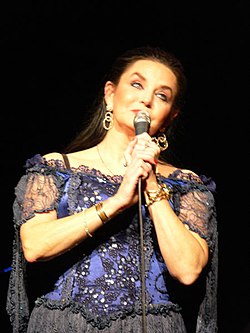
Brenda Gail Webb (born January 9, 1951), known professionally as Crystal Gayle, is an American country music singer widely known for her 1977 hit "Don't It Make My Brown Eyes Blue". Initially, Gayle's management and record label were the same as that of her oldest sister, Loretta Lynn. Not finding success with the arrangement after several years, and with Lynn's encouragement, Gayle decided to try a different approach. She signed a new record contract and began recording with Nashville producer Allen Reynolds. Gayle's new sound was sometimes referred to as middle-of-the-road (MOR) or country pop, and was part of a bigger musical trend by many country artists of the 1970s to appeal to a wider audience. Subsequently, Gayle became one of the most successful crossover artists of the 1970s and 80s.[2][3] She is also known for her floor-length hair.[4]
Key Information


Gayle was said to have begun her career in the 1960s performing as a background singer in Lynn's band (although Gayle says this actually never happened).[5] Lynn helped her sign a recording contract with Decca Records in 1970. Having minor success, she was encouraged to develop her own musical identity. Under the direction of producer Reynolds at United Artists Records, Gayle shifted towards a country pop style that was more successful. In 1975, "Wrong Road Again" became Gayle's first major hit. However, it was in 1977 when Gayle achieved her biggest success with "Don't It Make My Brown Eyes Blue". The single topped the Billboard country chart, crossed over to the top five of the Billboard Hot 100 and became a major international hit.
Gayle continued having success from the late 1970s and through late 1980s. Her biggest hits included "Ready for the Times to Get Better" (1977), "Talking in Your Sleep" (1978), "Half the Way" (1979) and "You and I" (1982). In the 1990s, Gayle shifted artistic directions by recording various genres of music. This included an album of inspirational music titled Someday (1995) and an album of standards called Crystal Gayle Sings the Heart and Soul of Hoagy Carmichael (1999). During the decade she also owned and operated a fine arts shop called Crystal's Fine Gifts and Jewelry. Her most recent studio release was in 2019 and Gayle has since continued to tour throughout the world.
Gayle has won one Grammy Award and has been nominated for several others since the 1970s. She has also won five Academy of Country Music awards; those awards include receiving the Cliffie Stone Pioneer Award in 2016. In addition, she has won two Country Music Association awards and three American Music Awards. Rolling Stone ranked her among the 100 greatest country artists of all time and CMT ranked her within their list of the 40 greatest women of country music. Gayle has her own star on the Hollywood Walk of Fame and was inducted as a member of the Grand Ole Opry in 2017.
Early life
[edit]
Gayle was born Brenda Gail Webb in Paintsville, Kentucky on January 9, 1951.[6] She was the last of eight children born to Clara Marie "Clary" (née Ramey; May 5, 1912 – November 24, 1981) and Melvin Theodore "Ted" Webb (June 6, 1906 – February 22, 1959). Unlike her siblings Melvin, Loretta, Herman, Jay Lee, Donald, Peggy Sue, and Betty, Gayle was the only child born at the Paintsville hospital, and not at home. Through her matriline, Gayle is a distant cousin of singer Patty Loveless.[7] Gayle and her siblings claim Irish and Cherokee descent, although she is not enrolled with any Native tribe.[8] Gayle's father was a coal miner who developed black lung disease. In search of better medical treatment, the family moved to Wabash, Indiana, when Gayle was four years old. They lived in a retired miner's community and Clara Webb worked as a nurse's aide.[9][10] Ted Webb died from a stroke in 1959.[11] From an early age, Gayle had an interest in singing. She noted that she could sing before she could walk.[10] The family's new home in Wabash was more suburban than Butcher Hollow and allowed her to experience both rural and urban life.[12] She sang along frequently to songs she heard on the radio and was inspired by the music of her sister Loretta Lynn.[13]
Gayle's musical interests were shaped further in her teenage years. She started singing in church, performed folk songs, and recorded demonstration tapes.[14][13] With encouragement from Lynn, she began touring during summers in high school.[13] At age 16, Gayle performed on the Grand Ole Opry in replacement of her sister who had gotten ill. She performed a cover of Gordon Lightfoot's "Ribbon of Darkness".[15] After graduating from high school in 1970, she signed her first recording contract with her sister's label: Decca Records. Upon signing with Decca, the label insisted that Gayle change her first name from "Brenda" to another name. The conflict was because Brenda Lee was already signed to Decca at the time. Shortly thereafter, Lynn drove past a sign for the Krystal fast-food restaurant and said to Gayle, "That's your name. Crystals are bright and shiny, like you."[16] It was then that she changed her name professionally to "Crystal Gayle", with "Gayle" taken from her middle name (Gail).[13]
Career
[edit]1969–1976: Decca Records and musical shifts
[edit]Gayle was first managed by Oliver Lynn (Loretta Lynn's husband) after signing with Decca Records. Among her first professional gigs were routine appearances on Jim Ed Brown's television show The Country Palace. On the program, Gayle performed original songs written by Loretta Lynn including "Sparklin' Look of Love" and "Mama, It's Different This Time".[16] Her debut single was released in 1970 titled "I've Cried (The Blue Right Out of My Eyes)". Also written by Lynn, the song peaked within the top 40 of the [[Hot Country Songs|Billboard Hot Country Singles chart.[13] The song was followed by other singles that reached minor positions on the country songs chart: "Everybody Oughta Cry" (1972) and "I Hope You're Havin' Better Luck Than Me" (1972).[16] Gayle's career stalled while at the Decca label.[13][16] This was because the label wanted Gayle to record in the same style as her sister. Steve Huey of AllMusic criticized her early singles, calling them "little Loretta records".[13] Writers Mary A. Bufwack and Robert K. Oermann noted that Gayle was "probably stigmatized" for being the sibling of Loretta Lynn.[11] In a 2019 interview with Forbes, Gayle reflected on the experience, "It didn't take me long to realize I was only there because I was Loretta's sister."[17] During this period, Lynn gave Gayle advice that prompted her to expand her musical styles. Lynn said, "quit singing my songs...We have one Loretta Lynn and we don't need another." The conversation led Gayle to ultimately leave Decca in 1974.[10]

Gayle signed a new recording contract with United Artists Records in 1974. Under the direction of producer Allen Reynolds, her musical style shifted.[13] Reynolds (who had recent success producing Don Williams) encouraged Gayle to record in a softer, mellower format. He also helped market her music towards a crossover audience.[12] Gayle also released her first United Artists single in 1974, "Restless". Mary Bufwack and Robert Oermann called the song "assertive" and "sexy".[7] The song peaked at number 39 on the Billboard country songs chart.[18] The same year, Gayle's self-titled debut album was issued,[13] reaching number 25 on the Billboard Top Country Albums survey.[19] The following year, she had her first top ten hit on the country chart with "Wrong Road Again", also written by Allen Reynolds.[13] She had minor hits with the singles "This Is My Year for Mexico" (1975) and "Beyond You" (1975). The latter song was co-written by Gayle and her husband, Bill Gatzimos. Her second studio album Somebody Loves You spawned a second top 10 hit: the title track.[20]
Gayle's shift towards country pop was received better than her earlier recordings with Decca. Kurt Wolff of Country Music: The Rough Guide praised the new style, calling it a "pleasant, easygoing sort of country-folk blend – a close cousin to music of Emmylou Harris."[12] Encyclopedic writer Collin Larkin called her new music approach to have the "easygoing charm" of records by Don Williams.[20] Oermann and Bufwack called the new style "ear-catching" and praised Allen Reynolds's "gentle rhythm productions."[7]
Reynolds had limited time to write material for Gayle. Instead, he arranged for songwriters Bob McDill and Richard Leigh to help compose music.[20] This arrangement proved successful when in 1976, Gayle had her first number 1 hit on the Billboard Hot Country Singles chart with "I'll Get Over You", written by Leigh. This was followed by a second number 1 hit, "You Never Miss a Real Good Thing (Till He Says Goodbye)", and the number 2 hit, "I'll Do It All Over Again".[21] Her third studio album, Crystal, was released in 1976, peaking at number 7 on the Top Country Albums chart.[22]
1977–1979: Crossover breakthrough
[edit]Producer Allen Reynolds believed Gayle was poised to have crossover pop success if the right song were found.[20] In 1977, Richard Leigh had composed a tune called "Don't It Make My Brown Eyes Blue". The song was originally intended for British singer Shirley Bassey.[23] When Reynolds heard the song he said to Leigh, "You're not sending that song anywhere."[24] As was common practice at the time, according to the documentary[25] the track was recorded alongside a guide or scratch vocal, which Gayle recorded in one single take. Going back later to re-record the final production vocal, after several tries, she said she couldn't get the same feeling back as in the original, so this was kept as the master.
"Don't It Make My Brown Eyes Blue" was released as a single in 1977, peaking at number 1 on the Billboard Hot Country Singles chart and crossing over to number 2 on the Billboard Hot 100. Internationally, it became a hit in several countries including the United Kingdom, where it reached the number 5 position. Since its release, "Don't It Make My Brown Eyes Blue" has been received positively by music critics and fans. They have also considered it her signature song.[23] Stephen Thomas Erlewine of AllMusic praised Gayle's vocals, commenting, "She never stressed it too heavily, nor were her vocals cloying — they were pretty and straightforward, making the song quite alluring."[26]

Gayle's fourth studio record, We Must Believe in Magic, was also released in 1977. The album peaked at number 2 on the Billboard country albums chart and number 12 on the Billboard 200.[27][28] We Must Believe in Magic has received positive reviews since its initial release. AllMusic gave the record 3.5 out of 5 stars.[29] Paul Dennis of My Kind of Country gave the album a "Grade A" rating, calling it "an eclectic mix of songs ranging from pop standards to rock 'n' roll hits to songs by contemporary country songsmiths."[30] We Must Believe in Magic became the first album by a female country artist to certify platinum in sales by the Recording Industry Association of America.[20][31] In 1978, Gayle earned the Grammy Award for Best Female Country Vocal Performance for "Don't It Make My Brown Eyes Blue", while Leigh won a Grammy for Best Country Song.[20]
In 1978, her fifth studio album When I Dream was released, also reaching number 2 on the country albums chart.[32] The album peaked at number 52 on the Billboard 200[33] and certified by platinum by the RIAA.[34] When I Dream also received positive reviews, garnering 3 out of 5 stars from AllMusic[35] and another "Grade A" rating from My Kind of Country.[36] Its lead single was the Roger Cook-penned "Talking in Your Sleep". It became a number 1 country single and crossed over to number 18 on the Hot 100. "Talking in Your Sleep" became Gayle's second international hit as well, peaking at number 11 in the United Kingdom. The album also included the hits "Why Have You Left the One You Left Me For" and the title track.[20] By the end of 1978, Gayle had won "Female Vocalist of the Year" from both the Academy of Country Music and the Country Music Association.[37] Before departing from the United Artists label, her sixth studio album We Should Be Together (1979) was released. It featured the two top-ten hits: "Your Kisses Will" and "Your Old Cold Shoulder".[20]
1979–1989: Continued crossover success
[edit]In 1979, Gayle moved to Columbia Records, bringing Reynolds with her.[38] Under Columbia, Gayle began recording more cover versions of songs. This decision received praise from music critics, who credited her for being "versatile".[7] Her seventh studio album, Miss the Mississippi was released in 1979 as well. It featured three major hits including "Half the Way", which became her third crossover pop hit.[39] Miss the Mississippi peaked at number 3 on the Billboard Top Country Albums chart[40] number 36 on the Billboard 200[41] and certified gold in sales from the RIAA.[42] Gayle's eighth studio release These Days (1980) spawned two more number 1 singles on the Billboard Hot Country Singles chart: "If You Ever Change Your Mind" and "Too Many Lovers".[43] In 1981, Gayle's ninth studio album Hollywood, Tennessee peaked at number 5 on the country albums chart[44] and number 99 on the Billboard 200.[45] Although commercially successful, it received mixed critical reviews. Mary A. Bufwack and Robert K. Oermann said that the album "symbolized her uptown inspirations"[7] and Jason Ankeny of AllMusic gave the album only 2.5 out of 5 stars.[46] Hollywood, Tennessee spawned three major hits on the Billboard country songs chart. This included the crossover hit, "The Woman in Me", and the social awareness tune, "Livin' in These Troubled Times".[11][46]
As Gayle's music crossed multiple genres, she made more appearances outside of the Nashville establishment. Among these was hosting two prime time television specials: The Crystal Gayle Special (1979) and Crystal (1980).[38] Both shows aired on CBS and were given critical acclaim. Gayle would also appear with Bob Hope on his 1979 television special called On the Road to China.[47] For the special, Gayle and Hope taped a performance on the Great Wall of China.[48] The special made Gayle the first artist to film a performance on the Great Wall.[49]

In 1982, Gayle collaborated with Tom Waits on the soundtrack of Francis Ford Coppola's film One from the Heart.[50] Originally, Bette Midler was chosen for the project, however Midler could not fit it into her schedule. At first the soundtrack was delayed by Columbia Records due to a dispute with Coppola's Zoetrope Studios.[51] When it was released, the soundtrack received positive reviews. Thom Jurek of AllMusic gave the release 4.5 out of 5 stars, who called it "one of the most beautifully wrought soundtrack collaborations in history".[52] Steve Pond of Rolling Stone called it "a dreamy series of duets with Crystal Gayle that drift in and out of the film, comment on the action and supply some crucial transitions."[51]
Also in 1982, Gayle moved from Columbia to Elektra Records, which would later merge with Warner Bros. Among the first recordings was a duet with Eddie Rabbitt titled "You and I".[50] The song reached number 1 on the Billboard Hot Country Singles chart and became her second top 10 hit on the Billboard Hot 100.[13] Gayle's first studio album with Elektra would also be issued in 1982, True Love. First produced by Allen Reynolds, when the album was presented to Jimmy Bowen (Elektra's division head), he commented that it "rocked too much". For these reasons, Bowen decided to produce three additional tracks for the album.[53] The album would receive a mixed reception. In Billboard Magazine's initial review, they praised Gayle's vocals despite the use of "tougher arrangements".[54] Tom Roland of AllMusic praised Gayle's performance, notably on the tracks "Our Love Is on the Faultline" and "Deeper Than the Fire". Roland also criticized the production arrangements Bowen arranged for.[53] True Love spawned three singles that all reached the number 1 spot on the Billboard Hot Country Singles]] chart: "Our Love Is on the Faultine", "Baby, What About You" and "'Til I Gain Control Again".[38]
In 1983, Gayle's released her next album called Cage the Songbird. It was the first of Gayle's to be produced entirely by Jimmy Bowen.[55] Cage the Songbird peaked at number 5 on the Top Country Albums chart[56] and number 171 on the Billboard 200.[57] Among its singles were the crossover hits "The Sound of Goodbye" and "Turning Away". Gayle had further hits from her next studio releases in 1985 and 1986. Among these were the number one hits, "Straight to the Heart" (1986) and "Cry" (1986). The latter was a song originally popularized by Johnnie Ray.[58][38] In 1983, she would also record the theme song for the television series Masquerade.[59] In 1984, she sang a duet with Hong Kong singer Danny Chan, titled "Tell Me What Can I Do",[60][61] it was largely unknown due to lack of promotional budget.[62]
Between 1985 and 1987, Gayle collaborated with country artist Gary Morris on a series of duets.[38] The first being the single "Makin' Up for Lost Time". The song reached number 1 on the Billboard Hot Country Singles chart in 1986.[63] "Makin' Up for Lost Time" was referred to as the "Lovers' Theme" on Dallas. It became an anthem for supercouple Bobby (Patrick Duffy) and Pam Ewing (Victoria Principal) on the CBS prime time soap opera.[64] The pair also recorded the theme for the NBC soap opera Another World. Also titled "Another World", it peaked on the Billboard Hot Country Singles chart at number four in February 1986. Gayle would also guest star in the show as herself. The show would ultimately use Morris' and Gayle's recording as the show's opening theme for nine years.[38] The duo would release their collaborative studio album in 1986 titled, What If We Fall in Love?. The album peaked at number 25 on the Billboard country albums list in September 1987.[65] In 1988, Gayle released her final album of the decade entitled Nobody's Angel. The album produced two singles; the title track and the single "Tennessee Nights".[66]
Also in 1987, Gayle opened a gift shop in Nashville called "Crystal's Fine Gifts and Jewelry". The store contained various gifts, such as jewelry and stones made by various European artisans.[67] The shop also included various types of crystals. In a 1994 interview, Gayle commented on her business: "The little shop turned into a much larger shop and it takes a lot of work, as anyone in retail well knows. But we have a lot of fun with it."[68] The shop officially closed in 2008.[69]
1990–present: Later career and recent years
[edit]In 1990, Gayle signed a new recording contract with Capitol Records and reunited with producer Allen Reynolds. The same year she released seventeenth studio album, Ain't Gonna Worry.[38] Bill Carpenter of AllMusic gave the release 4 out of 5 stars, calling it "an excellent set of country pop".[70] The album spawned several singles, beginning with "Just an Old Love". In its initial review Billboard gave it a positive response, praising the production style of Reynolds.[71] Its third single, "Never Ending Song of Love", would become Gayle's last charting single to date, reaching number 72 on the Billboard Hot Country Singles chart.[72] Her eighteenth studio album came in 1992 called Three Good Reasons. The album was produced by Buzz Stone.[38] The album's lead single of the same name spawned a music video. Bill Kohlhaase of the Los Angeles Times gave the song and video a positive review, saying, "The video, alternating between scenes of Gayle and her swirling tresses with sparsely staged visions of a single mother and her two children, is the kind of heartfelt, yet assertive statement that Gayle has parlayed into major success in the past."[4] AllMusic also gave the album 3 out of 5 stars.[73]

As the 1990s progressed, Gayle recorded material for smaller labels and issuing specialty projects. Her first small label was the Branson Entertainment Group, where she released an album of re-recorded hits titled Best Always.[50] In 1995, she signed with Intersound Records and recorded a pair of gospel studio albums. The first was 1995's Someday, which she co-produced with Bobby Wood.[74] The album's first single included a music that was filmed in Greece. In a 1995 interview, she explained the message behind the title track, "There are songs in there that definitely you've lived. The title track is a song that I think a lot of people, the way it's written, definitely relate to."[75] In 1997, her second gospel collection was released titled Joy & Inspiration.[76]
At the dawn of the new millennium, Gayle expanded her musical interests. In 1999, she released an album of jazz and American Standards called Crystal Gayle Sings the Heart and Soul of Hoagy Carmichael.[13] It was as a tribute to Hoagy Carmichael, whom Gayle worked with shortly before his death in the early 1980s. It album featured covers of songs he composed, including "Stardust" and "Georgia on My Mind".[77] AllMusic's Thom Jurek gave the release 4 out of 5 stars in his review of Heart and Soul. Jurek called it, "a gorgeous set, one that reaffirms Gayle's artistry to be sure, but also one that offers the first really new hearing of Carmichael in at least a decade."[78] Billboard Magazine praised the lead single, "Two Sleepy People" (a duet with Willie Nelson), calling it "sweet" and "playful".[79] In 2000, she released a studio album of children's music titled In My Arms.[80] In 2003, she released her second album of American standards called All My Tomorrows.[13] Robert Daniels of Variety commented positively, saying, "Gayle's singing boasts directness and subtlety. There are no flashy or show-busy theatrics."[81] AllMusic gave the release 4 out of 5 stars, calling Gayle's singing "stunning" and "capable."[82] In January 2007, fugitive Christopher Daniel Gay escaped from custody at an Interstate 95 welcome center near Hardeeville, South Carolina, and made his way to Tennessee where he stole Gayle's tour bus. Gay was arrested the following day and the bus was returned to Gayle.[83]
For several years, Gayle spent time recording her next studio release. She stated the album would consist of covers of country music classics and would be produced by her son, Chris Gatzimos. The project was originally titled Am I That Easy To Forget.[84] In 2019, Gayle announced it would be re-titled You Don't Know Me: Classic Country.[85] It was officially released in September 2019 via Southpaw Productions and The Orchard.[86] You Don't Know Me became Gayle's first studio album to chart since 1988, reaching number 40 on the Billboard independent albums list.[87] The album received positive reviews from critics. AllMusic critic Stephen Thomas Erlewine gave the release 3 of 5 stars. Erlewine noted that her upper register is "a little diminished", but she still "sounds amiable".[88] Markos Papadatos of the Digital Journal gave it an "A" rating, commenting, "Overall, Crystal Gayle is sensational on her new album, You Don't Know Me, which is country as grits. Grab a bottle of wine and let this country queen lure you in with her timeless voice."[86]
Personal life
[edit]
Gayle and her siblings claim Cherokee ancestry on their maternal and paternal lines.[8] In October 2001, she was inducted into the Native American Music Awards Hall of Fame in honor of her self-identified Cherokee linkage.[89][90]
Gayle has remained close to her seven siblings since childhood. Before signing a recording contract, she toured alongside her brother, Jay Lee Webb, in his band.[91] Included on her 2019 studio album is a cover of Webb's song "You Never Were Mine". In an interview with Rolling Stone, Gayle wished she had "done it a long time ago" because they spent a lot of time touring together.[2] Additionally, older sister Peggy Sue, has been an active member of Gayle's road show for several years. Peggy Sue performs background vocals on Gayle's show and does her own solo material too.[92]
Gayle also remained close to her oldest sister Loretta Lynn. Music writers and journalists have claimed the pair had "sibling rivalry". In an interview with People, Lynn explained that such a rivalry did not exist: "People try to make it like we compete, but that's all in their minds...We fight a little bit, but that's just sisters. And we never fight over the music business."[9] In a 2017 interview Gayle commented, "Of course, we're sisters. We can bicker... but we really didn't have a problem. You know, I look up to my sister...We both have flaws in different ways, but we're not gonna tell what they are, you know? But, I mean, we love each other."[93]
Gayle has been married to husband Bill Gatzimos since 1971.[94] The couple first dated in high school and while Gayle was signed to United Artists Records, Gatzimos attended law school at Vanderbilt University.[95] Following law school, Gatzimos became Gayle's manager and has since been president of the couple's company, Gayle Enterprises.[8] According to Gayle, their marriage has been successful because the couple pursues their "own interests" and lets each other "breathe".[96] The couple have two children: a daughter, Catherine (born 1983) and a son, Christos (born 1986).[11] Gayle's son is now a record producer and co-produced her 2019 album.[97]
When Gayle's first child was born, she continued working frequently. In 2003 she said, "When I was onstage, I remember coming off stage and breast-feeding and then doing another show." When the couple had their second child, Gayle stayed home with the children.[98] She also has two grandchildren named Elijah and Björn. Gayle spoke of her appreciation for grandchildren in a 2011 interview, "Holidays are so amazing with Elijah. We make cookies, which is great because I never really got much of a chance to do this with my own children. There's a pull when I go on the road when I'm not around him, and I want to be. He's just a bright spot that you want to see all the time. He loves life."[98]
Musical styles
[edit]Gayle's musical style is rooted in country, but is also in pop and folk music.[67] Unlike her siblings (who mostly were raised in rural Kentucky), Gayle's formative years were spent in an urban environment. In this diverse atmosphere, Gayle was exposed to various styles of music. In 2003, she commented, "I've always enjoyed folk, pop, rock, gospel, country, everything..." As a child, she especially liked music by Lesley Gore, Brenda Lee and Patsy Cline. In her teen years, she developed a fondness for folk groups, most predominantly Peter, Paul and Mary.[67]
Yet, Gayle also was attracted to the traditional country sound of her oldest sister Loretta Lynn. However it was Lynn that encouraged Gayle to develop a unique style. In an interview with the Chicago Tribune Gayle remarked: "But she (Lynn) said, `No, you gotta go the middle of the road and have a different sound.' And I'd never have made it if I had been straight-ahead country..."[99] This perspective encouraged her to record different styles. In 2007, she commented that she likes to be called a singer: "I call myself a singer of songs. I love to sing, whether it's country, folk, pop or rock. I grew up singing all different styles, though definitely country is my roots."[48] Gayle also said that her priority was to find quality material, "I've had great producers. Allen Reynolds is one of them, and he is just fantastic. I would always find great songs that other people wrote, and I wanted to put out really really good songs."[100]
Music journalists and critics have also described Gayle as having a smooth vocal delivery, different from that of her sister's. AllMusic's Thom Jurek noted "her signature phrasing and sophisticated material" to be a factor.[82] Stephen L. Betts of Rolling Stone explained that Gayle had "a polished persona and singing style tailor-made for country-pop crossover."[101] Kurt Wolff of Country Music: The Rough Guide commented that she had a "sweet radio-friendly voice" that "made a picture-perfect pop-country star."[12]
Image
[edit]Gayle's image has garnered her significant media attention. Notably, she is known for her floor-length hair.[4] As a child, Gayle's mother kept her hair short. She was inspired to grow her hair to her knees after seeing a woman with similar hair in Nashville.[98] When her hair increased in length by the late 1970s, Gayle's fan club also significantly increased.[94] By the early 1990s, her hair had reached floor's length. During that time, she considered significantly cutting her hair due to headaches and time spent maintaining it.[4] However, she ultimately decided not to cut it. Gayle credits her daughter for discouraging a haircut. Gayle's daughter told her, "You can't cut your hair — you won't be Crystal Gayle."[102] Gayle also stated that it is easier to have long straight hair, "I know some people think: 'Why does she keep it so long?' I'd probably love to try all the different styles, but I'm not a beautician. So, I keep it long. It's easy to wash and let it go."[103] However, according to Gayle, she still continues seeing a hairstylist. Within a year, she cuts 9 to 12 inches of hair.[96]
Gayle's physical appearance has also made her a sex symbol. Writers Robert K. Oermann and Mary A. Bufwack wrote in 2003, "Crystal Gayle will be forever recalled by music fans for the sexy toss of her head that sent waves of motion through her Godiva-like brunette tresses."[11] Author Kurt Wolff described Gayle as having "knockout good looks".[12] In 1983, People named her among the "50 Most Beautiful People in the World".[96]
Legacy
[edit]Gayle has been credited as one of the most successful and important country pop crossover artists.[24][12][11] Gayle's music and career helped open doors for future female country pop artists, including Faith Hill, Shania Twain and Carrie Underwood.[37][3] Writer Kevin John Coyne described her successes and contributions: "... she had accumulated an astonishing eighteen No.1 hits, two more than her older sister had under her belt, and fourth among all women in country music history, behind Dolly Parton, Reba McEntire and Tammy Wynette.[104]
In recent years, Gayle has been given several awards and accolades for her accomplishments. In 2003, she was included by Country Music Television on their list of the "40 Greatest Women of Country Music".[105] In 2008, she was inducted into the Kentucky Music Hall of Fame and Museum.[106] In 2009, she received a star on the Hollywood Walk of Fame. She was joined by artist Tanya Tucker and her family for the ceremony.[107] In 2016, she was presented with the "Cliffie Stone Pioneer Award" from the Academy of Country Music. Gayle commented in 2016, "It's nice to think maybe your music has influenced other artists who are out there."[108]
In November 2016 almost 50 years after making her debut as a guest artist, Gayle was asked to become a member of the Grand Ole Opry by Carrie Underwood. The two performed "Don't It Make My Brown Eyes Blue" before Underwood announced the invitation. Gayle was officially inducted by Loretta Lynn in January 2017.[109] In 2017, Gayle was included in Taste of Country's list of "Country Music's Most Powerful Women".[3] In 2019, she was among a dozen performers chosen to open the Country Music Association Awards as part of recognizing the women of country music. In the show's opening, Gayle performed "Don't It Make My Brown Eyes Blue".[110]
Discography
[edit]Studio albums
- Crystal Gayle (1975)
- Somebody Loves You (1975)
- Crystal (1976)
- We Must Believe in Magic (1977)
- When I Dream (1978)
- We Should Be Together (1979)
- Miss the Mississippi (1979)
- These Days (1980)
- Hollywood, Tennessee (1981)
- True Love (1982)
- Cage the Songbird (1983)
- Nobody Wants to Be Alone (1985)
- What If We Fall in Love (with Gary Morris) (1986)
- Straight to the Heart (1986)
- A Crystal Christmas (1986)
- Nobody's Angel (1988)
- Ain't Gonna Worry (1990)
- Three Good Reasons (1992)
- Best Always (1993)
- Someday (1995)
- Joy & Inspiration (1997)
- Crystal Gayle Sings the Heart and Soul of Hoagy Carmichael (1999)
- In My Arms (2000)
- All My Tomorrows (2003)
- You Don't Know Me: Classic Country (2019)
Filmography
[edit]| Title | Year | Role | Notes | Ref. |
|---|---|---|---|---|
| Dean Martin's Christmas in California | 1977 | Herself | television special | [111] |
| Bob Hope on the Road to China | 1979 | Herself | television special | [48] |
| The Crystal Gayle Special | Herself | television special | [38] | |
| Crystal | 1980 | Herself | television special | [38] |
| Second City Television | 1983 | Esther Blodgett | [112] | |
| Bob Hope's Happy Birthday Homecoming | 1985 | Herself | television special | [111] |
| Another World | 1987 | Herself | [38] | |
| The Country Mouse and the City Mouse: A Christmas Tale | 1993 | Emily | voice only | [113] |
Awards
[edit]See also
[edit]References
[edit]- ^ Gregory, Andy, ed. (2002). The International Who's Who in Popular Music – 2002. Psychology Press. p. 187. ISBN 978-1857431612.
- ^ a b Betts, Stephen L. (26 October 2019). "Crystal Gayle Sings With Loretta Lynn, Interprets Country Staples on 'You Don't Know Me'". Rolling Stone. Retrieved 30 December 2019.
- ^ a b c "Country Music's Most Powerful Women". Taste of Country. 10 September 2017. Retrieved 30 December 2019.
- ^ a b c d "SHORT TAKES: Hair Harasses Crystal Gayle". Los Angeles Times. 19 September 1990. Retrieved 1 January 2020.
- ^ "Country music icon Crystal Gayle blows through Texas once again for renewed tour". CultureMap San Antonio. Retrieved 15 April 2022.
- ^ "UPI Almanac for Thursday, Jan. 9, 2020". United Press International. 9 January 2020. Archived from the original on 15 January 2020. Retrieved 16 January 2020.
... country singer Crystal Gayle in 1951 (age 69)
- ^ a b c d e Oermann & Bufwack 2003, p. 344.
- ^ a b c Whiteley, Jenni (6 October 2017). "Country music star Crystal Gayle coming to Fort Hall Oct. 13". Associated Press. Retrieved 2 January 2020.
- ^ a b Windeler, Robert. "Loretta Lynn & Crystal Gayle: Sister Rivalry". People. Retrieved 30 December 2019.
- ^ a b c Osborn, Dave. "Crystal Gayle brings sweet sound to Bonita Springs on Friday". Naples Daily News. Retrieved 30 December 2019.
- ^ a b c d e f Oermann & Bufwack 2003, p. 345.
- ^ a b c d e f Wolff 2000, p. 439.
- ^ a b c d e f g h i j k l m Huey, Steve. "Crystal Gayle -- Biography & History". AllMusic. Retrieved 30 December 2019.
- ^ Zibart, Evee. "The Platinum Crossover". The Washington Post. Retrieved 30 December 2019.
- ^ "Crystal Gayle to Be Inducted Into Grand Ole Opry". Billboard. Retrieved 1 January 2020.
- ^ a b c d Larkin 2007, p. 1353.
- ^ Windsor, Pam. "Crystal Gayle Sings Classic Country On New "You Don't Know Me" Album". Forbes. Retrieved 1 January 2020.
- ^ "Crystal Gayle -- "Restless" Chart History". Billboard. Retrieved 1 January 2020.
- ^ "Crystal Gayle Chart History". Billboard. Retrieved 1 January 2020.
- ^ a b c d e f g h Larkin 2007, p. 1354.
- ^ DiMartino, Dave (1990). Music in the 20th Century. New York, NY: M.E. Sharpe. pp. 239. ISBN 0-7656-8012-2.
- ^ "Crystal Gayle -- Crystal Chart History". Billboard. Retrieved 1 January 2020.
- ^ a b Betts, Stephen L. (23 June 2017). "Flashback: Crystal Gayle's 'Brown Eyes Blue' Goes Global". Rolling Stone. Retrieved 2 January 2020.
- ^ a b Betts, Stephen L. (22 September 2014). "Crystal Gayle Reflects on 'Slick Country' and Coal Miner's Family". Rolling Stone. Retrieved 2 January 2020.
- ^ Country Girls
- ^ Erlewine, Stephen Thomas. ""Don't It Make My Brown Eyes Blue" -- Crystal Gayle -- Song info". AllMusic. Retrieved 2 January 2020.
- ^ "Crystal Gayle -- We Must Believe in Magic chart history (Country Albums)". Billboard. Retrieved 2 January 2020.
- ^ "Crystal Gayle -- We Must Believe in Magic chart history (Billboard 200)". Billboard. Retrieved 2 January 2020.
- ^ "We Must Believe in Magic -- Crystal Gayle -- Songs, Reviews, Credits". AllMusic. Retrieved 2 January 2020.
- ^ Dennis, Paul (12 January 2017). "Album Review: Crystal Gayle – 'We Must Believe In Magic'". My Kind of Country. Retrieved 2 January 2020.
- ^ "Gold and Platinum: We Must Believe in Magic". Recording Industry Association of America. Retrieved 2 January 2020.
- ^ "Crystal Gayle -- When I Dream chart history (Country Albums)". Billboard. Retrieved 2 January 2020.
- ^ "Crystal Gayle -- When I Dream chart history (Billboard 200)". Billboard. Retrieved 2 January 2020.
- ^ "Gold & Platinum -- When I Dream". Recording Industry Association of America. Retrieved 2 January 2020.
- ^ "When I Dream -- Crystal Gayle -- Songs, Reviews, Credits". AllMusic. Retrieved 2 January 2020.
- ^ "Album Review: Crystal Gayle – 'When I Dream'". My Kind of Country. 13 January 2017. Retrieved 2 January 2020.
- ^ a b Rosenberg, Sari. "February 24, 1977: Crystal Gayle Won Best Female Vocalist at the 12th Annual ACM Awards". Lifetime. Retrieved 2 January 2020.
- ^ a b c d e f g h i j k Larkin 2007, p. 1355.
- ^ Ankeny, Jason. "Miss the Mississippi -- Crystal Gayle -- Songs, Reviews, Credits". AllMusic. Retrieved 2 January 2020.
- ^ "Miss the Mississippi -- Crystal Gayle chart history (Country Albums)". Billboard. Retrieved 2 January 2020.
- ^ "Miss the Mississippi -- Crystal Gayle chart history (Billboard 200)". Billboard. Retrieved 2 January 2020.
- ^ "Gold & Platinum -- Miss the Mississippi". Recording Industry Association of America. Retrieved 2 January 2020.
- ^ Ankeny, Jason. "These Days -- Crystal Gayle -- Songs, Reviews, Credits". AllMusic. Retrieved 2 January 2020.
- ^ "Hollywood, Tennessee -- Crystal Gayle chart history (Country Albums)". Billboard. Retrieved 2 January 2020.
- ^ "Hollywood, Tennessee -- Crystal Gayle chart history (Billboard 200)". Billboard. Retrieved 2 January 2020.
- ^ a b Ankeny, Jason. "Hollywood, Tennessee -- Crystal Gayle -- Songs, Reviews, Credits". AllMusic. Retrieved 2 January 2020.
- ^ "Crystal Gayle (2009)". Davis Art Council. 21 February 2009. Retrieved 3 January 2020.
- ^ a b c Paulu, Tom (February 2007). "Crystal Gayle blowin' into town on Friday". TDN. Retrieved 3 January 2020.
- ^ Ross, Doug (29 February 2016). "Crystal Gayle". NWI. Retrieved 3 January 2020.
- ^ a b c Wolff 2000, p. 440.
- ^ a b Pond, Steve (April 1982). "Tom Waits on 'One From the Heart'". Rolling Stone. Retrieved 2 January 2020.
- ^ Jurek, Thom. "One from the Heart -- Tom Waits, Crystal Gayle -- Songs, Reviews, Credits". AllMusic. Retrieved 2 January 2020.
- ^ a b Roland, Tom. "True Love -- Crystal Gayle -- Songs, Reviews, Credits". AllMusic. Retrieved 2 January 2020.
- ^ "Billboard's Top Album Picks". Billboard. 1982. p. 64.
- ^ "Crystal Gayle -- Cage the Songbird (1983, Vinyl)". Discogs. 6 September 1983. Retrieved 2 January 2020.
- ^ "Cage the Songbird -- Chart History (Country Albums)". Billboard. Retrieved 2 January 2020.
- ^ "Cage the Songbird -- Chart History (Billboard 200)". Billboard. Retrieved 2 January 2020.
- ^ "Crystal Gayle -- "Straight to the Heart" -- chart history". Billboard. Retrieved 2 January 2020.
- ^ "About -- Crystal Gayle". Crystal Gayle.com. Archived from the original on 31 December 2019. Retrieved 3 January 2020.
- ^ ""Tell Me What Can I Do" EP (US/Australia Version) album database". Musicbrainz.org.
- ^ ""Tell Me What Can I Do" 7" Vinyl EP Photos". Dannychan.cn. 28 June 2015.
- ^ ""Tell Me What Can I Do" (Danny Chan, Crystal Gayle)". Youtube. WEA Records. 23 September 2019.
- ^ ""Makin' Up for Lost Time" chart history". Billboard. Retrieved 3 January 2020.
- ^ "Crystal Gayle – February 13th – 16th, 2020". Riverside Resort. Archived from the original on 3 January 2020. Retrieved 3 January 2020.
- ^ "What If We Fall in Love? chart history". Billboard. Retrieved 3 January 2020.
- ^ Ankeny, Jason. "Nobody's Angel -- Crystal Gayle -- Songs, Reviews, Credits". AllMusic. Retrieved 3 January 2020.
- ^ a b c Oermann & Bufwack 2003, p. 343.
- ^ Sweid, Nancy. "Crystal Gayle: Long-Haired Country Girl's Hobby a Fragile One". Nash Country Daily. Archived from the original on 4 January 2020. Retrieved 4 January 2020.
- ^ Nelson, Dick (14 September 2012). "Sunday Morning Classic Country Spotlight to Feature Crystal Gayle". Minnesota's New Country. Retrieved 4 January 2020.
- ^ "Ain't Gonna Worry -- Crystal Gayle -- Songs, Reviews, Credits". AllMusic. Retrieved 3 January 2020.
- ^ "Billboard Magazine: 1990 (November 24, 1990)" (PDF). American Radio History. Retrieved 3 January 2020.
- ^ "Crystal Gayle Chart History: Country Airplay". Billboard. Retrieved 3 January 2020.
- ^ "Three Good Reasons -- Crystal Gayle -- Songs, Reviews, Credits". AllMusic. Retrieved 3 January 2020.
- ^ Stambler, Irwin (2000). Country Music: The Encyclopedia. New York, NY: MacMillan. pp. 175. ISBN 0-312-15121-7.
- ^ Stout, Michael W. "Crystal Gayle Interview -- August 1995". Louisville Music News. Retrieved 3 January 2020.
- ^ Gayle, Crystal (1997). Joy & Inspiration (Cassette insert). Beautiful Music Company, Warner Special Products.
- ^ Gray, Michael. "Heart & Soul". Country Music Television. Archived from the original on 3 January 2020. Retrieved 3 January 2020.
- ^ Jurek, Thom. "Heart and Soul -- Crystal Gayle -- Songs, Reviews, Credits". AllMusic. Retrieved 3 January 2020.
- ^ "American Radio History: Single Reviews and Previews". Billboard. 11 December 1999. Retrieved 3 January 2020.
- ^ Demasters, Karen (10 December 2000). "JERSEY FOOTLIGHTS; A Familiar Country Voice". The New York Times. Retrieved 3 January 2020.
- ^ Daniels, Robert L. (27 October 2003). "Crystal Gayle — All My Tomorrows". Variety. Retrieved 3 January 2020.
- ^ a b Jurek, Thom. "All My Tomorrows -- Crystal Gayle -- Songs, Reviews, Credits". AllMusic. Retrieved 3 January 2020.
- ^ Russell, Steven (August 2007). "The Last Outlaw: The Ballad of Christopher Gay". Maxim: 102–08.
- ^ Christner, Ryan (7 December 2016). "Career not slowing for indomitable Crystal Gayle". The Hutchinson News. Retrieved 13 March 2017.
- ^ Gayle, Crystal (9 August 2019). "My new cd YOU DON'T KNOW ME is available for Pre-Sale at my online store. Ships on or around 9/6/19". Twitter.
- ^ a b Papadatos, Markos (6 September 2019). "Review: Crystal Gayle releases amazing country album 'You Don't Know Me'". Digital Journal. Retrieved 3 January 2020.
- ^ "Crystal Gayle chart history -- Independent Albums". Billboard. Retrieved 3 January 2020.
- ^ Erlewine, Stephen Thomas. "You Don't Know Me -- Crystal Gayle -- Songs, Reviews, Credits". AllMusic. Retrieved 3 January 2020.
- ^ "Gayle Honored at Native American Music Award". Country Music Television. Archived from the original on 4 January 2020. Retrieved 4 January 2020.
- ^ "HALL OF FAME". Native American Music Awards. Retrieved 4 January 2020.
- ^ Christner, Ryan. "Career not slowing for indomitable Crystal Gayle". The Hutchinson News. Retrieved 4 January 2020.
- ^ Lapann, Paul. "Crystal Gayle to perform at Peoples Bank Theatre in Marietta". The Parkersburg News and Sentinel. Retrieved 4 January 2020.
- ^ Liebig, Lorie (2 March 2017). "Crystal Gayle Discusses Her 'Rivalry' with Sister Loretta Lynn". Wide Open Country. Retrieved 4 January 2020.
- ^ a b "Crystal Gayle - Singer". Biography (TV program). Retrieved 4 January 2020.
- ^ Rockwell, John (9 April 1978). "Crystal Gale's Singing Career Is a Lot More Than Luck". The New York Times. Retrieved 4 January 2020.
- ^ a b c Wylie, Lorraine. "Country star Crystal Gayle on love of Northern Ireland, singing with Daniel O'Donnell and secret to long, happy marriage". Belfast Telegraph. Retrieved 4 January 2020.
- ^ "Gayle announces new album, first in 16 years". Country Standard Time. Retrieved 4 January 2020.
- ^ a b c Crosby, Christine (19 July 2011). "A Glimmer of the Grammy-winning Artist, Crystal Gayle and Her Grandson". Grand Magazine. Retrieved 4 January 2020.
- ^ Hurst, Jack (24 October 1997). "CRYSTAL GAYLE SEES HER MUSIC AS A SOURCE". Chicago Tribune. Retrieved 3 January 2020.
- ^ Papadatos, Markos (23 May 2017). "Crystal Gayle talks Adelphi University, Grand Ole Opry, longevity". Digital Journal. Retrieved 3 January 2020.
- ^ Betts, Stephen L. (15 June 2017). "100 Greatest Country Artists of All Time". Rolling Stone. Retrieved 3 January 2020.
- ^ Kruh, Nancy. "Country Pop Queen Crystal Gayle Returns to Her Roots: Traditional Music 'Is in My Soul'". People. Retrieved 4 January 2020.
- ^ Violanti, Anthony. "Crystal Gayle returns to Silver Springs". The Ocala Star Banner. Retrieved 4 January 2020.
- ^ Coyne, Kevin John (9 August 2018). "100 Greatest Women -- Crystal Gayle (27)". Country Universe. Retrieved 4 January 2020.
- ^ "40 Greatest Women Announced". Country Music Television. Archived from the original on 5 March 2016. Retrieved 7 September 2019.
- ^ "Crystal Gayle -- 2008 Inductions" (PDF). Kentucky Music Hall of Fame. Archived from the original (PDF) on 27 June 2019. Retrieved 4 January 2020.
- ^ Appleford, Steve. "Crystal Gayle - Hollywood Star Walk". Los Angeles Times. Retrieved 4 January 2020.
- ^ Van Vleet, Janet. "Country pioneer Crystal Gayle brings her music to West Texas Fair & Rodeo". Abilene Reporter News. Retrieved 4 January 2020.
- ^ Martin, Jeff (21 January 2017). "Country star Crystal Gayle inducted in Grand Ole Opry". WCVB-TV. Retrieved 22 January 2017.
- ^ Leimkuehler, Matthew; Watts, Cindy. "CMA Awards: Show opening with one dozen female country artists is 'epic celebration'". USA Today. Retrieved 4 January 2020.
- ^ a b Terrrance, Vincent (1985). Encyclopedia of Television Series, Pilots and Specials, Volume 2. New York, NY: New York Zoetrope. p. 108. ISBN 0-918432-61-8.
- ^ Robbins, Jeff (2014). Second City Television: A History and Episode Guide. Jefferson, NC: McFarland & Company Inc. p. 210. ISBN 978-0-7864-3191-5.
- ^ Bierbaum, Tom (8 December 1993). "Hbo Storybook Musicals the Country Mouse and the City Mouse: A Christmas Tale". Variety. Retrieved 3 January 2020.
Books
[edit]- Larkin, Colin (2007). The Encyclopedia of Popular Music. London: Omnibus Press. ISBN 978-0-85712--595-8.
- Oermann, Robert K.; Bufwack, Mary A. (2003). Finding Her Voice: Women in Country Music: 1800–2000. Nashville, TN: The Country Music Press & Vanderbilt University Press. ISBN 0-8265-1432-4.
- Wolff, Kurt (2000). Duane, Orla (ed.). Country Music: The Rough Guide. London: Penguin Books. ISBN 1-85828-534-8.
Further reading
[edit]- Flippo, Chet. (1998). "Crystal Gayle." In The Encyclopedia of Country Music. Paul Kingsbury, Ed. New York: Oxford University Press. pp. 156–7.
External links
[edit]

Crystal Gayle
View on GrokipediaEarly life
Family and childhood
Crystal Gayle was born Brenda Gail Webb on January 9, 1951, in Paintsville, Kentucky, as the youngest of eight children to parents Melvin Theodore "Ted" Webb, a coal miner, and Clara Marie "Clary" Ramey Webb.[1][2] Her family background was rooted in Appalachian poverty, with her father working in the coal mines to support the large household, which included her older sister Loretta Lynn, who had already married and moved away by the time of Gayle's birth.[1][9] When Gayle was four years old, her family relocated from Kentucky to Wabash, Indiana, in search of improved economic prospects away from the declining coal industry.[1][2] The move marked a significant shift, exposing the children to a more industrialized environment, though the family continued to face hardships. Tragedy struck in 1959 when her father died of a stroke at age 52, after suffering from black lung disease, leaving Gayle, then eight years old, without his influence during her formative years.[10][11] Following this loss, her mother took on work as a nurse's aide to provide for the family, instilling resilience in her children amid ongoing financial struggles.[1] From an early age, Gayle displayed a natural affinity for music, influenced by the sounds of country, folk, pop, and gospel that filled her home.[2] She began singing publicly in high school talent shows and provided backup vocals for her brothers' local country bands, honing her skills in a musical household that valued performance as a form of expression and potential escape from hardship.[1] Her older sister Loretta's emerging success in country music further inspired Gayle, fostering a deep sibling bond despite the age gap and physical distance, and laying the groundwork for her own entry into the industry.[1][9]Initial musical influences
Crystal Gayle, born Brenda Gail Webb in 1951 in Paintsville, Kentucky, grew up in a large, musical family as the youngest of eight children, which profoundly shaped her early exposure to music. Her family's Appalachian roots and relocation to Wabash, Indiana, when she was four immersed her in a blend of country and gospel traditions, often centered around radio broadcasts like the Grand Ole Opry. She recalled singing before she could walk, encouraged by her mother, and frequently performed for family visitors despite her shyness.[12][13][14] Key influences included pioneering female country artists such as Patsy Cline and Kitty Wells, whose smooth vocals and emotional delivery resonated with young Gayle during her formative years. She also drew from a broader spectrum of sounds, listening to pop and rock and roll acts like Lesley Gore, Brenda Lee, and The Beatles, as well as folk groups including Peter, Paul and Mary. Broadway show tunes and diverse radio fare further expanded her palette, fostering versatility beyond strict country boundaries. These eclectic tastes were reinforced by summers spent singing with her older sister, Loretta Lynn, though Gayle later sought to differentiate her style to avoid direct comparisons.[12][14][15] Gayle's childhood affinity for country ran deep—"it's in my soul," she has said—evident in her early admiration for traditional songs like "Please Help Me, I'm Falling" and "Ribbon of Darkness." Yet, Lynn advised her against pursuing pure country early on, warning that it would invite inevitable sibling rivalries in the industry. This guidance, combined with her wide-ranging influences, set the stage for Gayle's eventual crossover sound, blending country roots with pop sophistication.[15][12]Career
1969–1976: Decca years and transition
Crystal Gayle signed with Decca Records in 1970, shortly after graduating high school, under the management of her brother-in-law Oliver Lynn.[16] Her debut single, "I've Cried (The Blue Right Out of My Eyes)," written by her sister Loretta Lynn, was released that year and peaked at number 23 on the Billboard Hot Country Singles chart, marking her first entry on the country charts.[17] Follow-up singles, including "Everybody Oughta Cry" in 1972 (peaking at number 70) and "I Hope You're Havin' Better Luck Than Me" later that year (reaching number 49), achieved only modest success, as Decca emphasized her similarity to Lynn, limiting her artistic development.[18][19] During her Decca tenure from 1970 to 1973, Gayle released several singles but no full-length albums, with the label's focus on traditional country material hindering her ability to forge a distinct identity.[20] Frustrated by the lack of creative freedom and commercial progress, she parted ways with Decca in 1974 and signed with United Artists Records, where she collaborated with producer Allen Reynolds.[1] This shift allowed her to explore a smoother, more pop-infused country sound, beginning a transition toward crossover appeal.[16] Her United Artists debut single, "Wrong Road Again," released in September 1974, became her first top-ten hit, peaking at number six on the Billboard Hot Country Singles chart and establishing her as a rising solo artist.[18] This success carried into her self-titled debut album in 1975, which included additional charting singles like "This Is My Year for Mexico" (number 21). Later that year, "Somebody Loves You" reached number one on the country charts, solidifying her momentum. By 1976, with the release of her album Crystal, Gayle had fully transitioned into a major country act, blending genres in preparation for broader mainstream recognition.[16][18]1977–1979: Crossover breakthrough
In 1977, Crystal Gayle achieved her breakthrough into mainstream pop success under the production of Allen Reynolds, who sought to position her beyond traditional country audiences by blending sophisticated pop arrangements with her smooth vocal style. Her fourth studio album, We Must Believe in Magic, released that year on United Artists Records, marked a pivotal shift, becoming the first album by a female country artist to achieve platinum certification from the RIAA. The lead single, "Ready for the Times to Get Better," written by Reynolds, topped the Billboard Hot Country Songs chart while reaching No. 52 on the Billboard Hot 100, signaling early crossover potential. This momentum built to her signature song, "Don't It Make My Brown Eyes Blue," written by Richard Leigh, which spent three weeks at No. 1 on the country chart, peaked at No. 2 on the Hot 100, and earned Gayle a Grammy Award for Best Female Country Vocal Performance in 1978. The track's dreamy balladry and orchestral production exemplified her evolving sound, propelling the album to No. 2 on the Billboard Top Country Albums chart and No. 12 on the Billboard 200.[21] Gayle's accomplishments that year included winning the Academy of Country Music (ACM) Award for Top Female Vocalist and the Country Music Association (CMA) Award for Female Vocalist of the Year. Building on this foundation, Gayle's 1978 album When I Dream, also produced by Reynolds, further solidified her crossover status and became her second platinum-certified release. The title track, "When I Dream," written by Sandy Mason, topped the Hot Country Songs chart, while "Talking in Your Sleep," penned by Roger Cook and Bobby Wood, reached No. 1 on country charts and No. 18 on the Hot 100, showcasing her appeal to pop listeners through its soft rock influences. Another single from the album, "Why Have You Left the One You Left Me For," written by Marcy Levy and Martin Briley, also hit No. 1 on the country chart in early 1979. The album peaked at No. 2 on the Top Country Albums chart and No. 52 on the Billboard 200, reflecting sustained commercial impact. Gayle continued her awards dominance, securing the ACM Top Female Vocalist award and the CMA Female Vocalist of the Year for the second consecutive year, underscoring her rapid ascent as a genre-blending star. By 1979, Gayle transitioned to Columbia Records, where her sixth studio album, Miss the Mississippi, produced by Reynolds, maintained her momentum with a more polished country-pop aesthetic. Released in September, it peaked at No. 3 on the Top Country Albums chart. The standout single, "Half the Way," co-written by Ralph Murphy and Bobby Wood, reached No. 2 on the Hot Country Songs chart and No. 15 on the Hot 100, marking her third top-20 pop hit in three years and highlighting her enduring crossover viability. This period capped Gayle's breakthrough era, as she won her third consecutive CMA Female Vocalist of the Year award, affirming her transformation from a country newcomer to a multifaceted entertainer whose work bridged Nashville and broader American audiences.1980–1989: Mainstream success and collaborations
In the early 1980s, Crystal Gayle continued her crossover momentum with the release of her album These Days on Columbia Records in 1980, which produced two number-one singles on the Billboard Hot Country Singles chart: "It's Like We Never Said Goodbye" and "If You Ever Change Your Mind." The album's blend of country and pop elements solidified her mainstream appeal, peaking at number six on the Billboard Top Country Albums chart.[21] After These Days, her 1981 Columbia album Hollywood, Tennessee included the top-ten country hit "The Woman in Me" (No. 3 country), which also crossed over to number 81 on the Billboard Hot 100. In 1981, Liberty Records released the compilation album A Woman's Heart. By 1982, Gayle signed with Warner Bros. Records and released her self-titled album Crystal, which included the duet "You and I" with Eddie Rabbitt, reaching number one on the country chart and number seven on the Adult Contemporary chart. This collaboration highlighted her versatility in pairing with male vocalists for romantic ballads that appealed beyond country audiences. Her subsequent album Cage the Songbird in 1983 yielded additional hits like "Baby, What About You" (number two country) and "The Sound of Goodbye" (number one country), further establishing her as a pop-country staple. Gayle's mainstream trajectory peaked mid-decade with albums like Nobody Wants to Be Alone (1985) and Straight to the Heart (1986), producing number-one country singles such as "Turning Away" (1984), "Straight to the Heart" (1986), and the duet "Makin' Up for Lost Time" with Gary Morris (1985). These works emphasized her smooth, emotive style, often incorporating orchestral arrangements that bridged genres. In 1986, she and Morris released the collaborative album What If We Fall in Love? on Warner Bros., featuring tracks like "Another World" (number four country), marking her most extensive duet project of the era.[22] Additionally, Gayle contributed vocals to Tom Waits' soundtrack One from the Heart in 1982, dueting on songs like "Take Me Home" for Francis Ford Coppola's film, showcasing her adaptability in non-country contexts. Her final album of the decade, Nobody's Angel (1988), included the top-twenty single "Old Habits Die Hard," rounding out a period of consistent chart presence and genre-blending innovation.1990–present: Diverse projects and continued activity
In the early 1990s, Gayle signed with Capitol Records and released her seventeenth studio album, Ain't Gonna Worry (1990), which featured a mix of country and pop influences but marked a decline in commercial chart performance compared to her earlier hits.[23] She followed this with Three Good Reasons (1992) on Liberty Records, an album exploring themes of relationships and personal reflection through contemporary country arrangements.[24] These releases represented her final major-label efforts in mainstream country before she transitioned to independent labels and broader musical explorations. During the mid-1990s, Gayle diversified her repertoire by venturing into inspirational and gospel music, releasing Someday (1995) on Intersound Records, her first full-length gospel project, which included traditional hymns and original faith-based songs co-produced with Bobby Wood.[25] This was followed by the gospel album He Is Beautiful (1997), featuring covers of classic spirituals like "Amazing Grace" and "What a Friend We Have in Jesus."[26] In 1999, she paid tribute to American songwriter Hoagy Carmichael with Crystal Gayle Sings the Heart & Soul of Hoagy Carmichael, interpreting standards such as "Georgia on My Mind" and "Heart and Soul" in a jazz-inflected style.[27] The 2000s saw further variety, including the Christmas album In My Arms (2000) on Madacy Records, blending holiday classics with original material, and the standards collection All My Tomorrows (2003) on Southpaw Records, which showcased her vocal range on Great American Songbook tunes like "The Way You Look Tonight."[27] Gayle's later projects emphasized reinterpretations of classic songs, culminating in You Don't Know Me: Classic Country (2019) on BFD/The Orchard, where she covered country standards including Ray Charles' title track and Dolly Parton's "Put It Off Until Tomorrow," featuring a guest vocal from her sister Loretta Lynn on the latter.[28] In 2023, she released a new duet version of "You and I" with Pat Boone.[29] Throughout this period, she maintained an active touring schedule, performing at venues across the United States and internationally, with dates continuing into 2025 at locations such as the Ellis Theater in Philadelphia, Mississippi.[30] In 2017, she was inducted into the Grand Ole Opry by her sister Loretta Lynn, recognizing her enduring contributions to country music.[31] This ongoing activity has allowed Gayle to connect with new generations of fans while preserving her legacy through live performances and selective recordings.Personal life
Marriage and family
Crystal Gayle has been married to Bill Gatzimos since 1971, when she was 20 years old. The couple met as high school sweethearts, and Gatzimos later became her manager, supporting her early career while pursuing his own law degree.[32] In a 2023 interview, Gayle attributed the longevity of their marriage to mutual "give and take," emphasizing the challenges of balancing her touring schedule with family life.[33] Gayle and Gatzimos have two children: a daughter, Catherine, born in 1983, and a son, Christos (also known as Chris), born in 1986.[34] To provide stability for her daughter during school years, Gayle intentionally reduced her touring commitments, opting against homeschooling to ensure a normal childhood.[33] Her son has followed a path in the music industry as a record producer and engineer, co-producing Gayle's 2019 album You Don't Know Me and managing Audio 51 Music studio in Nashville.[35][36] Gayle is a grandmother to at least two grandsons from her son and his wife, Whitney, including Elijah (born in 2003)[37] and Björn Alexander, born in 2020.[34] She affectionately refers to herself as "Yaya" and her husband as "Papu," describing grandparenthood as a joyful aspect of her life that brings a "bright spot" amid her professional travels.[33]Health and philanthropy
Crystal Gayle has experienced health challenges primarily related to the maintenance of her signature long hair, which reached ankle length during the height of her career in the 1970s and 1980s. The weight and pressure from its extreme length caused her frequent headaches and neck aches, particularly during performances and daily activities.[38] By the early 1990s, these issues led her to consider significantly shortening her hair to alleviate the discomfort, though she maintained much of its length for years afterward.[39] In more recent years, with her hair now shorter, she has noted occasional headaches from styling it up for convenience.[40] Throughout her career, Gayle has been actively involved in philanthropy, focusing on causes supporting children and health research. She served as co-host for the Arthritis Foundation Telethon on multiple occasions, including in 1994 alongside Sarah Purcell and celebrities like Frankie Avalon, and in 1995 and 1996 with figures such as Fred Travalena and Andy Williams, helping to raise awareness and funds for arthritis research.[41][42] In support of the Make-A-Wish Foundation, she recorded the organization's official theme song, "Make a Dream Come True," which was featured in promotional efforts around 1995.[2] Her contributions to these and other charitable efforts earned her the distinction of being the first recipient of the Waterford Crystal "Celebration of Light" award in 1988, recognizing her humanitarian work and generosity with her time and talents.[14]Musical style and image
Evolving genres and influences
Crystal Gayle's musical journey began deeply rooted in traditional country music, shaped by her upbringing in a coal miner's family in Paintsville, Kentucky, where she was exposed to the genre through her siblings' performances and radio broadcasts. As the younger sister of Loretta Lynn, Gayle drew early inspiration from classic country artists such as Marty Robbins, Faron Young, and the harmony-driven sounds of the Wilburn Brothers, which influenced her initial recordings at Decca Records in the late 1960s. Lynn herself provided pivotal guidance, advising Gayle to avoid mimicking her style and instead pursue a middle-of-the-road (MOR) approach to carve out her own identity, stating, "Quit singing my songs and do not record anything that I would. You go MOR because we already have one Loretta and we don’t need another."[43][12][44] Under the guidance of producer Allen Reynolds starting in the mid-1970s, Gayle's sound evolved significantly, incorporating pop and soft rock elements while retaining country's storytelling essence, leading to her breakthrough crossover success. This shift was evident in hits like "Wrong Road Again" (1974) and later "I'll Get Over You" (1976), where Reynolds encouraged her to experiment with vocal phrasings, as she recalled: "Allen would say, ‘Now sing this song, do it different ways, and then listen back…’" Her style became known for its clear, confident delivery blending country with pop, earning her the descriptor of a "savvy blend of country and pop" that propelled her to major stardom in the late 1970s.[16][44][45] In the 1980s and beyond, Gayle continued to diversify, exploring folk, jazz, Broadway standards, and gospel, as seen in albums like We Must Believe in Magic (1977) and later projects such as All My Tomorrows (2003), which featured American standards like "Cry Me a River," and her 2019 album You Don't Know Me: Looking Back to Look Forward, consisting of country classics. This evolution reflected her broad early exposure to various styles, including school choirs, swing groups, and her brothers' country band, allowing her to transcend traditional country boundaries and influence subsequent crossover artists. She emphasized her versatility, noting, "I’m just a singer, a singer of songs... I didn’t think I had to stop singing songs that I loved to sing and that was a little bit of everything."[43][46][45][27]Signature look and persona
Crystal Gayle's signature look is most famously defined by her floor-length, straight brown hair, which she began growing out in the early 1970s as a deliberate choice to differentiate herself from her sister Loretta Lynn and establish a unique visual identity in country music.[1] This hairstyle, often reaching her knees or beyond, became an iconic element during her television appearances and performances in the 1970s and 1980s, captivating audiences and contributing significantly to her crossover appeal beyond traditional country venues.[47] Even into her later career, Gayle has maintained this look, despite occasional personal temptations to cut it shorter, as her children once remarked that doing so would mean "you won't be Crystal Gayle anymore."[47] Complementing her hair, Gayle's fashion style emphasized elegance and sophistication, often featuring flowing gowns, soft fabrics, and a glamorous yet approachable aesthetic that aligned with her country-pop sound.[32] This polished presentation, including subtle makeup and poised stage demeanor, helped her transcend the rougher edges of country imagery, positioning her as a refined figure in the genre.[48] Her persona exudes soft confidence and grace, characterized by a dulcet soprano voice delivered with effortless poise, which critics described as encompassing diverse material with natural ease.[32] Gayle cultivated an image of quiet strength and versatility, blending country roots with pop accessibility, which made her a trailblazer for female artists seeking broader audiences.[48] This persona, reinforced through high-profile TV specials and collaborations, solidified her as a beloved icon of enduring style and musical elegance.[1]Legacy
Cultural influence
Crystal Gayle's crossover success in the late 1970s played a pivotal role in broadening the appeal of country music to mainstream pop audiences, marking her as a trailblazer in the genre's evolution toward what became known as "slick country" or countrypolitan. Her 1977 hit "Don't It Make My Brown Eyes Blue" topped the country charts and reached No. 2 on the Billboard Hot 100, exemplifying her ability to blend smooth pop sensibilities with country roots and achieving the first platinum album by a female country artist. This breakthrough not only secured her two CMA Female Vocalist of the Year awards in 1977 and 1978 but also helped shift public perceptions of country music from niche to accessible, paving the way for subsequent genre fusions in the 1980s and beyond.[49][12][43] Her distinctive visual style further amplified her cultural footprint, with her floor-length hair—often described as reaching behind her knees or even the floor—becoming an enduring symbol of elegance and femininity in country music. This signature look, paired with chic designer outfits, contrasted with the more traditional rhinestone aesthetics of the era, modernizing the genre's image and attracting younger, urban listeners during her 1978 CBS prime-time special. Recognized as one of music's most influential stylists, Gayle's persona emphasized grace and adaptability, influencing how female country artists presented themselves on stage and in media.[32][49][46] Gayle's innovations have left a lasting mark on subsequent generations of performers, inspiring crossover artists who cite her smooth vocal style and genre-blending approach as foundational. Modern singers like Kacey Musgraves have acknowledged her role in breaking ground for countrypolitan sounds that prioritize emotional depth and pop accessibility, while figures such as Shania Twain and Faith Hill credit her trailblazing path in achieving seamless transitions between country and mainstream success. Her emphasis on versatility—drawing from folk, jazz, and Broadway influences—continues to resonate, encouraging artists to transcend traditional boundaries and expand country's global reach.[43][46]Awards and honors
Crystal Gayle has received numerous accolades throughout her career, including one Grammy Award, multiple wins from the Country Music Association (CMA) and Academy of Country Music (ACM), and several American Music Awards (AMAs), recognizing her contributions to country music.[50][31][51] In the Grammy Awards, Gayle won Best Female Country Vocal Performance for her hit single "Don't It Make My Brown Eyes Blue" at the 20th Annual Grammy Awards in 1978. She has also earned 11 Grammy nominations, including additional nods in the Best Female Country Vocal Performance category for works such as "Why Have You Left the One You Left Me For" (1980), "I'll Get Over You" (1981), and others in 1984, 1985, and 1987, as well as a nomination for Best Southern, Country or Bluegrass Gospel Album for Someday in 1996.[52][50] The Country Music Association honored Gayle with Female Vocalist of the Year awards in 1977 and 1978, highlighting her dominance in the genre during that period.[31][53] At the Academy of Country Music Awards, she secured Top Female Vocalist wins in 1977, 1978, and 1980, and later received the Cliffie Stone Pioneer Award in 2016 for her lifetime achievements in country music.[54][55][56][57] Gayle also won multiple American Music Awards, including Favorite Country Female Artist in 1978, 1979, 1980, 1981, 1984, and 1986, as voted by the public.[7][58] Beyond competitive awards, Gayle has been inducted into several halls of fame and received notable recognitions. She was inducted into the Kentucky Music Hall of Fame in 2008, acknowledging her roots in the state where she was born Brenda Gail Webb. In 2009, she received the 2,390th star on the Hollywood Walk of Fame, located near her sister Loretta Lynn's star. That same year, October 2 was declared "Crystal Gayle Day" in Hollywood, California. In 2017, she became a member of the Grand Ole Opry, following an invitation from her sister Loretta Lynn, marking 50 years since her debut performance there.[59][2][60]| Award Organization | Category | Year(s) | Notes |
|---|---|---|---|
| Grammy Awards | Best Female Country Vocal Performance | 1978 | Win for "Don't It Make My Brown Eyes Blue" |
| CMA Awards | Female Vocalist of the Year | 1977, 1978 | - |
| ACM Awards | Top Female Vocalist | 1977, 1978, 1980 | - |
| ACM Awards | Cliffie Stone Pioneer Award | 2016 | Lifetime achievement |
| American Music Awards | Favorite Country Female Artist | 1978, 1979, 1980, 1981, 1984, 1986 | Public-voted |
Works
Discography
Crystal Gayle's discography encompasses 25 studio albums released between 1975 and 2019, alongside numerous compilation albums, singles, and collaborative works, reflecting her evolution from traditional country to pop, gospel, and standards interpretations.[27][61] Her early releases on United Artists established her as a crossover artist, with breakthrough albums featuring hits like "Wrong Road Again" and "I'll Get Over You." Later works on labels such as Columbia, Elektra, and independent imprints explored diverse genres, including children's music and holiday themes. She has also issued over 60 singles, many achieving Top 10 status on the Billboard Hot Country Songs chart.[62]Studio Albums
| Title | Release Year | Label |
|---|---|---|
| Crystal Gayle | 1975 | United Artists |
| Somebody Loves You | 1975 | United Artists |
| Crystal | 1976 | United Artists |
| We Must Believe in Magic | 1977 | United Artists |
| I've Cried the Blues Right Out of My Eyes | 1978 | MCA |
| When I Dream | 1978 | United Artists |
| We Should Be Together | 1979 | United Artists |
| Miss the Mississippi | 1979 | Columbia |
| These Days | 1980 | Columbia |
| Hollywood, Tennessee | 1981 | Columbia |
| True Love | 1982 | Elektra |
| Cage the Songbird | 1983 | Elektra |
| Nobody Wants to Be Alone | 1985 | Elektra |
| Straight to the Heart | 1986 | Elektra |
| Ain't Gonna Worry | 1990 | Capitol |
| Three Good Reasons | 1992 | Liberty |
| Best Always | 1993 | Branson |
| Someday | 1995 | Intersound |
| Crystal Gayle Sings the Heart and Soul of Hoagy Carmichael | 1999 | Intersound |
| In My Arms | 2000 | Madacy |
| All My Tomorrows | 2003 | Southpaw |
| Talking in Your Sleep | 2006 | Crystal Gayle |
| You Don't Know Me: Classic Country | 2019 | Varese Sarabande |
Compilation Albums and Other Releases
Gayle has released at least 17 compilation albums, highlighting her hits and rarities. Key examples include Classic Crystal (1979, United Artists), a collection of early tracks; Greatest Hits (1983, Columbia), which peaked at No. 2 on the Billboard Country Albums chart; and The Best of Crystal Gayle (1987, Warner Bros.), featuring selections from her Elektra era. Later compilations like 20 Love Songs (2002) and EMI Country Masters (2012) aggregate her romantic ballads and country-pop material.[61] She has one live album, An Evening with Crystal Gayle (2000), capturing performances of her classics. Collaborative efforts include One from the Heart (1982, Columbia) with Tom Waits, a soundtrack for the Francis Ford Coppola film, and What If We Fall in Love (1987, Warner Bros.) with Gary Morris, which produced the duet single "Another World." Additionally, A Crystal Christmas (1986, Warner Bros.) showcases her holiday recordings.[62][61]Singles
Gayle's singles discography includes 68 releases, with 34 reaching the Top 10 on the Billboard Hot Country Songs chart. Seminal hits encompass "Wrong Road Again" (1975, peaking at No. 6), "I'll Get Over You" (1976, No. 1), "Don't It Make My Brown Eyes Blue" (1977, No. 1 country, Grammy for Best Female Country Vocal Performance), "Ready for the Times to Get Better" (1978, No. 1), and "Talking in Your Sleep" (1978, No. 1). Later successes like "Baby, What About You" (1982, No. 1) and "Turning Away" (1982, No. 1) underscore her 1980s pop-country phase. Post-2000 singles are fewer, often from independent releases, such as tracks from You Don't Know Me (2019).[62]Filmography
Crystal Gayle has had a limited but notable presence in film and television, primarily through musical performances, specials, and soundtrack contributions rather than extensive acting roles. Her work in these media often highlighted her vocal talents and crossover appeal, blending country music with broader entertainment formats. She starred in several television specials during the late 1970s and 1980s, and provided voice work for animation as well as songs for major films.[1]Television Appearances and Specials
Gayle's television career included starring roles in her own specials and guest spots on variety shows and series. Key credits include:| Year | Title | Role/Contribution | Notes |
|---|---|---|---|
| 1979 | The Crystal Gayle Special | Self/Host | CBS prime-time special featuring guests Judy Collins, Doug Henning, and B.B. King; directed by Russ Petranto.[63] |
| 1987 | Another World | Crystal Gayle | Guest appearance for one week on the NBC soap opera.[64] |
| 1987 | A Crystal Christmas in Sweden | Self/Host | CBS holiday special filmed in Sweden, showcasing seasonal performances.[65] |
| 1988 | Loretta & Crystal: Going Home | Self | Disney Channel special with sister Loretta Lynn, focusing on their family roots and duets.[66] |
| 1989 | From the Heart... The First International Very Special Arts Festival | Self | NBC special promoting arts for disabled individuals, with performances alongside other artists.[66] |
| 1993 | The Country Mouse & the City Mouse: A Christmas Tale | Emily (voice) | HBO animated holiday special; voiced the lead country mouse character opposite John Lithgow.[67] |
| 1995–1997 | The Statler Brothers Show | Vocalist/Self | Regular appearances on the TNN variety series, performing songs and collaborating with hosts.[68] |
| 1995 | Crystal Gayle: Someday | Self | Music video short tied to her album promotion.[68] |
| 1995 | Eddie Rabbitt & Crystal Gayle: I Made a Promise | Self | Music video duet performance.[68] |
| 2023 | An All-Star Salute to Lee Greenwood | Self | Tribute special honoring the country singer, with Gayle performing alongside peers.[69] |
Film Roles and Soundtrack Contributions
Gayle's film involvement centered on musical elements, including vocals for soundtracks and a behind-the-scenes contribution to a major motion picture. She did not have prominent on-screen acting roles in feature films but lent her voice to notable projects. In 1982, she recorded vocal solos and duets with Tom Waits for the soundtrack of Francis Ford Coppola's romantic musical One from the Heart, contributing to its dreamy, jazz-inflected score.[70] Her songs have appeared in various films, providing emotional depth to scenes across genres. Representative soundtrack credits include:| Year | Title | Song/Contribution | Notes |
|---|---|---|---|
| 1978 | Convoy | "Don't It Make My Brown Eyes Blue" | Featured in the Sam Peckinpah-directed trucker action film.[71] |
| 1981 | To Kill a Cop | "You and I" | Included in the TV movie's soundtrack.[72] |
| 1990 | Texasville | "'Till I Gain Control Again" | Featured in the sequel to The Last Picture Show, directed by Peter Bogdanovich.[73] |
| 2006 | Slither | "I Don't Wanna Lose Your Love" | Featured in the sci-fi horror comedy.[74] |
| 2015 | The Hateful Eight | "Ready for the Times to Get Better" | Featured in Quentin Tarantino's Western (70mm Roadshow version), underscoring a key scene. |