


Community hub
Recent from talks
Contribute something
Nothing was collected or created yet.
Dub FX
View on Wikipedia
Key Information


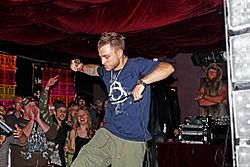
Benjamin Stanford (born 11 June 1983), better known by his stage name Dub FX (stylised as Dub Fx or DubFx), is an Australian musician and worldwide street performer.
Born in St Kilda, Melbourne, Australia,[1] at the start of his career he was singing in a local alternative rock and rapcore band initially known as Twitch, which would later change its name to N.O.N (Never or Now). In 2004 they released a debut and the only album Exeunt Omnes.[2][3] Soon after he moved to Italy and began a solo career. His trademark is creating rich live music using only his own performance aided by live looping and effects pedals combined with his voice.[4][5] He creates intricate hip hop, reggae, and drum and bass rhythms.[4]
During the COVID-19 pandemic Dub FX moved from Victoria, Australia to Lisbon, Portugal with his wife Sahida, and two daughters Sahara and Kalila.[6]
Associated acts
[edit]Stanford used to travel and perform with his former [citation needed] fiancée [citation needed] Shoshana Sadia aka Flower Fairy.[1][7] Dub FX first met her in Manchester, after which she joined him on his travels around the globe to busk for the public. Flower Fairy would usually be seen selling CDs during Dub FX's performances or on stage alongside Stanford when they perform several tracks together. She is also featured singing on tracks from Everythinks a Ripple, "Wandering Love", "Flow", and "Time Will Tell". To his travels also joined his friend and manager CAde, who is on tracks with Stanford like: "No rest for the wicked", "Supernova Pilot", "Easy", "Fresh" and others...
Two songs from Everythinks a Ripple, "Flow", and "Wandering Love", feature a street saxophonist named Mr. Woodnote, who also uses similar looping techniques as Dub FX, using a saxophone.
After his first summer traveling through Europe in 2006, he came home to Melbourne where he shared a flat with Melbourne-based producer Sirius. Stanford showed Sirius this new style from the UK called dubstep. and by 2010 together they released the album titled Dub FX and Sirius – A Crossworlds. Dub FX does not beatbox on this album.[8] [citation needed]
Dub FX is also part of the dubstep act Kila Mega Giga Tera, the other half being Glade Kettle (Distro)(aka Sirius). To date they have released one song on Aquatic Lab Sessions Volume 1, a CD and limited edition vinyl compilation released in 2009. Kila Mega Giga Tera also released an album, which was released in 2010. This album is called A Crossworlds. [citation needed]
Music
[edit]Dub FX is completely independent, using only live performance, word of mouth, internet social networking, and a number of easily accessible free samples. Dub FX is also the main founder of the label Convoyunltd, which could be described as a co-op label for Dub FX's own work and that of other artists.[4] To date, artists that have released albums on Convoyunltd are: Flower Fairy, Sirius, Mr. Woodnote, and Dub FX, with additional featured artists on separate songs of each album. Every album released through Convoyunltd has been produced by Dub FX with the exception of Dub FX & Sirius's release, A Crossworlds, a collaboration album released in 2010 which revealed a much darker and instrumental sound.[citation needed]
Dub FX's lyrics address both general world events and contemporary angst, while suggesting individual-based revolution through self-determination and engagement. He also addresses issues of social importance, the most notable example being the song Society's Gates, loosely based on the life of the philosopher Socrates.
Discography
[edit]Albums
[edit]| Title | Details |
|---|---|
| Live in the Street |
|
| Everythinks a Ripple |
|
| A Crossworlds (with Sirius) |
|
| Everythinks a Rmx |
|
| Theory of Harmony |
|
| Thinking Clear |
|
| Roots |
|
| Branches |
|
| Infinite Reflection |
|
Awards and nominations
[edit]Music Victoria Awards
[edit]The Music Victoria Awards are an annual awards night celebrating Victorian music. They commenced in 2006.
| Year | Nominee / work | Award | Result | Ref. |
|---|---|---|---|---|
| Music Victoria Awards of 2020 | Dub FX | Best Reggae or Dance Hall Act | Won | [9][10] |
References
[edit]- ^ a b Moses, Allan (2010) "Dubbing into Dub FX", The Hindu, 26 November 2010, retrieved 9 April 2012
- ^ "N.O.N". 16 October 2006.
- ^ "N.O.N on Bandcamp". Archived from the original on 30 January 2019.
- ^ a b c Wickrematunge, Raisa "Dub FX in Sri Lanka Archived 27 June 2018 at the Wayback Machine", Sunday Leader, retrieved 9 April 2012
- ^ "London City Guide | Dub_FX review May 08". Archived from the original on 21 July 2011. Retrieved 2 September 2009.
- ^ Popielarcheck, Stephen O'Regan, Rita Ansone, Kate (18 June 2023). "DUB FX o músico de rua que fez sucesso a partir de Lisboa". Mensagem de Lisboa (in European Portuguese). Archived from the original on 5 July 2023. Retrieved 6 June 2024.
{{cite web}}: CS1 maint: multiple names: authors list (link) - ^ Banerjee, Debesh (25 November 2010). "Medley Score". The Indian Express. Archived from the original on 26 June 2024. Retrieved 26 June 2024.
- ^ "The Philosopher Street Musician | Kortars". kortars.com. Retrieved 23 August 2016.
- ^ "Previous Nominess". Music Victoria. Archived from the original on 19 September 2020. Retrieved 13 August 2020.
- ^ "Previous Winners". Music Victoria. Archived from the original on 31 July 2019. Retrieved 13 August 2020.
External links
[edit]| International | |
|---|---|
| Artists | |

Dub FX
View on GrokipediaEarly Life
Childhood and Musical Beginnings
Benjamin Stanford, known professionally as Dub FX, was born in Australia and spent part of his early childhood in Italy, where he was exposed to popular dance music and what he described as "cheesy piano music."[7] His family had strong artistic inclinations, including relatives who were musicians, dancers, and actors; an uncle specifically encouraged his father to provide him with a computer for music production, which influenced his initial foray into the field.[7] In the early 1990s, Stanford relocated to Melbourne, Australia, to attend high school, marking a shift in his musical environment.[7] During high school in Melbourne, Stanford developed a keen interest in punk rock, citing bands such as the Offspring, Green Day, and Nirvana as early favorites that shaped his rebellious and energetic approach to music.[7] He joined a rap metal band reminiscent of Rage Against the Machine and participated in school music industry classes that covered production and promotion techniques.[7] Stanford began experimenting with beatboxing casually at parties and school events, while also exploring broader influences introduced by his father, including reggae acts like Sublime and Bob Marley, as well as Cuban jazz from the Buena Vista Social Club.[7] By ages 16 to 17, he started producing tracks using software like Fruity Loops and Cubase, building foundational skills in home recording alongside bandmates.[7] In his youth, Stanford became involved with the alternative rock and rapcore band N.O.N., which released its sole album in 2004 before he departed to pursue solo endeavors.[8] These experiences, combined with his high school production efforts and vocal experimentation with effects pedals in various genres—including metal, jazz, hip-hop, and soul—laid the groundwork for his distinctive one-man performance style.[7][9]Influences and Formative Experiences
Dub FX's musical development was profoundly shaped by his eclectic engagements across genres during his adolescence in Melbourne, Australia. At age 16, he formed part of a punk rock band that evolved into nu-metal, drawing direct inspiration from acts such as Limp Bizkit, Linkin Park, Rage Against the Machine, and Korn, which emphasized aggressive vocal delivery and heavy instrumentation.[10] By age 17, he expanded into beatboxing with school peers and collaborated with jazz musicians, incorporating elements of funk, hip-hop, and Caribbean rhythms; he also joined hip-hop and reggae bands while MCing over breakbeat and house tracks at raves, exposing him to electronic production techniques.[11][10] His father's diverse record collection further fueled this breadth, introducing soulful and improvisational styles that contrasted with rigid band structures. Reggae pioneers like Bob Marley and Alpha Blondy stood out as pivotal influences, alongside Cuban jazz and rave-derived electronica, fostering a preference for music with emotional depth over mere aggression.[11][10] Early experimentation with effects and delay pedals in these group settings honed his vocal manipulation skills, foreshadowing live looping.[10] A turning point came in 2006, at age 23, during travels in Manchester, where exposure to jungle music refined his genre-blending approach, prioritizing soulful grooves.[11] The frustrations of compromising in bands ultimately directed him toward solo expression, crystallizing his innovative fusion of dub, hip-hop, and electronica.[11][12]Career Development
Street Performing Origins
Benjamin Stanford, known professionally as Dub FX, initiated his street performing career in Melbourne, Australia, where he began busking as a means to hone his musical skills independently after playing in various local bands in pubs and clubs.[13][14] These early performances in his hometown of St Kilda allowed him to experiment with live layering techniques using effects pedals and a Boss Loop Station, transitioning from collaborative band settings to solo acts that emphasized self-reliance and improvisation.[13] In 2006, Stanford adopted the moniker Dub FX and departed Melbourne for Europe, intending to fund extended travels through busking while refining his one-man production style with loop pedals to create intricate dub, hip-hop, and electronic tracks on the spot.[4][15][16] This nomadic approach, often performed from a van or urban streets across countries including the United Kingdom, marked the crystallization of his signature method: beatboxing rhythms, layering vocals and melodies live without pre-recorded elements, and engaging passersby directly to build crowds.[4][14] By 2007, these semi-improvised European street sessions had begun attracting notice, setting the stage for broader recognition, though Stanford prioritized the raw, unfiltered interaction of busking over structured venues to maintain artistic control and direct fan connection via CD sales.[14][16] His persistence in adverse conditions, such as variable weather and foot traffic, underscored a commitment to organic growth, distinguishing his origins from conventional music industry paths.[15]Rise to International Fame
Dub FX's transition from street performer to international recognition began in earnest through viral YouTube videos capturing his live looping performances in Europe. After relocating from Melbourne to busk across the continent in 2006, he collaborated with filmmaker BD in Bristol, UK, who recorded the track "Love Someone" during a street session on October 10, 2008, and uploaded it to YouTube shortly thereafter.[5][4] This video, one of the earliest major music virals on the platform, amassed over 30 million views and showcased his innovative use of loop pedals, beatboxing, and effects to build full tracks solo.[4][10] Similar footage of songs like "Flow" followed, amplifying his exposure as social media platforms rose, drawing attention from global audiences without traditional label support.[2] The viral momentum translated into expanded opportunities by the early 2010s, with Dub FX leveraging online fame for independent tours and festival bookings. In 2012, he embarked on his first extensive North American tour, including headline slots at major events such as the Shambhala Music Festival in Canada, marking his initial foray into larger venues beyond street corners.[17] This period solidified his reputation as a self-sufficient artist, with performances at European festivals like EXIT in Serbia by 2014 further cementing his draw, where full sets highlighted his live production skills to thousands.[18] His approach—bypassing industry gatekeepers in favor of direct fan engagement via video shares—enabled rapid scaling from busking earnings to sold-out shows, amassing a dedicated following attuned to his dub-influenced, consciousness-themed sound.[9] By mid-decade, Dub FX had headlined alongside established acts at prominent gatherings, including Coachella and Glastonbury, reflecting sustained growth from digital virality to mainstream festival circuits.[2] This rise underscored a model of artist autonomy, where empirical audience response via views and attendance—rather than media endorsements—drove his trajectory, though he later critiqued platform algorithms for uneven artist compensation.[9]Recording Career and Album Releases
Dub FX's recording career originated from his street performing background, where he initially self-released Live in the Street in 2009 as a compilation of live recordings captured during performances in cities such as Italy, Manchester, Brighton, and London.[19] The album featured tracks like "Free My Soul" and "Rude Boy," emphasizing his one-man looping technique adapted to recorded format, and was initially sold directly by the artist before wider digital availability.[20] His debut studio album, Everythinks a Ripple, followed in 2009, marking a shift toward produced tracks blending dub, hip-hop, and electronic elements, with songs including "The Rain Is Gone" and "Society Gates."[21] Self-released initially through Convoy Unltd., it showcased Stanford's production skills using vocal layering and effects pedals, reflecting his independent approach without major label backing.[22] Subsequent releases built on this foundation, with Dub FX maintaining control over production and distribution via platforms like Bandcamp. Theory of Harmony arrived on July 19, 2013, exploring harmonic vocal experiments and remixes.[23] Thinking Clear, released August 29, 2016, incorporated introspective themes amid reggae and electronic fusions.[23] Roots followed on January 31, 2020, featuring tracks such as "Fire Every Day" and "Transmission," delving into raw, organic sounds.[24] Infinite Reflection emerged in 2023, continuing his evolution with self-reflective lyrics and layered beats.[25] The collaborative Open Secret Society with Mr. Woodnote was issued August 20, 2025, expanding into drum and bass influences.[26] Across six primary records, Dub FX has sold over 250,000 albums, primarily through direct-to-fan sales and independent channels, underscoring his self-sustained model rooted in live-derived techniques applied to studio work.[2]| Album | Release Date | Key Notes |
|---|---|---|
| Live in the Street | 2009 | Live compilation from street shows; 10 tracks.[19] |
| Everythinks a Ripple | 2009 | Debut studio; 14 tracks blending dub and hip-hop.[21] |
| Theory of Harmony | July 19, 2013 | Focus on vocal harmonics; includes remixes.[23] |
| Thinking Clear | August 29, 2016 | Introspective reggae-electronic hybrid.[23] |
| Roots | January 31, 2020 | Raw, organic production; 9 tracks.[24] |
| Infinite Reflection | 2023 | Self-reflective themes; latest solo full-length.[25] |
| Open Secret Society (with Mr. Woodnote) | August 20, 2025 | Drum and bass collaboration.[26] |