Hubbry Logo
Merit orderMerit orderMain
Open search
Merit order
Community hub
Merit order
logo
8 pages, 0 posts
0 subscribers
Be the first to start a discussion here.
Contribute something
Merit order
Merit order
from Wikipedia

The merit order is a way of ranking available sources of energy, especially electrical generation, based on ascending order of price (which may reflect the order of their short-run marginal costs of production) and sometimes pollution, together with amount of energy that will be generated. In a centralized management scheme, the ranking is such that those with the lowest marginal costs are the first sources to be brought online to meet demand, and the plants with the highest marginal costs are the last to be brought on line. Dispatching power generation in this way, known as economic dispatch, minimizes the cost of production of electricity. Sometimes generating units must be started out of merit order, due to transmission congestion, system reliability or other reasons.

In environmental dispatch, additional considerations concerning reduction of pollution further complicate the power dispatch problem. The basic constraints of the economic dispatch problem remain in place but the model is optimized to minimize pollutant emission in addition to minimizing fuel costs and total power loss.[1]

Plot from the SMARD data portal showing electricity generation in Germany in mid-December 2017. The ordering of the 'layers' is based on merit.

The effect of renewable energy on merit order

[edit]

The high demand for electricity during peak demand pushes up the bidding price for electricity, and the often relatively inexpensive baseload power supply mix is supplemented by 'peaking power plants', which produce electrical power at higher cost, and therefore are priced higher for their electrical output.

Increasing the supply of renewable energy tends to lower the average price per unit of electricity because wind energy and solar energy have very low marginal costs: they do not have to pay for fuel, and the sole contributors to their marginal cost is operations and maintenance. With cost often reduced by feed-in-tariff[clarification needed] revenue, their electricity is as a result, less costly on the spot market than that from coal or natural gas, and transmission companies typically` buy from them first.[2][3] Solar and wind electricity therefore substantially reduce the amount of highly priced peak electricity that transmission companies need to buy, during the times when solar/wind power is available, reducing the overall cost. A study by the Fraunhofer Institute ISI found that this "merit order effect" had allowed solar power to reduce the price of electricity on the German energy exchange by 10% on average, and by as much as 40% in the early afternoon. In 2007[needs update]; as more solar electricity was fed into the grid, peak prices may come down even further.[3] By 2006, the "merit order effect" indicated that the savings in electricity costs to German consumers, on average, more than offset the support payments paid by customers for renewable electricity generation.[3]

A 2013 study estimated the merit order effect of both wind and photovoltaic electricity generation in Germany between the years 2008 and 2012. For each additional GWh of renewables fed into the grid, the price of electricity in the day-ahead market was reduced by 0.11–0.13 ¢/kWh. The total merit order effect of wind and photovoltaics ranged from 0.5 ¢/kWh in 2010 to more than 1.1 ¢/kWh in 2012.[4]

The near-zero marginal cost of wind and solar energy does not, however, translate into zero marginal cost of peak load electricity in a competitive open electricity market system as wind and solar supply alone often cannot be dispatched to meet peak demand without incurring marginal transmission costs and potentially the costs of ``batteries. The purpose of the merit order dispatching paradigm was to enable the lowest net cost electricity to be dispatched first thus minimising overall electricity system costs to consumers. Intermittent wind and solar is sometimes able to supply this economic function. If peak wind (or solar) supply and peak demand both coincide in time and quantity, the price reduction is larger. On the other hand, solar energy tends to be most abundant at noon, whereas peak demand is late afternoon in warm climates, leading to the so-called duck curve.[citation needed]

A 2008 study by the Fraunhofer Institute ISI in Karlsruhe, Germany found that windpower saves German consumers €5 billion a year. It is estimated to have lowered prices in European countries with high wind generation by between 3 and 23 €/MWh.[5][6] On the other hand, renewable energy in Germany increased the price for electricity, consumers there now pay 52.8 €/MWh more only for renewable energy (see German Renewable Energy Sources Act), average price for electricity in Germany now is increased to 26 ¢/kWh. Increasing electrical grid costs for new transmission, market trading and storage associated with wind and solar are not included in the marginal cost of power sources, instead grid costs are combined with source costs at the consumer end.[citation needed]

Economic dispatch

[edit]

Economic dispatch is the short-term determination of the optimal output of a number of electricity generation facilities, to meet the system load, at the lowest possible cost, subject to transmission and operational constraints. The Economic Dispatch Problem can be solved by specialized computer software which should satisfy the operational and system constraints of the available resources and corresponding transmission capabilities. In the US Energy Policy Act of 2005, the term is defined as "the operation of generation facilities to produce energy at the lowest cost to reliably serve consumers, recognising any operational limits of generation and transmission facilities".[7]

The main idea is that, in order to satisfy the load at a minimum total cost, the set of generators with the lowest marginal costs must be used first, with the marginal cost of the final generator needed to meet load setting the system marginal cost. This is the cost of delivering one additional MWh of energy onto the system. Due to transmission constraints, this cost can vary at different locations within the power grid - these different cost levels are identified as "locational marginal prices" (LMPs). The historic methodology for economic dispatch was developed to manage fossil fuel burning power plants, relying on calculations involving the input/output characteristics of power stations.[citation needed]

Basic mathematical formulation

[edit]

The following is based on an analytical methodology following Biggar and Hesamzadeh (2014)[8] and Kirschen (2010).[9] The economic dispatch problem can be thought of as maximising the economic welfare W of a power network whilst meeting system constraints.

For a network with n buses (nodes), suppose that Sk is the rate of generation, and Dk is the rate of consumption at bus k. Suppose, further, that Ck(Sk) is the cost function of producing power (i.e., the rate at which the generator incurs costs when producing at rate Sk), and Vk(Dk) is the rate at which the load receives value or benefits (expressed in currency units) when consuming at rate Dk. The total welfare is then

The economic dispatch task is to find the combination of rates of production and consumption (Sk, Dk) which maximise this expression W subject to a number of constraints:

The first constraint, which is necessary to interpret the constraints that follow, is that the net injection at each bus is equal to the total production at that bus less the total consumption:

The power balance constraint requires that the sum of the net injections at all buses must be equal to the power losses in the branches of the network:
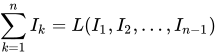
The power losses L depend on the flows in the branches and thus on the net injections as shown in the above equation. However it cannot depend on the injections on all the buses as this would give an over-determined system. Thus one bus is chosen as the Slack bus and is omitted from the variables of the function L. The choice of Slack bus is entirely arbitrary, here bus n is chosen.

The second constraint involves capacity constraints on the flow on network lines. For a system with m lines this constraint is modeled as:

where Fl is the flow on branch l, and Flmax is the maximum value that this flow is allowed to take. Note that the net injection at the slack bus is not included in this equation for the same reasons as above.

These equations can now be combined to build the Lagrangian of the optimization problem:

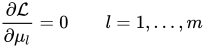
where π and μ are the Lagrangian multipliers of the constraints. The conditions for optimality are then:
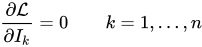
where the last condition is needed to handle the inequality constraint on line capacity.

Solving these equations is computationally difficult as they are nonlinear and implicitly involve the solution of the power flow equations. The analysis can be simplified using a linearised model called a DC power flow.

There is a special case which is found in much of the literature. This is the case in which demand is assumed to be perfectly inelastic (i.e., unresponsive to price). This is equivalent to assuming that for some very large value of and inelastic demand . Under this assumption, the total economic welfare is maximised by choosing . The economic dispatch task reduces to:

Subject to the constraint that and the other constraints set out above.

Environmental dispatch

[edit]

In environmental dispatch, additional considerations concerning reduction of pollution further complicate the power dispatch problem. The basic constraints of the economic dispatch problem remain in place but the model is optimized to minimize pollutant emission in addition to minimizing fuel costs and total power loss.[1] Due to the added complexity, a number of algorithms have been employed to optimize this environmental/economic dispatch problem. Notably, a modified bees algorithm implementing chaotic modeling principles was successfully applied not only in silico, but also on a physical model system of generators.[1] Other methods used to address the economic emission dispatch problem include Particle Swarm Optimization (PSO)[10] and neural networks[11]

Another notable algorithm combination is used in a real-time emissions tool called Locational Emissions Estimation Methodology (LEEM) that links electric power consumption and the resulting pollutant emissions.[12] The LEEM estimates changes in emissions associated with incremental changes in power demand derived from the locational marginal price (LMP) information from the independent system operators (ISOs) and emissions data from the US Environmental Protection Agency (EPA).[12] LEEM was developed at Wayne State University as part of a project aimed at optimizing water transmission systems in Detroit, MI starting in 2010 and has since found a wider application as a load profile management tool that can help reduce generation costs and emissions.[13]

References

[edit]
[edit]

See also

[edit]
Revisions and contributorsEdit on WikipediaRead on Wikipedia
from Grokipedia
Merit order is a foundational in competitive markets for dispatching resources, ranking available power plants by their ascending short-run marginal costs and activating them sequentially from lowest to highest until demand is met, thereby minimizing the total cost of production. This approach constructs an curve by stacking generator bids or offers, ensuring that low-cost units—often nuclear, hydroelectric, or renewables with near-zero variable costs—are prioritized over higher-cost plants. The merit order mechanism determines wholesale prices through uniform , where all dispatched generators receive the clearing set by the marginal (highest-cost) unit required to balance in real time. This incentivizes generators to bid close to their true marginal costs, fostering in markets like those in , , and parts of the , though deviations can occur due to transmission constraints or ancillary service requirements. A key implication is the merit order effect, whereby additions of low-marginal-cost capacity, such as intermittent renewables, shift the supply curve rightward, displacing costlier thermal plants and exerting downward pressure on prices during high renewable output periods. This dynamic has driven observed price reductions in markets with rising and solar penetration, underscoring the protocol's role in integrating variable generation while highlighting challenges for conventional plants' adequacy. ![German electricity production mid-December 2017 from BNetzA SMARD portal][center]
This illustrative snapshot from Germany's market reveals merit order in practice, with renewables dominating low-cost dispatch amid variable demand.

Fundamentals

Definition and Core Principles

Merit order refers to the ranking of electricity units by their ascending short-run marginal costs, determining the sequence in which they are dispatched to meet system while minimizing total variable production costs. Marginal costs primarily encompass expenses and variable operation and costs, excluding sunk fixed costs such as capital investments. This principle underpins economic dispatch in power systems, where the objective is to allocate across available units such that the incremental cost of serving the next increment of is equalized across dispatched resources. The core mechanism operates by stacking generation offers or bids from lowest to highest cost until is satisfied, with the marginal unit—the highest-cost needed—setting the uniform clearing price for all dispatched in competitive markets. In practice, dispatch follows this order to ensure operational efficiency, as lower-cost units like nuclear or renewables (with near-zero fuel costs) are prioritized over higher-cost plants. This approach assumes and focuses solely on variable costs, promoting cost minimization but potentially overlooking long-term capacity investments or network constraints unless explicitly incorporated. Key principles include the equality of marginal costs at the optimal dispatch point and the reliance on verifiable cost data or approximating true variables, which in centralized markets uses offer schedules to construct the merit order curve. Deviations from pure marginal costing can arise from strategic or regulatory interventions, but the foundational goal remains minimization for given . This framework has been standard in since the mid-20th century, evolving with market to inform wholesale pricing dynamics.

Marginal Costs and Dispatch Ordering

In electricity generation, the marginal cost of a power plant refers to the incremental expense required to produce one additional megawatt-hour (MWh) of electricity, primarily encompassing variable fuel costs, operational maintenance, and any short-term variable inputs, while excluding fixed costs such as capital investments or depreciation. For conventional thermal plants like coal or natural gas facilities, marginal costs rise with output due to increasing fuel consumption and potential efficiency losses at higher loads, often ranging from $20–$50/MWh for efficient combined-cycle gas turbines during periods of moderate fuel prices in 2023. In contrast, renewable sources such as wind and solar exhibit near-zero marginal costs once operational, as they rely on free natural resources without ongoing fuel expenses, though they may incur minor variable costs for maintenance or curtailment. Nuclear plants similarly feature low marginal costs, typically under $10/MWh, dominated by fuel fabrication and handling rather than combustion. Dispatch ordering under the merit order principle arranges available generation resources in ascending order of their marginal costs to meet at minimum total system , a process known as economic dispatch. The system operator incrementally commits units starting with those offering the lowest —often baseload resources like nuclear or renewables—until demand is satisfied, with the marginal unit (the last dispatched) setting the uniform clearing price for all inframarginal producers in competitive markets. This approach ensures efficient by prioritizing low-cost generation, theoretically minimizing welfare losses from over-reliance on expensive peaking plants, which have marginal costs exceeding $100/MWh due to rapid-start capabilities for gas peakers or oil-fired units. In practice, security-constrained variants incorporate transmission limits and reliability constraints, adjusting the merit order to avoid overloads while preserving minimization. The merit order dispatch mechanism underpins wholesale electricity markets by incentivizing generators to reveal costs through bids, though strategic bidding can deviate from true marginal costs, potentially leading to exercises in concentrated systems. Empirical data from U.S. independent system operators, such as , demonstrate that real-time dispatch follows this ordering, with resources offering below the marginal unit's bid cleared first, fostering and revealing signals through price spikes when high-cost units are needed. This framework, formalized in since the mid-20th century, relies on first-principles optimization: solving for the generation schedule that equates marginal costs across units subject to supply-demand balance, as deviations would increase total production expenses without necessity.

Historical Development

Origins in Traditional Utility Planning

In the early 20th century, as electric expanded into interconnected power systems with multiple generating units, the need emerged for systematic methods to allocate production among while minimizing costs, given the dominance of thermal generation reliant on , and gas. The economic dispatch problem, central to this allocation, was first formulated in the early to address the optimization of power generation across units in these growing grids, prioritizing based on ascending marginal costs—primarily variable expenses per megawatt-hour produced. This approach, known as merit order dispatch, ranked available units by their incremental heat rates () adjusted for prices, loading the lowest-cost units first to meet forecasted while respecting technical constraints like capacity limits and ramp rates. Under the vertically integrated, regulated monopoly structure prevalent in the United States and many other countries through much of the , utilities operated their own generation fleets to serve captive customers, with regulators approving rates based on recovered prudent costs. served as the core operational for short-term scheduling, enabling system operators to achieve least-cost dispatch without market , as all generation was internally coordinated within control areas. Initial implementations relied on manual calculations or early analog computers, evolving with digital tools post-World War II to handle real-time adjustments every few minutes or hours, ensuring reliability while minimizing expenses passed through to ratepayers. This framework assumed stable demand forecasts and predictable fuel costs, focusing on variable operating expenses while treating fixed capital costs as sunk and recovered via regulated tariffs, rather than influencing dispatch order. By the mid-20th century, merit order had become standard practice across major utilities, underpinning unit commitment decisions and load following, though it occasionally incorporated non-economic factors like fuel diversity or reserve margins mandated by regulators. The principle's emphasis on marginal cost efficiency aligned with the public utility model's goal of cost-of-service pricing, predating wholesale market liberalization and providing a foundation for later competitive adaptations.

Evolution in Deregulated Markets

In the late and early , of sectors in several countries transformed the merit order from an internal planning tool of regulated utilities into the foundational mechanism for competitive wholesale markets. The United Kingdom's Electricity Pool, launched on April 1, 1990, following the Electricity Act 1989, required generators to submit sealed bids for energy supply, which were then stacked in ascending order of bid prices to determine the dispatch schedule and set a uniform clearing price equal to the marginal bid. This system, managed by the National Grid Company, aimed to replicate efficient economic dispatch while introducing , with initial bids closely reflecting short-run marginal costs such as fuel expenses. By 1998, the Pool had facilitated a shift toward gas-fired generation, displacing higher-cost plants in the merit stack, contributing to wholesale price declines from around £30/MWh in 1990 to under £15/MWh by 2000. Parallel developments emerged in the Nordic region, where 's 1991 Energy Act enabled bilateral trading and led to the creation of a power exchange in 1993, which expanded into the multinational in 1996. implemented a uniform-price where hourly bids from producers across , , and were aggregated into a merit order curve, with the marginal bid setting the price for all dispatched units. This cross-border integration, handling over 300 TWh annually by the late , promoted hydro-dominated low-cost dispatch while accommodating variable supply through price signals. In the United States, the Federal Energy Regulatory Commission's Order No. 888, issued April 24, 1996, mandated to transmission grids, enabling the formation of Independent System Operators (ISOs) and Regional Transmission Organizations (RTOs) that centralized dispatch. These entities, such as PJM (operational as an ISO from 1997) and , adopted security-constrained economic dispatch algorithms that rank generator bids in merit order, incorporating transmission constraints to minimize total production costs while meeting demand. By the early , this framework covered regions serving over 200 million customers, with real-time and day-ahead markets clearing via locational marginal pricing derived from the marginal unit in each constrained area. Subsequent refinements in these markets addressed limitations of pure merit order bidding, such as strategic deviations from true marginal costs observed in the UK Pool, leading to reforms like the New Electricity Trading Arrangements (NETA) in , which shifted to voluntary bilateral contracting supplemented by a balancing mechanism retaining merit order principles. In the and , integration of renewables and capacity markets evolved the stack to include zero-marginal-cost resources at the base, but the core dispatch logic persisted, influencing price volatility and signals amid growing .

Implementation

Economic Dispatch Mechanics

Economic dispatch mechanics involve the systematic allocation of among available units to satisfy forecasted at the minimum total , guided by the merit order principle of prioritizing units with the lowest short-run marginal costs. Marginal costs typically include expenses, variable operation and , and startup/shutdown considerations, excluding fixed costs like capital investments. In practice, system operators, such as independent system operators (ISOs) or balancing authorities, execute this hourly or in sub-hourly intervals to balance in real time. The core process commences with load forecasting, drawing on historical data, weather patterns, and -side predictions to estimate required generation. Generators submit bids reflecting their incremental , which are sorted in ascending order to construct a merit order stack. Dispatch proceeds by incrementally loading units from the base (lowest-, often nuclear or renewables with near-zero marginal costs) upward until supply meets or exceeds , with output adjustments to equalize the incremental ( lambda) across online units under ideal conditions. The marginal unit's bid establishes the clearing price in competitive markets, ensuring efficient resource utilization. Operational constraints refine this stacking: capacities enforce security-constrained dispatch to prevent overloads, modeled via DC optimal power flow; unit-specific limits account for ramp rates (e.g., 1-5% of capacity per minute for gas turbines), minimum run times (often 4-8 hours for coal plants), and reserve margins for contingencies (typically 3-15% of load). Algorithms like priority list or merit order loading approximate solutions by committing units sequentially while checking feasibility, whereas advanced methods employ to solve the full optimization: minimize ∑ C_i(P_i) subject to ∑ P_i = D and network constraints, where C_i is the cost function and P_i output. In deregulated markets, such as those overseen by FERC in the U.S., economic dispatch integrates unit commitment decisions 24-48 hours ahead, transitioning to real-time adjustments via , which fine-tunes outputs in seconds to maintain at 60 Hz. This mechanics enhances , with studies estimating annual U.S. savings of $10-50 billion from optimized dispatch compared to non-economic scheduling. However, deviations from pure bidding, due to strategic behavior or must-run units, can introduce inefficiencies.

Mathematical and Operational Formulation

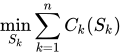
The mathematical formulation of merit order dispatch corresponds to the economic dispatch problem, which minimizes total generation costs while satisfying and capacity constraints. Formally, for nn generators, it is expressed as: minSkk=1nCk(Sk)\min_{S_k} \sum_{k=1}^n C_k(S_k) subject to k=1nSk=D,\sum_{k=1}^n S_k = D, 0SkSˉkk=1,,n,0 \leq S_k \leq \bar{S}_k \quad \forall k = 1, \dots, n, where Ck(Sk)C_k(S_k) denotes the convex cost function (often quadratic, Ck(Sk)=akSk2+bkSk+ckC_k(S_k) = a_k S_k^2 + b_k S_k + c_k) for generator kk, SkS_k is its output, DD is , and Sˉk\bar{S}_k is its capacity limit. This ignores transmission constraints and losses for simplicity, focusing on nodal or aggregate balance; extensions incorporate network flows via optimal power flow models. Operationally, the solution approximates via merit order loading: generators are ranked by ascending marginal cost λk=CkSk\lambda_k = \frac{\partial C_k}{\partial S_k}, forming a stepwise supply curve of cumulative capacity against λk\lambda_k. Dispatch proceeds by incrementally activating units from the lowest λk\lambda_k until Sk=D\sum S_k = D, with the system marginal price set to the λk\lambda_k of the marginal (last) unit. For constant marginal costs per plant (common approximation for baseload vs. peaking units), dispatch is all-or-nothing up to capacity; linear programming or Lagrange multipliers enforce equality at the optimum, yielding λk=λ\lambda_k = \lambda for inframarginal units. In competitive markets, this aligns with welfare maximization, dual to cost minimization, where uniform pricing equals the shadow price λ\lambda on the demand constraint. In practice, real-time implementation uses merit order curves updated hourly with bids reflecting short-run marginal costs (, variable O&M), excluding fixed costs or capacity payments. For example, in European markets as of 2023, this stacking yields locational marginal prices deviating from nodal optima by 5-15% due to omitted constraints, but it ensures efficient short-run allocation under assumptions. variants incorporate in DD or renewables via expected costs, transforming to multi-period optimizations.

Impacts on Markets

The Merit Order Effect from Renewables

The merit order effect from renewables arises because and solar generators, with marginal costs approaching zero, are dispatched ahead of thermal plants in the merit order, effectively shifting the curve to the right and lowering the market-clearing wholesale price for all produced in that period. This displacement reduces the need to run higher-marginal-cost units, such as gas or , during periods of sufficient renewable output. Empirical analyses confirm this causal link, with the magnitude of price suppression scaling with renewable penetration and the steepness of the residual supply curve excluding renewables. In , one of the earliest and most studied cases, the effect was quantified using data and simulations, showing average wholesale reductions of 1.7 €/MWh in 2001, rising to 7.83 €/MWh in 2006 as renewable shares grew under the EEG feed-in system. The total annual savings from this effect reached 4.98 billion € in 2006, exceeding the net subsidies paid to renewables that year. Extending the analysis to 2008–2012, wind generation contributed average reductions of 3.59–7.80 €/MWh, while added 1.55–3.56 €/MWh, with the combined effect totaling 5–11.36 €/MWh; these estimates derive from regression models isolating renewable output from and confounders. Similar patterns appear in other markets, though magnitudes vary with system characteristics. In U.S. ISO/RTO regions from 2008–2017, each 1% increase in (VRE) penetration—primarily and solar—correlated with a , yielding average annual reductions under $1.3/MWh in most markets but $2.2/MWh from solar in CAISO due to midday output alignment with demand. In ERCOT (), empirical quantile regressions on 2010–2019 data indicate that a 10% rise in lowers median real-time by 1.04–1.47% in northern zones, with stronger effects at lower quantiles reflecting supply curve flattening. These findings hold across econometric approaches, including fixed-effects and instrumental variable methods to address endogeneity from weather-driven renewable variability. The effect intensifies during high renewable output, often yielding negative prices when supply exceeds inflexible demand, as observed in (frequent sub-zero hours post-2010) and ERCOT (negative bids averaging -$2.6/MWh in high-wind periods). However, it diminishes at low penetrations or when renewables coincide with , and long-term estimates suggest partial offsets from capacity retirements or fuel switching, though short-run suppression remains dominant. This dynamic benefits wholesale buyers but erodes revenues for all inframarginal producers, including renewables themselves via price cannibalization.

Price Dynamics and Volatility

In electricity markets operating under merit order dispatch, price dynamics are shaped by the positioning of low-marginal-cost renewable sources at the front of the supply stack, which displaces higher-cost generators and reduces average wholesale . Empirical analyses in from 2014 to 2018 demonstrate that increased renewable generation lowered by 2.89 to 8.89 euro cents per , with the merit order effect accounting for the bulk of this reduction through systematic shifts in the supply curve. Across , this effect has persisted, with variable renewable energy (VRE) penetration exerting downward pressure on by flattening the merit order curve during periods of high output, though residual demand served by gas plants during peaks tempers the extent of the decline. However, these dynamics introduce greater price volatility, as VRE intermittency causes abrupt shifts in the effective supply curve: high renewable output correlates with near-zero or negative prices due to oversupply, while low output forces reliance on expensive peaking plants, triggering spikes. Studies of European markets from 2015 to 2025 show that rising VRE shares amplify short-term price variance, with renewable investments initially increasing volatility through merit order-induced fluctuations before potential long-term stabilization via scale effects. In 2022, amid high VRE penetration, European prices exhibited extreme swings, reaching 700 EUR/MWh in Spain during scarcity periods despite low-cost hydro availability, highlighting how merit order rigidity exacerbates oscillations between abundance and shortage. Price cannibalization further intensifies these patterns, as growing VRE capacity erodes revenues for renewables themselves during their peak production hours, compressing durations at low levels and widening the gap to scarcity-driven highs. This effect, observed in markets like and , stems from zero-marginal-cost bids saturating the merit order, reducing the frequency of mid-range prices and polarizing the distribution toward extremes. Empirical evidence from Iberian and German markets confirms that and solar integration heightens volatility determinants, with hourly data revealing amplified standard deviations in prices tied to VRE variability, though interconnectors and flexibility measures can partially dampen spreads.

Criticisms and Limitations

Failure to Account for Capacity and Fixed Costs

The merit order dispatch system relies on short-term marginal costs for sequencing generation, systematically overlooking the fixed costs—such as capital expenditures for plant construction, maintenance, and decommissioning—that constitute the bulk of expenses for dispatchable technologies like nuclear, , and gas-fired plants. These costs must be recovered over the asset's lifetime, but under merit order , revenues are derived primarily from energy sales at marginal clearing prices, which fail to provide adequate signals for long-term when from low-marginal-cost renewables displaces higher-cost units. As a result, generators operate fewer hours, eroding their ability to amortize fixed investments, a dynamic exacerbated in markets with high renewable penetration where zero-marginal-cost output shifts the supply curve rightward, suppressing average wholesale prices. This oversight manifests as the "missing money" problem, wherein energy-only markets using merit order dispatch generate insufficient revenues to incentivize capacity additions or retention of reliable , as peak-period —essential for recovery—remains infrequent or capped by regulatory interventions. Empirical analyses of European power markets with elevated shares of renewables demonstrate that the merit order effect correlates with declining generator profitability, leading to plant retirements without commensurate replacement capacity; for instance, in , wholesale prices fell by approximately 30-40% from 2010 to 2020 amid rising and solar deployment, contributing to the deactivation of over 10 GW of conventional capacity by 2022. Without mechanisms to value recovery, such as uplift payments or separate capacity auctions, the system underprices the reliability attributes of firm capacity, distorting investment toward intermittent sources that contribute negligibly to fulfillment. Capacity adequacy is further undermined because merit order treats all dispatched energy equivalently based on instantaneous costs, ignoring the distinct value of capacity—the probabilistic ability to deliver power on demand, particularly during . Dispatchable plants incur fixed costs to maintain readiness (e.g., spinning reserves or stockpiles), yet these are not compensated beyond margins, leading to chronic underinvestment; NREL modeling indicates that in scenarios with 30-50% , revenues cover only 60-80% of fixed costs for baseload units under pure marginal pricing. Critics, including analyses from the IEEE, argue this creates a reliability , as markets fail to internalize the societal cost of inadequate reserve margins, prompting ad-hoc interventions like out-of-merit dispatches that further erode price signals. In practice, jurisdictions like (ERCOT) have observed capacity shortfalls during high-demand events, attributable in part to merit order's neglect of fixed capacity investments, with 2021 winter storm Uri exposing vulnerabilities where pre-event retirements left the system with insufficient firm resources despite abundant intermittent capacity.

Reliability Risks and Backup Requirements

The prioritization of (VRE) sources such as and solar in merit order dispatch, due to their near-zero marginal costs, introduces significant reliability risks stemming from their and unpredictability. High VRE penetration levels—reaching 35-75% annually in systems like those in , , and —can reduce system by up to 30% for every 10% increase in VRE share, as converter-connected lacks the synchronous provided by traditional plants, heightening to and voltage . In the California ISO (CAISO), where solar contributed 11% of total in 2017 (up to 20% on peak days), rapid evening demand ramps—such as 15,000 MW increases—exacerbate risks when dispatchable capacity retires prematurely, driven by suppressed wholesale prices from midday VRE oversupply. Without adequate safeguards, up to 15% of projected global VRE (approximately 2,000 TWh by 2030) faces curtailment or integration delays, potentially increasing reliance on fossil fuels and undermining emission reductions by 20%. These risks manifest in depressed prices—often negative during high VRE output—which erode revenues for flexible dispatchable generators, diminishing incentives for in backup capacity and leading to resource adequacy shortfalls during extended low-VRE periods, such as multi-day wind lulls. The merit order effect thus contributes to a "missing " problem in energy-only markets, where fixed costs of capacity are not recovered through sales alone, prompting premature exits of baseload and peaker . System operators mitigate this through out-of-merit dispatch, where higher-cost units are activated for reliability despite economic signals, as seen in U.S. regional transmission organizations (RTOs) maintaining target reserve margins. However, such interventions distort signals and incur additional costs, with U.S. congestion expenses reaching USD 21 billion in 2022 amid rising VRE variability. Backup requirements intensify with VRE growth, necessitating flexibility across timescales: short-term (e.g., 50% increase needed by 2030 in for intra-hour balancing), weekly, and seasonal, met via batteries, pumped hydro storage (comprising most of the U.S.'s 25 GW grid-scale storage as of 2018), , and retained thermal capacity like flexible gas turbines. In high-penetration systems, reliability must-run contracts and capacity payments—implemented in markets like PJM and —ensure availability of dispatchable resources, while interconnections and synchronous condensers provide ancillary services. Curtailment rates of 5-10% in regions exceeding 30% VRE shares, such as and , underscore the operational trade-offs, often requiring compensatory mechanisms like Spain's strategic storage remuneration to avoid excessive waste. Global short-term flexibility demand is projected to double by 2030, primarily from solar PV variability, highlighting the need for hybrid approaches beyond pure merit order to sustain grid stability.

Market Distortions from Policy Interventions

Policy interventions, including subsidies for sources (RES), feed-in tariffs (FiT), and priority dispatch rules, modify the effective marginal costs used in merit order dispatch, often prioritizing intermittent generation over dispatchable plants regardless of system-wide . These mechanisms artificially lower the dispatch priority of subsidized RES by treating their variable output as having near-zero , displacing higher-cost plants and compressing wholesale prices through the merit order effect. However, this ignores externalities such as intermittency-induced backup needs and grid reinforcements, resulting in suboptimal where total system costs rise despite lower energy-only prices. Feed-in tariffs guarantee fixed payments to RES producers above market rates, decoupling their revenue from competitive bidding and incentivizing over-investment in low-capacity-factor assets that flood the market during peak output. In , solar FiT under the Sources Act led to a 7% average wholesale price reduction from 2008 to 2010, but amplified price volatility and daily maximum price drops by up to 20 euros per megawatt-hour on high-insolation days. Priority dispatch mandates, requiring grid operators to accept RES output first, bypass merit order principles, forcing curtailment of cheaper conventional or inefficient ramping of backup plants, as seen in European markets where RES penetration exceeded 40% of supply, yielding negative prices in over 10% of trading hours in 2020. Such rules distort flexibility markets by favoring subsidized RES curtailment over cost-effective demand-side or storage options for congestion relief. Capacity payments, introduced to address the "missing money" problem—where RES-driven price suppression erodes recovery for dispatchable capacity—further intervene by remunerating availability outside markets, potentially sustaining uneconomic plants and inflating total costs. In imperfect markets, these payments can exceed 20-30% of system expenses, as modeled in simulations for high RES scenarios, distorting signals toward overbuilding peakers while underincentivizing efficient baseload upgrades. Empirical analyses in European and U.S. markets show that combining capacity mechanisms with RES subsidies amplifies inefficiencies, with generators receiving dual payments that decouple dispatch from true marginal costs, leading to reliability risks during scarcity events like the 2021 Texas freeze or 2022 European gas crisis. These distortions compound under high RES penetration, where policies fail to internalize integration costs estimated at 1-2 euros per megawatt-hour for backup and balancing in systems by 2030, per modeling studies, often understated in academic assessments favoring rapid decarbonization. While proponents cite price suppression benefits, causal analyses reveal net welfare losses from stranded assets and elevated consumer bills, as subsidies totaling over 100 billion euros annually in the by 2022 have not proportionally reduced emissions due to coal-to-gas leakage and import dependencies.

Alternatives and Reforms

Capacity Markets and Hybrid Approaches

Capacity markets address limitations in pure energy-only systems, such as those relying solely on merit order dispatch, by compensating generators for maintaining available capacity rather than solely for dispatched energy. In these mechanisms, system operators procure commitments from resources to provide a specified amount of capacity (typically in megawatts) during peak demand periods, ensuring resource adequacy and grid reliability over multi-year horizons. Auctions, often held annually or biennially, determine payments based on bids reflecting the cost of capacity provision, with penalties imposed for failure to perform during scarcity events. This approach incentivizes investment in and , mitigating risks of underinvestment where marginal pricing alone fails to recover fixed costs like capital expenditures for peaker . Hybrid approaches integrate capacity markets with energy markets that employ merit order dispatch for real-time operations, creating complementary revenue streams: energy payments for produced megawatt-hours via lowest-marginal-cost sequencing, and capacity payments for availability assurances. For instance, in the PJM Interconnection's Reliability Pricing Model (RPM), implemented since 2007, forward auctions secure capacity three years in advance across zones, with the 2024 Base Residual Auction clearing at $269.92 per megawatt-day in most areas—a nearly tenfold increase from prior auctions due to retirements and demand growth—while energy dispatch remains merit-order based. Similarly, the UK's Capacity Market, established under the Energy Act 2013, conducts competitive T-4 auctions (four years ahead) to contract up to 50 gigawatts of capacity, blending with its energy-only wholesale market to support reliability amid . These hybrids aim to sustain incentives for flexible, reliable resources amid rising renewable penetration, where zero-marginal-cost intermittents suppress energy prices and erode scarcity signals. Such systems contrast with energy-only markets like Texas's ERCOT, where merit order dispatch prevails without dedicated capacity payments, relying instead on elevated scarcity pricing during shortages to signal investments; however, empirical evidence from periods of low price volatility suggests energy-only designs may underprovide capacity, prompting reforms toward hybrids in jurisdictions facing adequacy risks. Capacity mechanisms have proliferated, with over 30 countries implementing them by 2016 per analysis, often to counteract distortions from subsidized renewables that depress wholesale prices and fixed-cost recovery. While critics argue capacity markets can foster over-procurement or inefficient resource mixes, proponents cite improved planning horizons and performance obligations—such as must-run provisions during tests—as enhancing causal reliability over reactive energy pricing alone.

Environmental and Multi-Objective Dispatch

Environmental dispatch modifies the traditional merit order by integrating environmental externalities, primarily emissions of CO₂ and other pollutants, into the assessment of generation units, thereby prioritizing lower-emission sources to reduce overall system impacts alongside economic costs. This approach typically augments the variable cost of and operations with a term representing the monetized environmental cost, such as λ × e_k, where λ denotes the emission penalty factor (e.g., derived from carbon pricing or estimates) and e_k is the emission rate per unit output for generator k. As a result, the dispatch sequence shifts; for instance, units may supplant coal-fired plants earlier in the stack if emission penalties elevate the effective cost of the latter sufficiently. Multi-objective dispatch advances this framework by formulating the to balance conflicting goals—most commonly minimizing total fuel costs and total emissions—subject to , capacity limits, and transmission constraints, without relying solely on predefined weights for environmental factors. Solutions often yield a of trade-off options, enabling decision-makers to select dispatch plans based on real-time priorities, such as regulatory mandates or market signals; for example, in a 30-unit test system, multi-objective algorithms have demonstrated reductions in emissions by up to 20-30% at modest cost increases of 5-10%, depending on the weighting scheme. Techniques like non-dominated sorting genetic algorithms (NSGA-II) or are employed to navigate the non-convex solution space efficiently, particularly in systems integrating variable renewables where uncertainty in or solar output adds elements to the objectives. In practice, such dispatch has been proposed and simulated for integrated thermal-gas-renewable systems, where units serve as flexible bridges to renewables, yielding multi-objective improvements like 15% lower combined cost-emission metrics compared to single-objective economic dispatch. However, faces challenges including computational demands—solving high-dimensional problems can require hours for large grids—and sensitivity to emission valuations, which vary widely (e.g., U.S. social cost of carbon estimates ranging from $50-200 per ton CO₂ in 2023 federal analyses, contested for over-reliance on integrated assessment models with uncertain parameters). Empirical applications remain limited to research or pilot microgrids, as real-time market operators prioritize speed and reliability, often approximating multi-objectives via carbon taxes rather than full optimization.

Recent Developments

Adaptations for High Renewable Penetration

In electricity systems with high penetration of (VRE) sources like and solar, the traditional merit order dispatch—prioritizing generators by ascending marginal costs—encounters challenges from frequent oversupply periods, resulting in zero or negative wholesale prices and underutilization of conventional capacity during scarcity. Adaptations focus on enhancing flexibility, integrating storage, and refining market rules to maintain without abandoning the core merit order principle. These include shorter dispatch intervals and improved VRE to minimize imbalances, as longer lead times exacerbate errors in intermittent output predictions, leading to inefficient curtailment or over-reliance on reserves. Energy storage systems, particularly batteries, are integrated into the merit order by allowing operators to bid negative prices during charging (absorbing excess VRE generation) and positive marginal costs during discharge, effectively extending the supply stack to price volatility. This adaptation mitigates the "" phenomenon observed in high-solar markets like , where midday oversupply depresses prices, by shifting energy to evening peaks; studies show storage can raise low-price troughs by up to 20-30% and reduce peak prices, improving overall system economics without subsidies in competitive settings. mechanisms further adapt the curve, enabling large consumers to curtail or shift loads in response to real-time prices, acting as a virtual supply-side resource that complements VRE by aligning consumption with generation peaks. Separate flexibility and ancillary services markets address limitations of energy-only merit order by procuring ramping, frequency regulation, and reserves from sources like gas peakers or storage, decoupled from baseload dispatch to ensure grid stability amid VRE variability. In , post-2022 reforms preserved the merit order for spot markets while introducing two-way contracts for difference (CfDs) to provide revenue certainty for VRE investors, capping upside exposure during high prices but allowing pass-through of low prices to incentivize ; these were finalized in , aiming for 45% renewables by 2030 without inframarginal caps that distort dispatch. Hybrid designs, such as co-optimization of and reserves, have emerged in markets like PJM and ERCOT, where algorithms jointly clear bids to minimize total system costs under uncertainty, reducing VRE curtailment by 10-15% in simulations compared to sequential dispatch. These adaptations collectively sustain merit order viability, though empirical data from 2020-2024 indicates persistent needs for grid expansions to handle spatial mismatches in VRE output.

Policy and Regulatory Changes Post-2022 Energy Crisis

The 2022 energy crisis, exacerbated by Russia's invasion of and subsequent reductions in supplies, exposed vulnerabilities in Europe's merit order-based dispatch systems, where gas-fired plants often set marginal prices during , amplifying cost volatility into wholesale rates. Peak day-ahead prices in the EU reached €1,000/MWh in August 2022, driven by gas prices exceeding €300/MWh, prompting calls for market redesign to enhance security and affordability without undermining dispatch efficiency. In response, the proposed reforms in March 2023, culminating in the adoption of updated Electricity Market Design (EMD) rules by the and Council in May 2024, effective from July 2024. These preserved the core merit order principle for short-term dispatch—ordering plants by ascending marginal costs to minimize system costs—while introducing mechanisms to buffer prices from gas dependency. Key additions include mandatory two-way Contracts for Difference (CfDs) for new renewable and nuclear capacity, where producers receive fixed premiums or pay back windfalls relative to a reference price, stabilizing revenues for inframarginal (low-cost) generators without altering real-time bidding or clearing. Further enhancements targeted flexibility and integration: transmission system operators must prioritize renewables in dispatch where feasible, expand intraday and balancing markets for storage and , and implement tariffs to shift consumption from peak hours. Zonal reforms allow temporary market splitting in congestion-prone areas to reflect local supply-, potentially flattening effective merit curves by enabling cheaper cross-border flows, though uniform marginal persists within zones. Revenue from CfD adjustments and inframarginal rents is ring-fenced for rebates or grid investments, aiming to redistribute crisis-era windfalls from renewables. Nationally, extended and plant operations until 2024 via the 2022 Electricity Market Stability Act, injecting low-marginal-cost capacity into the merit order to avert shortages, while phasing out nuclear by April 2023; this temporarily depressed prices by €10-20/MWh on average but raised emissions. The , outside the , accelerated capacity market auctions post-crisis, awarding £2.3 billion in 2023 for reliable dispatch, indirectly supporting merit order by ensuring backup availability without direct intervention. These changes reflect a consensus to retain merit order's cost-minimizing logic—evidenced by simulations showing efficiency losses from alternatives like pay-as-bid exceeding 5%—while layering safeguards against geopolitical shocks.

References

Add your contribution
Related Hubs
Contribute something
User Avatar
No comments yet.