Hubbry Logo
Louis Antoine, Duke of AngoulêmeLouis Antoine, Duke of AngoulêmeMain
Open search
Louis Antoine, Duke of Angoulême
Community hub
Louis Antoine, Duke of Angoulême
logo
8 pages, 0 posts
0 subscribers
Be the first to start a discussion here.
Louis Antoine, Duke of Angoulême
from Wikipedia
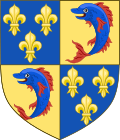
Coat of arms of Louis Antoine as Duke of Angoulême.

Key Information

Coat of arms of Louis Antoine as Dauphin.

Louis Antoine of France, Duke of Angoulême (6 August 1775 – 3 June 1844) was the elder son of Charles X of France and the last Dauphin of France from 1824 to 1830.

He was a petit-fils de France at birth, and was initially known as Louis Antoine d'Artois. After his father's accession to the throne, he became Dauphin de France, and his surname changed to de France, following the royal custom for princes with such rank.[1]

Biography

[edit]
The young duke with his siblings and mother, the Countess of Artois (by Charles Le Clercq, c. 1780–1782)

Early life

[edit]

Louis Antoine was born at the Palace of Versailles, as the eldest son of Charles Philippe, Count of Artois, the youngest brother of King Louis XVI. He was born one year after the death of his great-grandfather, King Louis XV and 7 years after the death of his great-grandmother, the Queen Marie Leszczyńska. His mother was Princess Maria Theresa of Savoy (known as Marie Thérèse in France), daughter of Victor Amadeus III of Sardinia and Maria Antonia of Spain.

Louis-Antoine by Rosalie Filleul, c. 1781

From 1780 to 1789, Louis Antoine and his younger brother, Charles Ferdinand, Duke of Berry, were educated by their gouverneur Armand-Louis, Marquis of Sérent in the château de Beauregard, located 5 km (3.1 mi) away from Versailles.[2] On the outbreak of the French Revolution in 1789, the two young princes followed their father into exile first to Turin, then the Holy Roman Empire, and finally England. In 1792, Louis Antoine joined the émigré army of his cousin, the Prince of Condé.

In June 1795, his uncle, the comte de Provence, proclaimed himself King Louis XVIII. Later that year, the 20-year-old Louis Antoine led an unsuccessful royalist uprising in the Vendée. In early 1797, he joined his brother and uncle in the German Duchy of Brunswick, hoping to join the Austrian Army. The defeat of Austria by France obliged them to flee, and they took refuge in Mittau, Courland, under the protection of Tsar Paul I of Russia.

There, on 10 June 1799, Louis Antoine married his first cousin, Marie Thérèse of France, the eldest child of Louis XVI and Marie Antoinette, and the only member of the immediate royal family to survive the French Revolution. Since her release from the Temple Prison in 1795, she had been living at the Austrian court. They had no children.

Military service

[edit]

In April 1800, Louis Antoine took command of a regiment of cavalry in the Bavarian army and took part in the battle of Hohenlinden against the French, showing some ability.

In early 1801, Tsar Paul made peace with Napoleon Bonaparte, and the French court in exile fled to Warsaw, then controlled by Prussia. For the next ten years, Louis Antoine accompanied and advised his uncle, Louis XVIII. They returned to Russia when Alexander I became Tsar, but in mid-1807 the treaty between Napoleon and Alexander forced them to take refuge in Britain. There, at Hartwell House, King Louis reconstituted his court, and Louis-Antoine was granted an allowance of £300 a month. Twice (in 1807 and 1813) he attempted to return to Russia to join the fight against Napoleon, but was refused by the Tsar.

Louis Antoine remained in Britain until 1814 when he sailed to Bordeaux, which had declared for the King. His entry into the city on 12 March 1814 was regarded as the beginning of the Bourbon Restoration in France. From there, Louis Antoine fought alongside the Duke of Wellington to bring about Napoleon's overthrow.

Flight to Britain and return

[edit]
Faience plate celebrating the Duke of Angoulême as Admiral of France. On display at the Musée national de la Marine, Paris.

Louis Antoine was, as chief of the royalist army in the southern Rhône River valley, unable to prevent the return of Napoleon to Paris, and he was again forced to flee to Britain during the "Hundred Days". He loyally served Louis XVIII after the final defeat of Napoleon at Waterloo. In 1823, he commanded a French army sent into Spain to restore the Spanish King's absolute powers, known as the Hundred Thousand Sons of Saint Louis. He was victorious in the Battle of Trocadero, after which the reactionary power of King Ferdinand VII of Spain was firmly restored. For this achievement, he was offered the title of Prince of Trocadero.[3]

Upon the Louis XVIII's death in 1824, his father became King Charles X and Louis Antoine became Dauphin, heir-apparent to the throne. He attended his father's coronation in Reims in May 1825.

July Revolution

[edit]

In the July Revolution of 1830, masses of angry demonstrators demanded the abdication of Charles. He reluctantly signed the document of abdication on 2 August 1830. It is said that Louis Antoine, who relinquished his right to the throne, became king "Louis XIX" between his father's signature and his own,[4] but in the abdication document he is only referred as "Louis Antoine". The document was signed in favour of his nephew Henri, duke of Bordeaux. For the final time he left for exile, where he was known as the "count of Marnes".[5]

22 Regent Terrace, Edinburgh

Louis Antoine and his wife travelled to Edinburgh, Scotland, in November 1830 and took up residence in a house at 21 (now 22) Regent Terrace[6][7] near Holyrood Palace where Charles X was staying.[8]

Emperor Francis I of Austria offered the Prague Castle in Prague to the royal entourage in 1832, so Louis-Antoine and Charles X moved there. Francis I, however, died in 1835, and his successor Ferdinand I told the French royal family that he needed the palace for his coronation in the summer of 1836.[8] The exiled French kings and their entourage therefore left and eventually arrived at the palace of Grafenberg[9] in Görz, Austria on 21 October 1836.[8]

Many legitimists did not recognize the abdications as valid, and recognized Charles X as king until his death in 1836, with Louis Antoine succeeding him as Louis XIX. Louis Antoine died in Görz in 1844, aged 68. He was buried in his father Charles X's crypt in the church of the Franciscan monastery of Kostanjevica in Nova Gorica, Slovenia. Upon his death, his nephew the Duke of Bordeaux became head of the Bourbon royal family of France under the regnal name Henry V, although he used the title of Count of Chambord in exile.

He is identified by the Guinness World Records as the shortest-reigning monarch, reigning for less than 20 minutes during the July Revolution,[10] but this is not backed up by historical evidence.[5] He never reigned over the country, but after his father's death in 1836, he was the legitimist pretender as Louis XIX.

In fiction and film

[edit]

The newborn Duke of Angoulême is portrayed by an uncredited child actor in a brief scene in the movie Marie Antoinette (2006), directed by Sofia Coppola. This scene contains an error, as it mistakenly names his parents as the Count and Countess of Provence, who never had children.

See also

[edit]

Footnotes

[edit]
[edit]
Revisions and contributorsEdit on WikipediaRead on Wikipedia
from Grokipedia
Louis Antoine of France, Duke of Angoulême (6 August 1775 – 3 June 1844) was the eldest son of Charles Philippe, Count of Artois (later King Charles X of France), and , making him a prominent figure in the Bourbon dynasty during and after the . As the last from 1824 to 1830, he embodied the legitimist claim to the throne amid the Bourbon Restoration's efforts to reestablish monarchical authority following decades of republican and imperial rule. Louis Antoine's military career defined much of his early life; in 1792, he joined the émigré Army of Condé to combat forces, later leading an unsuccessful uprising in the Vendée in 1795 and, during the Restoration, commanding the 1823 French intervention in that reinstated VII's absolute rule after liberal revolts. His tenure as lieutenant-general of the kingdom under his father highlighted his role in suppressing domestic unrest, though his leadership was tested by the of 1830, which forced Charles X's abdication in his favor. On 2 August 1830, Louis Antoine briefly reigned as Louis XIX for under twenty minutes before abdicating himself, a decision that legitimists later viewed as hastening the dynasty's fall and enabling the Orléanist branch's ascent under Louis Philippe, after which he and his wife, Marie Thérèse—the sole surviving child of and , whom he married in 1799—retired to exile in without issue. Regarded by royalists as the rightful king until his death, his life reflected the Bourbon line's persistent but ultimately unsuccessful resistance to revolutionary changes in governance.

Early Life and Formation

Birth and Immediate Family Context


Louis Antoine de Bourbon was born on 6 August 1775 at the Palace of Versailles during the reign of his great-uncle, King . He was the first child of Charles Philippe, —the third son of and youngest brother of the reigning King —and , whom the Count had married in 1773. At birth, conferred upon him the title of Duke of , reflecting his status as a petit-fils de France.
The Duke's immediate siblings consisted of a sister, , born on 5 August 1776 at Versailles and who died young on 5 December 1783, also at Versailles, and a brother, Charles Ferdinand, born on 24 January 1778 at Versailles, later titled . The family maintained a household within the opulent confines of Versailles, emblematic of the Bourbon court's lavish pre-revolutionary lifestyle, where the was known for his pursuits amid the era's fiscal strains. As the eldest male-line descendant of Louis XV's surviving sons after the childless Dauphin, Louis Antoine occupied a key position in the dynastic succession, poised behind his uncles and the Count of .

Education and Formative Influences

Louis Antoine's formal education commenced at the age of five in 1780, under the supervision of his appointed governor, Armand-Louis de Sérent, Marquis de Sérent. This arrangement placed him and his younger brother, , in a structured household at the Château de Beauregard near the . The educational regimen was overseen by a dedicated team comprising three spiritual preceptors for moral and religious instruction, two sub-governors, and four institutors responsible for academic and practical subjects. Emphasis was placed on preparing the princes for royal duties, including elements of military training; Louis Antoine later attended the royal artillery school in , where he served in the ranks and earned captain's epaulettes. The curriculum distanced the young duke from the excesses of Versailles court life, fostering a disciplined environment under Sérent's guidance, which contrasted with his father , Comte d'Artois's more libertine lifestyle. The profoundly shaped Louis Antoine's formative years, abruptly ending his sheltered education at age 14 when the royal family fled Versailles following the on July 14, 1789. This upheaval transitioned him from princely studies to exile and early military involvement in émigré forces, instilling a lifelong commitment to Bourbon restoration amid the chaos of revolutionary upheaval.

Military Career

Service in Émigré Forces and Vendée

In 1792, at the age of 17, Louis Antoine joined the , an émigré force composed primarily of French royalist exiles operating under Austrian auspices as part of the First Coalition against revolutionary France. The army, led by his cousin , conducted operations along the Rhine frontier, including engagements in the and German states, though specific actions attributed to Louis Antoine during this period emphasize his service in the ranks rather than independent command. He progressed to the rank of through , reflecting the merit-based advancement common among émigré officers motivated by restoration of the monarchy. The Army of Condé's campaigns were marked by logistical challenges and limited success, as coalition forces struggled against French revolutionary armies' numerical superiority and fervor; by 1795, the unit had suffered attrition from desertions, disease, and defeats such as the 1793 retreat from the . Louis Antoine's involvement aligned with broader émigré efforts to reclaim , but the force's reliance on foreign patrons like and Britain underscored the exiles' diminished autonomy compared to pre-revolutionary royal armies. In June 1795, following the proclamation of his uncle, the comte de , as King by émigré leaders, the 20-year-old Louis Antoine shifted focus to direct intervention in western . He led a royalist expedition aimed at sparking an uprising in the region, where counter-revolutionary insurgents had waged since 1793 against Republican forces. This effort sought to capitalize on lingering and Vendéan resistance amid the Directory's fragile control, but it faltered due to poor coordination with local rebels, insufficient landing support from British naval aid, and swift Republican countermeasures. The failure resulted in minimal territorial gains and heavy losses, exemplifying the émigrés' overestimation of domestic strength post-Terror.

Campaigns During the Napoleonic Era

In April 1800, Louis Antoine assumed command of a regiment within the contingent of the Habsburg-led during the . He participated in the on December 3, 1800, where Allied forces under Archduke John and General Kray suffered a decisive defeat against Jean Moreau's , leading to the collapse of the coalition's position in and contributing to the in 1801. His role involved reconnaissance and flanking maneuvers amid harsh winter conditions that exacerbated the Allies' logistical failures, though the engagement highlighted his personal bravery in sustaining charges against superior French numbers. As Napoleon's grip weakened during the in early 1814, Louis Antoine sailed from to on March 24, landing amid local royalist enthusiasm and proclaiming the restoration of as king. He organized approximately 10,000 royalist volunteers and units in southwestern , coordinating with Arthur Wellesley, Duke of 's Anglo-Portuguese-Spanish army advancing from the after victories at Nivelle (November 10, 1813) and (December 9-13, 1813). This effort secured and parts of for the Bourbons without major pitched battles, as French imperial forces under Soult withdrew northward, though tensions arose when rebuked Louis Antoine for overly aggressive proclamations that risked alienating local populations. By April, his administration had stabilized the region, facilitating the Allied push toward and . During the following 's return from on March 1, 1815, Louis Antoine commanded royalist forces in the southern Rhône Valley, rallying supporters in areas like Nîmes and against Bonaparte's rapid consolidation of power. Facing desertions and the advance of Emmanuel Grouchy's 20,000-man corps dispatched by on April 8, he withdrew toward but surrendered on April 14 near after minimal resistance, with his 8,000 troops largely disintegrating due to lack of cohesion and imperial amnesty offers. subsequently ordered his embarkation to , preventing further disruption in the south, though the episode underscored the fragility of Bourbon loyalism amid widespread military adherence to the emperor.

Command of the Spanish Expedition (1823)

In early 1823, appointed his nephew Louis Antoine, Duke of Angoulême, as of a French expeditionary force, dubbed the "Hundred Thousand Sons of Saint Louis," to intervene in and restore under amid the liberal uprising that had curtailed the king's powers since 1820. The force, though popularly named for 100,000 men, comprised approximately 60,000 troops, with Louis Antoine exercising nominal overall command while operational direction fell to experienced generals such as Armand Guilleminot. On April 7, 1823, the army crossed the into , encountering minimal initial resistance from Basque and Catalan populations, and advanced southward, capturing key cities including after a brief and entering on May 23 without major opposition. The campaign's decisive engagement occurred at the on August 31, 1823, near , where French forces under Louis Antoine's high command launched a surprise bayonet assault across tidal flats to seize Fort Saint-Louis from Spanish liberal defenders, resulting in the capture of around 1,700 prisoners and paving the way for the bombardment and surrender of on September 30. The expedition succeeded in liberating from confinement in , enabling him to dissolve the Cortes and reinstate absolutist rule by October 1823, after which French troops occupied to enforce stability, leaving a of 45,000 men upon withdrawal. Louis Antoine departed on November 5 and re-entered on November 23, 1823, having quelled the revolt with limited casualties—primarily from disease rather than combat—and bolstering Bourbon legitimacy across , though the intervention drew criticism for overriding Spanish . offered him the title "Prince of Trocadero" in recognition of the victory, which Louis Antoine declined.

Exile and Restoration

Flight from Revolutionary France

In the immediate aftermath of the on July 14, 1789, which marked the violent onset of the , Charles Philippe, —father to Louis Antoine—perceived an imminent threat to the Bourbon family's position amid rising radicalism in . The Count, known for his staunch defense of and opposition to reforms, decided against awaiting further developments under Louis XVI's hesitant leadership. On the night of July 16–17, 1789, he departed Versailles with his wife, , and their two eldest sons: Louis Antoine, aged 13 and holding the title Duke of Angoulême, and . This exodus positioned the Artois branch as among the earliest high to emigrate, contrasting with Louis XVI's family, which remained in France until their failed in June 1791. The flight proceeded southward through loyalist territories, evading revolutionary patrols by leveraging discreet routes and support from provincial sympathizers. The family crossed into —Maria Theresa's native region under the Kingdom of Sardinia—reaching by , where they received asylum from , Maria Theresa's brother. Louis Antoine, though young, had been groomed in courtly and military etiquette, but the abrupt departure severed him from his homeland amid confiscations of émigré property decreed by the later that year. The émigrés' departure fueled revolutionary narratives of aristocratic treason, intensifying decrees against nobles who fled, including the Law of Émigrés in that formalized property seizures. From , the family relocated repeatedly for security, moving to and then the by late 1789, as revolutionary forces eyed Italian states. Louis Antoine's initial exile thus initiated a peripatetic existence, with the group joining other Bourbon loyalists in forming networks. This early separation from underscored the Artois faction's proactive conservatism, prioritizing monarchical preservation over accommodation with constitutional changes, though it rendered them dependent on foreign patrons like and Britain.

Sojourn in Britain and Allied Support

Following the disruptions of earlier exiles in locations including , the , , and , Louis Antoine, Duke of Angoulême, relocated to Britain in 1807–1808 alongside his wife, Marie Thérèse, uncle , and father, the . The group established residence at Hartwell House in , where maintained a court of over one hundred attendants, providing a semblance of monarchical continuity amid Napoleonic dominance in Europe. This period marked a relatively subdued phase for Louis Antoine, focused on sustaining Bourbon legitimacy rather than active combat, though he aligned with allied opposition to . British hospitality extended beyond accommodation; the government under Prime Ministers such as and his successors provided financial subsidies to the Bourbon exiles, covering living expenses and enabling political correspondence aimed at restoration. These funds, rooted in Britain's strategic interest in countering French expansionism, totaled significant annual allotments—estimated at £25,000 for Louis XVIII's household alone by the early 1800s—sustaining the court's operations without reliance on private émigré contributions. Louis Antoine benefited indirectly, as the support preserved family unity and facilitated discreet coordination with British military leaders, including the Duke of Wellington, whose campaigns in the (1808–1814) eroded Napoleonic strength. Allied backing extended to logistical aid; as Napoleon's abdication loomed in 1814, British naval vessels transported Louis Antoine from Britain to , where he arrived on April 12 to rally royalist forces and proclaim Louis XVIII's , leveraging local discontent with imperial rule. This intervention underscored Britain's pivotal role in Bourbon prospects, contrasting with more cautious stances from and , which prioritized balance-of-power diplomacy over unconditional restoration. Throughout the sojourn, Louis Antoine's adherence to legitimist principles—eschewing compromise with revolutionary ideals—reinforced his position as , though childlessness strained dynastic hopes.

Return and Integration into the Bourbon Monarchy (1814)

Following the abdication of Napoleon Bonaparte on 6 April 1814 and the subsequent Allied occupation of , Louis Antoine, who had spent much of his exile in Britain, returned to to support the Bourbon restoration. He landed at in January 1814 amid the advancing British forces under the Duke of , then proceeded to , which had capitulated to the Allies without resistance. On 12 March 1814, he made a ceremonial entry into the city, where local authorities proclaimed as king, marking one of the first major public endorsements of the Bourbon return in southwestern . This arrival positioned Louis Antoine as a key figure in rallying sentiment in the , a region marked by lingering revolutionary sympathies and Vendéan royalist networks. Traveling onward to , , and , he issued proclamations affirming the constitutional charter promised by and urged loyalty to the restored monarchy, though his presence sometimes exacerbated local tensions between ultra-royalists and moderates. By late March, Bordeaux's acclaim had elevated his symbolic role, with crowds hailing him as a liberator, despite Wellington's private frustration over the prince's premature political maneuvering ahead of military consolidation. Upon Louis XVIII's entry into Paris on 3 May 1814, Louis Antoine integrated into the reconstituted court as the grandson of the Comte d'Artois (future Charles X) and a senior prince of the blood, resuming his pre-revolutionary titles and military precedence without formal legislative changes to the succession. Louis XVIII appointed him to command the Army of the South, tasked with securing the Rhône Valley and against potential Bonapartist holdouts and maintaining order amid reports of reprisals against former revolutionaries. This role underscored his transition from émigré general to active participant in the monarchy's stabilization efforts, though his limited independent authority reflected Louis XVIII's centralized control and preference for balanced governance over familial favoritism. Throughout spring and summer , Louis Antoine's activities in the south involved reviewing troops, distributing amnesties selectively, and coordinating with local prefects to enforce the king's , which granted a constitutional framework limiting absolute rule. His efforts contributed to the monarchy's foothold in restive areas, but they also highlighted early frictions, as ultra-royalist volunteers under his nominal oversight pursued vengeance against , foreshadowing the White Terror. By autumn, with the region pacified under Bourbon colors, he rejoined the court in , embodying the family's reintegration while adhering to the king's pragmatic policies against outright absolutism.

Personal Life and Succession Challenges

Marriage to Marie Thérèse

Louis Antoine married his first cousin , the daughter of and and the only surviving member of that branch of the Bourbon family, on 10 June 1799 at in Mitau, (modern-day ). The marriage, arranged by their uncle during the Bourbon exiles in Russia under the protection of the Duke of , sought to consolidate royalist claims by uniting the lines of and the Comte d'Artois (future Charles X). , then aged 20, consented to the match as it aligned with her late parents' wishes, though reportedly composed courtship letters in Louis Antoine's name to persuade her. The Comte d'Artois initially opposed the union, citing Louis Antoine's shy disposition and stammering speech as disqualifying traits for such a politically vital alliance. Despite these reservations, the wedding occurred amid the court's precarious circumstances. The couple remained childless throughout their lives, a fact attributed in historical accounts to the marriage's lack of consummation or deep incompatibility, rendering it notably unhappy; they often lived separately after the Bourbon Restoration in 1814.

Childlessness and Dynastic Implications

Louis Antoine married his first cousin, , the only surviving child of and , on 10 June 1799 in , then part of the . The union produced no children over its 45-year duration, despite initial expectations that it would secure the Bourbon lineage. Historians attribute the childlessness primarily to Marie Thérèse's profound from her experiences during the , including the execution of her parents and brother, and nearly two years of in the Temple prison from 1792 to 1795, which left her emotionally withdrawn and austere. Contemporary accounts describe the marriage as unhappy and distant, with Louis Antoine's timid personality unable to bridge her reserve; some reports suggest periods of separation and limited intimacy, though no evidence of physical infertility in either spouse has been substantiated. The absence of heirs amplified concerns over Bourbon dynastic continuity during the Restoration period. As to (r. 1814–1824) and later Dauphin under his father Charles X (r. 1824–1830), Louis Antoine's childlessness shifted the succession burden to his younger brother, , whose assassination on 13 February 1820 necessitated reliance on Berry's posthumous son, , (born 29 September 1820), as the next in line. This vulnerability exposed the senior Bourbon branch to extinction risks, as represented the final direct male descendant; Louis Antoine's 1830 explicitly renounced claims in favor of the child, underscoring the precariousness of the legitimist succession without a Dauphinal heir. The lack of issue thus contributed to the dynasty's ultimate failure to regain the throne, with 's childless death in 1883 ending the legitimate male line.

Political Role and Views

Positions During the Restoration

Upon the Bourbon Restoration in 1814, Louis Antoine, Duke of Angoulême, was restored to his status as a prince of the blood and admitted to the Chamber of Peers as a peer of , where royal princes held seats ex officio to advise on legislation. He also resumed his military standing with the rank of lieutenant général des armées, an honorary but prestigious position reflecting his prior émigré service under Condé's army. During the brief interregnum in 1815, appointed him governor-general of the southern military divisions on March 13 to organize resistance against Napoleon's forces; he commanded the 2nd advancing toward but faced challenges from defections and limited royalist support. After Napoleon's defeat at Waterloo and the Second Restoration, Angoulême continued in ceremonial military duties, including troop inspections and provincial tours to bolster loyalty to the monarchy, while avoiding substantive administrative governance. Politically, he aligned with the ultra-royalist faction led by his father, the Comte d'Artois, favoring stricter enforcement of royal prerogatives over the constitutional limits imposed by the , though he deferred to Louis XVIII's more pragmatic governance. His influence remained indirect, centered on upholding absolutist traditions amid tensions between and extremists in the Chamber of Peers, without assuming ministerial portfolios. This period solidified his reputation as a loyal but inactive , prioritizing dynastic legitimacy over active policymaking until his father's accession in 1824.

Dauphin Under Charles X (1824–1830)

Upon the death of Louis XVIII on 16 September 1824, Louis Antoine's father ascended as Charles X, elevating him to the position of Dauphin of France as heir apparent. In this capacity, he assumed membership in the privy council with deliberative authority and the senate, attending meetings to advise on state matters. Louis Antoine aligned closely with his father's ultra-royalist agenda, which sought to reinforce monarchical prerogative and ecclesiastical power against liberal encroachments. He endorsed symbolic acts like Charles X's coronation at Reims Cathedral on 29 May 1825, evoking pre-revolutionary divine-right traditions over the constitutional framework established in 1814. His support extended to legislative efforts, including the 1825 indemnity reimbursing emigrants for properties seized during the Revolution, reflecting a prioritization of noble restitution amid fiscal strains. Though pious and devoted to Bourbon legitimacy, the Dauphin exercised limited independent influence, deferring to Charles X's dominance and the counsel of ministers such as Jules de Polignac after 1829. He refrained from moderating the regime's reactionary turn, including press restrictions and electoral manipulations that alienated moderate royalists and fueled opposition. This passive adherence contributed to the government's isolation as economic downturns and liberal electoral gains intensified discontent in the late 1820s. In July 1830, amid escalating unrest, Louis Antoine was named lieutenant-general of the kingdom and supreme commander of royal forces on 29 July, tasked with quelling Parisian barricades, but the prior issuance of restrictive ordinances undermined military cohesion.

Conservative Principles and Critiques of Liberalism

Louis Antoine embodied conservative principles centered on dynastic loyalty, hierarchical order, and the preservation of monarchical authority derived from tradition and divine sanction, rather than popular consent or contractual arrangements. His lifelong commitment to the Bourbon cause, forged in exile and military service, emphasized the restoration of pre-revolutionary stability against the disruptive forces of revolution and reform. This worldview aligned with ultra-royalist emphases on Catholic integralism and the rejection of egalitarian doctrines that eroded royal prerogative. A pivotal expression of these principles occurred during the 1823 expedition to , where, as commander of over 100,000 French troops known as the Hundred Thousand Sons of Saint Louis, he dismantled the liberal constitutional regime of the (1820–1823). The liberal uprising, triggered by Rafael del Riego's on January 1, 1820, had compelled King to swear adherence to the 1812 Constitution, which curtailed royal powers, redistributed authority to a unicameral Cortes, and promoted individual liberties at the expense of absolutist governance—measures and his forces deemed to foster and weaken legitimate sovereignty. By capturing key fortresses like on August 31, 1823, and enabling Ferdinand's restoration, Angoulême's campaign critiqued liberalism as inherently destabilizing, prone to mob rule and the subversion of hereditary monarchy, echoing broader royalist concerns that constitutional experiments invited endless upheaval akin to the . While advocating restraint post-victory—dismayed by Ferdinand's subsequent purges and favoring a moderated charter over pure absolutism or unchecked —Angoulême's actions underscored a causal realism: stable rule required suppressing ideologies that prioritized abstract rights over empirical traditions of obedience and order. In , this translated to supporting institutional purges, such as the removal of Napoleonic-era officers from the army under Charles X, to embed conservative fidelity and prevent liberal infiltration. His stance implicitly rejected liberal parliamentarism's elevation of elected assemblies, which he saw as eroding the king's independent executive role under the 1814 Charter, favoring instead a system where actively checked populist excesses to avert societal dissolution.

The July Revolution and Its Aftermath

Precipitating Events and Monarchical Response

On July 25, 1830, King Charles X issued the , a series of four decrees that suspended , dissolved the newly elected —which had a liberal majority following the July 1830 elections—and called for new elections under restricted suffrage, while also appointing a new slate of reactionary councillors of state. These measures, drafted by the ultra-royalist ministry under , aimed to counter the electoral gains of opposition liberals who opposed the king's conservative policies, but they violated the by overriding parliamentary consent and reviving pre-revolutionary absolutist tendencies. The ordinances, published on July 26, sparked immediate protests in , escalating into fighting by July 27 as journalists, workers, and National Guardsmen defied and mobilized against perceived royal overreach. In response, Charles X deployed regular troops under Marshal to suppress the uprising, ordering the army to clear streets and restore order, but defections within the and insufficient loyalist forces allowed revolutionaries to seize key points by July 29, with over 800 deaths reported in the clashes. As the revolt spread and loyalty eroded, Charles X retreated to Rambouillet on July 31, where his son, the Dauphin Louis Antoine, Duke of Angoulême—who had commanded elements of the royal guard earlier—joined him amid reports of collapsing support. The monarchy's final response came on August 2, when Charles X abdicated in favor of Louis Antoine, designating him as Louis XIX and naming Louis Antoine's nephew Henri, Duke of Bordeaux, as to appease liberal demands for a younger successor; however, Louis Antoine promptly renounced the throne himself within minutes, citing the impossibility of effective rule amid the chaos, effectively ending Bourbon claims before forces under Louis Philippe consolidated power. This sequence underscored the monarchy's miscalculation in relying on suppression over , as troop withdrawals and abdications failed to halt the revolutionary momentum.

Abdication Crisis and Brief Reign

On August 2, 1830, at the Château de Rambouillet, King Charles X, facing the advancing revolutionary forces of the July Revolution, signed an act of abdication that transferred the throne to his son, Louis Antoine, Duke of Angoulême, thereby designating him as King Louis XIX, while naming Louis Antoine's nephew, Henri, Duke of Bordeaux, as the heir apparent. This decision came after Charles X's July Ordinances, which suspended press freedom, dissolved the liberal-leaning Chamber of Deputies, and called for new elections under restricted suffrage, sparking widespread unrest from July 27 to 29 that escalated into armed conflict and the capture of Paris by opposition forces. Louis Antoine, who had been actively involved in the military response to the uprising alongside his father, received the abdication document amid chaotic conditions, with reports indicating the royalist army's loyalty was faltering and the family's position untenable. The dauphin's acceptance of the throne proved fleeting; after a brief consultation—traditionally estimated at around 20 minutes—he signed his own , renouncing the crown in favor of the nine-year-old , whom would later style as Henry V, to preserve the direct Bourbon line untainted by the compromise. This rapid succession of abdications stemmed from Louis Antoine's conviction, shared with his wife Marie Thérèse, that assuming the throne under duress would legitimize the revolutionaries' demands and weaken the monarchy's absolute principles, preferring instead to entrust the succession to as a symbol of continuity and potential reconciliation with public sentiment favoring over the unpopular elder Bourbons. During this nominal reign, Louis Antoine exercised no governmental authority, issued no proclamations, and convened no councils, rendering it devoid of practical and confined to the act of non-rejection before renunciation. The dual abdications failed to avert the monarchy's collapse, as revolutionary leaders in , having secured the capital, rejected the transfers and proclaimed Louis Philippe, Duke of Orléans, as lieutenant-general of the kingdom on August 7, formalizing his ascension as "King of the French" two days later on August 9. Charles X attempted a partial revocation of his on August 14 from in the , arguing coercion invalidated the act, but this had no effect amid the entrenched regime. Louis Antoine's brief tenure thus marked the effective end of the Bourbon Restoration, underscoring the dynasty's inability to adapt to liberal pressures without conceding core absolutist tenets, and shifting Legitimist pretensions to the childless ex-dauphin's nephew.

Implications for Legitimist Claims

The abdication of Charles X on August 2, 1830, explicitly ceded the throne to Louis Antoine, designating him as Louis XIX for a brief interval estimated at approximately 20 minutes before he appended his own renunciation to the document, thereby transferring the claim to his nephew, Henri, Duke of Bordeaux. This sequence preserved the principles of succession within the Bourbon elder branch, as Louis Antoine's childlessness necessitated the designation of the next , avoiding any interruption in the legitimist line despite the upheaval. , emphasizing hereditary right over voluntary abdication, largely accepted this transfer as valid, viewing Louis Antoine's act not as a forfeiture but as a strategic concession to secure the dynasty's future under a younger claimant untainted by the immediate political failures of his father and grandfather. Louis Antoine's renunciation, executed amid duress from the July Revolution's disorders, introduced temporary uncertainty among legitimist adherents regarding the rightful , as some questioned the binding nature of abdications under coercion. However, the prevailing legitimist interpretation upheld the act's efficacy, reinforcing the unyielding adherence to and male-line inheritance that defined their opposition to the Louis Philippe's usurpation. This positioned —later styled Henri V—as the uncontested legitimist heir from 1830 onward, with Louis Antoine retaining nominal status only after Charles X's death in 1836 until his own in 1844, at which point the claim unequivocally devolved to Henri without factional division. The episode underscored the legitimists' doctrinal commitment to dynastic continuity over personal reign, as Louis Antoine's deference to his nephew exemplified a sacrificial prioritization of the Bourbon cause, which sustained legitimist cohesion through subsequent decades of republican and imperial interludes. By rejecting parliamentary validation of abdications and affirming hereditary entitlement, this succession maneuver fortified the ideological bulwark against liberal constitutionalism, ensuring the elder branch's claims endured as a counterpoint to the July Monarchy's perceived illegitimacy.

Final Exile and Pretendership

Life in Post-Revolutionary Exile

Following the abdication crisis of August 1830, Louis Antoine departed with his family, arriving in , , in November 1830, where they took up residence at 22 Regent Terrace near . The family remained there until 1832, when, as guests of Emperor Francis II of , they relocated to and resided at Hradschin Castle before moving to Tetschen Castle in . In exile, Louis Antoine devoted significant effort to the intellectual and moral education of his nephew, , the young legitimist heir, reflecting his commitment to the Bourbon dynasty's future despite personal hardships including chronic health issues like . The couple's marriage, long strained and childless, saw further separation, with Marie Thérèse often residing apart, though they maintained formal ties. By the early 1840s, the family had shifted to in the for health reasons, where Louis Antoine's condition worsened. He died there on June 3, 1844, at age 68.

Role as Louis XIX in Legitimist Eyes

In the perspective of , who upheld the and the fundamental principles of hereditary right against revolutionary interruptions, Louis Antoine succeeded his father Charles X as the rightful King of and upon the latter's death on November 6, 1836, assuming the Louis XIX. This view rejected the under as a usurpation, preserving the elder Bourbon line's claim uninterrupted by the forced abdications of 1830, which were seen as coerced and thus lacking full legal force under monarchical tradition. Louis Antoine's titular reign extended until his death on June 3, 1844, at the age of 68 in Görz (modern , then in ), after which the pretension passed to his nephew , styled Henri V. During these years, he resided primarily in Austrian exile, maintaining a low profile amid declining health, including chronic respiratory issues, and refrained from aggressive political agitation, consistent with his longstanding deference to familial and dynastic hierarchy. Legitimist supporters, though fragmented, acknowledged his seniority, with correspondence and private declarations from Bourbon loyalists affirming his status as sovereign, even as symbolic allegiance often centered on the childless as the future hope for restoration. The 1830 abdication crisis underscored divisions within royalist circles: Charles X's instrument renounced the crown for himself and designated Henri as successor, but Louis Antoine's near-simultaneous signature—effectively limiting his acceptance to about 20 minutes—was contested by some Legitimists as invalid due to duress from his wife, Marie Thérèse, and revolutionary pressure, reinforcing his enduring claim in purist interpretations. Nonetheless, the prevailing Legitimist consensus dated his kingship from 1836, aligning with Charles X's continued self-styling as king in exile until his passing, thereby upholding primogeniture without retroactive disruption. This framework emphasized causal continuity of legitimacy over factual possession of power, prioritizing the Bourbon lineage's intrinsic rights against parliamentary or popular sovereignty.

Death and Transmission of Claims

Louis Antoine died on June 3, 1844, in , then part of the (now , ), at the age of 68. The cause was , following a period of declining health during his exile. He had been residing in since the death of his father, Charles X, in 1836, maintaining a low-profile existence amid the Legitimist community's recognition of him as Louis XIX. His body was interred in the crypt of the Franciscan church in , alongside that of Charles X, in accordance with Bourbon traditions observed in exile. His widow, Marie Thérèse, the former Dauphine, survived him by seven years; she relocated to near , where she supported Legitimist causes until her death in 1851. The couple's childless marriage—marked by mutual fidelity but no heirs despite decades together—ensured no direct succession within their line. With Louis Antoine's passing, the Legitimist claim to the French throne transmitted via Salic law principles to the next senior male descendant in the Bourbon line: his nephew, Henri d'Artois, duc de Bordeaux and comte de Chambord (1820–1883), the posthumous son of Louis Antoine's assassinated younger brother, Charles Ferdinand, duc de Berry. Legitimists styled Henri as Henry V from 1844 onward, viewing him as the rightful king and continuing the direct Capetian-Bourbon succession uninterrupted by revolutionary disruptions or Orléanist interregnums. This transfer preserved the movement's adherence to primogeniture, excluding cadet branches like the Orléanists, though it later contributed to schisms upon Henri's own childless death in 1883.

Legacy and Historical Assessment

Achievements in Military and Monarchical Defense

Louis Antoine began his military career in 1792 by joining the French émigré army under his cousin, the Prince of Condé, to oppose the . In the same year, he led an attempted uprising in the region, though it ultimately failed due to insufficient support. Later, in April 1800, he commanded a Bavarian and participated in the against Napoleonic forces, demonstrating early commitment to counter-revolutionary causes despite the coalition's defeat. During the Bourbon Restoration, Louis Antoine contributed to the monarchy's return in 1814 by entering on March 12 alongside British and Portuguese allies, where he was welcomed by local royalists, facilitating Louis XVIII's consolidation of power in . In March 1815, following Napoleon's escape from , he was appointed to command royalist forces in the southern Valley to block the emperor's advance to ; although his troops surrendered to Marshal Grouchy amid defections, this effort underscored his role in attempting to defend the restored monarchy against Bonapartist resurgence. His most notable military achievement came in 1823 as commander-in-chief of the French Army of the Pyrenees, known as the Hundred Thousand Sons of Saint Louis, comprising approximately 60,000 troops tasked with intervening in Spain to suppress a liberal revolt and restore absolute rule under Bourbon king Ferdinand VII. The expedition crossed the Pyrenees on April 7, rapidly securing northern regions like Navarre, Asturias, and Galicia, and culminated in the capture of the Trocadéro fortress near Cádiz on August 31 after a decisive assault, followed by Cádiz's surrender on September 30. For this victory, which reinstated Ferdinand's absolutist regime and quelled constitutionalist forces, Louis Antoine was awarded the title Prince of Trocadéro, though operational command was largely delegated to General Guilleminot. He returned to France in November 1823, leaving an occupation force of 45,000 that remained until 1828. These campaigns exemplified Louis Antoine's dedication to monarchical defense, as his actions in 1814 aided the , his 1815 efforts resisted Napoleonic threats to the throne, and the 1823 intervention preserved Bourbon legitimacy abroad, thereby reinforcing ultra-royalist influence within the French regime against liberal encroachments. The Spanish success, in particular, demonstrated effective military restoration of , contrasting with prior setbacks and bolstering the ideological defense of hereditary rule during a period of revolutionary turbulence.

Criticisms, Defenses, and Historiographical Debates

Louis Antoine faced contemporary criticisms for his perceived personal and political shortcomings. Observers, including the Duchess d'Abrantès, described him as "mediocre" and "incomplete," lacking the initiative and vigor expected of a dauphin, which rendered him passive in the face of mounting liberal opposition during the Bourbon Restoration. His brief tenure as king—lasting approximately 20 minutes on August 2, 1830, following X's —drew accusations of indecisiveness and ; he reportedly expressed shame over his inaction amid the , lamenting there was "no mouse-hole small enough to hide me." These views positioned him as too liberal for ultraroyalists on the right, who faulted his support for constitutional elements, and too conservative for centrists, amplifying perceptions of him as a "blank sheet" unable to unify factions. Defenses of Louis Antoine emphasize his unwavering loyalty to family and dynasty, which motivated his abdication at Rambouillet to honor Charles X's wishes and clear the path for his nephew , , as successor, thereby attempting to preserve Bourbon legitimacy amid revolutionary chaos. Supporters praised his military competence, particularly as commander of the 1823 French expedition to , where he restored without excessive brutality, demonstrating strategic restraint and earning commendations for nobility. His scandal-free , devotion as a husband despite a childless , and adherence to oaths like the 1815 constitutional pledge further underscored his integrity as a principled, if unassertive, royalist. Historiographical assessments portray Louis Antoine as a tragic, overshadowed figure whose actions reflected deep-seated inferiority complexes and familial pressures rather than inherent weakness, contributing to the Bourbon downfall but not as its primary architect. Early Legitimist narratives defended his claim as Louis XIX (1830–1844), rejecting the efficacy of his in light of hereditary principles and viewing interruptions as illegitimate, which sustained debates over monarchical continuity post-1830. In broader Restoration scholarship, his minor roles in councils under and Charles X highlight a lack of charisma that marginalized him amid polarizations between and , with modern analyses attributing the dynasty's failure more to Charles X's intransigence than to the dauphin's passivity. These debates persist in evaluations of whether his deference prolonged or hastened the end of absolute monarchical pretensions, privileging causal factors like momentum over individual agency.

References

Add your contribution
Related Hubs
User Avatar
No comments yet.