


Community hub
Recent from talks
Contribute something
Nothing was collected or created yet.
Pig (zodiac)
View on Wikipedia
| Pig | |
|---|---|
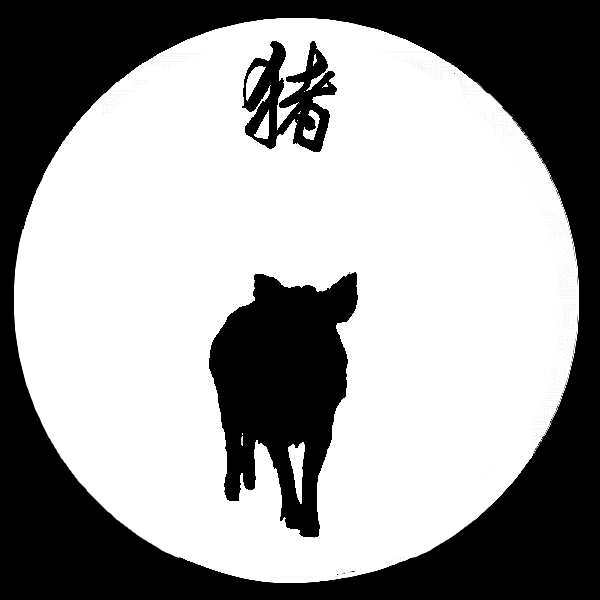
.svg) "Pig" in Traditional (top) and Simplified (bottom) Chinese characters | |
| Traditional Chinese | 豬 |
| Simplified Chinese | 猪 |


The Pig (豬) or sometimes translated as the Boar is the twelfth of the 12-year cycle of animals which appear in Chinese zodiac, in relation to the Chinese calendar and system of horology, and paralleling the system of ten Heavenly Stems and twelve Earthly Branches. Although the term "zodiac" (etymologically referring to a "[circle of] little animals") is used in the phrase "Chinese zodiac", there is a major difference between the Chinese usage and Western astrology: the zodiacal animals (including the zodiacal Pig) do not relate to the zodiac as the area of the sky that extends approximately 8° north or south (as measured in celestial latitude) of the ecliptic, the apparent path of the Sun, the Moon, and visible planets across the celestial sphere's constellations, over the course of the year.[clarification needed]
In Chinese astrology, "zodiacal" animals refer to fixed cycles of twelve animals. The same cycle of twelve is used for cycles of years and cycles of hours. In the case of years, the cycle of twelve corresponds to the twelve-year cycle of Jupiter. In the case of the hours, the twelve hours represent twelve double-hours for each period of night and day. In the continuous sexagenary cycle of sixty years, every twelfth year corresponds to hai, 亥 (the twelfth of the twelve Earthly Branches); this re-recurring twelfth year is commonly called the Year of the Pig (豬年).
There are five types of Pigs, named after the Chinese elements. In order, they are: Metal, Water, Wood, Fire, and Earth. These correspond to the Heavenly Stems. Thus, there are five pig years in every sexagenary cycle. For example, in the year 2019, the Earthly Branch is the twelfth, hài, and the Heavenly Stem is the sixth, jǐ 己. The Chinese New Year in 2019 is February fifth: this corresponds with the beginning of both the sexegenary year of jǐ hài and also the zodiac year of the Earth Pig.
In the Japanese zodiac[1] and the Tibetan zodiac,[2] the Pig is referred to as the boar. In the Dai zodiac, the Pig is replaced by the elephant.[3] In the Gurung zodiac, the Pig is replaced by the deer.[4] The Malay zodiac replaces the Pig with the tortoise.[5]
Pig in the Chinese zodiac legend
[edit]According to the myths, the Pig was the last to arrive when the Jade Emperor called for the great meeting. Other sources said that Buddha called for a great meeting when he was about to leave the Earth. The Pig arrived last.
Yet another legend has it that The Emperor organized a race to ascertain the order of the animals in the Zodiac. The pig not having arrived long after all of the other animals, he was about to call it a day when an oink and squeal were heard. The term "lazy pig" comes from this incident; the Pig had become hungry during the race, stopped for a feast, and then promptly fell asleep. The pig finally completed the race, however, and was accordingly named the 12th and last animal of the zodiac cycle.[6]
Other sources say that given his very stout form, he was just too slow a swimmer, and thus he could not do anything against the other animals (or conversely that he was so fast he went up the wrong side of the river first). [citation needed]
Years and the Five Elements
[edit]

The Pig and the Elements
[edit]The natural element of the Pig is Water. Thus, it is commonly associated with emotions and intuitions. Yet, given that along with the elements (called the Celestial stem), the animal zodiac (called the Earthly stem) also follows a cycle, each of the elements affect the characteristic of the same Earthly stem (see Sexagenary cycle).
However, the Pig is yin, and thus only the negative aspects of the elements can be attached to them, thus only 5 kinds of Pigs are found in the zodiac. They are the following:
- 乙亥 (yǐhài) – The Wood Pig
- 丁亥 (dīnghài) – The Fire Pig
- 己亥 (jǐhài) – The Earth Pig
- 辛亥 (xīnhài) – The Metal Pig
- 癸亥 (guǐhài) – The Water Pig
The Years of the Pig
[edit]
People born within these date ranges can be said to have been born in the "Year of the Pig", while bearing the following elemental sign:
| Start date | End date | Heavenly Branch |
|---|---|---|
| 4 February 1935 | 23 January 1936 | Wood Pig |
| 22 January 1947 | 9 February 1948 | Fire Pig |
| 8 February 1959 | 27 January 1960 | Earth Pig |
| 27 January 1971 | 14 February 1972 | Metal Pig |
| 13 February 1983 | 1 February 1984 | Water Pig |
| 31 January 1995 | 18 February 1996 | Wood Pig |
| 18 February 2007 | 6 February 2008 | Fire Pig |
| 5 February 2019 | 24 January 2020 | Earth Pig |
| 23 January 2031 | 10 February 2032 | Metal Pig |
| 10 February 2043 | 29 January 2044 | Water Pig |
| 28 January 2055 | 14 February 2056 | Wood Pig |
| 14 February 2067 | 2 February 2068 | Fire Pig |
| 2 February 2079 | 21 January 2080 | Earth Pig |
| 18 February 2091 | 6 February 2092 | Metal Pig |
| 7 February 2103 | 28 January 2104 | Water Pig |
Hour of the Pig
[edit]Similarly to the usage of the traditional Japanese clock, each day-night period was divided into 12 double-hours, each of which corresponding with one of the twelve signs of the Chinese zodiac, with similar symbolic motif and astrological significance. The first of the twelve double hours (the Hour of the Rat) encompasses midnight, at the middle of the double hour, corresponding with 11:00 p.m. to 1:00 a.m., with midnight being the midpoint of the first double-hour. The animals in the hourly sequence are the same and in the same order as in the yearly sequence. The Pig is the last in the sequence, with the Hour of the Pig corresponding to the double-hour 9:00 p.m. to 11:00 p.m., also known as the hour hai (亥).[7]
Given that the traditional Chinese day-night cycle was composed of 12 hours, each sign is given to the different signs of the zodiac. The Pig is assigned to govern the time between 21:00 hrs to 22:59 hrs. According to tradition, this is the time when the Pig is doing what it does best (sleeping and enjoying the sweet life).
In terms of astrology, the hours in which people were born (technically termed as the Ascendant) are the second most important facet of their astrology. Thus, this alters greatly the characteristics. Even if people were born in any year governed by another animal (for example, anyone born on 20 December 2000, i.e. year of the Dragon) will display strong characteristics of the Pig. Thus, they may be fierce and strong like the Dragon, but at the same time emotional and intuitive like the Pig.
Basic astrology elements
[edit]| Earthly Branches of Birth Year: | 亥 Hai |
| The Five Elements: | Water |
| The Five Planets: | Mercury |
| Cardinal Point: | North-Northwest (NNW) |
| Yin/ Yang: | Yin |
| Lunar Month: | Tenth |
| House: | XI The karma and unconscious |
| Earthly Branch Ruling Hours: | 21:00 to 22:59 |
| Twelve Heavenly Generals: | Sanskrit: Kiṃbhīra (Hanzi: 宮毘羅) |
| Lucky Flowers: | lily |
| Lucky Numbers: | 2, 5, 6, 8; Avoid: 3, 4, 9 |
| Lucky Colors: | yellow; Avoid: red, blue |
Cultural notes
[edit]Some Chinese Muslims will say that they were born in the year of the hai, 亥 (twelfth and final year of the zodiac) to avoid saying the "Pig".[8] This is because pigs are haram (forbidden to eat) in Islam and therefore Muslims consider pigs unclean.
Increasing numbers of countries and regions now issue lunar new year stamps. For the 2019 Year of the Pig, the USC U.S.-China Institute collected stamps from 56 jurisdictions.[9]
See also
[edit]References
[edit]- ^ "Japanese Zodiac Signs and Symbols". japanesezodiac.org/. 5 January 2012. Retrieved 1 January 2015.
- ^ ricardobaddouh (28 January 2014). "Tibetan Astrology – Table of Year-Animal-Element". Retrieved 9 June 2017.
- ^ "Chinese Zodiac". Warrior Tours. Retrieved 9 June 2017.
- ^ "Tamu (Gurung) Losar Festival". ECS Nepal. 11 July 2010. Archived from the original on 29 July 2017. Retrieved 9 June 2017.
- ^ Farouk Yahya (2015). "Glossary". Magic and Divination in Malay Manuscripts. Brill. p. 296-306. ISBN 978-90-04-30172-6.
- ^ Audrey Lim (3 March 2003). "Legend of the Chinese Zodiac". ThingsAsian. Retrieved 9 June 2017.
- ^ *Palmer, Martin, editor, et al, (1986). T'ung Shu: The Ancient Chinese Almanac. Boston: Shambala. ISBN 0-394-74221-4, pp. 34–35
- ^ Gillette, Maris Boyd (2002). Between Mecca And Beijing. Stanford: Stanford University Press. p. 124. ISBN 9780804764346 – via Google Book Search.
- ^ "Celebrating the Year of the Pig". USC U.S.-China Institute. 4 February 2019. Retrieved 7 February 2019.
Further reading
[edit]- Neil Somerville (2006). Your Chinese Horoscope 2007: What the Year of the Pig Holds for You. HarperCollins. pp. 384. ISBN 9780007211326.
- Neil Somerville (2012). The Pig in 2013: Your Chinese Horoscope. HarperCollins. p. 80. ISBN 9780007478651.
- Neil Somerville (2013). The Pig in 2014: Your Chinese Horoscope. HarperCollins. p. 320. ISBN 9780007537044.
- Neil Somerville (2015). The Pig in 2016: Your Chinese Horoscope. HarperCollins. p. 320. ISBN 9780008138189.
- Neil Somerville (2016). The Pig in 2017: Your Chinese Horoscope. HarperCollins. p. 52. ISBN 9780008205515.
External links
[edit] Media related to Pig (zodiac) at Wikimedia Commons

| Authority control databases: National |
|---|

Pig (zodiac)
View on GrokipediaOrigins and Legend
The Great Race Legend
The Great Race legend serves as the primary mythological explanation for the establishment of the 12-animal Chinese zodiac cycle. In this folk tale, the Jade Emperor, revered as the supreme deity in Chinese cosmology, sought to create an orderly system for measuring time by assigning each year to an animal. To achieve this, he decreed a grand race across a swift river, inviting all creatures to participate; the first twelve to arrive at his heavenly palace would earn a place in the zodiac, with their finishing order dictating the sequence of the cycle. This narrative underscores themes of cunning, perseverance, and chance in determining cosmic order.[6] The race unfolded with notable strategies among the animals. The resourceful Rat hitched a ride on the diligent Ox's back, leaping ahead at the last moment to claim first place, while the Ox secured second. The powerful Tiger swam vigorously to finish third, and the nimble Rabbit used floating logs and stepping stones to bound across fourth. The benevolent Dragon, who paused mid-race to summon rain for drought-stricken lands, arrived fifth. The sly Snake, having concealed itself in the Horse's hoof, startled it to take sixth place, with the Horse following seventh. Meanwhile, the cooperative Goat, Monkey, and Rooster lashed together a raft to cross as a team, earning eighth, ninth, and tenth positions respectively. The playful Dog, distracted by bathing in the river, came eleventh.[7] The Pig's participation highlights a more leisurely or unfortunate approach, resulting in its position as the twelfth and final zodiac animal. In the most common version of the tale, the Pig lagged behind due to its slow pace and distractions; it stopped midway to forage for food and subsequently dozed off, only awakening to trot across the finish line long after the others. This depiction portrays the Pig as naive or easily sidetracked, solidifying its last-place finish despite its determination to complete the course.[8] The Great Race is a traditional Chinese folktale of uncertain origin, likely rooted in oral traditions, while the zodiac system itself was formally documented during the Han Dynasty (206 BCE–220 CE) and has earlier roots in the Warring States period (475–221 BCE). Archaeological evidence, such as zodiac motifs on artifacts from these eras, supports the cultural entrenchment of the animal cycle, with the story serving to anthropomorphize and aid in memorizing the cyclical calendar. The tale's enduring variations reflect regional folklore adaptations across China, transmitted verbally before widespread literary recording in later dynasties.[9]Symbolic Role of the Pig
In Chinese zodiac tradition, the Pig symbolizes abundance and prosperity, often associated with wealth and good fortune due to its representation of fertility and plentiful harvests in ancient agrarian life.[10] This positive archetype is complemented by virtues such as honesty, kindness, and diligence, portraying the Pig as a hardworking and compassionate figure dedicated to supporting others.[11] However, these traits are contrasted with potential shortcomings like gullibility, naivety, and a tendency toward self-indulgence or over-reliance on others, which can lead to vulnerability in social or material pursuits.[4] The Chinese character for Pig, 猪 (zhū), derives from the ancient pictogram 豕 (shǐ), depicting a boar-like form, and is etymologically linked to concepts of home and stability, as seen in the character 家 (jiā, meaning "family" or "home"), which combines 豕 under a roof radical to evoke a pig sheltered within the household—a symbol of secured prosperity.[12] In agrarian societies of ancient China, where pigs were among the earliest domesticated animals after dogs, they served as vital assets for food, labor, and ritual offerings, reinforcing the zodiac Pig's ties to economic abundance and communal well-being.[10] As the twelfth and final animal in the zodiac cycle—stemming from its placement in the Great Race legend—the Pig embodies completion and renewal, marking the end of one phase and the preparation for rebirth with the Rat's arrival.[13] Unlike the Rat's cunning initiation of the cycle or the Dragon's dynamic power, the Pig's symbolism emphasizes closure through generosity and resolve, fostering a sense of fulfilled potential and cyclical harmony.[3]Cyclical Associations
Years of the Pig
The Chinese zodiac operates within the framework of the traditional lunisolar calendar, which combines lunar months of 29 or 30 days with intercalary leap months added roughly every three years to align with the solar year's 365.24 days and maintain harmony with seasonal cycles. In this system, each zodiac year, including those of the Pig, begins on the second new moon after the winter solstice—known as Chinese New Year or the Spring Festival—and typically falls between January 21 and February 20 on the Gregorian calendar. This lunisolar structure ensures that zodiac assignments for births depend on the precise date relative to Chinese New Year, rather than the Gregorian January 1, with leap year adjustments via extra months preventing drift from agricultural and solar events.[14] The Pig appears in the 12-animal cycle every 12 years, but the full 60-year sexagenary cycle incorporates the five elements (wood, fire, earth, metal, water), which cyclically modify each animal's attributes. The following table lists the Pig years from 1959 to 2031, including their elemental designations, Gregorian start and end dates based on Chinese New Year, and notes on leap adjustments where applicable (e.g., years with 13 lunar months due to intercalary insertions).[11]| Year | Element | Start Date (Gregorian) | End Date (Gregorian) | Notes |
|---|---|---|---|---|
| 1959 | Earth | February 8, 1959 | January 27, 1960 | Standard 12 lunar months |
| 1971 | Metal | January 27, 1971 | February 14, 1972 | Standard 12 lunar months |
| 1983 | Water | February 13, 1983 | February 1, 1984 | Standard 12 lunar months |
| 1995 | Wood | January 31, 1995 | February 18, 1996 | 13 lunar months (with intercalary 7th month) |
| 2007 | Fire | February 18, 2007 | February 7, 2008 | Standard 12 lunar months |
| 2019 | Earth | February 5, 2019 | January 24, 2020 | Standard 12 lunar months |
| 2031 | Metal | January 23, 2031 | February 10, 2032 | Standard 12 lunar months (projected) |
Integration with Five Elements
In the Chinese zodiac, the Pig sign (corresponding to the earthly branch Hai) integrates with the Wu Xing (Five Elements) theory, a foundational philosophical framework in ancient Chinese cosmology that posits wood, fire, earth, metal, and water as dynamic phases representing the processes of generation, interaction, and transformation in the universe.[16] According to Wu Xing, these elements operate through two primary cycles: the generation (sheng) cycle, where wood fuels fire, fire creates earth (ash), earth bears metal, metal collects water (condensation), and water nourishes wood (growth); and the conquest (ke) cycle, where wood parts earth, earth absorbs water, water extinguishes fire, fire melts metal, and metal chops wood.[16] These cycles influence the Pig's inherent water-associated qualities—such as adaptability, intuition, and fertility—by modulating its personality traits, fortunes, and interpersonal dynamics in the sexagenary cycle, emphasizing balance and interdependence rather than isolation.[17] The sexagenary cycle, formed by pairing the 10 heavenly stems (each tied to an element and yin-yang polarity) with the 12 earthly branches (zodiac animals), generates 60 unique year designations that repeat every 60 years, allowing the Pig to manifest under each element sequentially across cycles.[17] This elemental overlay refines the Pig's core benevolence and diligence, drawing from Wu Xing's principles to highlight how supportive generation enhances positive traits (e.g., water generating wood for growth in the Wood Pig) while conquest dynamics may introduce challenges (e.g., metal conquering wood, tempering impulsivity in the Fire Pig). For instance, the most recent Earth Pig year was 2019, illustrating the cycle's ongoing relevance.[3] The Wood Pig embodies compassion and growth-oriented tendencies, as the wood element—symbolizing vitality and expansion—amplifies the Pig's nurturing side, fostering empathy, loyalty to family and friends, and a generous spirit that derives pleasure from aiding others, though it may lead to impatience in decision-making.[3][18] The Fire Pig is characterized by passion and impulsivity, with fire's dynamic energy infusing the Pig with adventurous optimism, frank honesty, and enthusiasm that inspires others, yet it can result in inflexibility or hasty actions due to the conquest of water by fire, which tempers the sign's natural calm.[2][19] The Earth Pig reflects stability and generosity, as earth's grounding nature enhances the Pig's reliability, thoughtfulness, and community focus, promoting persistence in goals, sincere kindness, and a realistic approach that builds strong social ties, aligned with earth's role in the generation cycle as a mediator of harmony.[3][20] The Metal Pig demonstrates determination and righteousness, with metal's resilient and refining qualities strengthening the Pig's bravery, broad-mindedness, and independent ideas, often yielding a lively humor and tough resolve, though metal's conquest over wood may introduce a domineering edge to its inherent tolerance.[2][21] The Water Pig highlights intuition and adaptability, leveraging water's fluid essence—naturally resonant with the Pig's branch—to cultivate modesty, quick learning, and empathetic diplomacy, enabling creative problem-solving and a gentle bluntness, bolstered by water's generation of wood for sustained personal evolution.[2][22]| Element | Key Modifying Traits for Pig | Wu Xing Influence Example |
|---|---|---|
| Wood | Compassionate, growth-oriented, empathetic, loyal but impatient | Generation: Water nourishes wood, enhancing nurturing growth.[16] |
| Fire | Passionate, optimistic, frank, energetic but impulsive | Conquest: Fire extinguishes water, adding intensity to calm.[16] |
| Earth | Stable, generous, reliable, thoughtful, community-focused | Generation: Fire produces earth, fostering grounded harmony.[16] |
| Metal | Determined, righteous, brave, humorous, independent | Conquest: Metal collects water, refining resilience.[16] |
| Water | Intuitive, adaptable, modest, diplomatic, creative | Mutual resonance: Water aligns with Pig's inherent fluidity for balance.[16] |