


Community hub
Recent from talks
Contribute something
Nothing was collected or created yet.
Edwin O. Reischauer
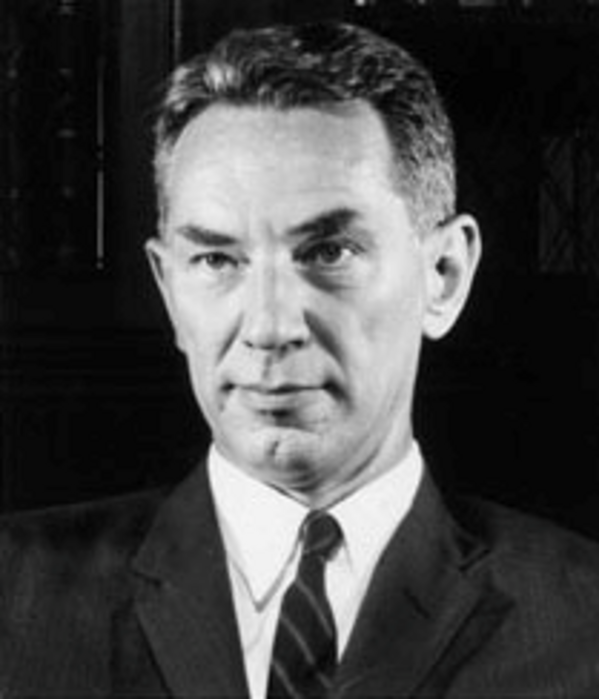
View on WikipediaEdwin Oldfather Reischauer (/ˈraɪʃaʊ.ər/ RYSHE-ow-ər; October 15, 1910 – September 1, 1990) was an American diplomat, educator, and professor at Harvard University. Born in Tokyo to American educational missionaries, he became a leading scholar of the history and culture of Japan and East Asia. Together with George M. McCune, a scholar of Korea and several Korean linguists, in 1939 he developed the McCune–Reischauer romanization of the Korean language.
Key Information


Reischauer became involved in helping create US policy toward East Asia during and after World War II. President John F. Kennedy appointed Reischauer as the United States Ambassador to Japan, where he served from 1961 to 1966. Reischauer founded the Japan Institute at Harvard University in 1973 and was its founding director. It was later named in honor of him.
Early life and education
[edit]Reischauer was born in Tokyo, Japan, the son of Helen Sidwell (Oldfather) and August Karl Reischauer, Presbyterian educational missionaries. His father helped found the Tokyo Woman's Christian University along with Nitobe Inazō and Yasui Tetsu. His mother founded the Japan Deaf Oral School, the first of its kind in Japan. He and his younger brother Robert attended the American School in Japan before going to the United States for college. Both did graduate work in Asian studies. Edwin graduated with a AB from Oberlin in 1931.[1] On his 75th birthday, Reischauer recalled publicly that his aim in life after graduating in 1931 was to draw American attention to Asia.[2]
Reischauer earned his PhD from Harvard University in 1939. He was a student of the Russian-French Japanologist Serge Elisséeff, who had been the first Western graduate of the University of Tokyo.[3] His doctoral dissertation was "Nittō guhō junrei gyōki: Ennin's Diary of His Travels in T'ang China, 838–847," a study and translation of the Japanese monk Ennin's travelogues on his journeys in China during the Tang dynasty.[4] Ennin's work, Record of a Pilgrimage to China in Search of the Law (入唐求法巡礼行記; Middle Chinese: Nyip-Dang gjuw-pjop zwin-léi hæng-kì), is written in Classical Chinese. Reischauer's work shows the high level of Sinological scholarship that a graduate student was expected to demonstrate.[3][5]
Wartime service
[edit]By October 1940, Reischauer had become aware of the possibility of war with Japan. He wrote a memorandum for the U.S. Navy pointing out that very few Americans knew the kind of written Japanese that was used in military situations and hardly any could read Japanese that had been handwritten in a hurry. His solution was to create a Japanese language school to train linguists in advance. Reischauer's warning did not go unheeded. It landed on the desk of Lieutenant (later Commander) Albert Hindmarsh of the U.S. Navy, and he agreed that there were indeed few competent Japanese-speaking officers available. The result was the creation of the U.S. Navy Japanese Language School, which spent most of the war at Boulder, Colorado. In the summer of 1942, at the request of the U.S. Army Signal Corps, Reischauer started running a top-secret course at Arlington Hall in Virginia. Arlington Hall had been a women's college, but it was taken over by the US Army Signal Intelligence Service in June 1942 and functioned like Bletchley Park in England as a secret cryptanalysis centre.[6]
Teaching career
[edit]Reischauer had a 40-year teaching career at Harvard. He and John King Fairbank developed a popular undergraduate survey of East Asian history and culture. The course, which was known as "Rice Paddies", was the basis for their widely influential textbooks, East Asia: The Great Tradition (1958) and East Asia: The Modern Transformation (1965). Reischauer wrote both for fellow scholars and for the general public, including Japan: Story of a Nation, which was published in several editions.
He served as director of the Harvard–Yenching Institute and chairman of the Department of Far Eastern Languages. For his farewell lecture at the Yenching Institute in 1981, students had to compete for seats with faculty colleagues, university officials, and a television crew from Japan.
In that crowded scene, he said, "As I remember, there were only two graduate students interested in East Asian studies when I first came here: myself and my brother."[7]
Ambassador to Japan
[edit]Reischauer was appointed US Ambassador to Japan by President John F. Kennedy in the spring of 1961, at a time when US-Japan relations were at a low point following the massive 1960 protests in Japan against the US-Japan Security Treaty.[8] In the immediate aftermath of the protests, Reischauer had traveled to Japan and spoken with various Japanese friends and associates to get a Japanese point of view on the protests.[9] After returning to the United States, Reischauer attracted the attention of Kennedy's transition team when he wrote an article about the protests in the prominent policy journal Foreign Affairs called "The Broken Dialogue with Japan." In this article Reischauer rejected the notion, put forth by the Eisenhower administration, that the protests had been a communist plot. Instead, he argued that the protests reflected real grievances on the part of the Japanese in relation to US, and were exacerbated by a failure by American leaders to reach out to Japanese opinion leaders and try to understand Japanese concerns. Reischauer argued forcefully that only skillful and nuanced diplomacy could repair this "broken dialogue."[9]
On the advice of his advisors, Kennedy decided that Reischauer himself would be the best candidate for the job, and nominated Reischauer to be his first (and only) ambassador to Japan. This was a break with precedent, because previous ambassadors to Japan had been career State Department officials who had no special connection with Japan.[8] In fact, State Department officials viewed strong connections with an ambassador's host country with suspicion and opposed Reischauer's nomination on these grounds.[8] However, Kennedy prevailed and Reischauer became the first US ambassador to Japan who actually knew the local language.
As Ambassador, Reischauer worked to repair the recent rift in US-Japan relations. Reischauer made "equal partnership" the watchword of his time as ambassador, and constantly pushed for more equal treatment of Japan.[10] He advocated and helped arrange a summit meeting between Kennedy and new Japanese prime minister Hayato Ikeda in Washington, D.C. in the summer of 1961. Historian Nick Kapur has argued that this summit was a success, and led to a substantial realignment of the US-Japan alliance in the direction of greater mutuality.[11] Reischauer hoped to return the favor by having Kennedy become the first sitting US president to visit Japan. Kennedy was agreeable, and initial preparations were made, but Kennedy was assassinated before he could make the visit and Secretary of State Dean Rusk went in his place in early 1964.[12] Reischauer also embarked on a nationwide listening tour in Japan; although he did not reach his goal of visiting all 47 prefectures by the end of his time in office, he did manage to visit 39 of them.[13] Reischauer's great efforts to charm the Japanese people were jocularly nicknamed the "Reischauer Offensive" (Raishawā rosen) by the Japanese press (sometimes alternatively, the "Kennedy-Reischauer Offensive").[13]
Reischauer's time as ambassador was seen as a success, and he stayed in the role until 1966, continuing on under the administration of Lyndon B. Johnson. However, his time as ambassador ended on two notes of tragedy. Toward the end of his ambassadorship, Reischauer increasingly had to defend the US war in Vietnam, and increasingly felt uncomfortable doing so, ultimately leading to his resignation.[14] In addition, Reischauer was hospitalized in March 1964 after being stabbed by Shiotani Norikazu, a Japanese youth, in an apparent assassination attempt. Shiotani had a history of mental illness and had Ménière's disease, a disorder of the inner ear. He felt that he had not been properly treated by the American occupation and wished to draw attention to this cause by assassinating Reischauer. The attacker apparently acted alone and had no connection to any group. In the aftermath of the violence, Japan's Minister of Public Safety was compelled to resign.[15] Reischauer received a blood transfusion and recovered from his wound, but the transfusion he received in the hospital was tainted with hepatitis C virus, which would lead to a variety of ailments for Reischauer in future years, and ultimately contribute to his death 26 years later.[16][17]
Personal life
[edit]Reischauer married (Elinor) Adrienne Danton in Tokyo on July 5, 1935. They had three children together. She died in 1955 of a heart ailment.[18] Author James A. Michener introduced the widower to Haru Matsukata at the Foreign Correspondents Club in Tokyo in 1955.[19] They married on January 16, 1956.[20] They learned that, as teenagers, they had attended the same Tokyo high school. Haru confessed to having had a secret crush on him. Together they became a formidable team.[21] They jointly designed their house in Belmont, Massachusetts. It is operated and used today as the Edwin O. Reischauer Memorial House.
Later life
[edit]In 1973, Reischauer was the founding Director of the Japan Institute at Harvard University. It was renamed the Edwin O. Reischauer Institute of Japanese Studies in his honor when he turned 75, in 1985.[22]
Reischauer was also honored in 1985 by the opening of the Edwin O. Reischauer Center for East Asian Studies at the Paul H. Nitze School of Advanced International Studies (SAIS), part of Johns Hopkins University. Speaking at the dedication ceremonies in Baltimore, Senator Jay Rockefeller, one of Reischauer's former students, described Reischauer as being "what a teacher is meant to be, one who can change the life of his students." At the same event, Japan's ambassador, Nabuo Matsunaga, read a personal message from Prime Minister Yasuhiro Nakasone: "I know of no other man who has so thoroughly understood Japan."[2]
Illness and death
[edit]For the last decade of his life, Reischauer was afflicted by a variety of ailments and illnesses related to the hepatitis infection he had contracted from tainted blood following the attempt on his life while serving as US Ambassador to Japan. As a result of these ailments, Reischauer had to withdraw from active teaching and lecturing. Finally, in 1990, Reischauer succumbed to complications of hepatitis C.[23]
Impact on US foreign policy
[edit]Reischauer promoted US foreign policy both in public and in government on Japan and the rest of Asia after World War II and during the Vietnam War.
World War II and afterward
[edit]On September 14, 1942, three years before the end of World War II, Reischauer, then an instructor in Far Eastern languages at Harvard University, wrote the "Memorandum on Policy towards Japan." It laid out a plan on how the US could attain its postwar objective of "winning the peace" in Asia.[24][25]
According to late 20th-century Japanese historian Takashi Fujitani, the memo revealed a "condescension toward Japanese people" and a "purely instrumentalist and manipulative stance."[26] In the abstract to his article, "The Reischauer Memo: Mr. Moto, Hirohito, and Japanese American Soldiers," Fujitani wrote:
Already at this early date in the war, Reischauer proposed retention of the Japanese emperor as head of a postwar “puppet regime” that would serve U.S. interests in East Asia. He also argued that Japanese Americans had until then been a “sheer liability” and that the United States could turn them into an “asset” by enlisting them in the U.S. military. He reasoned that Japanese American soldiers would be useful for propaganda purposes – that is, to demonstrate to the world and particularly the “yellow and brown peoples” that the United States was not a racist nation.[27]
Myth of saving Kyoto
[edit]During the war, Reischauer served as a Japan expert for the US Army Intelligence Service. A myth developed after the war that he had prevented the US from a nuclear bombing of Kyoto.[28] Robert Jungk, in his memoir about the war and atomic scientists, claimed that Reischauer convinced his boss to persuade Secretary of War Henry L. Stimson not to bomb Kyoto, and to have it crossed off the black list of potential sites.[29]
Reischauer specifically denied that popular myth:
I probably would have done this if I had ever had the opportunity, but there is not a word of truth to it. As has been amply proved by my friend Otis Cary of Doshisha in Kyoto, the only person deserving credit for saving Kyoto from destruction is Henry L. Stimson, the Secretary of War at the time, who had known and admired Kyoto ever since his honeymoon there several decades earlier.[30]
US bases in Okinawa
[edit]A secret memorandum, declassified in 1996, detailed a conversation among top US military and civilian officials on July 16, 1965, in Tokyo. Reischauer, then serving as the US Ambassador to Japan, proposed a plan to enable the US both to keep its military bases and to introduce nuclear weapons in Okinawa after the reversion of the US-occupied islands to Japanese sovereignty. Reischauer based his strategy on the symbolic political importance of reversion for Japan's conservative ruling party, but argued that the US did not have to "give Japan any real say in the use of our bases."[31]
He said that "if Japan would accept nuclear weapons on Japanese soil, including Okinawa, and if it would provide us with assurances guaranteeing our military commanders effective control of the islands in time of military crisis, then we would be able to keep our bases on the islands, even though 'full sovereignty' reverted to Japan."[31]
These "became key elements [of] the 1969 U.S.-Japan Okinawa Reversion Agreement," effectively making "U.S. military presence more or less permanent and maintaining the option to introduce nuclear weapons."[26] In a 1981 article, Time reported: "Former U.S. Ambassador to Japan Edwin O. Reischauer revealed that ...U.S. naval vessels carrying nuclear weapons have routinely visited Japanese ports—with Tokyo's tacit approval."[32]
The secret memo also revealed Reischauer's proposed countermeasures to quell "nationalistic reaction" to continuing US military presence in Okinawa. In his 2010 article, "'Secret' 1965 Memo Reveals Plans to Keep U.S. bases and Nuclear Weapons Options in Okinawa After Reversion," Steve Rabson, author and lecturer on Okinawan literature, history, and culture, wrote:
To reduce the risk of “disturbances” in Okinawa, Reischauer proposed an increase in U.S. aid, revision of the Price Act to increase compensation for owners of land the U.S. had seized for base construction, and a loosening of the ban on flying the Japanese flag. It is difficult to measure precisely his influence at the time, but all three of these recommendations became U.S. policy.[26]
Romanization of Korean
[edit]With George M. McCune, Reischauer in 1939 published the McCune–Reischauer system for romanization of the Korean language, which became the most-widely used system for many years.[33]
Reischauer called Hangul, the Korean alphabet, "perhaps the most scientific system of writing in general use in any language."[34]
Honors
[edit]- Elected to the American Academy of Arts and Sciences, 1957[35]
 Grand Cordon of the Order of the Rising Sun, 1968
- Elected to the American Philosophical Society, 1973[36]
- Japan Foundation Award, 1975[37]
- Edwin O. Reischauer Center for East Asian Studies at Johns Hopkins, 1984.[38]
- Edwin O. Reischauer Institute of Japanese Studies (RIJS) at Harvard, 1985[39]
- Edwin O. Reischauer Lectures, series of lectures from 1986 given at Harvard

Notable students
[edit]- Gail Lee Bernstein (University of Arizona)
- Albert M. Craig (Harvard University)
- John W. Dower (Massachusetts Institute of Technology)
- John Whitney Hall (Yale University)
- Howard Hibbett (Harvard University)
- Marius Jansen (Princeton University)
- Joyce Chapman Lebra (University of Colorado)
- John Curtis Perry (The Fletcher School, Tufts University)
- Sen. Jay Rockefeller
- Robert A. Scalapino (University of California at Berkeley)
- Conrad Totman (Yale University)
- Edward Willett Wagner (Harvard University)
Selected bibliography
[edit]The statistical overview of writings by and about Reischauer, OCLC/WorldCat encompasses some 300 works in more than 1000 publications in 18 languages and more than 23,000 library holdings.[40]
- The Romanization of the Korean language, Based Upon Its Phonetic Structure (1939) with G. M. McCune[41][42]
- Elementary Japanese for University Students (1942) with S. Elisséeff
- Japan: Past and Present (1946; rev. ed. 1952, 1964)
- The United States and Japan (1950; rev. ed. 1957, 1965)
- Translations from Early Japanese Literature (1951) with Joseph Yamagiwa
- Ennin's Travels in T'ang China (1955; reprinted, Angelico Press, 2020)
- Ennin's Diary: The Record of a Pilgrimage to China in Search of the Law (1955; reprinted, Angelico Press, 2020), translated from Chinese
- Wanted: An Asian Policy (1955)
- Our Asian Frontiers of Knowledge (1958)
- East Asia: The Great Tradition (1960) with J. K. Fairbank
- East Asia, The Modern Transformation (1965) with J. K. Fairbank and A. M. Craig
- A History of East Asian Civilization (1965)
- Beyond Vietnam: The United States and Asia (1968)
- Japan: The Story of a Nation (1970; rev. ed. 1974, 1981, 1990)
- A New Look at Modern History (1972)
- Translations from Early Japanese Literature (1972) with Joseph K. Yamagiwa
- Toward the 21st century: Education for a Changing World (1973)
- East Asia, Tradition and Transformation (1973; rev. ed. 1989) with J. K. Fairbank and A. M. Craig
- The Japanese (1977)
- My Life between Japan and America (1986, autobiography)
- The United States and Japan in 1986: Can the Partnership Work? (1986)
- The Japanese Today: Change and Continuity (1988; rev. ed. with Marius B. Jansen 1995)
- Japan, Tradition and Transformation (1989)
See also
[edit]


Citations
[edit]- ^ "Edwin O. Reischauer". Reischauer Institute of Japanese Studies, Harvard University. Archived from the original on 2014-07-04. Retrieved July 17, 2014.
- ^ a b "Reischauer is Feted in Capital". The New York Times. October 16, 1985.
- ^ a b Zurndorfer, Harriet Thelma. (1995). China Bibliography: A Research Guide to Reference Works About China Past and Present, p. 31 n85.
- ^ Schulman, Frank Joseph. (1970). Japan and Korea: An Annotated Bibliography of Doctoral Dissertations in Western Languages, 1877–1969, p. 909. (Reischauer 1610)
- ^ Edwin O. Reischauer (1939). Nittō Guhō Junrei Gyōki: Ennin's Diary of His Travels in T'ang China (838–847) (PhD). OCLC 76996908.
- ^ Peter Kornicki, Eavesdropping on the Emperor: Interrogators and Codebreakers in Britain's War with Japan (London: Hurst & Co., 2021), pp. 181, 184-5, 191.
- ^ Johnston, Laurie and Robert Thomas. "Notes on People; Reischauer, at Harvard, Gives Farewell Lecture", The New York Times. April 23, 1981.
- ^ a b c Kapur, Nick (2018). Japan at the Crossroads: Conflict and Compromise after Anpo. Cambridge, Massachusetts: Harvard University Press. p. 51. ISBN 9780674988484.
- ^ a b Kapur, Nick (2018). Japan at the Crossroads: Conflict and Compromise after Anpo. Cambridge, Massachusetts: Harvard University Press. p. 46. ISBN 9780674988484.
- ^ Kapur, Nick (2018). Japan at the Crossroads: Conflict and Compromise after Anpo. Cambridge, Massachusetts: Harvard University Press. pp. 53–4. ISBN 9780674988484.
- ^ Kapur, Nick (2018). Japan at the Crossroads: Conflict and Compromise after Anpo. Cambridge, Massachusetts: Harvard University Press. pp. 54–74. ISBN 9780674988484.
- ^ Kapur, Nick (2018). Japan at the Crossroads: Conflict and Compromise after Anpo. Cambridge, Massachusetts: Harvard University Press. p. 50. ISBN 9780674988484.
- ^ a b Kapur, Nick (2018). Japan at the Crossroads: Conflict and Compromise after Anpo. Cambridge, Massachusetts: Harvard University Press. p. 53. ISBN 9780674988484.
- ^ Packard, George (2010). Edwin O. Reischauer and the American Discovery of Japan. New York: Columbia University Press. pp. 213–35. ISBN 9780231512770.
- ^ Ford, Franklin L. (1987). Political Murder: From Tyrannicide to Terrorism. Cambridge, MA: Harvard University Press. p. 310. ISBN 978-0-674-68636-6. Retrieved 24 August 2012.
- ^ Packard, George (2010). Edwin O. Reischauer and the American Discovery of Japan. New York: Columbia University Press. pp. 203–213. ISBN 9780231512770.
- ^ McCurry J (2008). "Japan compensates some of its hepatitis C victims". Lancet. 371 (9618): 1061–1062. doi:10.1016/s0140-6736(08)60469-9. PMID 18380033.
- ^ Edwin O. Reischauer, My Life between Japan and America, John Weatherhill, Inc., pp. 57 and 137
- ^ Reischauer, My Life, p.140
- ^ Reischauer, My Life, p. 142
- ^ "Haru M. Reischauer, 83; Eased Tensions With Japan", The New York Times. October 5, 1998.
- ^ Reischauer Institute of Japanese Studies (RIJS), Director, 1974–1981
- ^ "Edwin O. Reischauer, Japan Expert, Dies", The Harvard Crimson. September 10, 1990.
- ^ Rabson, Steve. "'Secret' 1965 Memo Reveals Plans to Keep US bases and Nuclear Weapons Options in Okinawa After Reversion", The Asia-Pacific Journal, 5-1-10, February 1, 2010
- ^ Fujitani, T (2001). "The Reischauer Memo: Mr. Moto, and Japanese American Soldiers". Critical Asian Studies. 33 (3): 379–402. doi:10.1080/14672710122556. S2CID 143350660.
- ^ a b c Rabson 2010
- ^ Fujitani, T. (2001). "THE REISCHAUER MEMO: Mr. Moto, Hirohito, and Japanese American Soldiers". Critical Asian Studies. 33 (3): 379–402. doi:10.1080/14672710122556. S2CID 143350660.
- ^ Kelly, Jason M. (2012). "Why Did Henry Stimson Spare Kyoto from the Bomb? Confusion in Postwar Historiography". Journal of American-East Asian Relations. 19 (2): 183–203. doi:10.1163/18765610-01902004.
- ^ Jungk, Robert. (1959). Brighter Than a Thousand Suns: A Personal History of the Atomic Scientists, p. 178.
- ^ Reischauer, Edwin. (1986). My Life Between Japan And America, p. 101.
- ^ a b "Memorandum of Conversation: U.S. Policy in the Ryukyu Islands". July 16, 1965. Record Number 79651
- ^ "Japan: Time to Confess, Nuclear 'Lie' Strains U.S. Ties", Time, June 8, 1981
- ^ G. M. A. McCune, E. O. Reischauer, Royal Asiatic Society. Korea Branch, The Romanization of the Korean Language: Based Upon Its Phonetic Structure (Korea Branch of the Royal Asiatic Society, 1939).
- ^ Hyun, Peter. "A Trove of Unfamiliar Art from Korea", The New York Times. January 4, 1981.
- ^ "Edwin Oldfather Reischauer". American Academy of Arts & Sciences. Retrieved 2022-08-11.
- ^ "APS Member History". search.amphilsoc.org. Retrieved 2022-08-11.
- ^ Japan Foundation Archived 2008-03-11 at the Wayback Machine
- ^ Nitze School for Advanced International Studies (SAIS), Reischauer Center for East Asian Studies Archived 2010-11-28 at the Wayback Machine
- ^ RIJS Archived 2010-10-12 at the Wayback Machine named in his honor when he turned 75 in 1985.
- ^ WorldCat Identities Archived December 30, 2010, at the Wayback Machine: Reischauer, Edwin O. (Edwin Oldfather) 1910–1990
- ^ "Archived copy". Archived from the original on 2018-08-07. Retrieved 2018-08-06.
{{cite web}}: CS1 maint: archived copy as title (link) - ^ "Archived copy" (PDF). Archived from the original (PDF) on 2016-08-29. Retrieved 2018-08-06.
{{cite web}}: CS1 maint: archived copy as title (link)
General sources
[edit]- Chapin, Emerson. "Edwin Reischauer, Diplomat and Scholar, Dies at 79", The New York Times. September 2, 1990.
- Deptula, Nancy Monteith and Michael M. Hess. (1996). The Edwin O. Reischauer Institute of Japanese Studies: A Twenty-Year Chronicle. Cambridge: Reischauer Institute, Harvard University.
- Haberman, Clyde. "Books, East and West: My Life Between Japan and America by Edwin O. Reischauer", The New York Times. August 20, 1986.
- Kapur, Nick (2018). Japan at the Crossroads: Conflict and Compromise after Anpo. Cambridge, MA: Harvard University Press. ISBN 978-0-6749-8442-4.
- McDowell, Edwin. "Major Encyclopedia on Japan Written in English". The New York Times. October 11, 1983.
- Packard, George R. Edwin O. Reischauer and the American Discovery of Japan (New York: Columbia University Press, 2010). ISBN 978-0-231-14354-7
- Rabson, Steve. "'Secret' 1965 Memo Reveals Plans to Keep U.S. bases and Nuclear Weapons Options in Okinawa After Reversion", The Asia-Pacific Journal, 5-1-10, February 1, 2010.
- Reischauer, Edwin (1986). My Life Between Japan And America. New York: Harper & Row.
- Schulman, Frank Joseph. (1970). Japan and Korea: An Annotated Bibliography of Doctoral Dissertations in Western Languages, 1877–1969. London: Routledge. ISBN 978-0-7146-2691-8
- Zurndorfer, Harriet Thelma. (1995). China Bibliography: A Research Guide to Reference Works About China Past and Present. Leiden: Brill Publishers. ISBN 978-90-04-10278-1 (cloth) (reprinted by University of Hawaii Press, Honolulu, 1999). ISBN 978-0-8248-2212-5 (paper)
External links
[edit] Media related to Edwin O. Reischauer at Wikimedia Commons
 Works by or about Edwin O. Reischauer at Wikisource
- Works by or about Edwin O. Reischauer at the Internet Archive


| Resident Minister | |
|---|---|
| Envoy Extraordinary and Minister Plenipotentiary | |
| Ambassador Extraordinary and Plenipotentiary | |

Edwin O. Reischauer
View on GrokipediaEdwin Oldfather Reischauer (October 15, 1910 – September 1, 1990) was an American scholar and diplomat who specialized in Japanese history, language, and United States-Japan relations.[1][2] Born in Tokyo to Presbyterian missionary parents, Reischauer acquired fluency in Japanese during his childhood and survived the 1923 Great Kantō earthquake while attending school there.[3] He earned a bachelor's degree from Oberlin College in 1931 and a doctorate from Harvard University in 1939, where he joined the faculty and contributed to establishing Japanese studies as a rigorous academic discipline.[2] During World War II, Reischauer worked in military intelligence, analyzing Japanese communications for the Office of Strategic Services, and afterward advised on U.S. occupation policies in Japan.[1] Appointed by President John F. Kennedy, he served as U.S. Ambassador to Japan from 1961 to 1966, navigating tensions over issues like the Vietnam War protests and the renewal of the U.S.-Japan security treaty amid anti-American demonstrations.[4][5] As director of Harvard's East Asian Research Center (later renamed the Edwin O. Reischauer Institute of Japanese Studies), he expanded interdisciplinary programs on Asia, authoring influential books such as The United States and Japan (1950) that promoted mutual understanding between the two nations.[4] His efforts bridged scholarly analysis with policy, emphasizing Japan's post-war democratization and economic resurgence while critiquing isolationist tendencies in American foreign policy toward Asia.[1]
Early Life and Education
Childhood and Family Background in Japan
Edwin Oldfather Reischauer was born on October 15, 1910, in Tokyo, Japan, to August Karl Reischauer and Helen Sidwell Oldfather, American Presbyterian missionaries dedicated to educational work.[1][3] His father, a scholar of Japanese history and Buddhism, had arrived in Japan in 1901 after studying at Princeton Theological Seminary and Yale, while his mother supported the family's missionary efforts focused on deaf education.[6] The couple founded Japan's first school for the deaf in Kyoto in 1908, reflecting their emphasis on specialized Christian education amid Japan's Meiji-era modernization.[7] Reischauer's family included an older brother, Robert Karl, born in 1907, and a younger sister, Felicia, who was deaf and benefited from the parents' institutional work.[8] The Reischauers resided primarily in Tokyo after the Kyoto school's establishment, where August Karl balanced missionary duties with academic pursuits, including translations of Japanese historical texts.[6] This environment exposed young Edwin to Japanese language and customs from infancy, fostering bilingualism, though the family's expatriate status limited deeper integration into local society beyond professional interactions.[3] During his childhood, Reischauer attended the American School in Tokyo, an institution serving missionary and diplomatic children with a curriculum blending Western education and exposure to Japanese culture.[1] Between ages eight and twelve, he and his brother experienced periodic adjustments to boarding arrangements tied to their parents' travels, underscoring the transient nature of missionary family life in early 20th-century Japan.[8] This period until his mid-teens shaped his early affinity for Japan, informed by direct observation of societal changes under Taishō-era reforms rather than abstract study.[9]Formal Academic Training
Reischauer commenced his formal higher education in the United States at age sixteen, enrolling at Oberlin College, where he earned a Bachelor of Arts degree in 1931 and was elected to Phi Beta Kappa for academic excellence.[1][10] He then pursued graduate studies at Harvard University, obtaining a Master of Arts degree in 1932.[1] Following his master's, Reischauer conducted postgraduate research in Japan and China to deepen his expertise in East Asian languages and history, before returning to Harvard to complete his Doctor of Philosophy in 1939 under the supervision of Serge Elisséeff, a pioneering scholar in Japanese studies.[1][3] His doctoral work focused on Japanese history and philology, building on his early fluency in Japanese acquired during childhood in Tokyo, and positioned him to teach in Harvard's newly formed Department of Far Eastern Languages by the late 1930s.[3] This training emphasized rigorous linguistic analysis and historical methodology, reflecting Elisséeff's influence in establishing Western academic standards for East Asian studies.[3]Scholarly and Wartime Contributions
Development of Korean Romanization System
During a research trip to Korea in the summer of 1937, Edwin O. Reischauer collaborated with American scholar George M. McCune to develop a new romanization system for the Korean language, addressing limitations in prior methods such as the Japanese-imposed system enforced during colonial rule.[3][11] The McCune-Reischauer system prioritized a balance between phonetic accuracy—approximating Korean pronunciation for non-speakers—and orthographic fidelity to Hangul structure, incorporating diacritical marks (e.g., macrons for long vowels and breves for tense consonants) while avoiding excessive complexity for typewriter use in the pre-digital era.[12] The system was formally published in 1939 through the Transactions of the Korea Branch of the Royal Asiatic Society, marking its debut as a standardized tool for Western scholars studying Korean texts amid limited Hangul familiarity outside East Asia.[13][14] Reischauer's contribution stemmed from his linguistic expertise gained through childhood immersion in Japanese and self-study of related East Asian scripts, enabling him to refine rules for consonant aspiration and vowel harmony that McCune, a Korea-focused historian, had initially outlined.[3] This romanization gained traction in academic and library contexts, particularly in North America, where it became the de facto standard for Korean studies until the late 20th century, influencing transliterations in publications and catalogs despite later national shifts like South Korea's adoption of Revised Romanization in 2000.[15] Its enduring utility lay in facilitating precise scholarly access to Korean historical and literary sources without requiring native proficiency, though critics later noted ambiguities in handling certain diphthongs and regional dialects.[11]Intelligence Service During World War II
During World War II, Edwin O. Reischauer contributed to U.S. military intelligence efforts as a commissioned officer in the United States Army, leveraging his expertise in Japanese language and culture following the attack on Pearl Harbor on December 7, 1941.[16] He served in the Military Intelligence Service (MIS) of the War Department General Staff, where he focused on training personnel for signals intelligence operations against Japan.[17] In spring 1942, Reischauer initiated an intensive Japanese language course at Harvard University to address the urgent wartime demand for linguists capable of supporting cryptanalysis.[3] He soon relocated to Washington, D.C., to direct a specialized Japanese training school for the Army Signal Corps at a secret facility, instructing cryptanalysts in advanced language skills essential for decoding Japanese communications.[3][16] This program operated at Arlington Hall Station, the Army's primary signals intelligence site, where Reischauer served as one of the key instructors, emphasizing practical proficiency for intercepting and translating enemy messages.[18] Reischauer's role extended to analyzing intercepted intelligence and serving as director of the Language Liaison Group within the MIS, facilitating coordination between linguists and codebreakers to enhance the effectiveness of U.S. signals intelligence in the Pacific theater.[19] His efforts helped build a cadre of Japanese-speaking specialists, contributing to the Allied decryption of Japanese diplomatic and military codes, though specific operational impacts remained classified for decades post-war.[20] As a Japan expert, he also advised on broader intelligence assessments, countering misconceptions about Japanese society that could hinder strategic planning.[2]Academic Career
Pre-Ambassadorial Teaching at Harvard
Reischauer returned to Harvard University in 1946 after wartime service in U.S. intelligence, resuming his faculty role focused on Japanese language and history amid the postwar expansion of East Asian studies. He initially held the position of professor of Far Eastern languages from 1946 to 1950, transitioning to professor of Japanese history from 1950 until his departure for diplomatic service in 1961. During this period, he collaborated with department chair Serge Elisséeff to transform Harvard's Japanese language offerings from rudimentary classes into a structured, multi-year curriculum that emphasized practical proficiency and cultural context.[3] A cornerstone of his teaching was the co-development, with historian John K. Fairbank, of the undergraduate survey course "East Asian Civilizations," affectionately nicknamed "Rice Paddies" by students for its vivid depictions of agrarian societies. First offered in the late 1930s and formalized postwar, the course—spanning Reischauer's first term on Japanese topics followed by Fairbank's on China—introduced thousands of undergraduates to the historical, cultural, and social dynamics of East Asia, integrating lectures with lantern slides for visual engagement. It became a flagship of Harvard's General Education program, enduring beyond Reischauer's tenure and influencing generations of scholars by prioritizing empirical historical analysis over ideological narratives.[4][21] From 1956 to 1961, Reischauer directed the Harvard-Yenching Institute, an advanced research center for East Asian languages and civilizations funded by the Rockefeller Foundation, where he oversaw fellowships, publications, and interdisciplinary training for graduate students and faculty. Under his leadership, the institute supported dictionary projects, translation efforts, and fieldwork, fostering rigorous philological and historical scholarship while navigating Cold War-era demands for area expertise. His pre-ambassadorial classroom emphasis on Japan's premodern traditions, Meiji modernization, and imperial expansion equipped students with tools for understanding contemporary Asia, drawing on his firsthand linguistic fluency and archival research rather than secondary interpretations.[1][22]Post-Ambassadorship Academic Roles
Upon returning to Harvard University in the fall of 1966 following his resignation as U.S. Ambassador to Japan, Edwin O. Reischauer resumed his faculty position as a University Professor, a senior rank reflecting his expertise in East Asian studies.[4][22] In this role, he focused on undergraduate and graduate instruction, leveraging his diplomatic experience to emphasize practical insights into Japanese history, politics, and U.S.-Asia relations.[4] Reischauer continued teaching his longstanding course "Rice Paddies," formally titled East Asian Civilizations, which was part of Harvard's General Education curriculum and drew large enrollments for its accessible overview of regional history and culture.[4] He also offered specialized seminars, including Japanese Government and Politics in the Government Department and The United States and East Asia in the History Department, incorporating contemporary developments such as postwar Japanese society and bilateral security dynamics informed by his ambassadorship.[4] These courses highlighted his shift toward modern Japan, producing educational materials like videotaped lectures on Japanese history distributed for broader use.[4] In addition to teaching, Reischauer contributed to curriculum development by co-authoring East Asia: Tradition and Transformation in 1973 with John K. Fairbank and Albert M. Craig, a widely used textbook that integrated historical analysis with modern transformations across the region.[4] He retired from active teaching in 1981 after over four decades at Harvard but maintained influence through advisory roles in East Asian programs until the mid-1980s.[4]Diplomatic Career
Appointment and Tenure as U.S. Ambassador to Japan
President John F. Kennedy nominated Edwin O. Reischauer, a Harvard professor and Japan-born scholar fluent in the Japanese language, as United States Ambassador to Japan on March 29, 1961, marking an atypical selection of an academic specialist rather than a career foreign service officer.[10] The Senate confirmed the appointment, and Reischauer presented his credentials to Japanese authorities on April 27, 1961.[23] His expertise in Japanese history and culture positioned him to bridge bilateral understanding at a time of lingering tensions from the 1960 U.S.-Japan security treaty protests. Reischauer's five-year tenure emphasized fostering an "equal partnership" between the two nations, drawing on his personal ties to Japan and scholarly insights to enhance diplomatic engagement.[4] He worked to promote mutual respect and cooperation, contributing to Japan's increased outward orientation in international affairs, including hosting its first ministerial-level conference in April 1966.[24] His approachable style and cultural affinity earned widespread popularity among Japanese officials and the public, helping to mitigate anti-American sentiments in media coverage of issues like the Vietnam War.[25] A significant incident occurred on March 24, 1964, when Reischauer was stabbed in the abdomen by a deranged 23-year-old Japanese ultranationalist at the entrance to the U.S. Embassy in Tokyo, necessitating the surgical removal of a kidney and leading to chronic health issues.[26] Despite recovering sufficiently to continue his duties, the attack underscored vulnerabilities in personal security amid volatile domestic politics. Reischauer submitted his resignation in April 1966, formally leaving the post on August 19, 1966, primarily to resume his academic career at Harvard after deeming his diplomatic objectives achieved, with U.S.-Japan relations markedly strengthened.[27][24] U.S. Senators J. William Fulbright and Mike Mansfield lauded his unique qualifications and contributions to bilateral ties upon his departure.[24]Handling of Key Crises and Security Treaty Revisions
During his ambassadorship from March 1961 to 1966, Edwin O. Reischauer focused on stabilizing U.S.-Japan relations strained by the 1960 revision of the U.S.-Japan Security Treaty, which had sparked massive Anpo protests and contributed to the resignation of Prime Minister Nobusuke Kishi.[25] The revised Treaty of Mutual Cooperation and Security, signed on January 19, 1960, replaced the 1951 agreement with provisions for mutual defense obligations, prior consultation on U.S. force deployments, and indefinite duration subject to review after ten years, aiming for greater equality but fueling leftist opposition to perceived subordination and U.S. bases.[28] Reischauer, leveraging his scholarly expertise and fluency in Japanese, prioritized public diplomacy to counter anti-American narratives, engaging intellectuals, media, and politicians to emphasize shared interests in economic and security stability amid Cold War tensions.[25] A major challenge emerged with the escalation of the Vietnam War in 1964-1965, which intensified domestic protests in Japan against U.S. policy and the security alliance's implications for base usage and potential Japanese entanglement.[28] Japanese public opinion polls from the period showed widespread disapproval of U.S. bombing campaigns, with leftist groups exploiting the issue to rally against the treaty ahead of its 1970 review clause.[28] Reischauer responded by publicly critiquing Japanese media for biased coverage that amplified anti-U.S. sentiment without balanced reporting on North Vietnamese actions, which he argued stemmed from insufficient understanding of the conflict's complexities; this intervention reportedly moderated press tone and curbed a surge in demonstrations.[25] In a March 1964 memorandum to Secretary of State Dean Rusk, he urged a proactive U.S. strategy to integrate Japan more actively into regional security without alienating nationalists, recommending increased aid to the Ryukyu Islands (under U.S. administration, home to key bases affecting 900,000 ethnic Japanese) from $20 million to $50 million annually to mitigate grievances over reversion and basing rights.[28] Reischauer also navigated internal crises tied to the treaty's basing provisions, including friction over U.S. nuclear-armed vessel visits—later acknowledged in declassified documents as occurring without explicit prior consultation, despite Japanese non-nuclear principles—and the persistent presence of approximately 50,000 U.S. troops.[29] His approach emphasized "prior consultation" mechanisms introduced in the 1960 treaty to inform Japan of major actions, fostering trust while defending bases as essential for deterring Soviet and Chinese threats; he viewed Japanese aloofness in crises as a historical pattern but advocated evolving it toward cooperative burden-sharing.[28] By 1966, these efforts had diminished prospects for treaty abrogation in 1970, as leftist momentum waned and bilateral dialogue strengthened, though challenges like Okinawa's status persisted until later reversion talks.[25] A personal incident underscored the volatility: on March 24, 1964, Reischauer was stabbed by a right-wing assailant protesting government ties to the U.S., severing his femoral artery and requiring emergency surgery, yet he downplayed it as isolated extremism rather than systemic failure.[30]Foreign Policy Views and Controversies
Advocacy for Realistic U.S.-Japan Partnership
Reischauer consistently argued that the United States and Japan, as the two leading industrial powers on the Pacific rim, formed a natural partnership essential for regional stability and economic prosperity, emphasizing pragmatic cooperation over ideological alignment. In his 1950 book The United States and Japan, he highlighted the need for Americans to grasp Japan's unique historical and cultural context to avoid missteps in bilateral relations, advocating for policies that recognized Japan's post-war vulnerabilities while leveraging shared democratic values for mutual benefit.[31] This work, revised in 1957 and 1965, underscored realistic expectations by detailing the successes of the U.S. occupation—such as democratic reforms and economic recovery—while cautioning against over-idealizing Japan's rapid transformation without addressing lingering anti-American sentiments rooted in wartime experiences.[32] In a 1960 Foreign Affairs article titled "The Broken Dialogue with Japan," Reischauer critiqued the superficial nature of U.S.-Japan exchanges, urging a deeper, fact-based dialogue to rebuild trust amid tensions over the 1960 security treaty revisions. He contended that realistic appraisals of Japan's pacifist constitution and economic priorities would strengthen the alliance, rather than forcing Japan into uncomfortable military roles that could exacerbate domestic opposition.[33] This perspective informed his ambassadorship (1961–1966), during which he navigated protests against U.S. bases by promoting the treaty as a practical deterrent to Soviet and Chinese threats, while privately advising Washington to respect Japanese public opinion to sustain long-term partnership.[28] Upon retiring as ambassador on January 25, 1966, Reischauer reiterated in public statements that the U.S. and Japan must prioritize their "essential partnership" through candid acknowledgment of differences, such as Japan's aversion to overt militarism, to counterbalance communist expansion in Asia without unrealistic demands for Japanese rearmament.[34] He viewed equality in the relationship as key, rejecting paternalistic U.S. attitudes that treated Japan as a subordinate, and instead favored joint initiatives in trade and technology to align incentives. Later reflections, such as in 1978 lectures, affirmed Japan's democratic maturation as validating this approach, with broad Japanese consensus supporting close U.S. ties for security and growth.[35] Reischauer's framework thus emphasized causal links between mutual understanding, economic interdependence, and geopolitical realism, influencing subsequent U.S. policy toward a balanced alliance.[9]Debunking Myths and Addressing Criticisms of Wartime Role
A persistent myth claims that Reischauer personally intervened to prevent the atomic bombing of Kyoto, crediting him with single-handedly saving the city due to his expertise and affinity for Japanese culture. Reischauer explicitly denied this assertion, noting he had no direct involvement in atomic target selection.[36] The decision to exclude Kyoto originated with Secretary of War Henry L. Stimson, who on July 25, 1945, directed its removal from the atomic target list—initially proposed for its industrial value—to preserve a cultural center that could aid in Japan's post-war rehabilitation and reduce resentment during occupation.[37] Stimson's rationale emphasized strategic psychology over sentiment, arguing that destroying Kyoto's temples and shrines would harden Japanese resistance and complicate governance, a view informed by his own pre-war visits to the city rather than Reischauer's input.[38] Reischauer's actual wartime duties focused on signals intelligence and linguistic support, not bombing policy. Commissioned as a lieutenant colonel in U.S. Army Intelligence Service in 1943, he contributed to the top-secret MAGIC project by analyzing decrypted Japanese diplomatic cables, which provided insights into Tokyo's negotiations and military intentions.[6] He also instructed codebreakers and analysts in Japanese language and nuances at Arlington Hall Station, enhancing the U.S. capacity to process intercepts from operations like ULTRA and MAGIC, which yielded over 10,000 daily translations by 1945.[18] These efforts supported broader Allied strategy, including assessments of Japanese elite dynamics that informed occupation planning, but remained analytical rather than decisional. Criticisms portraying Reischauer as unduly pro-Japanese during the war often arise from his missionary upbringing in Japan and linguistic fluency, implying bias that softened U.S. resolve. Such views overlook the empirical value of his counsel: he urged realistic evaluations of Japanese societal structures over blanket demonization, advice that aligned with causal necessities for intelligence accuracy and post-surrender stability, as evidenced by its partial adoption in State Department planning despite initial military skepticism.[39] No declassified records indicate disloyalty or sabotage; instead, his work expedited code exploitation, contributing to victories like Midway, where linguistic decoding proved pivotal. Post-war, these contributions transitioned seamlessly into his advisory roles, underscoring their alignment with U.S. objectives rather than personal favoritism. Claims of wartime leniency thus conflate expertise with advocacy, ignoring the distinction between descriptive analysis and prescriptive policy.Positions on Military Bases and Japanese Pacifism
Reischauer consistently advocated for the retention of U.S. military bases in Japan as a cornerstone of the bilateral security alliance, emphasizing their role in deterring regional threats and ensuring mutual defense commitments under the 1960 U.S.-Japan Security Treaty. In a classified 1965 memorandum drafted while serving as ambassador, he proposed post-reversion arrangements for Okinawa that would preserve U.S. command authority over bases during crises, predicting that Japan's Liberal Democratic Party would prioritize symbolic reversion over substantive reductions in American presence.[40] He recommended measures such as increased economic aid to mitigate local anti-base protests, particularly amid Vietnam War escalations, while underscoring the bases' strategic necessity for stability in East Asia.[40] [28] Reischauer urged ongoing efforts to "minimize irritations" from bases through precautions like noise reduction and community engagement, but rejected outright withdrawal, viewing it as detrimental to Japan's security interests and the alliance's credibility.[28] Post-ambassadorship, he maintained that bases facilitated a pragmatic partnership, countering domestic opposition by highlighting empirical data on reduced Soviet and Chinese threats due to forward-deployed U.S. forces. His positions drew from causal assessments of power balances, prioritizing deterrence over ideological objections. Regarding Japanese pacifism, Reischauer characterized it as a post-World War II reaction yielding "ostrich-like" tendencies that enabled simplistic avoidance of defense responsibilities, as noted in a 1964 embassy assessment attributing public complacency to two decades of demilitarization.[41] He acknowledged the depth of pacifist sentiment—rooted in wartime devastation and Article 9 of the Constitution—but critiqued its excess as unrealistic in a volatile geopolitical context, arguing that Japan's economic prosperity depended on allied military umbrellas rather than unilateral renunciation of force. In 1981, after disclosing tacit U.S.-Japan understandings permitting nuclear-armed vessel visits despite official denials, Reischauer contended that rigid anti-nuclear principles ignored practical necessities, provoking parliamentary backlash but reinforcing his call for Japan to align policy with security realities.[42] [40] Reischauer's views evolved toward encouraging Japan to incrementally bolster its Self-Defense Forces contributions, debunking pure pacifism as unsustainable without risking dependency or vulnerability; he posited that empirical alliance dynamics, not moral absolutism, should guide revisions to accommodate emerging threats like North Korean aggression.[28] This stance reflected his broader realism, informed by historical precedents of isolationist errors, and contrasted with leftist protests that he saw as amplifying biases against U.S. presence without viable alternatives.Later Life and Legacy
Establishment of the Reischauer Institute
The Edwin O. Reischauer Institute of Japanese Studies at Harvard University traces its origins to the Japan Institute, established in 1973 to support research on Japan across disciplines and coordinate related academic activities university-wide.[43] Edwin O. Reischauer, who had returned to Harvard in 1966 after serving as U.S. Ambassador to Japan, played a central role as the prime mover in its founding, personally funding initial efforts and overseeing its development to advance East Asian studies, particularly Japan-focused scholarship.[4] Reischauer assumed the position of founding director in 1974, guiding the institute's early operations until 1981, during which it fostered interdisciplinary programs, fellowships, and events to deepen understanding of Japanese history, culture, and U.S.-Japan relations.[4] In 1985, coinciding with Reischauer's 75th birthday, the institute was renamed the Edwin O. Reischauer Institute of Japanese Studies in his honor, reflecting his lifelong contributions to Japanese studies and his vision for a dedicated hub at Harvard.[44] This renaming underscored the institute's mandate to promote rigorous, evidence-based research free from ideological constraints, aligning with Reischauer's emphasis on empirical historical analysis over politicized narratives.[43]Major Publications and Intellectual Influence
Reischauer's scholarly output included foundational texts on Japanese history and bilateral relations with the United States. His book The United States and Japan, initially published in 1950 and revised in editions through 1965, examined the evolving dynamics between the two countries, emphasizing historical patterns and the need for mutual comprehension to foster stable cooperation amid postwar reconstruction.[45] In Japan: The Story of a Nation, released in 1970 and updated in 1981, he traced Japan's political, social, and cultural evolution from ancient times to the modern era, drawing on primary sources to highlight continuity amid transformation.[47] These works, alongside earlier contributions like Ennin's Diary: The Record of a Pilgrimage to China in Search of the Buddhist Law (1955), which translated and analyzed a ninth-century Japanese monk's travels, established him as a meticulous philologist and historian focused on East Asian textual traditions.[48] Reischauer co-authored the widely adopted textbook East Asia: Tradition and Transformation in 1973 with John K. Fairbank and Albert M. Craig, synthesizing historical narratives of China, Japan, and Korea to underscore shared cultural legacies and divergent modernization paths; the volume became a staple in university curricula for its empirical grounding and avoidance of ideological overlays.[49] Later publications, such as The Japanese (1977), extended his analysis to contemporary society, portraying Japan as a resilient, consensus-driven democracy shaped by endogenous reforms rather than imposed changes.[50] These texts prioritized verifiable historical data over speculative interpretations, reflecting Reischauer's commitment to dispelling Western misconceptions through direct engagement with Japanese sources. His intellectual influence extended beyond publications to institutionalizing Japanese studies in American academia. At Harvard, Reischauer trained numerous specialists, pioneering interdisciplinary approaches that integrated linguistics, history, and diplomacy, thereby elevating the field's rigor and accessibility.[3] Regarded as the dean of U.S. Japanology, his efforts helped construct the modern framework for East Asian scholarship, influencing policy discourse by promoting realistic assessments of Japan's postwar pacifism and economic ascent over alarmist views.[9][51] Through public-facing works, he countered caricatures of Japan as inherently militaristic, advocating instead for recognition of its democratic institutions and cultural adaptability, which informed broader U.S. engagement strategies.[20][44]Honors, Students, and Enduring Impact
Reischauer received numerous honors recognizing his contributions to scholarship and diplomacy. In 1957, he was elected to the American Academy of Arts and Sciences as a historian, language scholar, educator, diplomat, and research institution administrator. In 1968, the Japanese government awarded him the Grand Cordon of the Order of the Rising Sun, First Class, presented by Emperor Hirohito and Prime Minister Eisaku Sato, for his service in strengthening bilateral ties.[16] In 1988, the American Historical Association bestowed upon him its Award for Scholarly Distinction, alongside recipients such as Sylvia L. Thrupp and Joseph R. Strayer, honoring his lifetime achievements in historical research.[52] As a longtime professor at Harvard University, Reischauer mentored hundreds of graduate students and taught thousands of undergraduates, guiding the development of East Asian studies curricula and fostering expertise in Japanese history, language, and culture.[9] His pedagogical influence extended through collaboration with figures like John K. Fairbank to build undergraduate programs that emphasized rigorous, language-based scholarship over superficial analysis.[44] Reischauer's enduring impact lies in his role as a bridge between academia and policy, promoting pragmatic U.S.-Japan engagement grounded in historical understanding rather than stereotypes.[9] His diplomatic tenure and writings helped stabilize the alliance amid post-war tensions, including protests over security treaties, laying foundations for a partnership that became central to U.S. strategy in Asia.[53] Initiatives bearing his name, such as the Reischauer Scholars Program established in 2003, continue to educate high school students on U.S.-Japan relations, echoing his emphasis on cultural empathy and informed realism to sustain bilateral cooperation.[54]Personal Life and Death
Marriages and Family
Reischauer married Elinor Adrienne Danton, an American scholar raised partly in China and daughter of an Oberlin College professor, on July 5, 1935, in Tokyo.[55] The couple had three children: daughters Ann and Joan, and son Robert Danton Reischauer, born in January 1941.[8] Adrienne Reischauer died of heart failure on January 17, 1955.[56] In early 1956, following the death of his first wife, Reischauer married Haru Matsukata, a Japanese-American journalist who served as Far Eastern representative for the Saturday Evening Post and secretary of the Foreign Correspondents' Club of Japan.[57] The pair had known each other since their school days in Japan, and Haru was the granddaughter of former Japanese Prime Minister Nobuaki Matsukata.[1] They had no children together, with Haru becoming stepmother to Reischauer's three children from his prior marriage.[1] Robert Reischauer pursued public service, directing the U.S. Congressional Budget Office from 1989 to 1995.[58] At the time of Edwin Reischauer's death in 1990, daughters Ann Heinemann and Joan Simon resided in San Diego and Larchmont, New York, respectively.[1]Health Decline and Passing
In March 1964, while serving as U.S. Ambassador to Japan, Reischauer was stabbed in the thigh by a Japanese ultranationalist assailant, requiring multiple blood transfusions that later transmitted non-A, non-B hepatitis (now identified as hepatitis C).[1][59] This infection developed into chronic hepatitis, which progressively impaired his liver function over the ensuing decades.[60] For the final decade of his life, Reischauer endured a range of complications from the hepatitis, including persistent fatigue, liver damage, and associated systemic ailments that limited his physical activities despite his continued scholarly engagements.[1][59] He managed the condition through medical monitoring but experienced worsening symptoms in his later years, reflecting the era's limited treatments for chronic viral hepatitis prior to antiviral therapies.[60] Reischauer died on September 1, 1990, at age 79, from complications of the chronic hepatitis at Green Hospital of Scripps Clinic and Research Foundation in La Jolla, California.[1][60][2]References
- https://www.[goodreads](/page/Goodreads).com/book/show/815869.Japan