


Community hub
0 subscribers8 pages, 0 posts
Recent from talks
All channels
Be the first to start a discussion here.
Be the first to start a discussion here.
Be the first to start a discussion here.
Be the first to start a discussion here.
Contribute something
Welcome to the community hub built to collect knowledge and have discussions related to Elapsoidea.
Nothing was collected or created yet.
Elapsoidea
View on Wikipediafrom Wikipedia
| Elapsoidea | |
|---|---|

| |
| Elapsoidea sundevallii | |

| |
| Elapsoidea guentherii | |
Scientific classification 
| |
| Kingdom: | Animalia |
| Phylum: | Chordata |
| Class: | Reptilia |
| Order: | Squamata |
| Suborder: | Serpentes |
| Family: | Elapidae |
| Genus: | Elapsoidea Bocage, 1866 |

| |
Elapsoidea is a genus of venomous snakes, commonly known as African garter snakes, in the family Elapidae. Despite their common names, they are unrelated to the harmless North American garter snakes of the genus Thamnophis.
Species
[edit]The following ten species are recognized as being valid.[1]
- Elapsoidea boulengeri Boettger, 1895 – Boulenger's garter snake[2] – Botswana, Malawi, Tanzania, Zambia, Zimbabwe
- Elapsoidea broadleyi Jakobsen, 1997 – Broadley's garter snake[2] – Somalia
- Elapsoidea chelazziorum Lanza, 1979 – Somali garter snake – Somalia
- Elapsoidea guentherii Bocage, 1866 – Günther's garter snake[2] – Angola, Cameroon, Democratic Republic of Congo, Republic of Congo, Zambia, Zimbabwe
- Elapsoidea laticincta (F. Werner, 1919) – Werner's garter snake[2] – Cameroon, Chad, Central African Republic, Democratic Republic of Congo, Ethiopia, Sudan, Uganda
- Elapsoidea loveridgei Parker, 1949 – Loveridge's garter snake[2] – Burundi, Democratic Republic of Congo, Ethiopia, Kenya, Rwanda, Sudan, Tanzania, Uganda
- Elapsoidea nigra Günther, 1888 – black garter snake – Tanzania
- Elapsoidea semiannulata Bocage, 1882 – Angolan garter snake – throughout central Africa
- Elapsoidea sundevallii (A. Smith, 1848) – Sundevall's garter snake[2] – Botswana, Eswatini, Mozambique, Namibia, South Africa, Zimbabwe
- Elapsoidea trapei Mané, 1999 – Senegal garter snake – Senegal, Mauritania
Nota bene: A binomial authority in parentheses indicates that the species was originally described in a genus other than Elapsoidea.
References
[edit]- ^ Genus Elapsoidea at The Reptile Database
- ^ a b c d e f Beolens, Bo; Watkins, Michael; Grayson, Michael (2011). The Eponym Dictionary of Reptiles. Baltimore: Johns Hopkins University Press. xiii +296 pp. ISBN 978-1-4214-0135-5. (Elapsoidea boulengeri, p. 34; E. broadleyi, p. 39; E. guentherii, p. 110; E. laticincta, p. 282; E. loveridgei, p. 161; E. sundevallii, p. 258).
Further reading
[edit]- Bocage JVB (1866). "Reptiles nouveaux ou peu connus recueillis dans les possessions portugaises de l'Afrique occidentale, qui se trouvent au Muséum de Lisbonne ". Jornal de Sciencias Mathematicas Physicas e Naturales, Academia Real das Sciencias de Lisboa 1: 57–78. (Elapsoidea, new genus, p. 70). (in French).
- Branch, Bill (2004). Field Guide to Snakes and other Reptiles of Southern Africa. Third Revised edition, Second impression. Sanibel Island, Florida: Ralph Curtis Books. 399 pp. ISBN 0-88359-042-5. (Genus Elapsoidea, p. 104).
| National | |
|---|---|
| Other | |

 | This Elapidae article is a stub. You can help Wikipedia by adding missing information. |
Elapsoidea
View on Grokipediafrom Grokipedia
Taxonomy
Etymology and history
The genus name Elapsoidea derives from the Greek "elaps," referring to a type of serpent, combined with the suffix "-oidea," denoting resemblance or form, thus highlighting its affinities within the Elapidae family.[2] The genus was established in 1866 by Portuguese zoologist José Vicente Barbosa du Bocage in his catalog of reptiles from Portuguese possessions in West Africa, with Elapsoidea guentherii—named in honor of British herpetologist Albert Günther—serving as the type species based on specimens from Angola.[2][6] Early taxonomy viewed Elapsoidea as comprising a single highly variable species, E. sundevallii (originally described as Elaps sundevallii by Andrew Smith in 1848), encompassing multiple subspecies differentiated by regional variations in scale patterns and coloration; this perspective was formalized in Donald G. Broadley's comprehensive 1971 revision of the genus, which synthesized morphological data from across Africa to delineate nine subspecies under E. sundevallii.[7] Subsequent revisions in the late 20th century, driven by detailed examinations of morphology, geography, and subtle diagnostic traits such as ventral scale counts and head scalation, led to the elevation of several subspecies to full species status, particularly through contributions from Broadley and collaborators in the 1990s; by the 2020s, these efforts had expanded the recognized species count to ten.[1][8] Notable among these developments was the 1979 description of Elapsoidea chelazziorum by Benedetto Lanza, based on specimens from southeastern Somalia distinguished by unique banded patterns and hemipenial morphology.[9] Similarly, in 1997, Anette Jakobsen introduced Elapsoidea broadleyi from southern Somalia in a review of East African members of the genus, separating it from E. sundevallii via differences in dorsal scale rows and coloration intensity, while providing an updated key to all then-known species.[10][11]Phylogenetic position
Elapsoidea is classified within the family Elapidae, specifically in the subfamily Elapinae, where it forms a clade with other African elapids, including genera such as Naja (cobras) and Hemachatus (spitting cobra). This placement positions Elapsoidea as part of the Afro-Asian radiation of advanced elapids, distinct from the New World coralsnakes and Australo-Melanesian hydrophiines.[12] Molecular phylogenetic analyses, including those using multi-gene datasets from up to 12 nuclear and mitochondrial loci, have confirmed Elapsoidea as a basal lineage among the African elapids. Studies such as Pyron et al. (2013) support its monophyly with high posterior probability and identify it as diverging early within the Elapinae, closely allied with Bungarus (kraits) and the Australasian elapid clade rather than the main Afro-Asian cobra-mamba group. This positioning highlights Elapsoidea's role in the diversification of Old World elapids during the late Eocene to Oligocene, with basal elapid radiations estimated around 31–26 million years ago based on relaxed clock methods.[12][13][14] Morphologically, Elapsoidea shares the family's defining synapomorphies, including proteroglyphous dentition with fixed, canaliculated front fangs for venom delivery and the absence of a loreal scale. These traits, combined with genetic evidence from cytochrome b and rRNA genes, underscore its placement within Elapidae while distinguishing it from colubroid relatives.[13][15][16] Elapsoidea exhibits superficial similarities in body form to worm-like snakes in other families, such as Amblyodipsas in Atractaspididae, but DNA sequencing from nuclear and mitochondrial markers has firmly established their separation, with Elapsoidea nested in Elapidae and Amblyodipsas in the atractaspidid radiation. This distinction resolves earlier morphological ambiguities and confirms Elapsoidea's independent evolutionary trajectory within the elapid lineage.[17][13]Physical description
Morphology
Elapsoidea species are characterized by a slender, cylindrical body form adapted for fossorial habits, featuring smooth, glossy scales that facilitate movement through loose soil and sand. Adults typically attain a total length of 30–100 cm, with the head only slightly distinct from the neck and lacking any pronounced widening.[18] The scalation consists of 13 dorsal scale rows at midbody, 131–181 ventral scales, a divided anal plate, and 13–33 paired subcaudal scales, contributing to their streamlined profile.[9] Cranially, members of the genus exhibit proteroglyphous dentition with fixed front fangs positioned near the anterior margin of the maxilla, small eyes bearing round pupils suited to low-light subterranean environments, and a short tail representing approximately 8% of total length. Sexual dimorphism manifests principally in relative tail length and subcaudal scale counts, wherein males possess longer tails and higher subcaudal numbers relative to females of comparable body size.[9]Coloration and variation
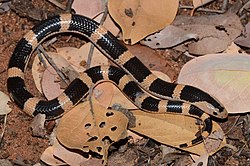
Species in the genus Elapsoidea generally display a pattern of alternating dark (black or brown) and pale (white, yellow, or tan) bands or annuli encircling the body and tail, typically numbering 12 to 38 depending on the species and age class. For instance, juveniles of Elapsoidea sundevallii exhibit 19–38 pale bands on a slate grey dorsum, while Elapsoidea boulengeri exhibits 12–17 such bands in juveniles, reducing to 8–17 narrower bands in adults or becoming nearly absent in uniform dark brown individuals.[19][18] These bands often extend onto the tail, contributing to a striped appearance that covers the cylindrical body form. Ontogenetic shifts in coloration are prominent across the genus, with juveniles possessing vivid, contrasting bands that serve as warning or disruptive signals, gradually fading in adults to produce a duller, more uniform dark dorsum for camouflage. In Elapsoidea guentherii, juveniles show well-defined alternating black and white crossbands of equal width, which diminish with maturity, resulting in plain dark coloration in many adults.[20] Similarly, Elapsoidea sundevallii juveniles are marked with bright alternating black and orange or tan bands that transition to a featureless slate grey in older individuals.[19] This change is also evident in Elapsoidea boulengeri, where pale-yellow juvenile bands fade to subtle or absent markings on a blackish-brown ground color.[18] Intraspecific variation occurs in band width, intensity, and persistence, influenced by locality and possibly environmental factors such as substrate type for camouflage. Populations in arid regions, for example, tend to exhibit narrower, less vivid bands that blend better with sandy habitats, as observed in southern African subspecies of Elapsoidea sundevallii.[21]Distribution and habitat
Geographic range
The genus Elapsoidea is distributed across sub-Saharan Africa, encompassing a broad expanse from Senegal in the west to Somalia and Ethiopia in the east, and extending southward to South Africa and Zimbabwe. This range spans diverse ecoregions, with the genus reported from over 40 countries including Benin, Botswana, Cameroon, Kenya, Malawi, Mozambique, and Uganda.[1] Species distributions within the genus vary significantly in extent. For instance, Elapsoidea sundevallii is widespread across savannas in southern Africa, occurring in Botswana, Eswatini, Malawi, Mozambique, Namibia, South Africa (across provinces such as KwaZulu-Natal, Limpopo, Mpumalanga, and North West), and Zimbabwe. In contrast, endemics such as Elapsoidea broadleyi are highly restricted, confined to Somalia.[1] Biogeographic patterns reveal a concentration of Elapsoidea in arid and semi-arid zones, including dry savannas and rocky outcrops. This distribution reflects adaptations to open, drier landscapes.[1]Habitat preferences
Elapsoidea species primarily inhabit arid savannas, semi-deserts, and regions with sandy soils throughout sub-Saharan Africa. These snakes exhibit a predominantly fossorial lifestyle, favoring loose, well-drained substrates that facilitate burrowing, such as aeolian and alluvial sands.[22][23] They avoid dense forests and wetlands, showing a clear preference for open, sparsely vegetated landscapes that support their subterranean habits.[24] Within these environments, Elapsoidea utilize specific microhabitats for shelter and foraging, including the undersides of rocks, abandoned termite mounds, and rodent burrows. These refugia provide protection from predators and extreme surface conditions, allowing the snakes to remain hidden during the day. Fossorial adaptations enable them to exploit these loose-soil niches effectively, with species like Elapsoidea boulengeri often emerging only at night in hot, dry areas.[18][22] The genus occupies an altitudinal range from sea level to approximately 2,000 m, with distributions spanning diverse climatic zones but consistently linked to semi-arid to mesic conditions. In hotter, drier regions, individuals are largely nocturnal to evade daytime heat, contributing to their elusive nature in these habitats.[22][25]Behavior and ecology
Activity patterns and defense
Species of the genus Elapsoidea exhibit primarily nocturnal and fossorial activity patterns, spending much of their time underground in burrows or termite mounds and emerging at dusk or during the night to forage, particularly following rainfall that softens the soil.[26][5] This secretive lifestyle reduces encounters with predators and conserves energy in arid or semi-arid habitats. Defensive behaviors in Elapsoidea emphasize evasion and intimidation over aggression, reflecting their generally placid nature. When threatened, they often hiss loudly, flatten the neck region to mimic a hood, and inflate the body to prominently display their colorful bands, which serve as an aposematic warning.[19][27] Strikes may follow in an erratic manner, but bites are rare unless the snake is handled or cornered, as individuals prefer to flee or burrow rapidly using lateral undulations to escape.[18] No territorial displays have been observed, and the snakes are solitary outside of brief mating periods.[1]Diet and reproduction
Species of the genus Elapsoidea exhibit a diet that is predominantly insectivorous and saurophagous, focusing on small reptiles and invertebrates adapted to their semi-fossorial lifestyle. Prey items commonly include skinks, geckos, and other small lizards, as well as amphibians such as frogs and occasionally other snakes and rodents. Insects, particularly termites, also form part of the diet, especially for species like E. guentheri. Juveniles tend to consume smaller prey, while adults target larger items relative to their body size.[25][28][29] These snakes employ an ambush predation strategy, often waiting in burrows or termite mounds to strike at passing prey, which they subdue using envenomation. Their nocturnal activity aids in foraging, allowing them to exploit cooler nighttime conditions in their arid and savanna habitats.[23] Elapsoidea species are oviparous, with females depositing clutches of 4–10 eggs during the summer months from October to December in southern Africa. Clutch size positively correlates with maternal body size, a pattern observed across elapid snakes. Eggs are laid in moist soil or burrows and incubated for approximately 50–60 days before hatching, with no parental care provided post-oviposition.[23][25][30]Venom
Properties and composition
The venom of Elapsoidea species is primarily neurotoxic, with some cytotoxic components, and is produced in modified salivary glands that function as venom glands.[31] It is delivered through a proteroglyphous dentition consisting of short, fixed front fangs, which enable rapid injection but may require the snake to chew into prey for effective envenomation due to the burrowing lifestyle influencing bite mechanics.[31] The biochemical composition is dominated by three-finger toxins (3FTx), non-enzymatic polypeptides of 60–74 amino acids that primarily target nicotinic acetylcholine receptors at the neuromuscular junction, leading to flaccid paralysis.[32] Phospholipases A₂ (PLA₂), enzymes of 13–15 kDa with neurotoxic and myotoxic properties, contribute to tissue damage by disrupting cell membranes.[31] In contrast to viperid venoms, which are rich in metalloproteinases, Elapsoidea venom contains low levels of these enzymes, emphasizing a simpler profile focused on rapid neurological effects.[31] Detailed proteomic studies on Elapsoidea venom remain limited, with much of the composition inferred from related African elapids. Evolutionarily, the venom has adapted for immobilizing small reptile prey, such as lizards, through prey-selective α-neurotoxins that exhibit high binding affinity to reptilian nicotinic receptors.[32]Effects and medical significance
Bites from Elapsoidea species generally produce mild envenomation characterized by local effects such as pain, swelling, and lymphangitis at the bite site, with systemic symptoms being rare and limited to neurotoxic manifestations like nausea, vomiting, light-headedness, facial tingling, and occasional double vision or disorientation.[33][34] In documented cases, such as those involving E. sundevallii longicauda, symptoms onset rapidly but remain localized initially, progressing to mild systemic involvement within hours before subsiding.[33] No fatalities have been recorded from Elapsoidea bites, and full recovery typically occurs within 1-3 days, even without specialized intervention.[33][18] Medical management focuses on supportive care, including immobilization of the affected limb, application of ice packs to reduce swelling, and administration of analgesics or anti-inflammatory drugs for pain and discomfort.[18] Antihistamines or corticosteroids may be used in cases with pronounced swelling or mild allergic responses, but no specific antivenom is necessary or available due to the venom's low potency and the infrequency of severe outcomes.[33] Encounters with Elapsoidea are uncommon, as these snakes are highly secretive and fossorial, often inhabiting underground burrows or termite mounds, which minimizes human-snake interactions.[34] Envenomations by Elapsoidea represent less than 1% of reported snakebites across Africa and constitute a minor public health concern, mainly affecting rural communities in savanna and arid regions where agricultural or foraging activities increase exposure risks.[35] The low incidence and non-lethal nature of bites underscore their limited epidemiological impact compared to more dangerous elapids like cobras or mambas.[36] The primarily neurotoxic composition of the venom, with minimal cytotoxic components, facilitates investigations into targeted pharmacological applications.[34]Species
Diversity and systematics
The genus Elapsoidea currently encompasses 10 recognized species, all endemic to sub-Saharan Africa, reflecting a relatively modest diversity within the Elapidae family.[1] Recent taxonomic revisions, particularly since the early 2000s, have resulted in the elevation of several former subspecies of E. sundevallii to distinct species status through genetic and morphological analyses, including E. loveridgei from the East African populations of the E. sundevallii complex.[1] Phylogenetic studies place Elapsoidea within the broader Elapoidea superfamily, with the group's evolutionary radiation linked to the Miocene epoch, coinciding with the appearance of early elapid fossils in Africa and adaptations to fossorial niches such as burrowing lifestyles and elongated bodies suited for underground foraging.[15] High levels of endemism are evident in certain lineages, particularly in the East African highlands, where species like E. loveridgei exhibit restricted distributions tied to montane habitats.[37] Systematic challenges persist, including debates over species boundaries within complexes like E. semiannulata, where morphometric variations have prompted discussions on potential synonymies and the recognition of cryptic taxa.[38] Conservation assessments indicate that most Elapsoidea species are rated Least Concern by the IUCN, owing to their widespread distributions, though narrow-range endemics such as E. chelazziorum face risks from habitat loss and fragmentation in arid Somali regions (Data Deficient).[39]List of species
The genus Elapsoidea comprises 10 accepted species (as of 2025), all of which are oviparous and possess mild venom that poses minimal threat to humans.[40] No species in the genus are known to be extinct.[40]| Scientific name | Common name | Range | Key identifying features | IUCN status |
|---|---|---|---|---|
| Elapsoidea boulengeri | Boulenger's garter snake | Southern Africa | Black body with white bands | Least Concern (LC)[41] |
| Elapsoidea broadleyi | Broadley's garter snake | Endemic to Somalia | Pale bands on dark body | Data Deficient (DD) |
| Elapsoidea chelazziorum | Somali garter snake | Somalia and Ethiopia | Narrow white bands on black body | Data Deficient (DD)[39] |
| Elapsoidea guentherii | Günther's garter snake | East Africa | Uniform dark coloration | Least Concern (LC)[42] |
| Elapsoidea laticincta | Werner's garter snake | Tanzania | Broad white bands | Least Concern (LC)[43] |
| Elapsoidea loveridgei | Loveridge's garter snake | East Africa | Vivid colors in juveniles, fading to banded adults | Least Concern (LC)[44] |
| Elapsoidea nigra | Black garter snake | Usambara Mountains, Tanzania | Uniform black body | Least Concern (LC)[45] |
| Elapsoidea semiannulata | Semi-annulate garter snake | Angola and Namibia | Incomplete or semi-annulate bands | Least Concern (LC)[46] |
| Elapsoidea sundevallii | Sundevall's garter snake | Widespread across southern and eastern Africa | Fading or narrow bands with age | Least Concern (LC)[4] |
| Elapsoidea tenuis | Slender garter snake | Zambia and Malawi | Slender body with thin bands | Least Concern (LC)[47] |