Hubbry Logo
Twenty-Four EldersTwenty-Four EldersMain
Open search
Twenty-Four Elders
Community hub
Twenty-Four Elders
logo
8 pages, 0 posts
0 subscribers
Be the first to start a discussion here.
Twenty-Four Elders
Twenty-Four Elders
from Wikipedia
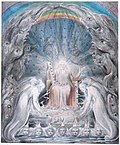
12th century A.D., France. The Portal Royal of the Chartres Cathedral, with Christ at the center, surrounded by the Four Evangelists with the 24 Elders of the Apocalypse above (with others).
Circa 1265-70 England. Douce Apocalypse - Bodleian Ms180. Angel with the seventh trumpet. Christ proclaimed by the elders. (Revelations 11: 15-17)

The Twenty-Four Elders are figures from the Book of Revelation who appear in the Revelations 4, 5, 7, 11 and 19 of the Christian Bible; in white robes and golden crowns they sit with musical instruments on thrones before God during the Apocalypse and praise and worship him.[1][2][3][4][5]

Religious scholars have pointed out the thrones indicate that these are beings of power and authority in Heaven, the crowns indicate that their faith has been tested and the white robes indicate that they are clothed in righteousness.[6][7]

They are described in the King James Bible, Book of Revelation 4 as:[1]

4 And round about the throne were four and twenty seats: and upon the seats I saw four and twenty elders sitting, clothed in white raiment; and they had on their heads crowns of gold.
10 The four and twenty elders fall down before him that sat on the throne, and worship him that liveth for ever and ever, and cast their crowns before the throne, saying,
11 Thou art worthy, O Lord, to receive glory and honour and power: for thou hast created all things, and for thy pleasure they are and were created.

From Revelation 5:[2]

8 And when he had taken the book, the four beasts and four and twenty elders fell down before the Lamb, having every one of them harps, and golden vials full of odours, which are the prayers of saints.

From Revelation 11:[4]

15 And the seventh angel sounded; and there were great voices in Heaven, saying, The kingdoms of this world are become the kingdoms of our Lord, and of his Christ; and he shall reign for ever and ever.
16 And the four and twenty elders, which sat before God on their seats, fell upon their faces, and worshipped God,
17 Saying, We give thee thanks, O Lord God Almighty, which art, and wast, and art to come; because thou hast taken to thee thy great power, and hast reigned.
18 And the nations were angry, and thy wrath is come, and the time of the dead, that they should be judged, and that thou shouldest give reward unto thy servants the prophets, and to the saints, and them that fear thy name, small and great; and shouldest destroy them which destroy the earth.

Depiction in artwork

[edit]
See Revelation's four living beings
Illumination from the Book of Kells, showing the Four Evangelists, Matthew (the Winged Man or Angel), Mark (the Winged Lion), Luke (the Winged Ox or Bull), and John (the Eagle).

The Elders are often depicted in medieval and Renaissance artwork with musical instruments.

The same medieval and Renaissance artwork draws from Revelation 4, showing the Elders with Christ. That artwork also depicts the "four beasts" who surround Christ.[1][8][9]

6 And before the throne there was a sea of glass like unto crystal: and in the midst of the throne, and round about the throne, were four beasts full of eyes before and behind.
7 And the first beast was like a lion, and the second beast like a calf, and the third beast had a face as a man, and the fourth beast was like a flying eagle.
8 And the four beasts had each of them six wings about him; and they were full of eyes within: and they rest not day and night, saying, Holy, holy, holy, Lord God Almighty, which was, and is, and is to come.
9 And when those beasts give glory and honour and thanks to him that sat on the throne, who liveth for ever and ever

The eagle, lion, calf and man may be the symbols of the Four Evangelists or their Gospels.[10] Alternatively they may be the four cherubim from Ezekiel 1 and Ezekiel 10.[10][11]

Non-Christian allegorical interpretation

[edit]

Champat Rai Jain, a 20th-century Jain writer claimed that the "Four and Twenty Elders" mentioned in the Christian Bible are "Twenty-four Jain Tirthankaras".[12] In his book, Jainism Christianity and Science, he wrote:

Briefly, the beasts represent the different kinds of souls that are embodied in the four elements (of matter), namely, the earth-bodied (represented by the lion, since he walks on earth), the air-bodied (represented by the eagle who flies in the air), the water-bodied (represented by the calf, which here is the young of the sea-mammals), and the fire-bodied (represented by the sun which is painted as the face of a man). Wings are a symbol for time, since it flies; and the number six is descriptive of the six aras (spokes) or a half-cycle in which four and twenty Tirthamkaras appear and preach the Truth. Plainly put, the significance of the secret teaching is only this that Life is Divine, and its divinity is manifested most perfectly and fully in the case of four and twenty Tirthamkaras, who appear in a half-cycle of time, consisting of six aras, and preach the Noble Truth to and for the benefit of the souls embodied in material bodies.[13]

However, this is a view which comes out of Jainism.[13] It doesn't come from the Bible or Christian tradition.

References

[edit]

Sources

[edit]
[edit]
Revisions and contributorsEdit on WikipediaRead on Wikipedia
from Grokipedia
The Twenty-four Elders are a group of heavenly figures prominently featured in the , the final book of the Christian , where they are depicted as sitting on twenty-four thrones encircling the central in the divine . Clothed in white garments symbolizing purity and wearing golden crowns denoting royal authority, they represent a collective of exalted beings engaged in perpetual worship. These elders first appear in Revelation 4, where they fall prostrate before the one seated on the throne, cast their crowns before it as an act of submission, and proclaim, "Worthy are you, our and , to receive glory and honor and power, for you created all things, and by your will they existed and were created." In the subsequent chapter, they hold harps and golden bowls filled with the prayers of the saints, falling down before the Lamb (a title for Jesus Christ) and singing a new song: "Worthy are you to take the scroll and to open its seals, for you were slain, and by your blood you ransomed for from every tribe and language and and nation, and you have made them a kingdom and priests to our , and they shall reign on the ." This redemptive hymn underscores their role in affirming the Lamb's sacrificial victory and the inclusion of diverse humanity in 's eternal kingdom. The elders reappear in later visions, including Revelation 7:11–17, where one explains the blessed state of those who have come out of the ; Revelation 11:16–18, amid the sounding of the seventh trumpet; Revelation 14:3, joining the in song before the ; and Revelation 19:4, praising at the announcement of the marriage supper of the Lamb. Throughout these scenes, they collaborate with the four living creatures—symbolic cherubim-like beings—and vast angelic hosts, emphasizing a cosmic assembly of praise and judgment. Theological interpretations of the elders' identity vary among scholars, but a predominant view holds them as symbolic representatives of the redeemed , embodying the church triumphant in heaven. This symbolism often draws on the number twenty-four as a multiple of twelve—evoking the (Exodus 24:4; Revelation 21:12) and the twelve apostles (Matthew 10:2–4; Revelation 21:14)—to signify the complete, unified body of believers from both Old and eras, ransomed and reigning as . Alternative perspectives include angelic intermediaries or a heavenly council of cosmic rulers distinct from humanity, though textual details like their crowns and the "us" in certain manuscripts of Revelation 5:9–10 favor a connection to redeemed saints. Scholars note the ambiguity in ancient manuscripts regarding the textual variants.

Biblical Context

Origin in the Book of Revelation

The Twenty-Four Elders are figures exclusively mentioned in the , also known as the Apocalypse of John, with appearances in chapters 4, 5, 7, 11, 14, and 19. This text, attributed to the apostle John, presents them as integral to the visionary depictions of heaven within its apocalyptic framework. Their initial depiction appears in Revelation 4:4, where John beholds a central surrounded by twenty-four additional thrones, upon which the elders are seated, "clothed in garments, with golden crowns on their heads." This scene establishes the elders as a heavenly encircling the divine , emphasizing a structured assembly in the celestial realm. Key symbolic elements define their portrayal: the white robes signify purity and righteousness, consistent with broader imagery in Revelation associating such attire with moral vindication and holiness. The golden crowns denote victory and authority, evoking royal and triumphant status in the heavenly order. The thrones they occupy further underscore roles in judgment and rulership within this divine council. The vision unfolds as part of John's prophetic experience on the island of , where he was exiled "on account of the word of God and the testimony of Jesus." Set amid prophecies of end-times events, this imagery highlights God's at the outset of the book's unfolding judgments and revelations.

Descriptions and Roles in Key Passages

In , the twenty-four elders play a prominent role in the heavenly of the Lamb, identified as Christ. When the Lamb takes the from the right hand of the one seated on the , the elders fall down before him in adoration. Each elder holds a and a full of , which represents the prayers of 's . They then sing a new proclaiming the Lamb's worthiness: "You are worthy to take the and to open its seals, because you were slain, and with your blood you purchased for persons from every and and and nation. You have made them to be a kingdom and to serve our , and they will reign on the earth." In , the elders appear alongside the four living creatures before the , contributing to the explanation of eschatological events. After the vision of the sealed from the tribes of and the great multitude in white robes standing before the , one of the elders addresses John directly. He asks, "These in white robes—who are they, and where did they come from?" Upon John's deferral, the elder explains: "These are they who have come out of the ; they have washed their robes and made them white in the blood of the Lamb." This dialogue underscores the elders' role in interpreting the salvation of the redeemed during tribulation. Revelation 11 depicts the elders in a posture of following the sounding of the seventh , which announces of 's kingdom. Seated on their thrones before , the twenty-four elders fall on their faces and , declaring: "We give thanks to you, Lord Almighty, the One who is and who was, because you have taken your and have begun to reign." Their affirms the of divine sovereignty over the kingdoms of the world. In , the elders are positioned before the throne with the four living creatures during the vision of the redeemed from the . They witness as the sing a new song that no one else can learn, highlighting the elders' ongoing presence in the heavenly assembly amid scenes of and redemption. While seated on thrones elsewhere in the narrative, their role here emphasizes authoritative oversight in the context of the Son of Man's harvest judgment. Revelation 19 shows the elders engaging in profound worship amid the announcement of the marriage supper of the Lamb. The twenty-four elders, together with the four living creatures, fall down before the one seated on the and cry out, ", !" This act of and praise occurs in response to the downfall of and the vindication of God's judgments, with the elders casting their crowns before the in a of submission seen earlier in the visions. Throughout these passages in the , the twenty-four elders serve collectively as intermediaries in the heavenly , facilitating worship, offering prayers on behalf of humanity, and bridging the divine with the unfolding history of human salvation. Their repeated actions of falling in worship, singing praises, and providing explanatory dialogue position them as key figures in the apocalyptic drama.

Theological Interpretations

Christian Perspectives

In early Christian theology, the Twenty-Four Elders of Revelation were often interpreted as symbolic representatives of the unity between the Old and New Testaments, embodying the complete people of God. Church Fathers such as Victorinus of Pettau viewed them as either the twenty-four books of the Old Testament prophets and law, which testify to divine judgment, or as the twelve patriarchs combined with the twelve apostles, signifying the foundational figures who will judge God's people. This patristic perspective emphasized their role in bridging scriptural traditions, portraying the elders as participants in heavenly worship that affirms the continuity of God's redemptive plan. During the medieval period, interpretations shifted toward viewing the Twenty-Four Elders as emblematic of the blessed souls or aligned with angelic hierarchies, underscoring their priestly function in perpetual . This emphasis on their priestly role reinforced the idea of the elders as intermediaries in the of , where they cast crowns before the , symbolizing the surrender of all glory to the Creator and the Lamb in unending service. Medieval thus portrayed them as perfected humanity or celestial beings engaged in the cosmic described in 4–5. Protestant Reformers interpreted the Twenty-Four Elders primarily as symbols of the glorified church or the redeemed human community, distinct from literal angelic entities, to stress the believers' ultimate participation in heavenly reign. This perspective underscored their humanity, redeemed and enthroned, to affirm the priesthood of all believers and the continuity of the church's calling across history. In modern Christian eschatology, interpretations diverge along interpretive lines, particularly in dispensationalism and amillennialism. Dispensational theologians often identify the elders as the raptured saints of the church age, already in heaven prior to the tribulation, clothed in white and crowned as a rewarded assembly distinct from tribulation martyrs or Israel. This view positions them as pre-tribulational believers praising the Lamb's worthiness, highlighting the church's removal and glorification. Conversely, amillennial scholars see the elders as symbolic of the complete redeemed community—uniting the twelve tribes of Israel and the twelve apostles—reigning spiritually with Christ in heaven throughout the present church age, which constitutes the symbolic "thousand years" of Revelation 20. Here, their number evokes covenantal wholeness, with the elders' worship affirming the already inaugurated kingdom. The number 24 itself carries symbolic weight in biblical numerology, representing completeness and divine order as a multiple of 12 (symbolizing governmental perfection, as seen in the 12 tribes of Israel and the 12 apostles) by 2 (indicating witness or duality, such as the Old and New Testaments). This numerological significance is further connected to the 24 priestly divisions established by King David in 1 Chronicles 24:1–19, suggesting the elders embody a priestly function in heaven, offering continuous worship and intercession on behalf of God's people. Doctrinally, the Twenty-Four Elders bolster key affirmations of Christ's exclusive worthiness to open the scroll and execute judgment, as their hymns declare the Lamb's redemptive achievement in purchasing humanity from every tribe and nation. Their persistent worship and enthroned status also illustrate the , portraying believers as secure in heavenly victory, immune to ultimate defeat, and called to endure earthly trials with eschatological hope. This imagery reinforces the assurance of eternal fellowship in God's presence, where redeemed humanity joins the eternal chorus exalting divine sovereignty.

Jewish and Non-Christian Views

In Jewish interpretive traditions, the twenty-four elders described in Revelation 4 are frequently paralleled with the twenty-four (mishmarot) instituted by King , as detailed in 1 Chronicles 24:1–19, where the descendants of were organized into rotating courses to serve in the Temple. This connection underscores a heavenly counterpart to the earthly priestly order, portraying the elders as archetypal figures of sacred service and mediation before the , a motif resonant with Jewish that envisions celestial hierarchies mirroring Temple rituals. In midrashic and apocalyptic contexts, these figures evoke a divine or assembly, akin to the exalted beings who witness and participate in God's cosmic judgments, though Revelation's imagery adapts this to a post-Temple eschatological framework. Outside , early non-Christian allegorical readings occasionally associate the elders with emanations or hierarchical beings in esoteric systems, though direct references in surviving Gnostic texts like the remain elusive, focusing instead on aeonic structures without explicit numerical alignment to twenty-four. In secular and philosophical interpretations of the nineteenth and twentieth centuries, , founder of , viewed the twenty-four elders as "time spirits" or evolutionary entities within cosmic hierarchies, representing the progressive unfolding of human spiritual development and the synthesis of historical revelations around the central figure of Christ. Steiner described them as foundational beings who laid the groundwork for the kingdoms of nature—mineral, , , and —while encircling the divine like guardians of temporal and eternal rhythms, emphasizing their role in mediating anthroposophical stages of consciousness evolution. Modern esoteric and perspectives often interpret the elders numerologically, with the number twenty-four signifying completeness as the product of two (duality) and twelve (cosmic order, such as the zodiac or tribes), symbolizing integrated spiritual wholeness. In these views, they represent twenty-four centers of and power within the human form, fusing the twelve pairs of (governing perception and interaction) with the twelve zodiacal archetypes of spiritual evolution, where six stages mark descent into matter and six ascent toward enlightenment. This symbolism ties to extended chakra systems beyond the traditional seven, envisioning the elders as awakened energy nodes activated through practices like , culminating in divine unity at the "throne" of higher . Expanding on allegorical readings through , the assembly of twenty-four elders echoes ancient Near Eastern divine councils, such as the Mesopotamian pantheon's gatherings under and , where subordinate deities deliberated cosmic fates and upheld order, adapting the motif to Revelation's monotheistic framework of a unified heavenly court. Recent interfaith dialogues on apocalyptic texts, including those between Jewish and Christian scholars, highlight these shared motifs of celestial assemblies to foster mutual understanding of eschatological imagery, emphasizing common roots in without endorsing Revelation's messianic claims.

Cultural and Artistic Representations

Depictions in Visual Art

Depictions of the Twenty-Four Elders in visual art emerged prominently in medieval Christian , often surrounding the divine throne in scenes inspired by the . In Romanesque of century, the Elders appear as enthroned figures wearing white robes and golden crowns, holding harps and vials symbolizing the prayers of the saints. These carvings, recurrent along pilgrimage routes, evolved from earlier standing processions to seated, hierarchical arrangements emphasizing apocalyptic worship; examples include the south porch at Aulnay-de-Saintonge with thirty-one enthroned Elders in voussoir registers, and the tympanum at Oloron-Sainte-Marie flanking a central Lamb with the . Medieval illuminated manuscripts further developed these representations with vibrant, narrative detail. In the Beatus Apocalypses, a series of Spanish commentaries on produced between the tenth and twelfth centuries, the Elders are shown in dynamic adoration around the throne, often with the four living creatures, using bold colors and expressive poses to convey heavenly . A notable thirteenth-century English example, the Getty Apocalypse manuscript, illustrates the Elders in the bottom register falling prostrate before an enthroned divine figure, casting their crowns in homage, rendered in colors, , and on for a luminous, devotional effect. During the Renaissance, artists integrated the Elders into larger eschatological compositions, emphasizing perspective and individualized features. Fra Angelico's Last Judgment (c. 1431–1435), a tempera panel now in the Museo di San Marco, Florence, places the twenty-four Elders as numerous, alike figures around Christ's tribunal, clad in white and crowned, underscoring their role in the separation of the saved and damned. Similarly, Albrecht Dürer's woodcut series The Apocalypse (1498) features the Elders in plate 3, St. John and the Twenty-Four Elders in Heaven, where they surround the enthroned Christ with harps and crowns, positioned hierarchically with the four Evangelist symbols (lion, ox, man, eagle) to symbolize the Old and New Testaments. In later periods, including the era, the Elders continued to appear in dynamic worship scenes, though specific integrations vary; ' compositions, such as those exploring themes, occasionally evoke their presence amid celestial turmoil. Modern interpretations persist in , as in the window of the Basilica of the National Shrine of the (completed 2017), where twenty-four crowns atop the design represent the Elders' worship of the Lamb, using vibrant glass to evoke eternal praise in a contemporary . Across these eras, artistic portrayals maintain symbolic consistency, with the Elders uniformly depicted in white robes denoting purity, golden crowns signifying authority, and often accompanied by the four living creatures to frame the ; this evolves from static, frontal poses in early to more expressive, interactive groupings in later works, highlighting their perpetual role in divine adoration.

Influences in Literature and Music

The Twenty-Four Elders from the Book of Revelation have influenced literary depictions of heavenly councils, particularly in John Milton's Paradise Lost (1667), where scenes of divine assembly evoke the elders' worship and throned presence around God's throne. In Book V, Milton describes the Son of God amid a celestial hierarchy that parallels the elders' role in Revelation 4–5, emphasizing themes of adoration and cosmic order. Similarly, Mary Shelley's apocalyptic novel The Last Man (1826) incorporates the elders' imagery in visions of divine judgment, portraying a figure enthroned amid twenty-four elders and four beasts to underscore humanity's isolation and eschatological despair. William Blake's prophetic poetry reimagines the Twenty-Four Elders as symbolic facets of divine humanity, integrating them into his mythological framework in works like The Four Zoas (1797 manuscript). In this unfinished epic, the elders represent aspects of the fragmented human psyche and eternal forms, drawing on Revelation's throne scene to explore themes of creation, fall, and redemption. Blake's illustrations and text blend the elders with his Zoas—archetypal figures embodying reason, emotion, and —transforming biblical motifs into a critique of . In music, the elders' harp-playing worship in :8 inspired Olivier Messiaen's Quartet for the End of Time (1941), composed during his imprisonment in ; the third movement, "Abîme des oiseaux," for solo clarinet, evokes the timeless reverence of the elders falling before the Lamb, while the full ensemble reflects apocalyptic harmony. Earlier, George Frideric Handel's (1741) indirectly references the elders through its drawn from Revelation's hymns of praise, such as in the "" chorus, which celebrates the Lamb's triumph amid heavenly hosts akin to the elders' acclamations. Contemporary fantasy literature draws on apocalyptic themes from , including in C.S. Lewis's (1950–1956), where eschatological elements in reflect heavenly assemblies and divine rule. In , Terrence Malick's The Tree of Life (2011) incorporates biblical imagery in its score and visuals during sequences of cosmic creation and judgment, conveying themes of eternal praise. Recent influences extend to hip-hop and rap, where artists sample themes featuring the Twenty-Four Elders to address and praise; for instance, TIGIT's track "John Saw in the Right Hand of God" (2025) raps directly from :1–14, highlighting the elders' harps and bowls of as metaphors for communal . Similarly, Christian hip-hop collective Rap Bible AI's Revelation (Word-for-Word Rap) (2025) narrates the elders' fall before the in rhythmic verse, updating apocalyptic motifs for modern audiences seeking empowerment through biblical .

References

Add your contribution
Related Hubs
User Avatar
No comments yet.