



Community hub
Recent from talks
Contribute something
Nothing was collected or created yet.
Electron mobility
View on WikipediaIn solid-state physics, the electron mobility characterizes how quickly an electron can move through a metal or semiconductor when pushed or pulled by an electric field. There is an analogous quantity for holes, called hole mobility. The term carrier mobility refers in general to both electron and hole mobility.
Electron and hole mobility are special cases of electrical mobility of charged particles in a fluid under an applied electric field.
When an electric field E is applied across a piece of material, the electrons respond by moving with an average velocity called the drift velocity, . Then the electron mobility μ is defined as


Electron mobility is almost always specified in units of cm2/(V⋅s). This is different from the SI unit of mobility, m2/(V⋅s). They are related by 1 m2/(V⋅s) = 104 cm2/(V⋅s).
Conductivity is proportional to the product of mobility and carrier concentration. For example, the same conductivity could come from a small number of electrons with high mobility for each, or a large number of electrons with a small mobility for each. For semiconductors, the behavior of transistors and other devices can be very different depending on whether there are many electrons with low mobility or few electrons with high mobility. Therefore mobility is a very important parameter for semiconductor materials. Almost always, higher mobility leads to better device performance, with other things equal.
Semiconductor mobility depends on the impurity concentrations (including donor and acceptor concentrations), defect concentration, temperature, and electron and hole concentrations. It also depends on the electric field, particularly at high fields when velocity saturation occurs. It can be determined by the Hall effect, or inferred from transistor behavior.
Introduction
[edit] |
Drift velocity in an electric field
[edit]Without any applied electric field, in a solid, electrons and holes move around randomly.[clarification needed] Therefore, on average there will be no overall motion of charge carriers in any particular direction over time.
However, when an electric field is applied, each electron or hole is accelerated by the electric field. If the electron were in a vacuum, it would be accelerated to ever-increasing velocity (called ballistic transport). However, in a solid, the electron repeatedly scatters off crystal defects, phonons, impurities, etc., so that it loses some energy and changes direction. The final result is that the electron moves with a finite average velocity, called the drift velocity. This net electron motion is usually much slower than the normally occurring random motion.
The two charge carriers, electrons and holes, will typically have different drift velocities for the same electric field.
Quasi-ballistic transport is possible in solids if the electrons are accelerated across a very small distance (as small as the mean free path), or for a very short time (as short as the mean free time). In these cases, drift velocity and mobility are not meaningful.
Definition and units
[edit]The electron mobility is defined by the equation: where:

- E is the magnitude of the electric field applied to a material,
- vd is the magnitude of the electron drift velocity (in other words, the electron drift speed) caused by the electric field, and
- μe is the electron mobility.
The hole mobility is defined by a similar equation: Both electron and hole mobilities are positive by definition.

Usually, the electron drift velocity in a material is directly proportional to the electric field, which means that the electron mobility is a constant (independent of the electric field). When this is not true (for example, in very large electric fields), mobility depends on the electric field.
The SI unit of velocity is m/s, and the SI unit of electric field is V/m. Therefore the SI unit of mobility is (m/s)/(V/m) = m2/(V⋅s). However, mobility is much more commonly expressed in cm2/(V⋅s) = 10−4 m2/(V⋅s).
Mobility is usually a strong function of material impurities and temperature, and is determined empirically. Mobility values are typically presented in table or chart form. Mobility is also different for electrons and holes in a given material.
Derivation
[edit]Starting with Newton's second law: where:

- a is the acceleration between collisions.
- F is the electric force exerted by the electric field, and
- is the effective mass of an electron.

Since the force on the electron is −eE:

This is the acceleration on the electron between collisions. The drift velocity is therefore: where is the mean free time
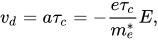

Since we only care about how the drift velocity changes with the electric field, we lump the loose terms together to get where


Similarly, for holes we have where Note that both electron mobility and hole mobility are positive. A minus sign is added for electron drift velocity to account for the minus charge.


Relation to current density
[edit]The drift current density resulting from an electric field can be calculated from the drift velocity. Consider a sample with cross-sectional area A, length l and an electron concentration of n. The current carried by each electron must be , so that the total current density due to electrons is given by: Using the expression for gives A similar set of equations applies to the holes, (noting that the charge on a hole is positive). Therefore the current density due to holes is given by where p is the hole concentration and the hole mobility.

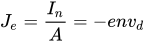


The total current density is the sum of the electron and hole components:

Relation to conductivity
[edit]We have previously derived the relationship between electron mobility and current density Now Ohm's law can be written in the form where is defined as the conductivity. Therefore we can write down: which can be factorised to




Relation to electron diffusion
[edit]In a region where n and p vary with distance, a diffusion current is superimposed on that due to conductivity. This diffusion current is governed by Fick's law: where:

- F is flux.
- De is the diffusion coefficient or diffusivity
- is the concentration gradient of electrons

The diffusion coefficient for a charge carrier is related to its mobility by the Einstein relation. For a classical system (e.g. Boltzmann gas), it reads: where:
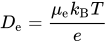
- kB is the Boltzmann constant
- T is the absolute temperature
- e is the electric charge of an electron
For a metal, described by a Fermi gas (Fermi liquid), quantum version of the Einstein relation should be used. Typically, temperature is much smaller than the Fermi energy, in this case one should use the following formula: where:

- EF is the Fermi energy
Examples
[edit]Typical electron mobility at room temperature (300 K) in metals like gold, copper and silver is 30–50 cm2/(V⋅s). Carrier mobility in semiconductors is doping dependent. In silicon (Si) the electron mobility is of the order of 1,000, in germanium around 4,000, and in gallium arsenide up to 10,000 cm2/(V⋅s). Hole mobilities are generally lower and range from around 100 cm2/(V⋅s) in gallium arsenide, to 450 in silicon, and 2,000 in germanium.[1]
Very high mobility has been found in several ultrapure low-dimensional systems, such as two-dimensional electron gases (2DEG) (35,000,000 cm2/(V⋅s) at low temperature),[2] carbon nanotubes (100,000 cm2/(V⋅s) at room temperature)[3] and freestanding graphene (200,000 cm2/(V⋅s) at low temperature).[4] Organic semiconductors (polymer, oligomer) developed thus far have carrier mobilities below 50 cm2/(V⋅s), and typically below 1, with well performing materials measured below 10.[5]
| Material | Electron mobility | Hole mobility |
|---|---|---|
| AlGaAs/GaAs heterostructures | 35,000,000[2] | 5,800,000[6] |
| Freestanding graphene | 200,000[4] | |
| Carbon nanotubes | 79,000[7][8] | |
| Cubic boron arsenide (c-BAs) | 1,600[9] | |
| Crystalline silicon | 1,400[1] | 450[1] |
| Polycrystalline silicon | 100 | |
| Metals (Al, Au, Cu, Ag) | 10–50 | |
| 2D material (MoS2) | 10–50 | |
| Organics | 8.6[10] | 43[11] |
| Amorphous silicon | ~1[12] |
Electric field dependence and velocity saturation
[edit]At low fields, the drift velocity vd is proportional to the electric field E, so mobility μ is constant. This value of μ is called the low-field mobility.
As the electric field is increased, however, the carrier velocity increases sublinearly and asymptotically towards a maximum possible value, called the saturation velocity vsat. For example, the value of vsat is on the order of 1×107 cm/s for both electrons and holes in Si. It is on the order of 6×106 cm/s for Ge. This velocity is a characteristic of the material and a strong function of doping or impurity levels and temperature. It is one of the key material and semiconductor device properties that determine a device such as a transistor's ultimate limit of speed of response and frequency.
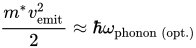
This velocity saturation phenomenon results from a process called optical phonon scattering. At high fields, carriers are accelerated enough to gain sufficient kinetic energy between collisions to emit an optical phonon, and they do so very quickly, before being accelerated once again. The velocity that the electron reaches before emitting a phonon is: where ωphonon(opt.) is the optical-phonon angular frequency and m* the carrier effective mass in the direction of the electric field. The value of Ephonon (opt.) is 0.063 eV for Si and 0.034 eV for GaAs and Ge. The saturation velocity is only one-half of vemit, because the electron starts at zero velocity and accelerates up to vemit in each cycle.[13] (This is a somewhat oversimplified description.[13])
Velocity saturation is not the only possible high-field behavior. Another is the Gunn effect, where a sufficiently high electric field can cause intervalley electron transfer, which reduces drift velocity. This is unusual; increasing the electric field almost always increases the drift velocity, or else leaves it unchanged. The result is negative differential resistance.
In the regime of velocity saturation (or other high-field effects), mobility is a strong function of electric field. This means that mobility is a somewhat less useful concept, compared to simply discussing drift velocity directly.
Relation between scattering and mobility
[edit]Recall that by definition, mobility is dependent on the drift velocity. The main factor determining drift velocity (other than effective mass) is scattering time, i.e. how long the carrier is ballistically accelerated by the electric field until it scatters (collides) with something that changes its direction and/or energy. The most important sources of scattering in typical semiconductor materials, discussed below, are ionized impurity scattering and acoustic phonon scattering (also called lattice scattering). In some cases other sources of scattering may be important, such as neutral impurity scattering, optical phonon scattering, surface scattering, and defect scattering.[14]
Elastic scattering means that energy is (almost) conserved during the scattering event. Some elastic scattering processes are scattering from acoustic phonons, impurity scattering, piezoelectric scattering, etc. In acoustic phonon scattering, electrons scatter from state k to k', while emitting or absorbing a phonon of wave vector q. This phenomenon is usually modeled by assuming that lattice vibrations cause small shifts in energy bands. The additional potential causing the scattering process is generated by the deviations of bands due to these small transitions from frozen lattice positions.[15]
Ionized impurity scattering
[edit]Semiconductors are doped with donors and/or acceptors, which are typically ionized, and are thus charged. The Coulombic forces will deflect an electron or hole approaching the ionized impurity. This is known as ionized impurity scattering. The amount of deflection depends on the speed of the carrier and its proximity to the ion. The more heavily a material is doped, the higher the probability that a carrier will collide with an ion in a given time, and the smaller the mean free time between collisions, and the smaller the mobility. When determining the strength of these interactions due to the long-range nature of the Coulomb potential, other impurities and free carriers cause the range of interaction with the carriers to reduce significantly compared to bare Coulomb interaction.
If these scatterers are near the interface, the complexity of the problem increases due to the existence of crystal defects and disorders. Charge trapping centers that scatter free carriers form in many cases due to defects associated with dangling bonds. Scattering happens because after trapping a charge, the defect becomes charged and therefore starts interacting with free carriers. If scattered carriers are in the inversion layer at the interface, the reduced dimensionality of the carriers makes the case differ from the case of bulk impurity scattering as carriers move only in two dimensions. Interfacial roughness also causes short-range scattering limiting the mobility of quasi-two-dimensional electrons at the interface.[15]
Lattice (phonon) scattering
[edit]At any temperature above absolute zero, the vibrating atoms create pressure (acoustic) waves in the crystal, which are termed phonons. Like electrons, phonons can be considered to be particles. A phonon can interact (collide) with an electron (or hole) and scatter it. At higher temperature, there are more phonons, and thus increased electron scattering, which tends to reduce mobility.
Piezoelectric scattering
[edit]Piezoelectric effect can occur only in compound semiconductor due to their polar nature. It is small in most semiconductors but may lead to local electric fields that cause scattering of carriers by deflecting them, this effect is important mainly at low temperatures where other scattering mechanisms are weak. These electric fields arise from the distortion of the basic unit cell as strain is applied in certain directions in the lattice.[15]
Surface roughness scattering
[edit]Surface roughness scattering caused by interfacial disorder is short range scattering limiting the mobility of quasi-two-dimensional electrons at the interface. From high-resolution transmission electron micrographs, it has been determined that the interface is not abrupt on the atomic level, but actual position of the interfacial plane varies one or two atomic layers along the surface. These variations are random and cause fluctuations of the energy levels at the interface, which then causes scattering.[15]
Alloy scattering
[edit]In compound (alloy) semiconductors, which many thermoelectric materials are, scattering caused by the perturbation of crystal potential due to the random positioning of substituting atom species in a relevant sublattice is known as alloy scattering. This can only happen in ternary or higher alloys as their crystal structure forms by randomly replacing some atoms in one of the sublattices (sublattice) of the crystal structure. Generally, this phenomenon is quite weak but in certain materials or circumstances, it can become dominant effect limiting conductivity. In bulk materials, interface scattering is usually ignored.[15][16][17][18][19]
Inelastic scattering
[edit]During inelastic scattering processes, significant energy exchange happens. As with elastic phonon scattering also in the inelastic case, the potential arises from energy band deformations caused by atomic vibrations. Optical phonons causing inelastic scattering usually have the energy in the range 30-50 meV, for comparison energies of acoustic phonon are typically less than 1 meV but some might have energy in order of 10 meV. There is significant change in carrier energy during the scattering process. Optical or high-energy acoustic phonons can also cause intervalley or interband scattering, which means that scattering is not limited within single valley.[15]
Electron–electron scattering
[edit]Due to the Pauli exclusion principle, electrons can be considered as non-interacting if their density does not exceed the value 1016~1017 cm−3 or electric field value 103 V/cm. However, significantly above these limits electron–electron scattering starts to dominate. Long range and nonlinearity of the Coulomb potential governing interactions between electrons make these interactions difficult to deal with.[15][16][17]
Relation between mobility and scattering time
[edit]A simple model gives the approximate relation between scattering time (average time between scattering events) and mobility. It is assumed that after each scattering event, the carrier's motion is randomized, so it has zero average velocity. After that, it accelerates uniformly in the electric field, until it scatters again. The resulting average drift mobility is:[20] where q is the elementary charge, m* is the carrier effective mass, and τ is the average scattering time.

If the effective mass is anisotropic (direction-dependent), m* is the effective mass in the direction of the electric field.
Matthiessen's rule
[edit]Normally, more than one source of scattering is present, for example both impurities and lattice phonons. It is normally a very good approximation to combine their influences using "Matthiessen's Rule" (developed from work by Augustus Matthiessen in 1864):
where μ is the actual mobility, is the mobility that the material would have if there was impurity scattering but no other source of scattering, and is the mobility that the material would have if there was lattice phonon scattering but no other source of scattering. Other terms may be added for other scattering sources, for example Matthiessen's rule can also be stated in terms of the scattering time: where τ is the true average scattering time and τimpurities is the scattering time if there was impurity scattering but no other source of scattering, etc.




Matthiessen's rule is an approximation and is not universally valid. This rule is not valid if the factors affecting the mobility depend on each other, because individual scattering probabilities cannot be summed unless they are independent of each other.[19] The average free time of flight of a carrier and therefore the relaxation time is inversely proportional to the scattering probability.[15][16][18] For example, lattice scattering alters the average electron velocity (in the electric-field direction), which in turn alters the tendency to scatter off impurities. There are more complicated formulas that attempt to take these effects into account.[21]
Temperature dependence of mobility
[edit]| Si | Ge | GaAs | |
|---|---|---|---|
| Electrons | ∝T −2.4 | ∝T −1.7 | ∝T −1.0 |
| Holes | ∝T −2.2 | ∝T −2.3 | ∝T −2.1 |
With increasing temperature, phonon concentration increases and causes increased scattering. Thus lattice scattering lowers the carrier mobility more and more at higher temperature. Theoretical calculations reveal that the mobility in non-polar semiconductors, such as silicon and germanium, is dominated by acoustic phonon interaction. The resulting mobility is expected to be proportional to T −3/2, while the mobility due to optical phonon scattering only is expected to be proportional to T −1/2. Experimentally, values of the temperature dependence of the mobility in Si, Ge and GaAs are listed in table.[22]
As , where is the scattering cross section for electrons and holes at a scattering center and is a thermal average (Boltzmann statistics) over all electron or hole velocities in the lower conduction band or upper valence band, temperature dependence of the mobility can be determined. In here, the following definition for the scattering cross section is used: number of particles scattered into solid angle dΩ per unit time divided by number of particles per area per time (incident intensity), which comes from classical mechanics. As Boltzmann statistics are valid for semiconductors .


For scattering from acoustic phonons, for temperatures well above Debye temperature, the estimated cross section Σph is determined from the square of the average vibrational amplitude of a phonon to be proportional to T. The scattering from charged defects (ionized donors or acceptors) leads to the cross section . This formula is the scattering cross section for "Rutherford scattering", where a point charge (carrier) moves past another point charge (defect) experiencing Coulomb interaction.

The temperature dependencies of these two scattering mechanism in semiconductors can be determined by combining formulas for τ, Σ and , to be for scattering from acoustic phonons and from charged defects .[16][18]


The effect of ionized impurity scattering, however, decreases with increasing temperature because the average thermal speeds of the carriers are increased.[14] Thus, the carriers spend less time near an ionized impurity as they pass and the scattering effect of the ions is thus reduced.
These two effects operate simultaneously on the carriers through Matthiessen's rule. At lower temperatures, ionized impurity scattering dominates, while at higher temperatures, phonon scattering dominates, and the actual mobility reaches a maximum at an intermediate temperature.
Disordered Semiconductors
[edit]

While in crystalline materials electrons can be described by wavefunctions extended over the entire solid,[23] this is not the case in systems with appreciable structural disorder, such as polycrystalline or amorphous semiconductors. Anderson suggested that beyond a critical value of structural disorder,[24] electron states would be localized. Localized states are described as being confined to finite region of real space, normalizable, and not contributing to transport. Extended states are spread over the extent of the material, not normalizable, and contribute to transport. Unlike crystalline semiconductors, mobility generally increases with temperature in disordered semiconductors.
Multiple trapping and release
[edit]Mott later developed[25] the concept of a mobility edge. This is an energy , above which electrons undergo a transition from localized to delocalized states. In this description, termed multiple trapping and release, electrons are only able to travel when in extended states, and are constantly being trapped in, and re-released from, the lower energy localized states. Because the probability of an electron being released from a trap depends on its thermal energy, mobility can be described by an Arrhenius relationship in such a system:

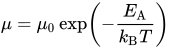
where is a mobility prefactor, is activation energy, is the Boltzmann constant, and is temperature. The activation energy is typically evaluated by measuring mobility as a function of temperature. The Urbach Energy can be used as a proxy for activation energy in some systems.[26]


Variable Range Hopping
[edit]At low temperature, or in system with a large degree of structural disorder (such as fully amorphous systems), electrons cannot access delocalized states. In such a system, electrons can only travel by tunnelling for one site to another, in a process called variable range hopping. In the original theory of variable range hopping, as developed by Mott and Davis,[27] the probability , of an electron hopping from one site , to another site , depends on their separation in space , and their separation in energy .


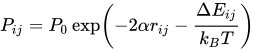
Here is a prefactor associated with the phonon frequency in the material,[28] and is the wavefunction overlap parameter. The mobility in a system governed by variable range hopping can be shown[27] to be:


![{\displaystyle \mu =\mu _{0}\exp \left(-\left[{\frac {T_{0}}{T}}\right]^{-1/(d+1)}\right)}](https://wikimedia.org/api/rest_v1/media/math/render/svg/2ec6dbb01dae46490fe94780f7719b272fd5f4ad)
where is a mobility prefactor, is a parameter (with dimensions of temperature) that quantifies the width of localized states, and is the dimensionality of the system.


Measurement of semiconductor mobility
[edit]Hall mobility
[edit]

Carrier mobility is most commonly measured using the Hall effect. The result of the measurement is called the "Hall mobility" (meaning "mobility inferred from a Hall-effect measurement").
Consider a semiconductor sample with a rectangular cross section as shown in the figures, a current is flowing in the x-direction and a magnetic field is applied in the z-direction. The resulting Lorentz force will accelerate the electrons (n-type materials) or holes (p-type materials) in the (−y) direction, according to the right hand rule and set up an electric field ξy. As a result there is a voltage across the sample, which can be measured with a high-impedance voltmeter. This voltage, VH, is called the Hall voltage. VH is negative for n-type material and positive for p-type material.
Mathematically, the Lorentz force acting on a charge q is given by
For electrons:

For holes:

In steady state this force is balanced by the force set up by the Hall voltage, so that there is no net force on the carriers in the y direction. For electrons,
![{\displaystyle \mathbf {F} _{y}=(-q)\xi _{y}+(-q)[\mathbf {v} _{n}\times \mathbf {B} _{z}]=0}](https://wikimedia.org/api/rest_v1/media/math/render/svg/7cf982828aabe02c406b8e0f377e23d99e065626)


For electrons, the field points in the −y direction, and for holes, it points in the +y direction.
The electron current I is given by . Sub vx into the expression for ξy,

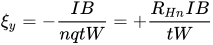
where RHn is the Hall coefficient for electron, and is defined as
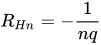
Since

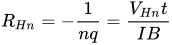
Similarly, for holes
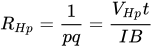
From the Hall coefficient, we can obtain the carrier mobility as follows:
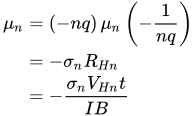
Similarly,
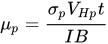
Here the value of VHp (Hall voltage), t (sample thickness), I (current) and B (magnetic field) can be measured directly, and the conductivities σn or σp are either known or can be obtained from measuring the resistivity.
Field-effect mobility
[edit]The mobility can also be measured using a field-effect transistor (FET). The result of the measurement is called the "field-effect mobility" (meaning "mobility inferred from a field-effect measurement").
The measurement can work in two ways: From saturation-mode measurements, or linear-region measurements.[29] (See MOSFET for a description of the different modes or regions of operation.)
Using saturation mode
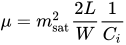
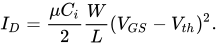
[edit]In this technique,[29] for each fixed gate voltage VGS, the drain-source voltage VDS is increased until the current ID saturates. Next, the square root of this saturated current is plotted against the gate voltage, and the slope msat is measured. Then the mobility is: where L and W are the length and width of the channel and Ci is the gate insulator capacitance per unit area. This equation comes from the approximate equation for a MOSFET in saturation mode: where Vth is the threshold voltage. This approximation ignores the Early effect (channel length modulation), among other things. In practice, this technique may underestimate the true mobility.[30]
Using the linear region
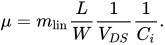
[edit]In this technique,[29] the transistor is operated in the linear region (or "ohmic mode"), where VDS is small and with slope mlin. Then the mobility is: This equation comes from the approximate equation for a MOSFET in the linear region: In practice, this technique may overestimate the true mobility, because if VDS is not small enough and VG is not large enough, the MOSFET may not stay in the linear region.[30]


Optical mobility
[edit]Electron mobility may be determined from non-contact laser photo-reflectance technique measurements. A series of photo-reflectance measurements are made as the sample is stepped through focus. The electron diffusion length and recombination time are determined by a regressive fit to the data. Then the Einstein relation is used to calculate the mobility.[31][32]
Terahertz mobility
[edit]Electron mobility can be calculated from time-resolved terahertz probe measurement.[33][34] Femtosecond laser pulses excite the semiconductor and the resulting photoconductivity is measured using a terahertz probe, which detects changes in the terahertz electric field.[35]
Time resolved microwave conductivity (TRMC)
[edit]A proxy for charge carrier mobility can be evaluated using time-resolved microwave conductivity (TRMC).[36] A pulsed optical laser is used to create electrons and holes in a semiconductor, which are then detected as an increase in photoconductance. With knowledge of the sample absorbance, dimensions, and incident laser fluence, the parameter can be evaluated, where is the carrier generation yield (between 0 and 1), is the electron mobility and is the hole mobility. has the same dimensions as mobility, but carrier type (electron or hole) is obscured.



Doping concentration dependence in heavily-doped silicon
[edit]The charge carriers in semiconductors are electrons and holes. Their numbers are controlled by the concentrations of impurity elements, i.e. doping concentration. Thus doping concentration has great influence on carrier mobility.
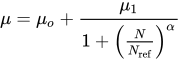
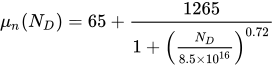
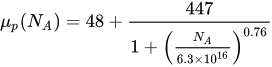
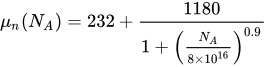
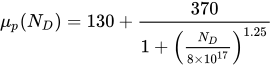
While there is considerable scatter in the experimental data, for noncompensated material (no counter doping) for heavily doped substrates (i.e. and up), the mobility in silicon is often characterized by the empirical relationship:[37] where N is the doping concentration (either ND or NA), and Nref and α are fitting parameters. At room temperature, the above equation becomes:

Majority carriers:[38]
Minority carriers:[39]
These equations apply only to silicon, and only under low field.
See also
[edit]References
[edit]- ^ a b c "NSM Archive - Physical Properties of Semiconductors". www.matprop.ru. Retrieved 2020-07-25.
- ^ a b Umansky, V.; Heiblum, M.; Levinson, Y.; Smet, J.; Nübler, J.; Dolev, M. (2009). "MBE growth of ultra-low disorder 2DEG with mobility exceeding 35×106 cm2 V−1 s−1". Journal of Crystal Growth. 311 (7): 1658–1661. Bibcode:2009JCrGr.311.1658U. doi:10.1016/j.jcrysgro.2008.09.151.
- ^ Dürkop, T.; Getty, S. A.; Cobas, Enrique; Fuhrer, M. S. (2004). "Extraordinary Mobility in Semiconducting Carbon Nanotubes". Nano Letters. 4 (1): 35. Bibcode:2004NanoL...4...35D. doi:10.1021/nl034841q. S2CID 45010238.
- ^ a b Bolotin, K; Sikes, K; Jiang, Z; Klima, M; Fudenberg, G; Hone, J; Kim, P; Stormer, H (2008). "Ultrahigh electron mobility in suspended graphene". Solid State Communications. 146 (9): 351–355. arXiv:0802.2389. Bibcode:2008SSCom.146..351B. doi:10.1016/j.ssc.2008.02.024. S2CID 118392999.
- ^ Nawrocki, Robert (2016). "300-nm Imperceptible, Ultraflexible, and Biocompatible e-Skin Fit with Tactile Sensors and Organic Transistors". Advanced Electronic Materials. 2 (4) 1500452. doi:10.1002/aelm.201500452. S2CID 138355533.
- ^ Chung, Y. J., Wang, C., Singh, S. K., Gupta, A., Baldwin, K. W., West, K. W., Shayegan, M., Pfeiffer, L. N., Winkler, R. (14 March 2022). "Record-quality GaAs two-dimensional hole systems". Physical Review Materials. 6 (3) 034005. arXiv:2203.10713. Bibcode:2022PhRvM...6c4005C. doi:10.1103/PhysRevMaterials.6.034005. ISSN 2475-9953.
- ^ Dürkop, T.; Getty, S. A.; Cobas, Enrique; Fuhrer, M. S. (2004). "Extraordinary Mobility in Semiconducting Carbon Nanotubes". Nano Letters. 4 (1): 35–39. Bibcode:2004NanoL...4...35D. doi:10.1021/nl034841q. S2CID 45010238.
- ^ Snow, E. S.; Campbell, P. M.; Ancona, M. G.; Novak, J. P. (2005). "High-mobility carbon-nanotube thin-film transistors on a polymeric substrate". Applied Physics Letters. 86 (3): 033105. Bibcode:2005ApPhL..86c3105S. doi:10.1063/1.1854721. ISSN 0003-6951. Archived from the original on September 24, 2017.
- ^ Shin, Jungwoo; Gamage, Geethal Amila; Ding, Zhiwei; Chen, Ke; Tian, Fei; Qian, Xin; Zhou, Jiawei; Lee, Hwijong; Zhou, Jianshi; Shi, Li; Nguyen, Thanh; Han, Fei; Li, Mingda; Broido, David; Schmidt, Aaron; Ren, Zhifeng; Chen, Gang (2022). "High ambipolar mobility in cubic boron arsenide". Science. 377 (6604): 437–440. Bibcode:2022Sci...377..437S. doi:10.1126/science.abn4290. PMID 35862526. S2CID 250952849.
- ^ He, Tao; Stolte, Matthias; Würthner, Frank (2013-12-23). "Air-Stable n-Channel Organic Single Crystal Field-Effect Transistors Based on Microribbons of Core-Chlorinated Naphthalene Diimide". Advanced Materials. 25 (48): 6951–6955. Bibcode:2013AdM....25.6951H. doi:10.1002/adma.201303392. PMID 24105872.
- ^ Yuan, Yongbo (2014). "Ultra-high mobility transparent organic thin film transistors grown by an off-centre spin-coating method". Nature Communications. 5 3005. Bibcode:2014NatCo...5.3005Y. doi:10.1038/ncomms4005. PMID 24398476.
- ^ Heremans, Paul (2015). "Mechanical and Electronic Properties of Thin-Film Transistors on Plastic, and Their Integration in Flexible Electronic Applications". Advanced Materials. 28 (22): 4266–4282. doi:10.1002/adma.201504360. PMID 26707947. S2CID 25457390.
- ^ a b Vladimir Vasilʹevich Mitin; Vi︠a︡cheslav Aleksandrovich Kochelap; Michael A. Stroscio (1999). Quantum heterostructures: microelectronics and optoelectronics. Cambridge University Press. pp. 307–9. ISBN 978-0-521-63635-3. Retrieved 2 March 2011.
- ^ a b Singh (2008). Electronic Devices And Integrated Circuits. PHI Learning Pvt. Ltd. pp. 77–. ISBN 978-81-203-3192-1. Retrieved 1 March 2011.
- ^ a b c d e f g h Ferry, David K. Semiconductor transport. London: Taylor & Francis, 2000. ISBN 0-7484-0865-7 (hbk.), ISBN 0-7484-0866-5 (pbk.)
- ^ a b c d Ibach, Harald.; Luth, Hans. Solid-state physics : an introduction to principles of materials science / Harald Ibach, Hans Luth. New York: Springer, 2009. -(Advanced texts in physics) ISBN 978-3-540-93803-3
- ^ a b Bulusu, A. (2008). "Review of electronic transport models for thermoelectric materials". Superlattices and Microstructures. 44 (1): 1–36. Bibcode:2008SuMi...44....1B. doi:10.1016/j.spmi.2008.02.008..
- ^ a b c Bhattacharya, Pallab. Semiconductor optoelectronic devices / Pallab Bhattacharya. Upper Saddle River (NJ): Prentice-Hall, 1997. ISBN 0-13-495656-7 (nid.)
- ^ a b Y. Takeda and T.P. Pearsall, "Failure of Mattheissen's Rule in the Calculation of Carrier Mobility and Alloy Scattering Effects in Ga0.47In0.53As", Electronics Lett. 17, 573-574 (1981).
- ^ Peter Y. Yu; Manuel Cardona (30 May 2010). Fundamentals of Semiconductors: Physics and Materials Properties. Springer. pp. 205–. ISBN 978-3-642-00709-5. Retrieved 1 March 2011.
- ^ Antonio Luque; Steven Hegedus (9 June 2003). Handbook of photovoltaic science and engineering. John Wiley and Sons. p. 79, eq. 3.58. ISBN 978-0-471-49196-5. Retrieved 2 March 2011. weblink (subscription only)
- ^ a b Chapter 2: Semiconductor Fundamentals Archived 2009-01-21 at the Wayback Machine. Online textbook by B. Van Zeghbroeck]
- ^ Hook, J. R.; Hall, H. E. (1991-09-05). Solid State Physics. Wiley. ISBN 978-0-471-92804-1.
- ^ Anderson, P. W. (1958-03-01). "Absence of Diffusion in Certain Random Lattices". Physical Review. 109 (5): 1492–1505. Bibcode:1958PhRv..109.1492A. doi:10.1103/PhysRev.109.1492.
- ^ Mott, N. F. (1967-01-01). "Electrons in disordered structures". Advances in Physics. 16 (61): 49–144. Bibcode:1967AdPhy..16...49M. doi:10.1080/00018736700101265. ISSN 0001-8732.
- ^ Brotherton, S. D. (2013). Introduction to Thin Film Transistors: Physics and Technology of TFTs. Springer International Publishing. p. 143. ISBN 978-3-319-00001-5.
- ^ a b Electronic Processes in Non-Crystalline Materials. Oxford Classic Texts in the Physical Sciences. Oxford, New York: Oxford University Press. 2012-03-24. ISBN 978-0-19-964533-6.
- ^ Emin, David (1974-02-11). "Phonon-Assisted Jump Rate in Noncrystalline Solids". Physical Review Letters. 32 (6): 303–307. Bibcode:1974PhRvL..32..303E. doi:10.1103/PhysRevLett.32.303.
- ^ a b c Constance Rost-Bietsch (August 2005). Ambipolar and Light-Emitting Organic Field-Effect Transistors. Cuvillier Verlag. pp. 17–. ISBN 978-3-86537-535-3. Retrieved 1 March 2011.. This reference mistakenly leaves out a factor of 1/VDS in eqn (2.11). The correct version of that equation can be found, e.g., in Stassen, A. F.; De Boer, R. W. I.; Iosad, N. N.; Morpurgo, A. F. (2004). "Influence of the gate dielectric on the mobility of rubrene single-crystal field-effect transistors". Applied Physics Letters. 85 (17): 3899–3901. arXiv:cond-mat/0407293. Bibcode:2004ApPhL..85.3899S. doi:10.1063/1.1812368. S2CID 119532427.
- ^ a b Constance Rost-Bietsch (August 2005). Ambipolar and Light-Emitting Organic Field-Effect Transistors. Cuvillier Verlag. pp. 19–. ISBN 978-3-86537-535-3. Retrieved 20 April 2011. "Extracting the field-effect mobility directly from the linear region of the output characteristic may yield larger values for the field-effect mobility than the actual one, since the drain current is linear only for very small VDS and large VG. In contrast, extracting the field-effect mobility from the saturated region might yield rather conservative values for the field-effect mobility, since the drain-current dependence from the gate-voltage becomes sub-quadratic for large VG as well as for small VDS."
- ^ W. Chism, "Precise Optical Measurement of Carrier Mobilities Using Z-scanning Laser Photoreflectance," arXiv:1711.01138 [physics:ins-det], Oct. 2017.
- ^ W. Chism, "Z-scanning Laser Photoreflectance as a Tool for Characterization of Electronic Transport Properties," arXiv:1808.01897 [cond-mat:mes-hall], Aug. 2018.
- ^ Ulbricht, Ronald; Hendry, Euan; Shan, Jie; Heinz, Tony F.; Bonn, Mischa (2011). "Carrier dynamics in semiconductors studied with time-resolved terahertz spectroscopy" (PDF). Reviews of Modern Physics. 83 (2): 543–586. Bibcode:2011RvMP...83..543U. doi:10.1103/RevModPhys.83.543. hdl:10871/15671. ISSN 0034-6861.
- ^ Lloyd-Hughes, James; Jeon, Tae-In (2012). "A Review of the Terahertz Conductivity of Bulk and Nano-Materials". Journal of Infrared, Millimeter, and Terahertz Waves. 33 (9): 871–925. Bibcode:2012JIMTW..33..871L. doi:10.1007/s10762-012-9905-y. ISSN 1866-6892. S2CID 13849900.
- ^ Evers, Wiel H.; Schins, Juleon M.; Aerts, Michiel; Kulkarni, Aditya; Capiod, Pierre; Berthe, Maxime; Grandidier, Bruno; Delerue, Christophe; van der Zant, Herre S. J.; van Overbeek, Carlo; Peters, Joep L.; Vanmaekelbergh, Daniel; Siebbeles, Laurens D. A. (2015). "High charge mobility in two-dimensional percolative networks of PbSe quantum dots connected by atomic bonds". Nature Communications. 6 8195. Bibcode:2015NatCo...6.8195E. doi:10.1038/ncomms9195. ISSN 2041-1723. PMC 4598357. PMID 26400049.
- ^ Savenije, Tom J.; Ferguson, Andrew J.; Kopidakis, Nikos; Rumbles, Garry (2013-11-21). "Revealing the Dynamics of Charge Carriers in Polymer:Fullerene Blends Using Photoinduced Time-Resolved Microwave Conductivity". The Journal of Physical Chemistry C. 117 (46): 24085–24103. doi:10.1021/jp406706u. ISSN 1932-7447.
- ^ B. L. Anderson and R. L. Anderson, "Fundamentals of Semiconductor Devices, " Mc Graw Hill, 2005
- ^ Caughey, D.M.; Thomas, R.E. (1967). "Carrier mobilities in silicon empirically related to doping and field". Proceedings of the IEEE. 55 (12): 2192–2193. Bibcode:1967IEEEP..55.2192C. doi:10.1109/PROC.1967.6123.
- ^ Del Alamo, J (1985). "Measuring and modeling minority carrier transport in heavily doped silicon". Solid-State Electronics. 28 (1): 47–54. Bibcode:1985SSEle..28...47D. doi:10.1016/0038-1101(85)90209-6.
External links
[edit]- semiconductor glossary entry for electron mobility Archived 2009-01-04 at the Wayback Machine
- Resistivity and Mobility Calculator from the BYU Cleanroom
- Online lecture- Mobility from an atomistic point of view
| International | |
|---|---|
| National | |
| Other | |

Electron mobility
View on GrokipediaFundamentals
Definition and Units
Electron mobility, denoted as or simply , quantifies the ease with which electrons respond to an applied electric field in a solid material, such as a metal or semiconductor. It serves as the proportionality constant between the average drift velocity of electrons and the electric field strength , formally defined by the relation . This definition captures the directed motion of charge carriers superimposed on their random thermal motion, providing a key parameter for understanding electrical transport properties.[5] The concept originated in early 20th-century solid-state physics as part of the Drude model, a classical theory of electron conduction in metals proposed by Paul Drude in 1900. In this model, electrons are treated as a free gas interacting with the ionic lattice, where mobility arises from the balance between accelerating electric forces and collisional scattering. The term "mobility" derives from its representation of the electrons' freedom of movement, distinguishing it from fixed lattice ions. A parallel quantity, hole mobility , applies to positive charge carriers (holes) in semiconductors, which behave as if moving oppositely to electrons; in materials like silicon, is typically about one-third of due to differences in effective mass and scattering.[6][7] In the International System of Units (SI), electron mobility has dimensions of area per volt-second, yielding m²/(V·s), which emerges dimensionally from drift velocity (m/s) divided by electric field (V/m). For practical applications in semiconductor device physics, the cgs-derived unit cm²/(V·s) is prevalent, where values for electrons in silicon range up to approximately 1400 cm²/(V·s) at room temperature, and 1 m²/(V·s) equals 10⁴ cm²/(V·s). This unit choice facilitates comparison with experimental data on carrier transport.[8][2]Drift Velocity and Derivation
In the presence of an applied electric field , charge carriers such as electrons in a semiconductor or metal experience a net directed motion superimposed on their random thermal velocities. The thermal velocity arises from the random kinetic energy due to temperature, typically on the order of cm/s for electrons at room temperature, resulting in no net current without a field. In contrast, the drift velocity is the average velocity acquired by the ensemble of electrons in response to the field, directed opposite to for electrons due to their negative charge, and is much smaller in magnitude under typical conditions.[7] This steady-state drift arises from a balance between the accelerating electric force and the decelerating effect of scattering events with lattice vibrations, impurities, or other obstacles. The electric force on an electron is (where is the elementary charge magnitude), imparting an acceleration , with as the effective mass accounting for band structure effects in the solid. Scattering introduces a frictional drag, approximated in the relaxation time model as a momentum loss term proportional to the velocity, with relaxation time representing the average time between collisions. In equilibrium, this balance yields the drift velocity .[1] To derive this formally, start with the semiclassical equation of motion for the average electron velocity : where the second term on the right models the exponential decay of momentum toward zero after each scattering event, assuming carriers lose their drift momentum upon collision. For steady-state conditions, , so The electron mobility is defined as the proportionality constant between and , giving , such that . This derivation relies on the relaxation time approximation from the Boltzmann transport equation, where is taken as constant.[9][7] The model assumes low electric fields where the linear response holds, an isotropic material with uniform scattering, and neglect of magnetic fields or other external influences that could alter carrier trajectories.[1]Transport Relations
Relation to Current Density
The drift current density arises from the collective motion of electrons under an applied electric field, directly linking microscopic electron mobility to macroscopic charge transport in materials such as semiconductors and metals. When an electric field is applied, electrons experience a drift velocity , where is the electron mobility (positive by convention), leading to a net current due to the imbalance in electron flow. The resulting drift current density for electrons is expressed as where is the electron number density and is the elementary charge ( C). This formula quantifies how efficiently electrons contribute to current flow, with higher mobility yielding greater current for a given field and carrier density.[10][7] From experimental measurements of current density under controlled conditions, electron mobility can be determined by rearranging the relation: assuming isotropic conditions and known and . This inversion is particularly useful in device characterization, where applied fields generate measurable currents to infer material properties. In the context of Ohm's law, (with as electrical conductivity), the drift current forms the primary contribution in low-field regimes for extrinsic semiconductors, bridging microscopic carrier dynamics to the material's overall resistive behavior.[10] For anisotropic materials, such as certain crystals or layered semiconductors where electron transport varies by direction due to band structure asymmetry, the scalar mobility is replaced by a second-rank mobility tensor . The drift current density then takes the vector form capturing direction-dependent responses; for example, in hexagonal crystals like graphene derivatives, may differ significantly from . This tensorial description is essential for modeling transport in non-cubic lattices, ensuring accurate predictions of current flow in devices exploiting anisotropy.[11]Relation to Electrical Conductivity
In the classical Drude model of electrical conduction in metals, the electrical conductivity is directly related to electron mobility through the formula , where is the electron density and is the elementary charge.[12] This expression arises from the drift velocity of electrons under an applied electric field, where the average drift speed leads to a current density , and thus . The model, proposed by Paul Drude in 1900, treats conduction electrons as a classical gas subject to random scattering, with mobility incorporating the relaxation time between collisions and the electron mass .[12] For semiconductors, the relation extends to account for both electrons and holes: the total conductivity is , where and are the electron and hole densities, respectively, and and are their respective mobilities.[13] In intrinsic semiconductors, , simplifying to , while in extrinsic cases, one carrier type dominates, such as for n-type materials. This formulation highlights how mobility influences charge transport efficiency, with higher values yielding greater and correspondingly lower resistivity , enabling better electrical performance in devices.[14] The dependence on effective mass further explains variations across materials: in the quantum mechanical refinement, , as the effective mass accounts for lattice interactions in band structures, replacing the free electron mass in Drude's original expression./Solar_Basics/C._Semiconductors_and_Solar_Interactions/II._Conduction_in_Semiconductors/4%3A_Carrier_Drift_and_Mobility) Drude's classical approach was refined in 1928 by Arnold Sommerfeld using Fermi-Dirac statistics, which better describes the Pauli exclusion principle for degenerate electron gases in metals, while Felix Bloch's band theory incorporated periodic lattice potentials to validate the conductivity-mobility link quantum mechanically.[15] These advancements preserved the core relation but provided a more accurate foundation for understanding material-specific behaviors.Relation to Electron Diffusion
In semiconductors, the diffusion current arises from the random thermal motion of charge carriers, leading to a net flow from regions of higher concentration to lower concentration. For electrons, this is expressed as , where is the elementary charge, is the diffusion coefficient, and is the electron concentration.[7][16] This component of current is distinct from drift current but contributes to the total transport under non-uniform conditions. The Einstein relation connects the diffusion coefficient to the electron mobility through , where is Boltzmann's constant and is the absolute temperature. This relation is derived by considering thermal equilibrium, where the net current is zero, balancing the drift current due to a built-in electric field and the diffusion current due to a concentration gradient. In equilibrium, the carrier concentration follows , leading to , and setting the total flux yields the Einstein relation.[17][7] Thermoelectric effects, such as the Seebeck effect, rely on this relation, as the Seebeck coefficient , which measures the voltage generated by a temperature gradient, incorporates the ratio to describe the diffusion-driven separation of carriers. In non-degenerate semiconductors, for electrons is approximately , where accounts for scattering, and the Einstein relation ensures consistency between thermal diffusion and mobility in the underlying transport equations.[16][7] The standard Einstein relation applies to non-degenerate semiconductors, where carrier statistics follow Maxwell-Boltzmann distributions. For degenerate cases, such as heavily doped materials where the Fermi level enters the conduction band, generalizations incorporate Fermi-Dirac integrals, modifying the relation to , where is the reduced Fermi energy and are Fermi-Dirac integrals.[18][7]Examples
In Traditional Semiconductors and Metals
In traditional semiconductors, electron mobility values provide a benchmark for carrier transport in established materials used in electronics. For intrinsic silicon at 300 K, the electron mobility is approximately 1400 cm²/(V·s), dominated by phonon scattering in lightly doped conditions.[7] Germanium exhibits higher mobility, with μ_e ≈ 3900 cm²/(V·s) in its intrinsic form at room temperature.[19] Gallium arsenide, a III-V compound semiconductor, shows even greater values, around 8500–8800 cm²/(V·s) for intrinsic material, enabling faster device speeds compared to silicon.[20] In metals, electron mobility is generally much lower due to the high density of conduction electrons (n ≈ 10^{22}–10^{23} cm^{-3}), despite high electrical conductivity. For copper, a prototypical conductor, μ_e ≈ 43 cm²/(V·s) at room temperature, limited primarily by electron-electron and electron-phonon interactions.[21] These mobility values are sensitive to material purity, where impurities introduce scattering that reduces μ_e, and to temperature, with phonon scattering causing a decrease as temperature rises.[7]| Material | Electron Mobility (cm²/(V·s)) | Conditions |
|---|---|---|
| Silicon (Si) | 1400 | Intrinsic, 300 K |
| Germanium (Ge) | 3900 | Intrinsic, room T |
| GaAs | 8500–8800 | Intrinsic |
| Copper (Cu) | 43 | Bulk, room T |