Hubbry Logo
search
logo

Elementary matrix

logo
Community Hub0 Subscribers
Read side by side
from Wikipedia

In mathematics, an elementary matrix is a square matrix obtained from the application of a single elementary row operation to the identity matrix. The elementary matrices generate the general linear group GLn(F) when F is a field. Left multiplication (pre-multiplication) by an elementary matrix represents the corresponding elementary row operation, while right multiplication (post-multiplication) represents the corresponding elementary column operation.

Elementary row operations are used in Gaussian elimination to reduce a matrix to row echelon form. They are also used in Gauss–Jordan elimination to further reduce the matrix to reduced row echelon form.

Elementary row operations

[edit]

There are three types of elementary matrices, which correspond to three types of row operations (respectively, column operations):

Row switching
A row within the matrix can be switched with another row.
Row multiplication
Each element in a row can be multiplied by a non-zero constant. It is also known as scaling a row.

Row addition
A row can be replaced by the sum of that row and a multiple of another row.

If E is an elementary matrix, as described below, to apply the elementary row operation to a matrix A, one multiplies A by the elementary matrix on the left, EA. The elementary matrix for any row operation is obtained by executing the operation on the identity matrix. This fact can be understood as an instance of the Yoneda lemma applied to the category of matrices.[1]

Row-switching transformations

[edit]

The first type of row operation on a matrix A switches all matrix elements on row i with their counterparts on a different row j. The corresponding elementary matrix is obtained by swapping row i and row j of the identity matrix.
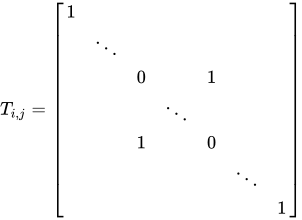
So Ti,j A is the matrix produced by exchanging row i and row j of A.

Coefficient wise, the matrix Ti,j is defined by :

Properties

[edit]
  • The inverse of this matrix is itself:
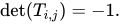
  • Since the determinant of the identity matrix is unity, It follows that for any square matrix A (of the correct size), we have
  • For theoretical considerations, the row-switching transformation can be obtained from row-addition and row-multiplication transformations introduced below because

Row-multiplying transformations

[edit]

The next type of row operation on a matrix A multiplies all elements on row i by m where m is a non-zero scalar (usually a real number). The corresponding elementary matrix is a diagonal matrix, with diagonal entries 1 everywhere except in the ith position, where it is m.
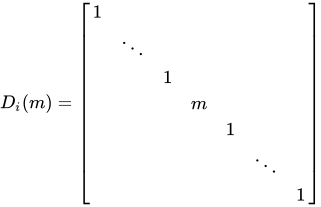
So Di(m)A is the matrix produced from A by multiplying row i by m.

Coefficient wise, the Di(m) matrix is defined by :

Properties

[edit]
  • The inverse of this matrix is given by
  • The matrix and its inverse are diagonal matrices.
  • Therefore, for a square matrix A (of the correct size), we have

Row-addition transformations

[edit]

The final type of row operation on a matrix A adds row j multiplied by a scalar m to row i. The corresponding elementary matrix is the identity matrix but with an m in the (i, j) position.
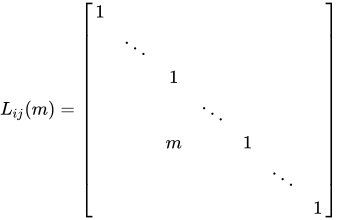
So Lij(m)A is the matrix produced from A by adding m times row j to row i. And A Lij(m) is the matrix produced from A by adding m times column i to column j.

Coefficient wise, the matrix Li,j(m) is defined by :

Properties

[edit]
  • These transformations are a kind of shear mapping, also known as a transvections.
  • The inverse of this matrix is given by
  • The matrix and its inverse are triangular matrices.
  • Therefore, for a square matrix A (of the correct size) we have
  • Row-addition transforms satisfy the Steinberg relations.

See also

[edit]

References

[edit]
Revisions and contributorsEdit on WikipediaRead on Wikipedia
from Grokipedia
In linear algebra, an elementary matrix is a square matrix obtained by performing a single elementary row operation on the identity matrix.[1] These operations include interchanging two rows (Type I), multiplying a row by a nonzero scalar (Type II), or adding a scalar multiple of one row to another row (Type III).[1][2] Multiplying a matrix on the left by an elementary matrix applies the corresponding row operation to it, which is fundamental for Gaussian elimination and row reduction processes.[1] Every elementary matrix is invertible, with its inverse also being an elementary matrix of the same type; for instance, Type I matrices are their own inverses, while the inverses of Type II and III involve the negative of the scalar used.[1] This invertibility property ensures that sequences of elementary row operations correspond to multiplication by a product of elementary matrices, preserving the equivalence of matrices under row transformations.[3] A key theorem states that a square matrix is invertible if and only if it can be expressed as a product of elementary matrices, highlighting their role in characterizing the general linear group of invertible matrices.[1] Elementary matrices are essential in applications such as computing matrix inverses—via augmenting with the identity and row reducing—and deriving LU decompositions for solving linear systems efficiently.[2][3]

Background: Elementary Row Operations

Row Switching

Row switching is an elementary row operation that exchanges two distinct rows, indexed as row ii and row jj where iji \neq j, in a matrix AA to form a new matrix with those rows interchanged.[4] This operation reorders the rows without altering the underlying relationships in the matrix.[5] The row switching operation is commonly notated as RiRjR_i \leftrightarrow R_j, indicating the interchange of row ii and row jj. In the context of elementary matrices, this is represented by left-multiplying AA by an elementary matrix EijE_{ij}, yielding EijAE_{ij}A as the matrix with rows ii and jj swapped.[6][7] For example, consider the 3×3 matrix
(031952213). \begin{pmatrix} 0 & 3 & 1 \\ 9 & 5 & -2 \\ 2 & 1 & 3 \end{pmatrix}.
Applying row switching R1R2R_1 \leftrightarrow R_2 produces
(952031213). \begin{pmatrix} 9 & 5 & -2 \\ 0 & 3 & 1 \\ 2 & 1 & 3 \end{pmatrix}.
[5]
In solving linear systems, row switching permutes the order of the equations but preserves the solution set, as the interchange simply rearranges the system without changing its equivalence./01:_Systems_of_Linear_Equations/1.03:_Elementary_Row_Operations_and_Gaussian_Elimination)[5] This operation originated in the methods of Gaussian elimination, developed by Carl Friedrich Gauss in the early 19th century, particularly in his 1809 work on celestial mechanics where he applied elimination techniques to solve systems of equations.[8][9]

Row Scaling

Row scaling is an elementary row operation that consists of multiplying all entries in a designated row ii of a matrix AA by a nonzero scalar kk, thereby producing a new matrix with the ii-th row scaled accordingly while leaving all other rows unchanged.[10] This operation is typically denoted as RikRiR_i \leftarrow k R_i, where RiR_i represents the ii-th row, indicating that the entire row is replaced by kk times its original entries.[5] For instance, consider the 2×22 \times 2 matrix
A=(1234). A = \begin{pmatrix} 1 & 2 \\ 3 & 4 \end{pmatrix}.
Applying row scaling to the first row by multiplying it by 3 results in the matrix
B=(3634), B = \begin{pmatrix} 3 & 6 \\ 3 & 4 \end{pmatrix},
where the first row has been uniformly scaled while the second row remains intact.[11] In the context of solving linear systems via Gaussian elimination, row scaling plays a key role in normalization by adjusting coefficients to simplify the matrix form, such as converting a leading entry (the first nonzero entry in a row) to 1 for easier pivot operations in subsequent steps.[12] The requirement that k0k \neq 0 ensures this operation preserves the rank of the matrix and the solution set of the corresponding linear system, maintaining equivalence without introducing inconsistencies or reducing the matrix's linear independence structure.[13]

Row Addition

The row addition operation is one of the three fundamental elementary row operations in linear algebra, consisting of adding a scalar multiple of one row to a different row in a matrix while leaving the source row unchanged.[5] This operation modifies only the target row by incorporating a linear combination from another row, ensuring that the overall structure of the matrix remains intact except for that specific alteration.[14] In standard notation, the operation is expressed as replacing row $ i $ with row $ i $ plus $ m $ times row $ j $, where $ i \neq j $ and $ m $ is a scalar (often a real number).[5] This can be written as $ R_i \leftarrow R_i + m R_j $, where $ R_i $ and $ R_j $ denote the $ i $-th and $ j $-th rows, respectively.[14] Consider the following 3×3 matrix as an example:
(124253467) \begin{pmatrix} 1 & 2 & 4 \\ 2 & -5 & 3 \\ 4 & 6 & -7 \end{pmatrix}
Applying the row addition operation to add 2 times row 1 to row 3 (i.e., $ m = 2 $, $ i = 3 $, $ j = 1 $) yields:
(1242536101) \begin{pmatrix} 1 & 2 & 4 \\ 2 & -5 & 3 \\ 6 & 10 & 1 \end{pmatrix}
Here, the third row is updated as $ [4 + 2 \cdot 1, 6 + 2 \cdot 2, -7 + 2 \cdot 4] = [6, 10, 1] $, while the first and second rows remain unchanged.[14] This operation plays a crucial role in Gaussian elimination, where it is used to zero out entries below pivot positions in the matrix, facilitating the transformation into row-echelon form for solving systems of linear equations.[5] By systematically applying row additions, subdiagonal elements can be eliminated, simplifying the process of back-substitution without altering the solution set of the corresponding linear system.[14] Unlike other operations, row addition is inherently invertible—its reverse can be achieved by adding the negative multiple—and it precisely preserves the row space of the matrix, as the modified row remains a linear combination of the original rows, maintaining the span of all rows.[15] This preservation ensures that matrices related by row addition are row equivalent, sharing the same solution space for associated linear systems.[16]

Definition and Construction

Formal Definition

In the context of linear algebra, elementary matrices are considered for square matrices of order $ n $ over a field $ F $, such as the real numbers $ \mathbb{R} $ or complex numbers $ \mathbb{C} $, where elements admit additive and multiplicative inverses (except zero for the latter).[2] An elementary matrix is a square matrix $ E $ obtained by applying exactly one elementary row operation to the $ n \times n $ identity matrix $ I_n $.[2][17] The resulting matrix $ E $ thus differs from $ I_n $ in a minimal manner, reflecting the localized effect of the single operation while preserving the overall structure close to the identity.[2] These matrices represent simple linear transformations that are perturbations of the identity transformation.[17] Every elementary matrix is invertible, with its inverse being another elementary matrix corresponding to the same type of operation.[18] The elementary row operations in question—interchanging two rows, multiplying a row by a nonzero scalar from $ F $, or adding a multiple of one row to another—are the foundational operations detailed in the background on elementary row operations.[2]

Generating Elementary Matrices

Elementary matrices are constructed by applying a single elementary row operation to the n × n identity matrix InI_n, where n2n \geq 2, resulting in a matrix EE that uniquely corresponds to that operation and size.[19][20] This process ensures EE is invertible and, when left-multiplied by any matrix AA, performs the same row operation on AA.[19] For row switching, the elementary matrix EijE_{ij} (with iji \neq j) is formed by interchanging rows ii and jj of InI_n. The resulting matrix has zeros at positions (i,i)(i,i) and (j,j)(j,j), ones at (i,j)(i,j) and (j,i)(j,i), and ones on all other diagonal entries.[21][19] For example, the 3 × 3 switching matrix swapping rows 1 and 2 is
(010100001). \begin{pmatrix} 0 & 1 & 0 \\ 1 & 0 & 0 \\ 0 & 0 & 1 \end{pmatrix}.
[19][20] The scaling elementary matrix Ei(k)E_i(k), where k0k \neq 0, is obtained by multiplying row ii of InI_n by the scalar kk. This yields a matrix with kk at position (i,i)(i,i), ones on all other diagonal entries, and zeros elsewhere.[19][20] For row addition, the elementary matrix Eij(m)E_{ij}(m) (with iji \neq j and scalar mm) is created by adding mm times row jj to row ii of InI_n. The matrix has ones along the entire diagonal and mm at the off-diagonal position (i,j)(i,j), with zeros elsewhere.[19][20]

Types of Elementary Matrices

Switching Matrices

Switching matrices, also known as interchange or permutation elementary matrices, are constructed by interchanging exactly two distinct rows of the n × n identity matrix I_n, leaving all other rows unchanged.[22] This results in a matrix with exactly one 1 in each row and each column, and 0s elsewhere, corresponding to a transposition permutation.[22] When a switching matrix E is left-multiplied by an arbitrary matrix A (i.e., EA), it performs the corresponding row interchange on A, swapping rows i and j while leaving other rows intact.[22] Right-multiplication (AE) similarly swaps the corresponding columns of A.[22] This structure arises from applying the elementary row switching operation to the identity matrix. For an n × n switching matrix E that interchanges two distinct rows, the determinant is det(E) = -1, reflecting its status as an odd permutation. The trace is tr(E) = n - 2, as it counts the number of fixed points on the diagonal (all but the two interchanged positions).[23] A simple example is the 2 × 2 switching matrix that interchanges the two rows of I_2:
E=(0110) E = \begin{pmatrix} 0 & 1 \\ 1 & 0 \end{pmatrix}
Multiplying this E on the left by a vector (ab)\begin{pmatrix} a \\ b \end{pmatrix} yields (ba)\begin{pmatrix} b \\ a \end{pmatrix}, effectively swapping the components.[22] Switching matrices are orthogonal, satisfying E^T E = I_n, and specifically for a transposition, E is symmetric, so E^T = E. Since applying the swap twice returns the identity (E^2 = I_n), it follows that E^{-1} = E.[23]

Scaling Matrices

A scaling matrix, also known as a diagonal elementary matrix, is formed by multiplying a single row of the identity matrix by a nonzero scalar kk, resulting in a diagonal matrix where all diagonal entries are 1 except for the ii-th entry, which is kk.[3] This structure ensures the matrix remains diagonal and differs from the identity only in one position.[3] When a scaling matrix EE premultiplies a matrix AA (i.e., EAEA), it scales the ii-th row of AA by the factor kk.[3] Conversely, postmultiplication (i.e., AEAE) scales the ii-th column of AA by kk.[24] These operations preserve the linear independence of the rows or columns, provided k0k \neq 0, which is required for the matrix to be nonsingular.[3] The determinant of a scaling matrix EE is equal to kk, as it is the product of the diagonal entries.[3] Since EE is diagonal, its eigenvalues are precisely the diagonal entries: n1n-1 eigenvalues equal to 1 and one eigenvalue equal to kk.[25] Among the three types of elementary matrices, only scaling matrices are diagonal, distinguishing them from permutation matrices (for row switching) and shear matrices (for row addition).[3] For example, consider the 3×3 scaling matrix EE that scales the second row by k=2k=2:
E=(100020001) E = \begin{pmatrix} 1 & 0 & 0 \\ 0 & 2 & 0 \\ 0 & 0 & 1 \end{pmatrix}
Applying EE to a sample matrix A=(123456789)A = \begin{pmatrix} 1 & 2 & 3 \\ 4 & 5 & 6 \\ 7 & 8 & 9 \end{pmatrix} yields EA=(12381012789)EA = \begin{pmatrix} 1 & 2 & 3 \\ 8 & 10 & 12 \\ 7 & 8 & 9 \end{pmatrix}, where only the second row is doubled.[3] Similarly, AEAE would double the second column of AA.[24]

Addition Matrices

Addition matrices, also known as transvection matrices, are a type of elementary matrix constructed by modifying the identity matrix InI_n of size n×nn \times n. Specifically, an addition matrix Ei,j(m)E_{i,j}(m) for iji \neq j and scalar mm is the identity matrix with an additional entry mm in the off-diagonal position (i,j)(i,j), while all other off-diagonal entries remain zero.[26][27] This structure corresponds to the elementary row operation of adding mm times one row to another.[28] When an addition matrix EE acts on a matrix AA via left multiplication EAEA, it performs a row operation: the ii-th row of the result is the ii-th row of AA plus mm times the jj-th row of AA, leaving other rows unchanged.[26] In contrast, right multiplication AEAE effects a column operation: the jj-th column of the result is the jj-th column of AA plus mm times the ii-th column of AA, with other columns unaffected.[29] These transformations preserve the linear dependence relations among the rows or columns of AA.[27] The determinant of an addition matrix is det(E)=1\det(E) = 1, reflecting its volume-preserving nature under linear transformations.[27][28] Furthermore, addition matrices are unipotent, expressible as E=I+NE = I + N where NN is a nilpotent matrix satisfying N2=0N^2 = 0.[27] In linear algebra, these matrices represent transvections, which are shear transformations that fix a hyperplane and add a multiple of a vector in that hyperplane to any vector.[26][27] For example, consider the 3×3 addition matrix EE with m=12m = -\frac{1}{2} at position (1,2)(1,2):
E=(1120010001) E = \begin{pmatrix} 1 & -\frac{1}{2} & 0 \\ 0 & 1 & 0 \\ 0 & 0 & 1 \end{pmatrix}
Applying EE to a matrix A=(a11a12a13a21a22a23a31a32a33)A = \begin{pmatrix} a_{11} & a_{12} & a_{13} \\ a_{21} & a_{22} & a_{23} \\ a_{31} & a_{32} & a_{33} \end{pmatrix} via left multiplication yields EAEA, where the first row becomes (a1112a21a1212a22a1312a23)\begin{pmatrix} a_{11} - \frac{1}{2} a_{21} & a_{12} - \frac{1}{2} a_{22} & a_{13} - \frac{1}{2} a_{23} \end{pmatrix}, effectively eliminating or adjusting the (1,1)(1,1) entry if AA has a specific pivot structure in Gaussian elimination.[26][22]

General Properties

Invertibility

A fundamental property of elementary matrices is that every such matrix is invertible, and moreover, its inverse is also an elementary matrix of the same type. This holds for all three types: switching, scaling, and addition matrices.[1][30] To establish this, consider the construction of an elementary matrix EE as the result of applying a single elementary row operation to the identity matrix InI_n. Since each elementary row operation is reversible by another elementary row operation, the inverse operation applied to EE yields InI_n, confirming invertibility.[31][1] For a switching matrix EijE_{ij} that interchanges rows ii and jj of InI_n, the inverse is EijE_{ij} itself, as applying the same interchange twice returns the original matrix. Thus, Eij1=EijE_{ij}^{-1} = E_{ij}, which is elementary of the same type.[30][1] For a scaling matrix Eii(k)E_{ii}(k) that multiplies row ii by a nonzero scalar kk, the inverse scales row ii by 1/k1/k, yielding Eii(1/k)E_{ii}(1/k). Explicitly, if Eii(k)=In+(k1)eiiE_{ii}(k) = I_n + (k-1)e_{ii} where eiie_{ii} is the standard basis matrix, then Eii(k)1=In+(1/k1)eiiE_{ii}(k)^{-1} = I_n + (1/k - 1)e_{ii}, which is elementary of the same type.[30][1] For an addition matrix Eij(m)E_{ij}(m) that adds mm times row jj to row ii (with iji \neq j), the inverse adds m-m times row jj to row ii, so Eij(m)1=Eij(m)E_{ij}(m)^{-1} = E_{ij}(-m). Explicitly, if Eij(m)=In+meijE_{ij}(m) = I_n + m e_{ij}, then Eij(m)1=InmeijE_{ij}(m)^{-1} = I_n - m e_{ij}, again elementary of the same type.[30][1][31] As a consequence, any finite product of elementary matrices is invertible, with the inverse being the product of the individual inverses in reverse order. This property implies that the elementary matrices generate the general linear group GL(n,R)\mathrm{GL}(n, \mathbb{R}), the group of all n×nn \times n invertible matrices over the reals.[1][31] Furthermore, the addition matrices generate the special linear group SL(n,R)\mathrm{SL}(n, \mathbb{R}), consisting of all n×nn \times n matrices with determinant 1.[32][33]

Similarity and Equivalence

Two matrices AA and BB over a field are row equivalent if one can be obtained from the other by a finite sequence of elementary row operations, which is equivalent to the existence of an invertible matrix PP, expressible as a product of elementary matrices, such that B=PAB = P A.[15] This relation partitions the set of all m×nm \times n matrices into equivalence classes, where matrices within the same class share the same row space and rank. Elementary matrices facilitate the reduction of any matrix AA to its row echelon form through left multiplication by a product of such matrices; specifically, there exist elementary matrices E1,,EkE_1, \dots, E_k such that EkE1A=UE_k \cdots E_1 A = U, where UU is in row echelon form (upper triangular with possible zero rows at the bottom).[3] This process defines the equivalence class uniquely, as the row echelon form is determined up to the positions of the pivots, and it underscores the role of elementary matrices in establishing canonical representatives for row equivalence classes.[34] For square matrices, conjugation by an elementary matrix induces a similarity transformation: if EE is elementary, then EAE1E A E^{-1} is similar to AA, preserving key spectral properties such as eigenvalues and their algebraic multiplicities.[35] Such transformations maintain the characteristic polynomial, ensuring that det(λIEAE1)=det(λIA)\det(\lambda I - E A E^{-1}) = \det(\lambda I - A).[36] Over a field, every invertible matrix can be expressed as a finite product of elementary matrices, a result central to the theory of matrix equivalence and extending to the Smith normal form in principal ideal domains.[1] This decomposition highlights the generative power of elementary matrices for the general linear group.

Applications

Gaussian Elimination

Gaussian elimination is a method for solving systems of linear equations by transforming the coefficient matrix into row echelon form through a sequence of row operations, each performed via left-multiplication by an elementary matrix.[37] This process systematically eliminates variables below each pivot, resulting in an upper triangular matrix $ U $ such that $ E_k \cdots E_1 A = U $, where each $ E_i $ is an elementary matrix corresponding to a row operation.[38] The augmented matrix with the right-hand side vector $ b $ is similarly transformed to $ E_k \cdots E_1 [A | b] = [U | c] $, enabling back-substitution to solve $ Ux = c $.[39] The algorithm proceeds column by column, starting from the first. For each pivot position $ (k, k) $, pivot selection identifies a nonzero entry in column $ k $ below or at row $ k $; if the diagonal entry is zero, a switching matrix interchanges rows to place a nonzero pivot there, as in partial pivoting which chooses the entry with the largest absolute value to enhance numerical stability.[40] Elimination then applies addition matrices to subtract multiples of the pivot row from rows below, zeroing entries beneath the pivot; for instance, to eliminate the entry in row $ i > k $, the matrix has 1's on the diagonal and $ -\lambda $ (where $ \lambda = a_{ik}/a_{kk} $) in the $ (i, k) $ position off-diagonal.[37] Scaling matrices may normalize the pivot to 1 after switching and elimination, though partial pivoting often scales post-switching to avoid introducing fractions that could amplify rounding errors.[38] This sequence repeats for subsequent columns until row echelon form is achieved. Consider the 3×3 system $ Ax = b $ with
A=(121261114),b=(273). A = \begin{pmatrix} 1 & 2 & 1 \\ 2 & 6 & 1 \\ 1 & 1 & 4 \end{pmatrix}, \quad b = \begin{pmatrix} 2 \\ 7 \\ 3 \end{pmatrix}.
First, the pivot at (1,1) is 1 (nonzero, no switch). Apply the addition matrix
E1=(100210101) E_1 = \begin{pmatrix} 1 & 0 & 0 \\ -2 & 1 & 0 \\ -1 & 0 & 1 \end{pmatrix}
to eliminate below: $ E_1 A = \begin{pmatrix} 1 & 2 & 1 \ 0 & 2 & -1 \ 0 & -1 & 3 \end{pmatrix} $, and $ E_1 b = \begin{pmatrix} 2 \ 3 \ 1 \end{pmatrix} $. For column 2, the (2,2) entry is 2 (nonzero). Apply
E2=(10001001/21) E_2 = \begin{pmatrix} 1 & 0 & 0 \\ 0 & 1 & 0 \\ 0 & 1/2 & 1 \end{pmatrix}
to zero the (3,2) entry: $ E_2 E_1 A = \begin{pmatrix} 1 & 2 & 1 \ 0 & 2 & -1 \ 0 & 0 & 5/2 \end{pmatrix} = U $, and $ E_2 E_1 b = \begin{pmatrix} 2 \ 3 \ 5/2 \end{pmatrix} = c $.[37] Back-substitution solves $ Ux = c $: from the last row, $ (5/2) x_3 = 5/2 $ so $ x_3 = 1 $; second row gives $ 2x_2 - x_3 = 3 $ so $ x_2 = 2 $; first row yields $ x_1 + 2x_2 + x_3 = 2 $ so $ x_1 = -3 $. The elementary matrices track the full transformation for solving similar systems or inverting $ A $.[39] The overall complexity of Gaussian elimination is $ O(n^3) $ floating-point operations for an $ n \times n $ matrix, dominated by the elimination steps where approximately $ n^3/3 $ multiplications and additions occur, while back-substitution requires only $ O(n^2) $ operations.[37] The use of elementary matrices not only performs the row operations but also preserves the equivalence of the original and transformed systems, ensuring the solution's accuracy.[38]

LU Factorization

LU factorization decomposes a square matrix AA into the product A=LUA = LU, where LL is a unit lower triangular matrix (with 1's on the main diagonal) and UU is an upper triangular matrix. The subdiagonal entries of LL arise from the multipliers applied during Gaussian elimination, and both LL and the elementary matrices involved are products of addition-type and scaling-type elementary matrices, specifically unit lower triangular forms.[41][3] The construction begins with Gaussian elimination on AA without row interchanges, using row operations that add integer multiples of one row to rows below it. These operations correspond to left-multiplication by a sequence of unit lower triangular elementary matrices E1,E2,,EkE_1, E_2, \dots, E_k, yielding the upper triangular matrix U=EkE2E1AU = E_k \cdots E_2 E_1 A. Thus, A=(EkE2E1)1U=LUA = (E_k \cdots E_2 E_1)^{-1} U = L U, where L=E11E21Ek1L = E_1^{-1} E_2^{-1} \cdots E_k^{-1}. Each inverse Ei1E_i^{-1} is also unit lower triangular, with subdiagonal entries that are the negatives of those in EiE_i, but the overall LL places the original elimination multipliers directly below the diagonal.[41][42] Specifically, for the jj-th elimination step, the multipliers mijm_{ij} (for i>ji > j) used to zero entries below the pivot in column jj become the entries ij=mij\ell_{ij} = m_{ij} in LL.[3] This factorization requires that no row exchanges occur during elimination, which holds if all leading principal minors of AA are nonzero, ensuring no zero pivots are encountered. If partial pivoting is necessary for stability, a permutation matrix PP—itself a product of row-swap elementary matrices—is applied first, resulting in PA=LUPA = LU.[41][43] The matrix LL is unit lower triangular and uniquely determined by the elimination process without pivoting, representing a product of inverses of addition and scaling elementary matrices that preserve the unit diagonal property.[3] For a concrete example, consider the matrix
A=(253312121). A = \begin{pmatrix} 2 & 5 & 3 \\ 3 & 1 & -2 \\ -1 & 2 & 1 \end{pmatrix}.
In the first step, eliminate below the (1,1) pivot: multipliers m21=3/2m_{21} = 3/2 and m31=1/2m_{31} = -1/2. After this, the second column requires multiplier m32=9/13m_{32} = -9/13 for the updated matrix. The resulting UU is
U=(253013/213/2002), U = \begin{pmatrix} 2 & 5 & 3 \\ 0 & -13/2 & -13/2 \\ 0 & 0 & -2 \end{pmatrix},
and LL incorporates the multipliers:
L=(1003/2101/29/131). L = \begin{pmatrix} 1 & 0 & 0 \\ 3/2 & 1 & 0 \\ -1/2 & -9/13 & 1 \end{pmatrix}.
Verification confirms LU=ALU = A. This decomposition arises directly from the sequence of elementary matrices applied during elimination.[3]

Matrix Inversion

One standard method to compute the inverse of an invertible n×nn \times n matrix AA using elementary matrices is to form the augmented matrix [AIn][A \mid I_n], where InI_n is the n×nn \times n identity matrix, and apply a sequence of elementary row operations until the left portion transforms into InI_n. The right portion then becomes A1A^{-1}. These row operations correspond to left-multiplication by elementary matrices E1,E2,,EkE_1, E_2, \dots, E_k, satisfying EkE1A=InE_k \cdots E_1 A = I_n. Consequently, A1=EkE1A^{-1} = E_k \cdots E_1, expressing the inverse as a finite product of elementary matrices. Each elementary matrix is invertible, with its inverse also elementary, ensuring the process aligns with the group structure of invertible matrices.[1] The row operations employed are interchanging two rows (via a switching elementary matrix), scaling a row by a nonzero scalar (via a scaling elementary matrix), and adding a scalar multiple of one row to another (via an addition elementary matrix). These are applied iteratively to reduce the left side to identity while simultaneously transforming the identity on the right. For example, consider inverting the 2×22 \times 2 matrix
A=(1234). A = \begin{pmatrix} 1 & 2 \\ 3 & 4 \end{pmatrix}.
Start with the augmented matrix
[AI2]=(12103401). [A \mid I_2] = \begin{pmatrix} 1 & 2 & | & 1 & 0 \\ 3 & 4 & | & 0 & 1 \end{pmatrix}.
First, subtract 3 times row 1 from row 2 using the addition elementary matrix
E1=(1031), E_1 = \begin{pmatrix} 1 & 0 \\ -3 & 1 \end{pmatrix},
yielding
(12100231). \begin{pmatrix} 1 & 2 & | & 1 & 0 \\ 0 & -2 & | & -3 & 1 \end{pmatrix}.
Next, scale row 2 by 1/2-1/2 using
E2=(1001/2), E_2 = \begin{pmatrix} 1 & 0 \\ 0 & -1/2 \end{pmatrix},
resulting in
(1210013/21/2). \begin{pmatrix} 1 & 2 & | & 1 & 0 \\ 0 & 1 & | & 3/2 & -1/2 \end{pmatrix}.
Finally, subtract 2 times row 2 from row 1 using
E3=(1201), E_3 = \begin{pmatrix} 1 & -2 \\ 0 & 1 \end{pmatrix},
producing
(1021013/21/2). \begin{pmatrix} 1 & 0 & | & -2 & 1 \\ 0 & 1 & | & 3/2 & -1/2 \end{pmatrix}.
Thus, A1=E3E2E1=(213/21/2)A^{-1} = E_3 E_2 E_1 = \begin{pmatrix} -2 & 1 \\ 3/2 & -1/2 \end{pmatrix}.[2]
This procedure works only if AA is invertible; if row reduction yields a row of zeros on the left before achieving the identity, the rank of AA is less than nn, indicating AA is singular with no inverse. More broadly, the ability to express any invertible matrix as such a product implies that the elementary matrices generate the general linear group GL(n,F)\mathrm{GL}(n, F) over a field FF.[33]

References

User Avatar
No comments yet.




