



Community hub
Recent from talks
Contribute something
Nothing was collected or created yet.
Matrix representation of conic sections
View on WikipediaIn mathematics, the matrix representation of conic sections permits the tools of linear algebra to be used in the study of conic sections. It provides easy ways to calculate a conic section's axis, vertices, tangents and the pole and polar relationship between points and lines of the plane determined by the conic. The technique does not require putting the equation of a conic section into a standard form, thus making it easier to investigate those conic sections whose axes are not parallel to the coordinate system.
Conic sections (including degenerate ones) are the sets of points whose coordinates satisfy a second-degree polynomial equation in two variables, By an abuse of notation, this conic section will also be called when no confusion can arise.


This equation can be written in matrix notation, in terms of a symmetric matrix to simplify some subsequent formulae, as[1]

The sum of the first three terms of this equation, namely is the quadratic form associated with the equation, and the matrix is called the matrix of the quadratic form. The trace and determinant of are both invariant with respect to rotation of axes and translation of the plane (movement of the origin).[2][3]

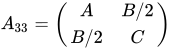

The quadratic equation can also be written as

where is the homogeneous coordinate vector in three variables restricted so that the last variable is 1, i.e.,


and where is the matrix

The matrix is called the matrix of the quadratic equation.[4] Like that of , its determinant is invariant with respect to both rotation and translation.[3]
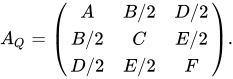
The 2 × 2 upper left submatrix (a matrix of order 2) of , obtained by removing the third (last) row and third (last) column from is the matrix of the quadratic form. The above notation is used in this article to emphasize this relationship.
Classification
[edit]Proper (non-degenerate) and degenerate conic sections can be distinguished[5][6] based on the determinant of :

If , the conic is degenerate.

If so that is not degenerate, we can see what type of conic section it is by computing the minor, :


In the case of an ellipse, we can distinguish the special case of a circle by comparing the last two diagonal elements corresponding to the coefficients of , and :


- If and , then is a circle.


Moreover, in the case of a non-degenerate ellipse (with and ), we have a real ellipse if but an imaginary ellipse if . An example of the latter is , which has no real-valued solutions.



If the conic section is degenerate (), still allows us to distinguish its form:

- Two intersecting lines (a hyperbola degenerated to its two asymptotes) if and only if .
- Two parallel straight lines (a degenerate parabola) if and only if . These lines are distinct and real if , coincident if , and non-existent in the real plane if .
- A single point (a degenerate ellipse) if and only if .



The case of coincident lines occurs if and only if the rank of the 3 × 3 matrix is 1; in all other degenerate cases its rank is 2.[2]
Central conics
[edit]When a geometric center of the conic section exists and such conic sections (ellipses and hyperbolas) are called central conics.[7]

Center
[edit]The center of a conic, if it exists, is a point that bisects all the chords of the conic that pass through it. This property can be used to calculate the coordinates of the center, which can be shown to be the point where the gradient of the quadratic function Q vanishes—that is,[8] This yields the center as given below.
![{\displaystyle \nabla Q=\left[{\frac {\partial Q}{\partial x}},{\frac {\partial Q}{\partial y}}\right]=[0,0].}](https://wikimedia.org/api/rest_v1/media/math/render/svg/b2c2d5dcd5abe1ed87051fb34a4ef8a0d5473170)
An alternative approach that uses the matrix form of the quadratic equation is based on the fact that when the center is the origin of the coordinate system, there are no linear terms in the equation. Any translation to a coordinate origin (x0, y0), using x* = x – x0, y* = y − y0 gives rise to

The condition for (x0, y0) to be the conic's center (xc, yc) is that the coefficients of the linear x* and y* terms, when this equation is multiplied out, are zero. This condition produces the coordinates of the center:

This calculation can also be accomplished by taking the first two rows of the associated matrix AQ, multiplying each by (x, y, 1)⊤ and setting both inner products equal to 0, obtaining the following system:
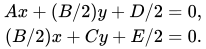
This yields the above center point.
In the case of a parabola, that is, when 4AC − B2 = 0, there is no center since the above denominators become zero (or, interpreted projectively, the center is on the line at infinity.)
Centered matrix equation
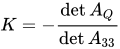
[edit]A central (non-parabola) conic can be rewritten in centered matrix form as where



Then for the ellipse case of AC > (B/2)2, the ellipse is real if the sign of K equals the sign of (A + C) (that is, the sign of each of A and C), imaginary if they have opposite signs, and a degenerate point ellipse if K = 0. In the hyperbola case of AC < (B/2)2, the hyperbola is degenerate if and only if K = 0.
Standard form of a central conic
[edit]The standard form of the equation of a central conic section is obtained when the conic section is translated and rotated so that its center lies at the center of the coordinate system and its axes coincide with the coordinate axes. This is equivalent to saying that the coordinate system's center is moved and the coordinate axes are rotated to satisfy these properties. In the diagram, the original xy-coordinate system with origin O is moved to the x'y'-coordinate system with origin O'.

The translation is by the vector

The rotation by angle α can be carried out by diagonalizing the matrix A33. Thus, if and are the eigenvalues of the matrix A33, the centered equation can be rewritten in new variables x' and y' as[9]


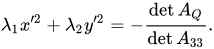
Dividing by we obtain a standard canonical form.
For example, for an ellipse this form is From here we get a and b, the lengths of the semi-major and semi-minor axes in conventional notation.

For central conics, both eigenvalues are non-zero and the classification of the conic sections can be obtained by examining them.[10]
- If λ1 and λ2 have the same algebraic sign, then Q is a real ellipse, imaginary ellipse or real point if K has the same sign, has the opposite sign or is zero, respectively.
- If λ1 and λ2 have opposite algebraic signs, then Q is a hyperbola or two intersecting lines depending on whether K is nonzero or zero, respectively.
Axes
[edit]By the principal axis theorem, the two eigenvectors of the matrix of the quadratic form of a central conic section (ellipse or hyperbola) are perpendicular (orthogonal to each other) and each is parallel to (in the same direction as) either the major or minor axis of the conic. The eigenvector having the smallest eigenvalue (in absolute value) corresponds to the major axis.[11]
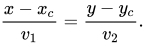
Specifically, if a central conic section has center (xc, yc) and an eigenvector of A33 is given by v(v1, v2) then the principal axis (major or minor) corresponding to that eigenvector has equation,
Vertices
[edit]The vertices of a central conic can be determined by calculating the intersections of the conic and its axes — in other words, by solving the system consisting of the quadratic conic equation and the linear equation for alternately one or the other of the axes. Two or no vertices are obtained for each axis, since, in the case of the hyperbola, the minor axis does not intersect the hyperbola at a point with real coordinates. However, from the broader view of the complex plane, the minor axis of an hyperbola does intersect the hyperbola, but at points with complex coordinates.[12]
Poles and polars
[edit]Using homogeneous coordinates,[13] the points[14] and are conjugate with respect to the conic Q provided


The conjugates of a fixed point p either form a line or consist of all the points in the plane of the conic. When the conjugates of p form a line, the line is called the polar of p and the point p is called the pole of the line, with respect to the conic. This relationship between points and lines is called a polarity.
If the conic is non-degenerate, the conjugates of a point always form a line and the polarity defined by the conic is a bijection between the points and lines of the extended plane containing the conic (that is, the plane together with the points and line at infinity).
If the point p lies on the conic Q, the polar line of p is the tangent line to Q at p.
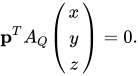
The equation, in homogeneous coordinates, of the polar line of the point p with respect to the non-degenerate conic Q is given by
Just as p uniquely determines its polar line (with respect to a given conic), so each line determines a unique pole p. Furthermore, a point p is on a line L which is the polar of a point r, if and only if the polar of p passes through the point r (La Hire's theorem).[15] Thus, this relationship is an expression of geometric duality between points and lines in the plane.
Several familiar concepts concerning conic sections are directly related to this polarity. The center of a non-degenerate conic can be identified as the pole of the line at infinity. A parabola, being tangent to the line at infinity, would have its center being a point on the line at infinity. Hyperbolas intersect the line at infinity in two distinct points and the polar lines of these points are the asymptotes of the hyperbola and are the tangent lines to the hyperbola at these points of infinity. Also, the polar line of a focus of the conic is its corresponding directrix.[16]
Tangents
[edit]Let line L be the polar line of point p with respect to the non-degenerate conic Q. By La Hire's theorem, every line passing through p has its pole on L. If L intersects Q in two points (the maximum possible) then the polars of those points are tangent lines that pass through p and such a point is called an exterior or outer point of Q. If L intersects Q in only one point, then it is a tangent line and p is the point of tangency. Finally, if L does not intersect Q then p has no tangent lines passing through it and it is called an interior or inner point.[17]
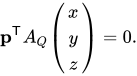
The equation of the tangent line (in homogeneous coordinates) at a point p on the non-degenerate conic Q is given by,
If p is an exterior point, first find the equation of its polar (the above equation) and then the intersections of that line with the conic, say at points s and t. The polars of s and t will be the tangents through p.
Using the theory of poles and polars, the problem of finding the four mutual tangents of two conics reduces to finding the intersection of two conics.
See also
[edit]Notes
[edit]- ^ Brannan, Esplen & Gray 1999, p. 30
- ^ a b Pettofrezzo 1978, p. 110
- ^ a b Spain 2007, pp. 59–62
- ^ It is also a matrix of a quadratic form, but this form has three variables and is .
- ^ Lawrence 1972, p. 63
- ^ Spain 2007, p. 70
- ^ Pettofrezzo 1978, p. 105
- ^ Ayoub 1993, p. 322
- ^ Ayoub 1993, p. 324
- ^ Pettofrezzo 1978, p. 108
- ^ Ostermann & Wanner 2012, p. 311
- ^ Kendig, Keith (2005), Conics, The Mathematical Association of America, pp. 89–102, ISBN 978-0-88385-335-1
- ^ This permits the algebraic inclusion of infinite points and a line at infinity which are necessary to have for some of the following results
- ^ This section follows Fishback, W.T. (1969), Projective and Euclidean Geometry (2nd ed.), Wiley, pp. 167–172
- ^ Brannan, Esplen & Gray 1999, p. 189
- ^ Akopyan, A.V.; Zaslavsky, A.A. (2007), Geometry of Conics, American Mathematical Society, p. 72, ISBN 978-0-8218-4323-9
- ^ Interpreted in the complex plane such a point is on two complex tangent lines that meet Q in complex points.

References
[edit]- Ayoub, A. B. (1993), "The central conic sections revisited", Mathematics Magazine, 66 (5): 322–325, doi:10.1080/0025570x.1993.11996157
- Brannan, David A.; Esplen, Matthew F.; Gray, Jeremy J. (1999), Geometry, Cambridge University Press, ISBN 978-0-521-59787-6
- Lawrence, J. Dennis (1972), A Catalog of Special Plane Curves, Dover
- Ostermann, Alexander; Wanner, Gerhard (2012), Geometry by its History, Springer, doi:10.1007/978-3-642-29163-0, ISBN 978-3-642-29163-0
- Pettofrezzo, Anthony (1978) [1966], Matrices and Transformations, Dover, ISBN 978-0-486-63634-4
- Spain, Barry (2007) [1957], Analytical Conics, Dover, ISBN 978-0-486-45773-4

Matrix representation of conic sections
View on GrokipediaGeneral representation
Quadratic equation
The general equation of a conic section in the Cartesian plane is a second-degree polynomial given by where are real numbers, not all zero.[5] This equation provides the algebraic foundation for describing the loci of points that define conic sections, capturing their curved paths through the inclusion of quadratic, linear, and constant terms.[6] This form represents all non-degenerate conic sections—ellipses, parabolas, and hyperbolas—along with their degenerate cases, with the specific type arising from the relative magnitudes and signs of the coefficients .[7] The geometric interpretations of these curves stem from ancient studies but were unified under this polynomial framework in the early modern period. The systematic study of conic sections began with the geometric treatises of Apollonius of Perga in the 3rd century BCE, who classified them based on intersections with cones, but the algebraic equation form was pioneered by René Descartes in his 1637 appendix La Géométrie, marking the birth of analytic geometry.[8] Specific examples illustrate the versatility of this equation. A circle, as a special ellipse with equal semi-axes, is described by , or in general form .[9] A parabola, opening upward, follows , equivalently .[10]Symmetric matrix form
The general equation of a conic section, , can be reformulated using matrix notation to highlight the quadratic terms. This is expressed as the quadratic form , where , , and is a symmetric 2×2 matrix that encodes the second-degree terms.[1][2] The off-diagonal entries incorporate half the coefficient of the cross term to ensure the matrix-vector product yields the correct expansion .[11] The symmetry of (i.e., ) is a fundamental property, guaranteeing that all eigenvalues are real numbers, which is essential for geometric interpretations.[1][11] Additionally, the trace of , given by , equals the sum of its eigenvalues , while the determinant equals their product .[1][2] These relations connect algebraic invariants of the matrix to the conic's shape and orientation. To incorporate the linear and constant terms, the equation extends to a homogeneous quadratic form using a 3×3 matrix , known as the conic matrix: Here, the off-diagonal blocks in the lower right include half the linear coefficients to maintain consistency with the quadratic expansion.[1][2] This matrix representation unifies the conic under projective geometry and facilitates the application of linear algebra techniques, such as eigenvalue decomposition for rotating to principal axes and analyzing conic types.[11][2]Classification of conics
Discriminant and conic types
The matrix representation of a conic section begins with the quadratic form associated with the general equation , where the symmetric matrix captures the second-degree terms. The determinant of this matrix, , serves as the primary discriminant for classifying the conic type in non-degenerate cases. Specifically, if , the conic is an ellipse (including the special case of a circle when and ); if , it is a parabola; and if , it is a hyperbola. To incorporate the linear and constant terms for a complete classification, the full conic equation is represented by the 3×3 symmetric matrix . The conic is non-degenerate if ; otherwise, it reduces to degenerate forms such as points, lines, or empty sets. Full classification relies on alongside adjugate invariants of , such as the trace of the adjugate matrix or determinants of its principal minors, which help distinguish real from imaginary cases and confirm the type indicated by . For instance, in the equation , , so , identifying an ellipse (unit circle). Similarly, for or , , yielding , confirming a parabola.[12][13] This discriminant-based classification is invariant under affine transformations, including rotations and translations, which do not alter the sign of or the non-degeneracy condition . Rotations, being orthogonal, preserve the eigenvalues of and thus , while translations affect only the linear terms without impacting the quadratic structure. This invariance facilitates type identification regardless of coordinate choice, ensuring consistent classification across equivalent representations.[14][13]Degenerate and imaginary cases
A conic section is degenerate if the determinant of its associated 3×3 symmetric matrix vanishes, i.e., .[15] In this case, the rank of classifies the degeneracy: full rank 3 corresponds to non-degenerate conics, while lower ranks yield specific degenerate forms.[15] Specifically, rank 2 indicates a pair of distinct lines (real or complex conjugate), rank 1 a repeated line, and rank 0 the entire plane (though the latter is atypical for conic equations).[15] For instance, the equation represents a degenerate hyperbola consisting of two intersecting real lines, and , with the matrix having rank 2.[16] Similarly, yields a single real point at the origin, interpreted as the intersection of two complex conjugate lines and , again with of rank 2, marking a degenerate ellipse.[4] Imaginary conics arise in non-degenerate cases () where the curve has no real points, often when the eigenvalues of the quadratic submatrix (the 2×2 block of ) share the same sign but the linear and constant terms ensure the quadratic form does not cross zero over the reals.[4] For example, describes an imaginary ellipse with (both eigenvalues positive) and of full rank 3, yet the equation admits no real solutions since is impossible.[4] In projective geometry, degenerate conics relate to the line at infinity, where cases like parallel lines emerge as intersections moved to infinity, unifying various degenerate forms under projective transformations that map the line at infinity accordingly.[15]Central conics
Identifying the center
Central conics, such as ellipses and hyperbolas, possess a well-defined center that serves as the point of symmetry. In the matrix representation of a conic section given by the quadratic equation , where is the symmetric matrix of quadratic coefficients and is the vector of linear coefficients, the center is the solution to the equation . This gradient condition yields the linear system , which simplifies to , provided that is invertible. The invertibility of , equivalent to , is a necessary condition for the conic to be central, excluding parabolic cases where the conic extends infinitely in one direction without a finite center. When , the conic may degenerate or represent a parabola, and no such center exists in the finite plane. To illustrate, consider the conic . The associated matrix is with . Solving gives the partial derivatives and . The solution is , , so the center is . Since , this confirms a central conic. Geometrically, the center represents the intersection point of the conic's axes of symmetry, which are the lines along which the conic is symmetric. This property facilitates translation of coordinates to a centered form in subsequent analyses.Centered matrix equation
To translate a general conic section to its center, perform a coordinate shift , where is the center obtained by solving the system of partial derivatives set to zero, as described in the previous section. Substituting this into the general matrix form eliminates the linear terms, yielding the centered equation , where the constant . This centered form simplifies analysis by removing translation effects, leaving only the quadratic terms governed by the symmetric matrix . If , the equation can be scaled by dividing through by to obtain the normalized centered form , where , , and are the elements of adjusted by the scaling factor. The sign of influences the reality of the conic: for an ellipse with positive definite , ensures the right-hand side is positive, yielding a real bounded curve, while may produce an imaginary conic. For example, consider the general conic , with , , and . The center is found from the previous method. Substituting gives , or after scaling, , confirming a centered ellipse.Diagonalization to principal axes
After translating the conic to its center, the equation takes the form , where is the symmetric matrix representing the quadratic terms and . Since is symmetric, the principal axis theorem guarantees that it admits an orthogonal diagonalization , where is an orthogonal matrix whose columns are the normalized eigenvectors of , and is the diagonal matrix of eigenvalues. This decomposition corresponds to a rotation of the coordinate axes to align with the principal axes of the conic, eliminating the cross term in the quadratic form. Substituting the change of variables into the centered equation yields , or explicitly . For hyperbolas, where the eigenvalues have opposite signs (say ), the equation can be rewritten as to match the standard form. The rotation matrix encodes the orientation of the principal axes relative to the original coordinates. The angle of rotation can be computed directly from the elements of as , which aligns the new axes with the eigenvectors. This formula derives from the condition that the rotation eliminates the off-diagonal terms, equivalent to solving . The eigenvalues and remain invariant under translation of the conic, as such shifts only introduce linear terms without altering the quadratic matrix . They scale proportionally under overall multiplication of the conic equation by a constant factor, reflecting changes in the equation's normalization but not the intrinsic shape.Properties of central conics
Axes and eigenvalues
In the matrix representation of central conics, following the diagonalization of the centered symmetric matrix into its principal axes form , the eigenvalues and (assuming ) determine the lengths of the semi-axes along the directions given by the corresponding eigenvectors.[2][17] For an ellipse, both eigenvalues are positive, and the semi-major axis length is while the semi-minor axis length is .[2][17] The eigenvectors indicate the orientations of these major and minor axes relative to the original coordinate system.[18] For a hyperbola, the eigenvalues have opposite signs, and the transverse and conjugate semi-axis lengths are derived from their absolute values: the transverse semi-axis is along the eigenvector for the positive eigenvalue, and the conjugate semi-axis is along the eigenvector for the negative eigenvalue.[17][18] The eigenvectors thus specify the directions of the transverse and conjugate axes.[18] Consider the diagonalized ellipse equation , where the eigenvalues of the associated matrix are and ; the semi-axes lengths are then and , aligned with the coordinate axes as the eigenvectors.[2]Vertices and foci
For central conics in their diagonalized matrix form , where is the symmetric matrix of quadratic terms with eigenvalues and , the vertices and foci are specific points along the principal axes determined after translation to the center and rotation via the eigenvector matrix.[19] For an ellipse, assume with both eigenvalues positive; the semi-major axis length is and the semi-minor axis length is . The vertices lie at the endpoints of these axes in principal coordinates: along the major axis and along the minor axis. The foci are positioned at , where . The eccentricity is given by , which relates to the eigenvalues via .[20] For a hyperbola, assume ; the semi-transverse axis length is and the semi-conjugate axis length is . In principal coordinates for the form , the vertices are at along the transverse axis. The foci are at , where .[19][17] To obtain these points in the original coordinates, first translate by the center found from solving the partial derivatives, yielding . Then apply the rotation matrix whose columns are the normalized eigenvectors of , so the principal coordinates are . The vertices and foci in original coordinates are thus , where takes the values , for ellipse vertices, or for hyperbola vertices and foci (with in place of for the latter).[19]Poles and polars
Definition via matrix inversion
In the matrix representation of a conic section, the general equation in homogeneous coordinates is given by , where is a point in the projective plane and is a symmetric 3×3 matrix defining the conic.[21] The polar of a point with respect to the conic is the line consisting of all points satisfying .[21] This equation represents a line in homogeneous coordinates, and for a non-degenerate conic (where ), the direct form is standard.[22] Dually, the pole of a line (with homogeneous coordinates ) is the point , which satisfies the reciprocal relation such that the polar of is .[21] If the conic matrix is singular (degenerate case), the pole is computed using the adjugate matrix instead, yielding , ensuring the construction remains valid without inversion.[22] This matrix-based definition via inversion or adjugation unifies the point-line duality inherent in the projective plane, allowing seamless reciprocity between points and lines with respect to the conic without coordinate-specific adjustments.[21]Geometric properties
The pole-polar relation in conic sections exhibits a fundamental reciprocity, whereby the pole of the polar line of a given point with respect to a conic is the original point itself. This involutive property ensures that applying the pole-polar transformation twice returns to the starting element, preserving the duality between points and lines in the plane. In the context of the matrix representation defined previously, this reciprocity arises from the symmetry of the conic matrix, but geometrically, it underscores the bidirectional nature of the correspondence.[23] Harmonic properties are central to the geometric interpretation of poles and polars. Specifically, if four lines pass through a fixed point, their polars with respect to a conic concur if and only if the lines form a harmonic set. Furthermore, the pole-polar relation generates harmonic conjugates: for a line intersecting the conic at two points, the pole divides the segment harmonically with respect to those intersection points and the points at infinity. These properties extend to ranges of points on a line, where conjugate points with respect to the conic form harmonic divisions, facilitating proofs of incidence theorems in projective geometry.[24] In central conics such as ellipses and hyperbolas, the polar of a focus is the corresponding directrix, linking the reflective properties of the conic to its polar duality. This relation is instrumental in projective geometry, where poles and polars define the envelope of the conic as the dual curve, enabling the study of tangent families without reference to metric concepts. For instance, consider the unit circle given by ; the polar of a point is the line , which intersects the circle harmonically and exemplifies the reciprocity for points outside the conic.[24][23]Tangent lines
Tangent from a point
In the matrix representation of a conic section, the equation of the pair of tangent lines drawn from an external point to the conic is given by , where and .[25] This equation represents the degenerate conic consisting of the two tangent lines passing through . The points of tangency can alternatively be found as the intersection points of the conic with the polar line of , which is the line .[25] For a central conic in the form , the square of the length of the tangent from an external point generalizes the circle case through diagonalization of . For the unit circle , the length is . In the principal axis frame, where is diagonal with eigenvalues corresponding to semi-axes , , the square of the tangent length is . To determine if a specific line is tangent to the conic, parametrize the line as , where is a point on the line and is the direction vector. Substituting into yields a quadratic equation in the parameter , with coefficients derived from the matrix elements of . The line is tangent if the discriminant , ensuring exactly one intersection point (double root).[26] Example: Tangents from to the unit circleHere, in homogeneous coordinates, so , , and . The pair of tangents is Expanding yields the explicit equation of the two lines; for instance, if , the pair equation yields , which factors as , giving the tangent lines . The length of each tangent is .[25]