


Community hub
0 subscribers8 pages, 0 posts
Recent from talks
All channels
Be the first to start a discussion here.
Be the first to start a discussion here.
Be the first to start a discussion here.
Be the first to start a discussion here.
Contribute something
Welcome to the community hub built to collect knowledge and have discussions related to Elopidae.
Nothing was collected or created yet.
Elopidae
View on Wikipediafrom Wikipedia
| Elopidae Temporal range:
| |
|---|---|

| |
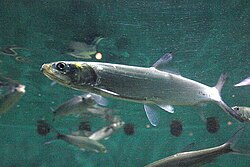
| Elops saurus | |

| |
| Davichthys, a fossil elopid from the Late Cretaceous | |
Scientific classification 
| |
| Kingdom: | Animalia |
| Phylum: | Chordata |
| Class: | Actinopterygii |
| Order: | Elopiformes |
| Family: | Elopidae Bonaparte, 1832 |
| Type species | |
| Elops saurus Linnaeus, 1766
| |
| Genera | |
|
See text | |
| Synonyms[2] | |
| |
The Elopidae are an ancient family of ray-finned fish, one of two living members of the order Elopiformes. They containing a single living genus, Elops, and many extinct genera dating back to the Late Jurassic, when the earliest stem-group elopids are known. They appear to have diverged from their closest relatives, the Megalopidae, during the Jurassic.[1]
Etymology
[edit]The name comes from the Ancient Greek ἔλοψ (élops), variant of ἔλλοψ (éllops), referring to a kind of serpent or serpentlike sea fish.[3] Compare the name of the unrelated family Elapidae.
Taxonomy
[edit]The following genera are known:
- Elops Linnaeus 1766 non Bonaparte 1831 non Commerson ex Lacépède, 1801 - Early Cretaceous (Aptian) to present
- †Ctenodentelops Forey et al., 2003 - Late Cretaceous (Cenomanian) of Lebanon[4]
- †Davichthys Forey 1973 - Late Cretaceous (Cenomanian to Santonian) of Europe and the Middle East
- †Elopsomolos Arratia, 2000 - Late Jurassic (Kimmeridgian) of Germany[1][5]
- †Esocelops Woodward, 1901 - Early Eocene of England[6]
- †Ichthyemidion Arratia, 1995 - Early Cretaceous of Spain [1][7]
- †Italoelops Taverne & Capasso, 2024 - Early Cretaceous (Aptian) of Italy[8]
- †Kipalelops Taverne, 1976 - Late Cretaceous of the Democratic Republic of the Congo[9]
- †Landanaelops Taverne & Smith, 2025 - Middle Paleocene of Angola[9]
- †Lyrolepis Romanowski 1886 non Rechiger, 1943 - Oligocene of North Caucasus, Russia
- †Nardoelops Taverne & Capasso, 2012 - Late Cretaceous (Campanian or Maastrichtian) of Italy[9]
- ?†Opisthopteryx Pictet & Humbert, 1866 - Santonian of Lebanon[10]
- ?†Palelops Applegate, 1970 - Late Cretaceous of Alabama, USA
- †Protelops Laube, 1885 - Cenomanian of England[4]
- ?†Sauropsidium Costa, 1850 - Early Cretaceous of Italy[10]
- ?†Thrissopteroides von der Marck, 1873 - Late Cretaceous of Germany and Lebanon[10]
See also
[edit]References
[edit]- ^ a b c d Near, Thomas J.; Thacker, Christine E. (2024-04-18). "Phylogenetic Classification of Living and Fossil Ray-Finned Fishes (Actinopterygii)". Bulletin of the Peabody Museum of Natural History. 65 (1): 101. Bibcode:2024BPMNH..65..101N. doi:10.3374/014.065.0101. ISSN 0079-032X.
- ^ "Elopidae" (PDF). Deeplyfish- fishes of the world. Archived from the original (PDF) on 18 June 2018. Retrieved 18 May 2017.
- ^ Froese, R.; Pauly, D. (2017). "Elopidae". FishBase version (02/2017). Retrieved 18 May 2017.
- ^ a b Amalfitano, Jacopo; Giusberti, Luca; Fornaciari, Eliana; Carnevale, Giorgio (2020-04-03). "Upper Cenomanian Fishes from the Bonarelli Level (Oae2) of Northeastern Italy". Rivista Italiana di Paleontologia e Stratigrafia. 126 (2). doi:10.13130/2039-4942/13224. ISSN 2039-4942.
- ^ Arratia, Gloria (2000). "Remarkable teleostean fishes from the Late Jurassic of southern Germany and their phylogenetic relationships". Fossil Record. 3 (1): 137–179. doi:10.1002/mmng.20000030108. ISSN 1860-1014.
- ^ Friedman, Matt; Beckett, Hermione T.; Close, Roger A.; Johanson, Zerina (2016-01-01), Johanson, Z.; Barrett, P. M.; Richter, M.; Smith, M. (eds.), "The English Chalk and London Clay: two remarkable British bony fish Lagerstätten", Arthur Smith Woodward: His Life and Influence on Modern Vertebrate Palaeontology, vol. 430, Geological Society of London, p. 0, ISBN 978-1-86239-741-5, retrieved 2025-02-21
- ^ POYATO-ARIZA, F. J (1995). "Ichthyemidion, a new genus for the elopiform fish «Anaethalion» vidali, from the Early Cretaceous of Spain: phylogenetic comments". Ichthyemidion, A New Genus for the Elopiform Fish «Anaethalion» Vidali, from the Early Cretaceous of Spain: Phylogenetic Comments. 320 (2): 133–139. ISSN 1251-8050.
- ^ Taverne, Louis; Capasso, Luigi (2024). "OSTEOLOGY AND RELATIONSHIPS OF ITALOELOPS FOREYI GEN. AND SP. NOV. (TELEOSTEI, ELOPIFORMES) FROM THE ALBIAN (LOWER CRETACEOUS) OF PIETRAROJA (CAMPANIA, SOUTHERN ITALY)" (PDF). Atti Mus. Civ. St. Nat. Trieste. XII (65): 7–21.
- ^ a b c Taverne, L.; Smith, T. (2025). "First Paleocene elopid fish (Teleostei, Elopiformes): Landanaelops gunnelli gen. and sp. nov. from the marine margin of the Congo Basin, Cabinda, Angola" (PDF). Proceedings of the Royal Academy for Overseas Sciences.
- ^ a b c Geology, British Museum (Natural History) Department of; Woodward, Arthur Smith (1901). Catalogue of the Fossil Fishes in the British Museum (Natural History): Actinopterygian Teleostomi of the suborders Isospondyli (in part), Ostariophysi, Apodes, Percesoces, Hemibranchii, Acanthopterygii, and Anacanthini. order of the Trustees.
Elopomorph genera | ||||||||||||||||||||||||||
|---|---|---|---|---|---|---|---|---|---|---|---|---|---|---|---|---|---|---|---|---|---|---|---|---|---|---|
| ||||||||||||||||||||||||||
| ||||||||||||||||||||||||||


 | This Elopiformes-related article is a stub. You can help Wikipedia by expanding it. |
Elopidae
View on Grokipediafrom Grokipedia
Taxonomy
Etymology
The family name Elopidae derives from the genus Elops, the type genus of the family, which in turn originates from the Ancient Greek term éllops (ἔλλοψ), a variant of élops (ἔλοψ), referring to a serpent or serpent-like sea fish.[1][3] This etymological root emphasizes the elongated, snake-like body form characteristic of the fishes in this group. In classical Greek texts, such as Athenaeus' Deipnosophistae (ca. 3rd century AD), the term elops appears in discussions of marine fauna, often describing elongated, predatory sea creatures akin to serpents or large, scaly fish, sometimes conflated with species like the sturgeon or other elongated swimmers. These references highlight the historical perception of elops as a mysterious, serpentine denizen of the deep, evoking imagery of agile, sinuous marine life in ancient literature. Common names for Elopidae species reflect their silvery appearance, acrobatic leaping behavior, and approximate adult weight of around 10 pounds (4.5 kg), including "ladyfish" (widely used in English-speaking regions for its graceful silhouette), "tenpounder" (noting the typical size), and "skipjack" (alluding to their surface-skipping habits).[4] In the Pacific, regional variations include "machete" (Spanish for Elops affinis), evoking the fish's blade-like body, while other locales use terms like "bonefish" or "silverfish" due to their bony structure and sheen.[5][6]Classification
Elopidae is classified within the phylum Chordata, class Actinopterygii, superorder Elopomorpha, order Elopiformes, and family Elopidae.[7][8] The family was established by Charles Lucien Bonaparte in 1832, with the type species Elops saurus (Linnaeus, 1766).[9][10] Elopidae contains a single living genus, Elops, with recognized synonyms including Elopina (Günther, 1868) and Siagonotes (Duméril, 1805).[9] Phylogenetically, Elopidae represents one of two extant families in the order Elopiformes and is the sister group to Megalopidae.[11]Fossil record
The fossil record of Elopidae spans from the Late Jurassic to the present, documenting one of the most ancient lineages among extant teleost families.[12] Early stem-group elopids first appear in Late Jurassic deposits, marking the divergence of Elopidae from its sister family Megalopidae within the order Elopiformes during this period.[13] This temporal range underscores the family's persistence through major geological events, including the Cretaceous-Paleogene extinction, with fossils providing key evidence for the basal position of Elopiformes among teleosts, characterized by primitive cranial and vertebral features such as an autogenous dermethmoid and reduced anterior vertebrae.[14] In Europe, the Late Jurassic Solnhofen Limestone of Bavaria, Germany (Early Tithonian, Hybonoticeras hybonotus zone), yields significant elopid fossils, including the extinct genus Anaethalion (e.g., A. angustus and A. knorri).[15] These specimens exhibit distinguishing primitive fin structures, such as elongate lower jaws with small teeth, large orbits framed by five infraorbitals, and a caudal skeleton with 6–7 uroneurals and 7–8 hypurals, reflecting early elopomorph morphology with cycloid scales bearing circuli.[15] Anaethalion shares traits like fused epineurals to neural arches with modern Elops, but differs in broader dermethmoid and absent axillary scale processes, positioning it as an early elopomorph close to Elopidae.[16] Post-Cretaceous records include the Paleocene genus Landanaelops gunnelli from the Landana Formation in Cabinda Province, Angola (early Selandian, early-middle Paleocene), representing the earliest confirmed elopid in that epoch.[17] This ~55 cm fish features a prognathous lower jaw, minute teeth on the jaws, a toothless palatine, and a first vertebra reduced and sutured to the basioccipital, integrating into the braincase—hallmarks of basal elopids adapted to marine margins of the Congo Basin.[17] Such fossils highlight Elopidae's role in early teleost diversification, with their ancient traits supporting phylogenetic analyses that place Elopiformes near the base of Teleostei.[13]Description
External morphology
Elopidae fishes possess a fusiform, elongate body that is slightly compressed laterally, facilitating swift movement through open water. The body is covered in small, smooth cycloid scales, which contribute to a streamlined profile, and a straight lateral line extends along the flanks from the operculum to the caudal fin base, comprising 95–120 scales.[1][18][18] Their coloration is predominantly silvery, enhancing camouflage against the reflective surfaces of marine environments.[1][18][18] The head features a large terminal mouth, with the upper jaw extending to the posterior margin of the eye and the lower jaw prominently projecting; a distinctive bony gular plate lies ventrally between the branches of the lower jaw, serving as a key diagnostic trait. Eyes are large and partially obscured by adipose eyelids, adapting them for vision in bright, pelagic conditions. Teeth are small and granular, distributed on the jaws, vomer, and palatines.[1][1][19] The fin arrangement is generalized and primitive: a single dorsal fin arises at the mid-body with 20-25 soft rays and a short base, lacking any prolonged filaments. The caudal fin is deeply forked, promoting agile propulsion, while pectoral fins insert low on the sides and pelvic fins are abdominal, positioned below or slightly behind the dorsal fin origin with 12-16 rays. Both dorsal and anal fins (13-18 rays) are encased in scaly sheaths at their bases, and all fins lack spines. Elopids exhibit 27-35 branchiostegal rays, underscoring their basal position within Elopiformes.[1][1][1]Internal anatomy
The internal anatomy of Elopidae is characterized by several primitive features that reflect their basal position within the order Elopiformes. The swim bladder is physostomous and unmodified, consisting of a single-chambered gas-filled sac connected to the esophagus by a pneumatic duct, which enables the fish to regulate buoyancy by gulping air directly from the surface—a trait conserved from early teleost ancestors.[20] This primitive configuration lacks the complex retia mirabilia or gas glands seen in more derived elopomorphs like eels, emphasizing Elopidae's generalized physiology.[21] The gill apparatus supports tolerance to brief aerial exposure, facilitated by a high number of branchiostegal rays, typically 26–35, which form an expansive membrane covering the branchial chamber and aiding in effective ventilation during low-oxygen conditions or when the fish leaps out of water.[22] The gill arches are posteriorly displaced with no bony connection to the neurocranium, and the fourth epibranchial lacks a levator or uncinate process, contributing to a flexible respiratory system suited to their coastal and estuarine habitats.[23] The second suprapharyngobranchial is present, maintaining a standard teleostean gill rack configuration for efficient oxygen extraction.[24] A distinctive aspect of Elopidae development is the leptocephalus larval stage, which exhibits a unique ribbon-like, laterally compressed body form with a gelatinous, transparent structure adapted for passive long-distance drift in oceanic currents. This morphology includes prominent W-shaped myomeres and a mucinous pouch that is resorbed during metamorphosis, supporting a planktonic lifestyle.[25] The larvae possess high lipid content, primarily in the form of phospholipids and triacylglycerols comprising up to 63% of the total lipid pool, which serves as an energy reserve for extended dispersal and growth before settlement.[26] This lipid-rich composition, ranging from 2.7 to 7.0 mg/g wet weight, underscores the physiological adaptations for surviving nutrient-scarce pelagic environments.[27] Skeletal elements are elongated to facilitate rapid, agile swimming, with the cranium retaining a primitive teleostean condition featuring a full complement of dermal bones and an extended neurocranium that accommodates the large mouth and eyes.[28] The vertebral column comprises 63–87 vertebrae,[2] with a diural caudal skeleton including two ural centra and a sharply upturned caudal axis at the penultimate vertebra (PU1), enhancing hydrodynamic efficiency and burst speed capabilities essential for predator evasion and foraging.[21] These features collectively contribute to the family's streamlined form, optimized for fast-paced locomotion in open waters.[29]Distribution and habitat
Global distribution
Elopidae, commonly known as tenpounders or ladyfishes, are distributed across tropical and subtropical waters worldwide, primarily in coastal marine and brackish environments. The family comprises seven species in the genus Elops, exhibiting largely allopatric distributions with limited sympatry in estuarine areas. This pattern reflects their adaptation to warm oceanic currents that facilitate larval dispersal while maintaining species isolation across ocean basins.[1][30] In the Western Atlantic, Elops saurus ranges from Cape Cod, USA, southward to southern Brazil, encompassing the Gulf of Mexico, Caribbean Sea, and Bermuda; its northern extension is supported by the warm Gulf Stream. Elops smithi occupies sympatric but overlapping ranges along the coasts of the Americas, Bahamas, and Caribbean islands, often in nearshore tropical zones. These distributions highlight the family's presence in the subtropical western Atlantic, with occasional vagrants reported farther north.[31][32] The Eastern Pacific hosts Elops affinis, distributed from Mandalay Beach in southern California, USA, to Peru, including the Gulf of California, spanning latitudes from 36°N to 19°S. In the Eastern Atlantic, two species occur along West African coasts: Elops lacerta from Mauritania to Angola or Namibia, and Elops senegalensis from Mauritania to the Democratic Republic of Congo, both favoring coastal waters up to 50 m depth. These African populations demonstrate the family's affinity for subtropical upwelling regions.[33][34][35] Across the Indo-West Pacific, Elops machnata extends from Mossel Bay in South Africa to the Red Sea, India, and possibly the western Pacific, covering a broad latitudinal range from 38°N to 37°S. Elops hawaiensis, the Hawaiian ladyfish, is found in the central Pacific, including the Hawaiian Islands, Society Islands, and Tuamotus, as well as from the Andaman Sea to southern Japan and New South Wales, Australia; it represents a case of regional endemism within a wider Indo-Pacific distribution. Overall, these patterns underscore Elopidae's circumtropical scope, with historical expansions linked to equatorial currents like the Gulf Stream enabling occasional temperate incursions.[36][37][1]Habitat requirements
Members of the Elopidae family inhabit coastal marine and estuarine waters, including lagoons, bays, mangroves, and hyper-saline areas, primarily in shallow neritic zones over muddy bottoms.[10] Juveniles typically occupy brackish nursery habitats such as estuaries and low-salinity embayments, where they seek protection and abundant food resources.[38] Adults, in contrast, are found in open coastal waters, rarely exceeding depths of 50 meters, and avoid deep oceanic environments.[10] Elopids exhibit broad tolerance to environmental variations, accommodating salinities from near-freshwater levels (as low as 0 ppt for larvae) to hypersaline conditions exceeding 40 ppt in coastal lagoons.[10][39] They thrive in temperatures ranging from 11°C to 34°C, with optimal conditions between 25°C and 29°C, aligning with their preference for warm tropical and subtropical coastal settings.[10] These habitat preferences render Elopidae vulnerable to degradation from coastal development, which threatens essential estuarine and mangrove nurseries through habitat loss and reduced water quality.[40]Ecology
Feeding habits
Elopidae species are primarily carnivorous and piscivorous, feeding on small fish such as anchovies, silversides, and menhaden, as well as crustaceans like shrimps and prawns, with occasional consumption of squid.[4][41][42] Stomach content analyses of Elops saurus indicate that bony fishes constitute up to 37% of the diet, followed by shrimps at 44%, while squid and other cephalopods appear sporadically as bait or opportunistic prey.[41][42] These fish are voracious and opportunistic feeders, employing rapid strikes to capture mid-water prey, which they swallow whole using small, sharp teeth adapted for grasping rather than tearing.[43][4] Juveniles exhibit a more varied diet, initially consuming plankton such as copepods and cyclopoids, along with insects and small invertebrates, before transitioning to small fish and crustaceans as they grow.[4][41] This shift reflects their development into active predators in estuarine and coastal environments. Stomach content studies of juvenile Elops saurus reveal high feeding plasticity, with diets comprising 69.93% teleost fish (e.g., Ophichthidae and Gobiidae) during rainy seasons when prey availability peaks, compared to 43.25% insects (e.g., Corixidae) in dry periods.[44] These seasonal variations, assessed via frequency of occurrence, numerical frequency, gravimetric frequency, and relative importance index, underscore their adaptability to fluctuating prey resources.[44] As mid-level predators, Elopidae occupy a key position in coastal food webs, controlling populations of small schooling fish and invertebrates while serving as prey for larger piscivores, seabirds, and sharks.[4][45] Their predatory role helps maintain trophic balance in estuarine and nearshore ecosystems, particularly in tropical and subtropical regions.[43]Reproductive biology
Elopidae species reproduce via external fertilization, with spawning occurring in offshore oceanic waters where females release large quantities of pelagic eggs that are broadcast-fertilized by males. Fecundity varies by species and size, but females typically produce 18,000–141,000 eggs per spawning event, as observed in Elops lacerta.[46] These eggs are small, ranging from 0.04 mm to 1.37 mm in diameter, and develop into pelagic larvae.[47] Similar patterns occur in other species, though spawning timing and fecundity vary by biogeographic region.[2] Reproduction in Elopidae involves multiple spawning events per year, often with gonadal development synchronized to wet seasons in tropical and subtropical regions to optimize larval survival. In the Gulf of Guinea, E. lacerta exhibits year-round spawning with peaks during the rainy period, including intensive breeding from January onward.[48] Gonadal maturation progresses through stages from immature to spent, with gonadosomatic indices peaking during these wet phases, reflecting substantial energy allocation to reproduction.[46] The overall sex ratio is approximately 1:1, though some populations show slight male bias.[46] E. lacerta attains sexual maturity at lengths of 33.8–35.2 cm total length and ages of 1.5–2 years, with maturing individuals observed from 20–30 cm in certain lagoons.[46][47] Following spawning, the resulting larvae drift toward coastal and estuarine nurseries, supporting recruitment into nearshore habitats.[49]Behavior and migration
Members of the Elopidae family, commonly known as ladyfishes, exhibit distinct behavioral patterns across their life stages, particularly in migration and social interactions. The leptocephalus larvae, characteristic of elopomorph fishes, are transparent and leaf-like in form, enabling passive drift with ocean currents from offshore spawning areas to coastal nurseries. This larval migration typically spans several months, during which the larvae are transported shoreward by prevailing currents, such as those in the Gulf of Mexico and western Atlantic, before reaching estuarine or nearshore habitats for further development.[50][51] Upon arrival in coastal waters, the leptocephalus larvae undergo metamorphosis into juveniles within estuaries, transforming their elongated, compressed bodies into the more streamlined form of adults. This process occurs in low-salinity environments, reflecting the family's tolerance to a wide range of salinities from near-freshwater to fully marine conditions. Juveniles often congregate in shallow, protected areas, gradually shifting to open coastal zones as they grow.[52][50] Adult ladyfishes are highly social, forming large schools near shorelines and over sandy or muddy bottoms, which serves as a defense mechanism against predators. They are active swimmers, capable of rapid bursts to pursue prey or escape threats, and frequently display leaping or skipping behaviors at the water surface, likely to evade predators or when disturbed. These fish undertake seasonal movements toward warmer coastal waters during cooler periods, aligning with temperature-driven patterns observed in subtropical and tropical regions. Diurnal activity predominates, with schools often visible feeding or migrating during daylight hours.[50][4]Species
Recognized species
The genus Elops comprises seven valid species, all placed within the family Elopidae.[30] These species were first differentiated from a previously assumed single cosmopolitan taxon in a taxonomic revision by Regan in 1909, who recognized multiple distinct forms based on morphological variations. Subsequent studies, including molecular analyses, have confirmed this diversity while refining boundaries through meristic and genetic characters.[53][30] The recognized species are:- Elops affinis Regan, 1909 (Pacific ladyfish): Distributed in the eastern Pacific; reaches a maximum length of about 91 cm TL.
- Elops hawaiensis Regan, 1909 (Hawaiian ladyfish): Distributed in the Indo-Pacific, including Hawaii; attains up to 120 cm SL.[37]
- Elops lacerta Valenciennes in Cuvier & Valenciennes, 1847 (West African ladyfish): Found along the eastern Atlantic coast of Africa; maximum size approximately 90 cm TL.
- Elops machnata (Forsskål, 1775) (Indo-Pacific ladyfish): Widespread in the Indo-West Pacific; grows to 120 cm SL.
- Elops saurus Linnaeus, 1766 (Atlantic ladyfish): Occurs in the western Atlantic; maximum length of 100 cm TL, distinguished by vertebral counts of 79–87 (usually 81–85).[53]
- Elops senegalensis Regan, 1909 (Guinean ladyfish): Restricted to the eastern Atlantic off West Africa; reaches a maximum of 90 cm TL (common length 60 cm).[35]
- Elops smithi McBride, Rocha, Ruiz-Carus & Bowen, 2010 (Southern African ladyfish): Known from the western Atlantic, including the Gulf of Mexico, Caribbean, Bahamas, and northern South America; maximum size around 44 cm TL, with vertebral counts of 73–80 (usually 75–78).[53]