Hubbry Logo
BlowtorchBlowtorchMain
Open search
Blowtorch
Community hub
Blowtorch
logo
8 pages, 0 posts
0 subscribers
Be the first to start a discussion here.
Blowtorch
Blowtorch
from Wikipedia
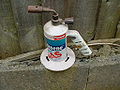
Modern gas blowtorch
An old-fashioned kerosene/paraffin blowtorch

A blowtorch, also referred to as a blowlamp, is an ambient air fuel-burning tool used for applying flame and heat to various applications, usually in metalworking, but occasionally for foods like crème brûlée.

Description

[edit]

Early blowtorches used liquid fuel, carried in a refillable reservoir attached to the lamp. This is distinct from modern gas-fueled torches burning fuel such as a butane torch or propane torch. Their fuel reservoir is disposable or refillable by exchange. Liquid-fueled torches are pressurized by a piston hand pump, while gas torches are self-pressurized by the fuel evaporation. The term "blowtorch" is commonly misused as a name for any metalworking torch, but properly describes the pressurized liquid fuel torches that predate the common use of pressurized fuel gas cylinders.

Torches are available in a vast range of size and output power. The term "blowtorch" applies to the obsolescent style of smaller liquid fuel torches. Blowtorches are typically a single hand-held unit, with their draught supplied by a natural draught of air and the liquid fuel pressurized initially by hand plunger pump, then by regenerative heating once the torch is in operating state. The larger torches may have a heavy fuel reservoir placed on the ground, connected by a hose. This is common for butane- or propane-fuelled gas torches, but also applies to the older, large liquid paraffin (kerosene) torches such as the Wells light.

Many torches use a hose-supplied gas feed, which can be mains gas when used in industrial settings. They may also have a forced-air supply, from either an air blower or an oxygen cylinder. Both of these larger and more powerful designs are less commonly described as blowtorches, while the term blowtorch is usually reserved for the smaller and less powerful self-contained torches. The archaic term "blowpipe" is sometimes still used in relation to oxy-acetylene welding torches.

History

[edit]

The blowtorch is of ancient origin and was used as a tool by goldsmiths and silversmiths. They began literally as a "blown lamp", a wick oil lamp with a mouth-blown tube alongside the flame. This type of lamp, with spirit fuel, continued to be in use for such small tasks into the late 20th century.

In 1797, German inventor August von Marquardt invented a blowtorch in Eberswalde.

Another early blow pipe patent comes from the US, dated May 13, 1856.

In 1882, a new vaporizing technique was developed by Carl Richard Nyberg in Sweden, and the year after, the production of the Nyberg blowtorch started. It was quickly copied or licensed by many other manufacturers.

The US version of the blowtorch was independently developed with a distinctive flared base and was fueled by gasoline, whereas the European versions used kerosene for safety and low cost.[1]

After the Korean War in the 1950s, wider availability of propane caused many changes in the blowtorch industry worldwide, and by the 1970s most manufacturers of the old type of blowtorch, using gasoline or kerosene as fuel, had disappeared.[2] There remain several manufacturers producing brass blowtorches in India, China and North Korea for markets where propane gas is difficult to obtain or too expensive to be viable.[3]

Applications

[edit]

The blowtorch is commonly used where a diffuse (wide spread) high temperature naked flame heat is required but not so hot as to cause combustion or welding. Temperature applications are soldering, brazing, softening paint for removal, melting roof tar, or pre-heating large castings before welding such as for repairing. It is also common for use in weed control by controlled burn methods, and for melting snow and ice from pavements and driveways in cold climate areas. Especially the US and Canada, road repair crews may use a blowtorch to heat asphalt or bitumen for repairing cracks in preventive maintenance. It is also used in cooking: a butane torch may be used to create the layer of hard caramelized sugar in a crème brûlée.[4]

Types and variants

[edit]

The blowtorch is referred to in industry and trade according to the fuel consumed by the tool:

In terms of gas torches, the fuel tank often is small and also serves as the handle. It is usually refueled by changing the fuel tank with the liquefied gas in it. The variants with gaseous fuel are sometimes fed from an LPG cylinder via a hose.

Variant

[edit]

A flame gun is a large type of blowlamp with built-in fuel tank, used for various purposes: weed control by controlled burn methods, melting snow and ice off walk and driveways in the winter, starting a fire, etc. It is commonly confused in word usage with a flamethrower.[5]

Media

[edit]

See also

[edit]

References

[edit]
[edit]
Revisions and contributorsEdit on WikipediaRead on Wikipedia
from Grokipedia
A blowtorch, also known as a blowlamp, is a portable fuel-burning tool that generates a hot, focused flame for applying intense heat to materials, typically used in metalworking tasks such as soldering, brazing, welding, and cutting. It operates by mixing a combustible fuel—commonly propane, butane, or acetylene—with ambient air or pure oxygen to produce flames reaching temperatures from approximately 2,000°F (1,100°C) to over 3,500°F (1,930°C), depending on the fuel type and configuration. The device consists of a fuel reservoir, a valve for controlling gas flow, a burner tip for directing the flame, and often an ignition mechanism, making it versatile for both professional and DIY applications in industries like automotive repair, plumbing, and construction. Common types include propane torches for general soldering and light welding, butane models for precision work such as jewelry making, oxy-acetylene variants for high-temperature metal cutting, and micro torches for intricate electronics soldering. Beyond metalworking, blowtorches find use in annealing metals, heat-shaping plastics, paint stripping, and even culinary applications like crème brûlée finishing, though safety precautions are essential due to the risk of burns and fire hazards. The history of the blowtorch traces back to the late 18th century with early inventions in France, evolving through 19th-century American innovations and into the early 20th century with the introduction of safer propane-fueled models around 1918, coinciding with broader applications in plumbing and beyond. Today, blowtorches remain essential tools, evolving with ergonomic designs and electronic ignition for enhanced safety and efficiency.

Design and Operation

Basic Components

A blowtorch's basic components form a portable system designed to generate and direct a high-temperature flame through controlled fuel delivery and combustion. Central to this is the handle or body, which serves as the ergonomic structure for gripping and houses connections for fuel lines or direct attachments, ensuring safe operation during prolonged use. The fuel reservoir or cylinder stores the combustible material, typically as a pressurized vessel for gaseous fuels like propane, butane, or acetylene, which are often disposable or refillable and color-coded for identification to match torch pressure ratings. In contrast, liquid fuel systems, such as those using gasoline or kerosene, employ a tank with an integrated hand pump to achieve at least 10 psi pressurization, facilitating fuel delivery without external gas cylinders. The burner nozzle, also known as the tip, is the outlet where fuel mixes with air or oxygen to produce the flame, featuring designs like multiple circular holes in oxy-fuel models to focus preheat jets for efficient combustion. Valve systems provide precise regulation of fuel and oxidizer flows, with separate controls for each to adjust flame characteristics and prevent mixing issues; these include levers or knobs that modulate pressure and volume, often integrated near the handle for quick adjustments. For gaseous fuels, valves handle high-pressure delivery directly from cylinders, whereas liquid fuel setups incorporate additional check valves to maintain tank pressure and avoid vapor lock. Ignition mechanisms initiate combustion reliably and safely, varying by torch type and fuel. Piezoelectric igniters, common in modern gas torches, generate an electric spark through mechanical compression of a crystal without needing batteries or flints, activated by a trigger or button for instant startup. Striker mechanisms use a flint wheel to produce sparks manually, suitable for rugged field use, while pilot lights maintain a small continuous flame for relighting, though less common in portable designs due to fuel inefficiency. Liquid fuel torches often ignite via an external spark on the vaporized mist at the nozzle, requiring initial heating of the tip on the workpiece. Construction materials prioritize heat resistance, corrosion protection, and structural integrity under high pressures and temperatures. Nozzles and valves are frequently crafted from brass for its thermal conductivity and durability, or stainless steel for enhanced resistance to oxidation in demanding environments. Torch bodies and handles may use cast aluminum for lightweight strength or steel for robustness, with components like flame tubes lined in heat-resistant alloys to contain combustion without deformation. These choices differ slightly by fuel type, as liquid systems require materials compatible with volatile solvents like gasoline, emphasizing sealed, non-reactive tanks.

Flame Generation Principles

The generation of a flame in a blowtorch relies on the fundamental principles of combustion, where a fuel gas is mixed with an oxidizer—typically ambient air or pure oxygen—to initiate and sustain an exothermic reaction that produces heat and light. In air-aspirated blowtorches, the fuel, such as propane or butane, draws in surrounding air through a venturi effect, achieving adiabatic flame temperatures around 1,980°C due to the limited oxygen supply from air (approximately 21% oxygen by volume). In oxy-fuel systems, the controlled mixing of fuel with nearly pure oxygen (≥99.5% purity) enables higher combustion efficiencies and temperatures up to 3,500°C, as seen in oxy-acetylene flames, where the reaction proceeds in stages: primary combustion forms carbon monoxide and hydrogen, releasing initial heat, followed by secondary oxidation to carbon dioxide and water. Blowtorch flames are classified into three primary types based on the fuel-oxidizer ratio, each with distinct properties affecting their applications. A neutral flame results from a stoichiometric balance of fuel and oxidizer, producing a stable, cone-shaped inner flame with no excess oxygen or fuel; it reaches approximately 3,200°C in oxy-acetylene setups and is ideal for welding as it minimizes oxidation or carbon addition to the workpiece. An oxidizing flame, achieved by increasing the oxidizer flow, features a shorter inner cone and excess oxygen, yielding higher temperatures around 3,480°C and promoting metal oxidation, which suits cutting processes. Conversely, a carburizing (or reducing) flame uses excess fuel, resulting in a longer, feathery outer zone with temperatures near 3,150°C; it creates a carbon-rich atmosphere that can harden surfaces but risks soot formation if unbalanced. Heat transfer from the blowtorch flame to the target primarily occurs through convection and radiation, enabling efficient energy delivery. Convection dominates in the inner cone, where hot combustion gases directly impinge on the surface via forced flow, transferring heat proportional to gas velocity and temperature gradients. Radiation, emitted from the luminous flame zone, provides non-contact transfer as infrared energy, with intensity increasing with the fourth power of the flame temperature; in high-temperature oxy-fuel flames exceeding 2,500°C, this mechanism accounts for a significant portion of total heat output, enhancing applications like brazing. Maintaining flame stability and efficiency hinges on precise pressure regulation and airflow dynamics. Regulators control fuel and oxidizer pressures—typically 1-15 psi for acetylene and up to 35 psi for oxygen—to ensure consistent mixing ratios and prevent instabilities like flashbacks or blow-offs. Airflow, influenced by nozzle design and gas velocity, promotes turbulent mixing for complete combustion, while even slight deviations, such as a 1% drop in oxygen purity, can reduce flame speed by 25% and lower overall efficiency. These factors collectively optimize heat release and flame adherence to the workpiece.

History

Early Inventions

The origins of the blowtorch trace back to the late 18th century in France, where the first self-acting blowtorch was invented by Théodore Pierre Bertin. In 1798, Bertin developed a device that utilized vapor pressure from a heated liquid fuel, such as alcohol or ether, to produce a directed flame without requiring manual blowing, marking a significant advancement over earlier mouth-blown blowpipes used by artisans. This invention, known as an "éolipyle" in French, was patented amid the French Revolution and laid the foundation for portable, self-contained heating tools. Key improvements followed in the mid-19th century, with Maurice Antoine Dunand patenting a more portable and efficient version in 1844 that refined Bertin's vaporization principle for greater reliability in fieldwork. By the 1860s, American inventors adapted these concepts; W.W. Wakeman Jr. and George Wanier received U.S. patents in 1867 for the first hand-held, self-contained blowtorches featuring external pipes for fuel delivery. John Summerfield Hull further advanced the design between 1866 and 1878, earning recognition as the "father of the American blowtorch" for introducing a mechanical pump that eliminated the need for pre-pressurization, making the tool safer and more user-friendly. These early models primarily used alcohol or oil as fuel and were essential for tasks requiring intense, localized heat. In the 1880s, innovations shifted toward more versatile fuels, exemplified by Swedish inventor Carl Richard Nyberg's 1881 patent for a commercial paraffin (kerosene) blowtorch, which he began producing in 1882. Nyberg's design incorporated a safety valve and a preheating bowl to vaporize the fuel safely, reducing explosion risks associated with earlier gasoline experiments, and quickly gained popularity for its efficiency. American adaptations during this decade, including gasoline-powered variants, built on these principles, with patents like Butler's 1889 design for pump-in-handle torches standardizing the form factor. Throughout the 19th century, blowtorches found primary application in soldering and plumbing, where their concentrated flames enabled precise joining of metals in construction, roofing, and pipework without large forges. Jewelers and dentists also adopted them for delicate heating tasks, highlighting the tool's role in enabling portable professional work before the widespread availability of electricity or compressed gases.

Modern Developments

The introduction of the oxy-acetylene torch in 1903 marked a significant advancement in blowtorch technology, enabling higher flame temperatures up to 3,500°C for industrial applications like welding and cutting. French engineers Edmond Fouché and Charles Picard developed this process by combining acetylene gas with pure oxygen, surpassing the limitations of earlier air-acetylene systems that relied on ambient air for combustion. During the 1930s, the shift toward gaseous fuels gained momentum, with propane torches emerging as safer alternatives to volatile liquid fuels like gasoline and kerosene, which posed risks of spills and explosions. Although propane-fueled blowtorches were first patented in 1918 by J.B. Anderson, their widespread adoption accelerated post-1930s due to improved storage in pressurized cylinders, reducing handling hazards. Following World War II, portable propane models proliferated, featuring compact designs with self-pressurizing mechanisms that enhanced mobility for field repairs and construction, supplanting heavier liquid-fuel variants by the 1950s. In the industrial sector, oxy-acetylene torches saw standardized adoption for welding during the 1940s and 1950s, driven by wartime demands for efficient metal joining in shipbuilding and aviation, followed by postwar infrastructure booms. Environmental regulations in the 1980s further transformed fuel choices, as the U.S. Environmental Protection Agency mandated the phase-out of leaded gasoline—previously common in some blowtorches—culminating in a near-complete ban by 1996 to curb air pollution and health risks. Recent innovations in the 21st century have focused on user-friendly features, with butane-powered culinary torches surging in popularity from the 1990s onward, coinciding with the home cooking trend for techniques like crème brûlée and searing. These compact, refillable devices offered precise, adjustable flames without external oxygen, appealing to both professionals and hobbyists. By the 2010s, battery-powered electronic igniters became standard in many models, replacing manual strikers or piezo mechanisms for reliable, one-handed operation and enhanced safety in diverse settings from kitchens to workshops. In the 2020s, as of 2025, blowtorch designs have continued to evolve with emphases on sustainability and smart technology, including eco-friendly fuel options, lighter materials, automatic temperature regulation, and integration with Internet of Things (IoT) for remote control and safety monitoring, driven by market demands for efficiency and reduced environmental impact.

Types

Oxy-Fuel Torches

Oxy-fuel torches, also known as oxy-fuel gas torches, operate by mixing a combustible fuel gas with pure oxygen to produce a high-temperature flame suitable for industrial tasks such as welding, cutting, and brazing. These torches achieve significantly higher flame temperatures than air-fuel variants due to the oxidizing properties of pure oxygen, enabling precise heat application on metals. The fuel-oxygen mixture is ignited at the torch tip, where the flame temperature depends on the specific fuel used and the ratio of gases. The most common subtype is the oxy-acetylene torch, which combines acetylene gas with oxygen to generate a flame temperature ranging from 3,200°C to 3,500°C, making it ideal for cutting and welding thick steel sections. Oxy-propane torches, using propane as the fuel, produce a slightly cooler flame at approximately 2,800°C, which is sufficient for preheating and cutting scrap metal but offers a broader, softer flame profile. Oxy-hydrogen torches, employing hydrogen generated often via electrolysis, reach temperatures around 2,800°C and are valued for their clean-burning properties in applications like jewelry soldering, though they are less common in heavy industrial use due to fuel generation complexity. The typical setup for an oxy-fuel torch includes separate pressurized cylinders for oxygen and the fuel gas, each equipped with regulators to control flow rates—oxygen often set to 30-50 psi and fuel to 5-15 psi depending on the application. Color-coded hoses (green for oxygen, red for fuel) connect the regulators to the torch handle, where a mixing chamber or tip blends the gases in a controlled ratio before ignition. Safety features such as flashback arrestors and reverse-flow check valves are integrated to prevent gas backflow and explosions. These torches provide advantages like precise flame adjustment for targeted heating and the ability to cut metals up to several inches thick, far surpassing air-based systems in efficiency for heavy-duty tasks. However, they require managing two gas cylinders, increasing portability challenges and operational costs, particularly with acetylene due to its higher price and instability compared to propane. Representative examples include the Victor Medalist 350 series, a versatile oxy-acetylene outfit used in professional welding for its durable construction and interchangeable tips, and the Harris Steelworker Classic, favored for cutting operations with its robust design and compatibility with multiple fuel gases.

Non-Oxy Fuel Torches

Non-oxy fuel torches, also known as air-fuel torches, operate by mixing fuel gases with ambient air for combustion, producing flames suitable for tasks like soldering, thawing, and light brazing without requiring a separate oxygen supply. These torches rely on fuels such as propane, MAP-Pro gas (a propylene-based substitute for the discontinued MAPP gas), and butane, each offering distinct flame characteristics for portable applications. Common subtypes include propane torches, which achieve a maximum flame temperature of approximately 1,980°C when burned in air, making them versatile for general heating and plumbing tasks. MAP-Pro gas torches, replacing the original MAPP gas (discontinued in 2008), reach up to 2,050°C in air, providing higher heat output for more demanding jobs like brazing copper pipes. Butane torches, often used in culinary settings, produce flames around 1,430°C, sufficient for precision work such as crème brûlée without excessive heat. The design of non-oxy fuel torches typically features a single-fuel cartridge or tank connected to a handle with a built-in air mixer that draws in atmospheric oxygen to facilitate combustion at the nozzle. Many models incorporate self-igniting mechanisms, such as piezoelectric igniters, allowing for quick startup without external lighters. These torches offer advantages in portability due to their compact, lightweight construction and single-gas operation, enabling easy transport for fieldwork or home use. Their ease of use stems from simple controls for flame adjustment and no need for gas regulators or oxygen tanks. However, a key disadvantage is their lower maximum temperatures compared to oxy-fuel systems, limiting them to non-industrial cutting or high-precision welding. Variants include trigger-start handheld torches, which feature a push-button igniter for instant flame activation and are ideal for extended sessions in soldering or defrosting. Disposable butane pens, resembling oversized lighters, provide convenient, one-time-use options for small-scale culinary or hobbyist applications. The shift to propane as a dominant fuel in modern non-oxy torches began in the mid-20th century for its balance of availability and performance.

Applications

Industrial and Professional Uses

Blowtorches, particularly oxy-acetylene variants, play a central role in industrial welding and cutting processes, especially for steel fabrication. These torches produce a high-temperature flame by mixing acetylene with oxygen, reaching up to 3,500°C, which melts base metals and filler rods to join or sever thick steel plates and structures. In fabrication shops, oxy-acetylene cutting is employed to precisely slice through heavy steel components, such as beams and sheets, enabling efficient assembly of machinery and infrastructure elements. In construction sites, oxy-fuel cutting torches are used to cut steel plates, rebar, and dismantle iron structures; they offer fast and powerful performance but produce significant sparks and smoke. This method has been a cornerstone of metal processing since the early 20th century, offering portability and cost-effectiveness for on-site operations. For brazing applications, propane-fueled blowtorches are widely used in plumbing and HVAC systems to join pipes without melting the base material. The flame, typically around 1,900°C, heats copper or steel fittings to draw in a filler metal like silver alloy, creating strong, leak-proof seals in large-scale installations. These torches are favored in professional settings for their ease of use and lower risk compared to oxy-fuel alternatives, supporting tasks like connecting refrigerant lines in commercial buildings. In metalworking trades, blowtorches facilitate soldering of copper components and annealing of metals, particularly in automotive repair. Soldering involves applying a propane or MAPP gas flame to heat joints between copper pipes or wiring harnesses, allowing solder to flow and bond without excessive distortion. Annealing uses controlled heating from an oxy-fuel torch to soften hardened metals like aluminum or steel panels, relieving internal stresses for easier bending or forming during vehicle frame repairs. This process enhances material ductility, enabling technicians to reshape exhaust systems or body panels efficiently. Construction professionals rely on propane blowtorches for thawing frozen pipes and bending asphalt in roofing and paving tasks. In cold climates, these torches direct a broad flame to gradually heat water lines encased in ice, preventing bursts while restoring flow in commercial plumbing systems. For asphalt work, high-BTU propane torches soften roofing membranes or repair driveway cracks by heating the material to a pliable state, allowing seamless patching without specialized equipment. Blowtorches have been integral to specific industries like shipbuilding since the 1940s, where oxy-acetylene torches were used for cutting and welding hull plates during World War II production surges. In U.S. naval yards, these tools enabled rapid fabrication of submarine and destroyer components, cutting portholes and seams in armor steel under tight deadlines. Similarly, in pipeline maintenance for oil and gas sectors, portable oxy-fuel torches support emergency repairs by brazing or cutting damaged sections, ensuring minimal downtime in remote field operations.

Culinary and Hobbyist Uses

In culinary applications, handheld butane torches have become essential tools for achieving precise, high-heat effects that enhance texture and flavor without overcooking underlying ingredients. They are commonly used to caramelize sugar toppings on desserts like crème brûlée, creating a signature crunchy crust while leaving the creamy custard intact. Similarly, these torches excel at searing the surface of meats, such as finishing sous vide steaks with a flavorful char or browning fish for dishes like toro without fully cooking the interior. Butane models are favored in kitchens for their portability, adjustable flames reaching up to 2,500°F (1,371°C), and clean-burning fuel, making them suitable for both professional and home use. The popularity of kitchen torches surged in the 1990s alongside the rise of molecular gastronomy, a culinary movement that emphasized scientific precision in cooking techniques and tools to innovate textures and presentations. This trend, pioneered by chefs applying physics and chemistry to food preparation, popularized torches for tasks like rapid caramelization and controlled browning, influencing modern patisserie where handheld butane models are standard for finishing tarts and custards. In media, post-2000s cooking shows such as MasterChef have featured torches in challenges, depicting them as versatile gadgets for creative finishing touches, from smoking ingredients to torching meringues. For hobbyists, blowtorches enable a range of DIY projects, particularly with non-oxy fuel types like propane and butane for accessible, lower-heat applications. Propane torches are widely used in home plumbing tasks, such as soldering copper pipes for repairs or installations, offering sufficient heat (up to 3,600°F or 1,982°C) in a portable format for amateur users. In paint stripping, hobbyists apply controlled flames to soften old layers on wood or metal surfaces, followed by scraping, to restore furniture or trim without chemical strippers. Jewelry making benefits from butane torches, which provide pinpoint flames for soldering small components like earring findings or annealing wire, allowing enthusiasts to craft custom pieces at home. Hobbyist kits often incorporate butane torches for specialized crafts, such as electronics soldering, where adjustable flames join circuits or repair components with precision. These kits typically include supportive tools like tweezers and flux for stable, hands-free work on model building projects, where torches heat adhesives or shape plastics in scale replicas. Such applications reflect a broader trend toward creative, consumer-level torch use in workshops, emphasizing safety features like self-ignition and flame locks for novice users.

Safety Considerations

Operational Hazards

Using a blowtorch exposes operators to significant burn risks from both direct flame contact and radiant heat emitted by the intense flame, which can reach temperatures exceeding 3,000°C in oxy-fuel variants. Direct exposure to the flame can cause immediate tissue damage, while radiant heat can lead to second-degree burns—characterized by blistering, severe pain, and partial-thickness skin injury—even without physical contact, particularly during prolonged operation or in confined spaces. These burns are common in industrial settings where operators handle materials near the torch tip, and skin exposure to the heat source can result in rapid onset of erythema and edema. Explosion hazards arise primarily from fuel leaks and improper gas mixtures in oxy-fuel blowtorches, such as those using acetylene and oxygen. Fuel leaks from hoses, regulators, or cylinders can create flammable vapor clouds that ignite upon contact with the torch flame or sparks, leading to violent explosions capable of rupturing equipment and causing shrapnel injuries. In oxy-acetylene systems, backfires—momentary flame reversal into the torch tip—can escalate to sustained backfires or flashbacks, where the flame propagates upstream into the hoses or cylinders, potentially detonating the fuel supply and producing a loud explosion with pressures sufficient to damage structures. Toxic fumes represent another critical operational hazard, particularly from incomplete combustion or decomposition of fuel gases in blowtorches. Acetylene, commonly used in oxy-fuel torches, contains impurities such as phosphine, which can be released during decomposition or welding processes, acting as a severe irritant to the eyes, respiratory tract, and potentially causing organ damage like kidney impairment upon inhalation. Additionally, incomplete combustion generates carbon monoxide, a colorless and odorless asphyxiant that binds to hemoglobin, reducing oxygen delivery and leading to symptoms ranging from headache and dizziness to unconsciousness and death in high concentrations, as evidenced in cases of welding sealed pipes where CO levels accumulated rapidly. Specific incidents underscore these risks, including early 20th-century factory fires attributed to improper storage of blowtorch fuels, where volatile liquids like gasoline in early non-oxy models leaked and ignited, contributing to multiple industrial blazes in the 1910s. More recently, in 2016, workers at a New York asphalt facility using a blowtorch to heat a valve ignited leaked vapors, resulting in an explosion that injured three individuals with burns and blast trauma.

Preventive Measures

To mitigate risks associated with blowtorch operation, personal protective equipment (PPE) is essential, including flame-resistant gloves to protect against burns, safety goggles or face shields to shield eyes from sparks and UV radiation, and protective aprons or clothing to cover the body from heat and debris. Adequate ventilation systems, such as fume extractors or exhaust fans, must be used to remove harmful gases and particulates from the workspace, preventing inhalation hazards. Operational protocols include conducting regular leak checks on hoses, regulators, and connections using a soap solution before each use to detect gas escapes. Proper flame adjustment requires lighting the fuel gas first at a low setting, then gradually introducing oxygen to achieve a stable flame, while prohibiting smoking or open flames near fuel sources to avoid ignition. For storage, cylinders should be positioned upright and secured with chains or straps to prevent tipping, kept at least 20 feet from combustible materials and heat sources in a well-ventilated, dry area, with oxygen and fuel gases stored separately. These practices align with OSHA standards under 29 CFR 1910.253, which emphasize protected, ventilated storage to minimize fire and explosion risks. Training is required for operators of oxy-fuel blowtorches, ensuring competency in equipment handling, emergency response, and hazard recognition through OSHA-compliant programs that demonstrate safe practices. In modern butane-powered models, built-in auto-shutoff mechanisms activate after periods of inactivity to prevent unintended fuel release, enhancing user safety.

References

Add your contribution
Related Hubs
User Avatar
No comments yet.