
Hubbry Logo
Pitch classPitch classMain
Open search
Pitch class
Community hub
Pitch class
logo
7 pages, 0 posts
0 subscribers
Be the first to start a discussion here.
Pitch class
Pitch class
from Wikipedia
  {
\override Score.TimeSignature #'stencil = ##f
\relative c' {
  \clef treble \key c \major \time 4/4
  <c c'>1
} }
Perfect octave
  {
\override Score.TimeSignature #'stencil = ##f
\new PianoStaff <<
\new Staff \relative c' {
  \clef treble \key c \major \time 4/4
  <c' c' c'>1 \bar "|."
}

\new Staff \relative c' {
  \clef bass \key c \major \time 4/4
  <c c, c, c,>1
} >> }
All Cs from C1 to C7 inclusive

In music, a pitch class (p.c. or pc) is a set of all pitches that are a whole number of octaves apart; for example, the pitch class C consists of the Cs in all octaves. "The pitch class C stands for all possible Cs, in whatever octave position."[1] Important to musical set theory, a pitch class is "all pitches related to each other by octave, enharmonic equivalence, or both."[2] Thus, using scientific pitch notation, the pitch class "C" is the set

{Cn : n is an integer} = {..., C−2, C−1, C0, C1, C2, C3, ...}.

Although there is no formal upper or lower limit to this sequence, only a few of these pitches are audible to humans. Pitch class is important because human pitch-perception is periodic: pitches belonging to the same pitch class are perceived as having a similar quality or color, a property called "octave equivalence".

Psychologists refer to the quality of a pitch as its "chroma".[3] A chroma is an attribute of pitches (as opposed to tone height), just as hue is an attribute of color. A pitch class is a set of all pitches that share the same chroma, just like "the set of all white things" is the collection of all white objects.[4]

In standard Western equal temperament, distinct spellings can refer to the same sounding object: B3, C4, and Ddouble flat4 all refer to the same pitch, hence share the same chroma, and therefore belong to the same pitch class. This phenomenon is called enharmonic equivalence.

Integer notation

[edit]

To avoid the problem of enharmonic spellings, theorists typically represent pitch classes using numbers beginning from zero, with each successively larger integer representing a pitch class that would be one semitone higher than the preceding one, if they were all realised as actual pitches in the same octave. Because octave-related pitches belong to the same class, when an octave is reached, the numbers begin again at zero. This cyclical system is referred to as modular arithmetic and, in the usual case of chromatic twelve-tone scales, pitch-class numbering is "modulo 12" (customarily abbreviated "mod 12" in the music-theory literature)—that is, every twelfth member is identical. One can map a pitch's fundamental frequency f (measured in hertz) to a real number p using the equation
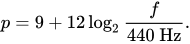
This creates a linear pitch space in which octaves have size 12, semitones (the distance between adjacent keys on the piano keyboard) have size 1, and middle C (C4) is assigned the number 0 (thus, the pitches on piano are −39 to +48). Indeed, the mapping from pitch to real numbers defined in this manner forms the basis of the MIDI Tuning Standard, which uses the real numbers from 0 to 127 to represent the pitches C−1 to G9 (thus, middle C is 60). To represent pitch classes, we need to identify or "glue together" all pitches belonging to the same pitch class—i.e. all numbers p and p + 12. The result is a cyclical quotient group that music theorists call pitch class space and mathematicians call R/12Z. Points in this space can be labelled using real numbers in the range 0 ≤ x < 12. These numbers provide numerical alternatives to the letter names of elementary music theory:

0 = C, 1 = C/D, 2 = D, 2.5 = Dhalf sharp (quarter tone sharp), 3 = D/E,

and so on. In this system, pitch classes represented by integers are classes of twelve-tone equal temperament (assuming standard concert A).

  {
\override Score.TimeSignature #'stencil = ##f
\relative c' {
  \clef treble \key c \major
  c1 cis d dis e f |\break
  fis g gis a ais b \bar "||"
} }
\addlyrics { "0" "1" "2" "3" "4" "5" "6" "7" "8" "9" t e }
\layout { \context {\Score \omit BarNumber} line-width = #100 }
Integer notation.

In music, integer notation is the translation of pitch classes or interval classes into whole numbers.[5] Thus if C = 0, then C = 1 ... A = 10, B = 11, with "10" and "11" substituted by "t" and "e" in some sources,[5] A and B in others[6] (like the duodecimal numeral system, which also uses "t" and "e", or A and B, for "10" and "11"). This allows the most economical presentation of information regarding post-tonal materials.[5]

In the integer model of pitch, all pitch classes and intervals between pitch classes are designated using the numbers 0 through 11. It is not used to notate music for performance, but is a common analytical and compositional tool when working with chromatic music, including twelve tone, serial, or otherwise atonal music.

Pitch classes can be notated in this way by assigning the number 0 to some note and assigning consecutive integers to consecutive semitones; so if 0 is C natural, 1 is C, 2 is D and so on up to 11, which is B. The C above this is not 12, but 0 again (12 − 12 = 0). Thus arithmetic modulo 12 is used to represent octave equivalence. One advantage of this system is that it ignores the "spelling" of notes (B, C and Ddouble flat are all 0) according to their diatonic functionality.

Disadvantages

[edit]

There are a few disadvantages with integer notation. First, theorists have traditionally used the same integers to indicate elements of different tuning systems. Thus, the numbers 0, 1, 2, ... 5, are used to notate pitch classes in 6-tone equal temperament. This means that the meaning of a given integer changes with the underlying tuning system: "1" can refer to C in 12-tone equal temperament, but D in 6-tone equal temperament.

Also, the same numbers are used to represent both pitches and intervals. For example, the number 4 serves both as a label for the pitch class E (if C = 0) and as a label for the distance between the pitch classes D and F. (In much the same way, the term "10 degrees" can label both a temperature and the distance between two temperatures.) Only one of these labelings is sensitive to the (arbitrary) choice of pitch class 0. For example, if one makes a different choice about which pitch class is labeled 0, then the pitch class E will no longer be labeled "4". However, the distance between D and F will still be assigned the number 4. Both this and the issue in the paragraph directly above may be viewed as disadvantages (though mathematically, an element "4" should not be confused with the function "+4").

Other ways to label pitch classes

[edit]
Pitch class
Pitch
class
Tonal counterparts Solfege
0 C do
1 C, D
2 D re
3 D, E
4 E mi
5 F fa
6 F, G
7 G sol
8 G, A
9 A la
10, t or A A, B
11, e or B B ti

The system described above is flexible enough to describe any pitch class in any tuning system: for example, one can use the numbers {0, 2.4, 4.8, 7.2, 9.6} to refer to the five-tone scale that divides the octave evenly. However, in some contexts, it is convenient to use alternative labeling systems. For example, in just intonation, we may express pitches in terms of positive rational numbers p/q, expressed by reference to a 1 (often written "1/1"), which represents a fixed pitch. If a and b are two positive rational numbers, they belong to the same pitch class if and only if

for some integer n. Therefore, we can represent pitch classes in this system using ratios p/q where neither p nor q is divisible by 2, that is, as ratios of odd integers. Alternatively, we can represent just intonation pitch classes by reducing to the octave, 1 ≤ p/q < 2.

It is also very common to label pitch classes with reference to some scale. For example, one can label the pitch classes of n-tone equal temperament using the integers 0 to n − 1. In much the same way, one could label the pitch classes of the C major scale, C–D–E–F–G–A–B, using the numbers from 0 to 6. This system has two advantages over the continuous labeling system described above. First, it eliminates any suggestion that there is something natural about a twelvefold division of the octave. Second, it avoids pitch-class universes with unwieldy decimal expansions when considered relative to 12; for example, in the continuous system, the pitch-classes of 19 equal temperament are labeled 0.63158..., 1.26316..., etc. Labeling these pitch classes {0, 1, 2, 3 ..., 18} simplifies the arithmetic used in pitch-class set manipulations.

The disadvantage of the scale-based system is that it assigns an infinite number of different names to chords that sound identical. For example, in twelve-tone equal-temperament the C major triad is notated {0, 4, 7}. In twenty-four-tone equal-temperament, this same triad is labeled {0, 8, 14}. Moreover, the scale-based system appears to suggest that different tuning systems use steps of the same size ("1") but have octaves of differing size ("12" in 12-tone equal-temperament, "19" in 19-tone equal temperament, and so on), whereas in fact the opposite is true: different tuning systems divide the same octave into different-sized steps.

In general, it is often more useful to use the traditional integer system when one is working within a single temperament; when one is comparing chords in different temperaments, the continuous system can be more useful.

See also

[edit]

References

[edit]

Further reading

[edit]
Revisions and contributorsEdit on WikipediaRead on Wikipedia
from Grokipedia
In music theory, a pitch class is defined as the group of all pitches that are related by octave equivalence—meaning they share the same letter name and are separated by whole octaves, such as all instances of C (including middle C, the C above it, and so on)—and , where pitches producing the same sound on equal-tempered instruments like are considered identical, such as A♭ and G♯. This concept abstracts away from specific frequencies or registers to focus on tonal identity within the Western chromatic scale, which comprises twelve distinct pitch classes labeled from C through B (or numerically as 0 for C, 1 for C♯/D♭, up to 11 for B). Pitch classes form the foundation of pitch-class , an analytical method pioneered by composers and theorists including in the 1950s and systematized by Allen Forte in works like his 1973 book The Structure of Atonal Music. This approach is particularly vital for examining twentieth- and twenty-first-century music, especially atonal and post-tonal compositions by figures such as , , and , where traditional tonal hierarchies are absent. In , collections of pitch classes—known as pitch-class sets—are analyzed for their interval content, symmetries, and relationships, often using on the 0–11 scale to identify recurring patterns, subsets, and transformations like transposition or inversion. The notation of pitch classes typically employs integer labels for precision in analysis, visualized on a clock-face diagram where positions represent semitones, enabling the study of complex harmonies, motives, and scales without reliance on functional tonality. While rooted in equal temperament, the concept extends to microtonal systems, though it remains most standardized in the twelve-tone framework of Western art music.

Definition and Fundamentals

Basic Concept

A pitch class is defined as the set of all pitches that share the same name and are related by octave equivalence and , grouping together tones that sound perceptually similar despite differing in register. For instance, the pitch class "C" encompasses every instance of the note C across all octaves, including enharmonic equivalents like B♯, treating them as identical in tonal identity regardless of their specific height on the musical staff. In contrast to pitch, which denotes a specific instance of a tone with a defined and placement, pitch class disregards these concrete attributes to form abstract equivalence classes centered on shared tonal qualities. A pitch such as middle C (C4) has a precise of 261.63 Hz, while the C one higher (C5) is at 523.25 Hz; both, however, belong to the same pitch class, illustrating how this concept prioritizes perceptual and structural similarity over measurable differences in height. This abstraction facilitates analysis in music theory by focusing on relational patterns rather than absolute positions. The modern concept of pitch class was introduced by in the and systematized by Allen Forte in his 1973 book The Structure of Atonal Music, where it became a cornerstone for analyzing atonal and post-tonal compositions by enabling systematic study of pitch relationships independent of octave. This development built upon earlier 19th-century psychoacoustic foundations laid by in On the Sensations of Tone (1863), which explored the physiological basis of tone and the perceptual unity of octave-related sounds through .

Octave Equivalence

Octave equivalence arises from the physical properties of sound waves, where pitches separated by an exhibit a of 2:1, leading to overlap that contributes to their perceptual similarity. For instance, the note C4 has a of approximately 261.63 Hz, while C5 is nearly exactly double at 523.25 Hz; this doubling means the harmonics of the higher pitch (multiples of 523.25 Hz) include all the harmonics of the lower pitch (multiples of 261.63 Hz starting from the second ), creating a shared structure that enhances consonance and timbral resemblance. Perceptually, humans tend to group octave-related pitches as similar due to psychoacoustic mechanisms that emphasize their shared spectral content, resulting in greater perceived consonance and timbre similarity compared to other intervals. Psychoacoustic studies demonstrate this through phenomena like the octave illusion, where alternating high and low tones an octave apart lead listeners to misperceive the pitch sequence across ears, highlighting the brain's tendency to integrate octave-displaced sounds as equivalent. Similarity ratings in controlled experiments further confirm that octave multiples are judged as more alike in pitch than intervals like the or , supporting the idea that octave equivalence is rooted in auditory processing rather than mere cultural convention. This equivalence manifests across diverse musical traditions, underscoring its broad perceptual foundation beyond Western . In , for example, the (saptak) encompasses 22 shrutis—microtonal intervals—yet treats pitches an apart as fundamentally the same note class, as seen in the cyclic repetition of the seven swaras within each range. Similarly, Balinese music employs octave-based scaling in its tuning systems, where instruments are voiced in octave pairs to reinforce timbral unity. Auditory experiments reinforce this, showing that participants across cultures more readily match tones an octave apart as the "same note" than those separated by other intervals, with response times and accuracy rates significantly higher for octaves. This perceptual grouping forms the basis for the abstraction of pitch class in music theory.

Notations and Representations

Integer Notation

Integer notation assigns the integers 0 through 11 to the twelve pitch classes in , with 0 typically denoting C, 1 denoting C♯/D♭, 2 denoting D, 3 denoting D♯/E♭, 4 denoting E, 5 denoting F, 6 denoting F♯/G♭, 7 denoting G, 8 denoting G♯/A♭, 9 denoting A, 10 denoting A♯/B♭, and 11 denoting B; octave equivalence is handled via modulo 12 arithmetic, ensuring that pitches differing by whole share the same integer label. This system gained prominence in the mid-20th century through its adoption by theorists and composers like , who employed numerical representations of pitch classes—often as order numbers in permutations—to structure twelve-tone serial compositions. It has since become a standard in environments, such as Max/MSP, where software processes pitch classes derived from data for algorithmic generation and analysis. A primary benefit of integer notation lies in its support for mathematical operations on pitch classes, including interval calculations via simple addition; for example, advancing from 0 (C) by 7 semitones reaches 7 (G), corresponding to a . To derive a pitch class from a specific pitch, the formula applies modulo 12 to the MIDI note number, such that middle C (MIDI note 60) yields 0, as 60 mod 12 = 0. As an illustrative case, the triad—comprising the pitches C, E, and G—is represented by the pitch-class set {0, 4, 7}.

Letter-Name Notation

In letter-name notation, pitch classes are represented using the seven letters A through G, supplemented by like sharps (♯) and (♭) to account for the full chromatic spectrum of twelve distinct classes within an . This system labels each pitch class without reference to octave position, allowing notes such as all instances of "C" or "F♯" to share the same designation regardless of register. For instance, the pitch class between C and D is commonly notated as either C♯ or D♭, reflecting its position in the equal-tempered scale. A key feature of this notation is , where a single pitch class may bear multiple letter names that sound identical but serve different contextual roles in or . Examples include B♯ equating to C, or E♯ to F, with the choice of spelling often determined by the prevailing , modulation, or intervallic relationships to avoid awkward leaps or to align with diatonic conventions. This duality requires performers and analysts to rely on surrounding musical for disambiguation, as the notation prioritizes and functional clarity over unique identifiers. The historical foundation of letter-name notation traces back to medieval developments, particularly the system introduced by Guido d'Arezzo around 1025–1050, which organized pitches into overlapping six-note segments starting on G, , or F to facilitate sight-singing and with syllables ut, re, mi, fa, sol, and la. Guido's innovations, detailed in treatises like the Micrologus, integrated these letters with staff lines to denote relative pitches, building on earlier alphabetic systems from while emphasizing practical for choral . Over centuries, this evolved into the modern key-signature-based naming, where adjust the diatonic letters to fit chromatic needs, standardizing the A–G cycle across Western musical education and composition by the . In contemporary usage, letter-name notation remains prevalent for denoting pitch classes in chord symbols and lead sheets, where a triad is simply written as C, E, G, implying the root-position without octave specifics to focus on vertical structure and tonal function. This approach supports and arrangement by abstracting pitches to their class level, as seen in and standards. For analytical purposes, these labels can cross-reference integer notation, such as mapping C to 0 and proceeding chromatically to B as 11.

Alternative Systems

Movable-do represents pitch classes relative to the tonic of a given key, assigning syllables to scale degrees that shift according to the tonal center. In this system, "do" denotes the tonic pitch class, "re" the , "mi" the , "fa" the , "sol" the dominant, "la" the , and "ti" the leading tone, emphasizing functional relationships over absolute pitches. For instance, in C major, do corresponds to , re to D, and mi to , while in , do shifts to G, re to A, and mi to B. This adaptable notation facilitates sight-singing and by highlighting tonal hierarchy, distinct from fixed-do systems that assign syllables to specific pitches regardless of key. Helmholtz notation employs German-influenced letter names with case distinctions and primes to indicate s, but when abstracted to pitch classes, it focuses on the letter root (e.g., c for all octaves of the C pitch class) to denote equivalence across registers. Developed by in the , the system uses lowercase for the octave from middle C upward (c to b) and uppercase for the octave below (C to B), with primes for higher or lower ranges (e.g., c' for the octave above middle C). This abstraction allows for pitch-class analysis in theoretical contexts, where octave-specific primes are omitted to emphasize class identity, such as treating all c's as the same entity in interval calculations. In non-Western traditions, uses sargam notation, where syllables Sa, Re (or Ri), Ga, Ma, Pa, Dha (or Dhi), and Ni represent the seven primary swaras (notes) modulo the , forming the basis of ragas as modal frameworks. Sa serves as the fixed tonic pitch class, with the others denoting relative intervals that can vary slightly in intonation (e.g., komal or tivra variants for Re/Ga/Dha/Ni), enabling flexible melodic construction within a raga's prescribed scale. For example, in Yaman, the ascending sargam might be Sa Re Ga Ma Pa Dha Ni Sa, corresponding to approximate Western equivalents C D E F# G A B C, but always relative to Sa as the root class. Similarly, Arabic maqam systems represent pitch classes through scale degrees organized into ajnas (tetrachordal segments), with the tonic as the first degree and subsequent notes defined by characteristic intervals, often including quarter tones. Maqams like Rast feature seven degrees (1-2-3-4-5-6-7) built from two ajnas, such as a major-like tetrachord (1-2-3-4) followed by another (5-6-7-1), where degrees are labeled numerically or by name relative to the tonic, modulo octave. In Bayati maqam, the scale degrees emphasize a half-flat second (e.g., 1 - ♭2 - 3 - 4 - 5 - ♭6 - 7), using neutral or quarter-flat intervals to evoke specific moods, with representation focusing on melodic paths rather than strict equality classes. These degrees facilitate modulation and ornamentation in performance, adapting to instruments like the oud. Modern variants extend pitch-class representation beyond the standard 12-tone framework, such as labeling positions on the circle of fifths with key names or root pitch classes to visualize tonal relationships and transpositions. The circle arranges the 12 pitch classes counterclockwise by descending perfect fifths (e.g., C-F-B♭-E♭-A♭-D♭-G♭-B-E-A-D-G back to C), with labels indicating major keys outward and minor inward, aiding in identifying shared classes between adjacent keys (e.g., and share six pitch classes). This diagrammatic notation highlights symmetry and is used in composition for generating progressions. For microtonal extensions, computer-based systems employ notation to encode finer divisions, such as 24 or 31 equal temperaments, where pitch classes are numbered in base-16 (e.g., 0 to F for 16 classes per ) to accommodate extended scales beyond 12. In jazz analysis, Roman numerals denote pitch-class functions relative to a key's tonic, using uppercase for (e.g., I for the tonic triad) and lowercase for (e.g., ii for the ), to analyze chord progressions and scales. For example, a ii-V-I in C labels Dm as ii (D-F-A pitch classes), as V (G-B-D-F), and Cmaj7 as I (C-E-G-B), emphasizing diatonic relations while allowing chromatic alterations. This functional notation, rooted in classical but adapted for 's modal flexibility, guides chord-scale choices like Dorian for ii chords.

Properties and Mathematical Structure

Interval Calculations

In pitch-class theory, a musical interval is defined as the directed distance between two pitch classes, measured in semitones modulo 12, reflecting the cyclic structure of the in . For instance, the interval from pitch class 0 () to pitch class 4 (E) spans 4 semitones, corresponding to a major third. This arithmetic approach abstracts away from specific , focusing on equivalence classes. The size of an ordered pitch-class interval is calculated using the formula (pc2pc1)mod12(pc_2 - pc_1) \mod 12, where pc1pc_1 and pc2pc_2 are the representations of the pitch classes, and the result yields a value between 0 and 11. The inversion of an interval ii is given by 12i12 - i, which represents the complementary distance in the opposite direction around the circle. Pitch classes are typically represented using notation from 0 to 11, which serves as the basis for these calculations. Ordered intervals, which preserve direction, are particularly useful in melodic analysis to distinguish ascent from descent. In contrast, unordered intervals consider the absolute distance, often taking the minimum of ii and 12i12 - i, and are applied in contexts where orientation is irrelevant; for example, third measures 3 semitones, while a major third measures 4 semitones. Consider the interval from E (pitch class 4) to (pitch class 11): (114)mod12=7(11 - 4) \mod 12 = 7, a perfect fifth. Its inversion is 127=512 - 7 = 5, a perfect fourth. Transposition of a pitch class or set involves adding a constant nn (modulo 12) to each element, preserving all internal intervals; for example, transposing the set {0, 4, 7} by n=5n = 5 yields {0, 5, 9}.

Circular Nature and Symmetry

Pitch classes in the twelve-tone equal-tempered system are arranged in a circular manner, analogous to the positions on a , where the twelve pitch classes form a closed loop with 0 (typically C) adjacent to 11 (B). This circular structure, often visualized as a clock, allows for wrap-around operations, such that moving from B to C represents an interval of +1 , reflecting the 12 arithmetic inherent in the system. The pitch-class circle exhibits various symmetries that underpin transformations in music theory. Rotation corresponds to transposition, shifting all pitch classes by a fixed interval while preserving their relative positions on the circle. Reflection, or inversion, mirrors pitch classes around a central axis; for instance, inversion around 0 swaps pitch class 1 with 11, 2 with 10, and so on, creating inversional symmetry. Subsets of pitch classes, such as diatonic collections, can display additional symmetries, like those arising from repeated interval patterns. Mathematically, the set of pitch classes forms the cyclic group Z/12Z\mathbb{Z}/12\mathbb{Z} under addition 12, where operations wrap around the circle, enabling the description of intervals and transpositions as group elements. This group structure captures the periodic nature of the , with the circle serving as a geometric representation of these algebraic relations. A prominent example of is the whole-tone scale, represented as the pitch-class set {0,2,4,6,8,10}\{0, 2, 4, 6, 8, 10\}, which remains invariant under rotation by 2 semitones (transposition by T2T_2), as each shift maps the set onto itself due to its uniform whole-step intervals. In tonal music, the circle of fifths acts as a generator of the full pitch-class , achieved by repeated by 7 12 (equivalent to adding 7 semitones), which cycles through all twelve classes and highlights the interconnectedness of keys./03%3A_The_Foundations_Scale-Steps_and_Scales/3.05%3A_Other_Commonly_Used_Scales)

Applications in Music Theory

Role in Tonal Harmony

In tonal harmony, the diatonic collection forms the foundation, comprising seven distinct pitch classes out of the twelve available in the . For instance, the scale utilizes the pitch classes {0, 2, 4, 5, 7, 9, 11}, where integers represent semitones above C (pitch class 0). This set defines the key's tonal material, with other major and minor keys obtained by transposition. The various diatonic modes, such as Dorian or Mixolydian, arise as rotations of this interval pattern within the pitch-class space, preserving the relative stepwise relationships while shifting the tonal center. Chords in tonal harmony are constructed as subsets of the diatonic pitch classes, emphasizing stability and tension through specific combinations. Major triads, for example, consist of pitch classes {0, 4, 7}, while minor triads use {0, 3, 7}, and diminished triads {0, 3, 6}. Seventh chords extend this, with the {7, 11, 2, 5} (as in in C major) creating tension that resolves by motion: the leading tone (11) to the root (0), and the seventh (5) to (4). In root position, these chords are identified solely by their pitch-class content, but inversions rearrange the voicing while retaining the same classes, allowing flexibility in bass lines without altering the . Functional harmony assigns roles to these pitch-class subsets, with the tonic {0, 4, 7} providing resolution and stability, the dominant {7, 11, 2} (or with seventh {7, 11, 2, 5}) generating tension toward the tonic, and the subdominant {5, 9, 0} offering preparatory relief. Cadences exemplify this, as in the authentic V-I progression where the dominant's pitch classes—particularly the leading tone (11 resolving to 0) and supertonic seventh (5 to 4)—create semitone pulls that reaffirm the tonic. This pitch-class framework underlies progressions like ii-V-I, ensuring hierarchical tension and release independent of octave placement. Pitch-class analysis in Beethoven's works, such as his symphonies and piano sonatas, highlights tonal balance through distributions that emphasize diatonic subsets while integrating chromatic inflections for dramatic effect, revealing structural coherence without reliance on specific pitches.

Use in Atonal and Serial Composition

In atonal music, particularly during Arnold Schoenberg's period of free atonality around 1908–1923, all twelve pitch classes are treated with equal status, devoid of the traditional tonal hierarchy that privileges certain notes as tonic or dominant. This approach emerged as composers sought to expand beyond common-practice tonality, allowing pitch classes to interact freely without a central key, as exemplified in Schoenberg's works like Pierrot lunaire (1912), where dissonant combinations and novel pitch relations create expressive ambiguity. The , developed by Schoenberg in the early 1920s, formalized this egalitarian treatment by organizing pitch classes into a —an ordered sequence containing each of the twelve chromatic pitches exactly once per statement. The row serves as the compositional foundation, with derivations such as the retrograde (row read backward), inversion (intervals mirrored), and ensuring structural variety while maintaining pitch-class balance across the work. This method, as in Schoenberg's Suite for Piano, Op. 25 (), prevents any single pitch class from dominating, promoting a sense of unity through permutation rather than repetition. Serialism extended these principles beyond pitch to other parameters, with composers like developing combinatorial arrays in the mid-20th century. These arrays treat pitch-class rows as permutations of the integers 0–11 (often using integer notation for analysis), enabling complex interweavings of prime, inverted, and retrograded forms to form aggregates that exhaust all pitch classes systematically. In Babbitt's Composition for Four Instruments (1948), such arrays facilitate "total serialism," where pitch-class orders align across multiple voices to create dense, non-repetitive textures without hierarchical emphasis. Alban Berg's Lyric Suite (1925–1926) illustrates the technique's motivic potential, deriving pitch-class sets from the to foster thematic cohesion; for instance, recurring hexachords from the row underpin melodic fragments, linking movements through shared interval structures. Post-serial composers like further adapted pitch-class concepts in the 1950s–, using clusters to group classes by registral density rather than strict rows, as in (1961), where overlapping micropolyphonic lines build sound masses that blur individual pitches into timbral continua. This approach emphasizes aggregate density over linear ordering, extending atonal equality into textural exploration.

Pitch-Class Sets

In music theory, a pitch-class set is defined as an unordered collection of distinct pitch classes, typically represented using integer notation modulo 12, where duplicates are excluded and order does not matter. This abstraction allows for the analysis of pitch collections independent of or specific ordering, facilitating comparisons across transpositions and inversions. For example, the set {0,1,4} represents a minor second followed by a major third, capturing a sonic configuration without regard to its starting pitch. Allen Forte's seminal system, outlined in his 1973 monograph, classifies all possible pitch-class sets from one to nine members using labels of the form n-m, where n indicates the cardinality (number of pitch classes) and m denotes the set's position in a specific ordering based on interval content and compactness. For trichords (n=3), there are 12 distinct classes, such as 3-11, which encompasses the triads; for hexachords (n=6), Forte cataloged 50 classes, many of these being significant in atonal analysis due to their structural properties and frequency in twentieth-century repertoire. Key operations on these sets include transposition (Tn), which shifts all pitch classes by n semitones 12; inversion (In), which reflects the set around an axis defined by n (equivalent to 2n - pc 12 for each pitch class pc); and complementation, which yields the set of the remaining pitch classes in the 12-tone universe (e.g., the complement of a trichord is a nonachord). These operations preserve set-class identity under equivalence, enabling relational analysis. To standardize representation, pitch-class sets are often expressed in normal form, which arranges the pitch classes in ascending order within the tightest possible span on the pitch-class —achieved by identifying the largest gap between consecutive classes (including from the last to the first) and starting the numbering just after that gap. For instance, the set {1,4,8} transposes to normal form {0,3,7} by subtracting 1. Prime form extends this by comparing the normal forms of the set and its inversion, selecting the one with the smallest vector (lexicographically lowest when read as a sequence); this minimizes the overall span via combined Tn and In operations to yield the canonical representation for the set class. A representative example is the major triad, denoted as {0,4,7} in integer notation, which achieves normal form [0,4,7] and prime form [0,4,7], corresponding to Forte label 3-11; its inversion yields the minor triad {0,3,7}, but both map to the same set class under prime form minimization. Forte's framework has been applied to analyze static pitch collections in atonal works, such as Stravinsky's early pieces, where recurring sets like 3-11 reveal underlying symmetries despite the absence of tonal function.

References

Add your contribution
Related Hubs
User Avatar
No comments yet.